
India’s manufacturing landscape is undergoing a remarkable transformation. Entrepreneurs pursue low-margin consumer products which include packaged snacks and agarbattis and paper cups. However, the real profit lies in high-margin, niche B2B products which include components and specialty chemicals and technical materials that industries use throughout their operations.
Indian businesses will import specialty chemicals worth more than ₹6 lakh crore in 2026 which creates a major opportunity for startup companies. Entrepreneurs should select between two options which include entering high-demand consumer markets or developing solutions for chemical, food processing, agricultural, defence, electric vehicle, healthcare, textile, and sustainable technology industries. Many of these opportunities are supported by government schemes like PLI, PMEGP, Make in India, Atmanirbhar Bharat, and SRIJAN, which can improve project economics by 10–20%.
Contents
- 1. Why Making Special Parts and Chemicals Works
- 2. 1. Special Chemicals: Knowledge is More Important Than Money
- 3. 2. Value Food and Farming Products
- 4. 3. Bio-Revolution in Agriculture
- 5. 4. Defense, Aerospace & Precision Components
- 6. 5. Electric Vehicle Parts and Electronics
- 7. 6. Healthcare, Medical Devices and Textiles
- 8. 7. Technology and Special Products
- 9. 42 Opportunities at a Glance
- 10. Government Programs to Help Entrepreneurs
- 11. How to Start with Limited Capital
- 12. How NPCS Can Help
- 13. Conclusion
- 14. FAQs
Why Making Special Parts and Chemicals Works
There are a few things that make a business successful when it comes to making parts and chemicals.
- Making parts that’re inside other things can be very profitable because there is not as much competition.
- Knowing a lot about the product How to make it is more important than having a lot of money to buy machines.
- The government can help these businesses by giving them incentives, which can make them more profitable.
With a small amount of money new businesses can start making special parts and chemicals.
Read the Complete Book Here: Handbook On Chemical Industries (Alcohol Based)
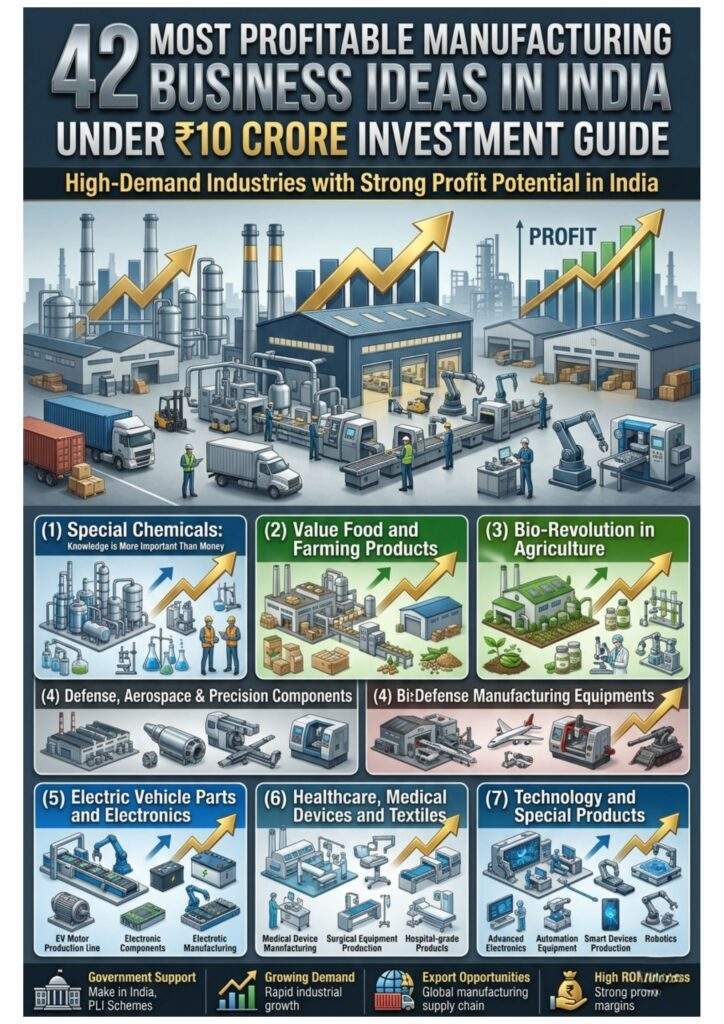
1. Special Chemicals: Knowledge is More Important Than Money
Special chemicals are very profitable because knowing how to make them is more important than having a lot of money to buy machines. India buys most of its chemicals from other countries. Once a business starts making these chemicals and other companies start using them it is unlikely that they will switch to a supplier. This means that the business can make an income.
Some examples of chemicals that can be profitable are:
- Special chemicals for electronics – this can cost between ₹3 crore and ₹8 crore to start and the profit margin can be between 35% and 55%.
- Chemicals for making things shiny – this can cost between ₹2 crore and ₹5 crore to start. The profit margin can be between 35% and 55%.
- Chemicals for cooling water – this can cost between ₹1 crore and ₹3 crore to start. The profit margin can be between 35% and 50%.
2. Value Food and Farming Products
India makes a lot of food and has a lot of farms. This means that there are opportunities to make high-value products from this food and these farms. For example pectin, which is a glue can be made from the peel of citrus fruits and the leftover parts of apples. These kinds of products are very important for companies that make food and other things. There is a steady demand for them.
Some examples of high-value products are:
- Pectin – this can cost between ₹5 crore and ₹15 crore to start. The profit margin can be between 35% and 45%.
- Pea protein – this can cost between ₹50 lakh and ₹15 crore to start. The profit margin can be between 20% and 35%.
- Spice oleoresins – this can cost between ₹50 lakh and ₹15 crore to start. The profit margin can be between 25% and 40%.
Get Detailed Project Report (DPR): Bio-Fertilizer from Birds Excreta Manufacturing Plant
3. Bio-Revolution in Agriculture
In India people are starting to use natural and sustainable ways of farming. This means that there is a growing demand for products that can help plants grow. These products can be made with a small amount of money and they can be very profitable.
Some examples of these products are:
- EDTA-chelated micronutrients – this can cost between ₹50 lakh and ₹2 crore to start and the profit margin can be between 30% and 45%.
- Bio-stimulants – this can cost between ₹25 lakh and ₹5 crore to start. The profit margin can be between 25% and 40%.
- Bio-pesticides – this can cost between ₹10 lakh and ₹5 crore to start. The profit margin can be between 30% and 50%.
4. Defense, Aerospace & Precision Components
In India the defense and aerospace industries are growing quickly. The government is encouraging companies to make things in India of buying them from other countries. This means that there are opportunities for new businesses to make parts for these industries.
Some examples of products that can be made are:
- Aerospace fasteners
- Anti-vibration parts
- Precision hydraulic manifolds
5. Electric Vehicle Parts and Electronics
In India the market for vehicles is growing very quickly. This means that there are opportunities for new businesses to make parts for these vehicles. For example motor laminations, high-voltage wiring and battery management systems are all things that can be made in India.
Some examples of products that can be made are:
- Motor laminations
- High-voltage wiring
- Battery management systems
6. Healthcare, Medical Devices and Textiles
In India many medical devices are bought from countries. This means that there are opportunities for new businesses to make these devices in India. For example diagnostic kits medical-grade silicone and specialty textiles are all things that can be made.
Some examples of products that can be made are:
- Diagnostic kit cassettes – under ₹2 Cr
- Medical-grade silicone components – ₹2–10 Cr
- Specialty textile auxiliaries & elastic tapes
7. Technology and Special Products
Combining manufacturing with technology can make a business very successful. For example making tags with RFID, anti-theft labels and special polymers can be very profitable.
42 Opportunities at a Glance
# | Opportunity | Investment | Margins | Competition | Sector |
1 | Electronic-grade ultrapure solvents | ₹3–8 Cr | 35–55% | Very low | Chemicals |
2 | Electroplating brighteners | ₹2–5 Cr | 35–55% | Low | Chemicals |
3 | Water treatment dosing chemicals | ₹1–3 Cr | 35–50% | Low-med | Chemicals |
4 | Foundry metallurgical chemicals | ₹1.5–5 Cr | 30–50% | Low | Chemicals |
5 | Specialty carbon black | ₹5–12 Cr | 25–40% | Low | Chemicals |
6 | Precipitated silica (RHA) | ₹3–15 Cr | 20–35% | Low | Chemicals/Green |
7 | Pectin extraction | ₹5–15 Cr | 35–45% | Low | Food ingredients |
8 | Food-grade emulsifiers | ₹50L–5 Cr | 20–35% | Low-med | Food ingredients |
9 | Natural food colorants | ₹30L–8 Cr | 25–40% | Medium | Food ingredients |
10 | Pea protein isolate | ₹50L–15 Cr | 20–35% | Low | Food ingredients |
11 | Spice oleoresins | ₹50L–15 Cr | 25–40% | Low-med | Food ingredients |
12 | Industrial enzymes | ₹50L–15 Cr | 25–45% | Medium | Food/industrial |
13 | Chelated micronutrients | ₹50L–2 Cr | 30–45% | Low | Agri inputs |
14 | Seaweed bio-stimulants | ₹25L–5 Cr | 25–40% | Low-med | Agri inputs |
15 | Trichoderma bio-pesticides | ₹10L–5 Cr | 30–50% | Low | Agri inputs |
16 | Aerospace alloy fasteners | ₹2–8 Cr | 30–50% | Low | Defence |
17 | MIL-spec connectors | ₹3–10 Cr | 35–60% | Very low | Defence |
18 | Rubber-metal anti-vibration | ₹1–4 Cr | 25–40% | Low | Defence |
19 | Hydraulic manifold blocks | ₹2–6 Cr | 25–40% | Low | Defence |
20 | EV motor laminations | ₹1.5–5 Cr | 20–30% | Low | EV supply chain |
21 | Thermal management hardware | ₹50L–3 Cr | 25–35% | Low-med | EV supply chain |
22 | HV wiring components | ₹1–5 Cr | 20–35% | Low-med | EV supply chain |
23 | BMS hardware/sensors | ₹50L–3 Cr | 25–45% | Low-med | EV supply chain |
24 | VCI packaging | ₹1.5–5 Cr | 25–40% | Low | Ind. packaging |
25 | Pharma-grade desiccants | ₹50L–3 Cr | 30–45% | Low-med | Ind. packaging |
26 | Geotextiles/geosynthetics | ₹8–20 Cr | 20–35% | Low-med | Infrastructure |
27 | Specialty grouts/coatings | ₹1–5 Cr | 30–50% | Low-med | Infrastructure |
28 | Recycled PET acoustics | ₹1–4 Cr | 25–40% | Low | Infrastructure |
29 | Diagnostic kit cassettes | ₹50L–2 Cr | 25–35% | Low-med | Med devices |
30 | Medical silicone parts | ₹1.5–5 Cr | 30–45% | Very low | Med devices |
31 | Advanced wound care | ₹2–8 Cr | 25–40% | Low | Med devices |
32 | Fusible interlining | ₹75L–3 Cr | 18–30% | Medium | Textiles |
33 | Retro-reflective materials | ₹1–4 Cr | 25–40% | Low | Textiles |
34 | Specialty elastic tapes | ₹75L–3 Cr | 30–45% | Low | Textiles |
35 | Textile finishing chemicals | ₹25L–5 Cr | 30–50% | Low | Textiles |
36 | Biochar | ₹30L–2 Cr | 30–50% | Low | Clean tech |
37 | Coconut shell activated carbon | ₹1–5 Cr | 25–40% | Medium | Clean tech |
38 | Effluent treatment chemicals | ₹50L–3 Cr | 20–35% | Low-med | Environment |
39 | HEPA filter media | ₹50L–25 Cr | 25–45% | Low | Filtration |
40 | RFID laundry tags | ₹1–4 Cr | 30–50% | Very low | Tech/textile |
41 | EAS anti-theft labels | ₹1.5–5 Cr | 25–40% | Low | Retail tech |
42 | Engineered polymer compounds | ₹50L–5 Cr | 25–40% | Low-med | Plastics |
Government Programs to Help Entrepreneurs
The government has programs to help new businesses. These programs can provide money reduce risk and make it easier to start a business.
Some examples of these programs are:
- PLI (Production Linked Incentive) – Boosts manufacturing in priority sectors.
- PMEGP (Prime Minister Employment Generation Programme) – Assists micro and small enterprises.
- Make in India & Atmanirbhar Bharat – Encourages domestic manufacturing.
- SRIJAN – Promotes indigenization in defense and aerospace.
These programs can increase profits by 10-20%, which can make it easier for new businesses to start.
How to Start with Limited Capital
- Under ₹2 crore: Bio-pesticides, chelated micronutrients, diagnostic kit cassettes, biochar, or textile auxiliaries.
- ₹2–10 crore: Electroplating brighteners, aerospace fasteners, VCI packaging, or medical-grade silicone components.
Knowledge-based businesses like specialty chemicals, enzymes, bio-stimulants, and polymer compounds depend on expert knowledge instead of financial resources, which makes these enterprises suitable for new business owners.
How NPCS Can Help
NIIR Project Consultancy Services (NPCS) offers more than 45 years of consultancy expertise to help Indian entrepreneurs establish their businesses. They provide:
- Detailed Project Reports (DPRs)
- Techno-economic feasibility studies
- Plant setup consulting
- Assistance with compliance, equipment selection, and government incentives
The NPCS framework enables startups to decrease operational risks while obtaining financial support, which allows them to implement practical solutions that create trust in their capacity to expand into lucrative business areas.
Website: www.niir.org | www.entrepreneurindia.co
Conclusion
The era of low-margin consumer goods is over for aspiring Indian manufacturers. The year 2026 presents a high-margin business-to-business product which does not show its existence for companies who want to generate revenue. Entrepreneurs who focus on specialty chemicals and agro-processing and bio-pesticides and aerospace components and EV parts and medical devices will achieve success through their specialized knowledge while obtaining government support to create sustainable income sources.
India can transform its manufacturing potential into successful business operations by implementing effective planning and obtaining professional assistance and making intelligent financial choices.
FAQs
Q1: Which ideas require the amount of money?
The total expenses for bio-pesticides and micronutrients and textile auxiliaries and diagnostic kits do not exceed ₹2 crore.
Q2: Are government incentives available for all ideas?
Many ideas qualify for PLI, PMEGP, Make in India, Atmanirbhar Bharat and SRIJAN schemes.
Q3: Which sectors offer the margins?
Defense connectors, aerospace fasteners electroplating brighteners and textile auxiliaries.
Q4: Can I start a business without heavy machinery?
Yes knowledge-based businesses like chemicals, enzymes, bio-stimulants and polymers rely more on expertise than money.
Q5: How does NPCS help startups?
NPCS provides guidance, on project reports, plant setup, costing, compliance and market strategy, which can help new businesses start confidently.