
Food processing business
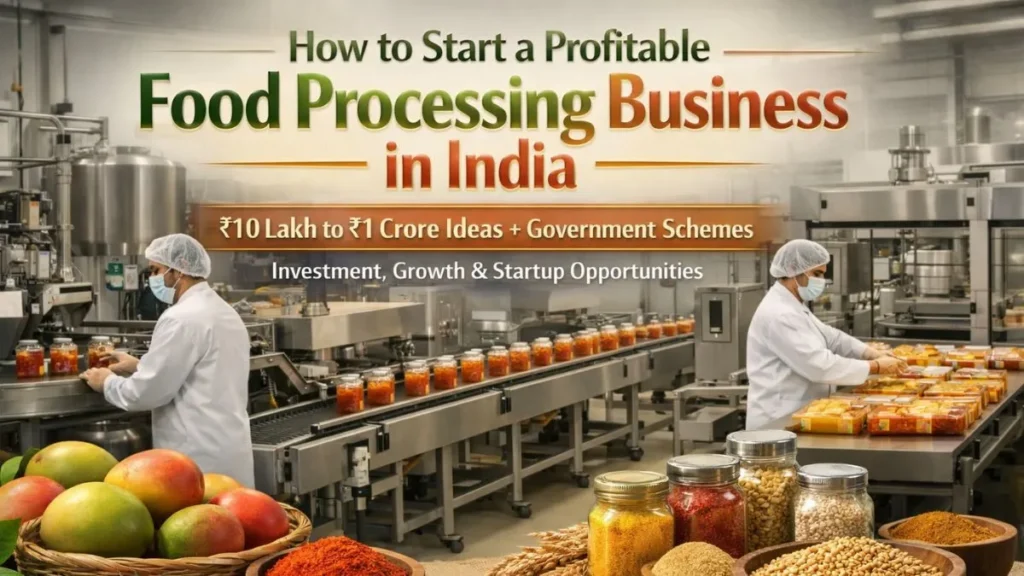
India has one of the best business opportunities in food processing industry, which is rapidly expanding. India is a big agricultural manufacturer, and majority of the raw food is not processed. This puts a massive disconnect between raw materials and finished products.
Due to shifting lifestyles, individuals have adopted the preference of packaged, hygienic and ready-to-eat food products. This is in demand both in city and country markets. Simultaneously, the government has facilitated the establishment of food-based manufacturing facilities and has enhanced infrastructure.
Simply, in this industry, you can purchase raw agriculture products at a low price, process them and sell them at significantly high prices.
Explore This Book: Manufacture of Food & Beverages with Project Profiles (3rd Edn.)
Why Food Processing Business is Profitable
The ability to add value to raw materials is the key reason why food processing is a profitable venture. An unprocessed agricultural product gains several times its worth once it is processed, packaged and branded.
As an illustration, raw fruits can earn minimal profits, but once these are processed into juice, jam, or dry snacks, the profitability will greatly rise. Likewise, branded products can be made out of spices, milk, grains and vegetables.
Key reasons this business works well in India:
- Constant need of food products.
- Availability of cheap raw materials
- Strong export market
- Government subsidies and loans.
- High value addition potential.
The second significant benefit is that food is a daily need and hence demand will be constant all year round.
Best Food Processing Business Ideas in India.
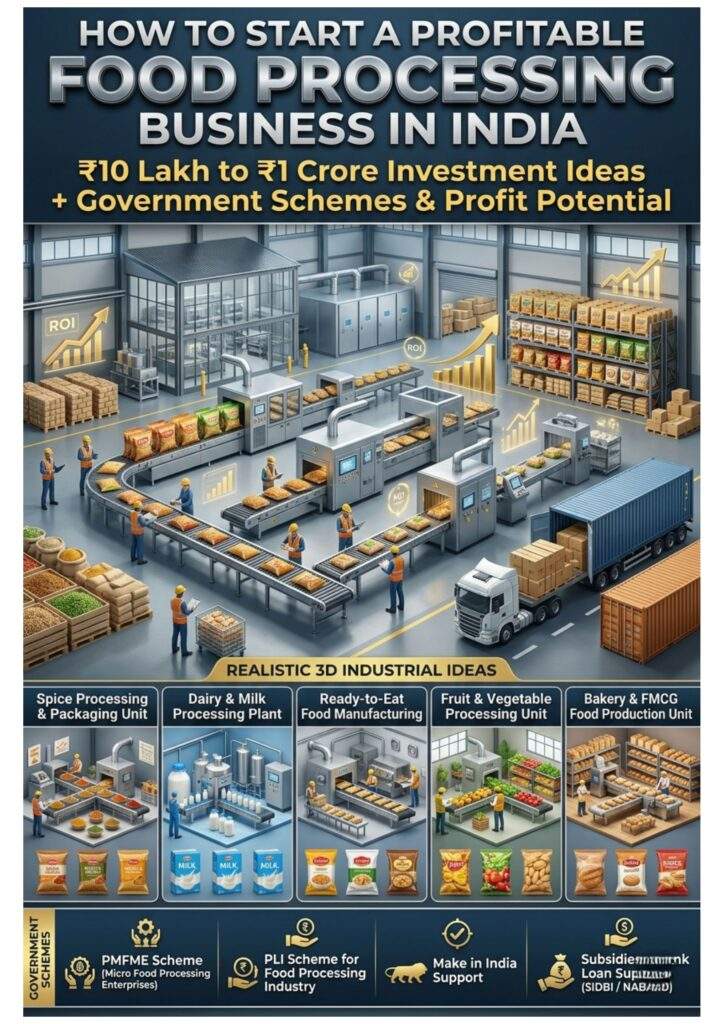
This industry has numerous business opportunities that are based on the level of investment and location. Fruit juice production, spice processing, frozen foods production, dairy products, bakery products, and health supplements are some of the most lucrative ideas.
The demand of fruit-based products such as juices, jam, and pulp has been on the increase because of the increasing health concern. Another powerful category is spice processing since India already leads the world in terms of spices.
Busy lifestyles are also increasing the rate at which frozen food is being consumed. Frozen foods such as vegetables, seafood, and ready-to-cook meals are gaining popularity in the urban homes.
High-demand food business ideas include:
- Fruit juice and beverage unit
- Spice grinding and packing unit.
- Frozen food processing
- Dairy products such as paneer and cheese.
- Bakery and snack production.
- Cold-pressed oil manufacturing
- Herbal health products and Moringa.
The investment level and profit margin in each of these segments vary, but each has a high potential of growth in the long-term.
Get Detailed Project Report (DPR): Fruits and Vegetables Value Addition and Food Processing Guide
How to Start a Food Processing Business
It cannot be done without proper planning but only by investing in this business. Market research is the initial step. You must know what products are sought after in your locality, what raw materials are readily accessible and what competition is already present.
Business registration is the next step after the product has been chosen. These will be MSME (Udyam) registration, GST registration, and FSSAI license which is a requirement of any business related to food in India.
Selection of the appropriate location becomes significant after registration. The industrial locations are generally more advantageous as they already possess some basic facilities such as electricity, water supply, and access to transport.
Another step is the choice of machinery. There are numerous reputable manufacturers of India who offer affordable machines to small and medium food processing plants. Lastly, there should be planning in the sourcing of the raw material by establishing direct linkages with the farmers or wholesale markets.
Investment and Profit Margin
The capital investment will be based on the size of the business. The initial investment required is approximately ₹10-20 lakh to start a small unit, and ₹50 lakh-1 crore or more to start a medium unit.
Typical investment structure:
- Machinery: 40–50%
- Setup and infrastructure: 20–30%
- Working capital: 20%
- Licensing and approvals: 5–10%
The profit margins differ according to the type of product. Packaged food products are lower margin as basic and more margins as branded and value-added food products yield much higher margins.
The profit margins in food processing are between 12-40 percent on average.
Government Schemes for Food Processing Business
This sector has a great support by the Indian government in terms of schemes. These plans contribute to a lowering of the start-up prices and simplify financing of new businesses.
Noteable schemes are PMEGP and PMFME that subsidize new businesses and micro food processing units respectively. Small businesses with no collateral can get MUDRA loans. CGTMSE also offers larger funding requirements but unsecured.
Key advantages of state plans:
- Subsidies up to 35%
- Collateral-free loans
- Low-interest funding options
- Export promotion support
- Startup tax benefits
Such plans ease financial stress among new entrepreneurs to a large extent.
Find high-return business ideas based on your budget & ROI
Role of NPCS (NIIR Project Consultancy Services)
NPCS (NIIR Project Consultancy Services) is significant in assisting the business starters to begin food processing business in India. It offers in-depth reporting of projects that are needed in bank loans and government schemes.
These reports encompass total business planning which includes machinery needs, production process, cost estimation, profit calculation and plant layout design.
NPCS will assist entrepreneurs by preventing mistakes by having a clear picture of the business prior to investing in it.
What NPCS provides:
- Detailed project reports (DPR).
- Plant and machinery set up advice.
- Financial feasibility reports
- Bank loan documentation support.
- Research and analysis of industries.
In the case of first-time entrepreneurs, NPCS can be particularly helpful since it lowers the risk and enhances choices.
Challenges in Food Processing Business
Despite the profitability of this business, there are challenges associated with it. The greatest problem is the fluctuation of the price of raw materials because of seasonal availability. The other difficulty is the ability to adhere to similar quality standards, which is required to be FSSAI compliant.
Managing working capital is also significant since the payment delays by distributors can also have an impact on cash flow. Nonetheless, these challenges can be managed with proper planning and effective supply chain management.
Related Article: Profitable Food Processing Business Ideas in India with Investment & Profit Guide
Future Scope of Food Processing Industry in India
The future of this sector is very high. Growing population, urbanization and evolving dieting trends are fuelling the consumption of processed food products. India is emerging as a world export center, too, in spices, frozen foods and packaged goods.
The growth in this sector is further enhanced by government assistance, development of cold chains and modern packaging technologies. In the coming ten years, the industry will generate millions of job opportunities and business opportunities on a large scale.
Conclusion
One of the greatest opportunities in business in India today is food processing. It has long-term growth and stability with high demand, government support, and potential of exports.
The right product, right planning and expert guidance such as NPCS project reports are the keys to success. When done right, even a tiny unit will expand to a big and lucrative brand.
FAQs
Q1. How much will it cost to invest?
It may require ₹1020 lakh to start a small food processing unit depending on the product.
Q2. Is food processing business lucrative in India?
Yes, it is very profitable with a margin of between 12-40 percent.
Q3. Which licenses are required?
Most food businesses are required to have FSSAI, GST, and MSME registration.
Q4. What is NPCS?
NPCS offers specific project reports and consultancy on the establishment of food processing industries.
Q5. What is the most accessible government scheme?
The schemes of PMEGP and PMFME are more beneficial to the new entrepreneurs.