
Hume Pipes (RCC Pipes) Market Research Report 2026: Size, Growth, Demand-Supply Gap and Business Opportunity for Startups in India
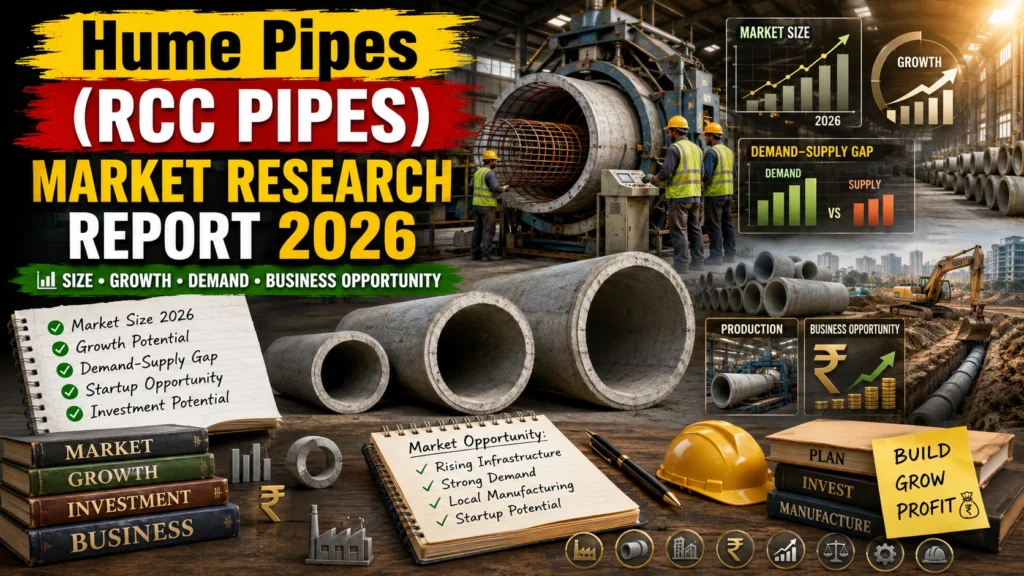
Hume Pipe Manufacturing Business The Hume pipe is one of the products that can be equated directly to India’s largest public infrastructure programme. Along with the expansion of AMRUT 2.0 water sewerage, India’s Jal Jeevan Mission is installing pipe networks in all the rural households in the country, the biggest water infrastructure programme in the world’s history with the spending of about ₹8.69 lakh crore till December 2028. The large diameter variety of reinforced concrete pipe is the backbone of stormwater drains, sewerage trunk lines and canal-lining projects, especially at large-scale, for which plastic pipe cannot match. That’s as close to a bottom floor as an entrepreneur can get. What Are Hume Pipes? Hume pipes, or also known as reinforced cement concrete (RCC) pipes, are pipes that have been precast with steel bars or steel mesh and are made by either centrifugal (spun) casting or vertical vibration-casting processes. It took its name from the patenting in 1910 of the centrifugal spinning process for making concrete pipes by the Hume brothers of Australia. They are produced in India to the Indian Standard specification IS 458 which is similar to the Australian, British and American standards and are available in strength grades (usually NP2, NP3, NP4) that are classified by the load-bearing requirements. There are several variants of the Hume pipe: Service life is typically specified as 50+ years (high grade concrete M30/M40) with good concrete installation. Diameters range typically from 150mm up to over 2600mm and lengths are typically from 2.5–3 metres. Related Article: Medium-Density Polyethylene (MDPE) Pipes Are A Lucrative Business for Any Entrepreneur Global and India Concrete Pipe Market Size and Growth The concrete pipe market is a well-established and a steady growing market in the world. It is estimated to be around USD 13.4-15.6 billion in 2025 and will reach USD 19.9 billion–USD 45.2 billion in 2034-2035, at beggar-taker rates of 3.5-4.5%, a mature-market rate, reflecting the balance of replacement-demand in developed markets and the new-build demand in urbanising economies. The story of India is a much more dynamic one. In total, the India pipes market (all materials) is expected to reach USD 16 billion by 2025 with a compound annual growth rate of more than 11% — and in this, concrete pipes will continue to hold a strong and non-substitutable position in irrigation canal projects, stormwater drainage, and sewerage trunk lines where plastic and HDPE pipes are not structurally viable at a large scale. Note on figures: This is not a stand-alone market segment for reinforced concrete pipes, but is a sub-segment of the “pipes” or “concrete pipe” market and can therefore be reported in different market studies. NPCS can provide a custom techno-economic feasibility study that can be developed for the diameter range you are interested in and can be tailored to the target customer (government water boards, PWD, private EPC) for investor grade numbers. The Government-Backed Demand Floor Concrete pipe demand in India is quite different from most of the manufacturing categories because it is not just a market demand but it’s a demand which is funded and policy-driven by the government. Policy Tailwinds 1. Mandatory BIS specification (IS 458): RCC pipes supplied to government water boards, PWD, and municipal corporations must conform to IS 458:2003, creating a quality-compliance barrier that favours established, certified manufacturers over informal producers. 2. Government direct project procurement: The concrete pipe demand is huge with government direct project tenders for multi years with empanelling of a manufacturer (Public Health Engineering Department, Public Works Department, municipal corporations, NHAI). 3. MSME manufacturing incentives: RCC pipe manufacturing units are labour and capital-intensive precast concrete units; therefore, they are eligible for MSME capital subsidy schemes in various states. 4. State industrial policies for precast concrete units: Some states provide land, power tariff and capital subsidy for the precast concrete product manufacturing due to its contribution towards the delivery of public infrastructure. View Full Project Details: Emerging Business of Ductile Iron Pipe Fittings India Demand-Supply Gap: Hume Pipes (RCC Pipes) Parameter Current Position Demand driver scale Jal Jeevan Mission 2.0 alone represents an ~₹8.69 lakh crore infrastructure programme through 2028, alongside AMRUT 2.0 urban sewerage expansion and PMKSY irrigation projects Domestic manufacturing base A mix of large organized players (The Indian Hume Pipe Co. Ltd., with 20+ factories) and hundreds of regional/MSME-scale manufacturers spread across nearly every Indian state Nature of the gap Primarily a regional capacity and logistics gap — concrete pipes are heavy, low-value-density products with high transport cost relative to product value, meaning demand often outpaces locally available capacity even where national aggregate capacity looks adequate Market structure Highly fragmented — organized players with pan-India reach coexist with a very large number of regional and local manufacturers; competitive dynamics are shaped by pricing, logistical proximity, and quality-standard adherence rather than brand power Opportunity for new entrants Strong for regionally-positioned manufacturers near government project clusters, given the product’s poor economics for long-distance transport and the sheer scale of ongoing government procurement Reading the gap: Hume pipes are a rare manufacturing category where the constraint is rarely “does demand exist” — government infrastructure spending guarantees that — but “is there enough locally-positioned, quality-compliant manufacturing capacity near where the pipe is needed.” Because transport cost is a large share of delivered price for a heavy, low-value-density product, a new regional manufacturer doesn’t need to compete nationally; it needs to be the best-positioned qualified supplier for its own district or state’s ongoing JJM, AMRUT, or PWD tenders. Major Indian Hume Pipe / RCC Pipe Manufacturers Company Base/Region Scale Notes The Indian Hume Pipe Co. Ltd. (IHP) Mumbai, Maharashtra (HQ); 20+ factories pan-India Large integrated national player Established 1926 by Walchand Hirachand; India’s original and largest Hume pipe manufacturer; also manufactures PSC pipes, PCCP, bar-wrapped steel cylinder pipes, and PSC railway sleepers; over 100 projects under execution; recently secured a ₹357+ crore water supply project from Madurai City Municipal Corporation Sneh Precast & ConstoSolutions Maharashtra Regional manufacturer Produces NP3/NP4-class RCC pipes for drainage and sewerage with spigot-socket joint configurations
UJALA ने 36 करोड़ LED बांटे — और अब replacement market शुरू हो रही है। Timing perfect है

LED Bulb Manufacturing Business India में IBEF Electronics India के अनुसार, India का electronics market $150 billion+ का है। UJALA Official Portal की scheme ने LED penetration dramatically increase की है — India अब world का largest LED market है। PIB UJALA Scheme के अनुसार, UJALA ने 36 crore+ LED bulbs distribute किए हैं। DPIIT Electronics PLI scheme LED component manufacturing को incentivize कर रही है। Invest India Electronics में electronics manufacturing को Make in India का pillar बताया गया है। World Bank Energy India report में India की energy efficiency progress में LED transition का crucial role है। इस article में LED Bulb Manufacturing Business India में की complete guide दी जाएगी — setup process, financing, market strategy और government support के साथ। India में यह sector unprecedented growth पर है। Ministry of MSME Schemes के through MSME financing और World Bank India Industry report में India के industrial growth में इस sector का critical role documented है। Get Detailed Project Report (DPR): LED Light Bulbs, Tubes, Fittings, Spotlights and Wall Lights Projects Market Size और Growth Opportunity यह sector India के fastest growing manufacturing businesses में से एक है। Domestic demand strong है और export potential भी excellent है। Government support, growing consumer demand और import substitution push — तीनों factors मिलकर इस business को ideal बनाते हैं। Invest India MSME के अनुसार, इस sector में MSME units को priority financing मिलती है। Small और medium entrepreneurs के लिए market entry का यह सही समय है। सरकारी Support और Schemes Ministry of MSME Schemes के under इस sector के businesses को PMEGP (25-35% subsidy), MUDRA loan और CGTMSE guarantee scheme का लाभ मिलता है। Application process: Udyam registration → DPR preparation → bank application। State-specific incentives भी available हैं। Industrial policy के under land, power और infrastructure में concessions। Additional central schemes sector-specific हैं — APEDA, DPIIT, Ministry of Commerce के माध्यम से। Related Article: LED Bulb Manufacturing Plant in India: Investment, Machinery & Business Opportunities Business Ideas — Detailed Analysis 1. Residential LED Bulb Assembly 9W, 12W, 18W — standard residential bulbs India की highest volume segment है। Assembly cost ₹35-45/unit, retail ₹80-120/unit। BIS IS 16102 certification mandatory है। Component sourcing: LED chips, drivers, aluminum heat sinks — from Delhi और Shenzhen wholesale markets। यह business segment profitability के लिए proven है। Raw material sourcing, quality control और consistent delivery — ये तीन success factors हैं। 2. Street Light और Commercial LED Fixtures Municipal tenders और industrial clients के लिए high-power fixtures। B2B model with larger margins। GeM portal पर government procurement। Minimum unit investment ₹50-80K। Monthly output 200-500 fixtures। Revenue potential ₹3-8 लाख/month। यह business segment profitability के लिए proven है। Raw material sourcing, quality control और consistent delivery — ये तीन success factors हैं। Access Complete Business Plan: LED Street Light Assembling 3. Agricultural LED Grow Lights Indoor farming और greenhouse sector में growing demand। Premium product — ₹2,000-15,000 per unit। Specialty spectrum LEDs urban farming revolution को drive कर रहे हैं। यह business segment profitability के लिए proven है। Raw material sourcing, quality control और consistent delivery — ये तीन success factors हैं। 4. Solar LED Hybrid Products Solar panel + LED combination road lights, garden lights। Off-grid areas में massive demand। PIB UJALA Scheme और MNRE दोनों solar LED को support करते हैं। यह business segment profitability के लिए proven है। Raw material sourcing, quality control और consistent delivery — ये तीन success factors हैं। Check Out This Recommended Book: Solar PV Power and Solar Products Handbook Financial Planning Investment analysis: Basic unit ₹50,000-₹1 लाख से शुरुआत possible है। PMEGP से 25-35% subsidy effective investment reduce करती है। MUDRA loan working capital provide करती है। Revenue projections: Month 1-6: ₹30,000-₹1 लाख (client building phase). Month 7-12: ₹1-3 लाख (established phase). Year 2+: ₹3-8 लाख (scale-up phase). Break-even typically 8-12 months। Profitability drivers: Product mix optimization, bulk buying, quality consistency और repeat clients। Higher margin products पर gradually shift करें। Marketing और Client Acquisition B2B marketing में industry associations, trade directories और referral network most effective हैं। B2C में online platforms, social media और local retail important हैं। GeM portal पर registration government procurement access देता है। Consistent quality और reliable supply chain से repeat business और referrals generate होते हैं। Satisfied clients से testimonials collect करें। Explore proven business ideas with high success potential Import-Export Opportunity APEDA Export Data के through export channels available हैं। IEC code DGFT से, relevant Export Promotion Council registration, और quality certification से export ready हो सकते हैं। Per unit export realization domestic से 1.5-3x होती है। MSME Success Stories कई Indian entrepreneurs ने इस sector में शुरुआत ₹50,000-₹1 लाख से की और आज lakhs earn कर रहे हैं। Consistent quality, strong client relationships और strategic expansion इनकी success का formula है। Government schemes का सही उपयोग — PMEGP subsidy, MUDRA loan, MSME Technology Centre training — ने entrepreneurs को faster scale up में help किया है। Conclusion यह manufacturing business sector India की growth story का important chapter है। Government support, market demand और technology advancement तीनों favorable हैं। अभी शुरू करें — Udyam registration, market research और पहली manufacturing unit।
Citric Acid Market Research Report 2026: Size, Growth, Demand-Supply Gap and New Business Opportunity for Startups in India
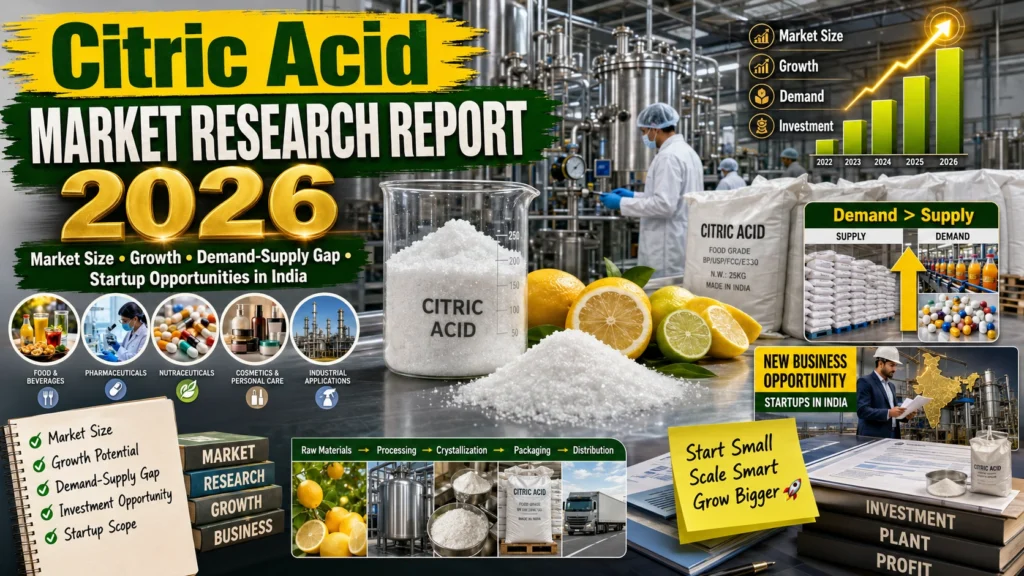
Citric Acid Manufacturing in India India is the second highest consumer of citric acid and second highest producer of citric acid in the world but it still imports almost the entire quantity of citric acid required to meet the domestic demand by the Chinese industry which produces nine times more citric acid than India. China’s export market is tightening through 2026 and India’s food, beverage and pharmaceuticals industry is still booming, while the fermentation process is one that India is familiar with. View Full Project Details: Citric Acid Manufacturing Plant – Detailed Project Report & Business Plan What Is Citric Acid? Citric acid is a weak organic tricarboxylic acid, which is commercially produced almost exclusively by microbial fermentation; Aspergillus niger mould fermented on sucrose, molasses or corn-steep liquor that can yield over 90% (on substrate basis). The metabolic product of the mould is filtered out and citric acid is precipitated as calcium citrate with lime (calcium hydroxide) and re-dissolved in sulphuric acid (or can be separated by liquid-liquid extraction). Citric acid is available in two main forms: It is widely used in the following applications: Related Article: How to Start a Citric Acid Manufacturing Business from Lemon Global and India Citric Acid Market Size and Growth The global citric acid market in 2025-26 was valued at an estimated range of USD 3.77–4.21 billion, and is expected to reach between USD 4.81–5.54 billion by 2031-2033, with the average rate of growth being in the range of 3.7% to 4.12%. China leads the world in production by volume, with an estimated 65-70% of global capacity, fueled by an integrated fermentation facility and a large supply of corn-based feedstock. India has a truly noteworthy but structurally weak stake in this situation: It is the 2nd largest consumer of citric acid with an estimated consumption of 420,000 tonnes per year, behind only China (1.1 million tonnes), and the 2nd largest producer with domestic production of around 296,000 tonnes per year. China produces about 2.6 million tonnes, compared to India’s nine times less ability. Note on figures: Citric acid market studies can be different in considering the acid alone or including its salts or esters (sodium citrate, potassium citrate, etc.). NPCS can provide a customised techno-economic feasibility study, tailored to your target product form (anhydrous vs. monohydrate) and your target grade (food versus pharmaceutical), for numbers for the investor. India’s Quantified Supply-Demand Deficit The consumption of about 420,000 tonnes, and domestic production of about 296,000 tonnes annually indicate that India has a structural deficit of about 124,000 tonnes per annum, which is met almost entirely by imports, with China being the predominant supplier. This gap is there while at the same time India maintains a significant market presence through valuable exports including to the United States, indicating a market where domestic supply is lacking, in terms of both volume and quality/grade mix, compared to market demand. The dependence is real and near term: Chinese export monitoring has ratcheted up and freight risk has risen since 2026, with almost 70% of all citric acid imports from just one country, which is just the type of geopolitical and logistics risk that has spurred new domestic investment in import-dependent markets. Policy Tailwinds 1. Capacity protection and incentives for domestic capacity: Thailand used anti-dumping duties on imports from China to protect and incentivise domestic supply of citric acid, a policy that India can use, as capacity is documented and significant and import dependency is high in the country as of January 2025 (in 57.79%). 2. Growing domestic food processing and beverage industry: India’s ready to drink (RTD) beverage, processed food and packaged food industry is a direct growth driver for citric acid, further supporting citric acid backward integration in the domestic market. 3. Clean label, natural preservative demand: Citric acid is GRAS/FSSAI approved as a natural preservative and acidulant, which is correlated with the demand of natural preservatives/synthetic preservative substitutes by the Indian consumer and regulatory preference. 4. Incentives for circular economy and waste valorisation: Indian citric acid producers have increasingly been looking into waste valorisation as a strategy, e.g., use of spent fermentation biomass for animal feed, biogas or compost, and it is being integrated into the overall value-addition and sustainability agenda of the government. 5. Domestic sugar production base: India has a large domestic sugar and molasses base, which gives an authentic raw material advantage for new capacity as a molasses and sugar-based fermentation process. India Demand-Supply Gap: Citric Acid Parameter Current Position India’s annual demand ~420,000 tonnes — the world’s second-largest national consumption India’s annual production ~296,000 tonnes — the world’s second-largest national production base Annual supply deficit ~124,000 tonnes, met almost entirely through imports Comparison to China China’s production capacity (2.6 million tonnes) is roughly 9x India’s output, despite India being a similarly large consumer Import value (2024) India imported approximately USD 105.2 million worth of citric acid ingredient streams in 2024 Market structure A few large players dominate domestic capacity, while many small and mid-sized units rely on imports or toll production, leaving the supply chain exposed to input shocks and logistics delays Nature of the gap A clearly quantified, persistent import-substitution gap — roughly 30% of India’s total demand is currently unmet by domestic production, a structural rather than cyclical shortfall Opportunity for new entrants Strong — greenfield fermentation capacity investment is already being actively evaluated in India, with feasibility studies indicating attractive project economics at meaningful scale Reading the gap: With India already the world’s second-largest producer, this is not a technology or process-knowledge gap — India’s fermentation industry (used similarly for enzymes, antibiotics, amino acids, and other bio-based chemicals) already has the relevant expertise. The gap is one of installed capacity relative to a demand base that continues to grow with India’s expanding food, beverage, and pharmaceutical sectors — and one that a documented feasibility study for a 30,000-tonne-per-annum greenfield plant estimates could achieve a 47% rate of return with break-even at just 45% capacity utilisation, indicating genuinely attractive project economics
Furfural Derivatives Market Research Report 2026: Size, Growth, Trends and New Business Opportunities for Startups in India

Furfural Derivatives Market in India In the specialty chemicals field, furfural derivatives have quietly emerged as one of the more intriguing sectors. They are at a crossroads that other chemical categories do not share, as they are created from agricultural waste such as corn cobs, sugarcane bagasse and rice husks but are utilised in a wide range of industries, including foundries, pharmaceuticals, agrochemicals and next-generation bioplastics. That’s a bit difficult to ignore in a nation of hundreds of millions of tonnes of crop residue – like India. This report explains the current state of the global and Indian furfural derivatives market, insights on market drivers, challenges and opportunities for new players, and why it is worth the attention of MSMEs and first-generation entrepreneurs looking into a manufacturing business. What Are Furfural Derivatives? (Meaning, Types and Production) Furfural (C5H4O2) is an organic aldehyde that is produced by the acid hydrolysis of pentosans, which are one of the hemicellulose components of lignocellulosic biomass. Furfural is not a petroleum-derived industrial organic chemical; it is only produced from plant residues like corncobs, sugarcane bagasse, rice husk, oat hulls and cottonseed hull. After its generation, furfural itself is used as a platform chemical that is subsequently transformed into a series of higher value derivatives such as: Since the raw material is farm waste and not crude oil, furfural derivatives are firmly in the “green chemistry” and circular economy dialogue which is becoming more relevant with regulators and buyers demanding lower carbon industrial inputs. View Full Project Details: Furfural Manufacturing & Project Report Furfural Derivatives Market Size 2026 and Growth Forecast (CAGR) The estimates of the furfural derivatives market vary significantly from research agency to research agency, partly due to the varying definitions of what is counted as furfural derivatives (some consider only furfuryl alcohol and THF to be furfural derivatives, while others extend the definition to the much wider furan-chemical family). Overall, the estimates converge on a similar growth trajectory, though not on exact figures. According to recent industry estimates, the global furfural derivatives market is valued in a broad range of roughly USD 13–15.4 billion for 2025–26, with most forecasts projecting expansion to somewhere between USD 22 billion and USD 28 billion by the early 2030s, at compound annual growth rates generally clustering between 6% and 8.3%. One recent 2026 study by Persistence Market Research places the market at approximately USD 15.4 billion in 2026, climbing to USD 25.7 billion by 2033 — a CAGR of 7.6%. A separate, narrower estimate focused specifically on furfural itself (the parent compound, excluding derivatives) puts that market closer to USD 700–770 million in 2025-26, underlining how much value gets added once furfural is converted downstream into furfuryl alcohol, THF, and specialty derivatives. Figures: Assume the numbers provided above are fairly approximate and should be used to gain a sense of scale and trajectory—not as exact numbers that you could present in a fundraising deck without following up with a cross-check on the scope definition from the published market study. If you need investor-grade numbers, NPCS can prepare a custom TEFS, with figures that are scoped very close to your product line and capacity. Regional Breakdown Asia Pacific leads the furfural derivatives market by a huge margin with estimated market share of 42-67% of the global market share which is primarily due to China’s production base and the availability of agricultural biomass in the region. Chinese Batch Process is estimated to account for a majority of global furfural production capacity, at a staggering 80% production rate, as it is the most cost-effective method of production (CVP), Grand View Research’s furfural market analysis showed and China is expected to produce an overwhelming 89% of the world’s furfural in 2025. In contrast, in the EU and North America, furfural and furfural derivatives are net imports and the local production capacity has been decreasing over decades, due to the high production costs compared to Asia. Thus, Western markets are not only the largest markets for the supply of bio-based chemicals through mechanisms such as the EU’s Carbon Border Adjustment Mechanism, but also are structurally dependent on imports — and India’s manufacturers are well poised to fill this gap in the Western markets. Furfural Derivatives Market in India: Import Dependence and the Manufacturing Opportunity The part of the story that is important to Indian entrepreneurs is that although India has some of the largest stocks of furfural feedstock in the world, the country is a net importer of furfural, largely from China and to a minor degree from Germany and other producers. More than 500 million tonnes of agricultural residue is produced in India on a yearly basis. Rice husk, sugarcane bagasse, corn cobs and wheat straw are produced in vast quantities in various agricultural states of Punjab, Haryana, Uttar Pradesh, Maharashtra, Odisha etc. A significant amount of this residue goes into burning in the field (which is a key source of seasonal air pollution in North India) or is used as a low value fuel in boilers where it could be transformed into a chemical intermediate valued roughly at ₹80 per kg to ₹500 per kg depending on the derivative and its purity level. Bagasse, in particular, is concentrated in Uttar Pradesh and Maharashtra which have dense clusters of sugar mills, which already produce bagasse as a byproduct of sugar and ethanol production; thus feedstock logistics for a furfural unit in close proximity to these sugar mills is much simpler than if a business were to establish a new sugar-based agriculture supply chain from scratch. India’s specialty chemicals industry as a whole is valued at more than USD 220 billion and growing at 9–12% annually — a growth trajectory tracked by the Department of Chemicals and Petrochemicals under the Ministry of Chemicals and Fertilizers — and furfural derivatives fit squarely inside that growth story as an underpenetrated, import-substitution opportunity rather than a saturated one. Policy Tailwinds There are a number of developments that relate to this opportunity from the government
Construction Chemicals Market Research Report 2026: Size, Growth, Demand-Supply Gap and Business Opportunity for Startups in India

Construction Chemicals Market in India India’s construction industry is in the midst of its biggest capital expenditure cycle in decades – metros, highways, smart cities and a housing boom in Tier-2 and Tier-3 cities. Each of those projects requires the use of construction chemicals: admixtures to create workable and durable concrete; waterproofing systems; tile adhesives, grouts, sealants and repair compounds. But it’s a category that’s expanding even faster than the construction industry, as the intensity of the use of chemicals relative to square feet is increasing even as construction volume is increasing. The entrepreneurs find that sweet soup of volume growth and growing penetration a rare double whammy. What Are Construction Chemicals? Construction chemicals are sold on performance specification, as opposed to commodity pricing, are generally higher-margin, technically differentiated products, in contrast to bulk construction materials (cement, steel, aggregates). View Full Project Details: Construction Chemicals Projects India Construction Chemicals Market Size and Growth Market sizes published by different research firms have significant variations both due to the extent of the product scope (some include paints and coatings while others exclude these) and the base year methodology (some use a different base year than others) but all major studies indicate double-digit growth in India. The India market is estimated to be between USD 2.25 billion to USD 4.64 billion in 2025-26, and is expected to grow at a CAGR of around 10% to 14% in the near future, significantly higher than the global market, which is expected to grow at an average CAGR of ~3.5% over the same period. Note on figures: The wide range is because there is a genuine variation in scope of product activity between different research agencies (including paints, coatings and adhesives which are not used in non-construction applications). Consider the numbers above as directional. NPCS can put together a personalized techno-economic feasibility study tailored to your particular product line (admixtures, waterproofing, tile adhesives etc.) for investors grade numbers. What’s Driving the Faster-Than-Construction Growth The reason for this is that the construction chemicals market is expanding at a meaningful rate faster than the construction market – the number of square metres of ready-mix concrete (which relies heavily on admixtures) has increased, the number of buildings being constructed using advanced waterproofing, instead of traditional, has increased, and the number of developers using tile adhesives and epoxy grouts, as opposed to sand-cement mortar, has increased. The double-digit growth rates come from this progression from “no chemical” to “basic chemical” and then “advanced chemical”” specification, added to the increased construction volumes. Policy Tailwinds 1. National Infrastructure Pipeline (NIP): An investment plan for roads, railways, urban infrastructure and housing, with the total planned capital investment of approximately INR 111 lakh crore (₹11.1 trillion+). 2. Smart Cities Mission and metro rail expansion: This requires high-performance construction chemicals for tunnels, bridges, elevated structures, which are higher than the specification for residential building. 3. Pradhan Mantri Awas Yojana (PMAY) and affordable housing push: Mass housing construction drives volume demand for tile adhesives, waterproofing, and basic admixtures even in cost-sensitive segments. 4. BIS standards for construction materials: Increasing enforcement of Bureau of Indian Standards specifications for concrete and building materials is pushing informal/unorganised segments of the market toward branded, tested construction chemical products. 5. MSME and Make in India manufacturing incentives: Domestic manufacturing of construction chemicals — as opposed to imported formulations — is supported by manufacturing-linked incentive frameworks and MSME capital subsidy schemes. Check Out This Recommended Book: The Complete Book on Construction Materials India Demand-Supply Gap: Construction Chemicals Parameter Current Position Market structure Fragmented — the top five companies together hold only an estimated ~19% of the India construction chemicals market by some industry analyses Organized vs. unorganized share Several sub-segments (sealants, grouting) see meaningful unorganised/local competition; segments requiring stricter quality compliance (protective coatings, repair chemicals) are more organized-player dominated Domestic manufacturing base A mix of large MNC-linked players (Sika India, BASF/MBCC, Fosroc, Mapei, Saint-Gobain Weber) and strong domestic majors (Pidilite, Asian Paints, STP Ltd., Chembond Chemicals) manufacturing within India Nature of the gap Primarily a regional and category-specific capacity gap rather than an import-dependency gap — India largely manufactures domestically, but Tier-2/Tier-3 city demand and specific sub-categories (advanced repair systems, specialty flooring) remain underserved by regional-scale manufacturing Opportunity for new entrants Regional manufacturing closer to Tier-2/3 construction clusters, MSME-scale entry into specific product categories (tile adhesives, waterproofing coatings, admixtures), and contract manufacturing for established brands Reading the gap: Unlike categories where India depends heavily on imports, construction chemicals in India are largely manufactured domestically — the gap here is about market fragmentation and regional reach rather than a supply shortfall. With the top players collectively holding under a fifth of the market, and demand growing fastest in Tier-2/Tier-3 cities where large national brands often have thinner distribution, there is genuine room for a well-positioned regional manufacturer to build a defensible niche. Major Indian Construction Chemicals Manufacturers Company Base Focus Area Notes Pidilite Industries Ltd. Mumbai, Maharashtra Adhesives, waterproofing, sealants, tile fix systems India’s largest adhesives and construction chemicals company; brands include Dr. Fixit and Roff; revenue of ~₹13,094 crore (2025) Asian Paints Ltd. Mumbai, Maharashtra Waterproofing, protective coatings India’s largest paint company, with an expanding construction chemicals and waterproofing portfolio STP Limited Kolkata, West Bengal Protective coatings, waterproofing, repair chemicals Long-established Indian construction chemicals manufacturer (STP Berger) Chembond Chemicals Ltd. Mumbai, Maharashtra Protective coatings, admixtures, industrial flooring Established Indian specialty chemicals manufacturer with a construction chemicals division Bigbloc Construction Ltd. Gujarat Adhesives, putty, waterproofing (new entrant) Diversified into construction chemicals in 2024–26 under the Nxtfix/Nxtplast/Nxtgrip brands; representative of new domestic entrants Sunanda Specialty Coatings Pvt. Ltd. India Flooring, protective coatings Recognised Indian specialty coatings and flooring systems manufacturer Ramco Cements (Hard Worker brand) Chennai, Tamil Nadu Construction chemicals (new brand, 2025) Major cement company’s new construction chemicals brand, targeting ₹2,000 crore revenue within 4–5 years Sakshi Chem Sciences India Waterproofing agents, concrete admixtures, polymer additives R&D-focused domestic manufacturer Cera Chemicals / Cera-Chem Pvt. Ltd. India Waterproofing, admixtures Established regional Indian manufacturer Major International/MNC
Biopesticide Market Research Report 2026: Size, Growth, Demand-Supply Gap and New Business Opportunity for Startups in India

Biopesticide Manufacturing Business in India Indian agriculture is faced with a dichotomy between the increasing pressure of pest and increasing resistance to conventional chemicals and at the same time the demand of the consumers, regulators and exporters for residue-free produce is also increasing. Biopesticides are exactly at that intersection and despite being on a strong tailwind of government support and export market driven adoption, India’s biopesticide sector is small in comparison to its farmland base and overall pesticide consumption. That’s the opportunity this report crosses. What Are Biopesticides? Biopesticides are substances that are used to manage pests and are derived from natural materials (plants, bacteria, fungi, viruses, and certain minerals) instead of synthetic chemical compounds. They can be generally divided into three types: In India, biopesticides are registered through the Central Insecticides Board & Registration Committee (CIB&RC) through BioRRAP (Biopesticides Registration and Regulatory Approval Process) portal, with 970 bio-registrants and approximately 28 different types of biopesticides registered in the country in microbial and botanical category. Read the Complete Book Here: Biopesticides Handbook Global and India Biopesticide Market Size and Growth There are some variations in the estimates, but they are not significant, and the trend is clear: this is one of the fastest-growing areas of crop protection, with estimates varying primarily in scope (whether biofertilizers and bio stimulants are counted as a single category or separated, and whether they are crop protection products or different categories of products) and base-year methodology. Global market: Estimates for the 2024/25 base year range from approximately USD 4.4–9.5 billion, and are projected to grow anywhere from USD 9.8 billion to more than USD 27 billion by the early/mid-2030s, with most of the projections within the 8–15% CAGR range. India market: Estimates for 2025 vary from approximately USD 242 million to 287 million, the vast majority of forecasts falling in the range of USD 380 million to USD 700+ million by 2030-2034, with a typical CAGR between 9.5% to 10.5%. As per estimates, the commercial formulation volume in India is around 35–38 thousand metric tonnes per year for 2025–26. Note on figures: Figures are approximate, and may vary greatly depending on the scope and methodology being used and are therefore directional. NPCS can develop a custom techno-economic feasibility study to your specific requirement for precise scope for your biopesticide category (microbial, botanical, or biochemical) and numbers for investors. Where India Stands Today Currently, the share of biopesticides in the Indian pesticide market is approximately 10-12% of total pesticide usage, which is expected to grow significantly as the acreage of organic farms increase (organic farms have grown at around 18% CAGR over the past few years) and as export markets implement increasingly stringent limits on pesticide residues. Despite all this, awareness is the real problem; according to ICAR studies, only 10–15% of Indian farmers are aware of biopesticides and how they can benefit their crops, indicating an under-saturated rather than over saturated market. The production is currently largely concentrated with over 50 big companies, primarily in Maharashtra, Gujarat, Tamil Nadu, Andhra Pradesh, Bengaluru is now becoming a hub for biopesticide research and development (R&D) as well as innovations in agriculture technology, including the University of Agricultural Sciences. Policy Tailwinds 1. Parampara at Krishi Vikas Yojana (PKVY): A scheme of Ministry of Agriculture & Farmers Welfare for the promotion of organic farming clusters which directly boosts the demand for biopesticides as an alternative to synthetic chemical inputs. 2. National Mission for Sustainable Agriculture (NMSA): Promotes the adoption of integrated pest management (IPM), including biopesticides. 3. Reduced time to market for new microbial strains: CIB&RC facilitated faster registration timelines which helped smaller producers and startups to come in with proven formulations. 4. State level organic inputs subsidies: There are a few states such as Punjab, Haryana, Maharashtra, Sikkim and Karnataka where certain inputs of biological crop protection are provided with subsidies and extension support. Sikkim has made itself as first state in India which adopted organic approach in totality. 5. Export residue-compliance requirements: Horticultural exporters (grapes, pomegranates, onions, basmati rice) face increasingly strict Maximum Residue Limit (MRL) norms in destination markets, making biopesticide adoption a practical export-enablement tool rather than a niche preference. View Full Project Details: Biopesticides Manufacturing Project Report India Demand-Supply Gap: Biopesticides Parameter Current Position Share of total pesticide use Biopesticides account for only ~10–12% of India’s total pesticide consumption today Farmer awareness Only an estimated 10–15% of Indian farmers are meaningfully aware of biopesticides, per ICAR-linked studies Domestic manufacturing base 50+ major producers concentrated in Maharashtra, Gujarat, Tamil Nadu, and Andhra Pradesh — a fragmented, largely regional industry structure Registered product base 970 bio-registrants with ~28 distinct biopesticide types under BioRRAP, a relatively narrow product range compared to the diversity of Indian cropping systems Nature of the gap Primarily an adoption and distribution gap rather than a raw material or capacity gap — India has the biological raw material base (agro-residue, native microbial strains) but limited farmer reach, cold-chain/shelf-life-appropriate distribution, and formulation diversity Opportunity for new entrants Significant white space in underserved crop segments, regional distribution, and shelf-stable formulation technology — not a mature market being fought over by entrenched incumbents Reading the gap: India is facing the Biopesticide gap as a penetration gap, since the market is small in comparison to the area being cropped and the Indian conventional pesticide market. The synergy of both (low current penetration + strong regulatory and export tailwinds) is exactly the type of category that new manufacturing capability and improved last-mile delivery forms the opportunity. Major Indian Biopesticide Manufacturers Company Base/Region Focus Area Notes Coromandel International Ltd. Hyderabad, Telangana Microbial and botanical biopesticides, biofungicides Major Indian fertiliser and agri-solutions company; launched “ECO Neem Plus,” a neem-extract biofungicide SOM Phytopharma India Ltd. Pune, Maharashtra Botanical extracts, pheromone-based products Established Indian biopesticide and biological crop-protection specialist, frequently profiled among global market players IPL Biologicals Ltd. Panchkula, Haryana Microbial biopesticides and biofertilizers Recognised domestic manufacturer with a diversified biologicals portfolio T. Stanes and Company Ltd. Coimbatore, Tamil Nadu Botanical
Acetic Anhydride Market Research Report 2026: Size, Growth, Demand-Supply Gap and Business Opportunity for Startups in India
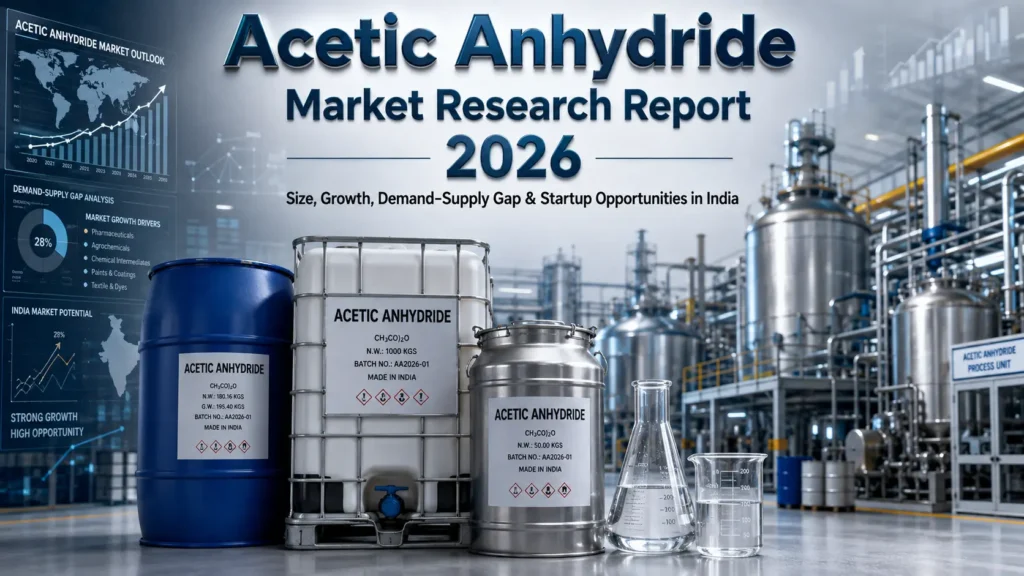
Acetic Anhydride Manufacturing in India India’s pharma sector is estimated to expand from USD 65 billion in 2024 to USD 130 billion by 2030 and acetic anhydride plays a central role in the synthesis process of some of the most widely consumed drugs produced by the industry, such as aspirin and paracetamol. However, the higher molecular weight acetyl chemical chain to which acetic anhydride belongs is one of the most import dependent industries in India as India imports over 85% of its need for upstream acetic acid. This opportunity is embedded in that dynamic: a growing demand for the pharma products downstream coupled with a highly import-dependent feedstock supply chain. What Is Acetic Anhydride? Acetic anhydride or ethanoic anhydride is a clear colourless liquid carboxylic acid anhydride produced mainly by the ketene process using glacial acetic acid as the raw material. It acts as a powerful acetylating agent (reacts with an alcohol or amine to add an acetyl group), which is useful in a number of key industrial value chains: Get Detailed Project Report (DPR): Acetic Anhydride Global and India Acetic Anhydride Market Size and Growth Global estimates for market value vary widely, depending on scope, from approximately USD 3.36 billion to USD 6.98 billion in 2025-26, rising to between USD 5.42 billion and USD 9.12 billion by the early-to-mid 2030s, with the CAGRs in the middle band. The size of India’s domestic market is estimated to be around USD 87–400 million (2024), with volume estimates ranging from approximately 76,000 metric tonnes (MT) in 2023, and most estimates of the Indian portion of the market CAGRs are significantly higher than the global average — ranging from 2.1% to as high as 7.8% across different studies — reflecting the country’s skewed higher growth pharmaceutical and agrochemical demand base compared to more mature global markets. Note on figures: Market studies of the acetic anhydride market differ in scope, some covering only the volume of the merchant market, others including the captive/integrated market. NPCS can develop an investor-grade numbers-based techno-economic feasibility study to suit your target application (pharma-grade vs. industrial-grade) and capacity. The Upstream Acetyl Chain Import Dependency The Indian supply position of acetic anhydride cannot be viewed in isolation as it is downstream of acetic acid and India’s acetic acid supply chain is extremely import dependent. India is the biggest consumer of acetic acid (around 1.2 million tonnes of acetic acid was consumed in 2024 ahead of China and the United States) but also imports over 85% of its acetic acid consumption, making the whole acetyl chain (including acetic anhydride, ethyl acetate and other derivatives) one of the most import dependent chemical sectors in India. The Indian acetyl chain market is estimated to be about USD 567 million, and could be significantly bigger by 2032 with the expansion of the downstream pharmaceutical and industrial market. This gives a unique strategic situation: domestic acetic anhydride capacity is growing (and recently has grown from established producers) – but even with this additional capacity, the production process still generally relies on the import of upstream acetic acid as feedstock – not just at the conversion stage of the process, but that stage is upstream. Explore This Book: Handbook On Chemical Industries (Alcohol Based) Policy Tailwinds 1. Pharmaceutical self-sufficiency push: India’s government emphasis on domestic API (Active Pharmaceutical Ingredient) production, aimed at reducing reliance on imports for critical drug intermediates, directly strengthens demand for domestically-manufactured, traceable, consistent-quality acetic anhydride. 2. PLI scheme of bulk drugs and key starting materials: Supporting the business case for backward integration investments for Acetyl chain – including Acetic anhydride – in indirect terms through PLI scheme for bulk drugs and key starting materials. 3. Expanding agrochemical export industry: India exports about 50% of its agrochemicals and the demand for acetic anhydride is closely linked to this export-intensive growth industry as it is used as a key raw material in the manufacture of organophosphate pesticides such as acephate. 4. Manufacturing relocation from stricter-regulation markets: Increasing environmental restrictions on pesticide manufacturing in the US and Europe are shifting agrochemical production toward India, further increasing domestic acetic anhydride demand. 5. Resurgent interest in cellulose acetate/bio-based materials: Revival of global interest in the use of cellulose acetate in the field of biodegradable plastics and sustainable textile products has generated new market opportunities for acetic anhydride in addition to the traditional cigarette filter tow market. India Demand-Supply Gap: Acetic Anhydride and the Broader Acetyl Chain Parameter Current Position India’s acetic acid position World’s largest consumption market (~1.2 million tonnes, 2024), yet imports over 85% of this requirement Broader acetyl chain market size ~USD 567 million (encompassing acetic acid, ethyl acetate, acetic anhydride, and related derivatives) India acetic anhydride market (2023) ~76,000 metric tonnes, growing at a CAGR estimated between 2.1% and 7.8% depending on the study Recent domestic capacity expansion IOL Chemicals & Pharmaceuticals expanded acetic anhydride capacity from 25,000 to 32,000 MTPA (March 2026); Laxmi Organic Limited has proposed further expansion at its Raigad, Maharashtra facility Nature of the gap A compound, two-tier import dependency — India’s acetic anhydride production capacity is growing, but much of it still relies on imported upstream acetic acid, meaning the more structural opportunity sits in backward integration across the full acetyl chain, not acetic anhydride conversion alone Downstream demand driver India’s pharmaceutical industry, projected to grow from ~$65 billion (2024) to ~$130 billion (2030), directly and substantially grows the addressable acetic anhydride market as a critical drug synthesis intermediate Opportunity for new entrants Strongest for integrated players capable of backward integration from acetic acid production through to acetic anhydride and downstream cellulose acetate/pharma intermediate manufacturing Reading in the gap: This is a multi-layered opportunity, not a one-and-done opportunity. India’s own government recognised acetyl-chain research explicitly states that the country is “one of the most import dependent chemical industries in India” since 85%+ dependence on Acetic Acid, and in turn, this is a constraint on realising self-sufficiency at the level of Acetic Anhydride with an increase in conversion capacity.
The 2026 Plymouth Barracuda Is Finally Back With a Stunning First Look

A Classic Muscle Icon Returns The famous Plymouth Barracuda is coming back in 2026, and car fans across the United States are excited about its return. After years of rumors, the company has finally revealed the first official look. The new Barracuda holds on to the spirit of the old muscle car but adds modern features, stronger performance, and a clean design that fits today’s world. Many people say it brings back memories while also feeling fresh and modern. Modern Power With a Retro Heart The new Barracuda mixes today’s technology with classic muscle style. It has a wide front, sharp headlights, and a hood inspired by the 1970 model. The interior is simple but stylish, with a big touch screen and smooth controls. The company says they wanted to keep the old charm but make it feel easier and more comfortable for everyday driving. Here are some features people noticed in the first look Engine Options and Early Performance Details The company has not shared every detail yet, but early information says there will be three engine choices. These include a turbocharged V6, a strong V8 engine, and a fully electric performance model. The electric version is expected to be the quickest, offering instant power. Experts say adding an electric option will help the Barracuda compete with other future muscle cars. Here is a quick look at expected engine performance Engine Type Expected Power Turbo V6 400 hp V8 Hemi 550 hp Electric Model 600+ hp Expected Price and Release Date The 2026 Barracuda is expected to arrive at dealerships by late 2025 or early 2026. The starting price may be around 45000 dollars for the base V6 model. The V8 model may cost around 60000 dollars, while the electric version could be the most expensive. Even with these prices, many fans say the return of the Barracuda is worth it because it is one of America’s most loved muscle cars. Why This Comeback Matters The Plymouth Barracuda has a special place in American car history. It first came out in the 1960s and became known for speed, style, and freedom. Its comeback shows that classic cars still matter in today’s market. With new technology, better engines, and updated safety, the 2026 model may attract both longtime fans and younger drivers who want a fast and stylish car. Many experts believe this could be one of the most exciting car comebacks of the decade. FAQs Is Plymouth coming back as a full brand? Right now, only the Barracuda has been confirmed. No other models have been announced yet. Will the 2026 Barracuda be electric only? No. There will be three choices which include a V6 engine, a V8 engine, and one electric model. How much will it cost? The starting price is expected to be around 45000 dollars, with higher prices for bigger engines. When can people buy it? The car should be available by late 2025 or early 2026.
India’s Chemicals Sector Targets Up to $81 Billion in Exports by 2030: Inside the NITI Aayog Blueprint

India Chemicals Sector Exports The chemicals industry in India is embarking on one of its biggest shifts in decades. The government’s top policy think tank, NITI Aayog, has recently submitted a report, which projects that the sector can drive exports to $81 billion by 2030—a nearly 2-fold increase from its current export value. Setting this target is part of a bigger picture: India becoming a net-zero chemical importer, a nation that now generates chemical products to keep pace with its rapidly growing consumption, and is also one of the major chemical exporters in the world. This is a bold move for an industry which has consistently experienced a persistent and growing trade deficit. It indicates that New Delhi is no longer considering chemicals as a sector that can support the other more prominent sectors such as pharmaceuticals, textiles, and agriculture but one that can sustain itself on a standalone basis in the process of India’s march towards a $5 trillion economy. Get Detailed Insights from This Book: Modern Technology of Industrial Chemicals The Numbers Behind the Ambition The NITI Aayog report details the export goal under various categories. Specialty chemicals are expected to shoulder the bulk of the load with anticipated exports in 2030 of $45 billion. The inorganic chemicals are in the middle somewhere between $5 billion and $10 billion, followed by the petrochemicals at about $26 billion. This adds up to a total export aspiration of $76 billion to $81 billion. In order to meet these levels, the report estimates that India’s chemicals industry will require a compound annual growth rate of 10 to 11 percent in consumption for the next five fiscal years, and even higher growth rates in the case of production — at about 14 percent per year. It’s a tough speed for an industry in a nation where infrastructure constraints, land acquisition time, and regulatory delays have held large-scale industrial development back in the past. The size of the domestic market opportunity behind this plan is massive. The chemicals consumption is expected to grow to $290 billion to $310 billion in Fiscal Year 2030, and India will be consuming 5-6 percent of the global amount. To meet that demand locally, rather than importing, India’s chemical production capacity must be scaled up by nearly 2x, from around $110 billion in fiscal 2023 to $220 billion-$280 billion by fiscal 2030, the report estimates. That’s not a simple capacity growth. It suggests a long-term sequence of new plants and plants that have grown larger, specialty chemical plants, and supporting infrastructure at ports, pipelines, and logistics corridors. If realised, it could also create 700,000 to one million new jobs by the end of the decade, which would be a major boost to the employment situation in the manufacturing sector in India, the report adds. Where the Growth Is Expected to Come From The report identifies four segments that have been identified as the main growth drivers for speciality chemical exports: dyes and pigments, paints and coatings, agrochemicals and flavours and fragrances. These are areas where India already enjoys a manufacturing capability and where international buyers have been willing to spread their purchasing beyond the traditional sources, mainly China. The change is already evident in trade figures. India’s exports of speciality chemicals have shown some solid ground in key markets, with the U.S. being around 17 percent of the exports, followed closely by Brazil with around 16 percent in 2024. These statistics indicate that speciality chemical producers from India have succeeded in gaining a foothold in markets which are not only large, but also tougher and more competitive. However, it is worth highlighting that India’s overall share in the major import markets is not high, approximately 8 percent. That’s not a liability, it’s a potential: while less than 10% of major markets are currently being accessed by Indian exporters, there’s significant scope for them to grow before they begin to face a level of saturation that would make it harder to gain market share. The other opportunities are the Petrochemicals. It is a “scale-intensive”, capital-intensive business in which the Indians already have a strong base in the sector of refining and cracker capacity, mostly public and private sector giants. The $26 billion export goal for this segment suggests a greater linkage of the refining complexes in India with their downstream petrochemical production, enabling the nation to monetise crude oil and naphtha feedstocks for an export value higher than that of exporting crude oil as intermediates or derivatives from it. Access Complete Business Plan: Chemicals (Organic, Inorganic, Industrial) Projects Why India Runs a Chemicals Trade Deficit in the First Place It is important to understand the significance of this export target by examining the present scenario of India’s chemicals trade. The country has a significant and increasing trade deficit in chemicals, for years. However, imports have far exceeded exports, with the demand for plastics, inorganic chemicals and petrochemical products increasing that domestic production has not matched. Import levels are high and the substantial proportion of these imports from China—providing a major source of chemical imports to India—as well as from other countries such as the United States, Southeast Asia, and South Korea. This dependence on imported chemicals, especially from the dominant single source, has emerged as a strategic worry for Indian policy-makers as world supply-chains have become more vulnerable than ever before in recent years. The structural challenge is the way India’s current petrochemicals plant capacity is currently structured. Very high percentage of Indian propylene is being used in the production of lower valued Polypropylene as compared to the world average. The same is true of ethylene, which is primarily used to make commodity-grade polyethylene, rather than the more valuable products like MDI, fluorochemicals or specialty feedstock for batteries and other advanced materials. This concentration on commodities lowers the value of the output for the large chemical industry in India than for more diversified industries in other countries. Existing industries in India, which are predominantly chemical, are not as
5 Seamless Tube Production Business Ideas That Can Earn You ₹2 Crore/Year
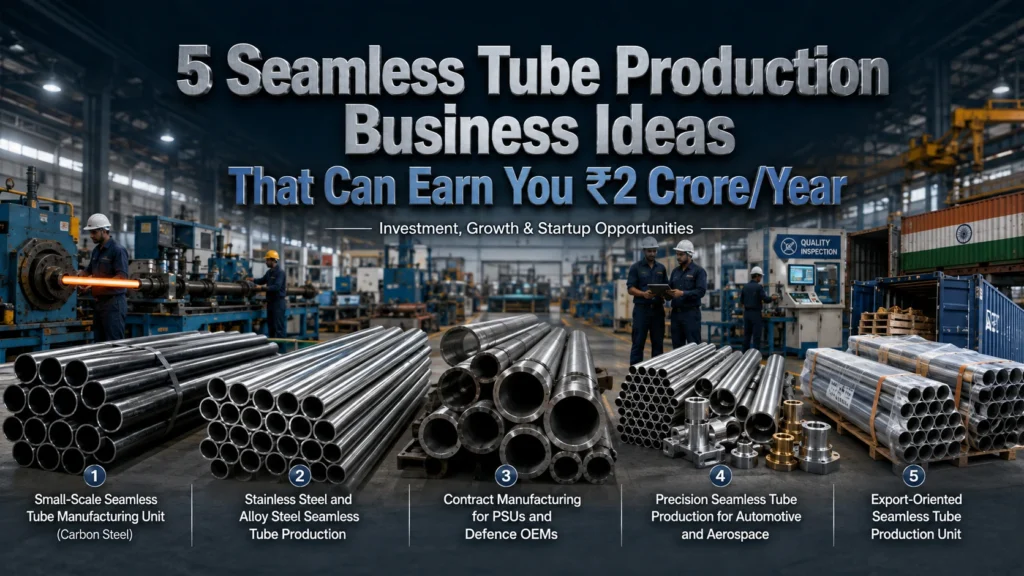
Why Seamless Tube Production Is One of India’s Most Compelling Business Ideas India’s goal of infrastructure development is on a full throttle. There’s no application where failure isn’t a concern, and there are no products as important as oil and gas pipelines, power plant boilers, automotive axles, aerospace assemblies, chemical reactors — and no place where a weld failure isn’t an option. Seamless tube manufacturing is a viable business venture as it has good industrial demand, export potentials and real government support when compared to other business ideas. Seamless tubes are manufactured from a solid billet, not welded, no weak point, unlike welded tubes. This structural superiority makes them essential in applications with high-pressure, high-temperature and corrosion. The demand is rising where India has the most aggressive expansion plans – energy, defence, railways, petrochemicals and nuclear power. However, domestic production is still not meeting demand which means there is a significant import deficit that enterprising manufacturers can exploit. This article analyzes the seamless tube production business in India in detail based on the available data providing a detailed outlook on the market opportunity, government incentives, various business models, trade dynamics and lessons learnt from the most successful MSME stories in this space in India. View Full Project Details: Seamless Tubes Manufacturing Project Report Why Seamless Tube Production Is a High-Growth Sector Right Now The global seamless tube and pipe market is estimated at more than USD 100 billion and is expected to grow at a moderate CAGR mainly due to the investments in energy infrastructure, urbanisation and defence modernization. This is the worldwide picture and, in some areas, India’s domestic demand outstrips it. India’s steel demand growth has been surpassing many developed economies, with finished steel demand posting a solid year-over-year growth due to infrastructural and manufacturing activity, as mentioned in IBEF Indian Steel Sector Report. Multi-Sector Demand: The Core Strength Seamless production of tubes is especially strong as a manufacturing investment because of its multiple industry end-user applications. There is no dominant end-industry in terms of consumption. Large diameter, high pressure seamless line pipes are needed for oil and gas exploration. The precision metallurgic requirements for boiler tubes in power generation, thermal and nuclear, are well known. Seamless tubes are applied to manufacturing of axle shafts, drive shafts and structural parts for the automotive industry. Seamless tubes in special alloys are needed for aerospace and defence applications. Corrosion resistant seamless tubes are used in chemical/pharmaceutical plants in stainless steel and duplex grades. This diversification will ensure that the demand does not slow down when any one sector slows down. India’s Infrastructure Push: A Direct Demand Catalyst The seamless tube consumption is directly related to the Government of India’s spending on infrastructure, such as the implementation of the National Infrastructure Pipeline, the PM Gati Shakti corridors, the city gas distribution network, and defence self-reliance initiatives. For every kilometre of gas distribution line, for every new boiler installation, for every renewal of a railway wagon. This initiative, known as Make in India — Metals and Mining, is actively encouraging the push towards domestic manufacturing and providing a demand signal as well as a preference towards buying seamless tubes made in India by government projects. Import Substitution: The Commercial Opportunity The current market demand for seamless tubes in India is fairly high particularly for high quality products like stainless steel, alloy steel, specialty API grade, etc. The prices these imports come in at are based on world freight, duties, and traders’ margins. An immediate and natural competitive advantage is achieved if a local company is able to compete at a lower effective cost while providing products of equivalent quality. Heavy engineering and capital goods manufacturing is growing at an accelerated pace as explained by Invest India’s study on the capital goods manufacturing boom in India that’s providing a tactical opportunity to Indian seamless tube manufacturers to outcompete imports in several grade categories. Government Policies and Incentives for Seamless Tube Production The policy landscape in India has been made one of the most conducive for manufacturing in the country’s history. There are some central government schemes that directly benefit the entrepreneurs who are contemplating investing in seamless tube production. PLI Scheme for Specialty Steel The Ministry of Steel’s Production Linked Incentive (PLI) Scheme offers support to business owners in the seamless tube segment directly for seamless tube products in alloy steel, stainless steel and other high value grades. This scheme offers monetary support for manufacturers for sales exceeding a base year sales amount. In a PIB press release announcing the launch of PLI Specialty Steel Round 3, it has been affirmed that investment commitments made under the scheme have reached ₹43,874 crore so far, creating jobs worth more than 13,000 direct jobs, and the scheme now covers 22 product sub-categories, such as seamless tube grades. The incentive rates vary by product sub-category from 4% up to 15% of incremental sales. MSME Credit and Financial Support If the seamless tube unit is registered on the Udyam portal, it will be eligible for obtaining loans up to ₹2 crore through MSME Credit Guarantee Fund Trust (CGTMSE), which offers collateral-free loans to eligible manufacturing units. New entrants’ financial burden further decreases because of concessional rates on priority sector loans, subsidised power tariffs in several states, and preferential consideration in government procurement. MSME registration can be done digitally and it should be done at the earliest by the new manufacturers. Invest India Capital Goods Support The Invest India Capital Goods sector page provides a complete solution to invest in India’s heavy engineering and capital goods manufacturing industry, which includes seamless tube manufacturing equipment and facilities. The sector has 100% FDI with automatic approval, no industrial licensing and no restrictions on technology transfer payments. Invest India’s investor facilitation services are designed specifically to assist manufacturers with approvals, to facilitate linkages with state governments for allocation of industrial land and to access central incentive schemes. Startup India and DPIIT Recognition Startups operating innovative seamless tube manufacturing ventures, especially