Our Categories

Our Categories

Industry Observer

Industry Observer is a forward-thinking company dedicated to empowering startups with reliable, data-driven industrial insights. By delivering curated market intelligence, trend analysis, and sector-specific updates, Industry Observer helps emerging businesses make informed decisions in fast-changing industries. With a strong focus on clarity and relevance, the company bridges the gap between complex industrial data and practical business application. Its services are designed to support entrepreneurs, founders, and innovators as they navigate challenges, identify opportunities, and scale effectively. Driven by a commitment to accuracy and innovation, Industry Observer has become a trusted resource for startups seeking actionable information and strategic guidance in today’s competitive landscape.

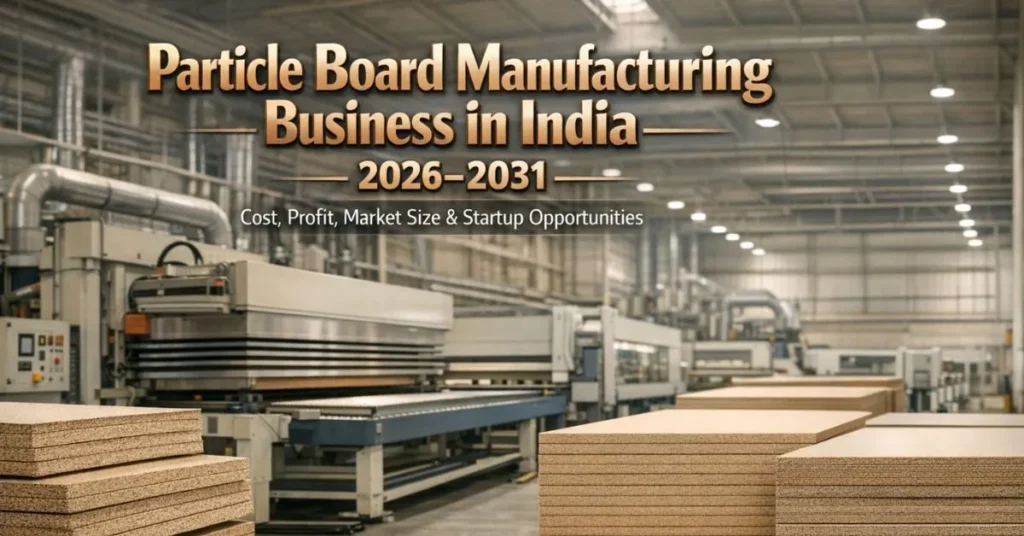
Particle board manufacturing plant in India with modern production machinery

Particle Board Manufacturing Business in India: Cost, Profit, Market Size & Startup Guide (2026 – 2031)

Particle Board Manufacturing Business in India: Cost, Profit, Market Size & Startup Guide (2026 – 2031) Read More »

Particle Board Manufacturing Business India’s engineered wood industry is growing well and particle board production is one of the most promising areas of the building materials ecosystem. Rapid urbanization, rise in the demand for modular furniture and growth in real estate construction are driving the consumption of particle boards in the country. Particle boards are very commonly used in modern interior because they are cheap and easy to process, used for mass furniture production. As consumer tastes lean towards modular kitchens, wardrobes and ready-to-assemble furniture, the manufacturers have turned to the engineered wood panel in place of the traditional solid timber. Another important development that helps shape the industry is the more stringent quality regulations that have been introduced by the Bureau of Indian Standards. These regulations mandate particle board manufacturers to seek BIS compliance licenses. There are many small and antiquated mills that are unable to meet these standards and are gradually being removed from the market. The current transition cycle creates a new requirement gap which modern production facilities can address. For entrepreneurs and MSMEs intending to move to manufacturing business, there is an enormous opportunity to invest in particle board production between 2026 and 2031. Read More: Products From Waste (Industrial & Agro Waste) 2nd Edition Market Size and Growth of Particle Board Industry India’s particle board market has witnessed steady growth in the last decade. The industry reports show that the market value will reach between USD 720 million and USD 780 million during the 2024-25 period while the market will expand to USD 1.16 billion by 2030. Several factors are contributing to this growth, such as the growth of furniture manufacturing, more and more housing construction, and the growing demand for organized solutions for the interior. Some of the key market indicators are: The furniture and cabinetry sector is responsible for over 60% of particle board consumption. The overall market is expected to grow at CAGR of around 10% between 2025 and 2030. Urban housing projects and commercial office spaces are the large consumers of engineered wood panels. These numbers demonstrate the strong potential of growth in the industry going forward in the next several years. Why Is Demand for Particle Boards Growing The growing demand for particle boards is closely related to the changes in the furniture and construction industries. Modern furniture manufacturers prefer particle boards due to the consistency of the product and the suitability of the boards for mass production. There are several major trends driving this demand. Growth of Modular Furniture Modern homes have increasingly switched to modular kitchen, wardrobe and storage systems. Particle boards are very popular for these applications due to their light weight, low cost and ease of laminating. Global furniture brands like IKEA make use of particle boards widely in the design of ready-to-assemble furniture. Growth of Real Estate Development Large infrastructure projects like Delhi-Mumbai Industrial Corridor and new smart cities like Dholera Smart City are boosting construction all over India. Residential and commercial buildings use interior furniture, partition, cabinets and decorative panels all of which make heavy use of particle boards. Growth of Office Spaces and Co-Working Spaces The emergence of flexible working spaces has led to a growing demand for standard office furniture. Companies like WeWork, Awfis are growing rapidly in the big Indian cities and this brings in a steady demand for office interiors and modular furniture components. Read More: Particle Board – Manufacturing Plant, Detailed Project Report, Profile, Business Plan, Industry Trends, Market Research, Survey, Manufacturing Process, Machinery, Raw Materials, Feasibility Study, Investment Opportunities, Cost and Revenue, Plant Layout Demand – Supply Gap in Indian Market Despite the growing demand, the particle board manufacturing capacity of India is limited. The organized sector is dominated by a handful of large manufacturers, but many smaller mills have been forced to shut down because of more stringent standards of compliance. Some of the top companies that work in this sector include: Century Plyboards (India) Ltd. Action TESA Greenply Industries Ltd. Associate Decor Ltd. Shirdi Industries Even with these manufacturers, the amount of particle boards supplied has not been able to catch up with the ever growing demand. Imports are resorted to fill the gap still and the cost of imports has been on the rise in recent years. Another important issue is geographic concentration. Most of the manufacturing plants are found in western and southern India, mostly in the state of Gujarat, Maharashtra and Tamil Nadu. However, there is a fast-growing demand in the north and east which rely on long distance transportation of particle boards from existing manufacturing hubs. This kind of geographic imbalance leaves big opportunities for the setting-up of new factories in areas such as Uttar Pradesh, Rajasthan, Madhya Pradesh and Bihar. Read More: Rice Husk, Rice Hull, Rice Husk Ash (Agricultural Waste) based Projects, (Precipitated Silica, Activated Carbon, Cement, Electricity, Ethanol, Hardboard, Oxalic Acid, Paper, Particle Board, Rice Husk Briquettes, Rice Husk Pellet, Silicon, Sodium Silicate) Raw Materials used in Making Particle Board The manufacturing of particle boards involves the compression of wood particles using adhesives and high temperature and pressure. Traditionally, the feedstock for this process was wood-based materials. Common raw materials used in the production include: Wood chips and sawdust from sawmills Shavings of wood from furniture factories Sugar can bagasse from sugar mills Agricultural residues such as rice husk and wheat straw Bagasse has emerged as a key material because it exists in abundant supply throughout India and delivers sustainable environmental advantages. By turning agricultural waste into industrial products, manufacturers can save money while adopting environmentally friendly production practices. Read More: Startup Selector Investment Needed to Establish a Particle Board Plant The setting up of a particle board manufacturing facility requires a huge investment in machinery and infrastructure. However, the industry does provide great long-term returns when the planning of projects is done efficiently. For MSME entrepreneurs, the investment in a small to medium scale plant ranges between a mere Rs. 15 crores to Rs. 40 crores depending
Maize Processing Industry in India

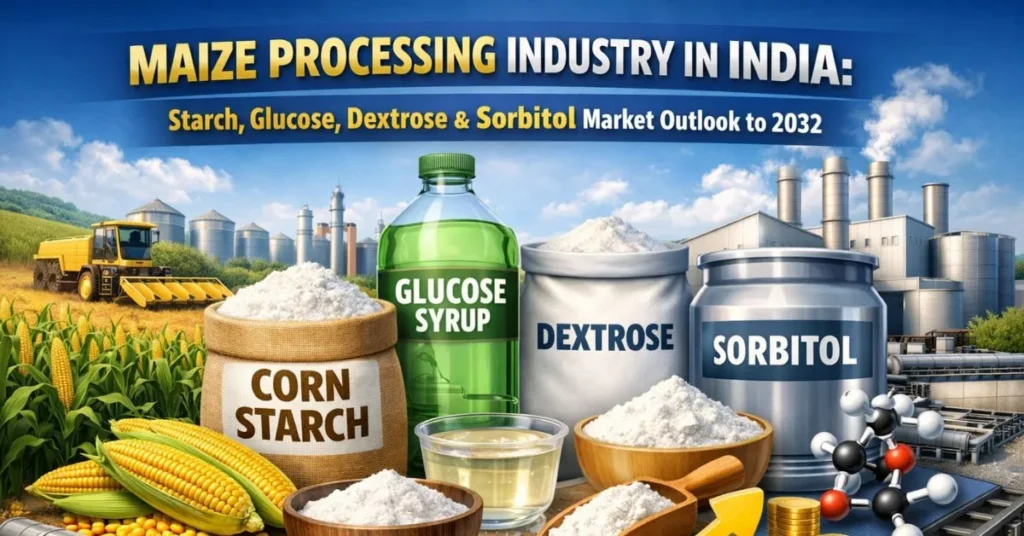
Maize Processing Industry in India: Starch, Glucose, Dextrose & Sorbitol Market Outlook to 2032

Maize Processing Industry in India: Starch, Glucose, Dextrose & Sorbitol Market Outlook to 2032 Read More »

Introduction: Maize Processing Industry in India India’s maize processing industry has seen a steady shift from the traditional grain milling operation to value-added biochemical processing industry. Today, maize-based derivatives are important in providing the raw materials for pharmaceuticals, food processing, textiles, paper industries, personal care products and fermentation industries. This transformation has been furled by rapid growth of FMCG, growing pharmaceutical production and growing domestic consumption of processed food products. India produces over 36-38 million metric tonnes of maize per year but less than 25% is made into industrial derivatives. This low penetration of processing, coupled with growing downstream demand, leaves a large opportunity for new investments in maize-based starch and sweetener manufacturing.(Maize Processing Industry in India) Read More: Maize (Corn) Products in India (Starch, Glucose, Dextrose, Sorbitol) Trends, Opportunities, Market Analysis and Forecasts (Upto 2030-31) Structure of Maize Processing Industry Of India Indian maize processing industry is mainly developed around four major derivatives used by various industries: Maize starch, used in large amounts in textiles, paper, pharmaceuticals and food applications Liquid glucose syrup (consumed by confectionery, bakery and fermentation industries) Dextrose monohydrate, a widely used ingredient in IV fluids, ORS and nutraceutical formulations Sorbitol, an important ingredient in toothpaste, cosmetics and pharmaceutical syrups These products guarantee a regular industrial demand all year round and shelter the manufacturers from seasonal fluctuations.(Maize Processing Industry in India) Industrial Demand Trends and Growth Factors Maize starch continues to dominate the market for starch derivatives due to the wide use in the textile sizing, paperboard manufacturing, pharmaceutical tablets binding and adhesives production. Growth in organized textiles, packaging and healthcare has ensured steady consumption through India.(Maize Processing Industry in India) Liquid glucose demand has grown in tandem with the confectionery and bakery segments, especially due to urbanization and the changing lifestyles. Additionally, industries based on fermentation, such as antibiotics, enzymes and organic acids, are extremely dependent on glucose syrups, further reinforcing demand. Dextrose Monohydrate has become one of the fastest growing maize derivatives because of the growing pharmaceutical manufacturing. The pharmaceutical industry alone is responsible for over 30% of total domestic dextrose consumption with strong demand coming from Gujarat, Maharashtra, Telangana and Himachal Pradesh. Sorbitol demand has increased steadily with the growth of the oral care, personal hygiene and cosmetics industry. Domestic averment is still feeble in comparison to the high demand for the pharmaceutical grade, although it suffices as a craver from the import business.(Maize Processing Industry in India) Read More: Maize (Corn) Products in India (Starch, Glucose, Dextrose, Sorbitol) Trends, Opportunities, Market Analysis and Forecasts (Upto 2017) Import Dependency and Market Gap Despite being a large producer of maize, India imports refined corn derivatives because of the lack of high purity processing infrastructure. This dependency makes it more costly for downstream manufacturers and exposes them to global price fluctuations. Key gaps in the present market include: Shortage of pharmaceutical grade sorbitol and glucose syrups Limited domestic production of specialty and modified starches Regional imbalance in supply in South and Central India These gaps clearly show high import substitution potential for integrated maize processing units.(Maize Processing Industry in India) Read More: Why India Imports Sorbitol Despite High Maize Production – A Golden MSME Manufacturing Opportunity Integrated Maize Wet Milling Business Feasibility Integrated maize wet milling plants have excellent economics because of diverse product production. In such facilities, maize is processed into starch that can be sold directly or further processed into glucose, dextrose and sorbitol. Major benefits of integrated plants are: Ability to serve various industries at the same time Higher capacity utilization and operational flexibility Additional income from by-products such as maize germ oil and gluten feed This multi-product structure helps to reduce risk to the business and helps improve long-term profitability. Key Players and Competitive Scenario Organised processing industry of maize in India includes some established manufacturers such as Gujarat Ambuja Exports Ltd., Sukhjit Starch & Chemicals Ltd., Riddhi Siddhi Gluco Biols Ltd. and Roquette India Pvt Ltd. These players mostly serve large FMCG and pharmaceutical clients. However, production facilities are clustered into few regions, thus leaving gaps in supply near emerging clusters of pharmaceutical and food processing industries. This provides scope for MSME-scale decentralized units.(Maize Processing Industry in India) Read More: Maize, Corn and its By Products, value added Products, Derivatives, Maize Processing Industry, Corn Starch, Dextrose, Liquid Glucose, Sorbitol, Oil, Gluten, Germ Oil, Wet Milling, Maize Starch Plant & related Products, High-Fructose Corn Syrup (HFCS) Government Support and Incentives The Government of India is actively involved in maize processing under various agro-industrial schemes. Entrepreneurs can benefit from: capital subsidies on plant and machinery Infrastructure support for integrated processing units Incentives at state level under industrial policies In addition, the growth of the pharmaceutical sector under the PLI scheme is likely to generate a considerable increase in the demand for maize based excipients.(Maize Processing Industry in India) Read More: Maize Processing Industry in India: Starch, Sorbitol & Value-Added Products Market Opportunity https://youtu.be/_Ojb64-SfK0?si=F1ck3AWZG6d2454M Market Outlook and Forecast Up To 2032 India’s maize derivatives market is expected to have a steady growth until 2032, aided by the growth in pharmaceutical manufacturing, growth in processed food consumption, demand for personal care products and fermentation-based chemical manufacturing. Important growth opportunities include: Import substitution in sorbitol & specialty glucose Drivers of manufacturing in India: – Regional cluster of manufacturing – Pharma and FMCG Value addition through integrated processing Entrepreneurs who ventured into this sector with proper plan and linkage with the market will surely anticipate scalable operations and stable returns in the long run.(Maize Processing Industry in India) Frequently Asked Questions (FAQ) Is maize processing profitable in India? Yes, as a result of diverse product output, good industrial demand and because of government incentives, maize processing has attractive returns. Why is sorbitol still imported? Due to limited domestic capacity for use of pharmaceutical grade sorbitol, which results in import dependency. Which industries are the heaviest consumers of maize derivatives? Pharmaceutical, food processing, textiles, paper, personal care and fermentation industries. Are there subsidies for maize processing

Phenol and Acetone Manufacturing

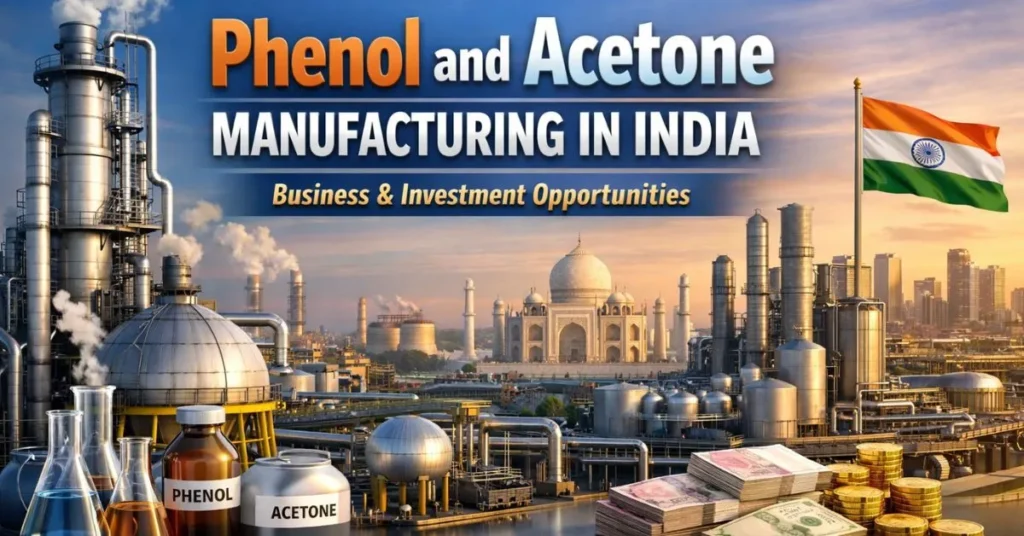
Phenol and Acetone Manufacturing in India: Business & Investment Opportunities

Phenol and Acetone Manufacturing in India: Business & Investment Opportunities Read More »

Phenol and Acetone Manufacturing India’s chemical industry is experiencing a fast growth, but some of the strategic intermediates are significantly import-dependent. Phenol and acetone are two excellent examples of these compounds in that they are key raw materials used to produce laminates, adhesives, resins, pharmaceuticals, and polycarbonates. With domestic demand exceeding domestic production, India is a promising investment destination in phenol and acetone manufacturing – in line with the government’s Atmanirbhar Bharat initiative. In this article, we examine the phenol and acetone scenario in India in terms of trends in production, gaps in consumption, the key players, downstream opportunities for MSMEs, and import substitution.(Phenol and Acetone Manufacturing) Read More: Phenolic Resins Technology Handbook (2nd Revised Edition) What Are Phenol and Acetone? Phenol is an aromatic organic compound which is mainly used for the making of bisphenol-A (BPA), phenolic resins and caprolactam. It is an important component in high-pressure laminates, adhesives, brake linings and electronics applications. Acetone, one of the co-products of phenol production from the cumene process, is an industrial solvent with wide applications in the pharmaceutical, paints, coatings, nail polish removers and cosmetics sectors. Both of these chemicals are of strategic importance as they are the base for several downstream industries such as polycarbonates, epoxy resins and specialty chemicals.(Phenol and Acetone Manufacturing) The Domestic Manufacturing Landscape in India India’s phenol and acetone market is presently in a duopoly that is dominated by Deepak Phenolics Ltd and Hindustan Organic Chemicals Ltd (HOCL). Hindustan Organic Chemicals Ltd (HOCL) HOCL’s Kochi plant commissioned in 1987-88 produces phenol, acetone and hydrogen peroxide. The Rasayani facility was closed down and Kochi became the only operational unit. HOCL’s capacity is modest: Phenol: 40,000 tonnes per annum (tpa) Acetone: 24,600 tpa Production has been volatile with the output of FY 2023-24 totalling 47,518 t phenol and 29,613 t acetone dropping to 34,874 t and 21,790 t respectively in FY 2024-25 due to market and working capital constraints. Deepak Phenolics Ltd (DPL) DPL, a subsidiary of Deepak Nitrite, has the largest phenol and acetone facility in India at Dahej in Gujarat: Phenol: 330 kta Acetone: 200 kta In 2025, DPL announced a total investment of Rs 3,500 crores for the construction of a greenfield facility, with another 300 kta of phenol, 185 kta of acetone and 100 kta of isopropyl alcohol (IPA), for import substitution and a combination with polycarbonate. Other Players Smaller producers such as Shree Ram Chemicals and the yet to be commissioned projects of Haldia Petrochemicals and Aarti Industries contribute marginally. Despite these efforts, Deepak Phenolics holds around 57% of the domestic market and HOCL covers the remaining market.(Phenol and Acetone Manufacturing) Read More: PHENOL/ACETONE – Manufacturing Plant, Detailed Project Report, Profile, Business Plan, Industry Trends, Market Research, Survey, Manufacturing Process, Machinery, Raw Materials, Feasibility Study, Investment Opportunities, Cost and Revenue, Plant Economic Production, Consumption and Trade Trends Installed Capacity vs. Production. Phenol installed capacity (government-monitored): 76.8 kta Phenol production FY 2023-24: 47.5 kt Acetone installed capacity 47.1 kta Acetone production FY 2023-24: 29.6 kt Capacity utilization is currently averaging 62% for phenol, and 63% for acetone – constrained by cyclical cumene availability, global price volatility, and working capital issues.(Phenol and Acetone Manufacturing) Demand–Supply Gap India’s phenol consumption has increased from 179.6 kt of 2019-20 to 261.1 kt in 2023-24. Acetone consumption from 97.7kt to 131.3kt happened in the same period. Phenol supply gap: ~213 kt Acetone supply gap: ~102 kt This deficit is now covered by imports, pointing to the existence of high potential for domestic producers.(Phenol and Acetone Manufacturing) Import Dependency India imports a large amount of phenol and acetone: Phenol: Net imports worth ($1,708 crore) (FY 2023-24), mostly from Thailand, Singapore and South Korea. Acetone: 148.21 kt imported in 2024 at ~$147.9 million. The main sources of data are Thailand which accounts for 47.7% South Korea which provides 22.1% Singapore which contributes 5.1% and China which supplies 2.7% of the total data. India depends on imports for over 50% of its acetone needs because the country requires acetone for its industrial operations which makes the industry vulnerable to price and supply changes.(Phenol and Acetone Manufacturing) Read More: Project Reports & Profiles Demand Factors of Phenol and Acetone Laminates & Plywood: The phenolic resins based on phenol play a key role in high pressure laminates, marine plywood and industrial applications. India has a laminate industry that grows 8-10% a year. Adhesives & Coatings: BPA and epoxy resins which manufacturers produce through phenol and acetone processing serve as essential components for coatings and adhesives and circuit boards and composite materials. The adhesive industry in India is expected to grow to USD 3 billion by 2030. Pharmaceuticals: Acetone functions as a primary solvent which people use to create pharmaceuticals and vitamins and cosmetics and personal care products while the pharmaceutical industry needs acetone to support its projected growth which will reach a USD 130 billion market size by 2030.(Phenol and Acetone Manufacturing) Construction & Automotive: Phenol-formaldehyde and epoxy resins for automotive brake pads, moulding compounds and lightweight EV composites. Growing in the construction and infrastructure sectors increases phenol demand. Investment Opportunities for Phenol and Acetone Large-Scale Manufacturing World scale plants (>200 kta phenol) are economically viable. Estimated cost for 100 kta plant: Rs 3000 to 4000 crore Integration with polycarbonate, BPA, or resin plants, which lowers the risk in the market. PCPIRs at Dahej, Paradip, Visakhapatnam and Cuddalore provide incentives & infrastructure support. Downstream Opportunities for MSME Phenolic Resins & Moulding Compounds. 5,000 – 10,000 tpa plants for laminates, brake linings and foundry binders. Bisphenol-A & Epoxy Resins: 10,000 tpa units, potential for higher value integrated products. Solvent Recovery & Formulations: Acetone and phenol serve as recycling materials in the pharmaceutical and cosmetic industries. Polycarbonate Compounding: Providing flame retardant and glass fiber reinforced PC for automobile and electrical applications. Read More: Top 20 Chemical Imports to India Financial Viability Large-scale plants: IRR 14–18%, investment ?3,000–5,000 crore. MSME resin units: 20-25% IRR, investment: 15-50 crore, payback period: 3-4 years. Raw materials (cumene, methanol); utilities;

Rail based export business India - container train at inland container depot

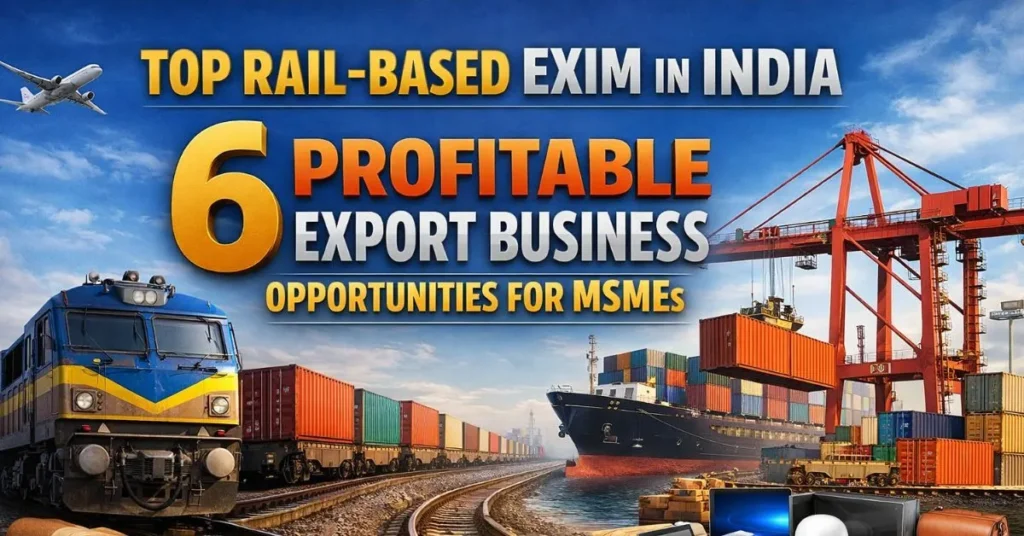
Top Rail-Based EXIM in India: 6 Profitable Export Business Opportunities for MSMEs

Top Rail-Based EXIM in India: 6 Profitable Export Business Opportunities for MSMEs Read More »

Introduction: rail based export business India For decades, Indian exports had been concentrated mostly around coastal manufacturing clusters. Businesses with a location near a port enjoyed natural logistical benefits and inland manufacturers were hindered by increased freight costs, unreliable transport schedules, and longer delivery times. That geography is changing fast. Rail-based EXIM logistics is changing the landscape of export in India by expanding global access of the market deep into the hinterland. With the growth in Dedicated Freight Corridors (DFC), Inland Container Depot (ICD), private freight terminals and PM Gati Shakti infrastructure initiative, railways have emerged as a strategic enabler of international trade. In 2023-24, over 63 million tonnes of EXIM container traffic was transported using rail-linked systems. Total freight commodity transported 1,588 million tonnes, which fetched earnings of Rs. 1,65,880 crore. These numbers are indicative of a structural transformation – not a temporary spike. For MSMEs and startups, this means one thing with power: You can conduct an export-oriented business without being located close to a port. Read More: Our Books The Structural Transformation in the Indian Trade Logistics Indian Railways has gone beyond the conventional method of freight movement. It is now a unified logistic backbone linking production centres with global gateways. Three major developments are leading to this transformation: Expansion of Inland Container Depots (ICDs) A number of intermodal publications in the SRI Library: – Operationalization of Dedicated Freight Corridors Multi-modal integration under Gati Shakti ICDs enable exporters to do their customs clearance nearer to their factories. Containers are then sent directly to ports by rail, avoiding congestion and delays. Dedicated Freight Corridors enhance the speed and reliability of transit by separating freight traffic from passenger lines. This adds predictability – and that is a key issue in export commitments. The Gati Shakti initiative ensures improved coordination between the rail, road and port infrastructure which makes the supply chains more efficient and cost-effective. For the inland states such as Uttar Pradesh, Madhya Pradesh, Rajasthan, Jharkhand and Chhattisgarh, this connection is opening up unprecedented export opportunities.(rail based export business India) Get Detailed Insights from This Book: Just For Starters: How To Start Your Own Export Business Why Rail Based EXIM Is Strategic Advantage for MSMEs Export success requires a high level of logistics efficiency. Many businesses are not unsuccessful because their products are not of quality, but because their supply chain is not stable. Rail based EXIM logistics has the following strategic advantages: Reduced per tonne transport cost of bulk and semi-bulk goods Predictable transit schedules Reduced risk of road congestion Better inventory planning Access to a number of ports from inland locations For MSMEs, this reduces uncertainty of operation and enhances pricing competitiveness in the international markets. Read More: Business Plans / Project Profiles High Potential Export Sectors Applicable to Rail Logistics Rail-based EXIM naturally services the industries that deal with heavy, bulk, or semi-bulk goods. Below are the most promising sectors for startup and small manufacturers. 1. Steel Products and Fabricated Structures Steel is weight intensive and also volume driven, so rail transport is ideal. Inland steel producers now have access to ports without having to move to coastal areas.(rail based export business India) Promising export segments are: Structural steel sections Fabricated beams and frames Pre-engineered building components Infrastructure related steel parts Rail connectivity is a great step to make exports cost viable. 2. Cement and Clinker Based Products India transports more than 150 million tonnes of cement every year on rail. Clinker exports to Africa and the Middle East are still increasing. Important export products in high demand include the following: Cement clinker Dry-mix mortars Precast concrete products Pavers and construction blocks Rail transport makes inland freight cheaper, thereby making price-sensitive exports competitive.(rail based export business India) 3. Agricultural and Processed Food Products Containerized rail movement has boosted bulk agricultural exports. With cold-chain improvement at terminals, value-added products are gaining ground. Export-ready products include: Rice and cereals Pulses and grains Dehydrated vegetables Food processing ingredient For Agri-MSMEs who are located away from ports, rail logistics opens up a major barrier.(rail based export business India) Read More: Project Reports & Profiles 4. Fertilizers and Argo-Chemical mixtures Nearly 59 million tonnes of fertilisers are moved by rail every year. Bulk rail logistics improves the viability of export for: NPK blends Specialty fertilisers Micronutrient formulations Cost efficiency is very important in this sector and rail offers that advantage.(rail based export business India) 5. Engineering Goods and Industrial Components Engineering exports are one of the best performing segments in India. Many parts are heavy and wouldn’t be transported over long distances on the road.(rail based export business India) High-potential exports are: Machinery components Industrial fasteners Electrical enclosures Fabricated assemblies Rail-to-port movement allows for international buyers to be more reliable in their delivery. 6. Chemicals and Industrial Intermediary Railways are used to transport chemicals in bulk and containerized forms. Organized handling systems minimize the risk of compliance and maximize safety. Export opportunities are available in: Specialty chemicals Dyes and pigments Industrial resins Additives and intermediates With proper planning, chemical MSMEs can go global.(rail based export business India) The Dual Model: Import Substitution Plus Export Many successful railway linked manufacturers use a two-stage approach. They start by replacing imports in their domestic markets. Once production stabilizes they look for export opportunities of surplus or value-added variants. There are several advantages to this approach: Better capacity utilization Reduced dependency on a single market Improved financial stability Rail logistics supports both domestic distribution as well as export movement over the same network of infrastructure. Read More: Railway Infrastructure Boom: Manufacturing Business Opportunities for New Entrepreneurs Why Is The Perfect Time Of Investment There are a number of macroeconomic and infrastructural factors that make this the right time to enter railway-linked export manufacturing: Dedicated Freight Corridors that are operational and expanding Inland container depots are growing in capacity Multi-modal logistic parks are being developed The move to diversify supply chains by global buyers Indian manufacturing policy is highly supportive of exports Entrepreneurs that

Profitable Manufacturing Business Ideas in India

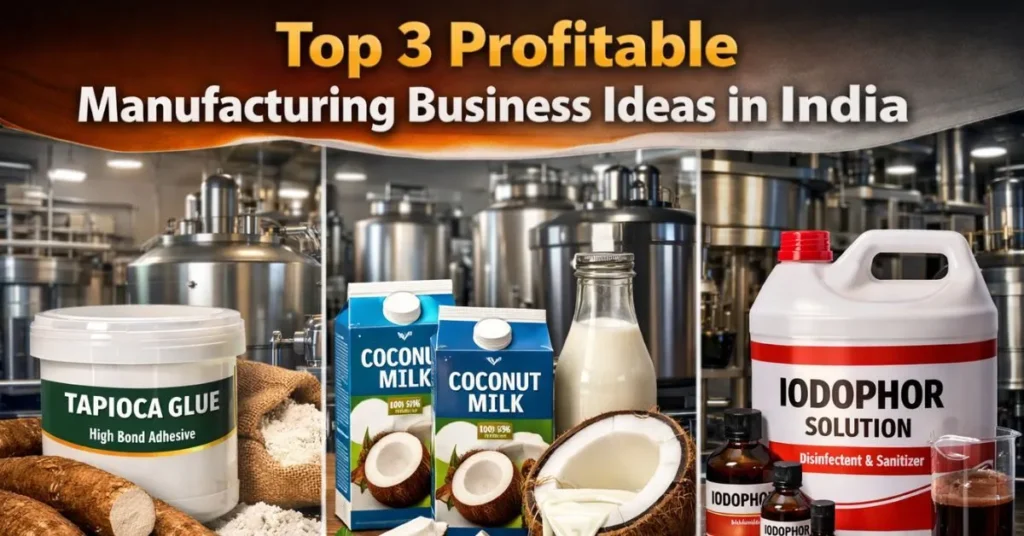
Top 3 Profitable Manufacturing Business Ideas in India: (Tapioca Glue, Coconut Milk, and Iodophor Solution)

Top 3 Profitable Manufacturing Business Ideas in India: (Tapioca Glue, Coconut Milk, and Iodophor Solution) Read More »

Introduction: Profitable Manufacturing Business Ideas in India India’s manufacturing sector is in powerful growth stage driven by growth in domestic demand, import substitution, sustainability trends and excellent policy support for MSMEs. For entrepreneurs and 1st generation manufacturers, opportunities today are not necessarily big industrial plants but demand-driven products that address everyday business and consumer problems. Three manufacturing segments are highlighted for their scalability and fairly manageable investment levels: tapioca starch-based glue, coconut milk processing, and iodophor disinfectant solution. The products represent different industrial clusters which currently experience fast growth because they create eco-friendly adhesives and plant-based food processing products and institutional hygiene chemicals. The article examines three manufacturing opportunities through its analysis of market potential and manufacturing process and demand drivers and profitability outlook to assist entrepreneurs in making investment decisions.(Profitable Manufacturing Business Ideas in India) Read More: The Complete Book on Coconut & Coconut Products (Cultivation and Processing) 1. Tapioca Starch Glue Manufacturing: A Sustainable Industrial Adhesive Enterprise Product Overview Tapioca starch glue is a bio-based glue made from cassava starch. It is used extensively in the manufacture of corrugated boxes, paper bonding, bookbinding, textile sizing and plywood lamination. With the industries moving away from petroleum based chemicals, starch adhesives are gaining good acceptance. The product is valued for its non-toxicity, biodegradability, fast bonding properties and cost advantage over synthetic alternatives. Growing e-Commerce and FMCG packaging demand has seen a big rise in consumption of corrugated boxes – indirectly leading to growth in adhesive demand.(Profitable Manufacturing Business Ideas in India) Manufacturing Process The production process is relatively simple and can be done in MSME scale units: Gelatinisation of tapioca starch by controlled heating Mixing with water and chemical additives Addition of preservatives to ensure shelf stability Viscosity control & packaging Typical plant capacity is between 1 and 5 tonnes per day, which enables gradual expansion. Capital investment is medium and energy consumption is not prohibitive. Raw Materials and Supply Chain Primary raw material: Tapioca starch (mostly sourced from Tamil Nadu and Andhra Pradesh). Secondary inputs include borax, caustic soda and stabilizers. Maintaining a consistent starch quality is the key to product reliability.(Profitable Manufacturing Business Ideas in India) Market Demand and profitability Industries that drive demand are: Manufacturers of corrugated packaging Notebook and stationery manufacturers Textile processing units Veins and plywood industries Bio-based adhesives market is expanding faster than the traditional adhesives and small units often get healthy operating margins due to steady repeat orders. Read More: White Phenyl – Manufacturing Plant, Detailed Project Report, Profile, Business Plan, Industry Trends, Market Research, Survey, Manufacturing Process, Machinery, Raw Materials, Feasibility Study, Investment Opportunities, Cost and Revenue, Plant Economics 2. Coconut milk processing: A High Growth Food Manufacturing Opportunity Product Overview Coconut milk has gone from being a regional item to an international food item. It is extensively used in ready-to-eat meals, vegan beverages, desserts, sauces and bakery applications. Increasing awareness among people about health and a growing demand for dairy alternatives have fueled great growth in this segment.(Profitable Manufacturing Business Ideas in India) In India rising urbanization and plant-based dietary trends are increasing the domestic market, whereas export demand is high in Europe, the Middle East and Southeast Asia. Manufacturing Process Coconut milk production consists of: Dehusking and shell removal Extracting and grinding kernel Pressing and filtration Thermal processing and homogenisation Packaging (pasteurised or aseptically) Units can start small – processing 5,000 to 10,000 coconuts per day – and work up to export grade production. Raw Material Sourcing Mature coconuts are largely coming from Kerala, Karnataka and Tamil Nadu. Price fluctuation is a significant issue, dealt with often by forming long-term supplier agreements or partnership with farmers. Standards of cleanliness, fat content and shelf stability are important, particularly for institutional buyers and the international market.(Profitable Manufacturing Business Ideas in India) Read More: The Complete Book on Coconut & Coconut Products (2nd Edition) Market Demand, Profitability Demand segments include: FMCG companies operating in curries and ready meals Hotels, restaurants, cloud kitchens Vegan and health food brands Export distributors In order to increase profitability, manufacturers can use by-products such as coconut oil and coconut residue. 3. Iodophor Solution Making: A High Trust Chemical Company Product Overview Iodophor solution is an iodine-based disinfectant that is widely used in dairy farms, food processing plants, breweries, pharmaceutical manufacturing and hospitals. The product delivers comprehensive antibacterial defines while releasing iodine at controlled rates which makes it appropriate for areas that require strict hygiene standards.(Profitable Manufacturing Business Ideas in India) The food sector and healthcare sector both experience rising demand for institutional disinfectants because sanitation regulations become more stringent. Manufacturing Process The process of production involves: Dissolving iodine using non-ionic surfactants Controlled mixing and stabilisation, Dilution with purified water Quality Testing and Packaging The project needs moderate funding yet it requires organizations to follow strict safety measures and complete regulatory obligations.(Profitable Manufacturing Business Ideas in India) Read More: Unlock Huge Profits With These Coconut Business Opportunities   Raw Materials and Operational Factors The manufacturing process depends on iodine and surfactants and acids and purified water as its main components. The business needs reliable sources of iodine and secure chemical storage facilities to ensure its daily activities run smoothly. Market Demand and Profitability Primary demand comes from: Dairy and poultry farms Food processing industries Pharmaceutical manufacturers sani pairs to institutional sanitation services The organization establishes long-term relationships with customers through its continuous institutional order process which generates predictable revenue streams. Key Lessons of Indian Manufacturing Success Stories Successful Indian industrialists prove that it is more important to execute with discipline than to expand fast. Entrepreneurs who pay attention to the stability of supply chains, quality control and targeted markets tend to build more resilient businesses.(Profitable Manufacturing Business Ideas in India) Backward integration into raw materials helps in reducing cost volatility. Export orientation, good compliance systems and consistent product quality create customer trust for the long term – especially within chemical and food manufacturing industries. Read More: The Role of Tapioca Starch Glue in Sustainable Manufacturing Policy Support for

Profitable manufacturing businesses in India

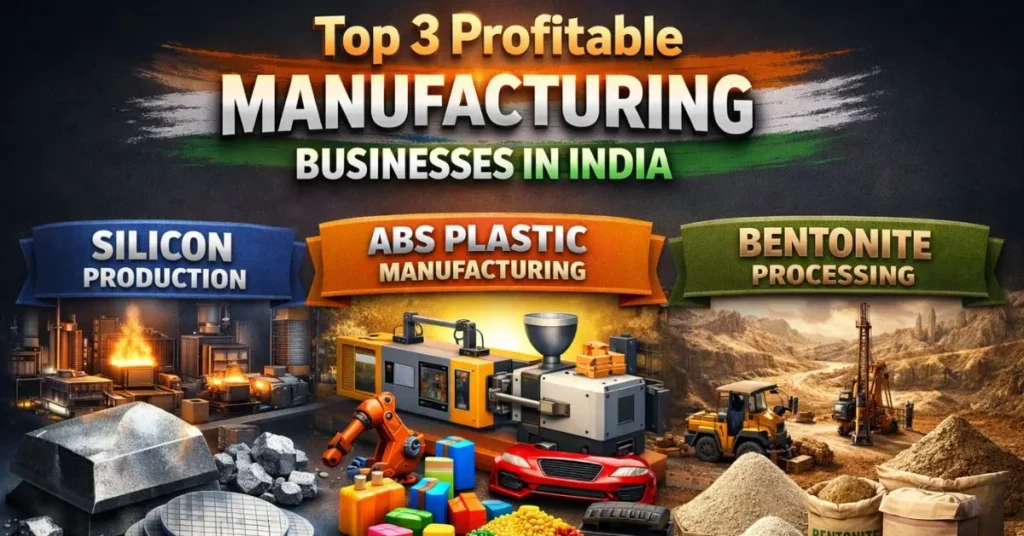
Top 3 Profitable Manufacturing Businesses in India (Silicon, ABS & Bentonite)

Top 3 Profitable Manufacturing Businesses in India (Silicon, ABS & Bentonite) Read More »

Introduction: Profitable manufacturing businesses in India India’s manufacturing sector is in a powerful phase of growth based on domestic demand, the modification of global supply chains, and government initiatives in support of industrial production. Many entrepreneurs are chasing digital trends, but manufacturing is one of the surest paths to building long-term wealth with tangible assets, repeat demand and scalable operations. Material-based manufacturing businesses are also attractive because they cater to many industries at the same time. From electronics to renewable energy resources, consumer goods to pet care products, raw material processing remains in constant and strong demand. This article discusses three promising manufacturing opportunities in India – Silicon Crystals, Acrylonitrile Butadiene Styrene (ABS) engineering plastic and Bentonite-based Cat Litter. Each of them represents a different level of investment and business model, and hence is suitable for large industrial investors as well as emerging MSME entrepreneurs.(Profitable manufacturing businesses in India) Read More: The Complete Book on Resins (Alkyd, Amino, Phenolic, Polyurethane, Epoxy, Silicone, Acrylic), Paints, Varnishes, Pigments & Additives (Surface Coating Products with Formulae)(3rd Revised Edition) 1. Silicon Crystals Manufacturing – Powering Electronics and Renewable Energy What Are Silicon Crystals? Silicon crystals are highly purified materials that are used in semiconductor wafers, solar panels, power electronics, and industrial sensors. Although they are not the products that consumers see, they are the backbone of modern technology. Every single smartphone, solar installation and industrial automation system is based on silicon-based parts.(Profitable manufacturing businesses in India) India’s dedication to electronics production together with its commitment to renewable energy has created an increased need for domestically produced silicon materials. Government incentives to solar energy and semiconductor manufacturing also strengthen the long-term growth potential. Overview of the Manufacturing Process The road of manufacturing starts with quality quartz or silica sand. Through carbothermic reduction in electric arc furnaces, silicon in metallurgical grade is produced. The process begins with material transformation into polysilicon through purification which uses Czochralski as a specialized crystallization method. Silicon manufacturing plants need: High capital investment Reliable energy supply Strict quality control Controlled production environments The existing plants need high capital investment yet they maintain their operation through extended supply agreements which secure steady income for extended periods. Read More: BENTONITE PROCESSING & PULVERISING – Manufacturing Plant, Detailed Project Report, Profile, Business Plan, Industry Trends, Market Research, Survey, Manufacturing Process, Machinery, Raw Materials, Feasibility Study, Investment Opportunities, Plant Layout Demand Factors and Market Potential The major industries which need silicon crystals for their operations include the following sectors: Solar panel manufacturing Semiconductor fabrication Electric vehicle power electronics Industrial automation systems The growth of domestic Electronics production in India creates new opportunities for businesses to replace imported products. Businesses that have the financial resources and engineering knowhow to operate in silicon production will achieve sustainable profits throughout their business lifecycle.(Profitable manufacturing businesses in India) 2. ABS Plastic Manufacturing: Engineering Thermoplastic of High Demand Understanding ABS Plastic Acrylonitrile Butadiene Styrene (ABS) is an engineering-grade thermoplastic that is known for its impact resistance, durability, and great molding properties. The material finds extensive application across various sectors including automotive interior construction and electrical equipment production and medical device manufacturing and toy creation and luggage design.(Profitable manufacturing businesses in India) As opposed to basic commodity plastics, ABS commands a better price based on its performance characteristics, and thus is profitable for manufacturers. Read More: Bentonite Processing – Manufacturing Plant, Detailed Project Report, Profile, Business Plan, Industry Trends, Market Research, Survey, Manufacturing Process, Machinery, Raw Materials, Feasibility Study, Investment Opportunities, Cost and Revenue Production and Manufacturing Process ABS, made by the polymerization of acrylonitrile and styrene in the presence of polybutadiene. This process requires controlled temperature and chemical handling systems. Commonly, manufacturers will produce ABS granules which are supplied to the injection molding companies and OEM manufacturers. A typical ABS plant is concerned with: Consistent formulation High-quality polymerization processes Efficient supply chain managemen Demand and Growth Prospects for the Market India’s burgeoning automobile industry and growing appliances manufacturing industry is a key growth driver for ABS. Increasing consumer expenditures on longer lasting goods like refrigerators, washing machines and electronics also contributes to rising demand. Major industries using ABS are: Automotive manufacturing Consumer electronics Medical equipment Household appliances The MSME sector offers business opportunities through three different paths which include niche development of ABS grades and compounding activities and partnerships with molded product manufacturers.(Profitable manufacturing businesses in India) 3. Bentonite Cat Litter Making Business: Low Investment, High Growth Product Overview Bentonite cat litter is a clumping absorbent litter that is made from natural clay. While it doesn’t come across as a very popular industry, India’s pet care market is rapidly growing and there’s a good demand for high-quality litter products. Additionally, bentonite has industrial applications in foundries, drilling fluids, and absorbents to provide diversified revenue streams.(Profitable manufacturing businesses in India) Read More: High-Capital Manufacturing Business Opportunities in India: Silicon Metal, Iron Ore Crushing, and MIBK Manufacturing Manufacturing Process Compared to the manufacture of chemicals or semiconductors, bentonite manufacturing is relatively easy and inexpensive. The process of production is as follows: Mining or sourcing of bentonite clay Drying and crushing Granulation and screening Optional fragrance or additives blending Packaging and branding Due to the moderate technology requirements, the segment is particularly suitable for first generation entrepreneurs and MSMEs.(Profitable manufacturing businesses in India) Market Opportunities and Profitability Urban pet ownership in India is rapidly growing, and there is a high demand for high-end pet products in the country. Retail expansion and e-commerce channels further enhance access in the market for new brands. Benefits of bentonite cat litters manufacturing include: Low capital investment Faster break-even period Branding opportunities Dual (industrial and consumer) markets This business segment provides entrepreneurs who want to start a manufacturing company with a production method which allows them to expand their operations.(Profitable manufacturing businesses in India) Key Lessons of Effective Indian Manufacturing Leaders Industrial leaders in India stress on process discipline, integration and long-term thinking. Companies that control both the source of raw materials and downstream products often have

port-based steel manufacturing in India

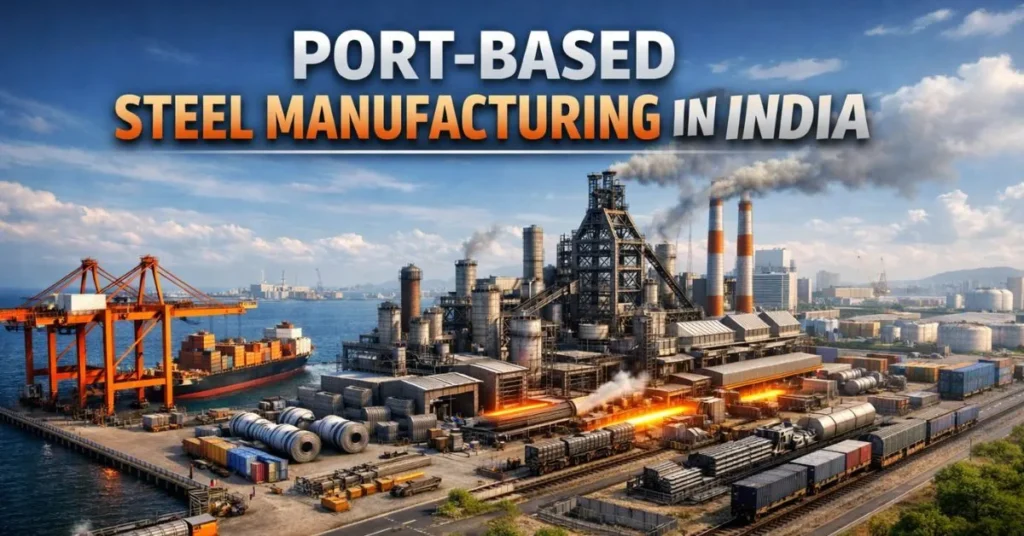
Port-Based Steel Manufacturing in India: Business Opportunity, Cost Advantages & Growth Potential

Port-Based Steel Manufacturing in India: Business Opportunity, Cost Advantages & Growth Potential Read More »

Introduction:Port-Based Steel Manufacturing in India Port-Based Steel Manufacturing in India is transforming the manufacturing sector through improved infrastructure, stronger global trade connections, and advanced logistics systems. The establishment of port-based manufacturing clusters has created integrated industrial ecosystems around major seaports, enabling businesses to enhance production efficiency, streamline transportation operations, and significantly boost export performance. In industries like steel and heavy fabrication, geography is increasingly becoming a strategic advantage, as opposed to just a logistical consideration. Port-based locations provide businesses with efficient access to both essential raw materials and international markets and institutional buyers which improves their ability to operate efficiently. For entrepreneurs, investors, and MSMEs looking for long term sustainability, steel manufacturing nearby ports is an attractive opportunity. The implementation of port-centric manufacturing models enables businesses to enhance their operational efficiency through two main methods which include reducing supply chain complexity and fulfilling their regular production needs. Read More: The Complete Technology Book on Hot Rolling of Steel (2nd Edition) The Concept of Ports Based Manufacturing Clusters Port-based manufacturing clusters are integrated industrial zones where production facilities are working in the close proximity to maritime infrastructure. These clusters create a complete system which combines all essential elements for manufacturing and logistics operations because they include facilities for production and storage and customs processing and distribution to international markets.(Port-Based Steel Manufacturing in India) The system creates an efficient value chain which enables direct port access to raw materials and requires minimal handling time to deliver finished products worldwide. Manufacturers benefit from reduced logistics expenses and faster delivery times and improved supply chain reliability. India’s increasing focus on the economic zones along its coast, port modernization and dedicated freight corridors has spurred the growth of such clusters. Ports are also evolving from transit points into more full-fledged industrial locations which facilitate long-term growth of manufacturing. Why Steel Manufacturing is the Perfect fit for Port Locations Steel production and fabrication are inherently logistics heavy activities. The industry depends on large raw materials such as iron ore, scrap metal and coal, while final products – everything from its structural components to its heavy equipment – also need efficient transportation. Port-based manufacturing solves these challenges by compressing the supply chain: raw materials may be acquired from anywhere in the world and transported directly to production facilities.” Finished steel products can be exported without the costly inland trucking requirement. Inventory storage requirements are reduced because of accelerated shipping cycles. Goods handling and material transfer costs are reduced to a great extent. For manufacturers, these advantages mean better margins and more constant operating expenses. In competitive markets where freight costs are often a major element in profitability, close proximity to ports can be a winning advantage.(Port-Based Steel Manufacturing in India) Read More: Steel Rolling Technology Handbook (2nd Revised Edition) Demand Stability through Institutional Buyers A high strength of the port-based manufacturing is found in its access to institutional and industrial buyers. Ports are complex environments of operation that need constant upkeep, infrastructure upgrade and equipment replacement. The primary factors which drive demand for this service include: Shipping lines & container operators Mariner Engineering and EPC Contractors Logistics and transportation companies Export-oriented manufacturers Infrastructure and maintenance agencies The institutional procurement process uses contract-based operations which operate differently from consumer markets that experience changes based on trends and economic fluctuations. The manufacturing process can create stable production schedules because the system produces consistent demand patterns which help manufacturers achieve constant machine operation throughout their production period. The current business environment assists MSMEs and mid-sized fabrication businesses to decrease their sales risk while they enhance their ability to predict their financial results.(Port-Based Steel Manufacturing in India) Steel Product Segments Most Suitable for Port Clusters Not all steel products have equal benefits from the proximity to the coast. The most successful categories have the following characteristics in common: they have high weight, they have an export orientation, and there is a continuous institutional demand.(Port-Based Steel Manufacturing in India) Read More: Steel Fabrication Industry Container and Container Component Production Shipping containers, corrugated panels and structural frames are directly related to port operations. Manufacturing these components in the vicinity of deployment areas curtails the turnaround time and allows for quicker servicing.(Port-Based Steel Manufacturing in India) Marine and Port Infrastructure Fabrication Ports require constant maintenance of safety and structural equipment such as bollards, fenders, access platforms, railings, crash barriers, etc. Replacement cycles create constant recurring demand. Structural Steel for Export Projects Prefabricated steel structures, which are used in international infrastructure projects, have the advantage of immediate access to the ports. Reduced shipping delay and logistics cost gives coastal fabrication units a strong competitive edge.(Port-Based Steel Manufacturing in India) Manufacturing of Logistics Equipment Trailers, skeletal carriers and cargo handling structures suffer intensive use within port ecosystems. Local manufacturing enables fast maintenance support and customer relationship building in the long run.(Port-Based Steel Manufacturing in India) Read More: Top 20 Steel Manufacturing Business Ideas   Economic Benefits and Profitability Apricots, Avocados and Apples Port-based steel manufacturing has some structural advantages that lead to long-term financial soundness: Predictable Logistics Costs: With shorter transportation distances, there is less exposure to volatility and fuel price risk in freight. Improved Payment Discipline: Institutional clients tend to adhere to structured procurement cycles and contracts, resulting in more predictable payment schedules. Export Pricing Opportunities: Manufacturers who access international markets can use international pricing standards as their benchmark instead of competing only within their local markets through price wars. Consistent Production Utilization: A constant demand from industrial activities in setback offers better asset performance at low idle time. Instead of being at the mercy of volatile market spikers, manufacturers within port clusters tend to enjoy steady margin of EBITDA supported by operation efficiency. Infrastructure Development Building a Demand Flywheel The extensive Indian investments in logistics and coastal infrastructure development create more attractive opportunities for port-based manufacturing operations. Key developments include: Expansion of Coastal Shipping Networks Dedicated freight corridors between industrial regions Inland Waterway Connectivity projects Modernized systems of cargo handling and containerization The

Have a business idea? Let's make it happen together-contact us now!


Contact Form Demo

This will close in 0 seconds

Translate »