
How to Start Natural Rubber Latex Condom Manufacturing 2026 | Plant Setup to Finished Product Opportunities
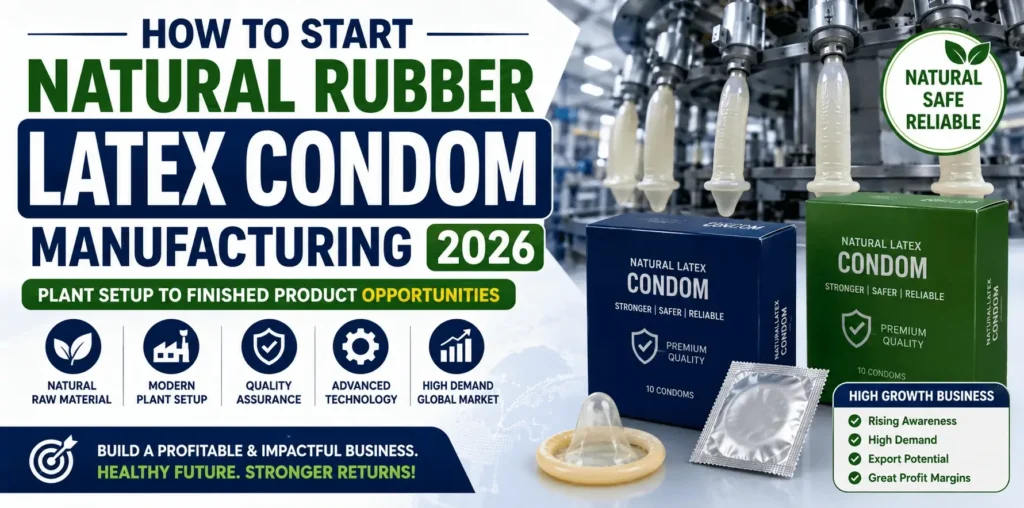
The Latex Condom Manufacturing Business is emerging as a high-potential opportunity in the healthcare and personal wellness industry due to increasing awareness of safe sex practices, rising population health initiatives, and growing global demand for contraceptive products. Natural rubber latex condoms continue to dominate the market because of their affordability, flexibility, durability, and effectiveness. India is becoming an important hub for latex condom manufacturing due to expanding healthcare infrastructure, government awareness programs, export demand, and advancements in automated production technologies. Entrepreneurs entering the condom manufacturing business can benefit from rising domestic consumption, NGO procurement programs, eCommerce growth, and international supply opportunities. This guide explains the complete latex condom manufacturing business setup process including machinery, manufacturing technology, raw materials, quality standards, licensing requirements, investment cost, and profitability analysis. What is Latex Condom Manufacturing? Latex condom manufacturing is an industrial process that produces natural rubber latex condoms through dipping, vulcanization, electronic testing, lubrication, and sterile packaging processes for healthcare and personal protection applications. Why Latex Condom Manufacturing is Growing in India Include: awareness programs government healthcare initiatives export demand eCommerce growth STI prevention awareness NGO procurement population control programs Understanding the Latex Condom Manufacturing Industry Latex condom manufacturing is part of the broader sexual wellness and healthcare segment. The product, made from natural rubber latex, undergoes a highly sensitive production process involving dipping, vulcanization, testing, and packaging. With increasing global concern over sexually transmitted infections (STIs), HIV/AIDS, and population control, the demand for quality condoms is growing, especially in developing nations. India, China, Brazil, and parts of Africa are considered high-potential markets for expansion. Governments and NGOs have made substantial investments in distributing free or subsidized condoms, which adds to the demand. Furthermore, the social taboo surrounding condom usage is diminishing due to awareness campaigns, which enhances the prospects for new players in the latex condom manufacturing industry. Step-by-Step Guide to Starting a Latex Condom Manufacturing Business 1. Market Research and Business Planning Before investing in machinery or infrastructure, conduct a detailed market analysis. Study regional and global demand, consumer behavior, competitor strategies, and potential distribution channels. Identify whether you’ll cater to the premium segment (flavored, textured, ultra-thin) or standard products. Create a business plan covering: Business objectives Target market Investment and financial projections Production scale Pricing and distribution model Compliance and certifications A solid plan will help attract investors and secure loans or grants from health-oriented funding agencies. 2. Legal Compliance and Licensing Given that condoms are classified as medical devices in many countries, manufacturing them requires stringent regulatory adherence. In India, approval from the Drug Controller General of India (DCGI) and registration with CDSCO (Central Drugs Standard Control Organization) is mandatory. Other global certifications include: ISO 4074:2015 (International standard for natural rubber latex condoms) CE Marking (European market) WHO Prequalification (for global NGO supply) GMP guidelines WHO quality standards Medical device regulations Quality testing protocols Apart from that, you’ll also need: Company registration GST or other local tax registration Factory license Pollution control and fire safety certificates Compliance helps ensure product safety, international acceptance, and eligibility for government and NGO procurement programs. 3. Location and Factory Setup Choosing the right location is essential. The ideal site should have good connectivity, access to skilled labor, and reliable water and electricity supply. The factory layout should consist of the following: Raw material storage Production and dipping area Drying and curing rooms Electronic testing section Packing and storage rooms The facility should follow GMP (Good Manufacturing Practices) and hygiene protocols to prevent contamination. 4. Machinery and Equipment Investing in high-quality automated machinery ensures efficiency and product consistency. Major equipment includes: Latex dipping machines Coagulum tanks Vulcanization oven Electronic testing equipment Packaging machines Conveyor belts and air compressors Automated machines improve output, reduce manual errors, and maintain hygiene. Depending on the production capacity, the machinery cost can range from ?1 crore to ?5 crore. 5. Raw Material Procurement The main raw material in latex condom manufacturing is natural rubber latex, sourced from rubber plantations or vendors. Other materials include: Coagulant solution Lubricants (silicone or water-based) Corn starch or talc (for dusting) Foils or wrappers (for packaging) Flavoring agents (for specialty condoms) Ensure that all materials are of medical-grade quality and comply with health regulations. 6. How are Latex Condoms Manufactured? The standard latex condom manufacturing process generally includes: Latex Compounding: Mixing raw latex with chemicals to improve elasticity and durability. Former cleaning and Dipping: Cleaned glass or ceramic molds are dipped in coagulant and then into the latex solution to form the condom layer. Vulcanization: Condoms are cured at high temperatures to strengthen the rubber. Leaching and Washing: The product is thoroughly washed to remove residual chemicals and proteins. Drying and Testing: Condoms are electronically tested for holes, strength, and elasticity. Electronic pinhole testing: Lubrication and packaging: Each piece is lubricated, sealed in foil wrappers, and then packed into boxes. Sterility and quality inspection The entire process must be handled in a contamination-free environment using sterilized equipment. 7. Quality Control and Testing Quality assurance is a vital component of latex condom manufacturing. International standards dictate rigorous testing, including: Electronic pinhole testing Air burst and tensile strength test Water leak test Lubricant quantity test Random samples are taken from each batch to ensure consistency and safety. If a batch fails any of the tests, it must be discarded. 8. Branding and Marketing Strategy Create a compelling brand identity that reflects trust, safety, and innovation. Use discreet yet bold packaging to attract consumers. Focus on: Health campaigns and CSR collaborations Social media marketing targeting youth and urban areas Online marketplaces and pharmacy tie-ups Government supply contracts and tenders Brand ambassadors, health influencers, and digital ads can help break taboos and promote acceptance. 9. Distribution Channels Condoms are widely sold through: Pharmacies and drugstores E-commerce platforms Supermarkets and convenience stores NGOs and health agencies Clinics and hospitals Partner with logistics companies that specialize in sensitive goods. Maintain an efficient supply chain to ensure consistent product availability. 10. Cost and Profitability Analysis Starting a latex condom manufacturing
List of Profitable Business Ideas for Production of Industrial & Engineering Products.
Industrial engineering is a multidisciplinary field that focuses on optimizing complex systems, processes, and operations. It blends engineering principles with business acumen to increase efficiency, productivity, and profitability across various industries. As businesses strive to become more competitive and resource-efficient, the demand for industrial engineering solutions is growing. Entrepreneurs who tap into this field can find numerous lucrative opportunities that cater to manufacturing, supply chain management, automation, and beyond. Exploring Business Potential in the Industrial Engineering Landscape The evolution of Industry 4.0, digital manufacturing, lean systems, and sustainability goals has created fertile ground for innovative ventures rooted in industrial engineering. From consultancy to automation solutions, the applications are vast and impactful. Let’s delve into some of the most profitable industrial engineering business ideas that aspiring entrepreneurs can explore in 2025 and beyond. 1. Lean Manufacturing Consultancy Lean manufacturing is one of the core areas in industrial engineering. Companies across the globe aim to minimize waste and improve efficiency without compromising quality. Starting a consultancy that specializes in implementing lean techniques—like Six Sigma, Kaizen, or 5S systems—can be highly profitable. This business idea involves helping clients redesign processes, optimize workflows, and reduce production costs, which aligns directly with the core objectives of industrial engineering. As a lean consultant, you can serve industries such as automotive, electronics, pharmaceuticals, and food processing. Offering training sessions, audits, and certifications can also become additional revenue streams. 2. Industrial Automation Solutions With the surge in smart factories and the integration of robotics, industrial automation has become a booming sector. Launching a business that provides automation services—including PLC programming, robotics integration, and SCADA systems—can yield substantial returns. This opportunity is closely aligned with industrial engineering, as it involves designing systems that boost productivity while reducing human error and operational costs. A company focusing on automating assembly lines, packaging units, or quality control processes can cater to mid-size and large manufacturing firms looking to upgrade their facilities. 3. Supply Chain Optimization Services Efficient supply chains are vital for business success, and industrial engineering plays a critical role in their design and management. Entrepreneurs can start a service-oriented business that helps companies improve their logistics, reduce lead times, manage inventories, and select optimal transportation modes. By leveraging tools such as simulation software, data analytics, and predictive modeling, this business can help clients streamline operations. Sectors such as e-commerce, retail, and logistics will greatly benefit from such expertise. 4. Energy Efficiency and Sustainability Consulting Environmental responsibility is a growing concern, and companies are under pressure to reduce their carbon footprint. Industrial engineering solutions can drive sustainable practices by enhancing energy efficiency, recycling waste, and optimizing resource usage. A consultancy that offers energy audits, green certifications, process redesign, and carbon tracking services can generate income while supporting global environmental goals. Many governments offer incentives for energy-efficient practices, making this industrial engineering business model even more attractive. 5. Custom ERP Development for Manufacturing Enterprise Resource Planning (ERP) software is essential for managing business operations—especially in manufacturing. While many generic ERPs exist, they often don’t meet the specific needs of individual factories. This presents an opportunity for entrepreneurs to create tailored ERP solutions for different industrial niches. As an industrial engineering expert, you can bridge the gap between software developers and factory managers by designing ERP modules that enhance production scheduling, inventory tracking, and workflow analysis. This hybrid business combines technical knowledge with digital innovation. 6. 3D Printing and Prototyping Services 3D printing has transformed the way industries approach product design, testing, and manufacturing. A business focused on rapid prototyping and custom part fabrication can serve a wide array of sectors including automotive, aerospace, healthcare, and consumer electronics. With an industrial engineering background, you can ensure your services focus on design optimization, cost control, and material efficiency. Offering design-to-delivery solutions will give you a competitive edge in this fast-growing niche. 7. Industrial Equipment Design and Fabrication Designing and fabricating specialized machinery or tools for specific industries can be a highly profitable venture. Industrial engineers are well-equipped to understand the technical and operational requirements of different production environments. Whether it’s conveyor belts, lifting equipment, material handling systems, or custom fixtures, this business has high potential, especially when offering tailor-made solutions. Additionally, offering post-installation support, maintenance contracts, or upgrades can add long-term value and recurring revenue to your business. 8. Warehouse Design and Optimization As online shopping continues to grow, so does the demand for efficient warehousing. Industrial engineering provides tools and techniques for designing optimal warehouse layouts, implementing automated storage and retrieval systems (AS/RS), and reducing material handling costs. Entrepreneurs can offer consulting services for warehouse setup, layout simulation, material flow analysis, and performance monitoring. Target clients could include e-commerce giants, logistics companies, and FMCG businesses. 9. Quality Control and Assurance Services Quality is non-negotiable in today’s competitive markets. Offering quality control and assurance services can be a successful industrial engineering business. This can include process audits, compliance testing, statistical process control (SPC), and ISO certification assistance. With a data-driven approach, your business can help manufacturers maintain high product standards and regulatory compliance, thereby reducing recalls and customer complaints. 10. Training and Skill Development Centers With industrial engineering rapidly evolving, there is a growing need for skilled professionals. Starting a training center that offers courses in lean manufacturing, automation, process improvement, and supply chain management can be highly profitable. You can collaborate with educational institutions or offer corporate training programs tailored to industry needs. Providing certification programs or online learning modules will increase your reach and scalability. Final Thoughts Industrial engineering is a gateway to numerous business opportunities, many of which are future-ready and technology-driven. Whether you aim to offer consulting, develop products, or implement advanced automation, the scope is wide and the rewards can be substantial. Starting a business in this field not only leverages your technical expertise but also contributes to the advancement of industries by making them more efficient and sustainable. Entrepreneurs who understand the value of optimization and systems thinking inherent in industrial engineering will find themselves at the
List of Profitable Processing and Manufacturing Business Ideas.
The food processing industry is experiencing a significant surge in demand globally, especially in the categories of meat, egg, and seafood. Driven by changing dietary preferences, urbanization, and rising income levels, the egg & seafood sector offers several lucrative opportunities for entrepreneurs and investors alike. Consumers are increasingly looking for convenient, ready-to-cook, and safe food options, which makes the processing of egg & seafood a promising avenue for profitable ventures. With the right technology, regulatory compliance, and market strategy, one can easily tap into this booming segment of the food industry. Why Invest in the Egg & Seafood Processing Industry? The global demand for high-protein foods is on the rise, and egg & seafood are leading sources of lean protein. The processing of these items not only ensures longer shelf life but also improves hygiene, safety, and convenience for consumers. According to industry estimates, the seafood processing market alone is expected to grow at a CAGR of over 5% in the coming years. Meanwhile, the egg processing market is projected to witness consistent growth due to increased usage in bakery, confectionery, and ready-to-eat meals. Government initiatives in many countries, such as subsidies, cold chain logistics support, and food safety incentives, have further encouraged investment in the egg & seafood sector. Moreover, the rise in online food delivery services, retail chains, and e-commerce platforms provides ready distribution channels for processed products. Let’s explore the top profitable ideas in the meat, egg & seafood processing industry that can be started with varying levels of investment. 1. Egg Powder Manufacturing Egg powder is widely used in baking, confectionery, mayonnaise, noodles, and other processed food items. The process involves spray drying of eggs to produce powder, which has a much longer shelf life compared to fresh eggs. This makes transportation and storage easier, especially for export markets.Investing in egg powder manufacturing can be highly profitable as the demand is high both in domestic and international markets. With proper licensing and safety protocols, small to mid-sized units can be set up with good ROI. 2. Liquid Egg Processing Liquid eggs (whole, whites, or yolks) are highly popular in the foodservice industry, especially among hotels, restaurants, and bakeries. These are pasteurized and packaged in cartons or pouches for easy use and storage.This segment of the egg & seafood industry requires moderate capital and automation equipment. The key to profitability lies in ensuring high hygiene standards, regular supply of raw eggs, and building a network with institutional buyers. 3. Seafood Freezing & Export Unit Seafood, especially shrimp, tuna, salmon, and squid, are in high demand globally. Setting up a seafood freezing unit near coastal areas can enable entrepreneurs to source raw material directly from fishermen and process them for export.The unit should focus on proper grading, cleaning, IQF (Individually Quick Frozen) technology, and vacuum packaging. While this requires significant initial investment, the profit margins in international markets make it a lucrative business in the long term. For entrepreneurs in coastal regions, this is one of the best egg & seafood processing ideas. 4. Fish Filleting and Packaging Plant Fish fillets are widely consumed in restaurants, fast-food chains, and homes. A filleting plant involves cleaning, deboning, slicing, and packaging of fish into ready-to-cook formats. It is an ideal small-scale business idea and can be scaled up gradually.Investing in vacuum sealing machines, cold storage, and sanitary working conditions is essential for success. Value addition through marinated fillets or ready-to-fry formats can boost profitability. As more consumers shift to convenient cooking, this egg & seafood segment is gaining rapid traction. 5. Processed Meat and Sausage Manufacturing While not part of the egg & seafood niche, meat processing complements these segments well. You can consider integrating processed meat products like sausages, salamis, and cold cuts with your existing infrastructure. These products have high shelf life and are in demand from retail and institutional buyers.Flavor innovation, high protein value, and international-style packaging can help your brand stand out. If you already process eggs or seafood, adding meat items allows for cross-selling and maximizing equipment utility. 6. Value-Added Shrimp Processing Shrimp is one of the most traded seafood products globally. A value-added shrimp processing unit can prepare products such as breaded shrimp, ready-to-fry shrimp, shrimp skewers, and shrimp curry. These products are ideal for retail and export.This egg & seafood sub-sector is best suited for entrepreneurs with some knowledge of marine handling and cold chain logistics. Investing in HACCP-certified processing units ensures compliance with global standards and makes the business export-ready. 7. Egg-Based Snacks and Protein Products Eggs are now being used in innovative snack formats such as boiled egg packs, egg protein bars, egg chips, and ready-to-eat egg curry. These high-protein, keto-friendly snacks are in demand among fitness enthusiasts and young professionals.With minimal investment and a focus on packaging and branding, this egg & seafood niche offers opportunities for homepreneurs and startups. Partnering with cloud kitchens, health stores, and gyms can rapidly boost sales. 8. Canned Fish and Seafood Products Canned tuna, sardines, mackerel, and seafood medleys are a staple in many countries. While canning involves a relatively high setup cost due to sterilization and vacuum sealing, it also allows long shelf life and global shipping.You can explore ethnic flavors and innovative packaging to differentiate your brand. Government schemes under marine export promotion boards can help reduce initial costs and enable faster market access. 9. Organic and Free-Range Egg Packaging Consumers are increasingly shifting toward organic and free-range food options. Starting an egg packaging and branding unit that focuses on ethically produced, chemical-free eggs can yield premium pricing.The key to success is sourcing from certified poultry farms and building brand trust through transparency. Selling through organic food stores, subscription boxes, and e-commerce platforms enhances reach. 10. Fish Meal and By-Product Processing Fish waste from filleting and cleaning can be converted into fish meal, fish oil, and pet food ingredients. This ensures zero waste and additional revenue streams from your seafood processing unit.With proper equipment for drying and grinding, fish by-products can
Auto Parts Manufacturing: Demand, Trends & Business Potential
India’s automotive industry is one of the fastest-growing in the world, making it an ideal location for entrepreneurs looking to venture into auto parts manufacturing. The rising demand for vehicles—both domestic and export-oriented—has led to a parallel increase in the need for high-quality and cost-effective spare parts. The Indian government’s “Make in India” initiative, coupled with incentives for manufacturing and exports, further makes auto parts manufacturing a lucrative business idea. Whether you’re planning to start small or aim for a large-scale operation, understanding the fundamentals is crucial. Understanding the Auto Parts Manufacturing Industry in India The auto parts manufacturing industry includes producing components such as engine parts, brake systems, electrical parts, suspension components, and body parts. It serves OEMs (Original Equipment Manufacturers), the aftermarket, and export markets. According to reports by ACMA (Automotive Component Manufacturers Association of India), the Indian auto component industry is expected to grow at a CAGR of 10.5% between 2021–2026, which is a strong indicator of long-term potential. India offers significant advantages: abundant skilled labor, a growing middle-class population, low-cost production capabilities, and strong export potential. Tier-1 and Tier-2 cities like Pune, Chennai, Gurgaon, and Ahmedabad are already well-established hubs for auto parts manufacturing. Steps to Start Auto Parts Manufacturing Business 1. Market Research and Niche Selection Before investing capital, conduct thorough market research to identify which auto parts are in high demand. This could be based on: The type of vehicles (two-wheelers, passenger cars, commercial vehicles) OEM requirements Export demand Aftermarket products You may choose to manufacture engine components, braking systems, cooling systems, batteries, or precision plastic components. Choosing a niche with less competition but stable demand is a smart strategy in the auto parts manufacturing business. 2. Prepare a Detailed Business Plan A solid business plan helps in securing finance and setting a clear path. Your plan should cover: Product offerings Machinery and raw material requirements Manufacturing process flow Break-even analysis Marketing and distribution strategy Financial projections for 3-5 years 3. Company Registration and Legal Compliance You must register your business as a sole proprietorship, LLP, or private limited company. Additionally, obtain: GST Registration Udyam Registration (MSME) Factory license under the Factories Act NOC from Pollution Control Board (if applicable) ISO Certification for quality assurance (optional but recommended) 4. Location and Infrastructure Choose a location with proximity to raw materials, transportation access, and skilled labor. Industrial zones are ideal due to tax benefits and infrastructural readiness. Ensure you have ample space for production lines, storage, and administration. For small-scale auto parts manufacturing, 1500–3000 sq. ft. space might suffice. For medium to large units, 5000–20,000 sq. ft. or more could be needed depending on the product line. 5. Machinery and Raw Materials Investing in the right machinery is vital. This will vary based on the component you manufacture. Some common machines include: CNC machines Die casting machines Injection molding machines Hydraulic presses Grinding, polishing, and lathe machines Source high-quality raw materials like aluminum, steel, rubber, or plastic polymers from reliable vendors. Having long-term contracts with suppliers can ensure consistent quality and pricing. 6. Hiring and Training Workforce The workforce is the backbone of any manufacturing business. Hire trained operators, engineers, technicians, and support staff. You’ll also need a quality control team and administrative support. Regular training programs should be conducted to keep up with modern manufacturing technologies. 7. Manufacturing Process Setup Set up a streamlined process flow from raw material intake to final packaging. Adopt lean manufacturing practices to reduce waste and improve productivity. Implement quality control checks at every stage of production to meet OEM and international standards. 8. Quality Certifications and Standards To gain trust and comply with customer standards, obtain necessary certifications like: ISO 9001 (Quality Management) IATF 16949 (for automotive industry) CE marking for exports (if applicable) Certifications boost your credibility and are often mandatory for OEM suppliers and exports. 9. Marketing and Sales Strategy Once production starts, focus on selling through: OEM partnerships Distributors and wholesalers B2B portals like IndiaMART, TradeIndia, and Alibaba Exhibitions and trade shows (like Auto Expo India) Export channels to regions like Africa, the Middle East, and Southeast Asia Digital marketing, website optimization, and cold outreach to potential clients also help build initial traction. 10. Government Schemes and Funding Take advantage of government support: MSME Loans: Provided by public and private sector banks at low interest MUDRA Scheme: For micro and small manufacturing businesses Credit Guarantee Scheme: For collateral-free loans PLI Scheme: For eligible auto components manufacturers Approach SIDBI (Small Industries Development Bank of India) or banks like SBI, HDFC, and ICICI for business loans or equipment financing. Challenges in Auto Parts Manufacturing and How to Overcome Them Like any industrial venture, auto parts manufacturing has its challenges: High Initial Investment: Offset by phased investment or government-backed loans Skilled Labor Shortage: Mitigated through skill development programs Maintaining Quality Standards: Solve with proper QA systems and certifications Raw Material Price Volatility: Hedge risk by negotiating long-term contracts Regulatory Hurdles: Stay updated with compliance changes and industry trends Future Outlook of Auto Parts Manufacturing in India With the rise of electric vehicles (EVs), there’s a new wave of opportunities in EV component manufacturing—motors, battery packs, and controllers. India is aiming to become a global EV manufacturing hub by 2030, and local auto parts manufacturing units can benefit from early adaptation. Moreover, global manufacturers are shifting their sourcing from China to India, offering export potential. By incorporating automation, AI, and IoT in manufacturing systems, Indian players can compete globally. Conclusion Starting an auto parts manufacturing business in India in 2025 is not only timely but strategically sound. The combination of rising automobile demand, strong government support, export opportunities, and industrial infrastructure makes this sector ripe for investment. By following structured planning, legal compliance, and investing in quality and skilled manpower, you can build a profitable and sustainable venture. Stay focused on innovation, efficiency, and customer satisfaction to succeed in this competitive but rewarding industry. Let your auto parts manufacturing journey begin today—with the right roadmap, the engine of
Production of I.V. Fluids (Saline and Dextrose).
In the world of modern medicine, IV (Intravenous) fluids are the backbone of hospital and emergency room care. From treating dehydration to delivering essential nutrients and medications, IV fluids are indispensable in healthcare settings. As healthcare infrastructure expands in developing and developed nations alike, there is a growing demand for sterile, safe, and efficient fluid packaging methods. One of the most advanced techniques currently in use is Blow-Fill-Seal (BFS) technology. This article explores the immense potential of IV Fluid Manufacturing using BFS technology and how entrepreneurs can tap into this profitable and essential market. Why BFS Technology is Revolutionizing IV Fluid Manufacturing Blow-Fill-Seal (BFS) is an automated process that forms, fills, and seals plastic containers in a single step under sterile conditions. It is one of the most significant advancements in aseptic packaging technology. The traditional method of manufacturing IV fluids involved the use of glass or semi-rigid plastic bottles, followed by separate filling and sealing. This not only increased contamination risks but also incurred higher production and labor costs. With BFS, IV fluids are packed in a closed, controlled environment, ensuring sterility and product integrity. This eliminates the chances of microbial contamination, a critical requirement in the pharmaceutical industry. Moreover, BFS requires minimal human intervention, significantly reducing labor costs and errors. It also supports high-speed production lines and meets the stringent quality standards of the US FDA, WHO, and other global health authorities. IV Fluid Manufacturing with BFS is considered a gold standard by many large pharmaceutical firms because it minimizes environmental contamination and optimizes production efficiency. The sealed units are lightweight, durable, and easy to transport—ideal for large-scale distribution across urban and rural healthcare centers. Market Potential for IV Fluid Manufacturing The global IV fluid market is expected to grow at a CAGR of over 6% in the next five years. The rising incidence of chronic diseases, increasing surgical procedures, and growing geriatric populations are major contributors to this surge. Moreover, the COVID-19 pandemic highlighted the critical need for robust and scalable IV Fluid Manufacturing capabilities across the world. India, with its growing population and expanding healthcare access, represents a significant share of this growth. The government’s initiatives under Ayushman Bharat and the push for Make in India have created favorable conditions for manufacturing healthcare products locally, including IV fluids. This sector also enjoys support in the form of subsidies and financing options from various development banks and MSME schemes, making it an attractive venture for new entrants and existing pharmaceutical businesses. Key Components and Raw Materials To set up an IV Fluid Manufacturing unit using BFS technology, several raw materials and infrastructure components are required: Water for Injection (WFI): This is the base component of IV fluids. It must be ultra-pure, free from pyrogens, and sterile. Large capacity WFI generators and reverse osmosis (RO) systems are used to produce this water. Active Ingredients: Depending on the IV fluid type, various salts and sugars such as dextrose, sodium chloride, potassium chloride, and ringer lactate are added. Polymers: BFS systems generally use LDPE (Low-Density Polyethylene) as the base material for forming the containers. It is non-toxic, flexible, and compatible with most formulations. Additives and Sterilants: These are minimal but may include preservatives or pH adjusters depending on the product. Packaging and Labeling Material: Printed labels, tamper-evident seals, and cardboard boxes for secondary packaging. BFS Plant Setup – Infrastructure and Machinery A modern IV Fluid Manufacturing facility with BFS capabilities requires precision equipment and a sterile cleanroom environment. The setup involves: BFS Machines: These are the core of the operation. Machines vary in size and output capacity—from 1000 units/hour to over 20,000 units/hour. Some of the leading BFS machine manufacturers include Rommelag, Brevetti Angela, and Weiler Engineering. Water Purification and WFI Generation Unit: This includes RO filters, electro-deionizers, and multi-column distillation units to prepare injectable-grade water. Formulation Tanks and Mixing Units: These tanks are designed for aseptic mixing of ingredients before filling. Cleanrooms: Manufacturing zones must comply with Class 1000 to Class 100 cleanroom standards with HEPA filtration and laminar airflow systems. Sterilizers and Quality Control Labs: For validation, testing, and batch release. HVAC and Utilities: Stable temperature, humidity, and pressure levels are maintained using HVAC systems with continuous monitoring. Setting up such a plant requires an initial investment ranging from ?10 crores to ?50 crores depending on scale, automation level, and location. Licensing, Certifications & Regulatory Compliance To legally start an IV Fluid Manufacturing business in India (or globally), the following licenses and registrations are mandatory: Drug Manufacturing License under the Drugs and Cosmetics Act, 1940. GMP and WHO-GMP Certification – essential for domestic and international trade. Environmental Clearance – since pharma manufacturing involves water and energy consumption. Factory License & Fire Safety Clearance. ISO Certifications – especially ISO 13485 (Medical Devices) and ISO 9001 for Quality Management. In addition to Indian regulatory bodies like CDSCO, facilities aiming for exports need to meet guidelines set by the USFDA, EMA (Europe), and other national agencies. Financial Outlook and Profitability Once operational, an IV Fluid Manufacturing unit can generate impressive revenue. Here’s a rough breakdown: Cost of Production (per 500ml IV bottle): ?8–10 Market Selling Price: ?18–25 Profit Margin: 40–60% after operational and labor costs Bulk hospital contracts, government supply tenders, and export deals offer steady demand and cash flow. With high-volume production and low defect rates, businesses can achieve breakeven in 2–4 years depending on scale and market access. Types of IV Fluids in Demand Some of the most commonly manufactured and in-demand IV fluids include: Normal Saline (0.9% Sodium Chloride) Dextrose 5% (D5) Ringer Lactate Dextrose Saline (DNS) Potassium Chloride in Saline Specialized fluids like amino acid solutions, total parenteral nutrition (TPN), and glucose-electrolyte combinations are also gaining popularity for niche medical use cases. Challenges and Risk Factors While the opportunity is lucrative, IV Fluid Manufacturing comes with certain risks: High Initial Capital: BFS machines and cleanroom setups are expensive. Regulatory Scrutiny: Sterile injectable products are highly regulated. Non-compliance can lead to shutdowns or recalls. Operational Complexity: Aseptic
February 2018 Entrepreneur India Monthly Magazine
The February 2018 Entrepreneur India edition served as a landmark publication capturing the pulse of a rapidly transforming Indian startup ecosystem. With innovation seeping beyond metro boundaries and budding founders emerging from diverse social and geographical backgrounds, this issue perfectly encapsulated the essence of “New India.” Exploring Entrepreneurship Beyond Boundaries Startups Blooming in Tier II and III Cities The February 2018 Entrepreneur India magazine focused heavily on the rise of startups in non-metro regions. Entrepreneurs from cities like Surat, Bhubaneswar, and Bhopal were building scalable businesses that addressed local problems. These ventures, often tech-enabled, were proving that India’s entrepreneurial spirit was not restricted to Bengaluru or Mumbai. Grassroots Innovations and Local Solutions One compelling story featured an agritech startup from Nagpur that used machine learning to optimize pesticide use and improve crop yield. The founder, a son of a farmer, combined domain knowledge with technology to uplift small-scale farmers in the Vidarbha region. Digital Empowerment Through E-Commerce Traditional artisans were now selling globally through Instagram and Amazon Handmade. Local craft clusters were making the most of digital tools, and their success stories were highlighted as examples of how even conventional industries could modernize. Changing Faces of the Indian Startup Landscape Student Startups Leading the Charge Another inspiring trend showcased in February 2018 Entrepreneur India was the emergence of student-led ventures. From e-commerce ideas incubated in dorm rooms to AI-enabled solutions being tested in labs, college campuses had become breeding grounds for disruption. Support from Institutions Incubation centers at IITs, NITs, and private universities offered mentorship, seed capital, and exposure to global networks, helping students translate ideas into businesses even before graduating. Funding Environment and Investment Trends A major report in this issue covered the state of venture capital and angel investment in 2018. It noted a recovery from the funding slowdown post-2016, with a renewed focus on early-stage startups and better due diligence. Sector-Wise Investment Insights Charts detailed that fintech, healthtech, and edtech were leading in investor interest. B2B SaaS, logistics, and AI were also emerging as hot sectors. Empowering Women Founders Feature: “Breaking Barriers: Women Who Mean Business” February 2018 Entrepreneur India paid special attention to women entrepreneurs who were breaking stereotypes and building impactful enterprises. From cybersecurity to food delivery, women were making their presence felt in traditionally male-dominated domains. Inspiring Case Studies One such story featured a Delhi-based bakery chain run entirely by single mothers. Another spotlighted a tech company co-founded by a journalist-turned-entrepreneur that provided cybersecurity solutions to SMBs. Government Policies and Startup India How Policies Were Supporting (or Hindering) Entrepreneurs The magazine offered an in-depth critique of Startup India, Digital India, and GST rollout. While many founders acknowledged the simplification of registration and compliance, issues like slow fund disbursement and bureaucratic hurdles were still prevalent. Global Comparison of Startup Policies In a comparative segment, India’s startup policy landscape was placed side by side with Brazil, Indonesia, and Israel. The analysis revealed that while India had made progress, execution and outreach needed strengthening. Mentorship, Mental Health & Founder Resilience More Than Capital: The Need for Mentorship A guest column by a Silicon Valley-based Indian angel investor stressed that funding alone isn’t enough—founders need coaching on leadership, operations, and market fit. His insight was timely, especially for early-stage Indian founders navigating their first ventures. Spotlight on Mental Health and Work-Life Balance February 2018 Entrepreneur India broke new ground by discussing founder burnout and emotional well-being—rare topics in Indian business media. The highlight was an interview with a tech founder who candidly shared his mental health journey. Wellness in the Startup Culture Suggestions on therapy, journaling, fitness, and time management were shared, pushing the narrative that mental fitness is as vital as funding for startup success. Co-Working and the Rise of Shared Spaces New Work Culture: Collaboration over Isolation The issue also analyzed the booming co-working culture. Spaces like WeWork, Innov8, and 91Springboard were redefining the way founders worked, interacted, and formed collaborations. Benefits Beyond Infrastructure These shared environments were incubators of creativity, where a chance encounter in a pantry could lead to a strategic partnership or product idea. Sector Deep Dives: Tech, Sustainability, and Beyond Tech Trends: Blockchain and Artificial Intelligence The February 2018 Entrepreneur India issue covered tech adoption with detailed columns on blockchain and AI. While blockchain was still in its infancy, its potential in supply chains, banking, and food traceability was acknowledged. AI in Indian Startups Early movers in customer service, predictive analytics, and HR tech were highlighted as pioneers. Case studies demonstrated how even bootstrapped ventures could implement AI using SaaS-based solutions. Greentech and Sustainability Ventures Eco-conscious startups found significant coverage. One featured startup recycled PET bottles into tiles and flooring. Another turned organic kitchen waste into cooking gas for rural homes. Business with Purpose These businesses combined profitability with purpose, challenging the assumption that sustainability is an expense rather than an advantage. Visual Storytelling & Entrepreneurial Tools Design and Readability High-quality visuals, bold layouts, and minimalist infographics gave the magazine a global appeal. Articles were easier to consume, especially data-driven pieces that used charts and diagrams. Startup Toolkit Section The back pages were reserved for a “Startup Toolkit”—legal document templates, pitch deck guidelines, SaaS tool reviews, and marketing playbooks. It made the magazine practically useful, not just inspirational. Templates and Cheat Sheets From NDAs to funding term sheets, the issue gave young entrepreneurs ready-to-use tools to kickstart operations efficiently. Building a Startup Community Promoting Collaboration Through Events The magazine encouraged founders to attend local events, startup weekends, and industry meets. By doing so, it strengthened the idea that success grows faster in communities rather than silos. Spotlight on Social Enterprises Social startups were not ignored. The February 2018 Entrepreneur India edition featured for-profit NGOs, education startups for underprivileged children, and ventures addressing urban sanitation. These stories were reminders that impact-driven businesses matter too. Conclusion In essence, the February 2018 Entrepreneur India magazine wasn’t just a reflection of entrepreneurial trends—it was a guide, a motivator, and a toolbox for founders at all
Looking for Business Ideas12 Amazing Startup Ideas.
India, with its booming economy, expanding digital infrastructure, and growing youth population, has become a fertile ground for startups. Indian entrepreneurs today are not just aiming for profit—they are solving real-world problems, leveraging technology, and creating value-driven enterprises. The startup ecosystem has also received a massive boost from government initiatives like Startup India, Atmanirbhar Bharat, and various state-level schemes. As new sectors emerge and consumer behavior shifts, the country presents a wide array of trending startup ideas that offer high potential for success. Top Trending Startup Ideas for 2025 and Beyond Here’s a curated list of trending startup ideas that Indian entrepreneurs can explore in 2025 and beyond. These ideas are drawn from various sectors like sustainability, tech, wellness, and more. 1. Sustainable Packaging Solutions With the Indian government pushing towards a ban on single-use plastics, sustainable packaging has emerged as one of the most promising trending startup ideas. Entrepreneurs can explore biodegradable packaging, plant-based containers, and reusable alternatives for retail and food delivery sectors. Startups like Ecoware and Bakey’s have already made a mark in this segment. Opportunities include: B2B eco-packaging supplies for food and ecommerce companies Compostable bags and films for agriculture and retail Innovative materials like mushroom packaging or seaweed-based packaging 2. Agritech Platforms for Small Farmers Agritech remains one of India’s most fertile grounds for innovation. With nearly 60% of India’s population dependent on agriculture, there’s a growing demand for tech-driven solutions to boost productivity, reduce waste, and increase profitability. AI-driven crop monitoring, soil testing services, and farm-to-fork models are now gaining attention. Why it’s a top trending startup idea: High potential for impact and scalability Government support and funding availability Massive untapped rural user base 3. Health and Wellness Startups Post-COVID, health has become a top priority for Indian consumers. This has sparked a wave of innovation in the wellness sector—from preventive healthcare apps to home diagnostic tools and personalized nutrition solutions. As people increasingly adopt holistic lifestyles, there is demand for startups offering both traditional and modern health solutions. Startup avenues include: Ayurvedic or herbal wellness products Virtual fitness coaching or yoga platforms Subscription-based healthy meal services This sector is among the most resilient and continues to rank high on the list of trending startup ideas for Indian youth and professionals alike. 4. EV Charging Infrastructure Electric vehicles are no longer a distant future. With Tata, Ola, and Ather leading the EV revolution, the supporting infrastructure is now the next big thing. Setting up EV charging stations, battery-swapping services, or EV fleet management solutions can be a game-changing business opportunity. Why it works: Aligned with India’s green energy goals Government incentives and subsidies Scope for partnerships with auto OEMs and real estate developers This is one of the most capital-intensive trending startup ideas, but also among the most futuristic. 5. Hyperlocal Delivery Services Even in Tier-2 and Tier-3 cities, consumers now expect instant delivery of groceries, medicines, and other essentials. Hyperlocal delivery startups, which use local supply chains and mobile tech, have disrupted traditional retail models. The model also enables micro-entrepreneurship, creating delivery jobs at scale. Business angles to explore: Last-mile delivery for rural ecommerce Subscription-based daily essentials delivery Cloud kitchens with in-house delivery fleets This is a sector where trending startup ideas intersect with convenience and real-time tech integration. 6. Edtech for Skill Development While K-12 and test-prep edtech startups have matured, the new wave is all about skilling and upskilling. With automation and AI changing the job market, startups focusing on future-ready skills—coding, digital marketing, data science, and soft skills—are in high demand. Great niches for entrepreneurs: Vernacular language learning platforms AI-powered personalized learning tools Bootcamps with placement guarantees This continues to be a goldmine among trending startup ideas, especially for those targeting India’s unemployed youth and working professionals looking to upskill. 7. Pet Care and Pet Tech Startups India is witnessing a sharp increase in pet ownership, especially in urban households. This has opened the door for startups that offer pet foods, online vet consultations, grooming services, and pet wearables. Pet tech is an emerging space with untapped potential. Startups can offer: Online pet pharmacy and vet advice platforms Subscription boxes for pet treats and toys GPS-based collars and fitness trackers for pets Pet care is an emotionally driven and recession-resilient industry, ranking high among trending startup ideas in 2025. 8. D2C Niche Brands Direct-to-consumer (D2C) is booming thanks to social media and ecommerce platforms. From organic teas to gender-neutral skincare, D2C brands are challenging traditional FMCG players. Success here lies in sharp branding, targeted storytelling, and creating value for a niche community. Popular niches: Sustainable fashion Regional snack brands Minimalist beauty and skincare products D2C remains a core part of the trending startup ideas pool, as it allows for lower overheads and high customization. 9. Tech-Enabled Real Estate Services The traditional real estate market in India is opaque and disorganized. Startups that bring transparency, digitalization, and ease to the property-buying or rental process are gaining investor interest. Virtual tours, AI-driven property matches, and digital documentation are just a few ways technology is transforming this sector. Opportunities include: Co-living spaces and managed rentals Real estate analytics platforms Proptech integrations with AR/VR This segment is particularly lucrative in metro cities, where housing is both a need and an investment. 10. Climate Tech and Carbon Offset Platforms As climate concerns grow globally, climate tech is emerging as one of the most forward-looking trending startup ideas. Indian startups are now developing solutions that reduce emissions, promote renewable energy, or help companies meet ESG goals. Ideas in this space: Carbon credit trading platforms Energy-efficient appliances and smart meters Climate-risk analytics for agriculture and insurance This is a nascent but fast-growing sector with strong future potential and impact. Final Thoughts India’s entrepreneurial spirit is stronger than ever. From bustling metropolises to rural heartlands, innovation is taking root in every corner. Whether you’re a student with a side hustle or a seasoned professional ready for a pivot, these trending startup ideas can serve as the perfect
Aluminium Recycling Plant Production of Aluminium Ingots from Aluminium Scrap.
The demand for sustainable and eco-friendly business ventures has soared over the last few years, and aluminium recycling stands out as one of the most viable and profitable opportunities. Aluminium is the most recycled metal globally, thanks to its high recovery rate and energy-efficient recyclability. Unlike other materials, aluminium can be recycled indefinitely without losing its quality, making it a sustainable asset in industrial and consumer product cycles. Establishing an aluminium recycling plant not only contributes to environmental conservation but also opens doors to a highly lucrative business. Entrepreneurs looking to invest in a green business can benefit immensely by tapping into the aluminium recycling market. Business Overview: Aluminium Recycling Plant An aluminium recycling plant involves collecting used aluminium products such as cans, foils, frames, and wires, then processing them into reusable aluminium. The process generally includes sorting, shredding, melting, purifying, and casting the metal into ingots or other desired forms. The finished recycled aluminium is then used in sectors like automotive, construction, packaging, and electronics. Market Potential India’s rapid industrialization, urbanization, and increasing environmental consciousness have boosted the demand for recycled metals. The Indian aluminium industry is expected to grow significantly, with the recycling segment forming a large part of this growth. With domestic and global demand rising, setting up an aluminium recycling plant offers excellent market opportunities. Key consumers such as construction firms, automotive manufacturers, and FMCG companies are now looking for greener supply chains, enhancing the prospects for aluminium recyclers. Key Processes Involved Collection & Sorting: Aluminium scrap is collected from industrial, commercial, and domestic sources. Sorting ensures only aluminium is processed, removing contaminants and mixed materials. Shredding: Sorted aluminium is shredded into smaller pieces to increase the surface area for melting and reduce energy consumption. Melting: The shredded aluminium is melted in a high-temperature furnace. Recycled aluminium uses up to 95% less energy than primary production. Purification: Molten aluminium is purified to remove any non-metallic residues or impurities. Casting: The pure molten aluminium is then cast into desired forms such as ingots, sheets, or bars, depending on the market requirement. Business Plan Essentials When starting an aluminium recycling plant, a solid business plan is critical. Here’s what should be included: Executive Summary: Define your business model, mission, and vision. Market Analysis: Study competitors, demand trends, and customer segments. Operational Plan: Describe how you will manage the recycling process, use specific technologies, and establish sourcing channels. Marketing Strategy: Identify how you will attract and retain clients. This could involve digital marketing, industry tie-ups, or government contracts. Financial Plan: Include capital requirements, revenue forecasts, break-even analysis, and ROI estimates. Risk Assessment: Address market risks, regulatory concerns, supply chain risks, and ways to mitigate them. Investment and Cost Breakdown Setting up an aluminium recycling plant can require a substantial initial investment depending on the scale of operations. Below is a rough estimate of costs involved in establishing a medium-scale recycling unit in India: Land & Building: ?30 – ?50 lakhs (can vary based on location) Machinery & Equipment: ?40 – ?80 lakhs (includes furnaces, shredders, sorters, and casting equipment) Licensing & Compliance: ?2 – ?5 lakhs (includes environmental clearance, factory registration, GST, and labour laws) Labor & Staff Setup: ?5 – ?10 lakhs annually Utilities (Power, Water, etc.): ?5 – ?8 lakhs annually Working Capital: ?10 – ?20 lakhs (for 6–12 months) Total Estimated Investment: ?90 lakhs to ?1.7 crore (for medium scale) Smaller setups can begin with ?30–?50 lakhs using semi-automated technology and local sourcing, while large-scale plants can exceed ?5 crore in capital investment. Raw Material Sourcing Raw materials for the aluminium recycling plant include used beverage cans, aluminium wires, foils, old utensils, window frames, and other scrap aluminium products. You can source scrap through. Scrap dealers and aggregators Industrial waste from factories Local municipal corporations Import of aluminium scrap (subject to import norms) Building a reliable sourcing network is vital for uninterrupted operations. Long-term contracts with industrial waste producers or government e-waste schemes can provide a consistent supply. Revenue Streams An aluminium recycling plant generates income through various streams: Selling Recycled Aluminium: Sold as ingots or semi-finished products to industrial clients. By-products: You can sell certain by-products, such as aluminium dross, to secondary processors. Custom Recycling Services: Offering tailored recycling services to large organizations or government bodies. Export Opportunities: Recycled aluminium has a strong global demand, opening doors for international sales. This industry offers impressive margins when you control input costs and maintain operational efficiency. Recycled aluminium typically sells at 70–85% of the primary aluminium price but costs significantly less to produce. Machinery and Equipment Required Running an efficient aluminium recycling plant requires the following commonly used machines. Conveyor belts for material transport Sorting machines (manual or automated) Shredders or crushers Rotary or reverberatory furnace Degassing and fluxing units Casting moulds or billet casters Cooling and finishing systems Pollution control equipment (bag filters, scrubbers, etc.) Technological upgrades and automation can reduce labour dependency and improve productivity in the long run. Regulatory and Environmental Compliance Operating an aluminium recycling plant requires strict adherence to environmental norms. Key compliance aspects include: Clearance from the State Pollution Control Board Hazardous waste handling authorization Air and water pollution management systems Fire safety and labour law compliance Annual environmental reporting A well-documented Environment Management Plan (EMP) is essential to ensure smooth operations and eligibility for government schemes. Government Support & Subsidies The Government of India, under the Make in India and Startup India initiatives, promotes recycling-based industries. Assistance can come in the form of: Capital subsidies for plant & machinery (especially under MSME schemes) Priority sector lending from banks for recycling-based ventures Technology Upgradation Funds for green and efficient machinery Environmental clearance fast-tracking under sustainable business programs Entrepreneurs should consult the Ministry of Environment, Forest and Climate Change (MoEFCC), Ministry of MSME, and SIDBI for scheme eligibility. Challenges to Watch Out For While the aluminium recycling plant business is promising, it also comes with challenges: Fluctuating scrap prices and inconsistent supply High energy consumption for melting processes Pollution control and
Manufacturing of Engine Parts, Piston, Pin, Piston Ring, Valve , Control Cable and Etc.
The automobile sector is a cornerstone of industrial development, and among its many segments, Auto Engine Parts manufacturing holds tremendous growth potential. With the global automotive market constantly expanding and India emerging as a leading automotive hub, venturing into this industry can be a highly profitable move. Be it two-wheelers, passenger cars, or heavy vehicles, every engine comprises multiple critical components that need precise engineering and consistent supply. As the demand for fuel-efficient and eco-friendly vehicles increases, the need for quality engine parts is also rising. This presents a golden opportunity for entrepreneurs to explore the Auto Engine Parts manufacturing business. Understanding the Auto Engine Parts Manufacturing Landscape The Auto Engine Parts sector includes the production of various components such as pistons, crankshafts, camshafts, valves, cylinder heads, connecting rods, and gaskets. These parts are essential for the functioning, durability, and performance of any vehicle. With the shift towards cleaner fuel technologies, electric hybrids, and BS6-compliant engines, manufacturers are also adapting their designs and production techniques to meet new technical standards. India’s automotive component industry is projected to reach USD 200 billion by 2026, and engine parts will occupy a significant share of this valuation. Several states, such as Maharashtra, Tamil Nadu, Gujarat, and Haryana, already boast well-established automobile clusters, providing an ideal ecosystem for such a venture. In addition, various government schemes under the “Make in India” initiative are further propelling growth by offering subsidies, tax rebates, and simplified compliance procedures to MSMEs engaged in manufacturing. Why Invest in Auto Engine Parts Manufacturing? There are several compelling reasons to enter the Auto Engine Parts business: Consistent Demand: The constant wear and tear of engine parts ensures steady aftermarket demand in addition to OEM requirements. Technological Advancements: Innovation in engine performance, emission control, and material usage is pushing new opportunities for specialized parts manufacturing. Export Potential: Indian-made auto parts are exported to over 160 countries, offering a lucrative opportunity to scale your business globally. Supportive Ecosystem: The presence of established supply chains, industrial clusters, and R&D centers makes it easier to source raw materials and skilled labor. Low-to-High Investment Flexibility: Depending on your chosen component and production scale, entry investment levels can be adjusted, making it suitable for both small and medium enterprises. Key Engine Parts You Can Manufacture To succeed in the Auto Engine Parts business, it is important to choose your product range wisely. Some high-demand components include: Cylinder Heads: These are critical for enclosing the combustion chamber. Precision casting and machining are vital for this part. Pistons and Rings: Vital for energy transfer from combustion, they require superior metallurgy and accuracy. Crankshafts: Responsible for converting linear motion to rotary motion, these need forging and high-precision CNC machining. Valves and Valve Guides: Control air-fuel mixture and exhaust gas flow; essential for performance and emissions. Connecting Rods: Join the piston to the crankshaft, demanding tensile strength and fatigue resistance. Camshafts: Control valve timings; require specialized grinding operations. You may begin with a select product line and expand based on market demand and your manufacturing capacity. Setting Up the Manufacturing Unit To start a Auto Engine Parts manufacturing business, you will need to follow certain steps: 1. Market Research and Feasibility Study Analyze the market demand for various components in your target region. Understand your competitors, pricing trends, technology used, and customer expectations. Identify whether you want to serve OEMs or enter the aftermarket space. 2. Business Registration and Legal Compliance Register your business entity (Proprietorship, LLP, or Pvt. Ltd.) and obtain the required licenses such as: UDYAM Registration for MSME benefits GST Registration Pollution Control Board clearance Factory license from local authorities BIS certification (for certain components) 3. Location and Infrastructure Choose a location close to automotive clusters or industrial zones. This reduces logistics costs and eases access to vendors and workforce. A 5,000–10,000 sq. ft. area is typically required for small-scale units. 4. Machinery and Equipment Depending on the parts you produce, you’ll need different machines like: CNC lathes and milling machines Surface grinders and boring machines Casting and forging units Heat treatment furnaces Quality testing instruments like CMMs, hardness testers, etc. 5. Raw Materials Procurement Use high-quality alloy steels, cast iron, aluminum, and other automotive-grade materials sourced from reliable vendors. Your supplier network must be robust to ensure consistency in quality and cost. 6. Skilled Workforce Hire trained machinists, production supervisors, quality inspectors, and maintenance staff. You can also tie up with ITIs or vocational training institutes to hire apprentices and reduce training time. 7. Quality Control and Standards The automotive sector has strict quality standards. Ensure your manufacturing processes follow ISO/TS 16949 or IATF certifications for global acceptability. Implement in-process and post-production inspection systems to avoid rejections. Marketing and Distribution Strategy To make your Auto Engine Parts business successful, marketing plays a crucial role: OEM Tie-Ups: Partner with vehicle manufacturers and tier-1 suppliers. These contracts offer large volumes and long-term stability. Aftermarket Sales: Work with spare parts dealers, service centers, and e-commerce platforms. Export Channels: Register with the Engineering Export Promotion Council (EEPC), attend trade expos, and list your products on B2B portals. Branding: Develop a strong brand for your parts, highlighting durability, performance, and warranty. Customer trust drives repeat purchases. Financial Requirements and Profit Margins Setting up a small to medium-scale Auto Engine Parts manufacturing business may require an investment of ?25 lakhs to ?1.5 crores, depending on the components, automation level, and infrastructure. Here’s a sample cost breakdown: Land and Building: ?10–30 lakhs (if owned) Machinery: ?15–40 lakhs Raw Materials: ?5–20 lakhs (recurring) Labor: ?2–5 lakhs/month Certifications and Licensing: ?2–4 lakhs Profit margins typically range between 10% and 25%, depending on the component type, order volume, and operational efficiency. Higher margins are achievable with value-added or precision components. Challenges and Risk Mitigation The Auto Engine Parts industry, while promising, comes with challenges: High Quality Expectations: Even minor defects can lead to serious engine damage. Capital Intensive Nature: Tooling and machinery can be expensive for precision parts. Raw Material Volatility: Steel and alloy prices fluctuate
Production of Automobile Components Auto Parts Manufacturing Industry.
The Indian automobile industry is a major contributor to the nation’s economy and one of the largest in the world. With the growing demand for vehicles, the need for quality auto parts has never been more critical. The auto parts manufacturing sector has emerged as a lucrative industry, offering a diverse range of opportunities from small-scale units to large-scale industrial setups. Whether it’s producing essential components like engine parts, brakes, or valves, or catering to aftermarket needs, this industry is a cornerstone of the automotive supply chain. Scope of Auto Parts Manufacturing in India India’s thriving auto industry, supported by policy reforms such as the Production Linked Incentive (PLI) scheme and Make in India initiative, has created a fertile ground for investment in auto parts manufacturing. The sector is diverse, covering everything from casting and forging to precision machining and assembly of parts like engine blocks, gear systems, brake pads, and filters. With both domestic and international OEMs (Original Equipment Manufacturers) sourcing from India, manufacturers have opportunities to serve both local and global markets. The expansion of electric vehicles (EVs) is further pushing the boundaries of this industry. Traditional parts such as pistons and exhausts are giving way to electric motors, battery casings, and control modules. Yet, the demand for internal combustion engine (ICE) components remains robust, especially in commercial vehicles, two-wheelers, and rural applications. Manufacturers that can cater to both ICE and EV segments are likely to gain a competitive edge. Key Components in Auto Parts Manufacturing The auto parts manufacturing industry includes several key components essential for vehicle functionality, performance, and safety. Below is a breakdown of major categories: Engine Parts Engine components are at the heart of automotive performance. Manufacturers produce cylinder heads, pistons, camshafts, crankshafts, oil pumps, and fuel injectors. These parts require high precision and durability, as they endure extreme temperatures and pressures. CNC machining, heat treatment, and quality control systems are critical to ensure consistency and reliability. Brake Systems Brakes are fundamental to vehicle safety. Brake pads, rotors, calipers, master cylinders, and ABS modules form the core of braking systems. Friction materials used in brake pads require rigorous testing and compliance with international safety standards. Advancements such as regenerative braking systems in EVs have opened up newer manufacturing segments in this area. Suspension and Steering Components These parts determine the handling and comfort of vehicles. Manufacturers produce shock absorbers, control arms, tie rods, ball joints, and power steering pumps. These components must be lightweight yet robust, often made with forged or cast aluminum alloys. Transmission Systems Gears, shafts, clutches, torque converters, and differentials are manufactured with high-grade metals and sophisticated metallurgical processes. The shift towards automatic and CVT transmissions is increasing demand for advanced components that reduce friction and increase fuel efficiency. Electrical and Electronic Systems Modern vehicles are equipped with a host of electronic systems including ECUs, sensors, ignition systems, lighting, and wiring harnesses. With the rise of smart vehicles, connectivity and embedded software have become integral parts of auto parts manufacturing. Valves and Fuel Systems Valves, carburetors, fuel pumps, and injectors form part of the fuel delivery mechanism. Precision is key in these components to ensure optimum engine performance and emission control. Steps to Start an Auto Parts Manufacturing Business Starting an auto parts manufacturing business involves careful planning, capital investment, technical know-how, and compliance with industrial regulations. Here’s a roadmap: 1. Market Research and Feasibility Study Analyze the demand for specific components in your target market. Evaluate competitors, potential customers (OEMs or aftermarket retailers), and profitability. Identifying a niche—like two-wheeler engine parts or commercial vehicle brake systems—can help narrow your focus and increase your chances of success. 2. Business Plan and Investment A detailed business plan should include the type of parts to be manufactured, production capacity, machinery, workforce, suppliers, and marketing strategies. The investment can vary depending on the scale—from ?10 lakhs for small machining setups to ?10 crores for fully automated assembly lines. 3. Location and Factory Setup Set up your unit in an industrial zone or auto cluster to benefit from shared infrastructure and easier supply chain management. Availability of skilled labor and proximity to OEMs or ports for export can also influence location choice. 4. Machinery and Technology CNC machines, hydraulic presses, injection molding machines, and testing equipment form the backbone of auto parts manufacturing. Invest in reliable and scalable machinery that can maintain tight tolerances and produce consistent quality. 5. Quality Certifications and Compliance Auto parts must adhere to national and international quality standards such as ISO 9001, TS 16949, and AIS (Automotive Industry Standards). Environmental compliance and worker safety measures under the Factories Act and Pollution Control Board norms are also mandatory. 6. Workforce and Training Skilled workers, engineers, machine operators, and quality control specialists are vital to smooth operations. Regular training on lean manufacturing, Six Sigma, and Kaizen can enhance productivity and reduce waste. 7. Supply Chain and Distribution Build strong relationships with raw material suppliers (steel, rubber, plastic), logistics providers, and distributors. Establish tie-ups with OEMs, tier-1 suppliers, or auto part retailers. Participation in trade fairs and B2B platforms can help expand your network. Growth Opportunities and Trends Several macroeconomic and industry-specific trends are shaping the future of auto parts manufacturing: Electric Vehicles (EVs): With government incentives and rising awareness, EVs are driving demand for new parts like e-axles, electric drive units, and lightweight materials. Localization: OEMs are reducing dependency on imports by sourcing parts domestically. This opens doors for Indian manufacturers to become preferred suppliers. Export Potential: Indian auto parts are exported to over 150 countries. Strategic partnerships, quality focus, and cost competitiveness give Indian manufacturers an edge globally. Digitization: Industry 4.0 technologies like IoT, predictive maintenance, and AI-based quality inspection are revolutionizing factory operations. Aftermarket Expansion: The growing number of vehicles on the road boosts the aftermarket segment—spare parts, accessories, and service kits offer high-margin opportunities. Challenges in Auto Parts Manufacturing Despite its potential, auto parts manufacturing comes with challenges: High Initial Investment: Setting up a modern facility requires significant