
Most Successful Small Business Ideas with Investment of 1.50 – 2 Crores (Plant and Machinery).
In today’s rapidly evolving entrepreneurial environment, the idea of launching Small Business Projects with an investment between ?1.5–2 crore is not only viable but also highly lucrative. The surge in demand for scalable, asset-light business models across sectors like manufacturing, eco-friendly goods, processed foods, and consumer products makes this budget range an attractive zone for high returns with manageable risk. From leveraging smart machinery to exploiting export potential, these businesses allow investors to build strong revenue streams with clear scalability. Top Small Business Projects Worth ?1.5–2 Crore Investment 1. Packaged Drinking Water Plant With the increasing awareness around health and hygiene, the market for packaged drinking water is booming. A well-established unit for mineral water with automated bottling, purification, and packaging units falls well within this budget. Total Investment: ?1.5–2 crore Major Costs: RO plant, bottling machine, blow molding machine, licenses (FSSAI, BIS) Profit Margin: 25–35% Payback Period: 18–24 months Location: Industrial zone or semi-urban outskirts for reduced land cost 2. Paper Napkin & Tissue Manufacturing This small business project caters to the growing hospitality and healthcare industry. With hygiene essentials becoming a norm, the demand for napkins, facial tissues, and toilet rolls is soaring. Raw Materials: Jumbo tissue rolls (virgin or recycled) Machinery: Automatic tissue converting, cutting, embossing, and packaging machine Investment: ?1.6–1.9 crore Capacity: 5,000–10,000 kg/day Target Market: Hotels, restaurants, airlines, hospitals, retail chains 3. Cold Storage & Warehouse Facility India’s agricultural economy often suffers losses due to the lack of proper cold chain infrastructure. A modern cold storage unit enables preservation of perishable goods—fruits, vegetables, seafood, pharmaceuticals. Ideal Location: Near wholesale mandis or logistic hubs Capacity: 500–1,000 MT Core Infrastructure: Ammonia or freon-based refrigeration system, insulated panels Revenue Source: Long-term rentals, leasing to food processors, exporters ROI: 18–22% annually 4. Eco-Friendly Carry Bag Manufacturing As the ban on single-use plastic becomes stricter, eco-friendly alternatives like jute, cloth, and paper bags are becoming mainstream. The business caters to supermarkets, garment stores, and corporate gifting. Setup Requirements: Bag stitching machine, printing unit, cutting press Raw Materials: Non-woven fabric rolls, cotton, recycled paper Investment: Around ?1.8 crore Scalability: Add branding services and custom orders for better margins Government Support: MSME and green industry subsidies available 5. Ready-to-Eat (RTE) Food Production Unit Urban lifestyles and increased demand for convenience food has created a strong market for RTE meals, frozen snacks, and dehydrated products. This small business project merges culinary innovation with mass production. Plant Area: 5,000–8,000 sq. ft. Machinery: Mixing, cooking, sterilization, packaging, freezing units Certifications: FSSAI, HACCP, ISO 22000 Target Market: Supermarkets, eCommerce platforms, export Investment Range: ?1.5–2 crore 6. Modular Furniture Manufacturing With a real estate shift toward smaller urban apartments, modular and space-saving furniture is in high demand. This project requires CNC cutting machines, edge banders, panel saws, and finishing stations. Materials Used: MDF, engineered wood, laminates, acrylic USP: Customization, quick installation, and ergonomic designs Sales Channel: Architects, interior designers, real estate builders Gross Margin: 40–50% Investment: ?1.7 crore (includes machinery, skilled labor, marketing) 7. Herbal Cosmetics & Ayurveda Products Unit India’s Ayurvedic legacy has sparked global interest in herbal skin and hair care. A GMP-certified herbal cosmetics plant can manufacture creams, shampoos, oils, and soaps. Initial Focus: 5–10 SKUs to start Machinery Required: Mixers, filling machines, labeling units Certifications: Ayush license, GMP, ISO 9001 Marketing Strategy: Online D2C brand + retail distribution Capital Required: ?1.5–2 crore Advantages of Investing in Small Business Projects with ?1.5–2 Crore Budget Affordability & Access to Capital: This range is well within reach for funded startups or family-run SMEs, with ease of availing loans under CGTMSE and SIDBI schemes. Quick Break-Even: Many small business projects in this range reach breakeven within 18–24 months. Flexibility in Operations: The investment scale allows you to automate only the critical production phases, while manual intervention can help control costs. Wider Market Reach: With proper digital marketing and channel partnerships, these businesses can quickly scale both locally and internationally. Key Considerations Before Starting 1. Location & Infrastructure Selecting the right location is critical for most Small Business Projects. Industrial areas offer power subsidies and logistical advantages. However, proximity to the target market should not be compromised. 2. Compliance & Licensing Ensure proper business registration (GST, MSME), safety certifications, environmental clearance (especially for manufacturing), and food safety licenses where required. 3. Automation & Manpower Balancing manpower with automation is key. High labor dependency in today’s inflation-prone market may cut into your profit margins. Invest wisely in semi-automatic setups. 4. Marketing & Distribution Having a solid B2B and B2C outreach strategy enhances your brand’s visibility. Investing in digital marketing—SEO, influencer partnerships, and paid campaigns—is essential. How to Select the Right Project for Your Investment? Start with assessing your market knowledge, operational experience, and willingness to take risks. For example, if you come from a family of agriculturists, setting up a food processing or cold chain business may give you an edge. If you’re tech-savvy, digital-first businesses like eco-friendly eCommerce or modular design platforms offer great ROI. Conduct thorough feasibility studies, including local demand, competitor analysis, pricing strategy, and capital forecasting. Don’t underestimate the value of building a great team, as operational efficiency can significantly enhance profitability. Government Schemes & Financial Assistance Leverage government-backed subsidies and schemes such as: PMEGP (Prime Minister’s Employment Generation Programme) MSME Credit Guarantee Fund Trust MUDRA Loans under Pradhan Mantri Yojana Startup India Initiative These programs can reduce initial financial pressure and provide support for training, development, and marketing. Conclusion: Creating Wealth through Smart Small Business Investments A capital investment of ?1.5–2 crore opens doors to multiple small business projects that are not only scalable but also aligned with future market trends. The key lies in identifying a niche, creating value through quality and service, and optimizing operations to boost margins. Whether it’s manufacturing, food processing, green initiatives, or consumer products, the potential to build a high-growth, profitable venture is immense within this range. Visit the page Select and Choose the Right Business Startup for You for sorting out the questions arising in your
10 Profit Making Business Ideas with Investment of 1.50 – 2 Core (Plant and Machinery).
India’s industrial sector is experiencing a significant transformation, fueled by technology upgrades, government support, and rising domestic demand. For entrepreneurs and investors with ?1.5–2 crore to invest, the plant & machinery sector offers a variety of lucrative business opportunities. This capital range is ideal for setting up small to medium-sized manufacturing units equipped with modern machinery, automation systems, and compliance with industry standards. High-Potential Plant & Machinery Business Ideas for ?1.5–2 Cr Investment The key to success in the plant & machinery segment lies in choosing the right industry, aligning with market demand, and using your investment wisely in infrastructure, equipment, and working capital. Let’s explore some of the most promising business ventures within this investment bracket. 1. Mineral Water Bottling Plant With growing awareness about safe drinking water, the demand for packaged mineral water has skyrocketed in urban and rural India. Setting up a fully automatic bottling plant, including machinery for water purification, bottling, labeling, and packaging, can cost between ?1.5–2 crore depending on the production capacity. Key Components: RO & UV treatment systems Bottle blowing and filling machine Packaging and labeling unit Profit Potential: With consistent demand from households, hotels, institutions, and retailers, ROI can be achieved in 2–3 years. 2. Paper Bag Manufacturing Unit With bans on plastic bags and a global shift toward sustainable alternatives, paper bag manufacturing is a high-margin, eco-friendly option. A semi-automated or fully automatic plant & machinery setup can be commissioned within ?2 crore. Required Setup: Roll-to-sheet cutting machine Printing and pasting machine Folding, gluing, and bottom sealing machinery Demand Sources: Retail stores, supermarkets, restaurants, and export markets. 3. Masala (Spice) Processing & Packaging Plant India is the largest producer and consumer of spices. A masala processing unit for turmeric, chili, coriander, garam masala, etc., can yield high returns. A 1,500–2,000 kg/day capacity plant & machinery setup can be installed within ?1.75 crore. Required Equipment: Pulverizers, blenders, sieves Dust collectors and conveyors Automatic pouch filling and sealing machines Market Scope: Retail brands, grocery chains, and bulk supply to food companies. 4. Solar Panel Assembly & Testing Plant As India pushes for solar adoption through schemes like PM-KUSUM and “Make in India,” assembling solar panels locally is a profitable venture. Within ?2 crore, you can establish a small-scale solar panel plant & machinery unit catering to residential, industrial, and commercial clients. Setup Includes: Tabber stringer machine Laminator and framing station IV tester and flash tester Future Growth: India’s solar power capacity target of 280 GW by 2030 provides a huge runway for success. 5. Agarbatti Manufacturing Plant Agarbattis (incense sticks) are used widely for religious and cultural purposes across India. A semi-automatic plant & machinery setup for agarbatti production requires low space and labor, yet offers decent profit margins. Key Machines: Stick making machine Drying chamber Perfume application and packing machines Why It Works: Steady year-round demand, easy raw material availability, and local distribution potential. 6. Automated Bakery & Snacks Manufacturing Unit Ready-to-eat products like cookies, bread, namkeen, and baked snacks are in high demand. Setting up an automated bakery with packaging machinery within a ?2 crore investment limit is feasible. Necessary Machinery: Dough mixer and divider Rotary oven or tunnel oven Seasoning and packaging line Profit Drivers: Retail chains, online marketplaces, and foodservice contracts. 7. Fly Ash Bricks Manufacturing Plant Fly ash bricks are gaining popularity in construction due to their durability and environmental friendliness. Government regulations favor these over traditional red bricks, making it a sound investment for someone venturing into the plant & machinery sector. Machinery Requirements: Brick press and pan mixer Conveyor system and batching plant Curing system and hydraulic pallet trolley Advantages: Low production cost, increasing demand in urban development, and government subsidies for eco-friendly building material production. 8. Cold Pressed Oil Extraction Unit The cold-pressed edible oil business is flourishing due to the surge in demand for organic, chemical-free oils. A cold press oil plant & machinery business can be established with multiple extractors and filtration lines within the ?2 crore budget. Suitable Oils: Sesame, groundnut, coconut, mustard, and sunflower. Machinery List: Oil press machine Filter press Bottling and labeling machine Market Target: Retail outlets, health stores, and premium cooking oil brands. 9. Ready-Mix Concrete (RMC) Plant The construction sector’s expansion has led to growing demand for ready-mix concrete. With an investment of ?2 crore, one can install a small-capacity RMC plant for urban and semi-urban development projects. Essential Machinery: Cement silos, mixers, batching plants Transit mixers Control system and loader Business Potential: Supply to real estate developers, contractors, and infrastructure projects. 10. Disposable Medical Products Manufacturing Unit Post-pandemic, the demand for medical consumables like face masks, surgical caps, gowns, and gloves remains strong. Establishing a hygienic, semi-automated plant & machinery unit within ?2 crore is viable. Product Range: Surgical face masks Disposable gloves Non-woven gowns and drapes Machinery Investment: Ultrasonic welding machines Cutting and stitching units Sterilization and packaging system Financial Considerations When planning to invest in a plant & machinery business, it’s crucial to allocate the budget wisely: Machinery & Equipment: 40–50% Factory Setup & Infrastructure: 25–30% Working Capital: 15–20% Licenses & Compliance: 5% Also, consider financing through bank loans under MSME schemes, which offer attractive interest rates and subsidies. Tips for Success in Plant & Machinery Business Market Research: Identify regional demand and competition. Compliance: Ensure your unit meets all legal, environmental, and safety regulations. Skilled Workforce: Hire or train employees who can operate and maintain the machines efficiently. Technology: Opt for semi-automated or fully automated equipment for quality and scalability. Branding & Sales: Leverage digital platforms, trade fairs, and B2B tie-ups to scale sales. Final Thoughts The plant & machinery business segment is ripe for smart investment, especially in the ?1.5–2 crore bracket. Whether you’re producing sustainable products like paper bags or venturing into high-demand sectors like solar panels and ready-mix concrete, success lies in precise planning and execution. Many of these businesses also benefit from government incentives under Make in India and MSME policies, further improving profitability. Choosing a profitable plant
List of Business Ideas to Start Your Own Industry with 1.50 – 2 Crore (Plant and Machinery Cost)
India’s industrial sector has seen unprecedented growth over the past few decades. With the government’s push toward “Make in India,” and improved ease of doing business, entrepreneurs are now eyeing this sector as a goldmine for opportunity. Investing ?1.5–2 crore in a well-thought-out industrial venture can provide excellent returns, job creation, and long-term scalability. But to ensure success, one needs to select industrial business ideas that are sustainable, scalable, and aligned with both market trends and government incentives. Top Industrial Business Ideas in India for ?1.5–2 Crore Investment Let’s explore profitable and scalable industrial business ideas that can be launched in India within a ?1.5 to ?2 crore setup cost. These ideas cover a range of sectors such as manufacturing, agro-processing, eco-friendly production, and modern technology-based plants. 1. LED Light Manufacturing Unit With the increasing demand for energy-efficient lighting solutions, setting up an LED light manufacturing unit is a smart industrial business idea. The initial investment includes land, machinery, raw materials, and licensing. A ?2 crore budget can accommodate a mid-sized facility equipped with SMT machines, aging test setups, and quality control labs. Key Features: High demand in urban and rural India Eligible for government subsidies under energy efficiency programs Export potential to Middle East and African markets 2. Ready-Mix Concrete (RMC) Plant Infrastructure development in India is booming. Roads, bridges, airports, and smart cities are under continuous development, creating consistent demand for Ready-Mix Concrete. An RMC plant falls well within the ?1.5–2 crore investment bracket and can yield returns quickly due to high construction demand. Investment Scope: Batching plant machinery Mixer trucks and silos Land for operation Skilled labor and QC systems This industrial business idea is ideal for Tier-1 and Tier-2 cities where construction activity is high. 3. Plastic Recycling and Granule Manufacturing Sustainability is no longer a choice—it’s a necessity. With increasing plastic consumption, a recycling plant that converts plastic waste into reusable granules is a lucrative venture. This not only contributes to environmental safety but also capitalizes on the circular economy trend. Project Requirements: Shredder and extrusion machinery Sorting and cleaning systems Space for sorting, storing, and processing You can also diversify into manufacturing plastic components from recycled granules—adding vertical integration to your industrial business ideas. 4. Organic Fertilizer Production Plant The organic farming trend has led to increased demand for organic fertilizers made from composted waste, animal dung, and plant remains. An industrial-scale organic fertilizer plant can be initiated with ?1.5–2 crore, especially in rural belts where raw materials are easily accessible. Advantages: Subsidies under government agriculture schemes Local market demand from farmers and agro-cooperatives Potential for exporting to organic food-producing countries Such a setup aligns well with the goals of sustainable agriculture and clean technology. 5. Biodegradable Packaging Material Unit As India restricts single-use plastic, the demand for biodegradable packaging is on the rise. Starting a plant that manufactures biodegradable cups, plates, and packaging material from sugarcane bagasse, corn starch, or paper pulp is both eco-friendly and economically viable. Financial Outline: Automated forming machines Pulp-making equipment Drying and packaging setup This is a futuristic industrial business idea with massive potential in the food delivery, FMCG, and e-commerce sectors. 6. Spices Processing and Packaging Unit India is the world’s largest producer and exporter of spices. A spice processing plant for turmeric, chili, coriander, cumin, and more can be established in agricultural zones with proximity to raw materials. This business includes cleaning, grinding, blending, and vacuum packaging of spices. Required Infrastructure: Pulverizers, blenders, and sieving machines Hygienic packaging lines FSSAI license and ISO certifications With an initial investment of ?1.5–2 crore, one can produce high-quality packaged spices for retail and export markets. 7. EV Battery Assembly and Testing Plant As the electric vehicle (EV) market gains momentum in India, there’s growing demand for lithium-ion batteries. Establishing a battery assembly and testing unit can be a strategic industrial business move. While full battery manufacturing is capital-intensive, assembly and QC fall within the ?2 crore range. Business Highlights: Target OEMs and EV startups Collaborate with cell manufacturers for sourcing Invest in automation for higher efficiency This venture is highly scalable and offers integration options with renewable energy projects. 8. Cold Storage and Food Processing Unit India loses a significant portion of its fruits and vegetables due to inadequate storage infrastructure. Setting up a cold storage facility along with a small food processing line (like fruit pulping or dehydrating vegetables) can create dual revenue streams. Budget Allocation: Cold storage units with temperature control Processing and packaging equipment Backup generators and solar energy integration This industrial business idea also qualifies for government support under the Pradhan Mantri Kisan SAMPADA Yojana. 9. Textile Dyeing and Finishing Unit The Indian textile industry is one of the largest in the world. A dyeing and finishing plant catering to cotton, polyester, or blended fabrics can be a smart business option. With ?1.5–2 crore, one can invest in eco-friendly dyeing technologies and effluent treatment systems. Considerations: Proximity to textile hubs (Tirupur, Surat, Ludhiana) Sustainable water usage High labor requirement Sustainable practices in textile dyeing are gaining attention globally, making this an appealing investment. 10. AAC Block Manufacturing Plant Autoclaved Aerated Concrete (AAC) blocks are replacing red bricks due to their thermal efficiency, lightweight structure, and eco-friendliness. The construction sector has widely adopted AAC blocks, especially in urban real estate. Project Essentials: Mixer and autoclave setup Curing chambers and molds Quality control lab and dispatch area This plant setup fits the ?2 crore bracket and has immense demand in housing projects. Critical Success Factors for Industrial Ventures Launching a successful industrial business in India goes beyond just selecting a trending idea. Entrepreneurs should focus on: Location: Industrial parks, SEZs, or proximity to raw material sources can reduce logistics costs and offer tax incentives. Technology Adoption: Modern automation, IoT systems, and data analytics improve efficiency and reduce operational errors. Compliance and Licensing: Getting proper licenses such as GST, factory license, pollution control clearance, and ISO certifications is crucial. Market Linkages: Establishing distribution networks, B2B contracts, and
Top Manufacturing Business Ideas with Investment of 2 Crore (Plant and Machinery).
India’s manufacturing sector is expanding rapidly, and MSMEs (Micro, Small & Medium Enterprises) are playing a vital role in this transformation. With the government’s focus on “Make in India” and self-reliance, MSME manufacturing has emerged as a lucrative opportunity for aspiring entrepreneurs. If you have a capital of ?2 crore and a strong desire to start your own venture, there are numerous MSME manufacturing projects that can deliver high returns and long-term sustainability. Top Profitable MSME Manufacturing Projects Under ?2 Cr Investment When considering investing ?2 crore into an MSME manufacturing project, it is essential to identify sectors that offer scalability, stable demand, and government support. Below are some of the most promising and profitable MSME manufacturing ideas that can be established within this budget range. 1. Sanitary Napkin and Hygiene Product Manufacturing The demand for personal hygiene products like sanitary napkins, baby diapers, and adult incontinence pads is growing rapidly, especially in semi-urban and rural India. With increasing awareness around menstrual health and hygiene, this MSME manufacturing project offers not only profitability but also social impact. Investment Breakdown: Plant & Machinery: ?50–60 lakh Raw Materials: ?15–20 lakh Working Capital: ?30–40 lakh Land/Lease: ?25–30 lakh Miscellaneous Expenses: ?10–15 lakh Estimated ROI: 25–35% annuallyScalability: HighKey Benefits: Government subsidies under MSME schemes, GST benefits 2. Plastic Granules Recycling Plant As environmental concerns rise, plastic recycling has become a significant business opportunity. Setting up a plastic granules recycling unit is one of the best MSME manufacturing options where ?2 crore can go a long way in establishing a medium-scale plant. Investment Highlights: Machinery & Equipment: ?60–70 lakh Setup & Infrastructure: ?30 lakh Utilities & Installations: ?15 lakh Raw Material Procurement: ?20–30 lakh Labour & Overheads: ?25–40 lakh Profit Potential: High, with demand from plastic product manufacturersSupport: Pollution control board approvals, MSME eco-incentives 3. Ready-to-Eat Food Manufacturing The fast-paced lifestyle has resulted in a surge in demand for ready-to-eat (RTE) foods like frozen snacks, gravies, and instant mixes. With an investment of ?2 crore, you can launch a modern RTE food unit with packaging and preservation equipment. Setup Details: Processing Machinery: ?60 lakh Cold Storage Facility: ?35 lakh Packaging Unit: ?15 lakh Branding & Marketing: ?20 lakh Licensing & Certification: ?10 lakh Opportunities: Export potential, tie-ups with retail chainsMSME Manufacturing Potential: Significant, due to recurring demand 4. Furniture Manufacturing (Modular/Wooden/Office) The rise in real estate, e-commerce, and work-from-home trends has boosted demand for modular and custom furniture. A well-designed MSME manufacturing unit for furniture can yield consistent revenue with quality craftsmanship and designs. Estimated Cost: Woodworking Machinery: ?45–55 lakh Showroom Setup: ?20 lakh Inventory & Raw Materials: ?25–30 lakh Skilled Labor: ?25 lakh Digital Marketing: ?10 lakh Unique Selling Proposition: Customization, eco-friendly materials, and online salesReturn Expectation: Medium to High, depending on scale and marketing 5. Pharmaceuticals and Ayurvedic Product Unit Healthcare is one of the fastest-growing sectors. You can invest ?2 crore into a WHO-GMP compliant plant to manufacture ayurvedic medicines, herbal extracts, or nutraceuticals under MSME registration. Cost Allocation: Plant & Machinery: ?70 lakh Quality Testing Lab: ?20 lakh Raw Material Storage: ?15 lakh Certifications (AYUSH, FSSAI): ?5–10 lakh Distribution & Logistics: ?30 lakh Why It Works: High market demand, low competition in regional brandsGovernment Support: Financial aid, R&D support under MSME schemes 6. Solar Panel Assembly Unit With the push for renewable energy and government targets for solar installations, setting up a solar panel assembling plant offers great long-term potential. Although full-fledged solar panel manufacturing needs heavy investment, a ?2 crore assembly unit for modules and accessories is viable and profitable. Capital Requirement: Assembly Line Equipment: ?80 lakh Testing Tools: ?20 lakh Panel Raw Materials: ?30 lakh Inventory & Packaging: ?20 lakh Infrastructure: ?30–40 lakh Growth Drivers: PM-KUSUM scheme, net metering, solar subsidiesMSME Manufacturing Relevance: High demand in domestic & industrial sectors 7. Paper Products (Paper Bags, Cups, Plates) Manufacturing Due to bans on single-use plastic and a shift toward sustainable alternatives, paper product manufacturing is booming. This includes biodegradable paper bags, paper cups, plates, and straws. With automation and low raw material costs, this MSME manufacturing idea is ideal for a ?2 crore budget. Investment Distribution: Fully Automatic Machine: ?40 lakh Raw Materials (Kraft Paper, Coating): ?15 lakh Packaging & Distribution: ?10 lakh Rent & Overhead: ?10–15 lakh Marketing & Branding: ?10 lakh Market: FMCG, restaurants, online food deliveryReturns: Steady, with potential for bulk B2B orders Key Factors to Consider Before Launching MSME Manufacturing Projects Before diving into a manufacturing venture, consider the following: 1. Location & Infrastructure Choose a location with access to raw materials, transport facilities, and industrial infrastructure like power and water supply. MSME parks or industrial zones are ideal. 2. Government Schemes & Support The Indian government provides numerous incentives, subsidies, and funding schemes like PMEGP, CGTMSE, MUDRA loans, and MSME SAMADHAAN. Registering your business under MSME brings access to tenders and credit facilities. 3. Licenses & Certifications Depending on your product, you may need FSSAI, ISO, BIS, or pollution control board approvals. Ensure all legal and environmental clearances are obtained beforehand. 4. Technology & Skilled Workforce Automation can increase productivity and reduce long-term costs. Hire trained manpower or partner with training institutes to meet industry standards. 5. Market Research & Branding Identify your target audience early. Build a strong brand presence via online platforms, exhibitions, and distributors. Good branding is critical to stand out in competitive MSME manufacturing sectors. Conclusion The MSME sector is India’s economic backbone, contributing significantly to employment, exports, and GDP growth. Investing ?2 crore in MSME manufacturing is not just financially rewarding but also aligns with national goals like “Aatmanirbhar Bharat.” Whether you’re manufacturing sanitary products, food, eco-friendly alternatives, or renewable energy components, your MSME manufacturing venture can create impact and prosperity. By focusing on the right industry, using modern technology, ensuring regulatory compliance, and leveraging government support, entrepreneurs can confidently embark on a successful journey in the MSME manufacturing domain. With the right vision and execution, your ?2 crore investment could become the foundation of a thriving enterprise that
Eco-Friendly Natural Bamboo Fiber Manufacturing Business as a Money-Making Industry.
In the current global scenario where sustainability and green alternatives are top priorities, launching an eco-friendly bamboo fiber manufacturing business presents an excellent opportunity. Bamboo, being a rapidly renewable resource, has gained immense popularity due to its low environmental impact and versatility in product applications. From textiles to personal care items, bamboo fiber is revolutionizing how we view eco-conscious materials. With growing awareness and government support for sustainable industries, entrepreneurs exploring bamboo fiber manufacturing stand to benefit both economically and environmentally. Understanding the Bamboo Fiber Manufacturing Process Bamboo fiber is derived from the pulp of bamboo plants and can be processed mechanically or chemically to extract the fibers. The mechanical process is more environmentally friendly but labor-intensive, whereas the chemical method is faster but requires careful management to reduce ecological harm. In the mechanical method, bamboo is crushed and natural enzymes are used to break down the walls of the bamboo. The resulting fibers are then combed out and spun into yarn. The chemical method involves soaking bamboo in sodium hydroxide to extract cellulose, which is then reconstituted into viscose fiber. Many modern companies opt for the Lyocell process (closed-loop system), which is less toxic and more eco-friendly. The bamboo fiber manufacturing process typically involves the following steps: Harvesting Bamboo – Fast-growing bamboo species like Moso are preferred. Pulping and Fiber Extraction – Using mechanical or chemical methods. Spinning – Converting fibers into yarn. Weaving or Product Molding – Creating textiles or forming other bamboo-based products. Finishing – Chemical or natural treatments to soften and finish the product. With increasing demand across industries like fashion, home goods, and hygiene products, setting up a bamboo fiber manufacturing unit with modern equipment ensures a consistent and scalable production line. Market Demand and Industry Growth The global bamboo fiber market is witnessing exponential growth. As more consumers prefer organic and biodegradable products, bamboo fiber has found applications in clothing, diapers, sanitary products, bedding, curtains, and even car upholstery. The market is being driven by two major trends: Sustainability in Fashion and Textiles – Brands are shifting to bamboo textiles as they are breathable, moisture-wicking, antibacterial, and biodegradable. Government Support and Policies – Governments around the world, especially in India and Southeast Asia, are incentivizing green manufacturing practices and offering subsidies for bamboo cultivation and processing units. This growth trajectory shows that bamboo fiber manufacturing is not just a short-term trend but a viable long-term business model. Investment Requirements and Business Setup To set up a medium-scale bamboo fiber manufacturing plant, you would typically need an investment of ?1.5 to ?2 crore. Here’s a general breakdown: Land and Infrastructure: ?30–40 lakhs Machinery and Equipment: ?60–80 lakhs (fiber extraction machines, pulping units, spinning machines) Raw Material Procurement: ?10–15 lakhs Labor and Operational Costs: ?10–20 lakhs Marketing and Branding: ?5–10 lakhs Registering your business under MSME schemes in India can also help you get financial aid, tax benefits, and easier loan approvals. Additionally, ensure compliance with pollution control norms, especially if using the chemical process, by installing an effluent treatment plant (ETP). Sourcing Bamboo and Raw Material Management A vital part of success in this business is ensuring a steady supply of quality bamboo. India is home to more than 130 species of bamboo, spread across Assam, Arunachal Pradesh, Tripura, Maharashtra, and Karnataka. Partnering with farmers and forming cooperatives for bamboo cultivation can secure raw materials at lower costs. Another option is contract farming, where the manufacturing company supplies seeds or seedlings to farmers and buys the harvest at a fixed rate. This model ensures mutual benefit, boosts rural employment, and maintains raw material consistency. Product Diversification in Bamboo Fiber Manufacturing The strength of bamboo fiber manufacturing lies in the diversity of its end-products. A business can start with a focus on one niche and expand as the brand gains market traction. Potential product lines include: Textiles: Shirts, undergarments, activewear, socks, scarves Baby Products: Diapers, towels, bibs Home Essentials: Towels, bed sheets, pillow covers, curtains Personal Hygiene: Bamboo sanitary pads, wipes, tissue papers Non-Woven Products: Surgical masks, filters, and upholstery By adopting value addition and branding strategies like “100% biodegradable” or “chemical-free”, you can command premium pricing and stand out in the competitive market. Environmental Benefits and Brand Positioning The core appeal of bamboo fiber lies in its eco-credentials. Bamboo grows without pesticides, requires less water than cotton, and regenerates rapidly. Its fiber is naturally antibacterial, hypoallergenic, and biodegradable, which makes it ideal for sensitive-use products. When building a brand around bamboo fiber manufacturing, make sure to: Highlight sustainability at every stage (raw material to packaging) Use eco-friendly dyes and processes Emphasize certifications (OEKO-TEX, GOTS, FSC, etc.) Educate consumers on the environmental advantages Positioning your brand as ethical, organic, and transparent will resonate strongly with today’s environmentally conscious consumers. Challenges and Solutions While the business opportunity is promising, it comes with its share of challenges: Technical Expertise – Managing the extraction and processing equipment requires trained personnel. Solution: Hire experienced technicians or invest in training programs. Supply Chain Risks – Inconsistent bamboo supply can hamper production. Solution: Create long-term supplier contracts and explore local bamboo farming initiatives. Consumer Awareness – Bamboo products are still niche in many regions. Solution: Invest in strong marketing campaigns and digital storytelling to educate your target audience. Cost Competitiveness – Competing with synthetic and cotton products can be tough. Solution: Focus on value-added eco-premium markets instead of mass production. Overcoming these hurdles with innovation and commitment to sustainability can help you establish a robust bamboo fiber manufacturing brand. Digital and Retail Marketing Strategies To scale your bamboo business, online marketing and strategic retail partnerships are essential. Use platforms like Instagram, Pinterest, and YouTube to share your eco-friendly journey, behind-the-scenes of the factory, and real stories from your workers and customers. Key strategies include: Creating an eco-centric eCommerce website Listing on Amazon, Flipkart, and other marketplaces Collaborating with sustainable influencers Running Google and Facebook ad campaigns targeting eco-conscious buyers Attending eco and fashion trade shows to build B2B links Retail tie-ups
Silica Produced From Rice Husk Ash. Rice Husk Ash Silica Manufacture.
In the modern industrial age, turning waste into wealth has become a critical component of sustainable development. Among the many agricultural byproducts, rice husk stands out as an underutilized resource with vast potential. One of the most valuable derivatives of this waste is Rice Husk Ash Silica—a highly useful compound employed in several industries ranging from construction to electronics. As rice remains one of the most consumed grains globally, its byproducts are available in abundance, making the business of producing silica from rice husk ash a promising and profitable venture. The Potential of Rice Husk Ash Silica Production Rice husk is the outer covering of the rice grain that is removed during the milling process. It constitutes about 20% of the weight of harvested rice. When rice husks are burned, they produce rice husk ash (RHA), which can contain up to 85–95% amorphous silica under controlled combustion conditions. Rice Husk Ash Silica is a fine, white to grey powder that has versatile applications and commercial value. From serving as a pozzolanic material in cement to being used in high-tech industries, silica derived from rice husk ash has a lucrative market globally. Understanding the Source and Availability Asia, especially countries like India, China, and Vietnam, is the largest producer of rice, which makes rice husk an abundantly available agro-waste. For every 1 ton of rice paddy milled, approximately 200 kg of rice husk is produced. If burned under controlled temperature (typically around 600°C), this husk yields about 20% ash. This means that from every ton of rice paddy, nearly 40 kg of silica-rich ash can be generated. With millions of tons of rice cultivated annually, the resource availability is virtually endless. The Process of Rice Husk Ash Silica Production The process of producing Rice Husk Ash Silica involves several well-defined steps, and it requires minimal but strategically placed investments in machinery and control systems. Here’s a step-by-step overview of the production process: Collection of Rice Husk: Gathered from rice mills. Drying and Cleaning: They dry the husk to remove moisture and clean it to eliminate impurities. Controlled Burning: Operators burn the dried husk in a furnace or boiler while controlling the temperature and airflow to ensure complete combustion and obtain amorphous silica. Ash Collection: After burning, the system collects and cools the ash. Silica Extraction: Industries separate silica from the ash using acid leaching, alkali extraction, or thermal methods, depending on the required purity. Washing and Drying: They then wash the silica to remove residual chemicals and dry it. Packaging: Final product is packaged as per industrial standards and specifications. Applications of Rice Husk Ash Silica The success of any industrial product depends on the diversity and demand for its applications. Rice Husk Ash Silica has a wide variety of applications that span across industries, which contributes significantly to its profitability: Construction Industry: Used as a pozzolanic material in cement and concrete, it enhances strength and reduces permeability. Rubber and Plastic Industry: Acts as a reinforcing agent improving durability and resistance. Steel Industry: Used as a slag conditioner during steel manufacturing. Ceramics and Refractories: Acts as an essential raw material in creating thermal insulating products. Paints and Coatings: Enhances strength and abrasion resistance. Electronics and Solar Panels: High-purity silica is utilized in silicon wafer production for solar cells. Agriculture: Used in soil conditioners and fertilizers due to its silicon content which is beneficial for plant health. Market Demand and Profitability The demand for amorphous silica is growing rapidly. With the world shifting towards green technologies and sustainable materials, industries are seeking alternatives to traditional silica sources like mined quartz. Rice Husk Ash Silica, being eco-friendly and cost-effective, presents a superior option. The global precipitated silica market generated over USD 2 billion in revenue in recent years and is expected to grow annually. Silica extraction from rice husk ash can yield significant profit margins, especially when businesses procure the source material at minimal or no cost. Many rice mills are willing to part with rice husk as waste or even pay for its disposal, turning the collection phase into a cost-saving opportunity. Setup and Investment Setting up a Rice Husk Ash Silica production plant involves a moderate capital investment, which makes it suitable even for small to medium enterprises. You need the following basic components to establish the plant: Land and Building: 5,000–10,000 sq. ft. area depending on capacity. Furnace/Boiler System: For controlled combustion of husk. Extraction Units: For chemical or mechanical extraction of silica. Washing and Drying Units: To refine the final product. Power Supply and Utilities: Regular electricity and water supply. Labor and Workforce: Skilled and semi-skilled operators. An initial investment of ?1.5 to ?2 crore (approximately USD 200,000 to 250,000) can set up a unit capable of processing several tons of rice husk per day, yielding high-purity silica for domestic and export markets. Environmental Benefits and Sustainability One of the major appeals of Rice Husk Ash Silica is its environmental benefit. Miners conventionally extract silica from quartz, which causes extensive ecological damage. In contrast, extracting silica from agricultural waste not only conserves natural resources but also mitigates air pollution from the open burning of rice husk—a common practice in many rice-producing countries. Additionally, by reducing waste accumulation and providing a value-added product, this business aligns with circular economy principles and supports national sustainability goals. In carbon-sensitive industries, using RHA silica can even contribute to carbon credit accumulation. Challenges and Risk Mitigation Although Rice Husk Ash Silica production is highly rewarding, it comes with its own set of challenges: Consistency in Raw Material Quality: Different types of rice and burning conditions yield different ash properties. Combustion Control: Ensuring complete and clean combustion is essential for quality output. Chemical Handling: When using acid leaching or similar methods, operators must maintain proper chemical safety Market Competition: Entry of larger players can affect price points and market access. Companies can mitigate these challenges by investing in quality control systems, securing reliable supply chains, implementing standard operating procedures, and focusing on niche or high-value
Fresh water fish processing. Business Opportunities in fish processing Industry.
In recent years, the demand for fresh, hygienic, and value-added fish products has increased significantly due to the rising awareness of the health benefits of seafood and the growing urban population. India, with its abundant freshwater resources and aquaculture practices, presents an excellent opportunity for entrepreneurs to enter the freshwater fish processing business. This business not only supports the aquaculture and fisheries industry but also offers the potential for substantial profit, employment generation, and rural development. Understanding the Freshwater Fish Processing Business The freshwater fish processing business involves the collection, cleaning, filleting, freezing, packaging, and distribution of fish caught from rivers, lakes, reservoirs, and aquaculture farms. With a well-planned approach and adherence to hygiene and quality standards, this business can tap into both domestic and international markets. The processing can be categorized into different stages depending on the level of value addition – from basic cleaning and freezing to ready-to-cook and ready-to-eat products. With consumer preferences shifting toward convenience foods, processed fish products like fish fillets, fish fingers, nuggets, and marinated portions are in high demand. Market Scope and Demand The Indian fish market is expanding rapidly, with freshwater fish contributing a large share to the total production. Species like Rohu, Catla, Mrigal, Tilapia, and Pangasius are commonly farmed and consumed. Urbanization, changing food habits, and increasing health consciousness are major factors driving the consumption of fish in various forms. Apart from household consumers, hotels, restaurants, cafeterias, and institutions are significant buyers of processed fish. Export opportunities are also growing, especially for frozen and value-added products. Countries in the Middle East, Southeast Asia, Europe, and the US offer lucrative markets for high-quality processed freshwater fish. Steps to Start a Freshwater Fish Processing Business To establish a successful freshwater fish processing business, one must follow a structured and comprehensive plan that covers all critical aspects from setup to marketing. 1. Conduct Market Research Before starting, conduct in-depth market research to understand local fish consumption trends, customer preferences, competitors, pricing, and regulatory standards. Identify the most in-demand fish species in your region and assess the availability of raw materials. You should also explore potential buyers such as supermarkets, exporters, and food service businesses. The insights gathered from research will help you develop a sound business strategy. 2. Choose a Strategic Location Select a location near a freshwater source or aquaculture hub to reduce transportation costs and ensure the availability of fresh fish. Proximity to wholesale fish markets or landing centers can also be advantageous. The site should have access to clean water, electricity, roads, and waste disposal facilities. Additionally, consider building infrastructure that meets hygiene and environmental standards as per government regulations. 3. Obtain Necessary Licenses and Registrations To run a legal and compliant freshwater fish processing business, you need several licenses and permits: FSSAI Registration: Mandatory for all food processing units. Factory License: For establishments using labor and machinery. Pollution Control Board Clearance: To manage effluent discharge. Import Export Code (IEC): If you plan to export your products. GST Registration: For taxation compliance. Also, ensure that your facility follows HACCP (Hazard Analysis and Critical Control Points) guidelines for food safety. 4. Develop the Business Plan Your business plan should include: Capital Investment: For land, building, equipment, vehicles, salaries, and working capital. Project Cost: A small-scale unit may need ?50 lakhs–?1 crore; a mid-size facility may cost ?1.5–2 crores. Revenue Projections: Estimate monthly processing volumes, pricing, sales, and profits. Break-even Analysis: Determine the time to recover your investment. Secure funding from banks, NBFCs, or government MSME schemes like PMEGP, Mudra Loan, or NABARD support. 5. Set Up the Processing Unit Design a facility that ensures smooth workflow and hygiene standards. The main sections of a fish processing unit include: Reception Area: For receiving and weighing raw fish. Cleaning and Gutting Section: For de-scaling, gutting, and washing. Filleting and Cutting Area: For value addition and portioning. Freezing and Cold Storage: Blast freezers and chillers for preservation. Packaging Section: For vacuum sealing and labeling. Waste Disposal Unit: For handling fish waste in an eco-friendly manner. Equip your facility with stainless steel tables, conveyor belts, water tanks, filleting knives, cutting machines, and hygienic flooring and drainage systems. 6. Hire Skilled Labor and Technicians Recruit staff trained in fish handling, processing, packaging, quality control, and machine operation. Skilled labor ensures high-quality output and efficiency. You may also need food technologists or microbiologists to monitor quality and safety parameters. Provide regular training in hygiene, workplace safety, and HACCP compliance to your workforce. 7. Source Freshwater Fish Establish tie-ups with local fish farmers, cooperatives, or wholesalers for a consistent and high-quality supply of raw fish. Offer competitive pricing and timely payments to build long-term supplier relationships. Ensure that the fish are transported quickly in iceboxes or insulated containers to prevent spoilage. 8. Maintain Hygiene and Quality Control Adherence to food safety standards is non-negotiable in the freshwater fish processing business. Implement SOPs for cleanliness, sanitation, and pest control. Regularly test water quality, product quality, and microbial safety. Use HACCP, ISO 22000, or other food safety certifications to boost customer trust and marketability. 9. Brand Development and Packaging Create a brand identity that reflects freshness, hygiene, and trust. Invest in attractive, tamper-proof, and informative packaging. Mention details like species name, date of packaging, shelf life, storage instructions, and nutritional value. Develop a variety of packaging sizes to cater to both retail and bulk buyers. 10. Marketing and Distribution Use both online and offline marketing channels to promote your freshwater fish processing business. Some effective strategies include: Partnering with grocery chains and seafood stores. Selling through online grocery platforms and food delivery apps. Participating in food expos, seafood fairs, and B2B networking events. Promoting through social media, email newsletters, and SEO-focused websites. Offering discounts to bulk buyers like hotels and caterers. Ensure your cold chain logistics are reliable for timely and fresh delivery to customers. 11. Explore Export Opportunities Processed fish products, especially frozen and vacuum-packed items, have growing demand in the international market. Ensure compliance with export regulations
Vinegar Manufacturing Business Idea – An Emerging Business Investment Opportunities in Food Processing Sector
Vinegar, a product as ancient as civilization itself, has stood the test of time due to its wide-ranging applications. From being a culinary staple and a preservative to having medicinal and cleaning properties, vinegar remains a product with constant demand. With the growing trend toward organic and healthy food products, the demand for different types of vinegar has increased globally. Starting a vinegar manufacturing business in 2026 is not only a promising idea but also one that aligns well with the shift toward sustainable, value-added food processing businesses. Starting a Vinegar Manufacturing Business in 2026 To launch a vinegar manufacturing business, you must understand the science behind vinegar production and identify your target market. Vinegar is essentially a dilute solution of acetic acid made through the fermentation of ethanol. It is produced from a variety of sources including fruits (like apple or grape), grains (like rice), or industrial alcohol. There are two main processes involved in vinegar production: the slow fermentation method and the fast fermentation method. The slow method is traditional and results in superior flavor—ideal for premium vinegars such as balsamic or apple cider. On the other hand, the fast method involves industrial fermenters and is suitable for mass production, ensuring quick turnover and higher profits. The market for vinegar spans multiple sectors: food and beverage, healthcare, cleaning products, and even cosmetics. With rising health awareness, especially post-pandemic, more people are incorporating organic apple cider vinegar and other specialty vinegars into their diet. This health-driven trend can be a significant growth factor for the vinegar manufacturing industry. Market Potential and Demand Forecast The global vinegar market is experiencing robust growth. According to various industry reports, it is expected to reach over USD 15 billion by 2030, driven by demand for organic and flavored vinegars. In India alone, the urban middle class is rapidly adopting apple cider vinegar as a health supplement. Restaurants and food processing industries use large quantities of white vinegar, creating bulk B2B opportunities. This market trend indicates that entering vinegar manufacturing in 2026 could be a highly profitable move, especially if you focus on quality and differentiation. Small-scale vinegar units with unique offerings—like herbal infusions, fruit-based flavors, or certified organic status—are becoming more popular among health-conscious consumers. Steps to Start a Vinegar Manufacturing Business To establish a successful vinegar business, a step-by-step approach is essential: 1. Market Research and Product Selection: Begin with in-depth market analysis. Decide whether you want to manufacture industrial vinegar, culinary vinegar (like white, malt, or wine vinegar), or premium health vinegars (like apple cider or rice vinegar). Study consumer trends, competitor brands, and pricing. 2. Choose the Production Method: For small-scale production, traditional fermentation using fruit or rice in wooden barrels is suitable. For larger scale, invest in acetators (machines used for fast fermentation), stainless steel tanks, and bottling machines. 3. Location and Infrastructure: Your production unit should be in a location with easy access to raw materials (fruits, grains, sugar), clean water supply, electricity, and transportation facilities. A 1000–1500 sq ft area is typically sufficient for a small unit. 4. Obtain Licenses and Registrations: Compliance with food safety regulations is crucial. You’ll need: FSSAI Registration (India) GST Registration Factory License MSME Udyam Registration Pollution Control Certification Trademark for branding 5. Machinery and Equipment: Depending on your scale, equipment may include: Fermentation tanks Heating and cooling systems Acetator (for fast vinegar production) Filtration units Bottling and labeling machines 6. Sourcing Raw Materials: Use quality fruits, grains, or molasses for fermentation. If producing apple cider vinegar, ensure a consistent supply of fresh apples or apple juice concentrate. For white vinegar, ethanol and sugar are required. 7. Skilled Workforce: Hire staff familiar with fermentation techniques, quality control, packaging, and marketing. While automation can reduce manpower needs, initial operations often require manual oversight. 8. Branding and Packaging: Today’s consumer is influenced by packaging and story. Highlight organic ingredients, traditional processes, or health benefits on your product label. Use eco-friendly bottles and attractive designs to enhance shelf appeal. 9. Marketing and Distribution: Distribute through supermarkets, health stores, restaurants, and online platforms like Amazon and Flipkart. Tie up with nutritionists, wellness centers, or dieticians for product endorsements. Attend food expos to showcase your brand. 10. Quality Control and Certification: Ensure batch testing and consistent pH and acetic acid levels in your vinegar. Certifications like ISO, HACCP, and organic standards can boost consumer trust and expand export potential. Investment and Profitability Setting up a small vinegar manufacturing unit in India can cost between ?15 lakh to ?40 lakh, depending on automation and capacity. A mini plant producing 1000 liters/day of vinegar can yield significant margins, especially if targeting niche markets with value-added products. Profit margins range between 30% to 60%, depending on your scale, branding, and distribution model. For example: Cost of production for 1 liter of apple cider vinegar: ?20–?30 Selling price in retail (premium market): ?120–?250 By scaling operations and adding variants, monthly profits can reach ?1 lakh to ?5 lakh within the first two years of operation. Future Trends in Vinegar Manufacturing Business 2026 and beyond will witness increasing demand for: Organic Vinegar: With organic lifestyles gaining traction, vinegar made without synthetic additives will dominate shelves. Infused Vinegars: Flavored with herbs, spices, or fruit, these offer both taste and health benefits. Export-Oriented Units: Indian entrepreneurs are exploring export potential in Europe, Southeast Asia, and the Gulf where demand for natural products is high. Eco-Friendly Packaging: Sustainable packaging adds brand value and appeals to environmentally aware consumers. Moreover, with AI and IoT entering food manufacturing, expect intelligent fermentation monitoring systems that can optimize yield and quality, reducing waste and improving profitability. Challenges in the Business Like any industry, vinegar manufacturing has its hurdles: Raw Material Fluctuation: Prices of fruits, sugar, or alcohol may fluctuate based on season and supply. Market Competition: Low entry barriers mean more players; unique branding is key. Regulatory Compliance: Food and beverage regulations are becoming more stringent, especially for health claims on packaging. Storage and Shelf Life: Vinegar has
Electric Motor Rewinding Business. Emerging Investment Opportunities in Rewinding of Burnt Electric Motors Industry
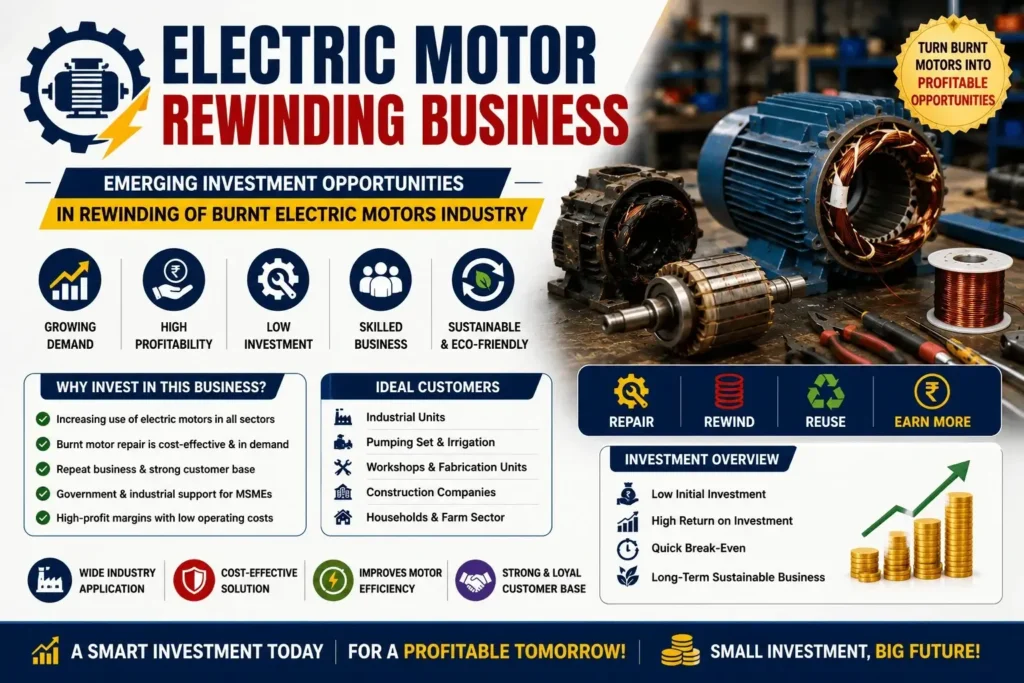
Electric motors are essential components in nearly every industrial sector, from manufacturing to agriculture, from mining to small home appliances. Over time, these motors suffer wear and tear, particularly in their windings, leading to decreased performance or failure. Replacing them can be expensive and time-consuming, especially in industrial environments. This is where the Electric Motor Rewinding business comes into play — offering a cost-effective solution and presenting a lucrative business opportunity for entrepreneurs with technical knowledge or access to skilled labor. Why Start an Electric Motor Rewinding Business? The increasing use of electric motors in nearly every mechanical system today ensures a constant demand for rewinding services. Whether it’s in water pumps, industrial machines, compressors, or fans, motors are everywhere. When these motors break down due to coil damage or insulation failure, rewinding offers a more economical option than replacement. This creates a steady and repeatable need for Electric Motor Rewinding, making it a viable and profitable venture. Understanding Electric Motor Rewinding Electric motor rewinding involves the process of removing damaged windings (typically copper wire) from a motor’s stator or rotor and replacing them with new windings of the same specifications. This restores the motor to its original or even improved efficiency. It typically includes disassembling the motor, cleaning and inspecting core parts, removing old windings, rewinding with fresh copper wire, varnishing, baking, reassembling, and testing. While the process may sound technical, with the right equipment and trained personnel, the business can be run smoothly. Many industries prefer rewinding as it saves 30-60% of the cost compared to buying a new motor, making the service highly attractive. Market Demand and Opportunities India’s rapidly growing industrial, commercial, and agricultural sectors rely heavily on electric motors. From textile mills and chemical plants to irrigation systems and urban infrastructure, the demand for electric motors and hence rewinding services is consistent. Additionally, the rise in energy efficiency awareness is leading many businesses to prefer motor rewinding with high-quality materials over complete motor replacement. Moreover, government incentives for MSMEs and skill-based manufacturing activities further make Electric Motor Rewinding a suitable business idea for those with limited initial capital. Initial Investment and Setup Setting up an Electric Motor Rewinding business can be done in phases, starting with small-scale servicing and gradually moving to medium or even large-scale industrial motors. A basic setup includes: Space: Minimum of 600–1000 sq ft for workshop and machinery layout. Machinery & Tools: Coil winding machine Coil inserting and forming tools Oven for varnishing and curing Testing instruments (megger, multimeter, voltmeter) Grinder, lathe (for rotor balancing), and other hand tools Workforce: Skilled rewinders and electricians, generally 3–5 technicians to start with. Investment: ?8–15 lakhs for a small to medium setup, with higher investments for industrial-grade services. Once you build a network of regular clients, including factories, pump repair centers, and institutions with heavy electrical infrastructure, the business can generate sustainable revenue. Business Model and Service Offerings Revenue in the Electric Motor Rewinding business typically comes from the following services: Motor rewinding (single-phase, three-phase) Armature rewinding (DC motors) Transformer rewinding Generator coil rewinding On-site motor dismantling and installation Motor bearing, shaft, and mechanical repairs Many rewinders also offer AMC (Annual Maintenance Contract) services to institutions and industries, ensuring repeat business and monthly cash flow. Profit Margins and Return on Investment Electric Motor Rewinding offers excellent profit margins, especially in industrial segments. For example: Small Motors (0.5–5 HP): Rewinding cost is ?500–?1500; profit margin 30–40% Medium Motors (5–20 HP): Cost is ?2000–?5000; margin 35–50% Large Industrial Motors (above 20 HP): Can charge ?8000–?30,000 or more with 50–60% margin depending on size and copper required Break-even can be achieved within 12–18 months with a consistent client base and quality output. Expanding to include transformer and generator rewinding services can boost ROI further. Skill Requirements and Workforce One of the advantages of this business is that it does not require the owner to be an engineer or technician. However, the presence of skilled labor is essential. Hiring or partnering with experienced rewinding technicians is a must. You can also train fresh ITI or polytechnic graduates under supervision, which is cost-effective. You may also consider tie-ups with local ITI colleges or offer apprenticeship programs that help train and retain skilled workers. Licensing and Compliance Starting an Electric Motor Rewinding business in India involves obtaining basic registrations such as: Udyam (MSME) Registration GST registration Local municipal shop act or trade license Pollution control clearance (in case of high-volume varnishing or burning activities) For commercial power load, approval from the local electricity board may be needed. Adhering to workplace safety standards and fire safety norms is essential too. Challenges and Mitigation Though rewarding, this business comes with its set of challenges: Material Costs: Copper prices fluctuate and can affect margins. Buying in bulk and maintaining a stock can mitigate this. Skilled Labor: Availability of reliable rewinders is limited. Training your own team is a good long-term solution. Quality Assurance: Sub-par rewinding can damage client machines. Always use standard gauge wires and high-quality insulation materials. Competition: Local workshops may offer low prices, but you can differentiate with quality, reliability, and timely delivery. Focusing on proper insulation, energy-efficient rewinding, and customer education can create a unique selling proposition (USP) for your brand. Digital Marketing and Client Acquisition Marketing is often neglected in this niche, but it plays a vital role in scaling the business. Here are a few proven ways to build clientele: Website and Google My Business Listing: Showcase your services, case studies, and client testimonials. WhatsApp and SMS Campaigns: Stay in touch with industrial clients for AMC renewals and service reminders. Local SEO & Online Ads: Run geo-targeted campaigns to reach factories and repair centers. Partnerships: Collaborate with motor manufacturers, resellers, and electrical supply stores to get referrals. Referral-based business can also grow exponentially with a reputation for quality. Future Scope and Expansion As more industries seek to become energy efficient and reduce machinery replacement costs, the future of Electric Motor Rewinding looks promising. The shift towards electric
30+ Profitable Plant and Machinery Business Ideas under 1 Crore
India’s manufacturing industrial ecosystem provides countless business opportunities for entrepreneurs looking to invest in plant and machinery business ideas under 1 crore. With Make in India and Atmanirbhar Bharat initiatives, MSME sectors are booming, especially those with efficient machinery setups. Choosing the right business idea with a solid return on investment (ROI) and scalable growth potential is crucial. Below, we present detailed and profitable plant & machinery business opportunities that can be initiated under 1 crore and generate consistent returns. 📌 Who Should Read This Guide? ✅ First-time entrepreneurs seeking manufacturing opportunities with ₹1 crore budget ✅ Existing MSME owners looking to diversify or expand capacity ✅ Investors evaluating plant and machinery-based ventures ✅ NRI entrepreneurs exploring industrial investments in India ✅ Rural entrepreneurs seeking government-supported projects 🚀 Why 2026 is the Best Year for Plant & Machinery Investment 1. Enhanced Government Support The MCGS-MSME Scheme has been revised to support MSME manufacturers with: 60% guarantee coverage for credit facilities up to ₹100 crore for equipment and machinery purchases Minimum project cost requirement reduced to 60% from earlier 75% Refundable upfront contribution (5% returned annually from 4th year onwards) Expanded coverage to include service sector MSMEs 2. Budget 2026 Support MSE Cluster Development Programme with GoI assistance up to 80% of project cost (max ₹30 crore) for Common Facility Centres Self Reliant India (SRI) Fund with ₹50,000 crore corpus providing equity/quasi-equity growth capital to MSMEs PM Vishwakarma Scheme with ₹13,000–15,000 crore outlay for traditional artisans 3. CGTMSE Credit Guarantee Doubled ceiling from ₹5 crore to ₹10 crore (effective April 2025) Term loans up to ₹20 crore for MSME exporters 4. Emerging Market Trends Sustainability & Green Manufacturing: Bioplastics, bamboo products, activated carbon from waste Healthcare & Hygiene: Surgical cotton, bandages, sanitary napkins, medical disposables Construction & Infrastructure: Fly ash bricks, PEB structures, uPVC profiles Agro-processing & Food: Spice grinding, oil extraction, dal mills, packaged water EV & Renewable Energy: Solar mounting structures, LED components, battery materials 🏆 Top 30+ Profitable Plant and Machinery Business Ideas Under 1 Crore 🏭 Manufacturing & Industrial Projects 1. Paper Plate & Disposable Products Manufacturing Unit In today’s eco-conscious market, biodegradable products like paper plates, bowls, and cups are in high demand. A semi-automatic or fully automatic plant for manufacturing paper disposables can be set up with an investment of ₹30–50 lakh. Investment: ₹30–50 lakhs Machinery: Paper plate machine, cutting machine, drying machine, raw material feeder Area Required: 1500–2000 sq. ft. Monthly ROI: ₹2–4 lakhs Target Clients: Event planners, catering services, retail markets Government Support: Plastic Waste Management Rules, State Subsidies This is one of the fastest-growing plant & machinery’s segments due to the ban on plastic products in many Indian states. 2. Packaged Drinking Water Bottling Plant Water purification and bottling continue to be a lucrative business in both rural and urban markets. With an increasing focus on clean drinking water, bottled water is a daily need product. Initial Investment: ₹60–80 lakh Machinery Required: RO system, bottling machine, UV system, labeling machine Area Required: 2000–3000 sq. ft. Profit Margin: 20–30% Licensing: BIS Certification, FSSAI License Target Clients: Educational institutions, corporate sectors, hotels, retail outlets Demand remains strong in educational institutions, corporate sectors, hotels, and retail outlets. 3. Spice Grinding & Packaging Unit India is one of the largest spice exporters in the world. Investing in a spice processing and packaging unit offers both local and global market potential. Investment: ₹35–45 lakhs Machinery: Spice grinder, pulverizer, packaging machine, mixer Plant Area: 1000–1500 sq. ft. Profitability: Up to ₹5 lakh/month in bulk supply Government Support: PM-FME Scheme, Udyam Registration This plant & machinery business is highly scalable and supported by robust government export schemes. 4. Mini Oil Extraction Plant Edible oils like groundnut, mustard, coconut, and sunflower oil are household staples. Small-scale oil extraction businesses have a high resale and bulk distribution value. Investment: ₹50–60 lakhs Machinery: Oil expeller, filter press, seed cleaner, packaging unit Space Needed: 1500–2000 sq. ft. Revenue Potential: ₹6–7 lakh/month depending on demand and location Healthy oils with minimal processing are trending in the premium FMCG market. 5. Agarbatti (Incense Stick) Manufacturing Plant The religious and cultural landscape in India ensures steady demand for incense sticks. A low-cost, semi-automated plant can produce thousands of units daily. Investment: ₹15–20 lakhs Machinery: Agarbatti making machine, drying chamber, raw material feeder Raw Material: Bamboo sticks, charcoal powder, joss powder, fragrances ROI: ₹1–2 lakh/month within 6 months Government Support: SFURTI, Udyam Registration This plant & machinery business model is ideal for rural entrepreneurship and small town clusters. 6. Mini Cement Brick & Fly Ash Brick Manufacturing Plant Construction materials are perennially in demand. Fly ash bricks are eco-friendly, affordable, and supported by government schemes like PMAY. Investment: ₹60–80 lakhs Machinery: Hydraulic brick press, pan mixer, conveyor Land Requirement: 3000+ sq. ft. ROI: ₹3–5 lakh/month depending on supply chain Government Support: Swachh Bharat Mission, State Subsidies Used widely in real estate, public infrastructure, and low-cost housing projects. 7. Detergent & Cleaning Product Manufacturing Unit With increasing hygiene awareness, detergent powders, liquids, and soaps are everyday household consumables. Starting this business under ?1 crore is entirely feasible. Investment: ₹25–40 lakhs Machinery: Blender, ribbon mixer, sealing machine, dryer Plant Area: 1000 sq. ft. onwards Clients: Retail chains, local shops, institutional bulk buyers A recurring demand cycle ensures this plant & machinery business runs with predictable revenue. 8. Plastic Moulding and Injection Molding Plant For industrial components, household items, and packaging material, injection molding remains a vital manufacturing technique. Investment: ₹40–60 lakhs Machinery: Injection molding machine, cooling tower, air compressor, mold sets Workforce: 8–10 skilled operators Profit Estimate: ₹8–10 lakh/month depending on volume A niche yet highly profitable venture, especially with product customization. 9. Bio-Fertilizer Production Plant With the organic farming trend rising, bio-fertilizer manufacturing is an excellent green business under ?1 crore. Demand exists from small farmers to agri-retail chains. Investment: ₹50–70 lakhs Machinery: Fermentation tanks, dryers, blenders, granulators Plant Space: 2000 sq. ft. Licenses: State Fertilizer Authority approval Government Support: Paramparagat Krishi Vikas Yojana This sustainable plant & machinery venture meets future agro-sector needs and opens export channels. 10. uPVC Profiles for Doors & Windows Manufacturing UPVC products are fire retardant and contain more than 70% unplasticised uPVC which turns 57% Chlorine. Demand is growing in modern construction. Investment: ₹30–70 lakhs Machinery: Extrusion line, cooling tank, haul-off unit, cutter Area: 2000–3000 sq. ft. Government Support: Udyam Registration 11. Wood Plastic Composite (WPC) Manufacturing Meet the rising demand for eco-conscious