
Bioplastic Products Manufacturing Industry, Profitable Business Ideas on Biodegradable Products
The global demand for sustainable alternatives to traditional plastics has surged, ushering in a new era of innovation and opportunity. Among the most promising sectors is bioplastic manufacturing, a field at the intersection of biotechnology, environmental sustainability, and industrial scalability. As we move into 2025, the market for bioplastics is not just growing — it’s exploding with potential for entrepreneurs, investors, and manufacturers alike. Why Bioplastic Manufacturing Will Dominate in 2025 The rise of bioplastic manufacturing stems from an urgent global shift away from petroleum-based plastics. Governments across continents are introducing strict regulations to curb plastic pollution, and consumers are gravitating toward eco-friendly alternatives. Bioplastics, which are made from renewable biomass sources like corn starch, sugarcane, and algae, offer a promising solution to the world’s plastic waste problem. According to market projections, the bioplastics industry is expected to exceed USD 30 billion by 2025, propelled by innovation, governmental incentives, and the rising environmental consciousness among end-users. This growth provides a lucrative opportunity for entrepreneurs to build sustainable, future-ready businesses in the bioplastic space. Types of Bioplastics You Can Manufacture Understanding the various types of bioplastics is essential before venturing into production. These include: PLA (Polylactic Acid): Derived from fermented plant starch (usually corn), PLA is widely used in packaging, 3D printing, and disposable tableware. PHA (Polyhydroxyalkanoates): Produced by bacterial fermentation, PHA is biodegradable and used in medical devices, packaging, and agricultural films. Starch Blends: A mixture of starch and other biodegradable materials, used in bags and packaging. Bio-PET: A bio-based version of PET (polyethylene terephthalate) with up to 30% renewable material content, used in bottles and containers. Each variant has specific applications, processing techniques, and end-user markets, allowing manufacturers to target diverse sectors such as food & beverage, healthcare, retail, and agriculture. Profitable Business Ideas in Bioplastic Manufacturing 1. Biodegradable Packaging Units With e-commerce and FMCG industries striving to become green, launching a biodegradable packaging manufacturing unit can be immensely profitable. Products like compostable courier bags, food containers, and shrink films are in high demand. Focus on lightweight, strong, and cost-efficient designs to attract bulk buyers. 2. Bioplastic Cutlery and Tableware Disposable plastic cutlery has been banned in many countries, making way for bioplastic alternatives. Manufacturing compostable plates, forks, spoons, and cups from PLA and CPLA materials is a scalable business, especially for catering services, event organizers, and food chains. 3. Agricultural Bioplastic Films Biodegradable mulch films made from bioplastics improve soil health, reduce labor, and eliminate the need for post-harvest plastic collection. Target the agricultural sector with offerings like compostable seedling trays, greenhouse covers, and irrigation tubing. 4. Bioplastic Components for Medical Use The medical sector increasingly uses bioplastics in sutures, drug delivery systems, and implants. Though this niche requires more certifications and precision, it offers high-margin opportunities and long-term contracts with hospitals and health institutions. 5. Custom Bioplastic Injection Molding Startups and R&D firms need custom-designed bioplastic prototypes. Launching a service-based business offering prototyping and low-volume manufacturing using bioresins can fill a niche need while enabling innovation partnerships. Paper Water Bottles, Bioplastics & Biodegradable Products Manufacturing Handbook Setting Up a Bioplastic Manufacturing Plant 1. Site and Infrastructure Choose an industrial zone with easy access to raw materials (like corn or sugarcane), utilities, and transportation. Ensure compliance with local environmental laws and acquire necessary licenses such as a Pollution Control Board certificate. 2. Machinery and Equipment The equipment you need depends on the type of bioplastic you’re producing. Basic machines include: Extrusion units Injection molding machines Granulators and pelletizers Mixers and dryers Thermoforming equipment Investing in semi-automatic or fully automatic setups ensures consistent product quality and higher throughput. 3. Raw Materials Sourcing Bioplastics rely heavily on agricultural feedstocks. Form strong partnerships with local farmers and agro-processing units for a stable, cost-effective supply. Consider importing specialized biopolymers if needed for high-end applications. 4. Workforce and Technical Expertise Hire skilled operators, mechanical engineers, and quality control personnel. For advanced products, retain R&D experts and biotechnologists to develop custom grades of biodegradable polymers tailored to client needs. 5. Certifications and Standards Acquire international certifications such as: ASTM D6400 / EN 13432 for compostability ISO 17088 for biodegradability FDA approval if manufacturing food-contact items These credentials enhance marketability and foster trust among clients and partners. Cost and Investment Breakdown Starting a small-scale bioplastic manufacturing unit typically requires an initial investment of ?50 lakhs to ?2 crores, depending on production scale and automation levels. Here’s a typical breakdown: Machinery and Equipment: ?25–80 lakhs Raw Materials: ?10–30 lakhs (initial inventory) Licensing and Certifications: ?2–5 lakhs Manpower and Operations: ?5–15 lakhs per year Marketing and Branding: ?2–10 lakhs Seek funding via green loans, venture capital, or government startup schemes like India’s Startup India or MSME Sustainable ZED Certification program. Marketing Strategy for Your Bioplastic Business To penetrate and dominate the market, implement a multi-channel marketing strategy: SEO-Optimized Website: Create keyword-rich blogs, product pages, and educational content on bioplastic manufacturing. B2B Portals: List your products on IndiaMART, TradeIndia, and Alibaba to reach global buyers. Certifications Showcase: Display compliance certificates prominently to build credibility. Social Proof: Use LinkedIn and Instagram to share client testimonials, process videos, and sustainability milestones. Trade Shows and Events: Participate in green-tech expos, environmental summits, and industry fairs. Future Outlook and Trends By 2025, bioplastics will no longer be an alternative — they’ll be the norm. Innovations like seaweed-based polymers, bacterial cellulose, and fungi-derived plastics are expected to reshape the landscape. Those who invest in research and adaptability today will lead the eco-industrial revolution tomorrow. Moreover, government bans on single-use plastics and mandates on Extended Producer Responsibility (EPR) will funnel demand toward bioplastic manufacturing units, creating a vibrant supply chain ecosystem from farm to factory to shelf. Bioplastic manufacturing in 2025 presents one of the most exciting, impactful, and financially rewarding ventures of our time. By aligning environmental priorities with industrial innovation, we can build a cleaner, greener world — while securing robust, future-ready businesses. Contact Us
How to Start a Profitable A4 Size Paper Manufacturing Business
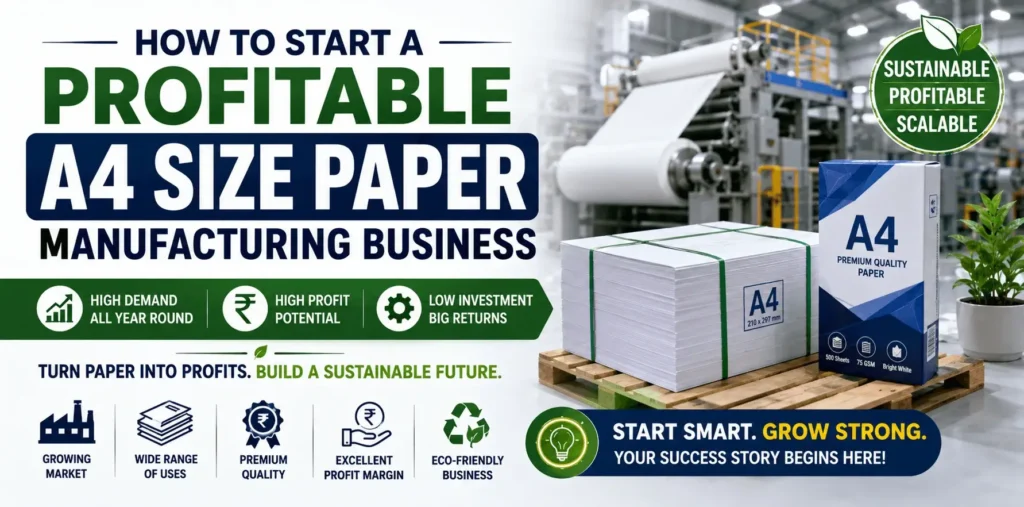
The A4 Size Paper Business is one of the most profitable and fast-moving opportunities in the paper and stationery industry due to continuous demand from schools, offices, government departments, photocopy centers, printing businesses, and corporate organizations. Despite increasing digitalization, the consumption of copier and photocopy paper continues to grow steadily across educational, commercial, and administrative sectors. With relatively low investment, simple machinery setup, and strong year-round market demand, many entrepreneurs are now exploring A4 size paper manufacturing business opportunities in India. Businesses involved in copier paper cutting, packaging, branding, and distribution can generate consistent recurring income through wholesale and institutional supply networks. What is an A4 Size Paper Business? An A4 size paper business involves cutting, packaging, branding, and distributing copier paper sheets commonly used for office printing, photocopying, educational work, and commercial documentation. This guide explains the complete A4 size paper business setup process including machinery, raw materials, manufacturing process, packaging methods, market opportunities, and profitability analysis. Why Starting an A4 Size Paper Manufacturing Unit is a Smart Investment The A4 size paper business has shown remarkable resilience over the years. Even as businesses shift toward digital, paper usage persists across multiple domains such as academic institutions, government sectors, corporate houses, and publishing industries. This specific paper size is considered the global standard for office documents, assignments, reports, photocopies, and formal communications. Why A4 Size Paper Business is Profitable Include: recurring office demand educational demand government supply demand low entry barrier scalable distribution B2B wholesale opportunities institutional contracts Understanding the A4 Size Paper Market Potential The A4 paper market is part of the global printing and writing paper industry, which has seen consistent demand due to its utility in formal documentation. In India alone, paper consumption is expected to reach over 30 million tonnes annually by 2030, and a substantial portion of this includes A4 sheets. This growth presents a golden opportunity for small and medium enterprises (SMEs) to establish localized units for manufacturing and supplying A4 size paper. The relatively low entry barrier in terms of capital investment and land requirement makes this a feasible venture for new entrepreneurs. Moreover, increasing awareness regarding eco-friendly practices has led to a rise in the demand for recycled A4 size paper, creating new niches within the sector. Machinery and Raw Materials Needed for A4 Paper Manufacturing Setting up an A4 size paper manufacturing unit requires some basic yet critical machinery and raw materials. The core components include: Slitting Machine: To cut large paper rolls into A4 dimensions. Ream Cutter Machine: For cutting and trimming the paper sheets accurately. Packaging Machine: To wrap and bundle paper sheets efficiently. Moisture Meter & Calibration Tools: To ensure quality and precision. The main raw materials required are: Jumbo paper rolls (Reel Form) Adhesive and ink (for branding and packaging) Packaging materials (boxes, shrink wraps) Sourcing raw materials from paper mills or wholesalers can reduce costs substantially, especially when purchased in bulk. Manufacturing Process of A4 Size Paper The production process involves several streamlined steps: Loading the jumbo rolls into the slitting machine. Cutting and trimming the paper to A4 dimensions. Counting and bundling the paper into standard reams (usually 500 sheets). Branding and packaging each ream with required labels. Packing the reams into cartons for distribution. Quality checks are performed during each stage to ensure consistency in thickness, brightness, and GSM (grams per square meter), which is a key indicator of paper quality. Legal Requirements and Licensing To establish a compliant unit, the following registrations and certifications are typically required: Udyog Aadhaar/MSME Registration GST Registration Factory License Pollution Control Board Clearance (if applicable) Trademark Registration (for branding) Adhering to these legal protocols ensures smooth operations and boosts the credibility of your business. Investment and Profit Margin in A4 Paper Business Starting a small-scale A4 paper cutting and packaging unit may require an initial investment of INR 10–25 lakhs, depending on the scale and automation of operations. A medium-sized unit can produce approximately 2,00,000 to 3,00,000 sheets per month. Profit margins range between 10% to 25%, depending on sourcing efficiency, operational costs, and distribution reach. With consistent orders and local dealership tie-ups, entrepreneurs can expect a return on investment (ROI) within 12–18 months. Target Customers and Market Strategies Target markets for A4 size paper include: Educational institutions Government offices Corporate houses Stationery wholesalers and retailers Photocopy and printing shops Effective strategies to penetrate the market: Offering bulk discounts to wholesalers and dealers. Establishing partnerships with schools and colleges. Participating in trade fairs to build visibility. Online B2B selling via platforms like IndiaMART, TradeIndia, and Amazon Business. Brand differentiation through eco-friendly or premium-quality paper offerings. Branding and Packaging Tips The look and feel of your paper packaging significantly affect the buying decision, especially in a saturated market. A well-branded ream of A4 size paper instills trust and signals quality. Key tips: Use eco-friendly packaging to attract sustainability-conscious customers. Include certifications or quality standards (like ISO, FSC) on the packaging. Highlight key features such as GSM rating, brightness, and suitability for inkjet/laser printing. Offer customized packaging for bulk corporate clients. Automation and Scaling Up Once the business reaches stability, investing in automated machines for stacking, cutting, and wrapping can enhance productivity. Automation reduces manpower dependency, improves accuracy, and enables higher output with lower operational costs. Scaling up can include: Expanding into A3 and legal size papers Manufacturing colored or recycled A4 sheets Launching a private-label brand and selling through e-commerce Exporting to nearby countries with paper demand Challenges and How to Overcome Them While the A4 size paper business offers lucrative returns, it is not without its set of challenges: Raw material price fluctuation High competition from established brands Logistics and distribution issues Solutions include: Entering into long-term supplier contracts to stabilize costs. Building a niche (such as recycled, sustainable paper). Developing a local distribution network to reduce transport costs. Sustainability and Future Trends The growing awareness of environmental impact is pushing manufacturers toward sustainable paper production. This includes: Using recycled pulp instead of virgin wood fiber.
Suggested Business Ideas with Investment of 25 Million (Machinery).
In today’s rapidly industrializing economy, entrepreneurs are actively seeking lucrative and scalable investment opportunities. Investing in machinery-based businesses offers immense potential for profitability, automation, and long-term sustainability. A budget of ?25 million (~$300,000) is ideal for launching mid-sized machinery projects with advanced technology and high returns. In this article, we explore some of the most profitable machinery project ideas for startups in India and abroad that fall within this budget. Top ?25 Million Machinery Project Ideas That Guarantee High Returns 1. Automatic Paper Bag Making Machine With increasing restrictions on plastic use, paper bags are becoming mainstream in the retail, grocery, and food sectors. An automatic paper bag making unit with a ?25 million investment can produce flat and gusseted bags at high speed with minimal labor. The demand for eco-friendly packaging is booming across metros and tier-II cities. Machinery Required: Roll feeding paper bag making machine, flexographic printing machine, and punching unit. Output Capacity: 30,000–50,000 bags/day. Profit Margin: 25%–30%. Market Scope: FMCG, food outlets, retail chains, garment stores. This machinery project ensures rapid scalability due to rising demand from B2B and B2C sectors. 2. Mineral Water Bottling Plant The bottled water market in India is growing exponentially, especially in urban and semi-urban areas. Starting a fully automatic mineral water plant under ?25 million is not only viable but highly profitable due to consistent consumption throughout the year. Machinery Required: RO system, UV sterilizer, bottling unit, labeling machine, and shrink wrapping machine. Output Capacity: 2000–5000 bottles/hour. Profit Margin: 40%–45%. Market Scope: Restaurants, hotels, hospitals, corporate offices, and retail. The machinery project thrives on recurring demand and can be diversified into flavored water and juices. 3. CNC Wire Bending and Forming Machine Precision in fabrication is the need of the hour in industries such as automotive, construction, and electronics. A CNC wire bending machine is a powerful investment that can automate the bending process for wires and rods used in various components. Machinery Required: CNC wire bending machine, straightening machine, welding unit. Materials Used: SS, MS, Copper wires. Profit Margin: 35%–50%. Clients: Furniture makers, HVAC companies, appliance manufacturers. This machinery project is known for low manpower dependency and consistent B2B contracts. 4. PET Bottle Recycling Unit India generates more than 9 million tons of plastic waste annually, making recycling an essential business segment. PET bottle recycling machinery transforms waste into reusable plastic granules, flakes, and polyester fibers. Machinery Required: Bottle crusher, washing line, dryer, granulator, extruder. Production Capacity: 300–600 kg/hour. Profit Margin: 40%. Buyers: Textile firms, packaging companies, exporters. This eco-conscious machinery project is supported by government schemes and is a major contributor to circular economy goals. 5. Ready Mix Concrete (RMC) Plant Construction in India is at its peak, and ready-mix concrete has become the backbone of modern infrastructure. Setting up an RMC batching plant offers consistent, high-quality concrete supply to developers and contractors. Machinery Required: Batching unit, mixer truck, aggregate hoppers, control panel. Daily Output: 30–60 cubic meters. Profit Margin: 30%. Major Buyers: Infrastructure companies, builders, local developers. A machinery project in this sector ensures long-term B2B relationships and quick returns. 6. Corrugated Box Manufacturing Unit With the explosion of e-commerce and retail, the demand for corrugated packaging has skyrocketed. Investing in a corrugated box making plant offers consistent orders from logistics and product-based companies. Machinery Required: 5-ply automatic corrugation line, die cutter, folder-gluer machine. Production: 10,000–20,000 boxes/day. Profit Margin: 25%–35%. Clients: Flipkart, Amazon vendors, FMCG brands, local manufacturers. A machinery project in this segment is easy to scale by expanding product sizes and printing options. 7. Extrusion Blow Molding Plant The plastic molding industry is growing steadily, and blow molding machines are extensively used to produce bottles, containers, and industrial plastic parts. With a ?25 million investment, you can install high-speed, multi-cavity machines. Machinery Required: Extrusion blow molding machine, chiller, trimmer, auto loader. Output: 2000–3000 products/hour. Profit Margin: 30%–50%. Market Scope: Lubricants, cosmetics, pharmaceuticals, household products. A highly profitable machinery project, especially in industrial zones or near manufacturing clusters. 8. Biomass Pellet Manufacturing Plant As industries shift towards green energy, biomass pellets are gaining demand as an alternative fuel for boilers and power plants. A pellet manufacturing unit is ideal for semi-rural and agro-cluster zones. Machinery Required: Pellet mill, hammer mill, dryer, conveyor, cooling system. Capacity: 500–1000 kg/hour. Raw Material: Sawdust, agricultural waste, husk. Profit Margin: 40%+. This sustainable machinery project is supported under renewable energy policies and biomass subsidies. 9. Masala/Spice Processing Plant Indian spices are renowned globally, and automated spice grinding and packaging plants are in high demand for local and export markets. With ?25 million, a modern semi-automatic plant can be set up. Machinery Required: Pulverizer, mixer, siever, packing machine, roasting machine. Capacity: 500 kg/hour. Profit Margin: 50%. Markets: HoReCa segment, e-commerce, export. One of the best food-processing based machinery projects with high ROI and quick brand establishment potential. 10. LED Light Manufacturing Unit With India pushing “Make in India” and energy-efficient products, LED lights are now a hot commodity in both residential and industrial sectors. A well-equipped unit can manufacture bulbs, tubes, panel lights, and street lights. Machinery Required: SMT machine, wave soldering, PCB assembly line, aging rack. Production Capacity: 5,000–10,000 units/day. Profit Margin: 30%. Buyers: Electric shops, government tenders, real estate firms. This futuristic machinery project is ideal for tech-savvy startups and is supported by energy efficiency grants. Conclusion: Choosing the Right ?25 Million Machinery Project A ?25 million investment opens doors to several industrial segments—packaging, plastic, energy, construction, food, and electronics. Before choosing your machinery project, conduct a detailed feasibility study, identify local raw material availability, understand market demand, and optimize operations with the right technology. Each of the above ideas is scalable, backed by growing demand, and supported by government schemes like MSME, Startup India, and Make in India. These machinery-based ventures are not just income-generating but also future-ready with automation, environmental impact, and digital integration. Build smart, scale fast, and automate your way to success. Visit the page Select and Choose the Right Business Startup for You for sorting
Opportunities for Entrepreneurs to Start their Own Business with Investment of 2 to 5 Crore Capital
Starting a business with a solid capital base opens up exciting possibilities, and a 2 to 5 crore capital gives entrepreneurs ample flexibility to explore high-growth, scalable ventures. Whether you’re an investor looking to diversify your portfolio or a passionate entrepreneur with dreams of building a sustainable enterprise, selecting the right industry is key. With careful planning, due diligence, and a strategic approach, your 2 to 5 crore capital can help establish a powerful brand and generate long-term profits. Top 10 Businesses You Can Start with 2 to 5 Crore Capital Below are ten highly promising and profitable business ideas that you can successfully launch with an investment under 5 crore. Each idea is selected based on market demand, future scalability, and the ability to create strong returns on investment. 1. Food Processing Unit India’s food processing industry is booming, and with a 2 to 5 crore capital, you can establish a mid-scale unit for processing products like spices, pickles, packaged snacks, or ready-to-eat meals. The demand for hygienic, ready-made food products is growing due to urbanization and changing consumer habits. You can also export products or supply to supermarket chains. Estimated Investment: ?3 – ?5 croreKey Requirements: FSSAI license, skilled labor, automation equipmentProfit Potential: High margins, long-term brand value 2. Pharmaceutical Manufacturing With health awareness on the rise, pharmaceuticals remain one of the most recession-proof industries. A small-scale pharma manufacturing unit for generic medicines, capsules, or syrups can be established within 5 crore capital. The profits in this sector are substantial, provided compliance with GMP and government norms is strictly maintained. Estimated Investment: ?4 – ?5 croreKey Requirements: Drug license, GMP certification, technical staffProfit Potential: High, with possibilities for export Drugs & Pharmaceutical Technology Handbook 3. Warehouse and Logistics Business India’s logistics and supply chain industry is growing exponentially, fueled by e-commerce and retail. With 2 to 5 crore capital, you can develop a warehouse facility and offer third-party logistics (3PL) services. The initial capital goes into acquiring land or renting industrial space, and installing inventory management systems. Estimated Investment: ?2.5 – ?5 croreKey Requirements: Strategic location, transportation fleet, logistics softwareProfit Potential: Steady and scalable 4. Renewable Energy Solutions The renewable energy sector, particularly solar power, is seeing substantial government support and demand from residential, commercial, and industrial consumers. You can start a solar panel installation company or set up a small solar power plant under a franchise model. Estimated Investment: ?3 – ?5 croreKey Requirements: Technical team, government approvals, EPC contractsProfit Potential: Moderate to high with long-term revenue 5. Luxury Boutique Hotel Tourism is a constantly growing sector, and a luxury boutique hotel can offer high-end personalized experiences to travelers. With a 2 to 5 crore capital, you can develop a hotel with 10-20 rooms in popular tourist destinations like Goa, Jaipur, or Kerala. Design, ambiance, and service quality are the key differentiators. Estimated Investment: ?4 – ?5 croreKey Requirements: Land/lease, interior design, staff training, licensingProfit Potential: High occupancy equals high ROI 6. Automobile Dealership or EV Showroom Owning a car dealership—whether for traditional vehicles or the rapidly growing electric vehicle (EV) segment—is a tried-and-tested business model. With a 5 crore capital, you can partner with mid-range auto manufacturers or establish a multi-brand EV showroom offering sales, service, and accessories. Estimated Investment: ?2 – ?4.5 croreKey Requirements: Large showroom space, service area, dealership rightsProfit Potential: Moderate to high, with potential for vertical expansion 7. Dairy Processing Plant The dairy industry in India is one of the largest in the world. With a 5 crore capital, you can start a dairy processing unit producing packaged milk, curd, butter, ghee, and flavored milk. As consumers look for hygienic and branded dairy products, this sector has promising margins. Estimated Investment: ?3.5 – ?5 croreKey Requirements: Chilling plant, packaging unit, quality control teamProfit Potential: Consistent demand with moderate growth Modern Technology Of Milk Processing & Dairy Products 8. IT Services and Software Development Company Digital transformation is driving demand for IT services in areas like mobile app development, SaaS solutions, data analytics, and AI-based applications. With a 2 to 5 crore capital, you can assemble a top-notch technical team and invest in product development and marketing. Estimated Investment: ?1.5 – ?4 croreKey Requirements: Office setup, skilled developers, cloud infrastructureProfit Potential: Scalable and high, especially in global markets 9. Biodegradable Packaging Manufacturing Eco-friendly packaging is replacing plastic globally, and businesses are looking for alternatives like paper-based and bioplastic materials. A manufacturing unit with 2 to 5 crore capital can produce biodegradable containers, bags, and food packaging items for FMCG and food delivery companies. Estimated Investment: ?3 – ?5 croreKey Requirements: Machines, raw materials, compliance certificationsProfit Potential: High, especially with B2B contracts 10. Organic Farming and Export Business Organic farming is not only sustainable but also highly profitable with export potential. With a 2 to 5 crore capital, you can purchase farmland, set up organic production of fruits, vegetables, and herbs, and market the produce domestically or export to developed countries where demand for chemical-free food is rising. Estimated Investment: ?2 – ?4.5 croreKey Requirements: Agricultural land, organic certification, export licenseProfit Potential: High margins with growing market demand Advantages of Starting a Business with upto 5 Crore Capital Using your 5 crore capital wisely can give you a significant edge over smaller competitors. Here’s why: Strong Infrastructure: You can afford better equipment, skilled employees, and quality raw materials. Professional Branding: Invest in marketing, branding, and digital presence from the beginning. Scalability: Many of the above businesses can expand nationwide or globally with proper reinvestment. Compliance and Quality: With sufficient capital, you can ensure high-quality products that meet compliance norms, opening doors to government or corporate contracts. Key Tips for Success with 2 to 5 Crore Capital Choose the Right Industry: Don’t follow trends blindly. Pick a business where you understand the customer and market dynamics. Start Lean, Grow Smart: Don’t blow the entire 2 to 5 crore capital upfront. Allocate funds strategically. Build a Strong Team: The success of your business heavily
Start Your Own Industry with Investment of 2.5 Crores (Plant and Machinery). Most Successful Business Ideas.
India’s economic growth, expanding industrialization, and emphasis on domestic manufacturing under schemes like “Make in India” have opened up immense opportunities for entrepreneurs. If you have capital ranging between ?2 to ?5 crore, investing in a plant & machinery business can be highly profitable. With the right selection of industry, technology, and market strategy, you can tap into evergreen and emerging sectors. In this article, we’ll explore some of the best plant & machinery businesses within this investment range, including their potential, profitability, and key requirements. Why Invest in Plant & Machinery Businesses? Investing in plant & machinery-based ventures offers long-term sustainability and tangible asset value. These businesses typically involve the manufacturing, processing, or assembly of products using machines and industrial setups. They often come with high entry barriers, which means less competition and better margins for those who enter early or wisely. Moreover, such ventures can offer employment, contribute to regional economic development, and open up scope for exports. Here’s a comprehensive list of plant & machinery businesses you can start with an investment between ?2–5 crore. 1. Fly Ash Brick Manufacturing Plant Fly ash bricks are eco-friendly, cost-effective, and in high demand due to the government’s emphasis on sustainable construction. With ?2–3 crore, you can set up a semi-automatic plant with machinery like hydraulic presses, mixers, conveyors, and curing systems. These plants can produce a variety of brick sizes and operate with minimal manpower. Key Points: Initial investment: ?2–3 crore Machinery required: Brick press machines, belt conveyors, pan mixers ROI: 18–24 months Government subsidies and tax benefits available under green building initiatives The use of recycled industrial waste like fly ash and the growing construction market ensure a steady demand for this plant & machinery business. 2. Paper Bag Manufacturing Plant The paper bag industry is booming, thanks to bans on plastic and rising eco-consciousness. With ?3–4 crore, you can set up a fully automated plant producing different sizes of kraft paper bags used in retail, food, and pharmaceuticals. Key Equipment: High-speed bag making machine Printing machine Sheet cutting machine Market Advantage: Paper bags have become a must-have for supermarkets, restaurants, and branded outlets. This makes it a high-demand industry. Plant & Machinery for this business requires precision components, and maintaining quality control is essential to meet market standards and gain large retail contracts. 3. Cold Storage Unit with Ripening Chamber India is one of the world’s largest producers of fruits and vegetables, yet suffers significant post-harvest losses. Investing ?4–5 crore in a cold storage and banana ripening facility can provide excellent returns. These setups are especially useful near agricultural zones and food processing hubs. Infrastructure Requirements: Refrigeration units Insulated panels Humidity control systems Ripening gas control (ethylene-based) You can tie up with farmers, wholesalers, or government procurement bodies. The plant & machinery used here is energy-intensive, so investing in solar power options may also boost sustainability and reduce operational costs. 4. Mini Dairy Processing Plant Dairy products like milk, curd, paneer, and ghee have ever-growing demand. With ?3–5 crore, you can establish a mini dairy plant with milk pasteurization, homogenization, packaging, and chilling units. Additional scope includes flavored milk or ice cream production lines. Machinery Includes: Milk processing unit Cream separators Packaging machinery Refrigeration systems This plant & machinery business is best suited in regions with good milk supply. Branding and distribution are crucial to scale the business and build customer loyalty. 5. Pet Preform & Bottle Manufacturing Unit With the beverage, oil, and pharmaceutical industries booming, PET bottles and preforms are in huge demand. This business involves setting up injection molding and blow molding machinery for bottle creation. Investment Needs: ?3.5–4.5 crore for plant setup Machines for PET preform molding and bottle blowing Ancillary equipment like chillers, dryers, and conveyors The machinery used in this business can operate around the clock and produces high-margin products. It’s a classic plant & machinery business with high automation and export potential. 6. Spice Processing & Packaging Plant India is the world’s largest exporter of spices, and domestic consumption continues to grow. A spice processing plant includes cleaning, drying, grinding, mixing, and packaging machinery. Investment Split: ?2.5–3 crore for plant & machinery ?0.5–1 crore for packaging and distribution With rising demand for hygienically packed and branded spices, there’s vast scope in both domestic and international markets. Custom blends and organic spices can fetch premium prices. 7. Solar Panel Assembly Plant The renewable energy sector is expanding rapidly in India. A solar panel assembling unit within ?5 crore can be highly viable. While full-scale cell manufacturing is capital-intensive, assembling imported cells into modules is achievable within this range. Machines Required: Cell stringer Laminator Framing machine Testing and quality control systems With government incentives under solar missions and a growing green energy market, the solar industry is a lucrative plant & machinery venture to explore now and in the future. 8. Agarbatti Manufacturing Plant Incense sticks are used across India and abroad. Setting up a fully automatic agarbatti unit, including dipping and fragrance sections, can be started with ?2–2.5 crore. Key Equipment: Fully automatic agarbatti making machines Dryer Dipping tank Packaging system It’s a high-volume, low-margin business that requires strong distribution. However, premium segment products and exports can yield higher profits. This is a good example of a plant & machinery business that balances tradition with technology. 9. Plastic Recycling Plant Plastic waste management is a growing sector backed by strong regulations. A ?3–5 crore investment can fund a plastic recycling unit that processes waste into reusable granules. Machinery Involved: Shredder Washing line Agglomerator Extruder with granulator This business is both environmentally sustainable and economically rewarding. With rising demand for recycled plastics in manufacturing and packaging, this plant & machinery sector will see more growth. 10. Tissue Paper Manufacturing Plant Tissue paper, napkins, toilet rolls, and facial wipes have surged in demand with rising hygiene awareness. You can set up a semi-automated unit with ?2–3.5 crore investment. Machines You’ll Need: Paper converting machine Embossing unit Slitter and rewinder Packaging line The
Production of Low Carbon Ferro Chrome. Opportunities in Ferrochrome, Ferroalloys Industry
The global ferroalloy industry is undergoing a major transformation in response to increasing environmental regulations, technological advancements, and changing market demands. Among the wide spectrum of ferroalloys, Low Carbon Ferro Chrome is rapidly gaining prominence due to its eco-friendly nature and essential role in stainless steel manufacturing. As steelmakers globally shift towards greener and more sustainable practices, the significance of Low Carbon Ferro Chrome in the future of the metallurgical industry is more relevant than ever. Why Low Carbon Ferro Chrome is the Future of Ferroalloys Low Carbon Ferro Chrome (LCFC) is an alloy of chromium and iron with low carbon content, typically less than 0.10%. It is primarily used in the production of stainless steel and special steels that require stringent control over carbon levels. The demand for high-quality stainless steel is increasing in industries such as construction, automotive, aerospace, and defense. This directly fuels the demand for Low Carbon Ferro Chrome, making it a cornerstone in the steel value chain. One of the main advantages of LCFC is its ability to introduce chromium into steel without increasing the carbon content, which is crucial for applications that require corrosion resistance and strength. As global steel production continues to grow, particularly in Asia and Europe, the use of LCFC becomes indispensable. Environmental and Regulatory Drivers The global emphasis on reducing carbon emissions is pushing industries to shift from high-carbon to Low Carbon Ferro Chrome. Traditional high-carbon ferro chrome involves processes that emit significant amounts of CO? and other greenhouse gases. In contrast, LCFC is produced using advanced refining techniques such as the aluminothermic reduction process, which offers better energy efficiency and lower emissions. With governments implementing stricter environmental norms, particularly in Europe and the U.S., steel manufacturers are under pressure to adopt cleaner raw materials. This is where Low Carbon Ferro Chrome steps in as a sustainable alternative. Additionally, certifications like ISO 14001 and ESG (Environmental, Social, Governance) compliance standards are pushing more companies toward low-carbon inputs to enhance their green credentials. Rising Demand in Stainless Steel Production The stainless steel industry is the primary consumer of Low Carbon Ferro Chrome, using it to achieve the desired levels of chromium without exceeding permissible carbon limits. Stainless steel is highly valued for its corrosion resistance, strength, and durability. Applications range from kitchen appliances and medical instruments to heavy-duty industrial machinery. As per market studies, global stainless steel production is projected to grow at a CAGR of 5% over the next decade. This steady increase in demand is anticipated to drive the growth of the Low Carbon Ferro Chrome market significantly. Moreover, sectors like clean energy, electric vehicles, and infrastructure development are demanding advanced steel grades, further escalating the need for quality ferroalloys. Technological Advancements in LCFC Production Production methods of Low Carbon Ferro Chrome are evolving, contributing to better quality, cost-efficiency, and reduced environmental impact. Some of the key technologies influencing the industry include: Vacuum Oxygen Decarburization (VOD): This process removes carbon while retaining chromium, allowing manufacturers to produce ultra-low carbon grades efficiently. Aluminothermic Process: Used to produce LCFC with very low carbon and silicon content, this process is suitable for specialty steels and superalloys. Plasma Arc Furnaces: Though still in experimental stages in many regions, these can potentially reduce energy consumption and increase purity levels of ferroalloys. These innovations are helping manufacturers meet the stringent quality specifications demanded by modern steel plants, reinforcing the role of Low Carbon Ferro Chrome in future metallurgical practices. Geographical Trends and Market Dynamics China, India, and South Africa are key players in the global ferroalloy market. China remains the largest producer and consumer of ferro chrome, while India is emerging as a strong supplier of Low Carbon Ferro Chrome due to its reserves of chrome ore and evolving manufacturing capabilities. In South Africa, there is an increasing focus on beneficiation of raw materials and value-added production, leading to more efficient LCFC manufacturing. European nations face strict environmental rules and are likely to become major importers of LCFC due to its low emission profile. As nations push for localized production and resource independence, Low Carbon Ferro Chrome is becoming a strategic commodity, influencing trade policies and bilateral agreements, especially between mineral-rich and steel-producing countries. Investment Opportunities and Market Potential With global industries seeking cleaner and high-quality alloys, investors are closely watching the Low Carbon Ferro Chrome segment. The market is poised for consistent growth, with potential investment avenues in: LCFC smelting units: These are in high demand in developing countries like India and Indonesia. Green ferroalloy plants: Integrated units that recycle waste heat and minimize emissions. R&D and Technology Parks: Focused on innovations in refining techniques and energy-efficient processes. Market analysts expect the Low Carbon Ferro Chrome market to surpass USD 3.5 billion by 2030, driven by rising demand in the construction, automotive, and energy sectors. Governments are also offering incentives for green metallurgy projects, further enhancing the profitability of such investments. Challenges and Strategic Considerations Despite its promising future, the Low Carbon Ferro Chrome industry faces challenges like fluctuating raw material prices, energy costs, and stringent regulatory compliance. Chrome ore, the primary input, is subject to geopolitical risks and export controls, particularly in countries like South Africa and Zimbabwe. Energy-intensive production processes mean that LCFC manufacturing can become cost-prohibitive in regions with high electricity tariffs. Hence, companies increasingly explore adopting renewable energy in smelting operations as a strategic move to reduce dependency on fossil fuels and improve cost structures. Furthermore, players need to stay ahead by integrating automation and digital technologies into their manufacturing workflows. The use of AI, IoT sensors, and predictive analytics can significantly boost efficiency and product quality, giving early adopters a competitive edge in the Low Carbon Ferro Chrome market. Conclusion: The Road Ahead for Low Carbon Ferro Chrome The transition to sustainable metallurgy and green manufacturing is no longer optional—it is imperative. In this context, Low Carbon Ferro Chrome emerges as a game-changing material that aligns with environmental goals, regulatory requirements, and market demands for superior steel products.
November 2019 Entrepreneur India Monthly Magazine
The Entrepreneur India Nov 2019 edition presented a fascinating mix of innovation, grit, and enterprise spirit that highlighted the growing potential of India’s startup ecosystem. The edition captured the real essence of the country’s dynamic business landscape, bringing to light entrepreneurial journeys, game-changing innovations, and business strategies that captivated investors and consumers alike. From AI to sustainable startups, from traditional businesses undergoing digital transformation to youth-led ventures shaking up industries, the November issue was packed with inspiring and trendsetting stories. Key Highlights of Entrepreneur India Nov 2019 Rise of Deep-Tech Startups Entrepreneur India Nov 2019 opened with a deep dive into how Indian startups are leveraging artificial intelligence, machine learning, and data analytics. Startups in Bengaluru and Hyderabad were showcased for developing revolutionary tools in healthcare and logistics. Health Tech Innovation A standout story focused on a Bengaluru-based company using AI to predict chronic illnesses early. The tool analyses patient data and local health trends to alert doctors before symptoms become critical. Sustainability Meets Profit The green business trend took center stage in the edition. Entrepreneurs tapping into biodegradable packaging, upcycling waste, and renewable energy were lauded for combining purpose with profit. Biodegradable Cutlery Business One Delhi-based founder’s journey stood out—turning agricultural waste into elegant biodegradable cutlery. Supported by India’s plastic ban policies, the business saw rapid growth in both domestic and export markets. Understanding Gen Z: The New Market Driver The magazine emphasized shifting consumer behavior, with Gen Z emerging as a powerful consumer segment. The emphasis was on mobile-first strategies, authenticity, and purpose-driven branding. Marketing in the Digital Age Marketing experts interviewed in Entrepreneur India Nov 2019 noted how brands must create immersive experiences across digital platforms to capture short attention spans. From Engineer to Fashion Mogul Among the human interest stories, one inspiring journey was of an IT engineer who turned her passion for traditional weaves into a global fashion brand. She combined technology with culture to deliver eco-conscious apparel. Local Roots, Global Reach The entrepreneur used e-commerce, storytelling, and digital marketing to build a community-driven brand that now exports to Europe and the US. Scaling Challenges in India India’s diverse and fragmented geography brings scaling difficulties. The edition highlighted how logistics, culture, and regulations vary dramatically across regions. Lessons from Tier-2 Cities Startups from Indore and Bhubaneswar shared their experience of bootstrapping and adapting to hyperlocal needs—proof that great businesses are thriving outside metro cities. Women at the Helm Entrepreneur India Nov 2019 gave a special nod to women entrepreneurs breaking industry stereotypes and leading powerful innovations across fintech, health, and education. Fintech for the Unbanked A feature on a female founder in Mumbai told the story of launching a micro-credit fintech startup using AI-based risk assessments, serving thousands of rural women with no prior banking history. Blockchain in Traditional Sectors Legacy sectors also underwent digital transformation. A textile firm in Surat implemented blockchain to build transparency in its supply chain. Competitive Advantage Through Tech This move gained international buyers’ trust and gave the firm an edge over competitors relying on manual tracking and outdated systems. The Startup Funding Landscape The edition dove into the shift in the startup funding scene, where VCs emphasized sustainable growth and profitability. Unit Economics Over Vanity Startups prioritizing cash flow and real value have a stronger chance of long-term survival, says leading VC. Global Expansion by Indian Startups Entrepreneur India Nov 2019 featured Indian companies successfully entering Southeast Asian and Middle Eastern markets. Case Study: EdTech in the Gulf An Indian EdTech firm expanded to Dubai, customizing content for local culture and language while maintaining the tech stack used in India. Startup Growth in Small Cities Entrepreneurship is rising in small-town India, driven by state incentives and improved digital infrastructure. Kochi and Lucknow: Rising Hubs These cities now host incubators, co-working spaces, and attract investors seeking talent and affordable growth opportunities. Practical Tips for Entrepreneurs Apart from stories, the magazine provided actionable tips for founders on building efficient teams, pitching investors, and creating strong company cultures. Column: Investor Pitch Do’s & Don’ts This section outlined the importance of narrative, vision clarity, and realistic projections when raising capital. India’s SaaS Boom India’s SaaS industry was recognized for its explosive growth. Companies developing automation tools, customer support platforms, and HR solutions were spotlighted. Chennai Leads the SaaS Charge A startup from Chennai offering customer engagement tools to SMEs was already serving clients in over 40 countries—proof of India’s tech credibility on the world stage. Purpose-Driven Business Leadership Entrepreneur India Nov 2019 highlighted how founders are creating inclusive, ethical, and impact-focused organizations. People Over Profits Several leaders shared that building a people-first company improved innovation, retention, and customer trust. Future Forecast: Trends for 2020 The magazine concluded with expert predictions about where entrepreneurship was heading. Emphasis was on remote work tools, personalization, mental wellness, and vernacular content. Key Insight: The Rise of Bharat Digital adoption in rural India, referred to as “Bharat,” is expected to shape product design and marketing strategies in the coming years. Conclusion The Entrepreneur India Nov 2019 edition was more than a magazine—it was a celebration of India’s entrepreneurial journey and a guide for those seeking to navigate it. By featuring bold ideas, courageous founders, and transformative strategies, it painted a rich picture of how business is evolving in India. The edition not only inspired readers but also offered them concrete lessons in leadership, innovation, and resilience. Entrepreneur India Nov 2019 offers timeless insight and guidance for launching, growing, or scaling a business. Visit the page Select and Choose the Right Business Startup for You for sorting out the questions arising in your mind before starting any business and know which startup you can plan. We, at NPCS, endeavor to make business selection a simple and convenient step for any entrepreneur/startup. Our expert team, by capitalizing on its dexterity and decade’s long experience in the field, has created a list of profitable ventures for entrepreneurs who wish to diversify or venture. We regularly update the list to give
Lucrative Business and Investment Opportunities to Start with 2 Crores

India’s startup landscape has seen a significant transformation in the past decade. With the rise in disposable income, favorable government policies, and the surge of digital transformation, many aspiring entrepreneurs are looking for the next big opportunity. If you’re one of those individuals and want to grab the opportunities to start with 2 crores capital investment, you’re in a uniquely strong position to start a high-return-on-investment (ROI) business. The good news is that there are many business ideas that can help you scale quickly and profitably within this investment range. Whether you’re considering manufacturing, services, food processing, or technology-driven ventures, having 2 crore capital gives you enough runway to build infrastructure, recruit talent, and capture market share. In this article, we’ll explore some of the most promising high ROI business ideas you can kickstart with this amount, providing both financial and strategic insights for each. Top High ROI Business Opportunities to start with 2 Crores Capital 1. Specialty Food Processing Unit With increasing health consciousness and preference for organic and artisanal foods, the specialty food market is booming. Investing your 2 crore capital into setting up a food processing unit—like organic snacks, frozen ready-to-eat meals, or plant-based meat alternatives—can yield great returns. The capital can cover machinery, certifications (FSSAI, ISO), raw materials, cold storage, and distribution. With the right branding and tie-ups with online marketplaces like BigBasket or Amazon Pantry, the scalability potential is massive. 2. Premium Pre-School Franchise Education remains one of the most lucrative industries in India. Starting a premium pre-school under a reputed franchise brand like Kidzee, EuroKids, or Little Millennium is a smart choice. These brands offer strong curriculum support, training, and brand recall. With 2 crore capital, you can secure a good location in a tier-1 or tier-2 city, furnish modern classrooms, and install CCTV-enabled security systems—an important feature for parents. Monthly ROI becomes visible within the first year if marketed well. 3. EV Charging Station Network With India’s push toward electric vehicles, there is a significant opportunity in setting up EV charging stations. Using 2 crore capital, you can establish a mini-network of charging points in urban or highway locations. Government schemes like FAME II offer subsidies, further improving ROI. The model is simple yet effective: charge users for energy consumption and offer value-added services like a café, rest area, or convenience store at the station. Once established, operational costs are minimal compared to the recurring income. 4. Boutique Resort or Glamping Site The travel and hospitality sector has pivoted toward experiential tourism. Setting up a boutique resort or glamping (glamorous camping) site in scenic but less commercial locations like Coorg, Rishikesh, or Lonavala can be an exciting venture. With 2 crore capital, you can purchase or lease land, construct unique accommodations (like tents, treehouses, or villas), and create eco-friendly amenities. This segment caters to HNIs and millennials looking for Instagram-worthy weekend escapes. ROI is high, especially during holiday seasons. 5. Custom Furniture Manufacturing Unit India’s real estate and interior design market have created demand for modern, customized furniture. With 2 crore capital, starting a custom furniture manufacturing unit equipped with CNC routers, cutting machines, and polish lines becomes feasible. The setup can cater to B2C through an online store and B2B by collaborating with interior designers or real estate developers. Using digital catalogs and 3D visualization tools increases customer experience. Margins in this business are excellent—especially in premium wooden or modular furniture. 6. Cold Storage Chain for Agri Produce India loses a significant portion of its perishable agri-produce due to poor storage infrastructure. Investing 2 crore capital into setting up a cold storage unit—especially in regions like Maharashtra, UP, or Punjab—can yield tremendous returns. The income can be generated by leasing storage space to farmers, exporters, or wholesalers. Add-on services like ripening chambers, transport logistics, and real-time inventory tracking increase revenue streams. The best part? It’s eligible for subsidies under NABARD and the Ministry of Food Processing Industries. The Complete Book on Cold Storage, Cold Chain & Warehouse 7. Digital Marketing Agency with Niche Services Marketing has gone digital, and businesses of all sizes are outsourcing this crucial function. Starting a high-end digital marketing agency—focused on niche industries like healthcare, real estate, or D2C brands—is a low-asset yet high-returns model. You can use 2 crore capital to hire top-notch talent, rent a premium office, and invest in SEO, PPC, analytics, and content tools. Offering performance-based pricing and specializing in ROI-driven results ensures long-term client retention and solid profitability. 8. D2C (Direct-to-Consumer) Brand in Personal Care Consumers are increasingly gravitating toward homegrown, sustainable, and natural personal care brands. With 2 crore capital, you can build a strong D2C brand from scratch. Product categories may include herbal skincare, grooming kits, or clean cosmetics. Spend capital on R&D, brand identity, influencer marketing, and an eCommerce platform. Once traction builds, margins improve, and customer lifetime value (CLTV) justifies the upfront marketing spends. Exiting to a larger FMCG firm is also a possible end goal. 9. Franchise Outlet of Cloud Kitchen Brands The cloud kitchen model is thriving due to lower overheads and increasing food delivery demand. Using 2 crore capital, you can secure multiple franchise licenses of popular brands like Faasos, Behrouz Biryani, or Box8. Centralize your kitchen and expand distribution across Zomato, Swiggy, and your own app. With centralized procurement and staff, operational efficiency remains high. Many brands offer revenue-sharing models, which lowers your entry risk. 10. Drone-Based Services Company Drones are revolutionizing sectors like agriculture, construction, and surveillance. Starting a drone-based services company with 2 crore capital involves procuring high-end drones, getting DGCA certification, and hiring certified pilots. Your services can cater to precision farming, aerial photography, land surveying, and industrial inspection. The initial costs are technology-heavy, but the profit margins are high due to lack of competition and rising demand. Recurring contracts with corporate’s or government projects can fuel sustainable growth. Strategic Tips for High ROI Businesses with 2 Crores Capital Start Lean, Scale Smart: Avoid overspending at the beginning. Use your capital
Best Profitable Project Profiles for New Venture. Projects to Start with Investment of 2 Crores (Machinery).
In today’s fast-evolving industrial landscape, investing ?2 crore in a high-potential business can pave the way for long-term profitability, especially in the machinery and manufacturing sector. The capital allows for the establishment of a medium-sized unit with state-of-the-art equipment and capacity for large-scale production. Entrepreneurs and investors seeking stable, asset-heavy industries with consistent demand should consider various machinery project profiles that promise scalability, export potential, and future growth in line with India’s economic trajectory. Exploring the Scope of Machinery Project Profiles India’s industrial growth is significantly influenced by the rise in demand for domestic and industrial machinery. From agriculture to pharmaceuticals, and from packaging to plastics, machinery remains a backbone for multiple sectors. Investing in machinery project profiles not only offers tangible assets but also ensures a higher degree of control over operational quality, consistency, and innovation. Given the ?2 crore budget, several capital-intensive projects can be implemented efficiently with high returns on investment. 1. Automatic Paper Bag Manufacturing Plant With the global shift towards sustainability and ban on single-use plastics in various states, automatic paper bag machines are gaining immense popularity. Investing in a full-scale paper bag manufacturing unit, complete with printing, folding, and pasting capabilities, is a smart move. The ?2 crore budget can be allocated toward importing high-speed machinery, setting up an efficient layout, and stocking quality raw materials. A project of this scale could generate revenue through contracts with supermarkets, restaurants, and e-commerce companies, all while tapping into the eco-conscious customer base. 2. Hydraulic Press and Tool Manufacturing Unit Hydraulic presses are extensively used in automotive, aerospace, and metal forming industries. Setting up a precision tool and press manufacturing facility could be highly lucrative under a well-structured machinery project profile. The capital investment allows for CNC machines, welding stations, high-pressure press setups, and in-house design software. Moreover, government schemes like “Make in India” and import-substitution drives further promote local manufacturing of industrial tools and machines, making this a future-forward investment. 3. PET Bottle Blowing and Filling Machinery The packaging sector in India is booming, especially in beverages, personal care, and edible oil industries. Investing ?2 crore into a plant that manufactures PET bottle blowing and filling machinery serves both product manufacturers and small entrepreneurs. The machinery production itself offers export potential, and you can also add a separate assembly unit for customization based on industry-specific needs. Creating such a comprehensive machinery project profile ensures long-term customer retention and repeat sales due to machine wear-and-tear replacements. 4. Solar Panel Mounting Structure Fabrication Unit With the government pushing renewable energy aggressively, there is a surge in demand for supporting equipment like solar panel mounting structures. Setting up a machinery manufacturing unit that fabricates these structures using mild steel, aluminum, or galvanized iron can be extremely profitable. This falls under a niche segment of machinery project profiles, where precision cutting, CNC bending, galvanizing, and coating play a major role. A portion of the ?2 crore investment can also go into getting ISO certifications and NABL-approved testing tools to boost customer trust and expand business to EPC contractors. 5. Commercial Kitchen Equipment Manufacturing As the restaurant and cloud kitchen industry scales rapidly in India, commercial kitchen equipment such as burners, grills, refrigerators, dough mixers, tandoors, and combi ovens are in great demand. Investing in this segment not only taps into domestic demand but also allows for exports to South Asia and the Middle East. The machinery used to manufacture such products—sheet metal cutters, TIG welders, polishing and buffing machines—can be purchased and assembled within a ?2 crore budget. This machinery project profile also benefits from strong B2B connections and scope for product innovation. 6. CNC Wire Bending and Forming Machine Manufacturing With applications in furniture, automotive, and construction, CNC wire bending machines are becoming a sought-after tool. Building a business that designs and manufactures these machines allows you to cater to domestic SMEs as well as international clients. The ?2 crore budget allows for investing in CAD design infrastructure, setting up precise mechanical assembly lines, and ensuring strict tolerance standards. As part of your machinery project profiles, CNC machinery manufacturing offers consistent demand, technical advancement, and potential for high margins. 7. Capsule Filling and Blister Packing Machine Unit India’s pharmaceutical sector will reach $130 billion by 2030, creating a golden opportunity to invest in supportive infrastructure like capsule filling and blister packing machines. These machines are used by pharma giants, nutraceutical companies, and even ayurvedic manufacturers. ?2 crore is sufficient to set up a machinery unit that can design, assemble, and test machines meeting FDA and GMP standards. This project profile comes with high client loyalty, given the critical role machinery plays in ensuring precision and hygiene in medicine packaging. Key Advantages of Investing in Machinery Project Profiles When evaluating long-term investments, especially with a ?2 crore capital, machinery project profiles offer several unmatched benefits: Asset-Backed Business: Tangible fixed assets in machinery units offer good resale value and can be leveraged for loans. Recurring Revenue Streams: Sales of spare parts, service contracts, and upgrades create continuous income. High Entry Barriers: Technical expertise, certifications, and capital requirements create a protective moat against competition. Export Potential: Indian-made machinery is gaining recognition in Africa, Southeast Asia, and the Middle East. Government Incentives: Access to subsidies under MSME schemes, duty rebates, and technology upgradation funds. Factors to Consider Before Starting a Machinery Project Starting a business around machinery project profiles requires proper groundwork. Here are some critical considerations: Market Research: Understand your end-users, whether it’s factories, farmers, or retailers. Analyze the competition and identify pricing gaps. Technical Expertise: Hiring skilled engineers and technicians is crucial. You may also need consultants for machine design and prototype development. Raw Material Supply Chain: Ensure availability of high-grade metals, electronics, and components required for assembly. Certifications & Compliance: BIS, CE, ISO, and industry-specific certifications boost customer confidence. After-Sales Service Network: Establishing a service arm can be a value proposition for customers relying on your machines for uninterrupted production. How to Scale the Business After Setup Once your
Top Small-Scale Business Ideas to Start with ₹2 Crore Investment (Plant & Machinery)
India’s manufacturing ecosystem has evolved rapidly over the past decade, offering entrepreneurs vast potential to build thriving ventures. If you’re looking for profitable small-scale business ideas, this guide is your starting point. With a budget of ₹2 crore, you can establish manufacturing units that meet both domestic and export market demands. These small-scale business ideas are designed to minimize risk while maximizing returns. In this comprehensive guide, we will explore the most profitable small-scale business ideas that require modest investment but promise substantial growth. Whether you are a first-time entrepreneur or an experienced investor, these small-scale business ideas offer scalability, sustainability, and long-term profitability. Top 10 Small-Scale Manufacturing Ideas to Start with 2 Crore Investment Below are the top 10 small-scale manufacturing ideas that combine scalability, affordability, and high demand. These opportunities are ideal for entrepreneurs eager to capitalize on India’s Make in India initiative, digital growth, and demand for sustainable and innovative products. 1. Organic Fertilizer Production Unit With the surge in organic farming and eco-conscious agriculture, starting an organic fertilizer manufacturing plant is a lucrative small-scale business. Vermicompost, bio-fertilizers, and seaweed extracts are in high demand by both domestic farmers and international buyers. Investment Needed: ?1.2 to ?1.6 crore Raw Materials: Cow dung, plant waste, microbial cultures Target Market: Organic farmers, agricultural co-operatives, retail stores ROI Timeline: 12–18 months The environmental shift toward chemical-free farming practices makes this a sustainable business with long-term benefits. 2. Paper Bag Manufacturing Unit With a countrywide ban on plastic bags, the paper bag manufacturing industry has grown exponentially. Businesses and retailers are moving toward eco-friendly alternatives, making this one of the fastest-growing small-scale business ideas. Investment Needed: ?50 lakh – ?1.5 crore Machines Required: Sheet cutter, printing press, bag-making machine Raw Materials: Kraft paper, glue, ink Profit Margins: 25–40% You can start locally and scale up to supply large retail chains or export markets. 3. LED Light Manufacturing The government’s push for energy-efficient solutions has led to a booming demand for LED products in India. LED bulb and light assembly is a cost-effective and profitable manufacturing venture under ?2 crore. Machinery Cost: ?60 lakh – ?1 crore Raw Materials: PCB, LED chips, resistors, casings Target Clients: Households, commercial buildings, municipal projects Certifications Needed: BIS Certification, ISO This small-scale business also opens doors to exports, especially in developing markets across Asia and Africa. 4. Disposable Tableware Manufacturing Biodegradable cutlery and tableware are now preferred in hotels, catering companies, and takeaway services. Disposable plates and cups made of areca, sugarcane bagasse, and paper are eco-friendly and highly marketable. Initial Capital: ?75 lakh – ?1.8 crore Machinery: Hydraulic press, forming machines Products: Plates, bowls, trays, glasses Markets: Domestic retail, food service industry, exports Sustainability trends make this business resilient even during economic fluctuations. 5. Ready-to-Eat (RTE) Snacks Production The snacking industry in India has seen double-digit growth. You can start a ready-to-eat snacks manufacturing unit under ?2 crore focused on regional delicacies, healthy snacks, or even ethnic products for NRIs. Investment: ?1.5–?2 crore Products: Namkeens, baked chips, millet snacks Market: Supermarkets, e-commerce, export channels Licenses: FSSAI, ISO 22000 Packaging and branding are key in this small-scale business, helping differentiate your product in a saturated market. 6. Sanitary Napkin Manufacturing A highly impactful business with social relevance, sanitary napkin production helps promote menstrual hygiene and is backed by several government initiatives. Startup Capital: ?1.2–?1.6 crore Raw Materials: Absorbent pads, non-woven fabric, adhesives Customer Base: Rural and urban women, NGOs, healthcare distributors ROI: High margins with good scalability With proper awareness campaigns, this small-scale business can gain momentum quickly, especially in semi-urban regions. 7. Detergent and Cleaning Product Manufacturing The cleaning and hygiene segment in India is recession-proof and consistently growing. Manufacturing detergents, floor cleaners, toilet cleaners, and dishwashing liquids is a solid business model. Setup Cost: ?80 lakh – ?1.5 crore Equipment Needed: Mixing vessels, filling and sealing machines Sales Channels: Wholesalers, supermarkets, B2B contracts Margins: 25–50% This small-scale business offers potential for private labeling and expansion into institutional supply. 8. Herbal Cosmetic and Ayurvedic Product Manufacturing The herbal and ayurvedic cosmetics market is expected to reach ?50,000 crore by 2030. Starting a herbal cosmetic manufacturing unit with face creams, soaps, oils, and shampoos is both trendy and lucrative. Capital Requirement: ?1.5 crore Key Ingredients: Aloe vera, turmeric, neem, sandalwood Certifications: GMP, AYUSH, ISO Target Audience: Beauty retailers, online shoppers, salons This is a high-growth small-scale business with tremendous potential, especially among the millennial and Gen Z demographic. 9. Ice Cream and Frozen Dessert Manufacturing The frozen dessert sector is booming, with rising consumer preferences for artisanal and health-focused ice creams. A manufacturing plant under ?2 crore can produce gelato, vegan ice cream, and kulfis. Startup Budget: ?1.5 crore Machinery: Pasteurizer, homogenizer, deep freezer Market: Café chains, retail, online food delivery platforms Compliance: FSSAI and Cold Chain Setup Flavored and healthy variations like fruit-based or sugar-free options can help you stand out. 10. Modular Furniture Manufacturing As real estate space gets compact, the demand for modular and space-saving furniture is on the rise. Entrepreneurs can start a small-scale modular furniture unit that serves offices, homes, and institutions. Investment Needed: ?1.8–?2 crore Equipment: CNC routers, edge banders, panel saws Materials: MDF, plywood, laminates Sales Channels: Interior designers, e-commerce, furniture showrooms This small-scale business requires precision but offers huge margins and room for customization services. Why Small-Scale Business is the Future of Indian Manufacturing Starting a small-scale business in India is no longer just an alternative; it’s often the first choice for entrepreneurs seeking agility, profitability, and innovation. With schemes like MSME registration, Mudra loans, and subsidies under Stand-Up India, the ecosystem supports ambitious founders. Moreover, the emphasis on local production and Atmanirbhar Bharat has created an urgent demand for decentralized, agile manufacturing units. Whether it’s a factory producing biodegradable utensils or LED bulbs, the common thread is affordability, fast setup, and high return on investment. By selecting the right niche based on your region, market understanding, and product demand, your small-scale business can thrive even in competitive sectors. Visit the page Select and