
38 MSME Manufacturing Business Ideas Up to Rs 75 Lakhs: New and Upcoming Opportunities
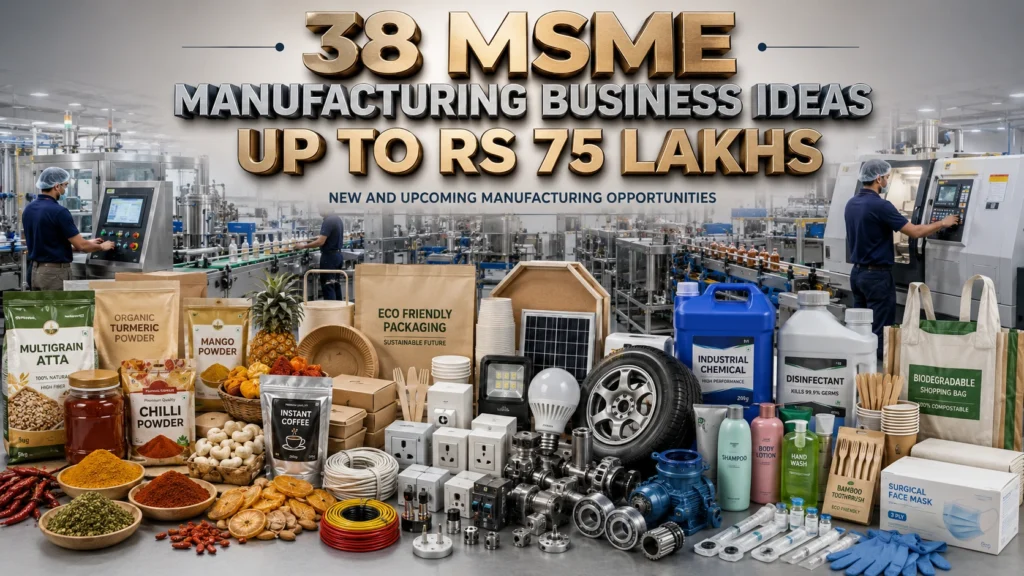
Introduction: Why Manufacturing Still Wins India’s MSME manufacturing sector is at a turning point. There has been a perfect alignment of policy tailwinds, expansion of domestic demand and structural changes in global supply chains, that is unusual. These 38 MSME manufacturing business ideas are a working blueprint, not a motivational talk for the first time entrepreneur and investor who is ready to study the opportunity thoroughly. The investment range covered here is deliberately chosen such that, investment up to ₹75 lakhs. It falls short of the micro enterprise, but it’s not too much for bank loans, government grants or reasonable personal investment. As per Ministry of MSME, the MSME sector is already contributing to over 29% of GDP and employing more than 1.11 crores of people in India. However, thousands of product categories are still not tapped, particularly in speciality manufacturing, agro-processing and industrial components. Those who see these gaps now are the ones who create sustainable and profitable ventures in the future. Why This Is the Right Moment to Enter MSME Manufacturing There are multiple structural forces at play. Global buyers are making supply chains more diversified by no longer relying on only one country. Although wages have been increasing in India, it has been found that the wages are still low as compared to the East Asian countries, in many verticals of the manufacturing industry. The buying habits of the domestic market are changing to more branded, packaged and processed products that MSMEs can compete at relatively low investment. Moreover, DPIIT data has always reflected that manufacturing investment in Tier-2 and Tier-3 cities yields higher ROCE as compared to investments in metros due to lower cost of land, labour and logistics. The Industrial corridors in Rajasthan, Uttar Pradesh, Madhya Pradesh, Odisha and Telangana are maturing with ‘plug and play’ factory sheds, reliable power and road connectivity. With the addition of government procurement through the GeM portal, one has a new channel of demand for new producers who are not present 10 years ago. The profit logic is also attractive. Companies of this size and brands with established products don’t compete in smaller product categories that are specialised. This presents huge white space for MSME manufacturers who have a strong understanding of their product category, maintain quality and establish connection with the B2B buyers or distributors before scaling. Government Support: Schemes Every Aspiring Manufacturer Must Know PMEGP – Prime Minister’s Employment Generation Programme PMEGP is still the most streamlined and direct entry stage for new MSME manufacturers. It provides project cost subsidy ranging from 25–35% up to ₹50 lakhs for manufacturing units and has lower subsidy rate for urban entrepreneurs and higher subsidy rate for SC/ST, women and ex-servicemen. Processing of applications is done at KVIC, KVIBs and District Industry Centres. The rest of the money comes from the bank and the entrepreneur’s own margin may be as little as 5–10% of project cost. CGTMSE – Collateral-Free Lending for MSMEs The Credit Guarantee Fund Trust for Micro and Small Enterprises will facilitate collateral-free credit facilities for eligible MSME manufacturers up to ₹2 crore. This is game-changer for asset-light businesses or entrepreneurs who don’t have mortgageable assets. Currently, most banks actively encourage CGTMSE-backed viable manufacturing projects. Technology Upgradation Fund and PLI Ancillary Benefits Technology Upgradation Fund Scheme (TUFS) offers subsidy on term loans for machinery to enable the new units to acquire modern machines at lower effective cost. In parallel, various schemes such as Production Linked Incentive (PLI) are driving demand from the supply chain that MSME sub-suppliers and ancillaries can directly tap. Udyam Registration and GeM Marketplace All MSME manufacturers should Udyam Registration before starting their business. It enables access to priority sector lending, reduced collateral and access to government procurement through the Government e-Marketplace (GeM). GeM has proved to be one of the most formidable demand channels for small manufacturers, giving them direct access with the institutional buyers in the central and state government departments. 38 New and Upcoming MSME Manufacturing Business Ideas Under ₹75 Lakhs 1. Compostable and Plant-Based Packaging The plastic restriction policy in India has ushered in a compulsory demand shift towards alternative options of packaging made from plants. Areca leaf plates, sugarcane bagasse containers, cornstarch films, and cassava-based bags are being provided by manufacturers to food chains, quick-service restaurant chains, airlines, and event managers. The purchase of thermoforming or hydraulic press setups with agricultural by-products can cost between ₹45 lakhs. The raw materials are mainly agricultural wastes and the margin is over 30%, due to the low acquisition cost. 2. Millet and Ancient Grain Food Processing Millets have come of age as a category of commercial crops. The Ragi pasta, jowar flour mixes, bajra health bars and foxtail millet porridge products are now available on major e-commerce platforms at a considerable premium over the grain-based products. A small food processing unit can be established with grading, roasting and packaging facility for as low as ₹30 lakhs. For this category, there is also the possibility of extra funding through the PMFME scheme and extra marketing assistance. 3. EV Wire Harness and Cable Assembly The need for components is higher than what can be delivered by the big Tier 1 manufacturers by the time India’s e-vehicle population grows. There are several high demand sub-assembly products such as wire harnesses, battery management system connectors, and cable assemblies for two- and three-wheel EV types. A precision wire harness unit with testing facility will cost you ₹40–70 lakhs and you can get a deal from the EV OEMs (originating equipment makers) in Pune, Chennai, Bengaluru, and the NCR belt. 4. Cold-Pressed and Wood-Pressed Oils The consumer willingness to pay 50-80% more for cold-pressed oils as compared to refined oils is the sign of a gradual change in their attitude towards health, which is now mainstream and not emerging. Cold pressed oils like groundnut, sesame, coconut and mustard are doing well in organic outlets, modern trade and D2C outlets. The cost of a traditional wood-press or steel-press unit with