
3 High-Demand Manufacturing Business Ideas – PET Preform, PET Bottle & Tile Adhesive – Each with ₹50 Lakh+ Annual Profit Potential
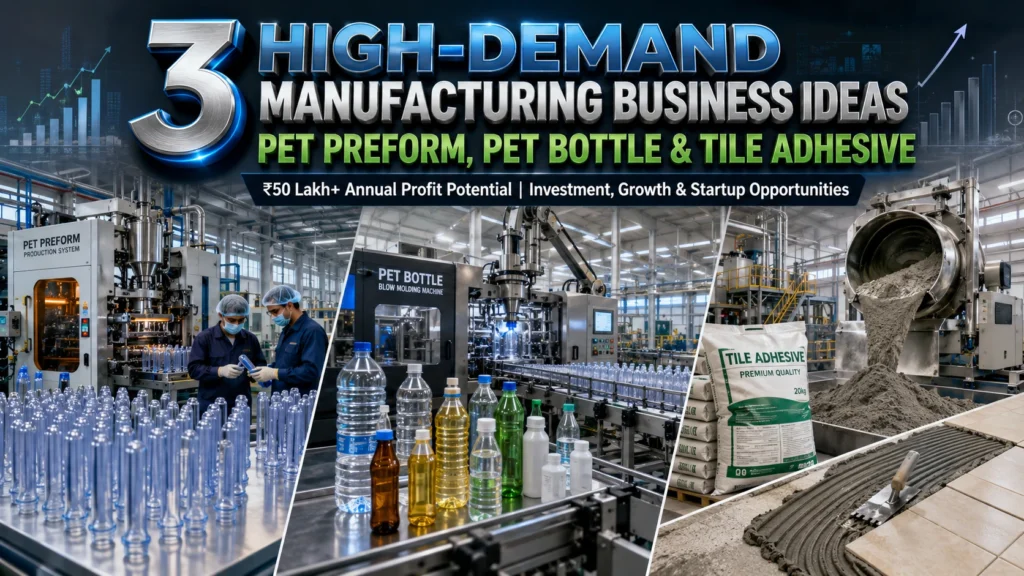
PET Preform Manufacturing Business Where Real Manufacturing Business Ideas Are Made As a nation on a fast track to a $5 trillion economy, the best business concepts often cannot be enjoyed in apps or fintech, but rather reside in the supply chain of everyday materials. PET preforms, PET bottles and tile adhesive might not be in the headlines, but they work behind the scenes to provide the backbone to India’s booming beverage sector, construction industry, and pharmaceutical supply chain. They’re not down-under plays. They are policy-mandated, demand-driven, capital efficient manufacturing avenues that are increasingly seen as one of the surest bets entry points for the manufacturing sector by first-generation entrepreneurs, MSME investors, and industrial consultants. These three segments are ones that should be closely monitored by anyone who is considering investing money on a project at the next investment cycle. Get Detailed Insights from This Book: Our Books Why This Sector — And Why Now Urbanization, organised retail and government infrastructure initiatives have put packaging and construction materials in a highly conducive situation. India’s per capita consumptions of packaged beverages are far below the global average and, for the PET packaging entrepreneur, this is nothing but structural space for growth. The disorganized construction material segment, on the other hand, is undergoing transformation in response to the rising demand for performance-based adhesives for tiles, as seen in the quality-driven approach of real estate developers and the mass housing goal of Pradhan Mantri Awas Yojana. India’s export prospects are good as the quality-price positioning is in their favour in the markets of Southeast Asia, Middle East, and parts of Africa. The domestic tile adhesives market is at a similar juncture—with the Indian flooring market shifting away from commodity tiles to higher value formats, the adhesive requirement per square metre has risen and so has the margin. These are not cyclical tailwinds; they are structural trends that are being fueled by regulatory adjustments, construction standardisation and urbanisation and income growth. Government Policies and Incentives Supporting Entry The government has made clear its intention to drive growth through manufacturing and it has given support for this in practice. The industrial infrastructure support, funding for technology upgradation, and single-window clearances are applicable to plastic packaging and construction material manufacturing units under the Make in India scheme. The Credit Guarantee Fund Trust for Micro and Small Enterprises (CGTMSE) scheme is a crucial support for first-generation entrepreneurs who do not have legacy assets to put up as collateral for loans for up to ₹2 crore, for MSME-registered units by the Ministry of Micro, Small & Medium Enterprises (MSME). The CLCSS (Credit Linked Capital Subsidy Scheme) of the DPIIT offers Capital subsidy of up to 15% for Technology Upgradation in Small Enterprises, applicable for Small PET Processing units who are investing in newer Injection Moulding or Blow Moulding technology. The Production Linked Incentive (PLI) framework is now focussed on the high investment sectors, but has generated momentum in the ecosystem, resulting in Tier-2 suppliers such as PET preform manufacturers, who serve large FMCG customers being benefitted. The National Housing Bank (NHB) and PM Awas Yojana are fueling the demand for tile adhesive in affordable housing market, which is providing regular off-take for new manufacturers. Other state governments have provided interest subventions, power tariff concessions and land package in the greenfield clusters of manufacturing units located in the industrial estates offered by various states, which significantly reduces capital deployment by the proponents of new projects. Manufacturing Business Ideas for Startups: Product-Wise Analysis 1. PET Preform Manufacturing from PET Resin A crucial entry point in the Indian packaging economy is PET preforms, intermediate mouldings in test tubes that are then stretch blow-moulded into PET bottles. The business model is simple in structure and requires utmost care in execution: raw PET resin (mostly obtained from Reliance Industries and IOCL and imported grades from Korea and China) is dried and then injection moulded with precise temperatures and pressures to get preforms of specific neck finish, weight and wall thickness as per client specifications. If a mid-size unit (4-6 injection moulding machines with a combined output of 8-12 million preforms per month) operates at prevailing market prices, it can generate a revenue of ₹4-6 crore/month, excluding other expenses such as resin cost, while the EBITDA margin is likely to range from 12-18% depending upon the efficiency of resin procurement and capacity utilisation. This is especially appealing to new investors thanks to the customer profile. PET preform buyers in the Indian market include some of the most credible players in the FMCG, beverage, and pharmaceuticals and personal care segments where the entire payment cycle is more or less standardised and there is a predictable offtake. Even having a committed supply contract with two or three local branded mineral or beverage water companies can give the base revenue predictability necessary to repay project debt. The following are important technical factors: 28mm, 38mm or custom finishes for the neck, IV (Intrinsic Viscosity) control in order to achieve the barrier properties, and optimisation of cycle time for the control of the per-unit conversion cost. The payback period is usually 3 – 4 years, for a commercially viable plant capital investment is in the range of ₹1.5 – 3 crore with 70%+ utilization of the machines. 2. PET Bottle Manufacturing The downstream part of the PET bottle value chain, after preform production, is the PET bottle segment, and it can be said that it is the more commercial part from the perspective of the public. These are either bought or produced in-house and are then stretched to the final bottle shape under air pressure in a mould (stretch blow moulding). PET bottles are used in beverages (carbonated soft drinks, juices, water), edible oil, pharmaceutical syrups, personal care (shampoo, hair oil, lotions) and home care products in India. Every segment is driven by specific specification demands – such as pressure ratings for CSD bottles and HDPE demands for pharma applications – and the small business person stepping into