
Chemical Manufacturing Business Ideas in India
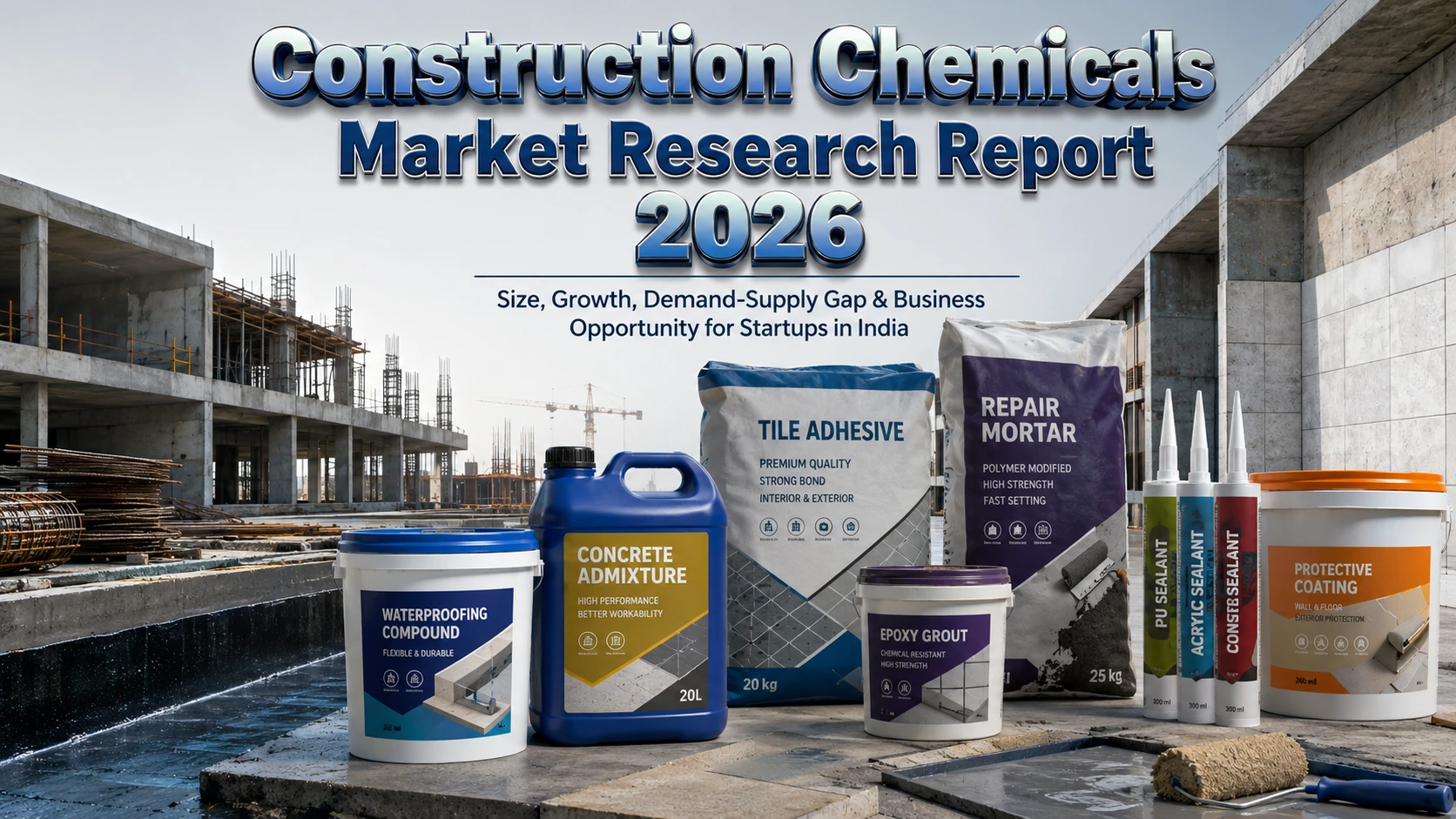
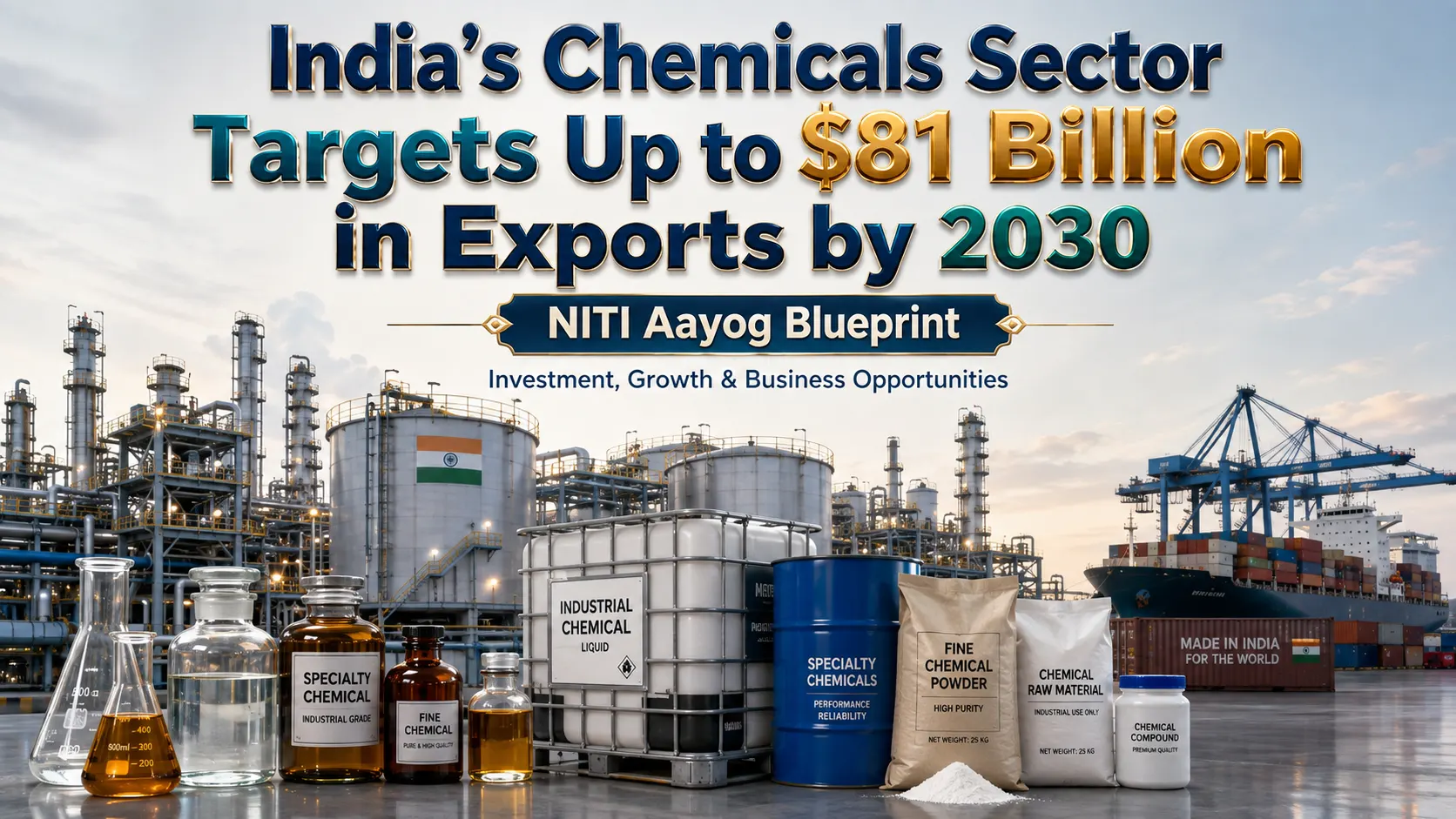
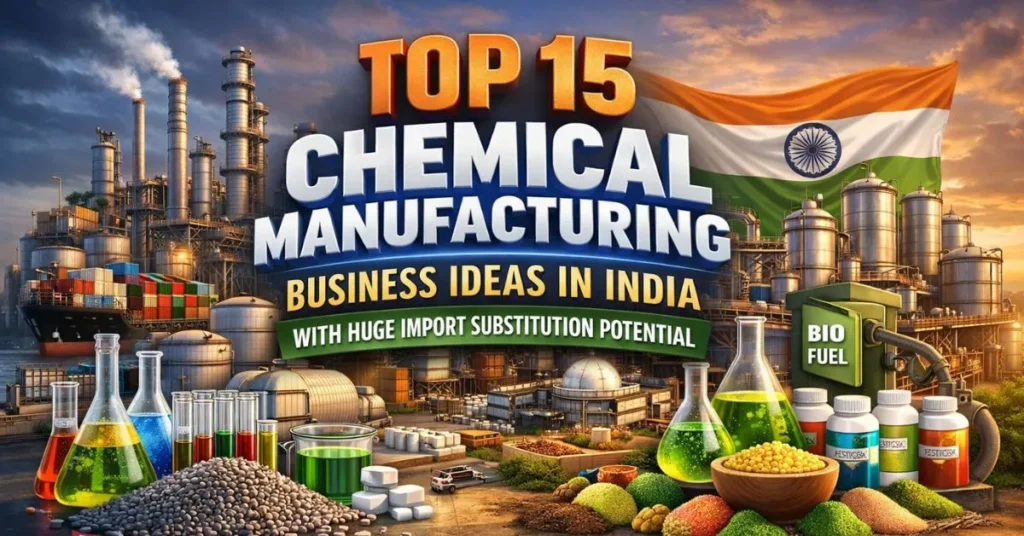
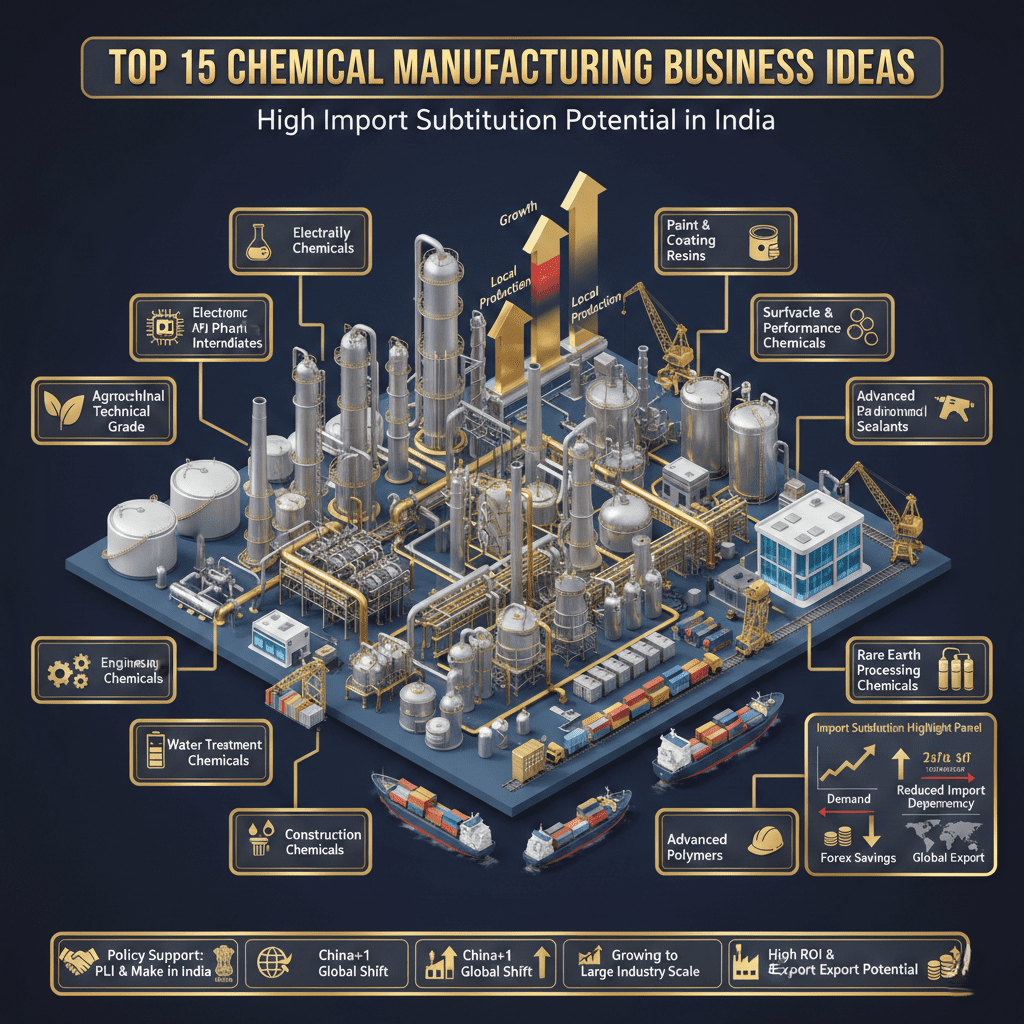
The chemical industry in India is growing faster than the manufacturing capacity. Growth in construction, automobiles, packaging, FMCG, electronics, textiles and renewable energy has severely impacted an increased demand for chemicals, while domestic supply is lagging. This mismatch has sent India’s import of chemical and petrochemicals (minus pharmaceuticals and fertilisers) to over ₹2.27 lakh crore in 2023-24.
For MSMEs and new entrepreneurs, this is a rare opportunity in this gap. With government support in the form of Plastic Park and PCPIR along with capital subsidies of up to 50%, manufacture of chemicals is not a preserve to ‘big’ corporates and ‘big’ players. Below are fifteen chemical manufacturing opportunities where import substitution, steady demand and scalability combine.
Contents
- 1. 1. Vinyl Acetate Monomer (VAM)
- 2. 2. Ethylene Vinyl Acetate (EVA)
- 3. 3. Acrylonitrile
- 4. 4. Butyl Rubber
- 5. 5. Styrene-Butadiene Rubber (SBR)
- 6. 6. Polybutadiene Rubber (PBR)
- 7. 7. EPDM Rubber
- 8. 8. Unsaturated Polyester Resin (UPR)
- 9. 9. Polyacetal Resin (POM)
- 10. 10. Mono Ethylene Glycol (MEG)
- 11. 11. Polycarbonate
- 12. 12. Toluene
- 13. 13. EDC and VCM (PVC Feedstocks)
- 14. 14. Hydrogen Peroxide
- 15. 15. Titanium Dioxide
- 16. Strategic Roadmap for MSMEs
- 17. Final Conclusion
- 18. Frequently Asked Questions (FAQs)
Read More: Handbook On Chemical Industries (Alcohol Based)
1. Vinyl Acetate Monomer (VAM)
Vinyl Acetate Monomer is a basic raw material for adhesives, emulsion paints, packaging films and EVA Polymers. Currently, India does not have a large-scale VAM manufacturing industry and imports more than 1470 crore rupees worth of VAM every year.
Why VAM is attractive
- Strong demand from construction adhesives and paints
- Near-total import dependence
- Clear scope for integration with ethylene & acetic acid
A domestic VAM unit which is close to a petrochemical hub can easily get high capacity utilisation because of strong downstream demand.(Chemical Manufacturing Business Ideas in India)
2. Ethylene Vinyl Acetate (EVA)
EVA is used widely in footwear soles, solar panel encapsulants, hot-melt adhesives, and flexible packaging. While the domestic capacity is limited, the imports remain more than ₹3,100 crore.
Business potential
- Rapid industrial growth in footwear and solar energy
- The benefits of this process include the following: – Opportunity in EVA compounding and sheet manufacturing
- Lower capital requirement in comparison with polymerisation plants
3. Acrylonitrile
Acrylonitrile is necessary to ABS plastics, acrylic fibres and nitrile rubber. India is entirely reliant on imports of almost 1800 crore per year.
Instead of immediately investing in large-scale production, MSMEs have an option to focus on downstream segments like ABS moulded components, nitrile rubber compounding and acrylic fibre based products.(Chemical Manufacturing Business Ideas in India)
4. Butyl Rubber
Butyl rubber is important in tyre inner tubes and in pharmaceutical closures. Even after the commissioning of the first major plant in India, the imports still seem to be in excess of ₹1,000 crores every year.
Where MSMEs fit in
- Manufacturing of inner tube and bladder
- Pharmaceutical bamboo stoppers
- Sealing products for the automotive sector
5. Styrene-Butadiene Rubber (SBR)
SBR is a backbone of the tyre industry. Despite domestic production, imports of SBR is still above Rs 2,000 crore because of increased automobile demand.
MSMEs can successfully work in the rubber compounding and customised SBR formulations for tyres, footwear and industrial belts.(Chemical Manufacturing Business Ideas in India)
Read More: Modern Technology of Industrial Chemicals
6. Polybutadiene Rubber (PBR)
Polybutadiene rubber has high levels of resilience and abrasion resistance, which makes it ideal for use in tyre treads and industrial products. Imports amounting to around Rs 1700 crore show the gap in supply.
Key opportunities
- High performing rubber blends
- Tyre tread compound modification
- Export oriented specialty grades
7. EPDM Rubber
EPDM rubber is commonly used in automotive weather seals, roofing membranes, and cable insulation. India does not have any domestic EPDM manufacturing which has led to imports of more than 1100 crore.
For MSMEs there is constant demand for EPDM extrusion, gasket production and sealing systems for vehicles and buildings.(Chemical Manufacturing Business Ideas in India)
8. Unsaturated Polyester Resin (UPR)
UPR is a base material for FRP tanks, panels, boat hulls, and wind energy components. Imports are around more than a 1000 crore a year because of infrastructure growth.
Small and medium UPR plants and FRP product manufacturing suit those MSMEs with regional market orientation.
9. Polyacetal Resin (POM)
Polyacetal is an engineering plastic for precision automotive and electrical components. India is still completely dependent on imports.
Why POM is promising
- Increase in automobiles and electronics
- High value-added applications
- Opportunity in compounding and precision moulding
Read More: Project Reports & Profiles
10. Mono Ethylene Glycol (MEG)
MEG is necessary in polyester fibres and PET bottles. Imports are more than a rupee four thousand three hundred crore per year despite domestic production.
MSMEs can reach this segment through bio-based MEG, polyester yarn spinning and PET recycling as per the sustainability goals.(Chemical Manufacturing Business Ideas in India)
11. Polycarbonate
Polycarbonate has a high impact strength and transparency, which makes them ideal for helmets, EV parts and electronics. Imports are more than 5000 crore every year.
MSME entry points
- Polycarbonate sheets and roofing (panels)
- Auto parts and electrical components
- Safety and glazing products
12. Toluene
Toluene has a wide variety of applications as a solvent and as a feedstock for chemical derivatives. Domestic supply is lacking and imports amount to almost crore 4800.
MSMEs can concentrate on purification, specialty solvent grades and derivative products for pharmaceuticals and specialty chemicals.(Chemical Manufacturing Business Ideas in India)
13. EDC and VCM (PVC Feedstocks)
EDC and VCM are important for making PVC. Due to demand for PVC exceeding the domestic capacity, imports of these feedstocks continue to be high.
Downstream scope
- PVC compounding
- Wire and cable insulation
- Flooring, medical grade PVC
14. Hydrogen Peroxide
Hydrogen peroxide is applied in the textiles, pulp and paper, chemicals and water treatment industries. High capacity utilisation is a sign of tightness in the supply.
Regional production, dilution units and specialty grades are viable MSME opportunities.(Chemical Manufacturing Business Ideas in India)
15. Titanium Dioxide
Titanium dioxide is the most commonly used white pigment in paints and plastics. Domestic production is limited in spite of good demand.
Value-added opportunities
- TiO2 masterbatch manufacturing
- Paint and plastic additives
- Import substitution on coatings industry
Strategic Roadmap for MSMEs
Across these segments, the pattern is clear: growing demand, import dependency and policy support. Entrepreneurs who identify the right product, location (within industrial clusters) and technology (which may be proven) can assemble scalable chemical businesses. The professional feasibility studies offered by Niir Project Consultancy Services establish bankability while decreasing operational risks.(Chemical Manufacturing Business Ideas in India)
Final Conclusion
India’s increasing chemical import costs create significant business opportunities for MSMEs. Entrepreneurs can establish successful manufacturing companies that meet both domestic and international market demands by using strategic business planning and targeted bullet point selection and chemical market analysis.(Chemical Manufacturing Business Ideas in India)
Frequently Asked Questions (FAQs)
Is chemical manufacturing viable for MSMEs in India?
Yes. Cluster-based infrastructure, subsidies, and strong domestic demand make several chemical segments ideal for MSMEs.
Which products offer the highest import substitution potential?
Polycarbonate, MEG, EVA, VAM, acrylonitrile, and specialty rubbers currently show the largest gaps.
What investment size is required?
Downstream processing units may start from ₹5–25 crore, while core chemical plants require higher investment depending on capacity.
Can MSMEs export chemical products?
Yes. Many of these chemicals and derivatives have strong export demand in Asia, Africa, and the Middle East.
Do I need prior chemical industry experience?
First-generation entrepreneurs who lack experience can achieve success through proper consultants and technology partners and effective feasibility studies.