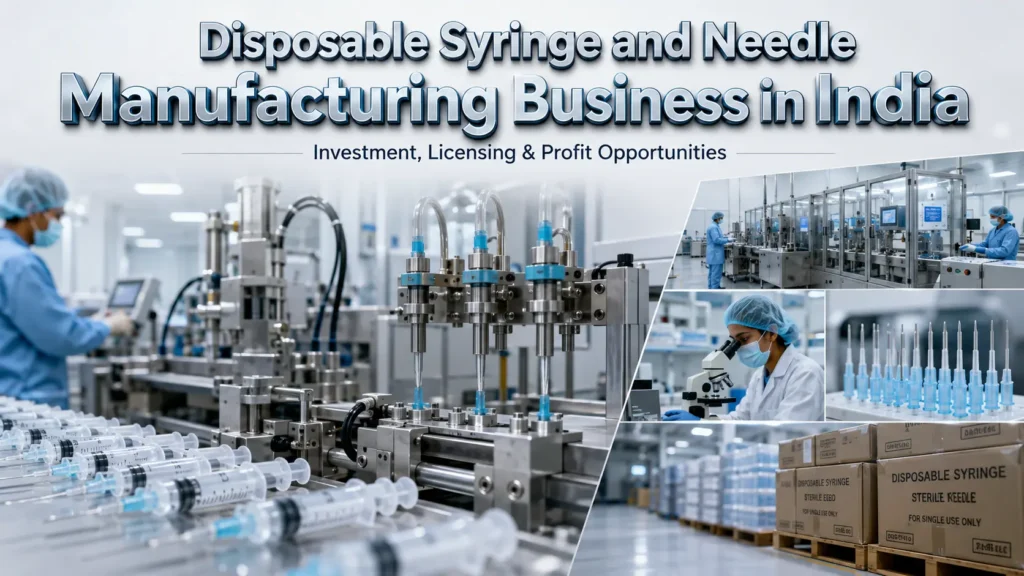

Disposable Syringe Manufacturing Business in India
Although India produces more than 16 billion syringes per year and exports almost 80 percent of the world’s auto-disables, the demand for both from government and PMJAY hospitals and export markets still lags behind supply in a number of geographies making this one of the most stable and scalable manufacturing opportunities in India’s medical devices sector. The disposable syringe market is a guaranteed market for an entrepreneur who can understand CDSCO and BIS certification, as well as have clear regulatory pathways, a runway of demand over many years.
Market Opportunity: Why This Business Cannot Be Ignored
Though the country is a global power in the manufacture of syringes, the production base is concentrated in a few centres in Faridabad (Haryana) and Baddi (Himachal Pradesh) thereby posing procurement risk to hospital buyers in lesser served states, according to Association of Indian Medical Device Industry (AIMED). Tier-2 and tier-3 cities are actively looking for regional suppliers for reliability and quick turnaround time, presenting a solid commercial opportunity for new manufacturing companies that are certified.State government health missions and new PMJAY-empanelled hospitals are also keen on sourcing from the region for reliability and quick turnaround time, offering a clear commercial opportunity for new certified manufacturers.
The segment is a geographic quality bottleneck and the Make in India production incentives by the MSME Ministry are specifically targeted to overcome this quality bottleneck. The production entrepreneurs who set up their business in less developed states are eligible for the benefit of capital subsidy under PMEGP, government industrial incentives, and preference in procurement from government health departments to diversify their medical consumables procurement from single cluster dependence.
Get Detailed Project Report (DPR): Disposable Plastic Syringes Manufacturing Project Report
Industry Analysis: Growth Drivers and Demand Outlook
Indian domestic syringe market is worth about Rs. 4,000 crores with growth rates of 10-12% CAGR. With registration on the Government e-Marketplace (GeM), all those manufacturers will automatically get guaranteed business from the public sector as it comes through NHM, CGHS and defence hospitals, which has proven to be one of the most consistent and expanding revenue streams for any medical device manufacturer in India. SYRINGES and INJECTION DEVICES are one of the top export categories for the medical devices sector in India, with the market expected to grow at a CAGR of 14.3% to USD 50 billion by 2030, according to the IBEF Medical Devices Sector Report.
With the introduction of mandatory product changeover from non-auto disable syringes to auto-disable (AD) syringes as a part of the National Health Mission’s Universal Immunisation Programme guidelines, only BIS IS:10654 manufacturers can leverage this product upgrade. The ISO 13485 and WHO-GMP certifications open the door to the UNICEF and UNFPA procurement programmes, which are among the most predictable international sources of income that are available. Auto-disable syringes have been identified as a top-10 priority import substitution product by the Invest India Medical Devices investment guide and PLI scheme incentives and government procurement preference are actively helping domestic manufacturers. The Directorate General of Foreign Trade (DGFT) handles the administration of RoDTEP and duty drawback claims, thereby enhancing the net export realisation of eligible syringes to international buyers by 2-5 percent. Indian manufacturers can follow these WHO Medical Devices Access Programme (MDAP) prequalification pathways to provide products to the UNICEF and UNFPA procurement agencies in 120+ LMICs.
India Syringe Industry Snapshot
| Parameter | Data | Source / Note |
| India Annual Syringe Output | 16+ billion units | FICCI and AIMED estimates |
| Domestic Market Value | Approx. Rs 4,000 crore | Industry estimates |
| Market Growth (CAGR) | 10-12% per year | NHM hospital expansion |
| India Global AD Syringe Share | ~80% of world supply | Hindustan Syringes data |
| Main Production Cluster | Faridabad, Haryana | Industry survey |
| Key Government Buyer | NHM, CGHS, state CMSDs, defence hospitals | GeM procurement |
| Leading Indian Brand | Dispovan (Hindustan Syringes and Medical Devices) | Faridabad, Haryana |
How to Start: Step-by-Step Guide for Entrepreneurs
Step 1: Business Registration and MSME Enrollment
Get your entity (Private Ltd, LLP or Sole Proprietorship) registered and enroll on the Udyam portal at udyamregistration.gov.in to avail MSME benefits. Locate in a state MIDC, GIDC or RIICO industrial estate on an industrial plot of at least 2,000 sq.ft. to avail benefit of lower utility charge and state capital subsidy. Before going for CDSCO License get a Factory License (Act 1948) and get GST Registration. Under the capital subsidy scheme, the new manufacturing units will have to register on the Udyam MSME Registration Portal to get benefits of the capital subsidy scheme for syringe manufacturing units, collateral-free loan under CGTMSE, and state industrial incentive which helps to keep the equity requirements minimised for setting up a syringe plant.
Step 2: CDSCO Class B License and BIS Certification
Disposable syringes are medical devices of class B under MDR 2017 which must be obtained from the State Licensing Authority in the form of a Manufacturing License (Form MD-5). Apply for BIS certification for both auto-disable syringes (IS:10654) and hypodermic syringe (IS:10178). Prepare your Quality Management System documentation for ISO 13485 certification which is strongly recommended to participate in government tenders and export.
Read the Complete Book Here: Handbook on Medical & Surgical Disposable Products
Step 3: Machinery Procurement and Clean Room Setup
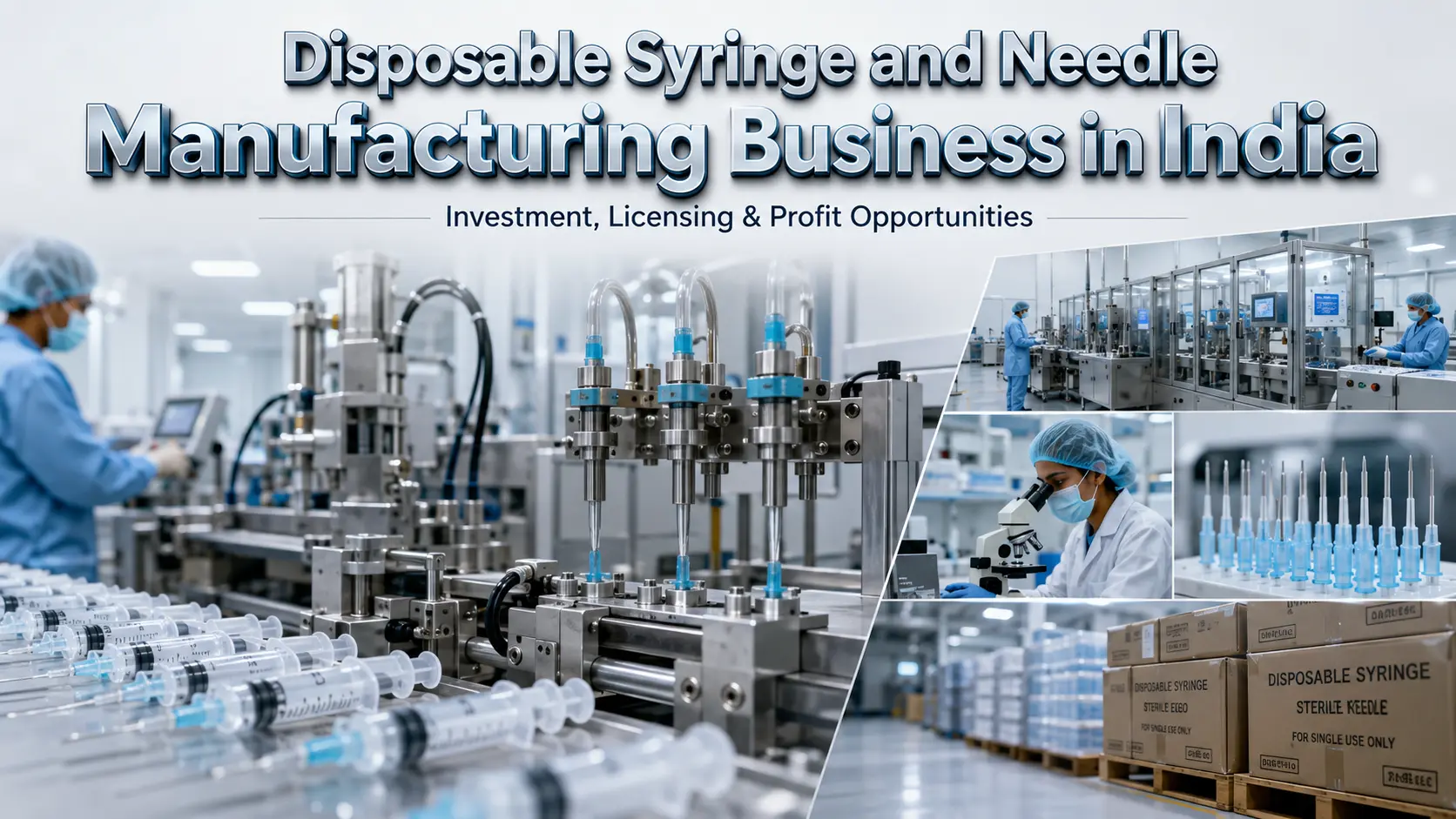
The core machinery mainly consists of polypropylene injection moulding machines for barrel, plunger, piston; blister sealing machine; needle tube cutting and grinding equipment; automated assembly conveyor. Set up ISO Class 7 or 8 cleanroom for assembly and packaging according to CDSCO GMP guidelines. Early stage, you can avail the contract with the certified third-party ETO or gamma sterilisation centres in Delhi NCR, Mumbai, and Bengaluru.
Step 4: Quality Control Lab and Sterility Testing
Maintain an in-house QC laboratory to perform dimensional checks, break-out point testing (AD syringes), dead space checks and sterility spot checks. Common instruments are a profile projector or digital calipers, a burst pressure tester, and a particle counter. Before you get a manufacturing licence, your QC lab protocol should meet the needs of CDSCO GMP and the appropriate BIS product standard specifications.
Step 5: GeM Registration, Sales, and Export
To avail NHM, CGHS as well as defence and railway hospitals procurement, register on Government e-Marketplace at the website of government e-Marketplace-gem.gov.in. Establish regional distributors for institutional pharmacy, hospital stores and medical wholesale market. To get access to UNICEF, UNFPA and bilateral government tender programmes, register with FIEO (Federation of Indian Export Organisations) and undergo WHO-GMP prequalification.
Project Investment Breakdown (Small Scale Unit)
| Cost Item | Estimated Amount (INR) | Notes |
| Industrial shed / lease (2,000 sq ft) | Rs 8 – 12 lakhs per year | Or one-time for owned site |
| Injection moulding machines (2 units) | Rs 18 – 28 lakhs | Barrel, plunger and piston moulds |
| Needle assembly and grinding unit | Rs 12 – 20 lakhs | Core production equipment |
| Assembly conveyor and sealing line | Rs 6 – 10 lakhs | Semi-automated |
| Clean room fitout (ISO Class 8) | Rs 5 – 12 lakhs | Depends on floor area |
| QC lab and testing instruments | Rs 4 – 7 lakhs | Dimensional, sterility checks |
| Raw material stock (1 month) | Rs 8 – 14 lakhs | PP resin, SS tube, rubber pistons |
| CDSCO, BIS licensing and ISO 13485 | Rs 3 – 5 lakhs | All regulatory costs |
| Working capital (3 months) | Rs 10 – 20 lakhs | Salaries, utilities, overheads |
| TOTAL ESTIMATED PROJECT COST | Rs 74 – 128 lakhs | Scales to Rs 3Cr+ at medium size |
Financial Projections and Profitability
Revenue generated by a small syringe machine that can produce 5 million per month will be Rs 3-5 crore per year. Net margins for medical consumables are generally in the range of 12-18 per cent after raw material, power, labour and overheads and the payback period is 2.5-4 years at this scale, FICCI’s Healthcare Sector Report said. Marketing costs are significantly cut back as all government tender contracts are of 1–2-year duration, giving the government the certainty of revenue.
Medium scale units have annual revenues of Rs 12-20 crore per month with 20-30 million productions. Direct selling of WHO-prequalified AD syringes through FIEO (Federation of Indian Export Organisations) creates another revenue stream, which offers a higher realisation value compared to tender-based sales in the domestic market; bilateral export organisations offer connections to buyers in Africa and Southeast Asia. Syringe exporters can use duty drawback claims and export documentation through Pharmexcil (Pharmaceuticals Export Promotion Council of India) to enhance net export realisation of WHO prequalified AD syringes to Africa and Southeast Asia.
Related Article: Medical Disposables Manufacturing in India: MSME Guide to Profitable Products & Export Opportunities
Government Schemes and Incentives for Medical Manufacturers
| Government Scheme | Key Benefit for Manufacturer | Eligible Business Type |
| PMEGP (KVIC/MSME) | 25-35% capital subsidy, max Rs 25 lakh for manufacturing | New micro and small units |
| CGTMSE (SIDBI) | Collateral-free loans up to Rs 5 crore for MSMEs | All MSME manufacturers |
| PLI – Medical Devices | 4-6% production-linked incentive on incremental sales | Approved device manufacturers |
| Startup India (DPIIT) | 3-year income tax holiday, fast-track regulatory support | DPIIT-recognised startups |
| State MSME Capital Subsidy | 15-25% subsidy on plant and machinery (varies by state) | State-notified MSME units |
| SIDBI MSME Loans | Concessional term loans for equipment and capacity expansion | All small manufacturers |
Entrepreneur Spotlight
Ravi Shankar Verma | Kanpur, Uttar Pradesh
Ravi Shankar Verma, a B.Pharm graduate from Kanpur, started a disposable syringe manufacturing unit with an investment of Rs 88 lakh (PMEGP subsidy and CGTMSE loan). He got the first NHM state level tender of Rs 1.2 crore within 18 months by clearing the BIS IS:10654 certification.
Today Ravi has a 10,000 sq ft plant with a capacity of 6 million syringes, 40 permanent employees and annual revenues of over Rs 4.5 crore. He can thank the NPCS Detailed Project Report he produced prior to going to his bank for convincing him to take his first loan out without any collateral.
How NPCS Supports Your Business Launch
In more than 45 years, Niir Project Consultancy Services (NPCS) has developed more than 8,000 Detailed Project Reports (DPRs) for various industrial sectors, such as medical devices and hospital disposables. The NPCS DPR provides for disposable syringe and hypodermic needle manufacturing, plants layout, plant machinery specifications with suppliers/contacts, raw material sourcing, CDSCO plant machinery licensing pathway, bank ready Plant Investment analysis, and financial projections.
Commissioning of an NPCS DPR brings entrepreneurs guidance on government scheme applications, export registrations and quality certification roadmaps tailored to scale and state. Visit niir.org to see project reports in this sector, or flip through Entrepreneur India magazine for sector case studies and investment analysis at Entrepreneur India magazine.
Start with clarity—choose the best business idea
Key Reference Links and Further Reading
Bureau of Indian Standards – IS:10654 and IS:10178: https://www.bis.gov.in
National Health Mission India: https://nhm.gov.in
Make in India – Medical Devices Sector: https://www.makeinindia.com/sector/medical-devices
AIMED – Association of Indian Medical Device Industry: https://www.aimed.info
Government e-Marketplace (GeM): https://gem.gov.in
Frequently Asked Questions
The starting cost of a syringe manufacturing business in India is Rs. 5 lakhs to Rs. 10 lakhs.
A small-scale disposable syringe unit will need Rs 75 lakh to Rs 1.25 crore of investment for equipment, clean room fitout, raw material stock, CDSCO and BIS licensing fees and working capital. Initial capital requirement can be reduced by hiring sterilisation service and leasing factory space instead of building a factory.
Disposable syringes can be manufactured in India under which license?
In India, Disposable Syringes are all classified as Class B medical devices according to the Medical Devices Rules 2017 (MDR). A Medical Device Manufacturing License is required from the State Licensing Authority (SLA) in the state in which your factory is located, on Form MD-5. For market sale and government procurement, BIS product certification in accordance to IS:10178 or IS:10654 also is necessary.
No, BIS is not a compulsory certification for the manufacture of syringes.
Yes. BIS has announced that the auto-disables syringes used in the government immunisation programme must be certified as per IS 10654. IS:10178 is relevant to an ordinary hypodermic syringe. Your products will not be able to be sold via government procurement or exported to certain markets, such as UNICEF procurement programmes, if they are not BIS certified.
What ingredients are needed to produce syringes and where do they come from?
Key raw materials are medical-grade polypropylene (PP) for barrel, plunger, and hub; SS304 stainless steel tubing for the needle cannula; synthetic rubber for the piston; and silicone oil for lubrication. Most materials are available from domestic suppliers such as Reliance Industries, IOCL and Specialty polymer distributors etc.
Is it possible to import syringes from India and what are required?
India is the world largest export of AD syringe to 120+ countries. WHO-GMP prequalification is a mandatory requirement for UNICEF and WHO funded export programme. CE marking is required for products to be exported to the EU. The export registration and buyer connection support is provided by the registered Indian medical device manufacturers to the FIEO, APEDA and PHARMEXCIL.
NPCS helps you begin the manufacture of syringes.
NPCS develops a detailed Project Report that includes Plant Layout, List of Machinery with their suppliers, Guide for sourcing of raw material, CDSCO and BIS plant licensing process, Profit and Loss statements, Bank loan ready financial model, Break even analysis etc. The DPR also includes information on eligibility for government schemes, guidance on implementing ISO 13485 and an export market entry roadmap. For details of Project Reports visit niir.org.
Conclusion
The disposable syringe and needle manufacturing industry is one of the most promising avenues for entry into India’s medical device industry. The upswing in medical devices in India is clearly evidenced by the government’s commitment to procuring these devices under NHM and PMJAY, combined with the expected growth of the medical devices market at 12-15 percent per year, and the business case is even stronger for entrepreneurs who invest in getting their products into compliance with Invest India and ensure CDSCO and BIS clearance.
It is beneficial for entrepreneurs to avail both institutional revenue and export revenue as they can get CDSCO license and BIS certification along with GeM registration. With a well-prepared Detailed Project Report prepared by NPCS, based on the regulatory framework of Medical Devices Rules 2017 by CDSCO, your bank loan application and investor pitch becomes technically credible and enables you to get the product from business idea to commercial production, with confidence and speed.