Our Categories

Our Categories

npcsblog

NPCS: Your Partner in Making Informed Project Investment Decisions NIIR Project Consultancy Services (NPCS) delivers the expertise and insights you need to successfully launch or expand your industrial project. We offer a comprehensive suite of services including: Detailed Project Reports (DPRs): Thorough outlines designed to guide your entire project, from concept to launch. Market Research and Feasibility Studies: Gain critical awareness of market trends, demand, and the competitive landscape. Business Planning and Investment Guidance: Ensure your plans and investments are supported by reliable data and analysis. Technical Support and Consulting: Receive expert advice on process selection, machinery, raw materials, and more. Why Choose NPCS for Your Project Needs? Reduce Risk, Maximize Potential: Our reports give you a clear picture of a project's viability, helping you make smart decisions. Market-Driven Insights: Understand your customers, their needs, and the key factors that will drive the demand for your product or service. Financial Clarity: Get detailed forecasts and breakdowns of project costs, revenue projections, and profitability expectations. Actionable Data: Our reports translate complex information into clear recommendations, aiding your decision-making. What's Included in a Typical NPCS Report? Product Overview: Key definitions, uses, and industry insights. Market Analysis: Current and future demand, import/export trends, and top players. Raw Materials and Suppliers: Detailed listings and requirements. Manufacturing Process: Step-by-step outlines and formulations. Project Financials: Plant capacity, investment breakdown, revenue, and profitability. Ready to Start Your Project? NPCS is here to assist you in making the best project choices for a successful future. Contact us today and let our expertise give your venture a decisive edge.

Potato Chips and Snack Food Setup Manufacturing Business

Potato Chips and Snack Food Setup Manufacturing Business Read More »

The Snack Food Setup Manufacturing Business stands as a lucrative venture in the fast-evolving food industry. Snacks such as potato chips and extruded products like Kurkure have immense popularity across urban and rural markets. The rising demand for ready-to-eat, tasty, and convenient snacks fuels this industry’s growth. This article offers a comprehensive overview of product types, manufacturing processes, market outlook, investment benefits, costs, marketing strategies, risks, and practical advice for starting your own snack manufacturing unit. Understanding the Products Potato chips are thinly sliced potatoes, either fried or baked until they become crispy and crunchy. Consumers appreciate their texture and flavorful coatings, which make them a favorite snack worldwide. Extruded snacks, such as Kurkure, differ in manufacturing and ingredients. These snacks consist of a mix of starches—typically wheat, corn, rice, and gram flour. The dough is cooked under high temperatures using an extruder, which shapes it into unique forms. After frying, the snacks are coated with various seasonings to enhance flavor and appeal. Kurkure-style snacks stand out for their crunchiness, unique shapes, and spicy, savory flavors. These factors allow manufacturers to appeal to diverse consumer groups and expand their market base effectively. Visit this Page for More Information: Start a Business in Potato Processing Industry Manufacturing Process Starting production begins with sourcing high-quality raw materials. Fresh potatoes and premium edible oil form the basis for potato chips. For extruded snacks, procuring good-quality flours and spices is crucial. Next, you invest in machinery such as potato slicers, fryers, extruders, conveyors, seasoning equipment, and packaging machines. The production scale determines if cold storage facilities are necessary. The production process for potato chips involves uniform slicing of potatoes, followed by frying or baking until crisp. Seasonings get applied afterward to achieve the desired taste. For extruded snacks, the dough passes through the extruder, which cooks and shapes it simultaneously. The snacks are then fried and seasoned. Finally, the finished products undergo hygienic packaging, ready for market distribution. Quality Control Maintaining consistent quality ensures customer satisfaction and brand loyalty. Start by inspecting raw materials for freshness and quality before production. During manufacturing, monitor temperature, frying duration, and seasoning amounts precisely. After production, test samples for moisture content, oil levels, and microbial contamination regularly. Use moisture-proof, airtight packaging to preserve freshness and extend shelf life. This step prevents spoilage and helps your product stand out on store shelves. A rigorous quality control system reduces wastage, enhances product consistency, and builds trust with consumers. Related Business Plan: Start Production of Potato Chips And Extruded Snack Food (Kurkure Type) Market Outlook The snack food market, especially potato chips and extruded snacks like Kurkure, continues to grow strongly. Rising incomes, urbanization, and changing lifestyles increase consumer demand for quick, flavorful snacks. Both urban and rural populations enjoy these products, providing a broad consumer base. Smaller cities and towns offer underserved markets with less competition, presenting growth opportunities for new businesses. Additionally, consumer trends favor healthier options such as baked or low-fat snacks, encouraging manufacturers to innovate. Expanding distribution channels—from local grocery stores to large supermarkets and e-commerce platforms—helps manufacturers reach more customers and increase sales. Investment Benefits The Snack Food Setup Manufacturing Business requires a moderate initial investment, making it accessible for startups and small enterprises. Machinery costs typically range from $10,000 to $25,000, depending on capacity and automation levels. Production processes are straightforward and scalable. Entrepreneurs can start small and gradually increase output by adding shifts or equipment. The steady demand for snacks, combined with long shelf life, reduces the risk of spoilage and waste. These factors support sustained revenue generation. The business also benefits from low raw material costs, especially for potato chips, which use inexpensive ingredients like potatoes and oil. Moreover, digital marketing and e-commerce enable easy market entry and expansion into new regions or international markets. Cost Considerations Key costs include machinery, raw materials, labor, utilities, and packaging. Machinery such as fryers, extruders, and slicers represent the largest upfront expense. Raw material costs fluctuate with market supply and production volume. Potatoes, edible oil, flours, and spices form the main input expenses. Labor costs involve operators, quality control staff, and packaging personnel. Utility bills cover electricity, water, and fuel for cooking. Packaging materials must be durable, moisture-proof, and attractive to preserve product quality and entice buyers. Marketing and distribution expenses vary with strategy but are crucial for brand growth and market penetration. Careful financial management and cost control are essential to maintain profitability. Marketing and Sales Strategies Effective marketing can determine your success in this competitive sector. Develop eye-catching, branded packaging that highlights your product’s unique flavors and quality. Leverage social media platforms and digital ads to connect with younger consumers and create brand awareness. Collaborate with local retailers, supermarkets, and convenience stores to secure prominent shelf placement. Participate in food fairs, exhibitions, and trade shows to promote your brand and network with distributors. Consider listing your products on popular online marketplaces to reach customers nationwide or globally. Introducing new flavors, healthier options, or packaging sizes can attract new customers and keep existing ones interested. Read Similar Articles: POTATO CHIPS AND EXTRUDED SNACK FOOD (KURKURE TYPE) Challenges and Risk Management This business faces challenges such as raw material price fluctuations, machinery breakdowns, and shifting consumer preferences. Develop strong supplier relationships to ensure stable raw material supply and negotiate favorable prices. Schedule routine maintenance to avoid unexpected equipment failures and production delays. Stay updated with market trends and consumer feedback to adapt your products accordingly. Implement strict hygiene and quality standards to safeguard product safety and brand reputation. Building a diverse product portfolio can help spread risks and tap into emerging market segments. Read Our Book Here: Potato and Potato Products Cultivation Conclusion The Snack Food Setup Manufacturing Business offers promising growth potential and profitability. Understanding the products, investing in quality inputs and equipment, and executing strong marketing strategies are crucial for success. This business suits entrepreneurs seeking moderate startup costs, scalability, and access to a large consumer base. By focusing on innovation, consistent quality,

February 2023 Entrepreneur India Monthly Magazine

February 2023 Entrepreneur India Monthly Magazine Read More »

The February 2023 Entrepreneur India monthly magazine, published by Niir Project Consultancy Services (NPCS), guides entrepreneurs and investors to the most promising business ideas. Unlike typical investment publications, February 2023 Entrepreneur India actively identifies high-potential opportunities that deliver maximum returns while minimizing risks. The magazine evaluates various business plans by analyzing market demand, cost factors, location advantages, and profitability, helping readers make informed investment decisions. Entrepreneurs and startups rely on this resource to discover viable projects and avoid costly mistakes. With its focus on practical, well-researched business ideas, the magazine empowers readers to confidently select and launch ventures that align with current market trends. This hands-on approach ensures that every project highlighted offers strong growth potential and sustainable success. Overall, the February 2023 Entrepreneur India magazine remains an indispensable tool for those serious about business growth and smart investment. Curated Business Plans for Smarter Investment Decisions Each issue of February 2023 Entrepreneur India presents a carefully curated list of business plans, meticulously selected by the NPCS team after analyzing multiple critical investment factors. These include product demand, current and future market potential, strategic location suitability, cost implications, payback periods, and profitability thresholds. This comprehensive assessment ensures that only viable and lucrative projects are recommended. Why a Detailed Business Plan is Crucial A business plan acts as a detailed roadmap, defining a company’s objectives and outlining the strategies to achieve them. It covers marketing, financial, and operational perspectives to guide startups and established firms alike.  The Importance of Choosing the Right Business Opportunities Many entrepreneurs overlook the critical step of thorough business opportunity selection. This oversight often results in wasted resources on unviable projects that ultimately fail. Startups today may have sufficient resources but lack the expertise to identify the right investment ideas. February 2023 Entrepreneur India addresses this gap by offering expert insights to help entrepreneurs select projects with the highest chances of success and sustainable growth. Empowering India’s Entrepreneurial Ecosystem India’s dynamic market offers unparalleled opportunities for new ventures. The February 2023 Entrepreneur India magazine emphasizes this potential, inspiring business communities to capitalize on rapid economic growth. With NPCS’s continual market research and analysis, entrepreneurs can confidently embark on new enterprises or expand existing ones, minimizing risks and maximizing returns. Comprehensive Project Profiles for Informed Decision-Making Each project featured in the magazine includes a detailed project profile. These profiles provide a snapshot of the venture, highlighting key activities, total investment requirements, plant capacity, machinery costs, working capital needs, expected returns, and break-even points. Such transparency enables investors to evaluate projects thoroughly before committing capital. Additional Resources and Market Insights Beyond detailed project profiles, the February 2023 Entrepreneur India magazine delivers valuable resources to entrepreneurs. It features NPCS proceedings, concise summaries of market research reports, and references to in-depth books authored by the company. By offering these comprehensive materials, February 2023 Entrepreneur India equips business owners with essential knowledge to stay competitive and make well-informed decisions. These resources help entrepreneurs understand market trends, evaluate opportunities, and strategize effectively for sustained growth. With this rich information, readers can confidently navigate complex business landscapes and maintain an edge over competitors. Commitment to Right Business at the Right Price NPCS ensures that every commercial initiative promoted through the magazine is grounded in rigorous analysis and realistic pricing. This commitment guarantees that investors are equipped to make sound decisions and achieve sustained business growth. In addition, the Entrepreneur India monthly magazine publishes a month’s worth of NPCS Proceedings. It also includes brief descriptions of several market research reports, and the titles of books that the company has written. The Entrepreneur India monthly magazine is widely distributed and has a large audience. We ensure that commercial initiatives and extensions take place at NPCS, but only in the right Business and at the right price. Business Ideas Covered in this Issue: Download Magazine Here: February 2023 Entrepreneur India Monthly Magazine NIIR PROJECT CONSULTANCY SERVICES An ISO 9001:2015 Company ENTREPRENEUR INDIA 106-E, Kamla Nagar, Opp. Mall ST, New Delhi-110007, India. Email: npcs.ei@gmail.com info@entrepreneurindia.co Tel: +91-11-23843955, 23845654, 23845886 Mobile: +91-9097075054, 8800733955 Website: https://www.entrepreneurindia.co https://www.niir.org     Contact Us

Business Plan for Entrepreneurs

Business Plan for Entrepreneurs Read More »

Are you planning to create the Best Startup Business Plan for lithium-ion batteries, super absorbent polymers, cold-pressed rice bran oil, glass sheets, or float glass? You’re in the right place. These five products offer strong market potential and diverse applications. From the growing demand for lithium-ion batteries to the health benefits of cold-pressed edible oils, and from the versatility of super absorbent polymers to the industrial use of glass sheets and float glass, each product provides a solid foundation for a successful business. With proper planning and strategy, you can launch a high-growth startup in any of these sectors. A Business Plan for Lithium Ion Battery (Battery Assembly) Rechargeable batteries called lithium ion batteries (Battery Assembly) are frequently found in portable electronic devices including tablets, laptops, and cell phones. Due to their high energy density, lengthy lifespan, and low self-discharge rate, lithium ion batteries are becoming more and more well-liked. The anode is a lithium ion battery’s most crucial part. Related Business Plan: Lithium Ion Battery (Battery Assembly) These electrons can be released when the battery is discharged and are stored in this portion of the battery, which is made of a substance like graphite or metal oxide. Lithium cobalt oxide makes comprises the cathode of the battery, which draws the electrons discharged from the anode. An electrolyte solution that serves as an electron conductor holds the two pieces together. Visit this Page for More Information: Start a Business in Lithium-Ion Battery Production Opportunity for Lithium Ion Battery Startups Business Lithium ion batteries now present a great business opportunity due to the rising need for energy storage solutions in the industrial, automotive, and consumer sectors. These batteries are an affordable solution for business owners who want to enter the battery assembly sector. Read our Books Here: Handbook on Production, Recycling of Lithium Ion and Lead-Acid Batteries (with Manufacturing Process, Machinery Equipment Details & Plant Layout) Due to the rising use of renewable energy sources like solar and wind energy, the lithium ion battery industry is anticipated to expand rapidly over the coming years. Startups now have the chance to develop ground-breaking goods and services that can benefit from this expansion. Read Similar Articles: How to Setup Lithium Ion Battery (Battery Assembly) Indian Market Outlook India’s lithium-ion battery market reached a value of US$ 1.91 billion in 2021, and experts project it will grow to US$ 5.2 billion by 2029. During the forecast period, the market will expand at a CAGR of 15.3%, reflecting strong demand across various sectors. Manufacturers frequently use lithium-ion batteries in electronic products such as smartphones, laptops, clocks, watches, and remote controls. As the Indian population grows and disposable incomes rise, consumers increasingly purchase these electronics, which drives battery demand. Over the past few years, India’s improved living standards and rising disposable income have directly contributed to the growth of the consumer electronics segment, further boosting the demand for lithium-ion batteries. Global Market Outlook In 2021, the global lithium-ion battery market reached a valuation of USD 41.97 billion. Analysts forecast it will grow at a CAGR of 18.1% from 2022 to 2030, driven largely by the rapid expansion of the electric vehicle (EV) sector. Automobile manufacturers around the world are increasing their focus on electric mobility, which has significantly elevated the demand for efficient, high-performance batteries. As EV adoption grows, so does the need for lithium-ion battery technology. Moreover, the number of global electric vehicle registrations is expected to surge throughout the forecast period, further accelerating battery market growth. In 2021, Asia Pacific dominated the global lithium-ion battery market, capturing over 40% of the total revenue share. The region’s dominance stems from the high concentration of battery manufacturers, growing EV demand, and strong consumer electronics production. Related Feasibility Study Reports: Lithium Ion Battery (battery Assembly) Start production of Cold Pressed Rice Bran Oil (Edible Oil) Cooking oil made from cold-pressed rice husk is known as cold-pressed rice bran oil (Edible Oil). Oil can be extracted from seeds or grains using the cold-pressing technique without the use of heat or chemical solvents. It’s a quick, easy, and secure way to get oil without surrendering any of its health benefits. Cold Pressed Rice Bran Oil (Edible Oil), one of the healthiest oils available, is growing in popularity as a result. Related Business Plan: Start Production of Cold Pressed Rice Bran Oil (Edible Oil) The necessary fatty acids and antioxidants found in cold-pressed rice bran oil (edible oil) are abundant. Due to its high smoke point, it can be used for sautéing and deep frying. It’s perfect for salads and dressings due to its mild and delicate flavor. Additionally, compared to other cooking oils, it has a longer shelf life, making it a more cost-effective option for many households. Visit this Page for More Information: Start a Business in Edible Oil Industry Benefits of Cold Pressed Rice Bran Oil (Edible Oil) An edible oil derived from the outer husk of the rice grain is called cold-pressed rice bran oil. It is well known for having a lot of antioxidants and for having health-improving qualities. Vitamin E, B vitamins, and other healthful monounsaturated fatty acids are all found in abundance in rice bran oil. Read Similar Articles: Investment Opportunity in Edible Oil Manufacturing Unit. Edible Oil Refinery Plant (Sunflower, Groundnut & Rice Bran Oil). Cooking Oil Production Following are some of the primary advantages of cold-pressed rice bran oil: Read our Books Here: Investment Opportunity in Edible Oil Industry in India Global Market Outlook In 2020, the market for rice bran oil was worth USD 6.16 billion. The market is anticipated to expand at a CAGR of 9.09% between 2021 and 2028, rising from USD 6.67 billion in 2021 to USD 12.27 billion by 2028. Consumer demand for skincare goods, such as creams, gels, and other options, is rising quickly. Related Feasibility Study Reports: Cold Pressed Rice Bran Oil (edible Oil) Manufacturing Business Vitamin E, vitamin B, and other elements found in abundance in this oil aid in hydrating the

Herbal Cosmetics Handbook 4th Edition

Herbal Cosmetics Handbook 4th Edition Read More »

As consumer demand for natural beauty products continues to soar, the Herbal Cosmetics Handbook 4th Edition stands out as an essential resource for entrepreneurs, formulators, and cosmetic manufacturers. This edition provides a comprehensive guide to the formulation, manufacturing, marketing, and regulatory aspects of herbal cosmetic products. With a sharp focus on sustainability, efficacy, and market trends, the handbook empowers businesses to build brands that are aligned with today’s health-conscious and eco-aware consumer base. Herbal Cosmetics Handbook 4th Edition: Your Ultimate Guide to Natural Beauty Product Success The Rising Popularity of Herbal Cosmetics in a Wellness-Driven Market The global herbal cosmetics industry has been growing steadily, driven by consumer concerns about synthetic chemicals, animal testing, and environmental impact. The Herbal Cosmetics Handbook 4th Edition provides deep insights into this dynamic sector, highlighting: Market trends and statistics across regions Key growth drivers including Ayurveda, organic certifications, and clean beauty movement Profiles of successful herbal brands and emerging players Future demand forecasts in skin care, hair care, and wellness sectors With increasing preference for transparency and natural ingredients, herbal cosmetics are not just a trend—they’re the future of beauty. Visit this Page for More Information: Start a Business in Herbal Products Industry Comprehensive Formulation Techniques for Herbal Products This edition offers detailed and scientifically-backed formulations for a wide range of herbal cosmetic products: Herbal face creams and gels enriched with aloe vera, turmeric, neem, and saffron Natural shampoos and conditioners using amla, hibiscus, bhringraj, and shikakai Ayurvedic soaps and body washes with sandalwood, rose, tulsi, and basil Lip balms and herbal lipsticks with beeswax, almond oil, and plant pigments Sunscreens and anti-aging creams using natural UV blockers and essential oils Each formulation includes precise ingredient ratios, preparation techniques, and pH stability data to help you create high-performance products with long shelf lives. Processing, Extraction, and Standardization of Herbal Ingredients To ensure consistency and efficacy, herbal cosmetic manufacturing must be grounded in reliable extraction and processing methods. This handbook guides readers through: Solvent-based and steam distillation methods Cold-press and maceration techniques for sensitive botanicals Standardization of extracts using HPLC and GC-MS Best practices for preserving actives during formulation Quality control standards to meet national and international benchmarks From raw material sourcing to extract purity, the book ensures you’re equipped to meet the highest standards in herbal manufacturing. Packaging, Labeling, and Branding of Herbal Cosmetics With natural products, branding and visual communication are crucial. This edition emphasizes: Eco-friendly and biodegradable packaging options Ingredient transparency and INCI-compliant labeling Organic and cruelty-free certifications Sensory branding using essential oil-based fragrance profiles Strategic product positioning in premium and mass-market segments These branding tactics help differentiate your herbal products in an increasingly crowded marketplace. Related Business Plan: Herbal Cosmetics Herbal Regulatory Framework and Global Certification Guidelines Understanding legal and compliance requirements is essential for launching herbal cosmetics. The Herbal Cosmetics Handbook 4th Edition provides: Overview of regulatory bodies: AYUSH, CDSCO, FDA, and EU-Cosmetics Regulation Guidelines for herbal claims, efficacy testing, and stability trials Documentation for GMP, ISO, and HACCP certification Export documentation and labeling norms for EU, US, and ASEAN markets Guidance on safety evaluation, skin patch tests, and dermatological validation Following these legal and scientific standards builds trust with customers and helps avoid compliance-related setbacks. Read Similar Articles: HERBS AND HERBAL BASED PRODUCTS Profitability and Business Planning for Herbal Cosmetic Ventures This handbook isn’t just technical—it’s practical. It includes: Cost breakdowns for R&D, raw materials, processing equipment, and labor Business model options: private label, white label, and in-house manufacturing ROI projections for different product categories Step-by-step startup guide for launching a small to medium-scale herbal unit Marketing strategies for digital, retail, and export markets Whether you are a formulator or entrepreneur, the handbook gives you a financial blueprint to succeed in the herbal beauty market. Consumer Preferences and Product Innovation Trends in Herbal Beauty With a growing global consciousness toward sustainability and wellness, herbal cosmetic innovation is thriving. The Herbal Cosmetics Handbook 4th Edition explores: The growing demand for vegan, cruelty-free, and waterless beauty Innovations in plant-based emulsifiers, botanical actives, and bio-preservatives Use of AI and biotech in personalized herbal formulations Development of multifunctional products like BB creams with SPF and anti-aging herbs Product line extensions in baby care, men’s grooming, and intimate hygiene These trends are crucial for maintaining competitive advantage and consumer loyalty. Read our Books Here: Herbal Cosmetics Handbook 4th Revised Edition Who Will Benefit from the Herbal Cosmetics Handbook 4th Edition? This book is a valuable asset for: Startups and entrepreneurs entering the herbal beauty space Ayurveda and herbal product manufacturers Cosmetic chemists and researchers Exporters of natural personal care products Students and institutions in cosmetic science and herbal studies Whether you’re formulating at a bench level or launching a brand, this handbook gives you the tools and insights to thrive. Conclusion The Herbal Cosmetics Handbook 4th Edition is more than just a technical guide—it’s a launchpad for success in the herbal beauty industry. From formulation to regulation, and branding to business planning, this handbook bridges the gap between science and entrepreneurship. In a market where natural, ethical, and effective products are in high demand, this guide provides everything you need to create, scale, and succeed in the world of herbal cosmetics.  Further, it is anticipated that the Indian Herbal Cosmetic industry is expected growing at a CAGR of 19% over the forecast period of continue in the coming years as well. Related Feasibility Study Reports: Herbs and Herbal Based Products Click here to send your queries/Contact Us See More Links: Download Pdf: Herbal Cosmetics Handbook 4th Edition Contact Us

Business Plans for a Successful Future Cashew, Carbon, Zeolite, Particle Board and (GFRP) Rebar

Business Plans for a Successful Future Cashew, Carbon, Zeolite, Particle Board and (GFRP) Rebar Read More »

In a fast-evolving economic landscape, future-ready businesses are those that blend innovation, sustainability, and profitability. The comprehensive guide, Business Plans for a Successful Future: Cashew, Carbon, Zeolite, Particle Board, and (GFRP) Rebar, presents five high-potential ventures that align with current global trends. From eco-friendly construction to renewable materials and agri-based exports, this book provides deep insights and practical strategies to build businesses that are both impactful and profitable. Business Plans for a Successful Future: Cashew, Carbon, Zeolite, Particle Board, and (GFRP) Rebar   Why These Five Sectors Hold the Key to Future Business Success The industries selected in this guide—cashew processing, carbon-based products, zeolite production, particle board manufacturing, and GFRP rebar (Glass Fiber Reinforced Polymer)—are not arbitrary. They were chosen based on long-term viability, growing demand, scalability, and alignment with sustainability goals. Each business model is grounded in industry research and supported by evolving market trends, offering entrepreneurs a diversified roadmap toward financial success. Read our Books Here: The Complete Technology Book on Chemical Industries Cashew Processing – A Profitable Agro-Based Venture with Export Potential Cashew processing is a low-risk, high-demand business, especially in India and African nations. This segment of the book covers: Raw cashew sourcing, sorting, and roasting techniques Technology for shell removal, grading, and vacuum packaging Quality control and food safety compliance Global demand trends and export opportunities in the US, EU, and Middle East ROI and breakeven analysis with projections Cashew processing not only supports farmers but also opens doors to value-added products like cashew butter, flavored nuts, and nutritional bars. Carbon Products – Driving Clean Energy and Industrial Applications The global shift to green energy has put carbon-based materials like activated carbon, carbon black, and graphite in the spotlight. This book details: Production techniques for coconut shell activated carbon and biochar Applications in water purification, air filtration, and battery manufacturing Investment and machinery requirement Trends in carbon sequestration and carbon credit trading Environmental compliance and certification needs With rising demand from the energy, health, and automotive industries, this business promises high returns and future scalability. Zeolite Manufacturing – High Demand from Agriculture and Water Treatment Zeolite, a naturally occurring mineral, is widely used for water purification, soil conditioning, and gas separation. Key insights from this chapter include: Raw material sourcing and synthetic zeolite processing Modular plant setup and cost-efficient production lines Demand from detergent, petrochemical, and agro sectors Use in fertilizers for nutrient retention and slow release Business expansion opportunities in rural and urban markets The zeolite business aligns with the rising demand for sustainable water and agricultural solutions, making it ideal for both startups and established players. Related Feasibility Study Reports: Chemicals (Organic, Inorganic, Industrial) Projects Particle Board Manufacturing – Eco-Friendly Building Materials for Tomorrow With rising environmental concerns and deforestation control policies, particle board offers a sustainable alternative to conventional wood. Covered extensively in the book: Waste wood, bagasse, and sawdust-based manufacturing Adhesive selection and board pressing technology Market segmentation for home décor, furniture, and construction BIS standards and product certification Financials including cost per unit, operating margin, and marketing strategy The particle board business supports circular economy goals while fulfilling the growing demand for budget-friendly construction materials. (GFRP) Rebar – Revolutionizing Construction with Corrosion-Free Alternatives Glass Fiber Reinforced Polymer (GFRP) rebars are disrupting the steel rebar market with their superior corrosion resistance and tensile strength. In this section: Pultrusion process and fiber-resin formulation Lightweight design and cost-saving in logistics Use cases in marine, industrial, and residential construction Industry standards such as ASTM D7957, ISO 10406-1, and ACI codes Feasibility study with investment requirements and ROI analysis With infrastructure projects increasingly specifying sustainable materials, GFRP rebar is set to become the new standard. Watch other Informative Videos: Production of Carbon Black Detailed Business Planning and Financial Forecasts for Each Sector The book offers: Market research summaries for each sector SWOT analysis for opportunity assessment Capital investment breakdown—land, plant, machinery, and working capital Cost-benefit analysis and payback period calculations Step-by-step implementation schedules Every plan is supported by realistic assumptions and industry benchmarks, enabling entrepreneurs to start and scale with clarity. Who Should Read ‘Business Plans for a Successful Future’? This book is a valuable resource for: Aspiring entrepreneurs and business school graduates MSME owners seeking diversification Investors looking for sustainable ventures Policy makers and development organizations promoting green industries Technical institutions aiming to provide industry-relevant knowledge Whether you’re launching a startup or expanding an existing business, this guide offers actionable knowledge and industry-ready strategies. The Environmental and Economic Impact of These Business Models Each plan combines profit potential with environmental responsibility: Cashew and zeolite support agriculture and food safety Carbon and GFRP rebar promote clean technology and sustainable infrastructure Particle board reduces reliance on forest wood and repurposes agro-waste This unique blend of impact and income makes these models ideal for modern entrepreneurs. Easy Accessibility and Additional Resources Available in both print and digital formats, the book ensures accessibility to a global audience. It also includes: Downloadable business model templates Vendor and machinery supplier directories Government scheme and subsidy guidance Online tools for financial planning and forecasting This user-centric design transforms the book from a reading resource into an execution roadmap. Read Similar Articles: RICE HUSK BASED Conclusion The book Business Plans for a Successful Future: Cashew, Carbon, Zeolite, Particle Board, and (GFRP) Rebar is not just a blueprint—it’s a catalyst for entrepreneurial growth in sustainable sectors. By providing detailed insights, practical strategies, and financial clarity, it enables readers to build future-proof businesses. Whether your goal is economic resilience, market leadership, or ecological impact, these business plans serve as your launchpad to long-term success. Download Pdf: The Best Business Plans for a Successful Future See More Links: Contact Us

Book on Biofertilizer and Organic Farming 3rd Edition

Book on Biofertilizer and Organic Farming 3rd Edition Read More »

As the agricultural world shifts toward sustainability, farmers, researchers, and policymakers are increasingly embracing organic farming and biofertilizers. The Book on Biofertilizer and Organic Farming – 3rd Edition emerges as a definitive guide, offering an in-depth look into natural farming practices, microbial inputs, and modern organic techniques. This comprehensive edition stands as a bridge between ecological responsibility and agricultural innovation. Book on Biofertilizer and Organic Farming 3rd Edition Why the Book on Biofertilizer and Organic Farming Matters Now More Than Ever Sustainable agriculture is no longer a trend—it’s a necessity. This book underscores the importance of replacing synthetic inputs with natural alternatives. With increasing concerns over soil degradation, food safety, and environmental impact, the third edition becomes a crucial tool for modern cultivators. It focuses on integrating organic methods with biofertilizers to enhance productivity while preserving the ecosystem.Visit this Page for More Information:  Start a Business in Fertilizer Industry What Are Biofertilizers and How Do They Work in Organic Farming? Biofertilizers are living organisms that naturally boost plant growth by enhancing soil nutrient cycles. Unlike chemical fertilizers that harm the soil over time, biofertilizers contribute to long-term fertility and soil structure. Key microbes such as Rhizobium, Azotobacter, Azospirillum, Phosphate Solubilizing Bacteria, and Mycorrhiza are explained in detail. Their modes of action, compatibility with crops, and application methods are covered thoroughly. Principles of Organic Farming Outlined in the Book Organic farming aims to work with nature, not against it. The book outlines key principles such as: Maintaining soil health through composting and green manures Enhancing biodiversity with intercropping and agroforestry Eliminating synthetic chemicals and relying on natural pest controls Rotating crops and using cover crops for nutrient management Building ecological resilience and food security These principles are not theoretical—they’re supported by proven, replicable practices presented with clarity. Related Business Plan: Biofertilizer Manufacturing Business What’s New in the 3rd Edition of the Book on Biofertilizer and Organic Farming? This latest edition incorporates groundbreaking content and updated research: Newly added chapters on microbial consortia and seed inoculants Techniques for urban rooftop farming and vertical gardens Success stories from Indian organic farms across diverse agro-climatic zones Updated compliance details on NPOP, USDA, and EU certifications Practical tables and illustrations for step-by-step field applications The enhancements make this edition suitable not just for traditional farmers, but also agri-entrepreneurs and startups. Scientific and Field-Based Content for Every Level of Reader Designed to serve as a reference across industries, the book offers: Protocols for biofertilizer culturing and storage Guides for vermiculture, compost tea, and farmyard manure use Soil testing techniques and nutrient management plans Transition checklists for farms converting from chemical to organic Crop-specific biofertilizer dosage schedules Whether you’re in academia or in the field, the structured layout simplifies the learning curve. Read our Books Here: The Complete Technology Book on Biofertilizer and Organic Farming How the Book on Biofertilizer and Organic Farming Supports Green Economics Going organic isn’t just good for the planet—it’s also good for your wallet. This book demonstrates: Lower input costs from using natural and locally available resources Premium pricing and increased demand for certified organic produce Easy access to export markets and niche health-focused consumers Details on government schemes, grants, and subsidies for organic cultivation By showcasing the business case for green farming, the book empowers both small-scale and commercial growers. Target Audience for the Book on Biofertilizer and Organic Farming The reach of this book extends to: Agricultural students and educators for curriculum and research Scientists and soil microbiologists focused on sustainable inputs Policy planners and NGOs driving eco-agriculture projects Experienced and new-age farmers exploring natural methods Organic food companies and agri-tech startups scaling natural produce Its broad appeal lies in its versatility—whether you’re planting a single acre or running a farming enterprise. Benefits of Using Biofertilizers in Organic Farming Explained When incorporated correctly, biofertilizers deliver outstanding results: They improve soil fertility, structure, and water-holding capacity Strengthen root development and make crops more resilient Leave no toxic residues, ensuring safe, chemical-free food Increase biological diversity in the soil Are compatible with all crops and farming scales The book provides precise data and field validation to support these claims. Related Feasibility Study Reports: Biofertilizer And Phosphate Rich Organic Manure (prom) Real-World Applications and Case Studies Readers get to explore verified success stories from across India: A Punjab farmer who increased wheat yield by 35% using Azospirillum An urban kitchen garden in Mumbai fully dependent on compost and microbes A tribal cooperative in Odisha converting 200 hectares to certified organic A Himachal orchard achieving 100% transition in three seasons These narratives add depth, motivation, and real-world perspective to every chapter. Where Can You Get the Book? The Book on Biofertilizer and Organic Farming 3rd Edition is available through: Amazon and Flipkart (both paperback and e-book) Major academic bookstores and agri-resource centers Google Books and Kindle for digital access Direct purchase from the publisher’s official website Bulk orders for training programs and institutional needs With easy availability, this essential guide is never out of reach. Conclusion The Book on Biofertilizer and Organic Farming – 3rd Edition is more than just a textbook—it’s a comprehensive manual for achieving agricultural sustainability. Whether you are a student, a seasoned farmer, or a green entrepreneur, this book arms you with the knowledge to implement practices that regenerate the earth, increase crop profitability, and meet global organic standards. The organic revolution begins with information—and this book provides it in abundance. A total guide to manufacturing and entrepreneurial success in today’s most demandable Biofertilizer and Organic Farming industry. This book is one-stop guide to one of the fastest growing sectors of the Biofertilizer and Organic Farming industry, where opportunities abound for manufacturers, retailers, and entrepreneurs. This is the only complete handbook on the commercial production of Biofertilizer. It serves up a feast of how-to information, from concept to purchasing equipment. See More Links: Download Pdf: The Complete Technology Book on Biofertilizer and Organic Farming 3rd Edition Contact Us

Entrepreneur India Monthly Magazine

Entrepreneur India Monthly Magazine Read More »

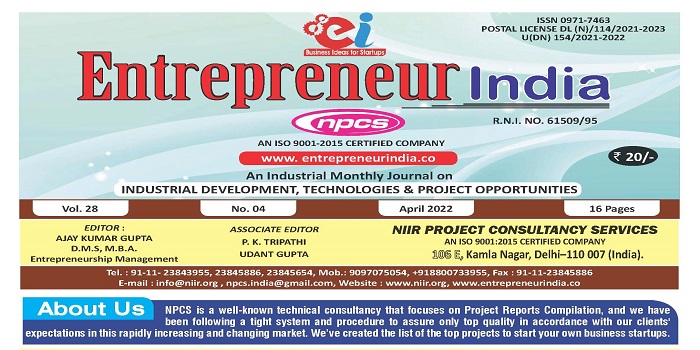
India stands at the cusp of a startup revolution, driven by innovation, digital transformation, and government-backed initiatives like Startup India. Each month, a fresh wave of entrepreneurs reshapes industries—from fintech to healthtech, agritech to edtech—in a market poised to become the world’s third-largest startup ecosystem. Entrepreneur India Monthly Magazine is a pivotal lens into this transformative journey, offering a deep dive into the players, policies, challenges, and opportunities defining the entrepreneurial narrative in India. The Rise of Startup Culture in India The Indian startup landscape has grown exponentially over the past decade. As of 2025, the country hosts more than 100,000 recognized startups, with over 100 unicorns reshaping the global market. What sets India apart is its diverse innovation hubs—spanning Tier-I cities like Bengaluru and Mumbai to emerging centers in Jaipur, Indore, and Bhubaneswar. Key drivers fueling this surge include: A growing youth population with risk-taking appetite Widespread internet penetration and mobile-first digital economy Expanding VC and angel investor networks Government incentives and tax reforms for startups Sectoral Trends Covered in Entrepreneur India Monthly Each edition of Entrepreneur India Monthly Magazine dives deep into sector-specific trends. Some of the most disruptive domains include: Fintech Revolutionizing Financial Inclusion India’s fintech sector has evolved from basic digital wallets to neobanks, AI-driven credit scoring systems, and blockchain-based payment platforms. With UPI clocking over 10 billion transactions monthly, startups like Razorpay, Cred, and BharatPe are redefining how India manages money. Healthtech: Digitizing Patient Care Telemedicine, AI-based diagnostics, and IoT-driven health wearables are central to the Indian healthtech boom. Startups such as Practo, 1mg, and PharmEasy are bringing affordable, accessible healthcare to millions. Agritech and the Rural Renaissance Indian agritech startups are integrating drones, soil sensors, and AI-powered forecasting to enhance farm productivity and reduce wastage. With over 58% of India’s population dependent on agriculture, this sector is vital to national growth. Notable players include DeHaat, Ninjacart, and AgroStar. Edtech’s Post-Pandemic Ascendancy The demand for remote learning, upskilling, and test prep solutions skyrocketed post-COVID-19. India’s edtech giants—BYJU’S, Unacademy, and Vedantu—are not only dominating the domestic scene but expanding into Southeast Asia, the Middle East, and the U.S. Startup Funding Landscape in 2025 Entrepreneur India Monthly Magazine provides monthly breakdowns of funding rounds, investor sentiment, and IPO watchlists. While 2023-24 saw cautious investor behavior due to global macroeconomic volatility, 2025 marks a steady rebound, with $40+ billion in startup funding forecasted for the year. Key trends in the funding ecosystem: Shift from growth-at-any-cost to profitability and sustainability Rise of domestic venture capital funds Focus on climate tech, EVs, deep tech, and SaaS Increased cross-border collaborations and joint ventures Women Entrepreneurs: Driving Inclusive Innovation India has witnessed a 42% increase in women-led startups since 2020. From tech founders to social entrepreneurs, women are breaking barriers and creating sustainable impact. Featured in recent editions of the magazine: Falguni Nayar (Nykaa) – Beauty to stock market trailblazer Richa Kar (Zivame) – Lingerie tech startup disrupting retail norms Ghazal Alagh (Mamaearth) – Revolutionizing baby and personal care with toxin-free products Policy Watch: Government Support & Reforms Entrepreneur India Monthly Magazine provides expert commentary and updates on policy reforms, taxation changes, and compliance advisories. Key initiatives highlighted: Startup India Seed Fund Scheme (SISFS) – ?945 crore funding boost for early-stage ventures Digital India Programme – Advancing India’s digital infrastructure PLI Schemes for Manufacturing & Electronics – Enabling hardware-focused startups Ease of Doing Business reforms – Single-window clearances and faster IP registration Incubators, Accelerators, and Startup Hubs India’s startup journey is bolstered by a network of over 400 incubators and accelerators, nurturing talent from ideation to product launch. Prominent incubators featured in the magazine: T-Hub (Hyderabad) – India’s largest innovation campus NSRCEL (IIM Bangalore) – Academic-industry collaboration model CIIE.CO (IIM Ahmedabad) – Deeptech and impact startups enabler Also, state-wise innovation rankings and policy assessments are provided to showcase best-performing regions. Success Stories: From Garage to Global One of the most impactful sections of Entrepreneur India Monthly is its Founder Spotlight and Company Case Studies. These stories serve as both inspiration and playbooks. Recent stories include: Zerodha – Bootstrapped stock trading platform disrupting brokerages Boat – Building a ?2,000 crore audio electronics empire Lenskart – Transforming eyewear with tech-enabled retail Each profile dives into product development, team-building strategies, fundraising journeys, and exit strategies. Emerging Technologies and the Next Big Thing The magazine dedicates a section to futuristic technologies shaping India’s entrepreneurial future. Highlighted trends: Artificial Intelligence & Machine Learning Quantum Computing Metaverse and Web 3.0 EV Infrastructure and Battery Innovation Carbon Capture & Clean Energy Startups Entrepreneurs leveraging these technologies are profiled with technical insights, market readiness, and investor perspectives. How to Get Featured in Entrepreneur India Monthly Aspiring to be featured in the magazine? Here are the key strategies that elevate your brand visibility: Demonstrate innovation with real-world impact Secure marquee partnerships or funding milestones Engage actively in startup forums and pitch contests Use data and analytics to back your growth narrative Maintain a strong digital presence across LinkedIn, Crunchbase, and Twitter Each edition scouts for high-potential founders, new product launches, and thought leadership articles from the startup ecosystem. Conclusion: The Magazine That Mirrors India’s Entrepreneurial Pulse Entrepreneur India Monthly Magazine is more than a publication—it’s a comprehensive knowledge repository, trend tracker, and networking platform for India’s entrepreneurial fraternity. It blends data-backed insights, market analysis, policy perspectives, and success stories, making it an indispensable resource for founders, investors, policymakers, and business enthusiasts. In addition, the Entrepreneur India monthly magazine publishes a month’s worth of NPCS Proceedings. It also includes brief descriptions of several market research reports, and the titles of books that the company has written. The Entrepreneur India monthly magazine is widely distributed and has a large audience. We ensure that commercial initiatives and extensions take place at NPCS, but only in the right Business and at the right price. Business Ideas Covered in this Issue:

Have a business idea? Let's make it happen together-contact us now!


Contact Form Demo

This will close in 0 seconds

Translate »