
Opportunities for Entrepreneurs to Start their Own Business with Investment of 2 to 5 Crore Capital

Starting a business with a solid capital base opens up exciting possibilities, and a 2 to 5 crore capital gives entrepreneurs ample flexibility to explore high-growth, scalable ventures. Whether you’re an investor looking to diversify your portfolio or a passionate entrepreneur with dreams of building a sustainable enterprise, selecting the right industry is key. With careful planning, due diligence, and a strategic approach, your 2 to 5 crore capital can help establish a powerful brand and generate long-term profits. Top 10 Businesses You Can Start with 2 to 5 Crore Capital Below are ten highly promising and profitable business ideas that you can successfully launch with an investment under 5 crore. Each idea is selected based on market demand, future scalability, and the ability to create strong returns on investment. 1. Food Processing Unit India’s food processing industry is booming, and with a 2 to 5 crore capital, you can establish a mid-scale unit for processing products like spices, pickles, packaged snacks, or ready-to-eat meals. The demand for hygienic, ready-made food products is growing due to urbanization and changing consumer habits. You can also export products or supply to supermarket chains. Estimated Investment: ?3 – ?5 croreKey Requirements: FSSAI license, skilled labor, automation equipmentProfit Potential: High margins, long-term brand value 2. Pharmaceutical Manufacturing With health awareness on the rise, pharmaceuticals remain one of the most recession-proof industries. A small-scale pharma manufacturing unit for generic medicines, capsules, or syrups can be established within 5 crore capital. The profits in this sector are substantial, provided compliance with GMP and government norms is strictly maintained. Estimated Investment: ?4 – ?5 croreKey Requirements: Drug license, GMP certification, technical staffProfit Potential: High, with possibilities for export Drugs & Pharmaceutical Technology Handbook 3. Warehouse and Logistics Business India’s logistics and supply chain industry is growing exponentially, fueled by e-commerce and retail. With 2 to 5 crore capital, you can develop a warehouse facility and offer third-party logistics (3PL) services. The initial capital goes into acquiring land or renting industrial space, and installing inventory management systems. Estimated Investment: ?2.5 – ?5 croreKey Requirements: Strategic location, transportation fleet, logistics softwareProfit Potential: Steady and scalable 4. Renewable Energy Solutions The renewable energy sector, particularly solar power, is seeing substantial government support and demand from residential, commercial, and industrial consumers. You can start a solar panel installation company or set up a small solar power plant under a franchise model. Estimated Investment: ?3 – ?5 croreKey Requirements: Technical team, government approvals, EPC contractsProfit Potential: Moderate to high with long-term revenue 5. Luxury Boutique Hotel Tourism is a constantly growing sector, and a luxury boutique hotel can offer high-end personalized experiences to travelers. With a 2 to 5 crore capital, you can develop a hotel with 10-20 rooms in popular tourist destinations like Goa, Jaipur, or Kerala. Design, ambiance, and service quality are the key differentiators. Estimated Investment: ?4 – ?5 croreKey Requirements: Land/lease, interior design, staff training, licensingProfit Potential: High occupancy equals high ROI 6. Automobile Dealership or EV Showroom Owning a car dealership—whether for traditional vehicles or the rapidly growing electric vehicle (EV) segment—is a tried-and-tested business model. With a 5 crore capital, you can partner with mid-range auto manufacturers or establish a multi-brand EV showroom offering sales, service, and accessories. Estimated Investment: ?2 – ?4.5 croreKey Requirements: Large showroom space, service area, dealership rightsProfit Potential: Moderate to high, with potential for vertical expansion 7. Dairy Processing Plant The dairy industry in India is one of the largest in the world. With a 5 crore capital, you can start a dairy processing unit producing packaged milk, curd, butter, ghee, and flavored milk. As consumers look for hygienic and branded dairy products, this sector has promising margins. Estimated Investment: ?3.5 – ?5 croreKey Requirements: Chilling plant, packaging unit, quality control teamProfit Potential: Consistent demand with moderate growth Modern Technology Of Milk Processing & Dairy Products 8. IT Services and Software Development Company Digital transformation is driving demand for IT services in areas like mobile app development, SaaS solutions, data analytics, and AI-based applications. With a 2 to 5 crore capital, you can assemble a top-notch technical team and invest in product development and marketing. Estimated Investment: ?1.5 – ?4 croreKey Requirements: Office setup, skilled developers, cloud infrastructureProfit Potential: Scalable and high, especially in global markets 9. Biodegradable Packaging Manufacturing Eco-friendly packaging is replacing plastic globally, and businesses are looking for alternatives like paper-based and bioplastic materials. A manufacturing unit with 2 to 5 crore capital can produce biodegradable containers, bags, and food packaging items for FMCG and food delivery companies. Estimated Investment: ?3 – ?5 croreKey Requirements: Machines, raw materials, compliance certificationsProfit Potential: High, especially with B2B contracts 10. Organic Farming and Export Business Organic farming is not only sustainable but also highly profitable with export potential. With a 2 to 5 crore capital, you can purchase farmland, set up organic production of fruits, vegetables, and herbs, and market the produce domestically or export to developed countries where demand for chemical-free food is rising. Estimated Investment: ?2 – ?4.5 croreKey Requirements: Agricultural land, organic certification, export licenseProfit Potential: High margins with growing market demand Advantages of Starting a Business with upto 5 Crore Capital Using your 5 crore capital wisely can give you a significant edge over smaller competitors. Here’s why: Strong Infrastructure: You can afford better equipment, skilled employees, and quality raw materials. Professional Branding: Invest in marketing, branding, and digital presence from the beginning. Scalability: Many of the above businesses can expand nationwide or globally with proper reinvestment. Compliance and Quality: With sufficient capital, you can ensure high-quality products that meet compliance norms, opening doors to government or corporate contracts. Key Tips for Success with 2 to 5 Crore Capital Choose the Right Industry: Don’t follow trends blindly. Pick a business where you understand the customer and market dynamics. Start Lean, Grow Smart: Don’t blow the entire 2 to 5 crore capital upfront. Allocate funds strategically. Build a Strong Team: The success of your business heavily
Vinegar Manufacturing Business Idea – An Emerging Business Investment Opportunities in Food Processing Sector
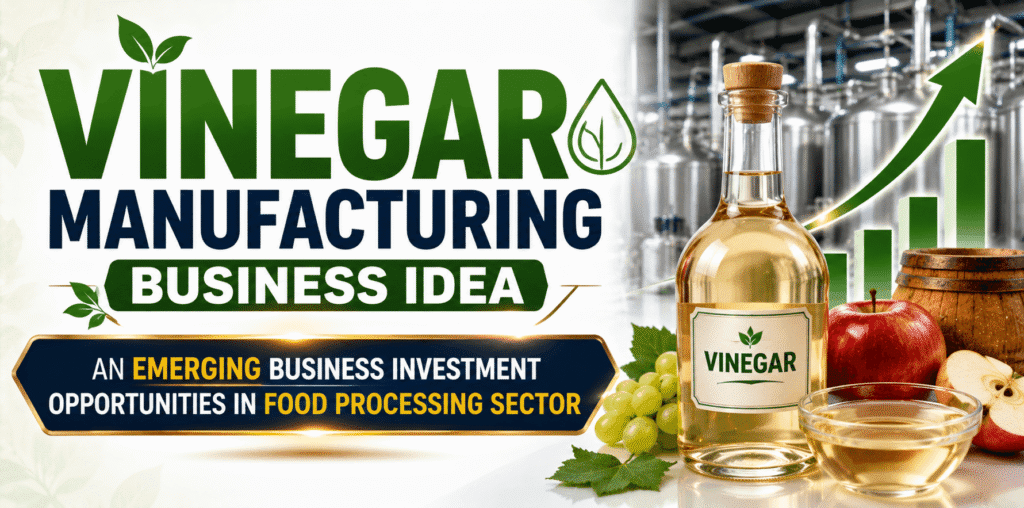
Vinegar, a product as ancient as civilization itself, has stood the test of time due to its wide-ranging applications. From being a culinary staple and a preservative to having medicinal and cleaning properties, vinegar remains a product with constant demand. With the growing trend toward organic and healthy food products, the demand for different types of vinegar has increased globally. Starting a vinegar manufacturing business in 2026 is not only a promising idea but also one that aligns well with the shift toward sustainable, value-added food processing businesses. Starting a Vinegar Manufacturing Business in 2026 To launch a vinegar manufacturing business, you must understand the science behind vinegar production and identify your target market. Vinegar is essentially a dilute solution of acetic acid made through the fermentation of ethanol. It is produced from a variety of sources including fruits (like apple or grape), grains (like rice), or industrial alcohol. There are two main processes involved in vinegar production: the slow fermentation method and the fast fermentation method. The slow method is traditional and results in superior flavor—ideal for premium vinegars such as balsamic or apple cider. On the other hand, the fast method involves industrial fermenters and is suitable for mass production, ensuring quick turnover and higher profits. The market for vinegar spans multiple sectors: food and beverage, healthcare, cleaning products, and even cosmetics. With rising health awareness, especially post-pandemic, more people are incorporating organic apple cider vinegar and other specialty vinegars into their diet. This health-driven trend can be a significant growth factor for the vinegar manufacturing industry. Market Potential and Demand Forecast The global vinegar market is experiencing robust growth. According to various industry reports, it is expected to reach over USD 15 billion by 2030, driven by demand for organic and flavored vinegars. In India alone, the urban middle class is rapidly adopting apple cider vinegar as a health supplement. Restaurants and food processing industries use large quantities of white vinegar, creating bulk B2B opportunities. This market trend indicates that entering vinegar manufacturing in 2026 could be a highly profitable move, especially if you focus on quality and differentiation. Small-scale vinegar units with unique offerings—like herbal infusions, fruit-based flavors, or certified organic status—are becoming more popular among health-conscious consumers. Steps to Start a Vinegar Manufacturing Business To establish a successful vinegar business, a step-by-step approach is essential: 1. Market Research and Product Selection: Begin with in-depth market analysis. Decide whether you want to manufacture industrial vinegar, culinary vinegar (like white, malt, or wine vinegar), or premium health vinegars (like apple cider or rice vinegar). Study consumer trends, competitor brands, and pricing. 2. Choose the Production Method: For small-scale production, traditional fermentation using fruit or rice in wooden barrels is suitable. For larger scale, invest in acetators (machines used for fast fermentation), stainless steel tanks, and bottling machines. 3. Location and Infrastructure: Your production unit should be in a location with easy access to raw materials (fruits, grains, sugar), clean water supply, electricity, and transportation facilities. A 1000–1500 sq ft area is typically sufficient for a small unit. 4. Obtain Licenses and Registrations: Compliance with food safety regulations is crucial. You’ll need: FSSAI Registration (India) GST Registration Factory License MSME Udyam Registration Pollution Control Certification Trademark for branding 5. Machinery and Equipment: Depending on your scale, equipment may include: Fermentation tanks Heating and cooling systems Acetator (for fast vinegar production) Filtration units Bottling and labeling machines 6. Sourcing Raw Materials: Use quality fruits, grains, or molasses for fermentation. If producing apple cider vinegar, ensure a consistent supply of fresh apples or apple juice concentrate. For white vinegar, ethanol and sugar are required. 7. Skilled Workforce: Hire staff familiar with fermentation techniques, quality control, packaging, and marketing. While automation can reduce manpower needs, initial operations often require manual oversight. 8. Branding and Packaging: Today’s consumer is influenced by packaging and story. Highlight organic ingredients, traditional processes, or health benefits on your product label. Use eco-friendly bottles and attractive designs to enhance shelf appeal. 9. Marketing and Distribution: Distribute through supermarkets, health stores, restaurants, and online platforms like Amazon and Flipkart. Tie up with nutritionists, wellness centers, or dieticians for product endorsements. Attend food expos to showcase your brand. 10. Quality Control and Certification: Ensure batch testing and consistent pH and acetic acid levels in your vinegar. Certifications like ISO, HACCP, and organic standards can boost consumer trust and expand export potential. Investment and Profitability Setting up a small vinegar manufacturing unit in India can cost between ?15 lakh to ?40 lakh, depending on automation and capacity. A mini plant producing 1000 liters/day of vinegar can yield significant margins, especially if targeting niche markets with value-added products. Profit margins range between 30% to 60%, depending on your scale, branding, and distribution model. For example: Cost of production for 1 liter of apple cider vinegar: ?20–?30 Selling price in retail (premium market): ?120–?250 By scaling operations and adding variants, monthly profits can reach ?1 lakh to ?5 lakh within the first two years of operation. Future Trends in Vinegar Manufacturing Business 2026 and beyond will witness increasing demand for: Organic Vinegar: With organic lifestyles gaining traction, vinegar made without synthetic additives will dominate shelves. Infused Vinegars: Flavored with herbs, spices, or fruit, these offer both taste and health benefits. Export-Oriented Units: Indian entrepreneurs are exploring export potential in Europe, Southeast Asia, and the Gulf where demand for natural products is high. Eco-Friendly Packaging: Sustainable packaging adds brand value and appeals to environmentally aware consumers. Moreover, with AI and IoT entering food manufacturing, expect intelligent fermentation monitoring systems that can optimize yield and quality, reducing waste and improving profitability. Challenges in the Business Like any industry, vinegar manufacturing has its hurdles: Raw Material Fluctuation: Prices of fruits, sugar, or alcohol may fluctuate based on season and supply. Market Competition: Low entry barriers mean more players; unique branding is key. Regulatory Compliance: Food and beverage regulations are becoming more stringent, especially for health claims on packaging. Storage and Shelf Life: Vinegar has
Electric Motor Rewinding Business. Emerging Investment Opportunities in Rewinding of Burnt Electric Motors Industry
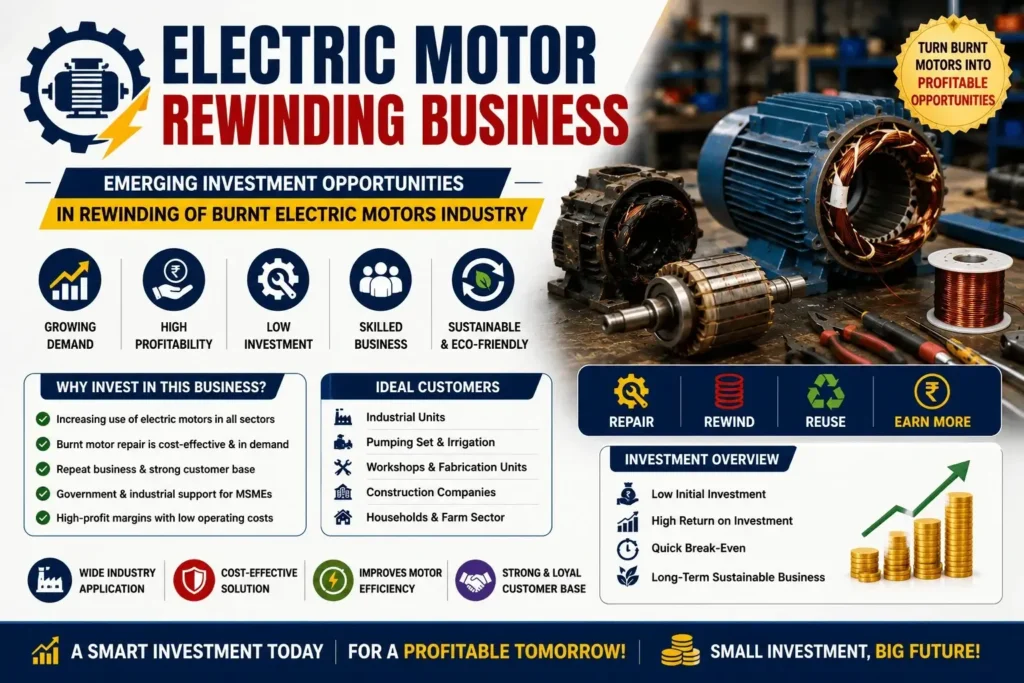
Electric motors are essential components in nearly every industrial sector, from manufacturing to agriculture, from mining to small home appliances. Over time, these motors suffer wear and tear, particularly in their windings, leading to decreased performance or failure. Replacing them can be expensive and time-consuming, especially in industrial environments. This is where the Electric Motor Rewinding business comes into play — offering a cost-effective solution and presenting a lucrative business opportunity for entrepreneurs with technical knowledge or access to skilled labor. Why Start an Electric Motor Rewinding Business? The increasing use of electric motors in nearly every mechanical system today ensures a constant demand for rewinding services. Whether it’s in water pumps, industrial machines, compressors, or fans, motors are everywhere. When these motors break down due to coil damage or insulation failure, rewinding offers a more economical option than replacement. This creates a steady and repeatable need for Electric Motor Rewinding, making it a viable and profitable venture. Understanding Electric Motor Rewinding Electric motor rewinding involves the process of removing damaged windings (typically copper wire) from a motor’s stator or rotor and replacing them with new windings of the same specifications. This restores the motor to its original or even improved efficiency. It typically includes disassembling the motor, cleaning and inspecting core parts, removing old windings, rewinding with fresh copper wire, varnishing, baking, reassembling, and testing. While the process may sound technical, with the right equipment and trained personnel, the business can be run smoothly. Many industries prefer rewinding as it saves 30-60% of the cost compared to buying a new motor, making the service highly attractive. Market Demand and Opportunities India’s rapidly growing industrial, commercial, and agricultural sectors rely heavily on electric motors. From textile mills and chemical plants to irrigation systems and urban infrastructure, the demand for electric motors and hence rewinding services is consistent. Additionally, the rise in energy efficiency awareness is leading many businesses to prefer motor rewinding with high-quality materials over complete motor replacement. Moreover, government incentives for MSMEs and skill-based manufacturing activities further make Electric Motor Rewinding a suitable business idea for those with limited initial capital. Initial Investment and Setup Setting up an Electric Motor Rewinding business can be done in phases, starting with small-scale servicing and gradually moving to medium or even large-scale industrial motors. A basic setup includes: Space: Minimum of 600–1000 sq ft for workshop and machinery layout. Machinery & Tools: Coil winding machine Coil inserting and forming tools Oven for varnishing and curing Testing instruments (megger, multimeter, voltmeter) Grinder, lathe (for rotor balancing), and other hand tools Workforce: Skilled rewinders and electricians, generally 3–5 technicians to start with. Investment: ?8–15 lakhs for a small to medium setup, with higher investments for industrial-grade services. Once you build a network of regular clients, including factories, pump repair centers, and institutions with heavy electrical infrastructure, the business can generate sustainable revenue. Business Model and Service Offerings Revenue in the Electric Motor Rewinding business typically comes from the following services: Motor rewinding (single-phase, three-phase) Armature rewinding (DC motors) Transformer rewinding Generator coil rewinding On-site motor dismantling and installation Motor bearing, shaft, and mechanical repairs Many rewinders also offer AMC (Annual Maintenance Contract) services to institutions and industries, ensuring repeat business and monthly cash flow. Profit Margins and Return on Investment Electric Motor Rewinding offers excellent profit margins, especially in industrial segments. For example: Small Motors (0.5–5 HP): Rewinding cost is ?500–?1500; profit margin 30–40% Medium Motors (5–20 HP): Cost is ?2000–?5000; margin 35–50% Large Industrial Motors (above 20 HP): Can charge ?8000–?30,000 or more with 50–60% margin depending on size and copper required Break-even can be achieved within 12–18 months with a consistent client base and quality output. Expanding to include transformer and generator rewinding services can boost ROI further. Skill Requirements and Workforce One of the advantages of this business is that it does not require the owner to be an engineer or technician. However, the presence of skilled labor is essential. Hiring or partnering with experienced rewinding technicians is a must. You can also train fresh ITI or polytechnic graduates under supervision, which is cost-effective. You may also consider tie-ups with local ITI colleges or offer apprenticeship programs that help train and retain skilled workers. Licensing and Compliance Starting an Electric Motor Rewinding business in India involves obtaining basic registrations such as: Udyam (MSME) Registration GST registration Local municipal shop act or trade license Pollution control clearance (in case of high-volume varnishing or burning activities) For commercial power load, approval from the local electricity board may be needed. Adhering to workplace safety standards and fire safety norms is essential too. Challenges and Mitigation Though rewarding, this business comes with its set of challenges: Material Costs: Copper prices fluctuate and can affect margins. Buying in bulk and maintaining a stock can mitigate this. Skilled Labor: Availability of reliable rewinders is limited. Training your own team is a good long-term solution. Quality Assurance: Sub-par rewinding can damage client machines. Always use standard gauge wires and high-quality insulation materials. Competition: Local workshops may offer low prices, but you can differentiate with quality, reliability, and timely delivery. Focusing on proper insulation, energy-efficient rewinding, and customer education can create a unique selling proposition (USP) for your brand. Digital Marketing and Client Acquisition Marketing is often neglected in this niche, but it plays a vital role in scaling the business. Here are a few proven ways to build clientele: Website and Google My Business Listing: Showcase your services, case studies, and client testimonials. WhatsApp and SMS Campaigns: Stay in touch with industrial clients for AMC renewals and service reminders. Local SEO & Online Ads: Run geo-targeted campaigns to reach factories and repair centers. Partnerships: Collaborate with motor manufacturers, resellers, and electrical supply stores to get referrals. Referral-based business can also grow exponentially with a reputation for quality. Future Scope and Expansion As more industries seek to become energy efficient and reduce machinery replacement costs, the future of Electric Motor Rewinding looks promising. The shift towards electric
30 Profitable Business Ideas under 75 Lakhs 1 Crore (Plant and Machinery Cost)
India’s thriving industrial ecosystem provides countless opportunities for entrepreneurs looking to invest in plant & machinery’s ventures under a budget of ?1 crore. With Make in India and Atmanirbhar Bharat initiatives, MSME sectors are booming, especially those with efficient machinery setups. Choosing the right business idea with a solid return on investment (ROI) and scalable growth potential is crucial. Below, we present detailed and profitable plant & machinery business opportunities that can be initiated under ?1 crore and generate consistent returns. Top Plant & Machinery Business Ideas to Start Under ?1 Crore 1. Paper Plate & Disposable Products Manufacturing Unit In today’s eco-conscious market, biodegradable products like paper plates, bowls, and cups are in high demand. A semi-automatic or fully automatic plant for manufacturing paper disposables can be set up with an investment of ?30–50 lakh. Machinery Required: Paper plate machine, cutting machine, drying machine, raw material feeder Area Required: 1500–2000 sq. ft. Monthly ROI: ?2–4 lakh Target Clients: Event planners, catering services, retail markets This is one of the fastest-growing plant & machinery’s segments due to the ban on plastic products in many Indian states. 2. Packaged Drinking Water Bottling Plant Water purification and bottling continue to be a lucrative business in both rural and urban markets. With an increasing focus on clean drinking water, bottled water is a daily need product. Initial Investment: ?60–80 lakh Machinery Required: RO system, bottling machine, UV system, labeling machine Area Required: 2000–3000 sq. ft. Profit Margin: 20–30% Licensing: BIS Certification, FSSAI License Demand remains strong in educational institutions, corporate sectors, hotels, and retail outlets. 3. Spice Grinding & Packaging Unit India is one of the largest spice exporters in the world. Investing in a spice processing and packaging unit offers both local and global market potential. Machinery Required: Spice grinder, pulverizer, packaging machine, mixer Investment Range: ?35–45 lakh Plant Area: 1000–1500 sq. ft. Profitability: Up to ?5 lakh/month in bulk supply This plant & machinery business is highly scalable and supported by robust government export schemes. 4. Mini Oil Extraction Plant Edible oils like groundnut, mustard, coconut, and sunflower oil are household staples. Small-scale oil extraction businesses have a high resale and bulk distribution value. Investment: ?50–60 lakh Required Machines: Oil expeller, filter press, seed cleaner, packaging unit Space Needed: 1500–2000 sq. ft. Revenue Potential: ?6–7 lakh/month depending on demand and location Healthy oils with minimal processing are trending in the premium FMCG market. 5. Agarbatti (Incense Stick) Manufacturing Plant The religious and cultural landscape in India ensures steady demand for incense sticks. A low-cost, semi-automated plant can produce thousands of units daily. Machinery Cost: ?5–10 lakh Total Setup Cost: ?15–20 lakh Raw Material: Bamboo sticks, charcoal powder, joss powder, fragrances ROI: Can reach ?1–2 lakh/month within 6 months This plant & machinery business model is ideal for rural entrepreneurship and small town clusters. 6. Mini Dairy Processing Unit India is the largest milk producer in the world, and dairy processing units (paneer, curd, butter, ghee) are essential in every tier of distribution—from local to institutional. Machinery: Pasteurizer, homogenizer, milk chiller, separator, packaging machine Investment: ?70–90 lakh Licenses: FSSAI, pollution control board clearance Plant Space: Minimum 2500 sq. ft. Potential: High-volume profit from retail & B2B clients This segment offers good opportunities for cold chain integration and contract manufacturing. 7. Detergent & Cleaning Product Manufacturing Unit With increasing hygiene awareness, detergent powders, liquids, and soaps are everyday household consumables. Starting this business under ?1 crore is entirely feasible. Initial Setup: ?25–40 lakh Machinery Used: Blender, ribbon mixer, sealing machine, dryer Plant Area: 1000 sq. ft. onwards Clients: Retail chains, local shops, institutional bulk buyers A recurring demand cycle ensures this plant & machinery business runs with predictable revenue. 8. Plastic Moulding and Injection Molding Plant For industrial components, household items, and packaging material, injection molding remains a vital manufacturing technique. Machine Investment: ?40–60 lakh Required Tools: Injection molding machine, cooling tower, air compressor, mold sets Workforce: 8–10 skilled operators Profit Estimate: ?8–10 lakh/month depending on volume A niche yet highly profitable venture, especially with product customization. 9. Bio-Fertilizer Production Plant With the organic farming trend rising, bio-fertilizer manufacturing is an excellent green business under ?1 crore. Demand exists from small farmers to agri-retail chains. Machinery: Fermentation tanks, dryers, blenders, granulators Capital Needed: ?50–70 lakh Plant Space: 2000 sq. ft. Licenses: State Fertilizer Authority approval This sustainable plant & machinery venture meets future agro-sector needs and opens export channels. 10. Mini Cement Brick & Fly Ash Brick Plant Construction materials are perennially in demand. Fly ash bricks are eco-friendly, affordable, and supported by government schemes like PMAY. Machine Setup: Hydraulic brick press, pan mixer, conveyor Total Investment: ?60–80 lakh ROI: ?3–5 lakh/month depending on supply chain Land Requirement: 3000+ sq. ft. Used widely in real estate, public infrastructure, and low-cost housing projects. Key Takeaways for Aspiring Entrepreneurs Venturing into the plant & machinery sector under ?1 crore offers immense potential across industries like FMCG, agriculture, packaging, construction, and wellness. It is essential to: Analyze regional demand and raw material availability Obtain necessary licenses and regulatory approvals Implement efficient workforce training and quality control Invest in marketing and B2B networking for distribution With strategic planning and effective execution, these businesses offer financial independence and long-term viability in the Indian industrial landscape. Visit the page Select and Choose the Right Business Startup for You for sorting out the questions arising in your mind before starting any business and know which start-up you can plan. We, at NPCS, endeavor to make business selection a simple and convenient step for any entrepreneur/startup. Our expert team, by capitalizing on its dexterity and decade’s long experience in the field, has created a list of profitable ventures for entrepreneurs who wish to diversify or venture. The list so mentioned is updated regularly to give you a regular dose of new emerging opportunities. Contact Us
Establishment of new Pharmacy college (B-pharma and D-pharma)
India’s pharmaceutical education sector continues to grow rapidly in response to the ever-increasing demand for qualified pharmacists across healthcare and manufacturing domains. Setting up a B.Pharma & D.Pharma college in 2025 offers a promising entrepreneurial opportunity backed by regulatory reforms, growing healthcare awareness, and significant student interest. Whether you’re an investor, educationist, or healthcare entrepreneur, this guide will walk you through the critical aspects of launching a successful B.Pharma & D.Pharma institution. Comprehensive Overview of Setting Up a B.Pharma & D.Pharma College To establish a pharmaceutical institution offering both Bachelor of Pharmacy (B.Pharma) and Diploma in Pharmacy (D.Pharma) courses, a well-structured approach involving regulatory approvals, infrastructural development, curriculum design, and skilled faculty recruitment is essential. 1. Regulatory Approvals and Affiliations To start a B.Pharma & D.Pharma college in India, institutions must secure approvals from: Pharmacy Council of India (PCI) – Mandatory for both B.Pharma and D.Pharma. All India Council for Technical Education (AICTE) – Required for B.Pharma course. State Government Approval – Necessary to operate any professional institution. Affiliation to a Recognized University – Typically for B.Pharma programs. State Pharmacy Council Registration – Allows for recognized practice licenses post-graduation. All applications must be submitted online via the PCI portal by the prescribed dates, usually by early March every academic year. 2. Ideal Land and Infrastructure Requirements Setting up a B.Pharma & D.Pharma college requires significant land investment and modern infrastructure as per PCI norms. Land Area: Minimum 2 acres in metropolitan areas; 3 acres in non-metro regions. Built-up Area: Approx. 45,000–50,000 sq. ft. for combined B.Pharma & D.Pharma programs. Classrooms: Well-ventilated smart classrooms with audio-visual aids. Laboratories: At least 12 fully-equipped labs, including: Pharmaceutics Lab Pharmacology Lab Pharmaceutical Chemistry Lab Pharmacognosy Lab Library: Minimum 2000 reference books with subscriptions to pharmaceutical journals. Computer Lab: 1:5 student-computer ratio with internet connectivity. Additional Facilities: Auditorium, girls’ and boys’ common rooms, administrative offices, placement cell, hostel accommodation. 3. Faculty Recruitment and HR Planning The PCI mandates stringent faculty-to-student ratios. A standard requirement for B.Pharma is 1:15. Each department should have a Head (Ph.D. preferred), associate professors, and assistant professors. Principal: Qualified with Ph.D. and minimum 15 years of experience. Professor/Associate Professors: Minimum 5–10 years experience. Supporting Staff: Lab technicians, non-teaching administrative staff, peons, and IT support. Hiring experienced faculty boosts institutional credibility and attracts student admissions. 4. Investment Requirements and Financial Planning Launching a B.Pharma & D.Pharma college typically involves an initial capital expenditure of ?6 to ?15 crore depending on location and infrastructure scale. Land & Building: ?3–7 crore Equipment & Lab Setup: ?1.5–3 crore Library & Digital Infrastructure: ?50–80 lakhs Faculty Salaries (Annual): ?1–2 crore Marketing & Branding: ?20–50 lakhs annually Institutions can explore financial assistance from education loan schemes, private investors, or PPP (Public-Private Partnership) models. ROI is usually visible within 4–6 years with strategic student intake and efficient management. 5. Curriculum Design and Program Structure Curriculum must strictly follow the syllabus prescribed by PCI. The B.Pharma course is of 4 years (8 semesters), while D.Pharma is a 2-year program (4 semesters). Key subjects include: Human Anatomy & Physiology Pharmaceutical Organic Chemistry Pharmacognosy & Phytochemistry Pharmacology & Toxicology Biopharmaceutics & Pharmacokinetics Hospital & Clinical Pharmacy Pharmaceutical Jurisprudence Focus should be laid on hands-on training, research projects, and industry exposure through MoUs with pharma companies and hospitals. 6. Marketing, Admission Strategy, and Branding To attract quality students in a competitive environment, strategic marketing is essential. This includes: Offline Promotions: Seminars in schools, education fairs, newspaper ads. Online Campaigns: SEO-optimized website, social media ads, lead generation via Google Ads. Admission Helplines: 24/7 query support, virtual counseling sessions. Alumni Engagement: Build credibility through successful alumni case studies. Admissions can be through entrance exams like GPAT, state-level pharmacy CETs, or direct management quotas as per norms. 7. Technology Integration and Smart Campus Initiatives In 2025, the use of technology is vital in education. Your B.Pharma & D.Pharma college should integrate: Learning Management Systems (LMS): Moodle, Google Classroom, etc. Virtual Labs & Simulation Software: For pharmacology and chemistry. Biometric Attendance: For staff and students. ERP Solutions: For administration, academics, HR, and finance. AI Chatbots: For student support and automated query handling. A tech-savvy campus improves operational efficiency and enhances student experience. 8. Placement Cell and Industry Tie-ups An active placement cell is a major value addition. Partner with pharmaceutical companies, hospitals, and research firms for: Internships and industrial training Campus recruitment drives Guest lectures and workshops Industry-sponsored labs and research funding Top recruiters include Cipla, Dr. Reddy’s, Sun Pharma, Apollo Hospitals, and Aurobindo Pharma. 9. Quality Assurance and Accreditation Obtaining accreditations elevates institutional standards: NAAC Accreditation – Ensures overall academic excellence. NBA Accreditation – Specific to the B.Pharma program. ISO Certification – For administrative and service quality. Regular audits, academic reviews, and feedback systems help maintain excellence and compliance. 10. Sustainability and Future Roadmap A successful B.Pharma & D.Pharma institution should plan for: Postgraduate Courses (M.Pharm) in areas like Pharmaceutics, Pharmacology, and Quality Assurance. Research Centers for clinical trials, herbal medicine, and formulation studies. Skill Development Programs in medical coding, regulatory affairs, and pharmaceutical marketing. International Collaborations with pharma colleges abroad for faculty exchange and global exposure. With the Indian pharma sector projected to touch $130 billion by 2030, such expansions will future-proof the institution. Conclusion The opportunity to establish a B.Pharma & D.Pharma college in 2025 is not just about infrastructure and curriculum—it’s about building a trusted academic brand. With regulatory compliance, excellent faculty, modern labs, and strategic outreach, your institution can become a benchmark in pharmaceutical education. Timely execution, proper funding, and quality focus will lead to a profitable and impactful venture in the healthcare education domain. Visit the page Select and Choose the Right Business Startup for You for sorting out the questions arising in your mind before starting any business and know which start-up you can plan. We, at NPCS, endeavor to make business selection a simple and convenient step for any entrepreneur/startup. Our expert team, by capitalizing on its dexterity and decade’s long experience in the field, has created
How to Start a Profitable Camphor Manufacturing Business in India
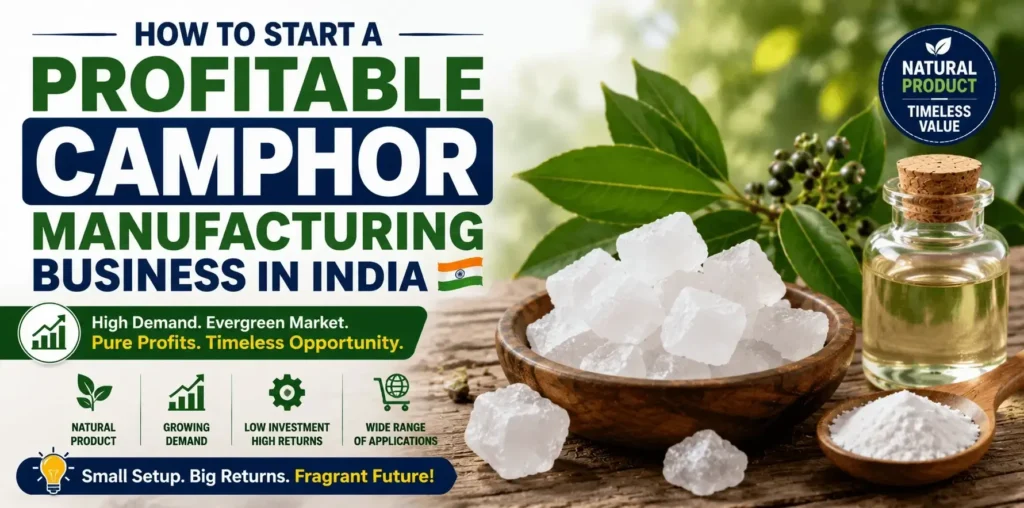
The Camphor Manufacturing Business is emerging as one of the most profitable small-scale manufacturing opportunities in India due to rising demand across religious, pharmaceutical, aromatherapy, and industrial sectors. Camphor, commonly known as Kapoor, is widely used in temples, pooja rituals, ayurvedic products, pain balms, air purification products, and fragrance applications. With relatively low investment, simple machinery setup, and strong year-round demand, many entrepreneurs and small investors are now exploring camphor manufacturing business opportunities in India. From camphor tablets and cones to scented and industrial-grade camphor products, the market continues to expand steadily. What is a Camphor Manufacturing Business? A Camphor Manufacturing Business involves producing camphor tablets, cones, powders, or industrial camphor products using camphor powder, molding machines, and packaging systems for religious, medicinal, and industrial applications. Is Camphor Manufacturing Business Profitable? Yes, the camphor manufacturing business can be highly profitable due to: continuous religious demand growing aromatherapy usage pharmaceutical applications low production cost strong wholesale market Profit margins can range between 25% to 45% depending on production scale, branding, and distribution efficiency. This guide explains the complete camphor manufacturing business setup process including machinery, raw materials, production methods, licensing, packaging, profit margins, and marketing opportunities. Understanding the Camphor Manufacturing Business Setup The foundation of a successful Camphor Manufacturing Business lies in understanding the raw materials, processing steps, machinery requirements, licensing, and market potential. To establish a fully functional camphor production unit, we must begin with well-researched planning, suitable investment, and quality control systems to ensure that our camphor meets market standards. Types of Camphor in the Market There are primarily three types of camphor available in the market: Edible camphor (used in small quantities in food and medicines) Religious camphor (used in temples and rituals) Industrial camphor (used in chemical and pharmaceutical industries) Our business plan should clearly define the target segment, as the machinery and quality parameters vary accordingly. Raw Materials Required To manufacture camphor, the primary raw materials include: Turpentine Oil – The base ingredient in synthetic camphor. Salts and stabilizers Packaging materials – Glass jars, plastic pouches, or aluminum containers. These materials should be sourced from reliable vendors to maintain consistency and quality in production. Machinery and Equipment Setting up a Camphor Manufacturing Business requires semi-automatic or fully automatic machines. The essential machinery includes: Camphor Tablet Press Machine Camphor Mixing Machine Camphor Slab Molding Machine (for slab-based camphor) Packaging Machine Weighing Machine Electric Dryer/Oven (optional for faster processing) A basic semi-automatic plant setup requires a space of around 500–1000 sq. ft. and an investment of ?8–15 lakhs, depending on the capacity. Camphor Manufacturing Process The typical camphor manufacturing process involves: Mixing – Turpentine oil is mixed with appropriate catalysts. Heating – The mixture is subjected to controlled heat to form white crystalline camphor. Cooling – The heated mixture is allowed to cool and harden. Molding/Pressing – Hardened camphor is crushed and molded into tablets, cubes, or slabs. Drying and Finishing – The product is dried and trimmed for final packaging. Packaging – Final camphor pieces are packed and labeled as per market standards. Careful handling and standardized production ensure product purity and safety. Licensing and Legal Compliance To start a Camphor Manufacturing Business, we must comply with local and national regulations: Udyam/MSME Registration Factory License NOC from State Pollution Control Board GST Registration Trademark Registration (optional but recommended) BIS Certification (for industrial camphor) FSSAI License (for edible camphor) Ensuring legal compliance helps avoid penalties and builds consumer trust. Target Market and Applications Camphor has widespread applications, which opens multiple market avenues: Household Use – Pooja rituals, aroma diffusers, cleaning. Pharmaceutical Industry – Balm, ointments, and medicinal vapors. Chemical Industry – Used in explosives and celluloid production. Food Industry – In very limited quantities, edible camphor is used in sweets. Ayurvedic Products – Soaps, oils, and creams. By diversifying the product line, we can tap into multiple revenue streams. Packaging and Branding Strategy Packaging plays a crucial role in the consumer perception of camphor. For this reason: We should use moisture-resistant, odor-proof, and tamper-proof packaging. Invest in attractive labeling with usage instructions and legal declarations. Establish a unique brand identity to build customer loyalty. Private labeling and white labeling options can also expand our market reach. Manpower and Operational Needs A small-scale camphor unit can operate with a modest team: 1 skilled technician to operate machines 2–3 unskilled workers for raw material handling, packaging 1 supervisor/manager for inventory, accounts, and compliance We must ensure proper training for safety and efficiency. Marketing and Distribution Channels To make our Camphor Manufacturing Business profitable, marketing is key: Offline Distribution – Tie-ups with religious shops, general stores, ayurvedic outlets, and chemists. Online Sales – Listing on Amazon, Flipkart, Jiomart, and personal e-commerce website. B2B Sales – Selling in bulk to temples, spas, or industrial buyers. Export Opportunities – Markets like Nepal, Bangladesh, and the Middle East show demand for Indian camphor. Aggressive marketing with digital promotion, social media advertising, and SEO optimization will ensure high visibility. Profit Margin and ROI Analysis The profit margin in the Camphor Manufacturing Business can range from 25% to 45%, depending on scale, sourcing efficiency, and distribution reach. A small unit producing 100 kg/day can expect to break even within 12–18 months under proper management. Key profit boosters include: Reducing raw material costs through bulk purchase Expanding product variety (e.g., scented camphor, camphor cones) Automating packing for large-scale production Challenges and Risk Factors Although profitable, camphor manufacturing has certain risks: Volatility in Turpentine Oil Prices Regulatory Scrutiny on Edible and Industrial Grades Low-quality competition offering substandard products Fire Hazard Risks – Camphor is flammable, so safety measures are crucial Strict quality control, brand differentiation, and robust safety protocols are necessary to mitigate these risks. Sustainability and Innovation Going forward, innovation can reshape the industry: Eco-friendly Camphor made from plant-based essential oils Scented and Designer Camphor Tablets for premium markets Smart Diffusers with Camphor Tablets for homes and offices Refill packs to promote eco-conscious packaging With rising awareness of aromatherapy and natural products, Camphor Manufacturing Business
10 Profitable Small Scale Manufacturing Business Ideas Under ₹60 Lakhs
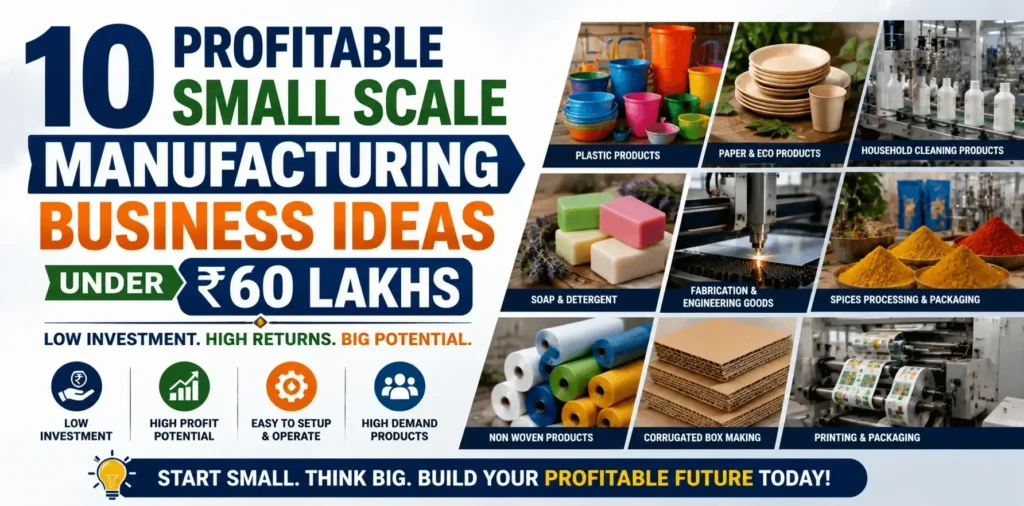
India’s growing economy, rising demand for locally manufactured products, and strong government support for MSMEs have created massive opportunities in the small scale manufacturing sector. Entrepreneurs and investors are increasingly exploring profitable small scale manufacturing business ideas that require moderate investment and offer long-term growth potential. With an investment of ₹50–60 lakhs, it is possible to establish scalable manufacturing units in sectors such as food processing, eco-friendly packaging, detergents, furniture, LED lighting, garments, and household products. These businesses benefit from rising consumer demand, low operational costs, and expanding domestic and export markets. What are Small Scale Manufacturing Businesses? Small scale manufacturing businesses are production units that manufacture products using limited capital, moderate machinery, and small operational teams. These businesses usually focus on local, regional, or niche markets while offering scalable growth opportunities. Why Small Scale Manufacturing Businesses Are Profitable in India government MSME support Make in India rising local demand export opportunities low setup costs scalable operations employment generation Home-Based Small Scale Manufacturing Business Ideas Include: candles detergents agarbatti paper bags soaps handmade foods Small Scale Manufacturing Industries with High Future Demand Include: eco-friendly products electric products organic products biodegradable packaging LED products cleaning products This guide explores some of the best small scale manufacturing business ideas in India that can be started with plant and machinery investment under ₹60 lakhs. Top Small scale Manufacturing Business Ideas with Investment of 50-60 Lakhs When thinking about small scale manufacturing, it’s crucial to focus on sectors with consistent market demand, relatively low overheads, and scalable potential. Below are some of the best business ideas under a ?60 lakh investment bracket: 1. Paper Bag Manufacturing Unit With increasing environmental concerns and a ban on plastic in many Indian states, paper bags have seen a surge in demand. A small scale manufacturing unit can produce kraft paper bags, carry bags, and customized printed paper bags for retail outlets, restaurants, and packaging suppliers. An investment of ?25–?40 lakhs can cover semi-automatic machinery, raw material, setup, and working capital. Why It’s Worth It: High demand due to eco-friendliness Government support for sustainable businesses Easy marketing to retail and wholesale clients 2. Agarbatti (Incense Stick) Manufacturing A traditional yet thriving sector, agarbatti production is a low-technology, high-demand business that aligns well with the ?60 lakh budget. The raw materials include bamboo sticks, charcoal powder, wood powder, and essential oils. With semi-automatic or fully automatic machines, one can manufacture thousands of sticks daily. Benefits: Large domestic and export markets Simple machinery and raw material procurement Fast break-even period 3. Packaged Drinking Water Plant The need for clean and safe drinking water continues to rise across India. A packaged drinking water plant typically requires filtration units, bottling machinery, labeling machines, and a basic quality control lab. For ?50–?60 lakhs, you can set up a medium-capacity unit and get the necessary BIS and FSSAI certifications. Advantages: Continuous market demand Opportunity to expand to flavored and mineral water Sell to retailers, supermarkets, and offices 4. Spice Powder Manufacturing India is a land of spices, and there is massive demand for packaged spice powders both domestically and internationally. With ?40–?60 lakhs, you can invest in grinding machines, packaging units, branding, and marketing. Raw materials like turmeric, chili, coriander, and cumin can be procured from local farmers or wholesalers. Why Choose This: Potential for strong brand identity Export opportunities Value addition with blends and organic options 5. Detergent and Cleaning Product Manufacturing Soaps, liquid detergents, and toilet cleaners are essential household items. A small scale manufacturing business producing these products can be started with an investment of ?30–?50 lakhs, covering mixing machines, formulation expertise, and packaging solutions. Perks: High repeat purchase rate Customizable formulas Brand-building potential in local and regional markets 6. LED Light Assembly Unit With a focus on energy efficiency and “Make in India” initiatives, LED lights are replacing traditional lighting solutions. An assembly unit requires tools, testing equipment, and packaging. A ?60 lakh investment allows you to hire skilled technicians and build inventory. Why It’s Profitable: Urban and rural market expansion Increasing demand for affordable LED solutions Government subsidies for energy-saving products 7. Phenyl and Floor Cleaner Production Phenyl and disinfectants are essential items used in homes, offices, schools, and hospitals. The setup requires mixers, tanks, and packaging machines and can be established within ?15–?25 lakhs. The remaining capital can be utilized for marketing and bulk production. Advantages: Large institutional buyers Low production cost Potential for creating a brand 8. Furniture Manufacturing Unit Custom and modular furniture is always in demand due to rising urbanization and housing projects. A ?60 lakh investment can set up a workshop with carpentry tools, wood polish equipment, and labor to produce beds, wardrobes, and office furniture. Highlights: Rising demand from real estate and commercial sectors Customization brings high margins Potential to supply to e-commerce furniture platforms 9. Garment Stitching and Embroidery Unit A small scale manufacturing business in garments can cater to ethnic, western, or kidswear segments. With ?50–?60 lakhs, you can set up stitching machines, embroidery units, ironing and packaging sections, and create your private label. Opportunities: Strong export potential Growth of e-commerce platforms High employment generation 10. Organic Fertilizer Manufacturing As organic farming gains popularity, so does the demand for compost-based fertilizers. A plant producing vermicompost, cow dung compost, or biofertilizers can be set up under ?60 lakhs, including compost pits, shredders, and packaging machines. Why Go Organic: Government incentives for organic farming Tie-ups with agricultural cooperatives Sustainable and eco-friendly approach Licensing and Legal Aspects Every small scale manufacturing unit must adhere to state and central regulations. Some key licenses you might require include: GST registration Udyam (MSME) registration Factory license Pollution Control Board clearance (for applicable sectors) FSSAI license (for food and water units) Early compliance helps build credibility with clients and ensures smooth operation. Funding Options for Small Scale Manufacturing In addition to personal capital, here are common sources of funding: Mudra Loan Scheme: For small business owners under PMMY SIDBI Assistance: Loans and equity support for manufacturing Startup
Potato Starch Production. Extraction of Starch from Potato
Potato starch is a widely used industrial and culinary ingredient derived from the tubers of the potato plant. It is prized for its excellent thickening, binding, and stabilizing properties in the food industry, and is also applied in textile, paper, and pharmaceutical sectors. The production of potato starch involves a systematic and hygienic extraction process that ensures maximum yield and purity. With the growing demand for natural and plant-based starches, the potato starch industry is gaining significant attention globally. Understanding the Potato Starch Extraction Process The extraction of potato starch is a meticulous process involving multiple stages, each essential for ensuring the quality and efficiency of the final product. Here is a detailed step-by-step guide to the complete potato starch production process, from raw material selection to final drying and packaging. 1. Selection and Cleaning of Potatoes The process begins with the selection of healthy, mature potatoes. High-starch content varieties like Russet Burbank or Innovator are typically preferred. Once harvested, the potatoes are thoroughly cleaned to remove soil, stones, leaves, and other debris. This step is crucial to ensure that contaminants do not interfere with the subsequent processing steps or reduce starch quality. The cleaning process involves: Dry cleaning (using rotating drum washers) Wet cleaning (water sprays and brushing machines) Final rinsing to eliminate surface residues 2. Grinding or Rasping After cleaning, the potatoes are ground or rasped to break the cell walls and release the starch granules. This is done using a mechanical grater or rasper. The key goal here is to ensure maximum cell rupture while minimizing the damage to starch granules. The rasped potato mash is then ready for the next stage, where starch separation begins. Efficient rasping significantly affects the overall yield of the potato starch production. 3. Starch Extraction In this step, the aim is to separate the starch granules from the fiber, protein, and juice. The potato mash is passed through centrifugal sieves or rotary screens. Water is added to aid the separation process, and the resulting starch milk (a mixture of starch and water) is collected. The fiber residue is typically discharged for use in animal feed or compost. Advanced extraction units may also include decanter centrifuges or hydrocyclones for more precise separation. 4. Starch Milk Refining The raw starch milk still contains impurities such as cell fragments, proteins, and soluble components. It undergoes refining in hydrocyclones or multi-stage washing systems. The goal here is to enhance the purity of the potato starch and prepare it for drying. At this stage, the refined starch milk will contain 35–40% dry matter. Proper refinement ensures a high-quality end product suitable for various industrial and food applications. 5. Dewatering Before drying, the process removes excess water from the starch milk through dewatering. Operators commonly use vacuum filters or peeler centrifuges for this step. The dewatered starch cake typically contains around 20–25% moisture. Efficient dewatering not only reduces energy consumption during drying but also minimizes product losses and ensures consistent drying outcomes. 6. Drying Drying is a crucial step in the potato starch production process. Flash dryers or air dryers dry the wet starch cake to reduce the moisture content to around 18%. The drying must be quick and uniform to maintain the granular structure and whiteness of the starch. Many industries prefer flash drying systems because they handle large volumes efficiently and maintain product quality. After drying, operators cool the starch to prevent lumping or microbial growth. 7. Sieving and Packaging After drying, processors sieve the potato starch to ensure uniform particle size and remove any remaining impurities. They then pack it in moisture-proof bags to preserve its quality during storage and transport. Packaging sizes may vary from 25 kg sacks for industrial buyers to smaller retail packs. The final product is a fine, white, odorless powder that is ready for commercial use or export. 8. Quality Control and Storage Throughout the potato starch production process, quality control is critical. Technicians test parameters like moisture content, whiteness, particle size, and microbial safety at various stages. The starch must meet regulatory and industry standards before manufacturers can sell it in domestic and international markets. Storage should be in cool, dry, and pest-free conditions to maintain the starch’s shelf life and quality. Proper inventory rotation and climate control are essential to avoid caking or microbial contamination. Industrial and Commercial Applications Potato starch is used extensively in various industries: Food Industry: As a thickener in soups, sauces, gravies, snacks, and confectionery Textile Industry: For fabric sizing and finishing Paper Industry: To improve strength and texture of paper Pharmaceuticals: As a binder and disintegrant in tablet production Bioplastics and Adhesives: As a biodegradable raw material Its excellent swelling properties, clarity, and neutral taste make potato starch a preferred choice in many high-end applications. Economic and Environmental Aspects Setting up a potato starch production unit requires an initial investment in machinery like washers, raspers, hydrocyclones, dryers, and packaging systems. However, the return on investment can be favorable due to the high demand across diverse sectors. Modern potato starch factories also focus on environmental sustainability. The facility treats wastewater before discharge and uses by-products like potato peels and pulp for animal feed or biogas generation. This adds both economic and ecological value to the process. Future Trends and Innovations With the global shift toward natural, clean-label ingredients, the demand for potato starch continues to rise. Emerging trends include: Organic and GMO-free starch production Modified potato starch with specific functional properties Integration of AI and automation in starch processing for efficiency Expansion of starch applications in bio-based plastics and eco-friendly products Investing in research and technology can help manufacturers improve yield, reduce costs, and develop high-value starch derivatives. Conclusion In conclusion, potato starch production is a complex yet profitable industry that blends traditional processing with modern technology. From the careful selection of raw potatoes to advanced drying and packaging methods, every stage plays a vital role in determining the quality of the final product. Whether for food, industrial, or pharmaceutical use, potato
Triangle Tailors Chalk Manufacturing Business
Starting a Triangle Tailors Chalk Manufacturing business can be a promising and cost-effective venture for entrepreneurs interested in the garment or textile accessory sector. Tailors chalk is a vital tool in the fashion, apparel, and upholstery industries, used to make temporary markings on fabric before sewing or cutting. The triangle shape is especially popular due to its ergonomic design and precise edge markings. With rising demand from tailors, fashion designers, textile manufacturers, and tailoring shops, there is ample opportunity to establish a profitable and scalable business. Market Potential of Triangle Tailors Chalk The market demand for Triangle Tailors Chalk Manufacturing is steadily growing with the rise in ready-made garment production, fashion design studios, boutiques, and custom tailoring services. Chalks are consumable items, meaning they are used repeatedly and need constant replenishment. The triangle chalk is more preferred than the rectangular variant because of its comfortable grip, sharper edges, and cleaner lines on fabric. This makes it ideal for industrial and domestic use. With a low entry barrier, minimal raw material requirement, and manageable production setup, this business can be started even with a moderate investment. Moreover, since triangle tailor’s chalk is a lightweight and compact product, it’s ideal for mass production, easy packaging, and bulk distribution. Key Benefits of Starting the Business: Low initial investment Simple manufacturing process Steady domestic and export demand Scalability of operations Applicable for government tenders and MSME schemes Manufacturing Process of Triangle Tailors Chalk To successfully set up a Triangle Tailors Chalk Manufacturing unit, understanding the production process is critical. The manufacturing involves preparing a paste from plaster of Paris (POP) or chalk powder, adding colorants and lubricants, pouring the mixture into triangle molds, and allowing it to set. Step-by-step Production Guide: Raw Material PreparationThe basic ingredients include plaster of Paris, water, coloring agents (like pigments), stearic acid or paraffin (to ensure smooth application on fabric), and mold-release agents. MixingPOP is mixed with water in specific proportions to form a smooth paste. Pigments are added at this stage to produce different colored chalks. Stearic acid or paraffin wax is also blended for a smoother surface finish. MoldingThe mixture is then poured into triangular molds made of plastic, silicone, or metal. Vibrating the mold trays lightly helps release trapped air bubbles. Drying and CuringThe filled molds are allowed to set at room temperature or in a drying chamber. Curing can take several hours to ensure the chalk hardens well and doesn’t break during handling. FinishingAfter demolding, each chalk piece is inspected, polished if necessary, and trimmed for a clean edge. They are then packed in sets (usually 10, 20, or 50 pieces per box). Packaging and BrandingAttractive and sturdy packaging enhances the product’s appeal. Branding is crucial for standing out in competitive markets, especially in exports. Machinery and Equipment Required To initiate the Triangle Tailors Chalk Manufacturing business, you will need basic machinery that is cost-effective and easily available. Mixing machine or hand stirrers Triangular molds (plastic or silicone) Drying racks or chamber Polishing tools (optional) Packing table and materials Weighing scale Safety gloves, masks, and aprons These machines are low maintenance and don’t require specialized technicians to operate. Semi-automatic or manual units are adequate for small to medium-scale production. Raw Materials and Suppliers The availability of raw materials is a significant factor in determining the viability of your chalk business. Common suppliers for POP, pigments, and lubricants are chemical wholesalers, online marketplaces, and industrial supply stores. Basic Raw Materials List: Plaster of Paris (POP) Stearic acid or paraffin wax Color pigments (blue, red, white, yellow) Water Mold release oil All materials are affordable and easily sourced, especially in countries with a thriving garment sector. Legal and Registration Formalities To operate a Triangle Tailors Chalk Manufacturing business legally and professionally, certain registrations are required: Udyam/MSME Registration GST Registration Trade License from local authority Factory License (if employing more than 10 workers) Trademark Registration (for brand protection) Pollution NOC (if required by your state) These certifications improve your credibility and help you participate in government supply tenders and export incentives. Investment Required One of the key attractions of this business is the low to moderate investment needed. Here’s a breakdown of potential costs: Expense Head Approximate Cost (INR) Raw Material (1st month stock) ?30,000 – ?50,000 Molds and Equipment ?50,000 – ?1,00,000 Packaging Material ?20,000 Factory Space Setup ?1,00,000 – ?1,50,000 Marketing & Branding ?50,000 Miscellaneous & Contingencies ?25,000 Total Estimated Investment ?2.5 – ?4 Lakhs A home-based setup or small industrial unit is sufficient to begin with, making this a budget-friendly business option. Marketing and Sales Strategy Effective marketing plays a crucial role in establishing your Triangle Tailors Chalk Manufacturing brand in the competitive market. Target Customers: Tailoring and fashion design shops Garment manufacturing units School vocational centers Online craft and tailoring stores Wholesale garment accessory suppliers Promotion Methods: Direct selling to tailoring hubs and garment units B2B listings on platforms like IndiaMART, TradeIndia Social media advertising and demo videos Participation in trade fairs and exhibitions Export via Amazon Global, Alibaba, or export agents Create a strong brand identity with eco-friendly packaging, consistency in product quality, and reliability in delivery timelines. Quality Control and Safety Maintaining quality is essential in the Triangle Tailors Chalk Manufacturing process. Poor-quality chalks break easily, stain fabric, or do not mark clearly. Here’s how you can maintain high standards: Use premium-grade POP and pigments Ensure molds are cleaned regularly Test every batch for strength and smoothness Use non-toxic pigments to ensure fabric safety Avoid moisture contamination by air-tight storage Safety measures such as wearing gloves and masks during mixing and curing help protect workers from dust and chemical exposure. Profitability and Business Scaling Profit margins in this industry can be high due to the low cost of raw materials and simple production. On average, manufacturers spend ?1 to ?2 to produce one piece of triangle chalk and sell it for ?5 to ?10, depending on the market. With consistent orders from tailoring units or bulk buyers, monthly revenues can reach
Learn How to start Fruits & Vegetables Powder Manufacturing Business in 2026

The Fruits & Vegetables Powder Manufacturing industry is rapidly gaining momentum across global markets due to increasing demand for natural and healthy food alternatives. Entrepreneurs and agro-processing businesses are now capitalizing on the nutritional benefits and long shelf life of these powders to tap into health-conscious consumer segments, including fitness enthusiasts, food manufacturers, baby food companies, and cosmetics brands. Comprehensive Guide to Start a Fruits & Vegetables Powder Manufacturing Business Starting a Fruit & Vegetable Powder business requires a well-thought-out approach, combining agricultural knowledge, manufacturing technology, and market strategy. From sourcing fresh produce to packaging and distribution, every step of the process must align with food safety standards, consumer expectations, and profitability goals. Understanding the Market Demand for Fruits & Vegetables Powder The shift toward healthier eating habits has created a substantial market for Fruit & Vegetable Powder. Consumers are increasingly turning to powders due to their convenience, extended shelf life, and rich nutrient content. Industries such as beverages, baby food, bakery, sauces, cosmetics, and dietary supplements rely heavily on these products for natural flavoring, coloring, and fortification. A few of the most popular powders include: Tomato, spinach, beetroot, and carrot powders in savory food manufacturing Banana, mango, apple, and blueberry powders in smoothies, cereals, and desserts Mixed vegetable powders for health supplements and instant soup mixes Handbook on Fruits, Vegetables & Food Processing with Canning & Preservation Sourcing Raw Materials and Managing Supply Chain To begin, it’s essential to establish a reliable supply chain of fresh, ripe, and pesticide-free fruits and vegetables. Partnering with local farmers or operating a small-scale contract farming model ensures consistent quality and quantity. Key sourcing tips: Procure during peak harvest seasons for cost efficiency Establish cold storage or dehydration facilities to minimize spoilage Implement strict quality control to reject overripe or damaged produce Working with organic farmers can also boost your branding efforts, especially when targeting health-conscious or export markets. Manufacturing Process and Equipment Setup Setting up your manufacturing unit requires a structured workflow with minimal nutrient loss during processing. The primary stages include: Washing and sorting – Remove dirt, pesticides, and impurities. Peeling and cutting – Mechanically or manually slice produce for dehydration. Dehydration – Use techniques like freeze-drying, spray-drying, or air-drying based on the fruit or vegetable type. Grinding – Pulverize the dried produce into a fine powder using food-grade grinders. Sieving – Ensure uniform texture and particle size. Packaging – Use moisture-proof, vacuum-sealed pouches to ensure shelf stability. For small to mid-scale operations, equipment like belt dryers, fluid bed dryers, hammer mills, and pouch sealing machines are essential. Investing in automation can reduce labor costs and increase batch consistency. Licenses, Certifications, and Legal Compliance To legally run a Fruit & Vegetable Powder business, the following licenses and registrations are mandatory in most countries: FSSAI License (India) or FDA Registration (USA) GST Registration Trade License from local authorities MSME Registration for availing subsidies and incentives Organic Certification (if applicable) Quality certifications such as ISO 22000, HACCP, and GMP can enhance your brand credibility and facilitate exports. Product Packaging, Branding, and Labeling In the food industry, packaging and branding are just as critical as the product itself. Use eco-friendly, food-grade pouches or containers that are tamper-proof and airtight. Design an attractive, informative label that includes: Nutritional facts Ingredients Shelf life Storage instructions Manufacturing and expiry dates Clear, honest labeling ensures trust and regulatory compliance. Highlighting “No preservatives,” “100% Natural,” or “Organic” can influence purchasing decisions. Food Packaging Technology Handbook Developing Product Range and Target Audience Diversifying your Fruits & Vegetables Powder portfolio helps cater to a broader market. Some suggested categories include: Single-fruit powders (mango, banana, apple) Mixed fruit powders (for smoothies and beverages) Green powders (spinach, kale, broccoli for supplements) Baby food blends Functional powders (beetroot for stamina, moringa for immunity) Target B2B and B2C segments such as: Food manufacturing units Health and wellness product brands Export houses Supermarkets and organic stores Online health product marketplaces Cost Estimation and Profit Margins Setting up a small-scale Fruits & Vegetables Powder unit typically requires an investment between ?20 – ?50 lakhs (India) or $25,000 – $75,000 (globally), depending on automation level and capacity. Breakdown of major cost components: Equipment and setup: 40% Raw material procurement: 25% Labor and utilities: 15% Packaging and branding: 10% Marketing and logistics: 10% Profit margins in this sector can range between 20%–35%, with higher margins on organic and specialty blends. Wholesale B2B supply can yield quicker turnover, while retail or D2C channels provide higher profit per unit. Marketing and Sales Strategies An effective marketing campaign is key to driving awareness and sales. Strategies include: Digital presence: Launch a branded website and eCommerce store Social media campaigns: Showcase benefits and recipes using powders Influencer collaborations: Leverage nutritionists and chefs Local exhibitions and organic trade fairs B2B tie-ups: Approach health food brands, cafés, and exporters Offer free samples, discount coupons, and product bundles to attract new customers. Implement loyalty programs for repeat purchases. Sustainability and Waste Management Embracing sustainability is a major selling point. Utilize rejected fruits and vegetables (still safe for consumption) to reduce food waste. Compost peels and residues, or use them in biofuel generation or animal feed. Adopt energy-efficient drying methods and biodegradable packaging to minimize your environmental impact. Challenges and Risk Management Like any food business, this one comes with its set of challenges: Seasonal raw material fluctuation Storage and humidity control Maintaining consistency in taste and color Meeting global food safety standards for exports Mitigate risks through diversified sourcing, regular quality audits, staff training, and investment in R&D for new product development. Find the most profitable startup for your investment range Growth Potential and Future Trends The global Fruits & Vegetables Powder market is projected to grow at a CAGR of over 6% through 2030, fueled by increasing demand for clean-label and immunity-boosting products. Emerging trends include: Superfood blends with moringa, berries, and spirulina Custom health mixes for fitness enthusiasts Cosmetic-grade powders for natural skincare formulations Instant beverage powders with no added sugar With innovations