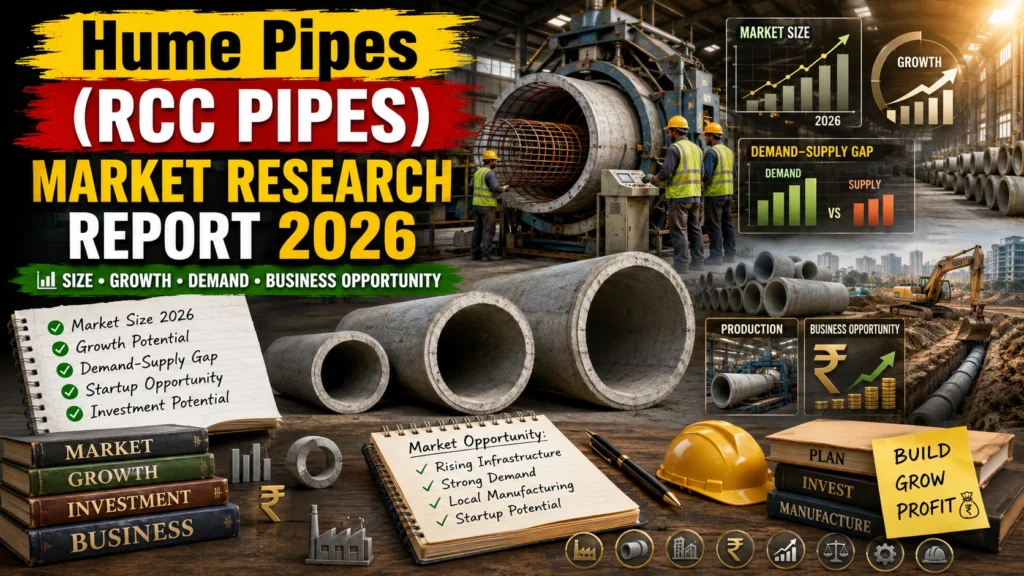

Hume Pipe Manufacturing Business
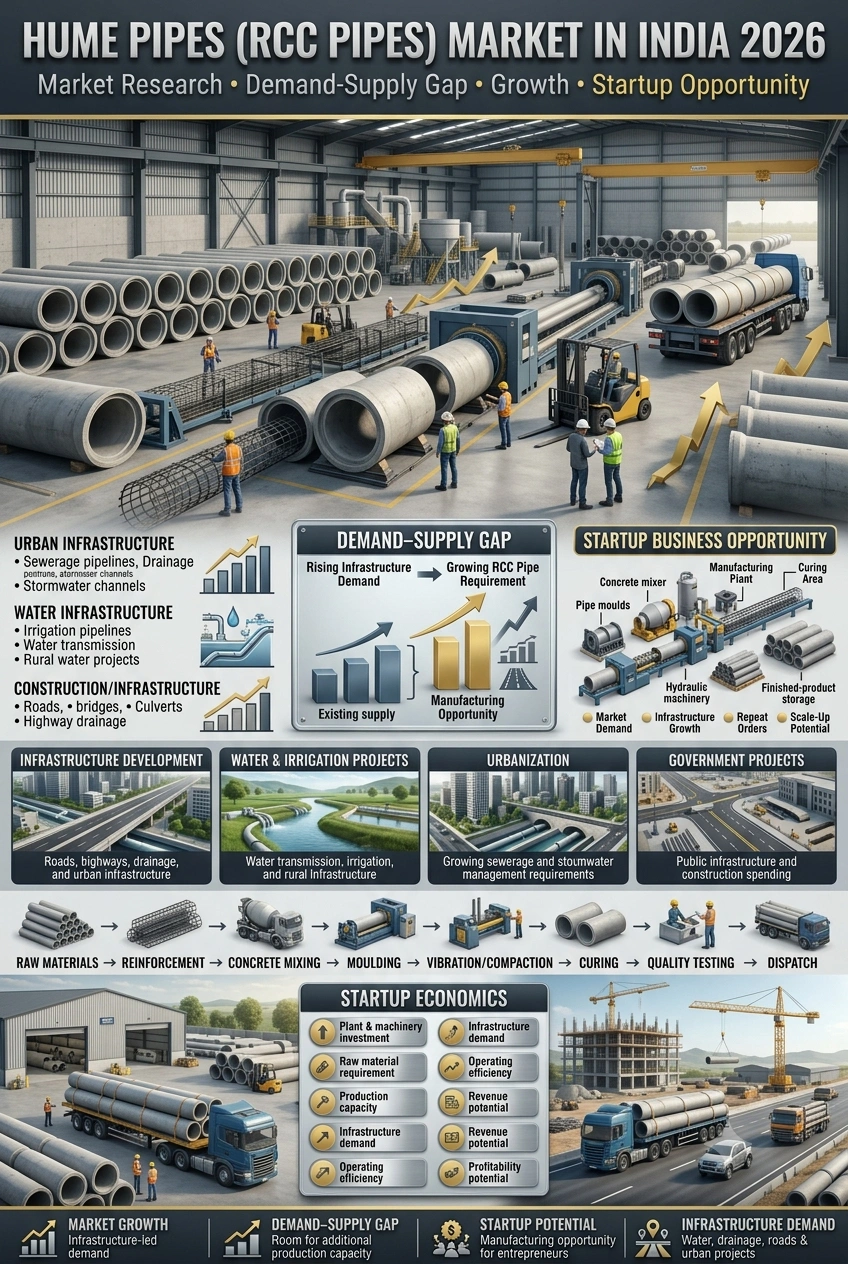
The Hume pipe is one of the products that can be equated directly to India’s largest public infrastructure programme. Along with the expansion of AMRUT 2.0 water sewerage, India’s Jal Jeevan Mission is installing pipe networks in all the rural households in the country, the biggest water infrastructure programme in the world’s history with the spending of about ₹8.69 lakh crore till December 2028. The large diameter variety of reinforced concrete pipe is the backbone of stormwater drains, sewerage trunk lines and canal-lining projects, especially at large-scale, for which plastic pipe cannot match. That’s as close to a bottom floor as an entrepreneur can get.
What Are Hume Pipes?
Hume pipes, or also known as reinforced cement concrete (RCC) pipes, are pipes that have been precast with steel bars or steel mesh and are made by either centrifugal (spun) casting or vertical vibration-casting processes. It took its name from the patenting in 1910 of the centrifugal spinning process for making concrete pipes by the Hume brothers of Australia. They are produced in India to the Indian Standard specification IS 458 which is similar to the Australian, British and American standards and are available in strength grades (usually NP2, NP3, NP4) that are classified by the load-bearing requirements.
There are several variants of the Hume pipe:
- Reinforced Cement Concrete Pipes (RCCP) – plain pipes made of reinforced cement concrete for gravity flow drainage and sewerage systems.
- Prestressed Concrete (Non-Cylinder) Pipes – higher strength pipes with prestressing wire for pressure applications
- Prestressed Concrete Cylinder Pipes (PCCP) – pipes containing a steel cylinder, suitable for high-pressure water transmission
- Bar-Wrapped Steel Cylinder Pipes – a combination of steel and concrete for high pressure and large diameter pipes
Service life is typically specified as 50+ years (high grade concrete M30/M40) with good concrete installation. Diameters range typically from 150mm up to over 2600mm and lengths are typically from 2.5–3 metres.
Related Article: Medium-Density Polyethylene (MDPE) Pipes Are A Lucrative Business for Any Entrepreneur
Global and India Concrete Pipe Market Size and Growth
The concrete pipe market is a well-established and a steady growing market in the world. It is estimated to be around USD 13.4-15.6 billion in 2025 and will reach USD 19.9 billion–USD 45.2 billion in 2034-2035, at beggar-taker rates of 3.5-4.5%, a mature-market rate, reflecting the balance of replacement-demand in developed markets and the new-build demand in urbanising economies.
The story of India is a much more dynamic one. In total, the India pipes market (all materials) is expected to reach USD 16 billion by 2025 with a compound annual growth rate of more than 11% — and in this, concrete pipes will continue to hold a strong and non-substitutable position in irrigation canal projects, stormwater drainage, and sewerage trunk lines where plastic and HDPE pipes are not structurally viable at a large scale.
Note on figures: This is not a stand-alone market segment for reinforced concrete pipes, but is a sub-segment of the “pipes” or “concrete pipe” market and can therefore be reported in different market studies. NPCS can provide a custom techno-economic feasibility study that can be developed for the diameter range you are interested in and can be tailored to the target customer (government water boards, PWD, private EPC) for investor grade numbers.
The Government-Backed Demand Floor
Concrete pipe demand in India is quite different from most of the manufacturing categories because it is not just a market demand but it’s a demand which is funded and policy-driven by the government.
- Jal Jeevan Mission 2.0: Launched till December 2028 with an approximate budget of ₹8.69 lakh crore (~USD 104 billion) for reaching piped water connections to each and every rural household. As of early/mid-2026, more than 15.4 crore rural households had been connected.
- AMRUT 2.0 (Atal Mission for Rejuvenation and Urban Transformation): Urban sewerage networks, Stormwater drainage, approved water supply projects of more than ₹1,18,000 crore, which directly contributes to the use of large-size RCC pipes.
- PMKSY- Pradhan Mantri Krishi Sinchayee Yojana (PMKSY): Canal lining and micro irrigation works using concrete pipelines for conveyance of water.
- National Infrastructure Pipeline: Inception of investments in roads, railways and urban drainage projects on a larger scale, which comprises investments in culvert and cross-drainage applications of RCC pipes.
Policy Tailwinds
1. Mandatory BIS specification (IS 458): RCC pipes supplied to government water boards, PWD, and municipal corporations must conform to IS 458:2003, creating a quality-compliance barrier that favours established, certified manufacturers over informal producers.
2. Government direct project procurement: The concrete pipe demand is huge with government direct project tenders for multi years with empanelling of a manufacturer (Public Health Engineering Department, Public Works Department, municipal corporations, NHAI).
3. MSME manufacturing incentives: RCC pipe manufacturing units are labour and capital-intensive precast concrete units; therefore, they are eligible for MSME capital subsidy schemes in various states.
4. State industrial policies for precast concrete units: Some states provide land, power tariff and capital subsidy for the precast concrete product manufacturing due to its contribution towards the delivery of public infrastructure.
View Full Project Details: Emerging Business of Ductile Iron Pipe Fittings
India Demand-Supply Gap: Hume Pipes (RCC Pipes)
| Parameter | Current Position |
| Demand driver scale | Jal Jeevan Mission 2.0 alone represents an ~₹8.69 lakh crore infrastructure programme through 2028, alongside AMRUT 2.0 urban sewerage expansion and PMKSY irrigation projects |
| Domestic manufacturing base | A mix of large organized players (The Indian Hume Pipe Co. Ltd., with 20+ factories) and hundreds of regional/MSME-scale manufacturers spread across nearly every Indian state |
| Nature of the gap | Primarily a regional capacity and logistics gap — concrete pipes are heavy, low-value-density products with high transport cost relative to product value, meaning demand often outpaces locally available capacity even where national aggregate capacity looks adequate |
| Market structure | Highly fragmented — organized players with pan-India reach coexist with a very large number of regional and local manufacturers; competitive dynamics are shaped by pricing, logistical proximity, and quality-standard adherence rather than brand power |
| Opportunity for new entrants | Strong for regionally-positioned manufacturers near government project clusters, given the product’s poor economics for long-distance transport and the sheer scale of ongoing government procurement |
Reading the gap: Hume pipes are a rare manufacturing category where the constraint is rarely “does demand exist” — government infrastructure spending guarantees that — but “is there enough locally-positioned, quality-compliant manufacturing capacity near where the pipe is needed.” Because transport cost is a large share of delivered price for a heavy, low-value-density product, a new regional manufacturer doesn’t need to compete nationally; it needs to be the best-positioned qualified supplier for its own district or state’s ongoing JJM, AMRUT, or PWD tenders.
Major Indian Hume Pipe / RCC Pipe Manufacturers
| Company | Base/Region | Scale | Notes |
| The Indian Hume Pipe Co. Ltd. (IHP) | Mumbai, Maharashtra (HQ); 20+ factories pan-India | Large integrated national player | Established 1926 by Walchand Hirachand; India’s original and largest Hume pipe manufacturer; also manufactures PSC pipes, PCCP, bar-wrapped steel cylinder pipes, and PSC railway sleepers; over 100 projects under execution; recently secured a ₹357+ crore water supply project from Madurai City Municipal Corporation |
| Sneh Precast & ConstoSolutions | Maharashtra | Regional manufacturer | Produces NP3/NP4-class RCC pipes for drainage and sewerage with spigot-socket joint configurations |
| Bharat Hume Pipes | Satna, Madhya Pradesh | Regional manufacturer | Serves food, chemical, and fertiliser industry clients in addition to municipal infrastructure |
| Vishwa Infrastructures and Services Pvt. Ltd. | New Delhi (with pan-India operations) | Regional/national infrastructure and precast player | Active RCC Hume pipe manufacturer and infrastructure EPC contractor |
| Chandragupt Buildcon Pvt. Ltd. | India | Regional manufacturer | Recognised among top-ranked Indian Hume pipe manufacturers |
| Reliance Cement Products | India | Regional manufacturer | Recognised precast concrete pipe manufacturer |
| A large base of MSME-scale regional manufacturers | Distributed across nearly every Indian state (UP, Gujarat, Telangana, Odisha, Rajasthan, Karnataka, West Bengal) | Local/regional | Hundreds of smaller manufacturers supplying state PWDs, municipal corporations, and private construction projects at the district/regional level — the segment most representative of the MSME entry opportunity |
Concrete Pipe Industry: International Context
Unlike globally-traded specialty chemicals, concrete/RCC pipe manufacturing is inherently a local-to-regional industry everywhere in the world — the product’s weight and transport cost make cross-border trade uneconomical except in rare cases. Rather than “international players competing in India,” the more relevant global context is the industry structure in comparable large markets:
| Region/Country | Notes |
| China | The world’s largest concrete pipe consumer, driven by continued water diversion and urban infrastructure megaprojects (e.g., the South-North Water Transfer Project); manufacturing is almost entirely domestic and regionally distributed |
| United States | A mature replacement-driven market; recent large M&A activity (Commercial Metals Company’s ~USD 675 million acquisition of Concrete Pipe & Precast, and its acquisition of Foley Products Company) reflects industry consolidation among large regional players |
| European Union | Aging infrastructure replacement cycles and urban redevelopment sustain steady demand; production is organized around large national or regional precast groups |
| Southeast Asia | Similar to India, transport economics favour local manufacturing over imports; countries in the region face logistical hurdles that reinforce this local-manufacturing structure |
This confirms the structural reality for an Indian entrepreneur: this is fundamentally a regional manufacturing and logistics business, not an import-substitution or export-oriented one. Success is determined by proximity to demand and quality compliance, not by competing against foreign producers.
Market Segmentation
By Type
- Reinforced Concrete Pipes (RCP) — non-pressure, gravity-flow applications (dominant segment)
- Prestressed Concrete (Non-Cylinder) Pipes
- Prestressed Concrete Cylinder Pipes (PCCP) — pressure water transmission
- Bar-Wrapped Steel Cylinder Pipes
By Application
- Urban sewerage systems and stormwater drainage
- Rural and urban water supply transmission (Jal Jeevan Mission, AMRUT)
- Irrigation and canal-lining projects (PMKSY)
- Culverts and cross-drainage (highway and railway infrastructure)
- Industrial effluent and process water conveyance
By Diameter Range
- Small diameter (150–400mm) — residential and small municipal drainage
- Medium diameter (400–900mm) — municipal sewerage and stormwater
- Large diameter (900mm–2,600mm+) — trunk sewerage, major stormwater, and bulk water transmission
By End User
- State Public Health Engineering Departments (PHED) and Jal Nigam/Jal Board entities
- Municipal corporations (AMRUT and urban sewerage projects)
- National Highways Authority of India (NHAI) — culverts and cross-drainage
- State irrigation departments (canal lining under PMKSY)
- Private construction and industrial clients
Get Detailed Insights from This Book: Our Books
Key Growth Drivers
1. Jal Jeevan Mission 2.0. The single biggest material for Indian pipe demand, which was extended till 2028 and will spend about ₹8.69 lakh crore, is being used for water transmission infrastructure, and the large diameter concrete pipe is one of its components.
2. AMRUT 2.0 urban sewerage expansion. The main use of large diameter RCC pipes, where plastic pipes are not structurally viable, is in the construction of city-level sewerage network and stormwater drainage projects.
3. fast urbanisation and Tier-2/Tier-3 city development. As the urban population in India is expected to grow to 600 million by 2031, a large amount of new drainage and sewerage network will need to be built in cities, which currently do not have organized underground utility networks.
4. PMKSY – irrigation & canal modernisation. Demand for concrete pipe in canal lining and water conveyance continues to grow, particularly in the canal area, as a result of government investments in irrigation efficiency.
5. Aging infrastructure replacement. In existing cities in India, the steady demand for replacement of the old concrete and cast-iron pipe networks is not associated with the construction of new pipes.
6. High strength and durability for large diameter and heavy load applications. Concrete still is the best option for stormwater and sewerage trunk lines larger than 600mm diameter, and continues to challenge HDPE/PVC in this category.
Challenges and Restraints
- High transportation cost/value of product. Heavy and low value density of concrete pipes makes logistics a significant competitive advantage and limits the economic service area available to a single plant to a reasonable radius.
- Volatility and unpredictability of raw material prices. The main raw material costs, cement and reinforcing steel, have commodity price fluctuations which directly impact margins.
- Government tender-cycle dependency. A substantial amount of the demand is through public tenders, which is a commercially relevant aspect for manufacturers in terms of empanelment, bid timing and payment cycle management.
- Good practices/Quality standard compliance (IS 458). New players need to be ready to spend on testing facilities and quality control which are required to conform to BIS norms for government project supply.
- Competition for plastic/HDPE alternatives in smaller diameters. Concrete pipe’s competitive advantage is being focused on larger diameter, heavier load applications while PVC and HDPE pipes are growing in popularity for smaller diameter, lower load applications.
Competitive Landscape
The Indian Hume pipe industry has one strong national-scale producer – The Indian Hume Pipe Co. Ltd. with over 20 factories and over 100 projects going on simultaneously – and a huge number of players at the regional and MSME scale that cater to the local government tenders and private construction demand. This is a logical configuration, not a temporary one, because the product’s transport cost economics is more of a logistical and reliable battle against IHP in a region where a well-positioned plant is near an active cluster of JJM or AMRUT projects.
Hume Pipe Manufacturing: Business Opportunity for Startups and MSMEs
1. Regional RCC pipe manufacturing unit near an active infrastructure cluster. A plant positioned close to ongoing Jal Jeevan Mission, AMRUT, or PWD project zones can capture government tender demand that national players serve less efficiently due to transport cost — the most direct MSME entry format in this category.
2. Diameter-specialised manufacturing. By concentrating on a nominated diameter band (e.g. medium diameter municipal sewerage pipe) mould and machine use can be optimized while trying to serve the entire available diameter range from the start.
3. Manufacturing of integrated precast concrete products. Production of RCC pipe along with associated precast products (manholes, culverts, cable duct) allows for diversification of income and better utilization of common precast batching/curing facilities.
4. Focus on empanelment of officers of the State PWD and municipal corporations. It is better to develop a business by consistently getting work from the state departments than from a variety of private orders.
5. Irrigation-sector focused manufacturing. Canal-lining and irrigation-conveyance pipe demand under PMKSY provide a unique customer base to the entrepreneur in agriculturally important states compared to urban water/sewerage projects.
The capital cost, machine specification (centrifugal spinning vs vertical vibration casting) and capacity figures are subject to wide variations for the target diameter range and production technology. From the target diameter range and customer base, NPCS can create detail, bankable Project Reports, including details of the machinery, guidance on compliance to IS 458 and financial projections for your location.
Smart entrepreneurs start here—find your perfect venture
How NPCS Supports Entrepreneurs Entering This Space
For any entrepreneur considering entering into an activity of Hume pipe/RCC pipe manufacturing, the initial step should be to prepare a detailed project report (DPR) which would cover the capacity of the manufacturing plant, the type of machines to be used (centrifugal spinning or vertical casting), the availability of raw materials, manpower needs, project costs, and the profitability of the operation for the chosen location and customer base (government or private customers).
About NPCS (Niir Project Consultancy Services)
Founded in 1994, NPCS is an Industrial Consultancy organization of New Delhi and an ISO 9001:2015 certified organization having more then 30 years experience in techno-economic and Project consultancy. During the last 30 years NPCS has provided over 150,000 project reports and profiles in 85 countries for an almost complete range of manufacturing and process industries, including precast concrete products, building materials and infrastructure linked manufacturing.
NPCS is active on three integrated platforms:
These detailed techno-economic feasibility studies for the manufacturing of various food products were compiled by niir.niir is the main source of Detailed Project Reports, business plans and techno-economic feasibility studies for various food products.
- niir.org — the primary repository of industry-specific Detailed Project Reports, business plans, and techno-economic feasibility studies
- entrepreneurindia.co — market research, project profiles, and manufacturing business opportunity content aimed at entrepreneurs and MSMEs
- npcsblog.com — industry insight, trend analysis, and manufacturing sector commentary
NPCS’s core deliverables relevant to a Hume pipe venture include:
- These include techno-economic feasibility studies with IS 458 compliance guidance.
- Financial modelling includes project cost analysis, profitability analysis, ROI (return on investment) and break-even analysis.
- Specific regional government project pipelines of raw material and market assessment.
- Support documents for MSME loan applications, subsidy schemes, bank funding requirements etc.
Entrepreneurs evaluating this sector can access relevant Hume pipe manufacturing profiles directly on niir.org and entrepreneurindia.co, or request a custom feasibility study scoped to a specific diameter range and region.
Government and Institutional Reference Links
- Jal Shakti Ministry / Jal Jeevan Mission
- Ministry of Housing & Urban Affairs (AMRUT)
- Ministry of Micro, Small and Medium Enterprises (MSME)
- Development Commissioner, MSME (DCMSME)
- Bureau of Indian Standards (BIS)
- National Highways Authority of India (NHAI)
- Ministry of Jal Shakti — Department of Water Resources, PMKSY
- Press Information Bureau (PIB), Government of India
- Startup India
- Invest India (National Investment Promotion and Facilitation Agency)
Entrepreneurs are advised to verify the latest JJM/AMRUT scheme guidelines, IS 458 specification updates, and MSME subsidy norms directly on these portals, as programme funding and technical standards are periodically revised.
Conclusion
Hume pipes have a unique position in the manufacturing opportunities: They are a mature product category, with a long and technically well understood development history, and they sit atop one of the world’s longest and most widely pledged public infrastructure programmes. This is a manufacturing business where the key to success lies in being well-connected and quality-approved close to the location of the Government construction, not out-innovating a competitive national market.
Entrepreneurs and MSMEs considering investments in precast concrete manufacturing will find Hume pipe an extremely unique combination of proven technology, government support of demand visibility, and natural protection from long distance competitors.