
Our Categories

Our Categories

P.K. Tripathi

P. K. Tripathi is Associate Editor at Entrepreneur India and a seasoned business consultant with over 35 years of experience advising startups and established enterprises across multiple industries. He has worked closely with founders and business leaders, offering strategic guidance on business planning, project execution, and market positioning — helping entrepreneurs transform ideas into viable, scalable ventures. A published author of several business books on startups, manufacturing opportunities, and practical entrepreneurship, P. K. Tripathi is known for his grounded, execution-focused approach that cuts through theory to deliver actionable insights. Through his writing and consulting work, he continues to equip aspiring entrepreneurs with the real-world knowledge, industry intelligence, and practical strategies needed to thrive in competitive markets.

26 Small Manufacturing Business Ideas to Start with Investment of 60- 75 Lakhs

26 Small Manufacturing Business Ideas to Start with Investment of 60- 75 Lakhs Read More »

India’s booming industrial sector and favorable government policies make it an ideal destination for entrepreneurs looking to start a small manufacturing business. With an investment capacity of ?60–75 lakh, several lucrative opportunities are available that can generate good returns and contribute to job creation. Whether you are planning a semi-automated unit or a full-fledged production line, the scope for growth is immense. In this article, we explore the best small manufacturing business ideas with 60–75 lakh investment, providing insights into demand, profitability, and feasibility. Why Invest in Small Manufacturing Businesses? India’s small manufacturing sector contributes significantly to GDP and employment. The growing “Make in India” initiative, along with easy credit from banks and government subsidies through MSME schemes, makes the manufacturing ecosystem attractive. With ?60–75 lakh, entrepreneurs can establish a scalable business, invest in modern machinery, hire skilled labor, and ensure product quality with ample working capital. Let’s now explore the best small manufacturing business ideas with 60–75 lakh capital. 1. Paper Bag Manufacturing With the ban on plastic bags and increasing demand for eco-friendly alternatives, paper bag manufacturing is booming. You can start a semi-automated unit producing kraft paper, shopping bags, and customized branded bags. Estimated Investment: ?65–70 lakh (includes land, machinery, and raw materials)Profit Margin: 15–25%Target Customers: Retailers, supermarkets, clothing brands, restaurants This is among the best small manufacturing business ideas with 60–75 lakh due to low competition and rising demand. 2. LED Light Manufacturing The energy-efficient lighting industry is growing, especially in urban and rural electrification programs. LED bulbs, tube lights, and panel lights are in high demand. The business includes assembling circuits, housing units, and testing. Estimated Investment: ?70–75 lakhProfit Margin: 20–30%Target Market: Real estate projects, government tenders, commercial complexes The high return on investment and future-ready nature of this segment make it one of the best small manufacturing business ideas with 60–75 lakh investment. 3. Packaged Drinking Water Plant Clean water is a necessity, and with rising awareness of health, the packaged drinking water industry is flourishing. With proper BIS certification and hygienic bottling, this business can scale quickly. Estimated Investment: ?60–72 lakhProfit Margin: 25–35%Scalability: High, with options to expand into flavored water and soda Given the year-round demand, this is undoubtedly one of the best small manufacturing business ideas with 60–75 lakh capital. 4. Disposable Cutlery and Plates Manufacturing With increasing restrictions on single-use plastics and a shift towards biodegradable options, the market for disposable cutlery made from sugarcane bagasse, areca leaves, and cornstarch is booming. Estimated Investment: ?65 lakhProfit Margin: 20–30%USP: Eco-friendly and export potential This green initiative qualifies as a sustainable and profitable venture, ranking among the best small manufacturing business ideas with 60–75 lakh. 5. Agarbatti (Incense Stick) Manufacturing India is the world’s largest producer and consumer of incense sticks. The raw material is easily available, and the product has religious and cultural significance across regions. Estimated Investment: ?60–68 lakh (includes semi-automatic machines)Profit Margin: 30–40%Export Potential: High, especially to Southeast Asia and the US This culturally rooted and low-entry-barrier business is undoubtedly one of the best small manufacturing business ideas with 60–75 lakh for quick profits. 6. Furniture Manufacturing With rising urbanization and real estate development, the demand for custom and modular furniture has increased. Using a blend of CNC routers, polish machines, and skilled artisans, this business is highly scalable. Estimated Investment: ?70–75 lakhProduct Range: Office desks, kitchen cabinets, beds, wardrobesTarget Market: Retail, wholesale, B2B, interior designers Thanks to steady demand and customization trends, this is a long-term and stable venture—easily among the best small manufacturing business ideas with 60–75 lakh. 7. Detergent and Cleaning Products Manufacturing With increasing hygiene awareness, the market for liquid detergents, dishwash liquids, floor cleaners, and handwashes is growing rapidly. The sector also allows for private labelling opportunities. Estimated Investment: ?60–65 lakhProfit Margin: 20–35%Scope: Home care, hotels, hospitals, retail chains This FMCG product segment is recession-proof, making it one of the best small manufacturing business ideas with 60–75 lakh investment. 8. Garment Manufacturing Unit Textiles and garments remain India’s top export industries. You can set up a small unit producing t-shirts, uniforms, or women’s ethnic wear, using semi-automated machines and hiring tailors. Estimated Investment: ?70 lakhProfit Margin: 20–25%Target Markets: E-commerce, export, wholesale markets With good design, branding, and quality control, this can scale fast, making it one of the best small manufacturing business ideas with 60–75 lakh. 9. Solar Panel Assembly Unit As renewable energy adoption grows, small-scale solar panel assembly units are in demand. While manufacturing from scratch is capital-intensive, assembling parts locally is feasible in this budget. Estimated Investment: ?75 lakhCustomers: Residential buildings, schools, rural electrification, MSMEsSupport: Government subsidies and net-metering policies With environmental sustainability and market expansion, this is clearly one of the best small manufacturing business ideas with 60–75 lakh. 10. Ayurvedic and Herbal Products Manufacturing India’s wellness industry is booming. With licenses and certifications (FSSAI, AYUSH), one can manufacture face creams, oils, supplements, herbal juices, etc. Estimated Investment: ?60–70 lakhProfit Margin: 25–40%Sales Channels: E-commerce, Ayurveda clinics, retail stores Given the rise in natural product preference, this sector promises high returns and is among the best small manufacturing business ideas with 60–75 lakh investment. Key Factors to Consider Before Starting While exploring these best small manufacturing business ideas with 60–75 lakh, keep these essential factors in mind: Licensing & Compliance: Ensure all statutory registrations like MSME Udyam, GST, pollution control, factory license, etc., are completed. Location: Choose an industrial zone or semi-urban area with access to raw materials, manpower, and transportation. Machinery & Technology: Invest in reliable semi-automated or automated machinery for efficiency and scalability. Skilled Manpower: Hire or train staff for operating machinery and maintaining product quality. Marketing Strategy: Leverage B2B networks, local distributors, and digital platforms for brand visibility. Conclusion Starting a small manufacturing business with a ?60–75 lakh budget is a strategic decision with the potential to yield high returns if executed well. Whether you are inclined towards eco-friendly products, FMCG, or technological innovation, there are ample opportunities to explore. From LED lights to herbal products, these

Learn How To Do Best Sweet Scented Supari Manufacturing Business 2026 - NPCS Blogs

Learn How To Do Best Sweet Scented Supari Manufacturing Business 2026

Learn How To Do Best Sweet Scented Supari Manufacturing Business 2026 Read More »

Starting a Supari Manufacturing Business in India can be a highly profitable venture, especially given the widespread use of supari (areca nut) in cultural, religious, and social practices across the country. Supari, also known as betel nut, is consumed in various forms—raw, scented, or processed—and is a key ingredient in products like pan masala and gutka. Due to its high demand and the relatively low investment needed for small-scale operations, this business is gaining popularity among budding entrepreneurs. This article will guide you step-by-step through how to start a Supari Manufacturing Business in India, discussing everything from market potential to machinery requirements, licensing, and profit margins. Market Potential and Scope of Supari Manufacturing Business The Supari Manufacturing Business has tremendous market potential in India and abroad. India is the largest consumer and producer of areca nuts, which are predominantly grown in states like Karnataka, Kerala, Assam, and West Bengal. The product is consumed in both urban and rural areas, and its use in religious rituals, hospitality, and social gatherings ensures a consistent demand throughout the year. Additionally, processed supari is exported to countries like the UAE, Nepal, Bangladesh, and the UK, opening up avenues for international trade. The industry also supports multiple layers of value addition—flavored supari, silver-coated supari, sweet supari, and branded products—each with its own pricing and market. Entrepreneurs can begin small and gradually scale operations depending on demand and capital availability. Given the rising preference for branded and hygienically packaged supari, there is also ample room for innovation and premium positioning. Steps to Start a Supari Manufacturing Business 1. Conduct Market Research Start with understanding the types of supari that are popular in your target market. Conduct surveys or talk to local traders and retailers to understand consumer preferences—flavored supari, scented supari, sweet supari, or plain chopped areca nuts. Check your competition, pricing strategies, and packaging trends to identify your business’s unique selling proposition. 2. Decide on the Business Model You can either go for a small-scale manual processing unit or set up a semi-automatic or fully-automatic manufacturing unit. For beginners, a semi-automatic setup is ideal—it offers a balance of cost-efficiency and operational ease. Depending on your capital, you may start with basic equipment and a workforce of 5–10 people. 3. Business Registration and Legal Compliance Before launching your Supari Manufacturing Business, ensure you complete all legal formalities. Some of the essential registrations and licenses include: Udyam Registration for MSME benefits GST Registration Trade License from local municipal authority FSSAI License if you plan to process and package flavored or sweet supari Factory License for medium or large-scale units Trademark Registration for branding If you’re planning to export, obtaining an Import Export Code (IEC) from DGFT is mandatory. 4. Choose a Suitable Location The ideal location for a Supari Manufacturing Business should be close to the source of raw materials (i.e., areca nut growing regions) or near the market where demand is high. Ensure proper water, electricity, and transportation facilities are available. A small-scale unit can be established in 1000–1500 sq. ft. of area, depending on the level of automation. 5. Procure Machinery and Equipment Depending on your budget and production capacity, the basic machinery required for supari manufacturing includes: Supari cutting machine Polishing drum Flavor mixing unit Roasting machine Dryer Weighing scale Packing machine (manual or automatic) Sealing machine A semi-automatic plant can cost anywhere between ?5 lakhs to ?15 lakhs. Make sure to buy machinery from reputed vendors who provide installation support and warranty. 6. Hire Skilled and Unskilled Labor You’ll need machine operators, flavoring technicians (if producing flavored supari), packagers, and quality control staff. Training them in hygiene, handling of machinery, and consistency in product quality is essential for a successful operation. 7. Source Raw Materials The primary raw material is raw areca nut (supari), which you can procure directly from farms or through wholesale markets. Other materials include: Flavors and sweeteners (cardamom, menthol, etc.) Silver leaves (optional for premium supari) Packing materials (plastic pouches, jars, labels, etc.) Quality raw material ensures a good product, which leads to customer retention and brand loyalty. 8. Manufacturing Process Here is a typical process flow for a small-scale Supari Manufacturing Business: Cleaning: Remove dust and impurities from raw areca nuts. Cutting: Use cutting machines to chop the nuts into uniform pieces. Roasting: Optional step to enhance flavor and shelf life. Flavor Mixing: Add flavors or sweeteners depending on product type. Polishing: Polishing in drums to improve texture and appearance. Drying: Ensures moisture-free supari, important for storage. Packaging: Final step involving sealing and labeling for retail. Each step must maintain hygiene and quality control. Keep records of batch production for consistency and traceability. 9. Branding and Packaging Branding is key to success in the Supari Manufacturing Business. Focus on attractive, tamper-proof, and food-grade packaging that stands out on retail shelves. Offer multiple pack sizes (2g, 10g, 50g, etc.) to cater to various market segments. Invest in a professional logo, design labels with proper FSSAI and manufacturing details, and build a distinct identity. 10. Marketing and Distribution Start with local markets—pan shops, general stores, tea stalls, and local distributors. Gradually expand to wholesale markets in nearby cities and states. Some effective marketing strategies include: Offering free samples Local newspaper or radio advertising Participation in trade fairs Tie-ups with wholesalers and distributors Social media promotion for urban reach If you’re making premium or flavored supari, you can even explore online selling through platforms like Amazon, Flipkart, or your own website. 11. Financial Planning and Investment Starting a small-scale Supari Manufacturing Business requires a modest investment, mostly in machinery, raw materials, and working capital. Here’s a rough estimate: Machinery and Equipment: ?5–15 lakhs Raw Materials (monthly): ?1–3 lakhs Packaging Materials: ?50,000–1 lakh Labor and Utilities (monthly): ?1–2 lakhs Marketing and Logistics: ?50,000+ Licensing and Registration: ?50,000 Total estimated initial investment: ?10–20 lakhs for a small to medium setup. 12. Profit Margin and ROI With proper planning and efficient production, you can expect a net profit margin of 20–30%. A small-scale

10 Powerful Tips to Start Castor Oil Manufacturing Business

10 Powerful Tips to Start Castor Oil Manufacturing Business Read More »

Castor oil is a highly valuable vegetable oil obtained from castor beans, widely used across pharmaceuticals, cosmetics, lubricants, paints, and biodiesel industries. With India being one of the largest producers and exporters of castor oil, establishing a Castor Oil Manufacturing unit is a profitable business opportunity. It not only serves the domestic demand but also has significant export potential. If you are looking to enter the agro-based industrial segment with good returns and moderate investment, this guide will walk you through every essential step to start your own Castor Oil Manufacturing unit. Step-by-Step Guide to Start a Castor Oil Manufacturing Unit 1. Understanding the Castor Oil Industry The Castor Oil Manufacturing industry is driven by its diverse industrial applications. From being a vital ingredient in medicinal formulations to acting as a lubricant in the aviation industry, castor oil enjoys steady demand. India alone contributes over 85% of the world’s castor oil supply, making it an ideal country to launch such a unit due to easy access to raw material (castor seeds), skilled labor, and export infrastructure. The major by-products—castor cake and hull—also find use in fertilizers and fuel, enhancing the overall profitability of the plant. 2. Market Research and Business Plan Before setting up your Castor Oil Manufacturing unit, carry out extensive market research to identify the demand trends, competitor analysis, and export potential. Based on your findings, draft a detailed business plan that includes: Investment requirements Operational model (manual/semi-automatic/fully automatic) Target markets (domestic/export) Profit and loss projections Break-even analysis Regulatory framework and licenses This plan will not only serve as a roadmap but will also be essential for attracting investors or securing bank loans. 3. Selecting Location and Land Requirements Choose a location close to castor seed-producing regions such as Gujarat, Rajasthan, Andhra Pradesh, or Tamil Nadu. Being near the raw material source reduces transportation costs and ensures a steady supply chain. For a medium-scale Castor Oil Manufacturing unit, you will need around 1 to 1.5 acres of land. The land should have facilities for: Raw material storage Machinery installation Processing unit Quality control lab Packing section Office space Waste management and effluent treatment systems Ensure that the site has access to water, electricity, roads, and connectivity to markets or ports (for exports). 4. Legal Licenses and Registrations To start a legally compliant Castor Oil Manufacturing business in India, you must obtain the following licenses: Company registration (as proprietorship, partnership, or private limited company) GST Registration Factory License under the Factories Act Pollution Control Board (PCB) clearance Import Export Code (IEC) for exports FSSAI license (if selling for edible use) Trade License from the local municipal authority BIS certification for oil quality (optional but recommended) Additionally, if you plan to export, get your unit certified by APEDA (Agricultural and Processed Food Products Export Development Authority). 5. Machinery and Raw Material Procurement Machinery Required for Castor Oil Manufacturing: Depending on your scale, you will need the following equipment: Castor seed cleaning machine Cooking kettle or steam boiler Oil expeller or screw press Filter press Oil refining unit (for refined grade) Storage tanks Packaging machine (pouch or tin filling) Quality testing instruments Invest in semi-automatic or fully automatic machinery for efficient and continuous production. The cost of machinery for a medium-scale Castor Oil Manufacturing plant can range from ?30 lakhs to ?80 lakhs. Raw Material: Castor Seeds – Easily available in India; buy from local farmers or wholesale mandis. Packaging material – Tins, bottles, plastic pouches, and cartons for final products. Chemicals (if refining) – NaOH, bleaching earth, activated carbon. 6. Castor Oil Production Process The Castor Oil Manufacturing process involves the following stages: Seed Cleaning: Removal of impurities such as dirt, stones, and broken seeds. De-hulling: Separation of castor seed hulls from kernels. Cooking/Conditioning: Seeds are heated to loosen oil content and increase efficiency. Pressing/Extraction: Mechanical expellers are used to extract crude castor oil from seeds. Filtration: Oil is passed through a filter press to remove solid particles. Refining (Optional): For medicinal or cosmetic use, refining is done using chemicals to improve color, odor, and shelf life. Packaging: Final oil is filled in containers, sealed, labeled, and ready for market or export. 7. Manpower and Staffing You’ll need a mix of skilled and semi-skilled labor to operate your Castor Oil Manufacturing unit. For a medium-scale plant, the required workforce may include: 2-3 machine operators 1-2 quality control staff 3-5 helpers for loading/unloading and packaging 1 electrician and maintenance technician 1 production manager 1 accountant or administrative staff Provide training and safety equipment to ensure smooth operations and compliance with factory norms. 8. Marketing and Distribution Strategy To ensure profitability in your Castor Oil Manufacturing business, a strong marketing and distribution plan is essential: Domestic Markets: Sell to pharmaceutical companies, cosmetic brands, soap manufacturers, and lubricant makers. Export Markets: Target USA, China, Japan, Europe, and Brazil, which are large importers of castor oil. Online Sales: Create a website or tie-up with e-commerce platforms to sell refined castor oil in consumer packs. Branding: Invest in attractive labeling, proper certifications, and product quality to build customer trust. Bulk Supply Agreements: Partner with industrial users for regular, large-volume supply. 9. Financial Requirements and Profitability The total investment to set up a medium-scale Castor Oil Manufacturing unit may range between ?75 lakhs to ?1.5 crore depending on land, machinery, and production scale. Break-up includes: Land & construction – ?20–30 lakhs Machinery & installation – ?30–80 lakhs Raw materials – ?5–10 lakhs (initial inventory) Working capital – ?10–15 lakhs Licenses and miscellaneous – ?5–10 lakhs Profit Margins: Profit margins in the Castor Oil Manufacturing industry range between 15% to 25% depending on the quality, market, and scale. With an efficient supply chain and export deals, ROI can be expected within 2–3 years. 10. Challenges and Risk Mitigation Some common challenges in the Castor Oil Manufacturing industry include: Price volatility of castor seeds – Manage via long-term contracts with farmers. Competition from large players – Focus on niche markets like organic or medicinal-grade oil. Environmental regulations

Desiccated Coconut Powder Production Business

Desiccated Coconut Powder Production Business Read More »

In recent years, the food processing industry has experienced massive growth due to rising global demand for packaged, processed, and ready-to-use food products. Among them, Desiccated Coconut Powder has carved a niche for itself in the bakery, confectionery, and culinary sectors. This highly versatile product is made from the dried, ground kernel of mature coconuts. For aspiring entrepreneurs, setting up a Desiccated Coconut Powder making unit can be a highly rewarding venture, both economically and environmentally. Market Overview and Scope of Desiccated Coconut Powder The global market for coconut-based products has seen consistent growth, driven by rising health consciousness and the trend towards natural food items. Desiccated Coconut Powder is in high demand in countries like India, Sri Lanka, the Philippines, Indonesia, and the Middle East. It is extensively used in sweets, chutneys, curries, cookies, cakes, and as a garnish in several dishes. Its longer shelf life, compared to fresh coconut, makes it an ideal product for export. India is one of the top producers of coconuts, and states like Kerala, Tamil Nadu, Karnataka, and Andhra Pradesh are leading hubs for coconut farming. This provides a sustainable raw material base for establishing a Desiccated Coconut Powder unit. With proper planning and quality control, small and medium-scale entrepreneurs can enter this domain and scale up gradually. Step-by-Step Guide to Start a Desiccated Coconut Powder Manufacturing Unit 1. Conduct Market Research and Feasibility Study Before jumping into any business, understanding the market is crucial. Study the demand for Desiccated Coconut Powder in your targeted region—be it local, national, or international. Analyze who your competitors are, what pricing strategy they follow, and what product quality they deliver. This will help you identify a unique selling proposition (USP) for your brand. 2. Prepare a Detailed Project Report (DPR) Your DPR should cover technical, financial, and marketing aspects of the business. Include machinery costs, land and building, working capital, labor, packaging, raw material sourcing, profit margin, and breakeven analysis. A detailed project report is essential if you plan to seek loans or financial assistance from banks or government schemes. 3. Select a Suitable Location The success of your unit largely depends on proximity to coconut-producing areas. Transportation costs and the freshness of raw materials play a big role in maintaining profitability and product quality. An area with easy access to utilities like water, electricity, and roads is ideal. 4. Business Registration and Licensing Register your business as a sole proprietorship, partnership, LLP, or private limited company depending on the scale and ownership model. Obtain the following licenses and permits: Factory License FSSAI Registration (Food Safety and Standards Authority of India) GST Registration Pollution Control Board Clearance (if required) MSME Udyam Registration for government subsidies and support Trade License from the local municipality 5. Arrange Finance and Working Capital Depending on the capacity (small, medium, or large scale), your investment may range from ?10 lakhs to ?1 crore. Funding can be arranged through: Bank loans under Mudra or Stand-Up India schemes Government subsidies for food processing units Angel investors or venture capitalists (for larger setups) Self-financing or family/friends 6. Procurement of Machinery and Equipment To produce Desiccated Coconut Powder, you’ll need the following key equipment: Dehusking Machine Deshelling Machine Paring or Peeling Machine Washing Unit Blanching Unit Pulverizer or Grinder Dryer (tray or conveyor type) Sieving and Packaging Machines Ensure that you choose machinery that meets food-grade standards and is easy to clean and maintain. Automated and semi-automated setups are available depending on your budget. 7. Manpower Requirements You’ll need trained and semi-skilled personnel for various processes such as handling raw materials, machine operations, quality testing, and packaging. For a small unit, a team of 8–10 members is sufficient, while a medium-scale unit may require 15–20 employees. 8. Raw Material Procurement Mature coconuts with thick, firm kernels are used for Desiccated Coconut Powder production. You can source coconuts directly from local farmers, wholesale markets, or cooperative societies. Building long-term relationships with suppliers ensures consistent quality and pricing. 9. Production Process The manufacturing process of Desiccated Coconut Powder involves several steps: Selection and Cleaning: Choose mature coconuts and wash thoroughly. Dehusking and Deshelling: Remove the outer husk and shell. Paring: Peel off the brown layer of the coconut. Washing: Clean the white kernel under fresh water. Blanching: Submerge the kernel in hot water to reduce microbial load. Grinding: Shred or grind the coconut to fine particles. Drying: Dry the ground coconut at 60–80°C to remove moisture (moisture content should be less than 3%). Sieving and Grading: Separate the powder based on size (fine or medium grade). Packaging: Pack in moisture-proof, food-grade bags to retain freshness. 10. Quality Control and Standards To ensure consistency and quality in your Desiccated Coconut Powder, you must: Maintain hygiene in production areas Use stainless steel machinery Conduct moisture, fat, and microbial tests Follow FSSAI and AGMARK standards Regularly calibrate equipment Quality certification like ISO 22000 or HACCP adds credibility to your brand, especially for exports. 11. Branding and Marketing Strategy Packaging plays a crucial role in the appeal of Desiccated Coconut Powder. Use attractive, informative, and tamper-proof packaging. You can sell under your own brand through: E-commerce platforms like Amazon, Flipkart, and BigBasket Local grocery and supermarket chains B2B platforms for bulk orders Direct supplies to bakeries and sweet shops Marketing strategies may include: Digital marketing via social media Free samples and influencer collaborations Participation in food expos Trade directories and online B2B listings 12. Export Potential The global demand for Desiccated Coconut Powder is expanding in countries like the USA, UAE, Canada, and Europe. To export, you’ll need: Importer Exporter Code (IEC) Compliance with international food safety standards Attractive export-grade packaging Tie-ups with export houses or direct international buyers The Agricultural and Processed Food Products Export Development Authority (APEDA) offers guidance and subsidies to exporters. Profitability and ROI Analysis A well-run Desiccated Coconut Powder unit can yield 20–30% profit margins. The ROI depends on capacity, raw material cost, machinery efficiency, and market penetration. For example, a small unit producing 500

List of Profitable Small Manufacturing Business Ideas with Investment of 50 Lakhs (Plant and Machinery)

List of Profitable Small Manufacturing Business Ideas with Investment of 50 Lakhs (Plant and Machinery) Read More »

India’s economy is rapidly expanding, and entrepreneurship is being celebrated like never before. Aspiring business owners are increasingly exploring manufacturing opportunities, particularly in the small-scale sector. One of the most promising investment brackets for first-time entrepreneurs is under ?50 lakhs. This budget is enough to establish a production unit, buy essential machinery, and begin operations while keeping risks relatively low. With the right planning and execution, small manufacturing ideas can evolve into profitable ventures with long-term sustainability. Top Small Manufacturing Ideas Under 50 Lakhs in India When it comes to small-scale industries, innovation, market demand, raw material availability, and government support play a major role in deciding success. Here are some of the most viable and profitable small manufacturing ideas that can be launched with an investment of ?50 lakhs or less: 1. Paper Bag Manufacturing With the ban on plastic in many Indian states and the growing preference for eco-friendly alternatives, paper bag manufacturing is a highly lucrative option. The process requires minimal manual labor and basic semi-automatic machinery. Investment Range: ?10-15 lakhsKey Requirements: Kraft paper, printing unit, cutting machineTarget Market: Retailers, shopping malls, restaurants, grocery stores This is one of the most sought-after small manufacturing ideas due to low raw material costs and high demand. 2. Spice Powder Manufacturing India is one of the world’s largest consumers and exporters of spices. Starting a spice powder manufacturing business involves sourcing raw spices, drying, grinding, packaging, and marketing the final product. Investment Range: ?20-30 lakhsKey Requirements: Pulverizer machine, packaging equipment, drying chamberTarget Market: Local supermarkets, restaurants, export markets Among the small manufacturing ideas, spice powder production is scalable and has a consistent market throughout the year. 3. Sanitary Napkin Manufacturing As awareness about menstrual hygiene rises, so does the demand for affordable sanitary pads. This sector is also supported by several government subsidies and NGO partnerships. Investment Range: ?30-40 lakhsKey Requirements: Semi-automatic pad making machines, sterilization units, soft cotton & absorbent gelTarget Market: Rural areas, schools, women welfare organizations This venture is not only profitable but also contributes to a social cause, making it one of the most impactful small manufacturing ideas. 4. Handmade Soap Production Handmade and herbal soaps have become extremely popular due to the rise of organic and chemical-free personal care products. This business is easy to start and allows high customization. Investment Range: ?8-12 lakhsKey Requirements: Soap molds, mixing equipment, oils, essential oils, herbal extractsTarget Market: Urban consumers, spas, hotels, e-commerce platforms Being a low-cost entry, it’s one of the most ideal small manufacturing ideas for home-based entrepreneurs. 5. Disposable Cutlery and Plates The shift towards sustainable food packaging has opened a vast market for biodegradable cutlery made of areca leaf, bamboo, sugarcane bagasse, etc. This industry has enormous growth potential in both domestic and export markets. Investment Range: ?25-35 lakhsKey Requirements: Molding machines, raw plant material, packaging unitTarget Market: Restaurants, food stalls, wedding planners, eco-friendly stores This eco-conscious business option is among the top small manufacturing ideas for the future. 6. Agarbatti (Incense Stick) Manufacturing India’s cultural and religious diversity ensures a massive and ongoing demand for agarbattis. This business is labor-intensive but can be started with a small team and limited equipment. Investment Range: ?5-10 lakhsKey Requirements: Agarbatti making machine, bamboo sticks, essential oils, perfumesTarget Market: Temples, households, retailers, exporters It is a traditional yet evergreen option among small manufacturing ideas, especially in semi-urban and rural areas. 7. Detergent Powder and Liquid Manufacturing The cleaning product industry is recession-proof. People need detergents year-round, which makes this business a consistent revenue generator. Investment Range: ?15-20 lakhsKey Requirements: Blender machine, mixing vessel, packaging system, raw chemicalsTarget Market: Households, laundries, hotels, wholesalers It is a highly recommended model for anyone researching dependable small manufacturing ideas with fast market entry. 8. LED Bulb Assembly Unit With government support for energy-saving products, the LED market has exploded in India. Starting a small LED bulb assembly plant can be an economical and scalable business. Investment Range: ?20-25 lakhsKey Requirements: Soldering machines, PCB boards, LED chips, testing equipmentTarget Market: Electrical shops, wholesalers, B2B suppliers One of the fastest-growing small manufacturing ideas with the added benefit of helping reduce carbon emissions. 9. Ice Cream Cone Manufacturing Ice cream cones are always in demand, especially in summers. The cone-making business requires a small setup but offers good profit margins when tied up with ice cream parlors and brands. Investment Range: ?10-15 lakhsKey Requirements: Cone baking machines, mixing equipment, packaging toolsTarget Market: Ice cream manufacturers, dessert parlors, cafes A niche yet fun-filled venture among small manufacturing ideas with opportunities to diversify into waffle cones and edible cups. 10. Ready-to-Cook Food Packaging With fast-paced lifestyles, the ready-to-cook meal segment is rapidly growing. From pre-cut vegetables to frozen parathas, this industry offers immense potential. Investment Range: ?30-45 lakhsKey Requirements: Cold storage, packaging unit, sealing machine, hygiene certificationTarget Market: Working professionals, college students, grocery retailers, online delivery platforms Perfect for urban areas, this idea is among the top trending small manufacturing ideas in the food sector. Tips to Succeed with Small Manufacturing Business Do In-Depth Market Research: Understand the competition, supply chain, customer preferences, and pricing. Location Matters: Choose a place with access to raw materials and near your target market to reduce logistics cost. Apply for Government Subsidies: MSME schemes, Startup India initiatives, and state-specific grants can significantly reduce startup costs. Quality is Key: Even for small-scale operations, quality control is essential for gaining consumer trust and brand loyalty. Branding and Digital Marketing: Promote your brand using social media, marketplaces, and local events. A good online presence gives a major edge. Final Thoughts Manufacturing is one of the strongest pillars of economic growth and employment in India. With the right planning, even small entrepreneurs can make a big impact. The options listed above not only offer great returns but also allow you to contribute to employment generation and import substitution. The most important factor is to choose an idea that aligns with your skills, passion, and the market demand. These small manufacturing ideas under ?50

Nitrous Oxide Production

Nitrous Oxide Production Read More »

Nitrous oxide, commonly known as laughing gas, is a colorless, non-flammable gas with a slightly sweet odor and taste. Widely used in the medical industry for its anesthetic properties, as well as in the food and automotive industries, nitrous oxide plays a significant role in modern manufacturing. In this article, we provide a comprehensive overview of how nitrous oxide is produced in factories, detailing each phase of the production process, the equipment involved, and safety measures taken to ensure quality and consistency. Industrial Process of Nitrous Oxide Production Raw Material Selection and Preparation The primary raw material used for the industrial production of nitrous oxide is ammonium nitrate (NH?NO?). This compound is selected for its stability and availability. Before initiating the production process, high-purity ammonium nitrate is sourced and stored in airtight, temperature-controlled containers to prevent contamination and degradation. Factories must ensure that the ammonium nitrate used does not contain impurities like chlorides, which can produce unwanted by-products and corrode reaction vessels. Quality control is crucial at this stage. Thermal Decomposition of Ammonium Nitrate The production of nitrous oxide is centered on the thermal decomposition of ammonium nitrate. This chemical reaction occurs under carefully controlled temperatures ranging from 250°C to 270°C. The reaction can be written as: NH?NO? ? N?O + 2H?O This exothermic reaction takes place in a decomposition reactor made of corrosion-resistant materials such as stainless steel or Inconel alloys. The reactor is designed to evenly distribute heat to prevent hot spots that might lead to explosive decomposition. Gas Separation and Cooling The gas mixture emerging from the reactor contains primarily nitrous oxide and water vapor, along with trace amounts of nitrogen, nitric oxide, and ammonia. To purify the gas: Cooling Units – The system first passes the gas through a heat exchanger or condenser, which cools the vapor and allows the water to condense and separate. Scrubbing Columns – The system directs the partially dried gas through alkaline scrubbers, often using caustic soda (NaOH), to neutralize acidic impurities like nitric acid or ammonia. Drying Towers – Desiccant drying towers filled with materials like silica gel or activated alumina further dehydrate the substance. These steps are critical to ensure that the final nitrous oxide product is free from contaminants and suitable for medical or industrial use. Compression and Storage Once purified, nitrous oxide is compressed using multi-stage compressors into high-pressure cylinders, typically at pressures around 50 to 60 bar. For transportation and storage, the gas is liquefied under pressure and stored in stainless steel cylinders fitted with pressure relief valves for safety. In high-capacity plants, cryogenic distillation may also be employed to liquefy and store large volumes of nitrous oxide. This ensures stability during shipping and long-term storage. Quality Control and Testing Every batch of nitrous oxide produced in factories undergoes stringent quality control testing to verify: Purity levels (typically above 99%) Moisture content Acidity and alkalinity Presence of toxic impurities like NO, NO?, and NH? Gas chromatography and infrared spectroscopy are commonly used analytical techniques. Medical-grade nitrous oxide must comply with pharmacopeia standards like USP or BP. Environmental and Safety Considerations Producing nitrous oxide requires strict safety protocols due to the risk of explosion and exposure to toxic gases. Factories employ: Explosion-proof equipment Gas leak detectors Automated shutdown systems Proper ventilation Personal protective equipment (PPE) for workers Additionally, since nitrous oxide is a greenhouse gas, modern plants use abatement systems to capture and decompose excess emissions using catalysts like rhodium or vanadium pentoxide, thereby reducing their environmental impact. Applications of Nitrous Oxide Once produced, nitrous oxide finds uses in several industries: Medical Use: As an anesthetic and analgesic, especially in dentistry and childbirth. Food Industry: As a propellant in whipped cream dispensers (E942). Automotive Industry: Enhancing engine performance in racing cars by increasing the oxygen available for combustion. Semiconductor Industry: As an oxidizer in the manufacture of microchips. The demand for nitrous oxide is growing rapidly, which is driving innovation in its production processes to ensure scalability, safety, and environmental sustainability. Latest Technological Advances Emerging trends in the industry aim to optimize nitrous oxide production through: Automated control systems for precision in temperature and pressure regulation. Catalytic converters that reduce NOx by-products during decomposition. Energy recovery systems that utilize heat from the decomposition process. Green chemistry approaches, such as using renewable electricity for heat generation. These technologies not only improve yield and efficiency but also reduce operating costs and emissions, making the process more sustainable. Global Production Leaders and Market Insights Countries like the United States, Germany, China, and India are major producers of nitrous oxide, with both public and private sector involvement. Companies such as Linde, Air Liquide, and Praxair dominate the commercial supply chain, investing heavily in advanced plant designs and regulatory compliance. The global market is expected to grow due to increased demand from the healthcare and food processing sectors. Sustainable manufacturing practices and stringent government regulations will shape the future of nitrous oxide production. Conclusion Producing nitrous oxide in factories involves a highly controlled thermal decomposition of ammonium nitrate, followed by rigorous purification, drying, and compression processes. By maintaining strict safety and quality standards, manufacturers ensure that the gas meets industrial and medical-grade specifications. As environmental concerns continue to rise, the industry is embracing cleaner technologies and advanced safety systems to make production more sustainable and efficient. Visit the page Select and Choose the Right Business Startup for You for sorting out the questions arising in your mind before starting any business and know which startup you can plan. We, at NPCS, endeavor to make business selection a simple and convenient step for any entrepreneur/startup. Our expert team, by capitalizing on its dexterity and decade’s long experience in the field, has created a list of profitable ventures for entrepreneurs who wish to diversify or venture. We regularly update the list to give you a steady dose of new and emerging opportunities. Contact Us

Tyre Retreading Business

Tyre Retreading Business Read More »

India, being one of the largest automobile markets in the world, consumes millions of tyres annually. While new tyre manufacturing continues to grow, the demand for cost-effective, eco-friendly alternatives has also increased. Tyre retreading business has emerged as a viable and profitable venture in India, especially in commercial and transport sectors where tyre costs form a significant part of operational expenses. This article provides a comprehensive guide on how to start a tyre retreading business in India, including its setup, machinery, licenses, and profitability. Understanding the Tyre Retreading Process Tyre retreading is the process of renewing old and worn-out tyres by replacing the tread with a new one. This extends the life of the tyre and offers a cost-effective solution compared to purchasing a new tyre. The process involves inspecting, buffing, repairing, and applying a new tread on the old casing. There are mainly three types of tyre retreading methods: precure retreading, mold cure retreading, and bead-to-bead retreading. Among them, the precure method is most commonly used in India due to its simplicity and cost-efficiency. Market Scope for Tyre Retreading Business The Indian market presents enormous opportunities for the tyre retreading business, particularly due to the high demand in commercial transport. Trucks, buses, agricultural vehicles, and heavy-duty construction equipment often rely on retreaded tyres to reduce operational costs. A retreaded tyre can cost up to 40% less than a new tyre while delivering nearly 80-90% of the performance, making it an attractive option for fleet operators. Additionally, with increasing environmental awareness, retreading helps in recycling old tyres and reducing rubber waste, aligning with India’s sustainable development goals. Steps to Start Tyre Retreading Business in India Here’s a step-by-step breakdown of starting your tyre retreading business: 1. Conduct Market Research Before investing, analyze the local market demand for retreaded tyres. Identify your target customers such as truck fleets, transport companies, agricultural cooperatives, and government departments. Study your competitors and identify their pricing, technology, and service quality. 2. Choose the Business Model You can start a small-scale unit catering to local transportation needs or invest in a medium to large-scale operation targeting larger fleets or regional markets. Choose between manual, semi-automatic, or fully automatic retreading systems based on your investment capacity. 3. Location and Infrastructure Select an industrial area or a location on the outskirts of cities with good transport access. You’ll need around 3,000 to 5,000 square feet of space for a small-to-medium unit. Ensure proper ventilation, electricity, drainage, and storage space for raw materials and tyres. 4. Machinery and Equipment To start a tyre retreading business, you will need the following machines: Tyre inspection spreader Buffing machine Tread builder Curing chamber/autoclave Envelope remover Tyre inflator Conveyor belts and tyre lifters Air compressor The cost of basic machinery for a small setup can range from ?10 lakh to ?25 lakh depending on the type and brand. 5. Raw Materials Required The essential raw materials include: Precured tread rubber Cushion gum Vulcanizing cement Envelope and curing tubes Repair cords and patches Sourcing high-quality materials is crucial for the performance and safety of the retreaded tyre. 6. License and Registration To operate a tyre retreading business, ensure you have the following registrations: MSME Udyam Registration Trade License from local authority GST Registration Factory License (if applicable) Pollution Control Board NOC BIS certification for quality standards (if you plan to scale up) It is important to follow the Bureau of Indian Standards (BIS) guidelines for retreading to ensure product quality and customer trust. 7. Skilled Workforce Hire trained operators, supervisors, and technicians who are familiar with tyre retreading processes. You can also provide training through institutes or machinery suppliers. For a medium setup, around 10 to 15 workers may be required. 8. Marketing Strategy Develop a strong marketing and customer outreach strategy. Use local advertising, tie-ups with transport unions, roadside garages, and fleet operators. Offer attractive rates, free pickup and delivery services, or loyalty discounts to gain trust and recurring orders. 9. Quality Control Maintaining strict quality control is essential in the tyre retreading business. Use proper inspection methods to select good casings and ensure the final retreaded tyre passes tests for safety, performance, and balance. Customer satisfaction directly depends on durability and performance. Investment and Profit Margin The initial investment for a small to medium tyre retreading setup in India ranges between ?20 lakh to ?40 lakh, including machinery, infrastructure, labor, and working capital. On average, retreading a tyre costs ?1,500 to ?2,500 and can be sold at ?3,000 to ?4,000 depending on the size and type. If your unit processes 20 to 30 tyres per day, you can expect a monthly turnover of ?12 to ?18 lakhs with a gross profit margin of 30-40%. Challenges in Tyre Retreading Business While the tyre retreading business is lucrative, it comes with challenges: Quality control and ensuring casing suitability Availability of skilled labor Competing with low-cost new tyres from unorganized markets Educating customers about the benefits of retreading Managing waste disposal and environmental compliance With proper planning and quality assurance, these challenges can be effectively managed. Government Support and Incentives The Government of India promotes MSMEs and recycling businesses through subsidies, tax benefits, and soft loans. You can avail financial support through: Stand-Up India scheme Credit Linked Capital Subsidy Scheme (CLCSS) State-level Industrial Development Corporations (SIDCs) Loans from SIDBI or nationalized banks Approaching your district industries center (DIC) can help you understand the available schemes and application processes. Growth Prospects in Future The future of the tyre retreading business in India looks promising. With increasing logistics demands, government infrastructure spending, and environmental consciousness, the need for sustainable tyre solutions is bound to rise. Automation and advanced retreading techniques are further improving efficiency and quality, giving businesses an edge. Export potential to neighboring countries in Africa and South Asia also exists for high-quality retreaded tyres. Final Thoughts Starting a tyre retreading business in India offers a sustainable and profitable business model with moderate capital requirements and significant demand in the transport sector. By combining technical

Capacitors Manufacturing Business

Capacitors Manufacturing Business Read More »

The capacitor manufacturing industry continues to experience robust growth, driven by escalating demand across automotive, industrial, telecommunications, and consumer electronics sectors. As we enter 2025, global focus on smart electronics, renewable energy, and electric mobility opens up new dimensions for entrepreneurs looking to invest in this high-potential sector. Understanding the Capacitor Manufacturing Business A capacitor is a fundamental passive component used in almost every electronic device. From smartphones to EVs and power grids, capacitors play a critical role in energy storage, voltage regulation, signal coupling, and more. The capacitor manufacturing business involves meticulous precision, high-quality raw materials, and advanced technological know-how. We guide you through the entire process to help you launch and scale this business effectively in 2025. Types of Capacitors and Their Applications There are various types of capacitors manufactured based on their materials, design, and use cases. Understanding the market demands and selecting a niche is the first step toward building a competitive edge. 1. Ceramic Capacitors One of the most commonly produced capacitors, ceramic capacitors are known for their reliability and wide frequency range. They are widely used in smartphones, laptops, and consumer electronics. 2. Electrolytic Capacitors These have high capacitance and are ideal for power supply filtering and energy storage. Electrolytic capacitors find usage in industrial power systems, audio equipment, and inverters. 3. Film Capacitors Film capacitors offer excellent stability and longevity, and are used in applications such as electric motor drives, lighting ballasts, and automotive electronics. 4. Tantalum Capacitors Tantalum capacitors are known for their small size and high performance, commonly found in military, aerospace, and medical equipment. Raw Materials Required A successful capacitor manufacturing setup depends on the availability and quality of raw materials. The primary materials include: Dielectric materials (ceramic, plastic film, paper, tantalum oxide) Metal foils (aluminum, tantalum, silver) Electrolytes (for electrolytic capacitors) Leads and terminals Encapsulation compounds Sourcing high-purity raw materials is essential to maintain product consistency and meet international quality standards. Machinery and Equipment Setup To establish a high-performance capacitor manufacturing unit, the following machinery is typically required: Winding machines for coiling the dielectric material Metalizing units for applying electrode layers Drying ovens for removing moisture content Assembly and soldering stations Encapsulation equipment Testing and quality control devices Automation plays a significant role in maintaining production efficiency and minimizing human errors. Consider integrating smart production lines and IoT-enabled quality monitoring systems. Manufacturing Process Overview The typical steps involved in capacitor manufacturing are: Dielectric Preparation – Selection and pre-treatment of dielectric material according to the capacitor type. Electrode Formation – Deposition of metal electrodes on dielectric surfaces via metallization or foil lamination. Winding or Stacking – The manufacturer either winds the dielectric-electrode assembly for cylindrical capacitors or stacks it for rectangular ones. Impregnation and Encapsulation – Manufacturers impregnate the assembly with insulating liquids and seal it with epoxy or resin to prevent moisture ingress. Lead Attachment – Electrical terminals are attached using soldering or welding techniques. Aging and Testing – Capacitors undergo controlled aging and rigorous testing to ensure electrical properties meet the standards. Marking and Packaging – Capacitors are marked with specifications and packed for shipment. Quality Standards and Certifications Compliance with global quality standards is mandatory in the capacitor manufacturing sector. Key certifications include: ISO 9001 for quality management systems RoHS (Restriction of Hazardous Substances) REACH (Registration, Evaluation, Authorisation, and Restriction of Chemicals) UL Certification (for product safety) Investing in in-house quality labs and following strict quality control measures helps in maintaining brand credibility and gaining customer trust. Market Opportunities in 2025 The capacitor manufacturing business is expanding rapidly with the rise of several megatrends: Electric Vehicles (EVs): The shift to EVs requires high-capacitance components for power control units and battery management systems. 5G Infrastructure: The deployment of 5G requires compact, high-frequency capacitors for signal processing equipment. Renewable Energy Systems: Wind and solar power systems use capacitors in inverters and converters. Industrial Automation: IoT and Industry 4.0 applications demand rugged and reliable capacitors. Targeting these high-growth markets can provide significant revenue potential and long-term stability. Financial and Licensing Requirements Setting up a capacitor manufacturing plant involves moderate to high capital expenditure, depending on the scale of operation. Major cost heads include: Land and Building Machinery and Equipment Raw Material Inventory Labor and Training Utility and Maintenance In India, you need to obtain the following licenses: Company registration (Private Ltd or LLP) GST Registration Pollution Control Clearance Factory License under the Factories Act BIS Certification (Bureau of Indian Standards) for electronic components Government subsidies and MSME incentives can also reduce the financial burden for startups in this field. Key Success Factors for 2025 To thrive in the capacitor manufacturing industry in 2025, focus on: Innovation: Offer miniaturized, high-performance capacitor solutions. Customization: Provide tailor-made products for specific industries like defense or healthcare. Quality Assurance: Maintain rigorous quality control protocols to meet global export standards. Sustainability: Use eco-friendly materials and comply with environmental norms. Digital Marketing: Leverage B2B platforms, trade expos, and SEO to gain visibility. Export Potential India’s capacitor exports are growing steadily due to favorable trade policies and rising global demand. Key export destinations include: USA Germany Japan UAE Singapore Invest in IEC registration, product certifications, and participate in international expos like Electronica or Asia Electronics Exhibition to explore global markets. Future Outlook and Trends By 2025, the capacitor market is expected to cross USD 30 billion globally. Emerging trends include: AI-Powered Manufacturing – Smart factories with AI-controlled defect detection. Graphene-Based Capacitors – Offering ultra-high energy density. Flexible and Wearable Electronics – Driving the need for soft, bendable capacitors. 3D Printed Capacitors – Revolutionizing custom electronics manufacturing. Entrepreneurs who embrace these trends early will position themselves as leaders in the new era of electronics manufacturing. Conclusion Launching a capacitor manufacturing business in 2025 presents a strategic opportunity to tap into growing global electronics demand. With the right investment, quality systems, and market focus, businesses can establish a strong foothold in this vital sector. Visit the page Select and Choose the Right Business Startup for You for sorting out

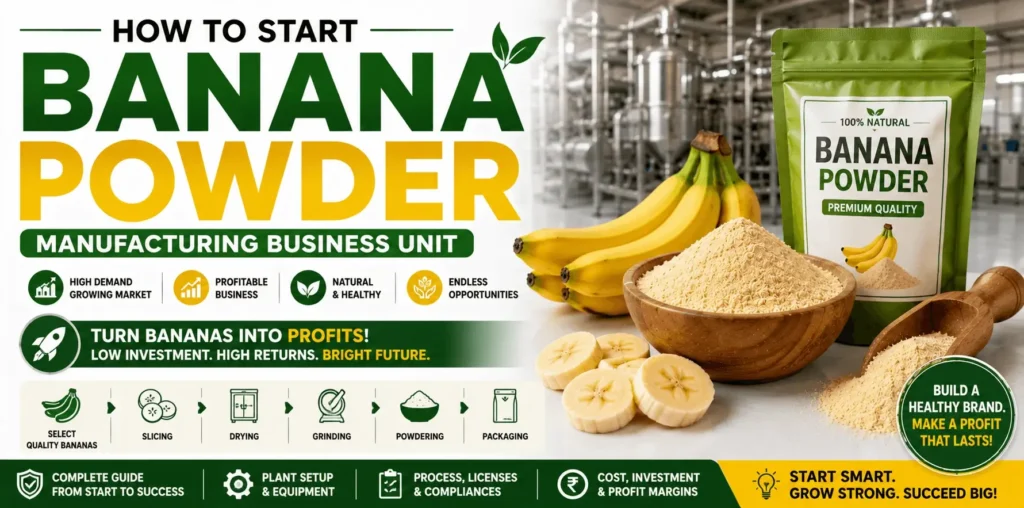
How to Start Banana Powder Manufacturing Business Unit in India - NPCS Blog

How to Start Banana Powder Manufacturing Business Unit

How to Start Banana Powder Manufacturing Business Unit Read More »

Banana powder is a versatile product with growing demand in the food processing, baby food, bakery, and pharmaceutical industries. Derived from processed bananas, it serves as an excellent natural flavoring and nutritional enhancer. Entrepreneurs looking to enter the agro-processing industry will find banana powder manufacturing business a lucrative opportunity, especially in banana-producing regions. This article offers a complete guide on how to set up a banana powder manufacturing business unit, covering everything from raw material procurement to market strategy. Understanding the Banana Powder Manufacturing Business India is one of the largest producers of bananas globally, making it a natural hub for banana powder manufacturing business. The industry benefits from abundant raw material availability, government support for agro-based industries, and a steadily increasing demand in both domestic and export markets. The manufacturing process involves cleaning, slicing, drying, milling, and packaging bananas in powdered form, which retains much of the fruit’s nutritional value and taste. Market Potential and Applications Banana powder is widely used in baby food, bakery products, ice creams, milkshakes, health supplements, and as a natural sweetener. Its long shelf life, easy transportability, and high nutritional content make it ideal for both B2B and B2C segments. With increasing awareness around health foods and the shift toward natural additives in food products, the global demand for banana powder is expected to rise. The product also sees export demand from countries in the Middle East, Europe, and Africa. The key market drivers include convenience, affordability, and the growing popularity of organic and plant-based food products. Key Steps to Set Up a Banana Powder Manufacturing Business Unit 1. Market Research and Business Plan Begin with in-depth market research. Analyze demand trends, competitor analysis, pricing strategy, and customer expectations. A well-researched business plan should include production capacity, investment outlay, machinery and technology needs, financial projections, and a marketing roadmap. 2. Location and Infrastructure The ideal location for a banana powder manufacturing unit is near banana-growing regions to minimize transportation costs and ensure the freshness of raw materials. The infrastructure should include: Space for processing unit and storage Water supply and power backup Waste disposal system Good connectivity to markets You’ll need about 1,500–2,000 sq. ft. of space for a small-scale setup. 3. Legal and Regulatory Requirements Register the business as an MSME or under any other suitable business entity. Obtain the following: GST registration FSSAI license (Food Safety and Standards Authority of India) Pollution Control Board clearance Factory license from the state government Trademark for branding (optional but recommended) Compliance with food safety regulations is critical for building trust and expanding your reach. 4. Procurement of Raw Materials Procure fully ripe and blemish-free bananas directly from farmers or wholesalers. It’s best to develop long-term relationships with reliable suppliers to ensure year-round availability. Organic bananas are in high demand, so sourcing certified organic produce can help cater to premium markets. Additional raw materials include: Food-grade packaging materials Preservatives (optional and based on regulatory standards) Cleaning and sterilizing agents 5. Machinery and Equipment For a small to medium-scale banana powder manufacturing business unit, you will need the following equipment: Banana peeler Slicer or cutter Blanching tank (optional) Dryer or dehydrator (solar or electric) Pulverizer or grinder Sieving machine Packaging machine Weighing scale Machinery should meet food-grade standards. Automation can significantly increase efficiency and output. 6. Manufacturing Process The production process typically follows these steps: Sorting and Cleaning – Select and clean the bananas thoroughly to remove dust, dirt, and surface contaminants. Peeling and Slicing – Peel and cut the bananas into uniform slices to ensure even drying. Drying – Dry the slices using solar, hot air, or freeze drying methods. This step is crucial for shelf life and product quality. Grinding – Dried slices are ground into fine powder using a pulverizer. Sieving – The powder is sieved to remove coarse particles and ensure uniformity. Packaging – The final product is packaged in moisture-proof and food-grade containers. Strict quality control at every stage ensures the consistency, flavor, and safety of the product. 7. Manpower Requirement For a small unit, 6–10 employees are sufficient. This includes machine operators, quality controllers, packaging staff, and administrative personnel. Trained workers improve efficiency and reduce waste. 8. Investment and Profitability Setting up a small-scale banana powder manufacturing business unit may require an investment of ?10–20 lakhs depending on scale and automation level. The cost breakdown includes: Machinery: ?5–10 lakhs Infrastructure: ?3–5 lakhs Raw materials and working capital: ?2–5 lakhs Profit margins range between 20%–35%. With consistent quality and strong market demand, breakeven is possible within 1–2 years. 9. Branding and Packaging Effective branding plays a major role in attracting customers, especially for retail sales. Focus on: Eye-catching logo and packaging design Nutritional information and usage instructions Eco-friendly packaging materials Retail packs of 100g, 250g, 500g, and 1kg are popular. Bulk packaging (25kg, 50kg) is used for industrial customers. Marketing Strategy and Distribution A robust marketing strategy helps you penetrate the market and build a loyal customer base. Target the following: B2B Segment Food processing companies Bakeries Ice cream manufacturers Baby food brands Exporters and traders B2C Segment Health food stores Supermarkets and online retailers Organic and natural product outlets Direct-to-consumer (via website or marketplaces) Use digital marketing, SEO, social media, and product sampling to build awareness. Participation in food expos and industry events boosts visibility and networking. Government Support and Schemes The Indian government offers several schemes for agro-based and food processing industries, including: PMFME (Pradhan Mantri Formalization of Micro Food Processing Enterprises) NABARD subsidies and low-interest loans Stand-Up India Scheme for SC/ST and women entrepreneurs NSIC and MSME support for machinery procurement Leverage these schemes for funding, training, and infrastructure development. Challenges and Solutions Banana powder manufacturing business comes with its own set of challenges, including: Raw material perishability – Tie-ups with local farmers and cold chain logistics can minimize waste. Price fluctuations – Long-term procurement contracts and buffer stock help maintain cost stability. Quality control – Invest in testing equipment and follow standard operating procedures to maintain consistency.

Copra Oil Manufacturing Industry. Coconut Oil Production from Copra

Copra Oil Manufacturing Industry. Coconut Oil Production from Copra Read More »

Coconut oil extracted from copra, the dried kernel of the coconut, holds immense industrial and commercial significance. As one of the most sought-after oils in the world, coconut oil from copra is used in the food industry, cosmetics, pharmaceuticals, and even in biofuels. The global demand for organic and virgin coconut oil is steadily increasing, driven by its health benefits and multiple applications. Setting up a business in coconut oil from copra production can yield substantial returns if planned strategically. Understanding the Coconut Oil Production from Copra To embark on a successful business in coconut oil from copra, it’s vital to understand the step-by-step production process. The manufacturing flow from raw coconut to refined oil involves a sequence of technical and manual operations that require precision, hygiene, and efficient machinery. Raw Material Procurement The primary raw material, copra, is obtained by drying the white coconut meat. It can be sun-dried or kiln-dried, and the quality of drying directly impacts the oil yield and purity. Copra is sourced from coconut farms, especially in coastal regions like Kerala, Tamil Nadu, and Andhra Pradesh, where coconut cultivation is abundant. Cleaning and Cracking of Copra The dried copra is first cleaned to remove dirt, stones, and foreign matter. It is then broken into smaller pieces using copra cutters. The broken copra pieces are passed through a screw conveyor to the expeller machine. Oil Extraction Process The heart of the coconut oil from copra process lies in mechanical expelling. A screw press or oil expeller machine is employed to crush the copra and squeeze out the oil. The temperature and pressure settings are controlled to retain the oil’s nutrients and flavor. Cold Pressed Method: This method ensures the oil retains its natural aroma and medicinal properties. It is preferred for edible oil and cosmetic use. Hot Pressed Method: Slight heating increases yield but may alter the flavor. This oil is often used for industrial applications. Filtration and Purification After extraction, the processor passes the crude coconut oil through a filter press to remove residual solids (oil cake). Then, settling tanks and centrifugal filters further purify the oil by eliminating fine particles and moisture. Refining (Optional) In case of commercial-grade oil or export purposes, the oil undergoes refining which includes degumming, neutralization, bleaching, and deodorization. This ensures the final product is colorless, odorless, and free from impurities. Packaging and Storage The refined coconut oil from copra is packed in HDPE drums, bottles, or pouches depending on the target market. Storage in a cool and dry environment preserves the oil’s shelf life and quality. Coconut Oil Manufacturing Business Plan Setting up a coconut oil from copra manufacturing business requires a detailed blueprint, from investment planning to execution. Below is a comprehensive guide to building a profitable venture: Market Research and Feasibility Analysis A thorough understanding of the current market demand, competitor analysis, and pricing strategy is crucial. Identify high-potential regions where coconut cultivation is robust and labor is available. Business Registration and Compliance Register the business under the appropriate legal structure (Proprietorship/LLP/Pvt Ltd). Obtain essential licenses such as: FSSAI Registration Factory License GST Registration Pollution Control Board NOC BIS Certification (optional for edible grade oil) Location and Infrastructure Choose a location close to coconut farms to reduce transportation costs. The facility should have adequate space for raw material storage, processing unit, packaging section, and administrative office. Basic infrastructure includes: Power connection Water supply Drainage system Waste management setup Machinery and Equipment To produce coconut oil from copra at scale, invest in efficient and durable machinery. A medium-sized unit would require: Copra Cutter Oil Expeller Filter Press Steam Boiler (for hot press) Refinery Unit (optional) Packaging Machines Storage Tanks Manpower Requirement Hire skilled and semi-skilled workers to operate machinery, manage logistics, and handle quality control. For a 1-2 ton/day plant, a team of 10–12 workers is usually sufficient. Cost Estimation and Funding Setting up a coconut oil from copra manufacturing unit involves moderate capital investment. Below is a rough breakdown: Land & Building: ?15-20 Lakhs (leased/purchased) Machinery: ?10-15 Lakhs Raw Material (initial stock): ?5-8 Lakhs Labor & Operations: ?3-5 Lakhs/month Licensing & Miscellaneous: ?2-3 Lakhs You can arrange funding through bank loans under MSME schemes, private investors, or government subsidies. Marketing and Distribution Strategy A robust marketing strategy ensures steady demand for your coconut oil from copra. Focus on: Creating brand identity with attractive packaging Targeting FMCG companies, cosmetic brands, and retailers Listing on online platforms like Amazon, Flipkart Participating in trade expos and agricultural fairs For B2B supply, approach: Exporters Ayurvedic product manufacturers Food processing units Profit Margin and ROI Consistent quality, efficient production, and competitive pricing drive profitability in this sector. The average yield from 1 ton of copra is 600–650 liters of oil. With growing demand for pure and organic products, margins can range from 20% to 30% post break-even. Key Benefits of Starting Coconut Oil from Copra Business High Demand: Coconut oil supports multiple sectors, ensuring a continuous market. Raw Material Availability: Copra grows abundantly in tropical regions. Scalability: The business can start small and scale up with ease. Multiple By-products: The leftover copra cake after oil extraction serves as cattle feed, further increasing revenue. Challenges and Risk Mitigation Like any manufacturing business, coconut oil from copra production comes with challenges: Fluctuation in Raw Material Prices: Hedge through long-term procurement contracts. Maintaining Quality Standards: Regular lab testing and SOPs are essential. Market Competition: Differentiate through quality certifications, organic labeling, and superior branding. Sustainability and Eco-Friendly Practices Adopting eco-conscious methods not only helps the environment but also boosts brand image: Use biomass boilers fueled by coconut shells Recycle packaging material Treat wastewater and adhere to pollution norms Conclusion With increasing global preference for natural and organic oils, venturing into the coconut oil from copra business presents a lucrative opportunity. From its vast market potential to its versatile applications, this enterprise offers entrepreneurs a sustainable path to profitability. By following a structured business plan, investing in quality infrastructure, and implementing efficient marketing strategies, one can

Have a business idea? Let's make it happen together-contact us now!


Contact Form Demo

This will close in 0 seconds

Translate »