
Toyota Unveils the 2026 Mini Land Cruiser: A Compact Off-Road SUV Packed with Power and Efficiency

Toyota has added a new member to its legendary Land Cruiser family, and this one is smaller, easier to handle, and designed to bring genuine off-road ability to a wider group of buyers. The 2026 Toyota Land Cruiser FJ is the brand’s new compact Land Cruiser, combining a rugged body-on-frame design with four-wheel drive and the durability associated with the Land Cruiser name. Unlike many compact SUVs that focus mainly on city driving, the Land Cruiser FJ has been developed around the idea of going off-road while still being practical enough for everyday use. Toyota officially launched the FJ in Japan on May 14, 2026. A Smaller Land Cruiser With the Same Tough DNA The Land Cruiser FJ is the smallest member of Toyota’s current Land Cruiser family, joining the larger Land Cruiser 300, 70 and 250 series. Toyota says the FJ was created to offer an easier-to-handle size while keeping the key qualities of the Land Cruiser: reliability, durability and off-road performance. The SUV has a boxy shape with a strong upright front end and round-style headlights that give it a clear connection to earlier Land Cruiser designs. The design is not only about appearance. Toyota has also focused on making the body practical for outdoor use, including options for carrying and attaching equipment. Compact Dimensions Make It Easier to Drive Although Toyota calls it a compact Land Cruiser, the FJ is not a tiny SUV. Its body is large enough to offer useful cabin space while being shorter than the Land Cruiser 250. Specification Toyota Land Cruiser FJ Length 4,575 mm Width 1,855 mm Height 1,960 mm Wheelbase 2,580 mm Seating 5 passengers Drive system Part-time 4WD Minimum turning radius 5.5 meters The shorter wheelbase is especially useful when driving on narrow trails. Toyota says the FJ’s wheelbase is 270 mm shorter than the Land Cruiser 250, helping improve maneuverability. 2.7-Liter Petrol Engine Delivers 163 PS The Japanese-market Land Cruiser FJ uses Toyota’s 2.7-liter 2TR-FE four-cylinder gasoline engine. It produces a maximum of 163 PS and 246 Nm of torque. Power is sent through a six-speed Super ECT automatic transmission. The SUV uses a part-time four-wheel-drive system, giving drivers the ability to use four-wheel drive when road and trail conditions require additional traction. Engine Detail Specification Engine 2.7-liter 4-cylinder petrol Engine code 2TR-FE Maximum power 163 PS Maximum torque 246 Nm Transmission 6-speed Super ECT automatic 4WD system Part-time 4WD Fuel economy 8.7 km/L WLTC Fuel economy is rated at 8.7 km/L in Japan’s WLTC test cycle. Actual fuel consumption can vary depending on traffic, driving style, road conditions and use of four-wheel drive. Built for Real Off-Road Driving The biggest difference between the Land Cruiser FJ and many regular compact SUVs is its body-on-frame construction and proper four-wheel-drive system. Toyota has also equipped the FJ with suspension hardware designed for both road and off-road use. The front uses a high-mount double-wishbone setup, while the rear uses a four-link rigid suspension with a lateral rod. The combination is intended to give the SUV good control on normal roads while allowing the suspension to handle rough and uneven terrain. Rugged Exterior With Practical Design The exterior has a simple but strong look. The upright front section, wide body and squared-off design give the FJ a traditional off-road appearance. Toyota has also focused on making the vehicle easy to customize. Dealer-installed accessories are available for the Japanese market, including equipment for changing the way luggage space and the exterior are used. MOLLE-style panels are also part of the FJ’s outdoor-focused design. These panels can be used to attach different pieces of equipment, making the SUV more useful for camping, travel and other outdoor activities. Interior Focuses on Practicality Inside, the Land Cruiser FJ has a two-row layout with seating for five people. The cabin follows the same practical approach as the exterior rather than trying to turn the SUV into a luxury-focused vehicle. The dashboard and controls are designed to be easy to use, while the luggage area can be adapted for different types of outdoor equipment. This makes the FJ suitable for buyers who want a vehicle that can handle both daily driving and weekend adventures. Toyota’s Focus on Reliability and Durability Reliability remains one of the main selling points of the new FJ. Toyota developed the SUV using the same basic Land Cruiser idea that has been used for decades: build a vehicle that can handle difficult roads and continue to work reliably. Toyota says the Land Cruiser family has accumulated sales of more than 12 million vehicles across more than 190 countries and regions. The FJ is intended to bring that same basic philosophy to a smaller and more manageable vehicle. Japan Price and Availability Toyota launched the Land Cruiser FJ in Japan on May 14, 2026. The Japanese-market VX version is priced at ¥4,500,100, including consumption tax but excluding recycling fees and certain regional differences. Market Detail Information Japan launch May 14, 2026 Japanese model Land Cruiser FJ VX Seating 5 Drivetrain Part-time 4WD Japanese listed price ¥4,500,100 Pricing and specifications can be different in other countries. Toyota has not announced that the Japanese price will directly translate into the final price of another market. Is the Mini Land Cruiser Really Efficient? The Land Cruiser FJ is not designed to be an economy-focused small SUV. Its focus is on combining useful fuel economy for its size with genuine four-wheel-drive capability and durability. The naturally aspirated 2.7-liter petrol engine is a proven Toyota powertrain, while the six-speed automatic transmission is designed to provide smooth acceleration and easier control at lower speeds. The official Japanese WLTC rating of 8.7 km/L gives buyers a clearer idea of its expected fuel use, although real-world results will depend heavily on how and where the vehicle is driven. Why the Land Cruiser FJ Is Important The FJ gives Toyota something it did not previously have in the current Land Cruiser lineup: a smaller model designed to make the Land Cruiser experience
New Toyota Hilux 2026 Revealed: Price, Specs, Features and Global Review Smart Technology
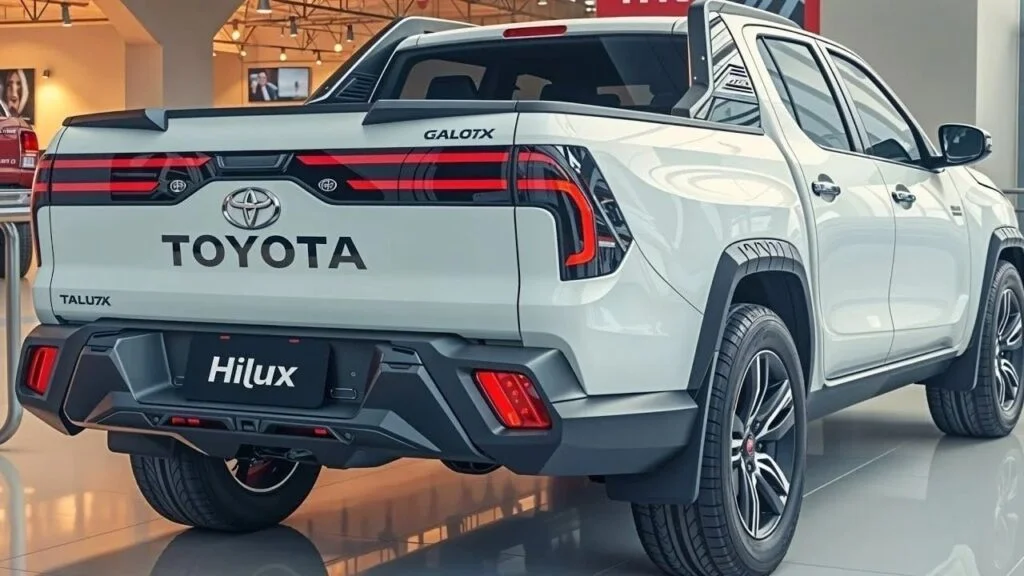
Toyota has officially introduced the New Toyota Hilux 2026, bringing fresh styling, improved technology, and the rugged capability that has made the Hilux one of the world’s most trusted pickup trucks. While the overall design remains familiar, the latest model receives updated exterior styling, a more premium cabin, smarter connectivity features, and enhanced safety technology. The 2026 Hilux continues to target buyers looking for a dependable pickup that performs equally well on highways, city roads, and challenging off-road terrain. Whether used for work, adventure, or everyday driving, the latest Hilux aims to deliver improved comfort without compromising its legendary durability. Updated Exterior Gives the Hilux a More Premium Look The new Hilux features a redesigned front fascia with a bolder grille, sharper LED headlamps, and a revised bumper that gives the pickup a more aggressive appearance. Toyota has also introduced new alloy wheel designs and fresh exterior color options to modernize the overall look. The truck retains its high ground clearance, muscular wheel arches, and durable body construction, making it well suited for demanding road conditions and off-road driving. Engine Options and Performance Toyota continues to offer powerful diesel engines depending on the market. The flagship version is powered by a 2.8-litre turbo diesel engine that delivers excellent towing capability and strong low-end torque for heavy-duty applications. Specification Details Engine 2.8L Turbo Diesel Maximum Power Up to 204 PS* Peak Torque Up to 500 Nm* Transmission 6-Speed Manual / 6-Speed Automatic* Drive Type 4×2 and 4×4 Options Fuel Type Diesel *Engine output and transmission options may vary depending on the country and variant. The Hilux is designed to offer confident performance on rough terrain while maintaining comfortable highway cruising. Its ladder-frame chassis and advanced suspension continue to provide excellent durability. Smart Technology and Interior Features Toyota has significantly improved the cabin experience by introducing more modern technology while keeping the interior practical and functional. Larger touchscreen infotainment system Wireless Apple CarPlay and Android Auto Wireless smartphone charging Digital instrument cluster Additional features may include dual-zone automatic climate control, premium leather upholstery on higher variants, powered driver seat, push-button start, multiple USB charging ports, and connected vehicle functions in selected markets. Safety Features Toyota equips the 2026 Hilux with a comprehensive suite of safety technologies to improve driver confidence both on and off the road. Toyota Safety Sense driver assistance features Multiple airbags Lane Departure Alert Adaptive Cruise Control Depending on the market, buyers may also receive Blind Spot Monitoring, Rear Cross Traffic Alert, Automatic Emergency Braking, Hill Assist Control, Downhill Assist Control, Vehicle Stability Control, and a 360-degree camera. Expected Price Pricing varies across global markets depending on taxes, variant, and equipment levels. Market Expected Starting Price India Around ₹30 lakh (if updated model is introduced) Australia Varies by variant Thailand Varies by variant Europe Varies by country Toyota will announce market-specific pricing and availability according to individual regional launch schedules. Global Review The Toyota Hilux continues to receive strong reviews worldwide because of its proven reliability, excellent build quality, and dependable diesel engine. It remains one of the most trusted pickup trucks for commercial users, adventure enthusiasts, and families who need a capable utility vehicle. The improved cabin technology, better comfort, and additional safety equipment make the 2026 model more competitive against rivals while maintaining the toughness that has defined the Hilux for decades. Should You Buy the New Toyota Hilux 2026? If you need a pickup truck that combines rugged off-road ability with everyday practicality, the Toyota Hilux 2026 remains one of the best choices available. It offers dependable diesel performance, strong towing capability, modern technology, and Toyota’s reputation for long-term reliability. Buyers looking for a premium pickup with proven durability, advanced safety features, and improved interior comfort are likely to find the latest Hilux a well-rounded package. The New Toyota Hilux 2026 builds on the strengths that have made it a global icon. With refreshed styling, smarter technology, advanced safety systems, and powerful diesel engine options, it continues to set a high standard in the pickup truck segment. Whether for business, outdoor adventures, or daily driving, the latest Hilux delivers a balanced combination of performance, comfort, and legendary reliability that few competitors can match.
Best MSME Business Ideas in India for 2026: Top 50+ Profitable Projects
India’s economic backbone is powered by Micro, Small, and Medium Enterprises (MSMEs), contributing significantly 30% to GDP, employing over 110 million people, and 45% of manufacturing outputs. Over 63 million MSMEs across the country, the sector is poised for massive growth in 2026. The Indian government has rolled out significant MSME reforms in 2026, including revised classification norms (effective April 2025), expanded investment and turnover limits, and enhanced support through Udyam Registration, which now unlocks collateral-free loans up to ₹5 crore and 25% government procurement reservation. With the government providing strong support and the market showing increased demand for local, sustainable, and value-driven services, MSME business projects are proving to be highly lucrative. Whether you’re a first-time entrepreneur or looking to expand into new sectors, or an NRI seeking investment opportunities in India. This comprehensive list of 50+ profitable MSME business ideas covers low-investment, high-growth, and policy-backed opportunities across sectors. Top 50 Profitable MSME Business Projects to Start in 2026 Here’s a curated list of 50 profitable MSME business projects across different sectors to help you identify the right opportunity based on your skillset, investment level, and market demand: 1. Packaged Food Manufacturing With the rise in urban lifestyles, ready-to-eat meals, snacks, and organic packaged food are in demand. This MSME business project is ideal for food technologists or home cooks. 2. Mobile Phone Repair Services Low investment and high demand make this a reliable urban MSME opportunity. Adding doorstep service or franchising can scale it faster. 3. Customised -T-Shirt Printing Great for creative entrepreneurs. Use online platforms to accept orders and deliver custom-printed clothing. 4. Handmade Organic Soaps Consumers are moving toward chemical-free personal care. This MSME business project requires basic training and minimal equipment. 5. Digital Marketing Agency As businesses move online, they require SEO, social media, and content marketing support. This is a service-heavy business with low setup costs. 6. Solar Panel Installation Green energy is the future. Residential and commercial sectors are increasingly adopting solar panels, creating a booming MSME sector. 7. Paper Bag Manufacturing With plastic bans, eco-friendly alternatives like paper bags are in demand. This MSME project is both sustainable and scalable. 8. Spice Powder Packaging Traditional spices are essential in Indian kitchens. Value-added packaging and branding can help tap global markets too. 9. Online Tutoring Services From school subjects to music or coding, online tutoring is gaining traction. A simple platform and internet access are all you need. 10. Furniture Making & Restoration Custom and vintage furniture is in demand. This MSME business project can be pursued locally with skilled labor. 11. LED Light Manufacturing Energy-saving products like LEDs are now in every home and office, offering large-scale demand. 12. Cloud Kitchen Without a dine-in space, you save costs and cater to online food orders. This model thrives on low investment and high returns. 13. Herbal Beauty Products Herbal creams, oils, and face packs are sought-after in both Indian and international markets. 14. Dairy Products Processing Paneer, ghee, flavored milk, and curd are daily essentials. With quality control, this MSME project offers high profitability. 15. Toy Manufacturing India is promoting local toy production. Unique, safe, and educational toys have a growing market. 16. Electric Vehicle (EV) Charging Station A future-ready MSME business project, particularly in urban and tier-2 cities. 17. Agarbatti & Dhoop Stick Manufacturing A religious and cultural staple, these products see daily use and repeat purchases. 18. Cold Storage Facility Fruits, vegetables, dairy, and meat require refrigeration—ideal for rural or semi-urban setups. 19. Event Management Weddings, corporate events, and brand launches provide continuous business if executed professionally. 20. Eco-Friendly Disposable Tableware Plates, cups, and cutlery made from leaves or sugarcane are becoming mainstream in catering and restaurants. 21. Mobile Car Wash Service On-demand cleaning services are gaining popularity due to convenience. 22. Pet Grooming & Care Pet ownership is growing, and this niche market is underserved. 23. Digital Printing Press From visiting cards to product labels, businesses and individuals need quick-print solutions. 24. Custom Jewelry Making Ethnic and designer jewelry always has a fanbase. This MSME business project needs creativity and design tools. 25. Coir Products Manufacturing Eco-friendly mats, ropes, brushes, and bags made from coconut fiber are popular in domestic and export markets. 26. Vermicompost Production As organic farming grows, so does the need for organic fertilizers like vermicompost. 27. Stationery & School Supplies Selling notebooks, pens, and art material to students, schools, and coaching centers ensures steady business. 28. Bakery Products Pastries, cakes, bread, and cookies have timeless demand. Home bakers are turning into full-scale MSMEs. 29. Packaged Drinking Water Plant A must-have in urban and industrial zones. Brand positioning is key here. 30. Plant Nursery Business Urban gardening, landscaping, and indoor plants are trending. It requires limited space and high profit margins. 31. Detergent Powder & Liquid Manufacturing Household cleaners are basic necessities. You can supply to local kirana stores or create your own brand. 32. Mushroom Farming Quick growth and high protein content make mushrooms a popular food item with good export potential. 33. Mobile App Development Apps are essential for businesses, events, and personal services. You can even develop your own product and monetize it. 34. Car Rental Services Ride-hailing and self-drive services are ideal for tier-1 and tourist cities. 35. Ice Cream Manufacturing Start with a local setup and expand through retailers or parlors. 36. Millet-Based Food Products As health consciousness rises, millet snacks and mixes are growing in popularity. 37. Paper Cup & Plate Manufacturing Single-use eco-disposables are necessary for events, eateries, and stalls. 38. Ayurvedic Medicine Manufacturing Traditional medicine has a strong hold in India and abroad. Requires licenses and formulation knowledge. 39. E-waste Recycling A fast-growing MSME business project that focuses on sustainability and tech waste management. 40. Fabric Printing & Embroidery Unit Traditional prints and custom embroidery are always in demand, especially in ethnic wear. 41. Photocopy & Documentation Services Schools, offices, and students need easy access to print, scan, and document facilities. 42. Ice Cube Production Essential for restaurants, bars, and caterers.
पैकेजिंग इंडस्ट्री में बिजनेस — कम निवेश, हर सेक्टर में डिमांड
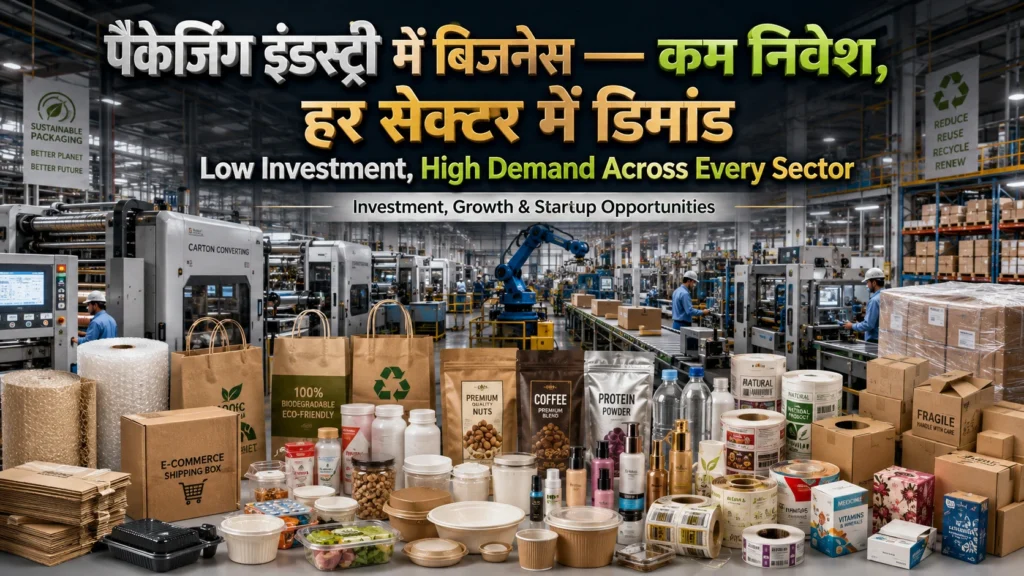
पैकेजिंग इंडस्ट्री में बिजनेस Packaging एक ऐसी industry है जो किसी एक sector पर निर्भर नहीं है। Food, pharma, FMCG, e-commerce, cosmetics, agriculture — हर जगह packaging चाहिए। यही कारण है कि packaging manufacturing को ‘recession-proof’ industry भी कहा जाता है। और अगर आप कम investment में एक ऐसा business idea ढूंढ रहे हैं जिसमें demand कभी कम न हो, तो packaging sector सबसे suitable जवाब है। भारत की पैकेजिंग इंडस्ट्री — मौजूदा स्थिति भारत दुनिया के top packaging markets में से एक है। Indian Institute of Packaging (IIP) के अनुसार, भारत का packaging sector तेज़ी से विस्तार कर रहा है। E-commerce boom, FMCG growth, और food processing expansion — तीनों ने इस growth को fuel किया है। Get Detailed Insights from This Book: Handbook on Modern Packaging Industries पैकेजिंग के मुख्य सेगमेंट 1. Corrugated Box Manufacturing यह packaging industry का सबसे large segment है। E-commerce ने corrugated boxes की demand में massive jump लाया है। Amazon, Flipkart के sellers को हमेशा boxes चाहिए। Investment ₹15-40 लाख से शुरू होता है। Monthly revenue एक medium unit से ₹20-50 लाख तक हो सकती है। 2. Flexible Packaging Laminated pouches, standup pouches, और multilayer films food और pharma packaging का सबसे popular format बन चुका है। यह traditional rigid packaging से lighter, cheaper, और more attractive है। Related Article: Sustainable Packaging Business in India – Future, Investment & Profit Guide 3. Rigid Plastic Containers Bottles, jars, और containers की demand personal care, pharma, और food sectors में बहुत ज़्यादा है। Injection molding machines से ये बनते हैं — एक machine से multiple products बना सकते हैं। 4. Paper और Paperboard Packaging Paper bags, paper cups, paper plates, और folding cartons की demand plastic ban के बाद और बढ़ गई है। यह एक environmentally friendly segment है जिसमें premium market भी है। Get Detailed Project Report (DPR): Biodegradable Packaging & Bio-based Polymers 5. Industrial Packaging Drums, IBCs (Intermediate Bulk Containers), और pallet wraps — ये industrial buyers के लिए हैं। Chemical, paint, और lubricant companies इनके बड़े buyers हैं। सबसे Profitable Packaging Products — Comparison Product Investment (₹) Target Market Profit Margin Scalability Corrugated Boxes 15–40 लाख E-commerce, FMCG 15–25% बहुत ज़्यादा Flexible Pouches 30–80 लाख Food, Pharma 20–35% ज़्यादा Plastic Containers 20–60 लाख Personal care, Food 25–40% ज़्यादा Paper Bags/Cups 5–20 लाख Retail, Cafes 25–40% मध्यम Industrial Drums 25–70 लाख Chemical, Paint 20–30% मध्यम E-Commerce Packaging — सबसे तेज़ Growing Segment E-commerce packaging सबसे fast-growing packaging segment है। Confederation of Indian Industry (CII) के अनुसार, India का e-commerce market तेज़ी से बढ़ रहा है, जिससे packaging demand में proportional growth आ रही है। Customized boxes, protective packaging (bubble wrap, foam inserts), और branded mailer bags की demand हर महीने बढ़ रही है। Packaging Business के लिए ज़रूरी Machines Corrugated Box Unit: Die-cutting machine, Flexo printing machine, Stitching machine Paper Bag Unit: Paper bag making machine, Handle fitting machine Plastic Container: Injection molding machine, Blow molding machine Flexible Pouch: Lamination machine, Pouch making machine सरकारी Support और Schemes Packaging industry को MSME schemes का पूरा benefit मिलता है। Udyam registration के बाद MUDRA loan, CGTMSE credit guarantee, और Credit Linked Capital Subsidy Scheme (CLCSS) — सब available हैं। Export के लिए DPIIT (Department for Promotion of Industry and Internal Trade) की startup और MSME schemes का लाभ उठाएं। Choose the right startup backed by real market demand Packaging Business में सफलता के Tips Quality consistency सबसे ज़रूरी है। एक bad batch पूरा contract खो सकती है। इसलिए raw material quality पर कभी compromise नहीं करें। Delivery reliability भी उतनी ही ज़रूरी है। Packaging buyers को just-in-time delivery चाहिए। इसलिए production planning और inventory management strong होना चाहिए। Customization offer करना competitive advantage देता है। Branded packaging, custom colors, और special printing — इससे आप commodity supplier से value-added supplier बन जाते हैं। अक्सर पूछे जाने वाले सवाल (FAQ) Q1. Packaging business के लिए minimum investment कितना चाहिए? Paper bag manufacturing जैसे simple segment में ₹5-10 लाख से शुरुआत हो सकती है। Corrugated boxes या flexible packaging के लिए ₹20 लाख से ज़्यादा चाहिए। Q2. Packaging में export का scope है? हां, pharmaceutical packaging और specialty packaging में India के export opportunities बड़े हैं। FDA-compliant packaging units को US और European clients मिलते हैं। Q3. क्या घर से packaging business शुरू हो सकता है? बहुत छोटे scale पर — जैसे handmade paper bags या gift packaging — घर से शुरू हो सकता है। लेकिन industrial scale के लिए dedicated space ज़रूरी है। Q4. Packaging में BIS या किसी certification की ज़रूरत है? Pharma packaging के लिए FDA approval ज़रूरी है। Food contact packaging के लिए food-grade material certification चाहिए। General packaging के लिए कोई mandatory certification नहीं है। निष्कर्ष Packaging industry एक ऐसी manufacturing business है जिसमें demand कभी नहीं रुकती। E-commerce, food processing, pharma — ये सभी sectors growing हैं, और सबको packaging चाहिए। कम investment में high demand वाला यह business idea उन उद्यमियों के लिए perfect है जो stable और scalable business चाहते हैं। अधिक जानकारी और Detailed Project Report के लिए niir.org पर जाएं।
India–Czech Republic: High-Growth Manufacturing Business Ideas in Machine Tools, Industrial Automation & Precision Engineering
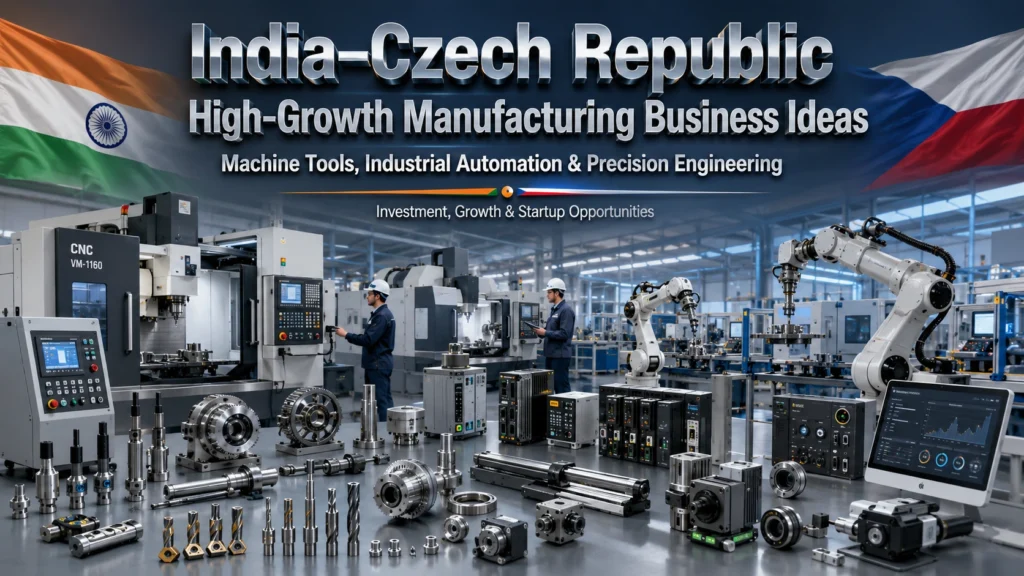
India Czech Republic Manufacturing A Strategic Industrial Corridor Taking Shape India and the Czech Republic are seldom found one and a half sentences back from each other in the business discussions. However, this two-way exchange might just be some of the most interesting manufacturing business opportunities today for entrepreneurs looking for real, fundable and globally accessible business ideas. The two nations have a shared history in sectors that are at the core of the global manufacturing economy such as machine tools, precision engineering, hydraulics, castings and advanced automation. The Embassy of India in Prague states that bilateral trade has reached a figure of US$ 4 billion, from less than US$ 86 million in 1993. This isn’t a trivial tweak. It’s a structural change and it represents that the industrial complementarity of the two economies has gone beyond diplomatic niceties to genuine commercial flows. This moment is not something to take lightly for a startup founder, MSME investor, or an industrial project planner. The Czech Republic has over 40 years of experience in precision manufacturing, not only in CNC machining, forging, hydraulics, environmental technology, but also in electrical power machinery. India offers scale, cost competitiveness, an ever-improving engineering talent pool and a growing domestic market with its increasing sophistication. Both countries can develop a strong two-way supply chain that will be beneficial to manufacturers and investors on both sides. The Embassy of India, Prague is very active in documenting this increasing industrial connection which can be very useful for entrepreneurs. In this article we will discuss specifically which sectors, the policy landscape, ideas for business projects and the trade dynamics make the India–Czech manufacturing corridor a meaningful project to develop? Related Article: How to Start a Fasteners and Precision Parts Manufacturing Export Business in India Why This Industrial Sector Deserves Your Attention Now The world of manufacturing is constantly evolving. The disruptions in the supply chain, geopolitical realignment and the “China Plus One” procurement strategy has compelled European industrial buyers to diversify their procurement aggressively. India has become one of the biggest beneficiaries of this change, especially in the areas of capital goods, precision components, casting, forging and automation in the industrial sphere. The other side of the coin, however, is the Czech economy, which is very engineering oriented. Its manufacturing sector features world-class skills in CNC machine tools, hydraulic & pneumatics, surface engineering, welding technology and Industry 4.0 integration. Czech companies offer technical expertise that is required by Indian manufacturers to enter into international markets. The cost efficiency and the size of Indian companies offer a number of advantages that Czech companies need to globally compete. The Numbers Behind the Opportunity India is already the 2nd largest producer of castings in the world. The turnover of the foundry industry alone is about US$ 20 billion and the exports are nearly US$ 3.54 billion. India Foundry Market is expected to post a CAGR of 10.30% to cross the US$ 31.77 billion mark by 2029. Data published by the IBEF shows that engineering industry makes up 27% of the total factories in the industrial sector in India and 63% of all foreign collaborations in the country. The India machine tool market is another indicator. One such indicator of the gaps in domestic manufacturing capacity is the quantum of import of machine tools which has crossed the ₹40,000 crore mark in a recent fiscal year. These gaps are opportunities for business investment by entrepreneurs who are able to establish import substitution or technology transfer businesses with a Czech business entity. In addition, Czech businesses are investing into India. India has attracted more than 37 Czech companies, such as Škoda Auto, Doosan Škoda Power and Bonatrans, who have invested over US$ 283m in the country. A significant partnership between Tata AutoComp and the Czech rail parts maker Škoda Group is another example of Czech trust in India’s manufacturing capabilities. This is the place in which a fresh entrepreneur can move with a thoroughly prepared feasibility plan. Government Policies and Incentives Supporting This Opportunity The bilateral manufacturing opportunity is viable for startups and MSMEs in India and Czech Republic due to robust policy frameworks. The policy momentum is strong on the Indian side. Production Linked Incentive (PLI) Scheme Now implemented in 14 critical sectors of industry, the PLI scheme has already attracted ₹2 lakh crore investment and incured incremental production of more than ₹18.7 lakh crore. The scheme has directly and indirectly generated more than 12.6 lakh jobs till September 2025. Strategic PLI beneficiaries are those in the capital goods and engineering industries that feed directly into the machine tools and automation industries discussed in this article. As an entrepreneur, you can have a steady and high demand pipeline by matching your project with the PLI connected anchor units. Please refer to Press Information Bureau, Government of India for more details. National Capital Goods Policy and Make in India A dedicated policy has been announced by the government namely National Capital Goods Policy for the machine tools and industrial equipment industry. It aims to boost value addition, cut imports and make India a global hub for capital goods manufacturing. Union Minister HD Kumaraswamy, at the event of IMTEX 2025, assured this would pave the way for innovation and help in cutting India’s reliance on imported precision machines. The Indian machine tool industry is expected to achieve a revenue of US$ 3.8 billion by 2030. Make in India initiative by DPIIT will continue to allow 100% FDI under the Automatic route for manufacturing of capital goods and machine tools. No licensing requirements for industry, no impediments to technology import agreements, and no foreign equity restrictions in most sectors involved. Investors looking into this path should utilise the Make in India portal. Get Detailed Insights from This Book: Our Books MSME Schemes and Credit Support The Ministry of MSME has a slew of support programs for small manufacturers, including the Credit Guarantee Fund Trust for Micro and Small Enterprises (CGTMSE), which offers collateral-free loans worth up
The Government Will Pay 35% of Your Factory Setup Cost. Most People Don’t Know.
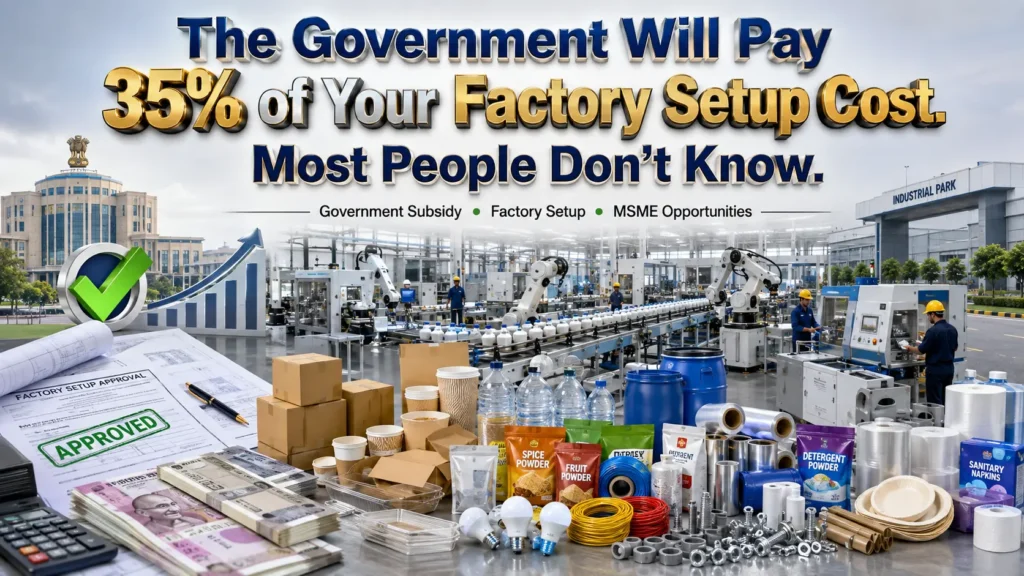
Government Pays 35% Factory Cost India has one of the world’s most untapped pool of manufacturing business ideas and startup capital, and a significant portion of it is from the Government. Thousands of entrepreneurs are investing their savings, borrowing from relatives or borrowing money on high interest rates to establish a factory and do not know that the Prime Minister’s Employment Generation Programme (PMEGP) provides up to 35% of the project costs as a direct capital subsidy. This works out to be a sum of ₹17.5 lakh of free government money for a manufacturing unit, valued at ₹50 lakh. However, many of the first-generation entrepreneurs have either never heard of it, or think they can’t be part of it. This article explains how the scheme works, who’s eligible to use it and which manufacturing business ideas have the greatest potential for success — with the government lining up on your side. Why Manufacturing Remains the Smartest Business Entry Point in India India is on the verge of witnessing the biggest change in decades for the manufacturing sector. The government has bitten off more than it can chew: it has set itself the ambitious target of increasing the contribution of manufacturing to GDP from 17% to 25%. All its policies, from tax breaks to investments in infrastructure, are geared toward this goal. This is an unusual confluence of circumstances: high demand, government support, export opportunity, and lower competition for the entrepreneur and investor. Additionally, the Make in India initiative has been successful in not only securing investments in Indian supply chains but also in creating and expanding premium procurement chains involving domestic component manufacturers. This means that the window of opportunity for a first-generation manufacturer has been greater than ever before. The initial cost of setup in the factory is still competitive. Availability of raw material is good. The domestic middle class keeps on consuming manufactured goods faster than any other economy in the world. Furthermore, with import substitution becoming a national priority, the government is actively encouraging local production under various overlapping schemes. If an entrepreneur really grasps this policy stack, he can significantly reduce his actual capital requirement by 35% to 50% prior to manufacturing even the first unit. Government Policies That Can Fund 35% of Your Manufacturing Business Setup PMEGP – The 35% Capital Subsidy You Are Missing The Prime Minister’s Employment Generation Programme (PMEGP) is the flagship programme for manufacturing start-ups in India. It is the direct capital subsidy offered by Khadi and Village Industries Commission (KVIC), Ministry of MSME, for 15% to 35% of the project cost. The general category entrepreneurs in urban areas get 15% and the special category entrepreneurs (women, SC/ST, minorities, ex-servicemen, differently abled) in rural areas get 35% of the subsidy. Manufacturing Businesses – The maximum eligible project cost is ₹50 lakh. Importantly, the funding from the applicant represents a small percentage (5-10%) of the total project cost. The remaining amount is financed by the bank. This translates to a capable businessman can establish a manufacturing business with ₹50 lakh with a mere investment of ₹2.5 lakh of his own funds. The bank finances ₹30 lakh and the government finances ₹17.5 lakh. That’s a capital efficiency ratio that hardly any private investment structure can beat. Production Linked Incentive (PLI) Scheme for Scale Businesses The Production Linked Incentive (PLI) Scheme provides performance-based financial incentives of up to 14 key sectors with 4% to 6% of incremental sales over a fixed base year for the entrepreneurs who are willing to scale up. PLI covers sectors like electronics, pharmaceuticals, food processing, textiles, automobiles and specialty steel. As of November, of the previous reported year, invested amount in committed PLI projects was ₹1.61 lakh crore which resulted in production and sales of around ₹14 lakh crore, and generated direct and indirect employment creation of 11.5 lakh. CLCSS and CGTMSE – Technology and Credit Support The Credit Linked Capital Subsidy Scheme (CLCSS) offers a capital subsidy of 15% on institutional finance received for technology upgradation in 51 specified sub-sectors with a maximum limit of ₹1 crore. At the same time, the Credit Guarantee Fund Trust for Micro and Small Enterprises (CGTMSE) has been introduced to provide collateral-free loans of up to ₹5 crore to MSMEs, which is a significant benefit for first-generation entrepreneurs who may not have an asset base. Manufacturing Business Ideas for Startups: High-Profit Units You Can Start With PMEGP 1. Food Processing and Packaging Unit Among all the business ideas in India, food processing is still one of the most resilient and least volatile businesses. The food processing industry has continued to grow in India, and the Ministry of Food Processing Industries is keen to encourage new food processing units by offering several capital and grant schemes. A start-up unit for grinding spices, milling pulses or manufacturing packaged snacks can be set-up in a project cost of Rs 30 lakh – Rs 50 lakh which falls within the project manufacturing limit of PMEGP. The operational economics are also favourable for the entrepreneur as there is a ready availability of raw materials, a developed distribution system and increasing demand for Indian food products in foreign markets. This is one of the financially most approachable avenues in manufacturing for the women entrepreneurs who start rural food processing units receiving the full subsidy of 35% under PMEGP. Get Detailed Project Report (DPR): Food & Beverage Packaging 2. Agarbatti (Incense Stick) and Dhoop Manufacturing The manufacture of agarbatti is one of those few business ideas, where the demand is huge in the country, export market is good and the government is encouraging production in the country. India is the world’s major importer as well as exporter of incense products. The SFURTI Scheme (Scheme of Fund for Regeneration of Traditional Industries) is particularly supporting the agarbatti clusters with infrastructure and technology support. The cost of setting up a basic mechanised agarbatti unit is in between ₹10 lakh to ₹20 lakh, which is perfect for first-time entrepreneurs to avail
Stop Waiting for the Perfect Business Idea. Start With This One
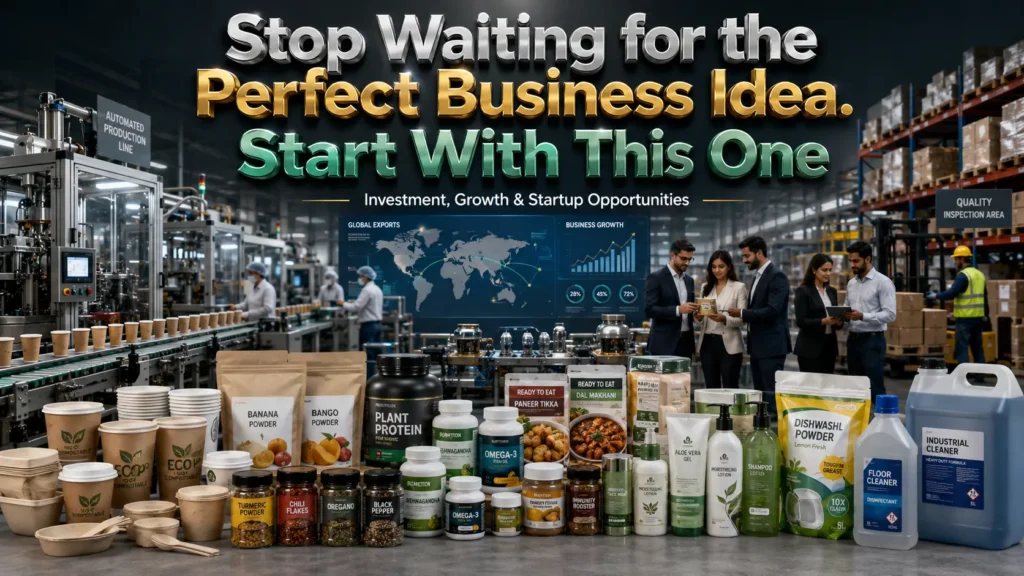
The first-time entrepreneurs start their own business, they wait years for the one “perfect” idea that’s risk-free, endlessly scalable and completely original. Meanwhile, thousands of smart manufacturing ideas quietly generate steady income, create jobs and build generational wealth for those who paused, and just took action. But the reality is, the Indian market does not honor the creative idea finder. It can pay off the one who can implement a successful concept with discipline and proper planning. The manufacturing industry is at a tipping point in India. The opportunity is not merely theoretical; it is structural and has an impact on nearly 30% of GDP and 45% of total exports through more than 7.5 crore MSMEs. The government policy, credit access and trade infrastructure is aligned to actually favour new manufacturers. The issue isn’t this time around whether to establish a manufacturing venture. The challenge now is to choose the idea and to do it smartly. Stop guessing—choose the right business with confidence Why Manufacturing Business Ideas Are Winning Right Now India’s expansion to become a viable option to the Chinese led supply chains has generated real demand deficits in a wide range of product categories. The MNCs are on the lookout for suppliers from India. The growth of domestic consumption is picking up pace in Tier 2 and Tier 3 cities. But e-commerce has created distribution channels that would have needed a lot of capital to reach before. In addition, India’s local manufacturing production is steadily increasing. Government data shows that the contribution of the MSME industry to overall manufacturing is 36%. In a recent reporting period, the credit growth in MSME sector has expanded by 19.6% YoY, which signifies the growing demand for new businesses as well as the rise of lender confidence. Today, 2/3rd of Indian MSMEs is digitally prepared and can manage procurement, sales and export documentation without having to hire a large support team for the new founder. The fact that it is a combination of rising domestic demand, export pull, government-backed credit, and robust digital infrastructure, makes manufacturing business ideas truly accessible for first-generation entrepreneurs rather than well capitalised conglomerates. Government Policies That Are Actually Helping New Manufacturers Manufacturing policy in India is now more pro-startup than ever. There are now multiple schemes layered on top of each other, thereby providing an actual capital advantage to new entrants. Production Linked Incentive (PLI) Scheme Under PLI Scheme, there are 14 priority sectors and cash incentive from 4% to 20% on increment sales over the base year. The actual investment made under PLI has surpassed ₹2.40 lakh crore, which has created more than 14 lakh direct and indirect employment. The secret to the PLI opportunity, for an MSME founder, is to be not only eligible to enter the fray but also be able to cater to the need of large manufacturers who are registered with PLI, a B2B play that most new entrepreneurs are not focusing on. PMEGP — The First-Generation Entrepreneur’s Launchpad The Ministry of MSME runs the Prime Minister’s Employment Generation Programme to provide credit linked subsidy for establishing micro manufacturing units. The subsidy for the general category applicants is 15% in urban areas and 25% in rural areas. For SC/ST and women entrepreneurs it is up to 35%. This will lead to a reduction in the breakeven risk for a new founder and the maximum government subsidy that could be availed will be between ₹6.25 lakh and ₹8.75 lakh for the manufacturing unit costing ₹25 lakh. CGTMSE and Collateral-Free Lending Credit Guarantee Fund Trust for Micro and Small Enterprises (CGTMSE) is a scheme between Ministry of MSME and SIDBI to provide banks with loans for micro and small manufacturers without requiring collateral. That’s very important for people who are first-generation entrepreneurs without property assets to put up as collateral. Having access to MUDRA loans for working capital, an MSME founder can easily start their business without needing to provide a single rupee of traditional collateral. Startup India and DPIIT Recognition Registered Startups under Startup India are offered with income tax exemption for three consecutive years, patent fee concessions and simplified exit norms. The Department for Promotion of Industry and Internal Trade (DPIIT) also eases the way for manufacturing startups by providing for fast-track regulatory clearances, thereby eliminating the typical delays that manufacturing entrepreneurs might face. Manufacturing Business Ideas for Startups: Where to Actually Begin The following business ideas are not dream concepts. They are current government policy priorities and categories of products that have proven to have market demand, viable startup economics, and documented. These are concepts that the market is talking about you, you just have to respond. 1. Food Processing and Value-Added Agricultural Products India is one of the world’s biggest producers of fruits, vegetables, dairy and spices; however, a considerable amount of the agricultural produce is wasted because of lack of processing infrastructure in the country. This vacuum is one of the lucrative and scalable manufacturing business ideas that aspiring entrepreneurs have these days. A food processing unit can commence with a specific product, such as dehydrated vegetables, spice blends, ready to eat snacks or packaged pulses and generate sales both from domestic retail markets and export markets. The investment cost starts from ₹10 lakh for micro processing unit to ₹40 lakh for mid-scale units. The Food Safety and Standards Authority of India (FSSAI) offers a clear regulatory roadmap and there are PLI incentives for several processed food categories. The average margin is 18-35% depending on the product and its value added. In addition, the Ministry of Food Processing Industries provides incentive for cold chain development to the sector. Explore This Book: Handbook on Fruits, Vegetables & Food Processing with Canning & Preservation 2. Herbal and Ayurvedic Product Manufacturing The Indian herbal and wellness product market is booming with increasing health awareness among Indians and people around the world. The cost of setting up a small-scale herbal manufacturing unit, where one produces hair oils, immunity supplement, skin care products,
प्लास्टिक बैन के बाद कौन से नए उद्योग उभरे — और कैसे करें शुरुआत
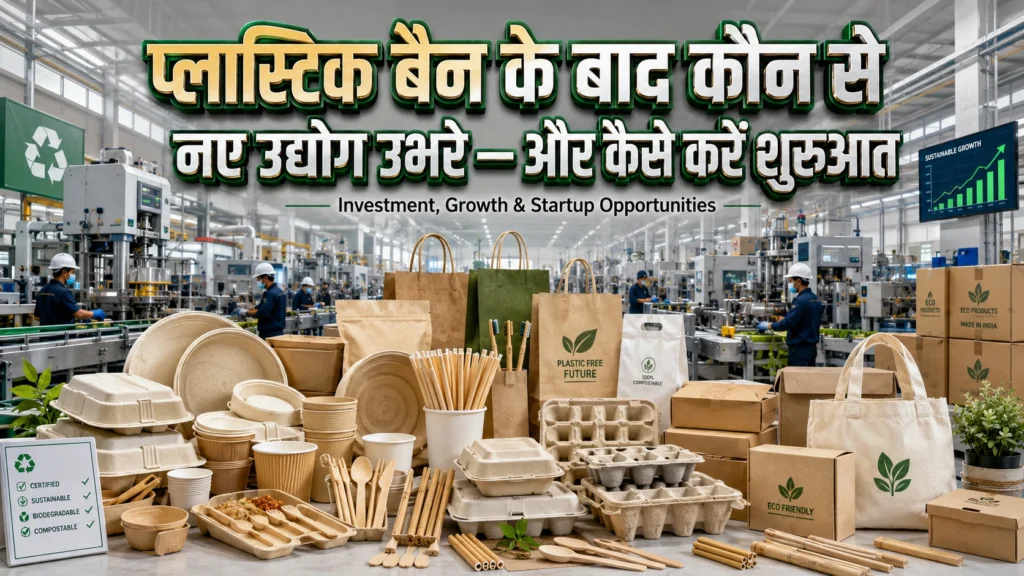
प्लास्टिक बैन के बाद बिजनेस आइडियाज Single-use plastic पर ban एक ऐसा decision था जिसने एक साथ एक industry को बंद किया और कई नई manufacturing industries के दरवाज़े खोल दिए। जो लोग इस shift को समझ गए, उन्होंने नए business ideas में जल्दी कदम रखा। और अब वे अच्छा कमा रहे हैं। इस आर्टिकल में हम देखेंगे — plastic ban के बाद कौन से नए उद्योग उभरे हैं, किसमें सबसे ज़्यादा demand है, और कैसे आप इस बड़े market opportunity का फायदा उठा सकते हैं। Related Article: The Green Manufacturing Revolution: Paper Water Bottles, Bioplastics & Biodegradable Products भारत में प्लास्टिक बैन — क्या बंद हुआ? जुलाई 2022 से भारत सरकार ने single-use plastic के 19 items पर complete ban लगा दिया। Ministry of Environment, Forest and Climate Change के इस फैसले ने plastic alternatives की demand एकदम बढ़ा दी। Plastic bags (75 micron से कम), straws, cutlery, thermocol cups — सब बंद हो गए। 1. पेपर बैग मैन्युफैक्चरिंग यह plastic bag का सबसे सीधा और popular alternative है। Shopping malls, grocery stores, restaurants, और pharmaceutical companies — सभी को paper bags चाहिए। Demand इतनी है कि छोटी paper bag units भी महीनों के orders advance में बुक हैं। इस business की शुरुआत ₹5-15 लाख में हो सकती है। एक small machine से रोज़ 10,000-20,000 bags बन सकते हैं। और profit margin 25-35% तक होता है। Access Complete Business Plan: Paper & Paper Products Manufacturing 2. जूट बैग और जूट प्रोडक्ट्स Jute एक eco-friendly, biodegradable material है। National Jute Board कई support schemes चलाता है। Jute bags, rugs, और packaging India और export दोनों markets में खूब बिकते हैं। Jute manufacturing units को raw material आसानी से मिलता है, खासकर पश्चिम बंगाल, असम, और बिहार में। Read the Complete Book Here: The Complete Book on Jute & Coir Products 3. बायोडिग्रेडेबल प्लेट और कप Areca palm leaf, sugarcane bagasse, और bamboo से बनी plates और cups का market बहुत तेज़ी से बढ़ रहा है। Hotels, caterers, और food delivery companies इन्हें prefer करते हैं। यह एक ऐसा business है जो rural areas में भी शुरू हो सकता है। Raw material local farms से मिलता है और machines की cost ₹3-10 लाख के बीच है। 4. कपड़े के थैले (Cloth Bag Manufacturing) Cotton, canvas, और non-woven fabric से बने bags की demand retailers, FMCG companies, और government schemes में है। ये bags reusable हैं और premium segment में भी अच्छी कमाई है। 5. कागज़ के स्ट्रॉ और बर्तन Paper straws, paper cups, और paper plates की demand cafes, QSR chains, और airlines में तेज़ी से बढ़ी है। एक small paper straw manufacturing unit ₹8-20 लाख में लग जाती है। 6. बांस के प्रोडक्ट्स Bamboo toothbrushes, bamboo straws, bamboo cutlery — ये सब premium eco-friendly products की category में आते हैं। Export potential भी बहुत अच्छा है। Identify high-growth industries before others do बैन के बाद उभरे उद्योग — तुलनात्मक जानकारी उद्योग शुरुआती लागत (₹) मुख्य बाज़ार Profit Margin Paper Bags 5–15 लाख Retail, Pharma 25–35% Jute Products 8–25 लाख Retail, Export 20–30% Areca/Bagasse Plates 3–12 लाख Hotels, Catering 30–40% Cloth Bags 2–8 लाख FMCG, Retail 25–35% Paper Straws/Cups 8–20 लाख Cafes, QSR 20–30% Bamboo Products 5–18 लाख Premium, Export 35–50% शुरुआत कैसे करें — प्रैक्टिकल गाइड सबसे पहले अपना product decide करें। फिर local market में demand check करें — nearby shops, hotels, restaurants से बात करें। Raw material suppliers identify करें और एक छोटे scale पर trial production करें। Udyam registration और GST के बाद अपना product B2B channels पर list करें। IndiaMART और TradeIndia पर profile बनाना एक अच्छी शुरुआत है। अक्सर पूछे जाने वाले सवाल (FAQ) Q1. क्या plastic alternatives का business profitable है? हां, यह highly profitable है। Demand बढ़ रही है और competition अभी उतना ज़्यादा नहीं है। Profit margin 25-50% तक होता है। Q2. Biodegradable products के लिए कोई certification चाहिए? BIS और CPCB certification आपके product को premium market में मदद करती है। हालांकि शुरुआत में FSSAI (अगर food packaging है) ज़रूरी है। निष्कर्ष Plastic ban ने एक नई manufacturing economy को जन्म दिया है। जो उद्यमी आज इन business ideas में निवेश कर रहे हैं, वे कल के market leaders बन सकते हैं। Environment-friendly होना अब सिर्फ नैतिकता नहीं, बल्कि एक smart business strategy भी है।
India-Oman CEPA: New Export Opportunities for MSMEs in Manufacturing & Business
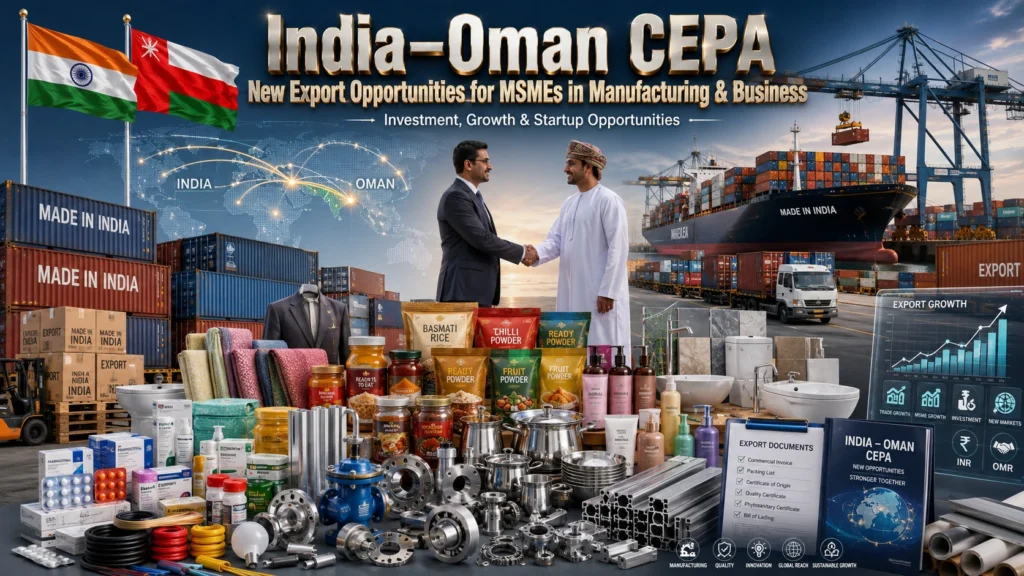
India Oman CEPA Export Opportunities A Trade Agreement That Changes the Manufacturing Math Trade pacts do not generally evoke excitement in the minds of MSMEs. Most of them are framed in bilateral diplomacy and not in terms of any practical business ideas for manufacturers/exporters on the ground. The India-Oman Comprehensive Economic Partnership Agreement (CEPA), however, is unique — and the difference is significant to anyone who operates or is considering a manufacturing unit in India. The CEPA was signed by India and Oman in a strategic setting. Oman is located at the mouth of the Arabian Sea, part of the Gulf Cooperation Council (GCC) trade corridor and is actively diversifying its economy from hydrocarbons. This deal is a boon to Indian manufacturers and exporters, especially MSMEs as they gain access to a high-income and import-dependent market on preferential tariffs. The timing coincides with India’s own desire to expand its exports of goods massively. This treaty is beneficial to several business sectors — processed foods, Pharma, Engineering Goods, Chemicals, Textiles and Handicrafts. In this article, we examine which sectors have the best export prospects for the MSMEs and what government initiatives can help magnify those benefits, and how Indian MSMEs can capitalise on the Oman corridor for long-term export success. Why the India-Oman Trade Corridor Is Gaining Strategic Importance Oman is not a big economy in the world. It is a strategic one, though. The country imports almost 80% of its food, most of its industrial raw materials and increasing amounts of its manufactured products. Such reliance leads to a permanent market for foreign suppliers. Traditionally, India has been a main source of imports for Oman, especially in the areas of Food Products, Textiles, Engineering Goods, and Construction Materials. The CEPA is an agreement that formalises and strengthens this relationship. The CEPA between India and Oman encompasses thousands of product lines as per the Ministry of Commerce and Industry, Government of India. The biggest advantage for India’s exporting companies is the gradual removal of customs duties on a host of manufactured products. This directly helps the price competitiveness, the main problem of Indian SME exporters in the Gulf countries where Chinese and SE Asian competition is dominating the market. Oman is also a re-export point to the wider GCC region outside of tariffs. A manufacturing company which develops a distribution chain up into Oman effectively places itself to distribute into Saudi Arabia, United Arab Emirates, Kuwait, Bahrain and Qatar. The corridor’s multiplier effect is the reason why the area is seriously considered by people monitoring business growth through exports. Related Article: India-Oman CEPA: The Trade Gateway Every Indian Exporter Has Been Waiting For Government Policies and Incentives Supporting MSME Exporters India has put together an effective package to facilitate Indian manufacturers from entering the export markets. These schemes work better under the CEPA framework as the pricing difference at the destination is decreased through preferential tariffs. Below are the most relevant policies for MSME exporters for Oman: MSME Export Promotion Schemes Small manufacturers directly get financial relief from Interest Subvention Scheme, Credit Guarantee Fund Trust for Micro and Small Enterprises (CGTMSE) and the Ministry of MSME’s ZED (Zero Defect Zero Effect) Certification Programme. Export-oriented units (EOU) are supported in a way that is very advantageous for an MSME with collateral-free credit of ₹2 crore provided by the CGTMSE. RoDTEP: Duty Refund for Exporters The Remission of Duties and Taxes on Exported Products (RoDTEP) scheme is implemented by Directorate General of Foreign Trade (DGFT) that will refund embedded taxes that exporters are unable to claim elsewhere. RoDTEP provides a 1–4% extra margin on FOB value for manufacturing industries such as processed foods, pharma, engineering goods, etc. which are some of the best beneficiaries of RoDTEP. That is a minimal amount but on an annual export order worth of ₹5 crore it’s ₹ 5 – 20 lakh of direct savings. ECGC and Export Credit The Export Credit Guarantee Corporation of India (ECGC) offers a risk cover to exporters who have dealings with foreign buyers. ECGC coverage is highly beneficial for new MSME exporters, who are entering into the market of Oman, as it reduces the risk of non-payment. It is coupled with post-shipment credit lines by the partner banks, which makes it possible even for an exporter with a turnover of ₹1-5 crore. Learn more at ECGC. PLI and Sector-Specific Incentives The PLI Scheme applies to 14 sectors such as food processing, pharmaceuticals, textiles, advanced chemistry cells, specialty chemicals, etc. for larger manufacturing plays. The PLI offers incentives of up to 20% on incremental production to MSMEs. When PLI is combined with preferential access to CEPA, a strong cost competitiveness can be gained. State-Level Export Incentives There are a few incentives available for export-oriented manufacturers in several states of India. Both Invest Rajasthan and Gujarat Industrial Development Corporation (GIDC) provide subsidy on land, power and infrastructure for MSMEs establishing export units. There are also MSME export promotion policies for Tamil Nadu, Karnataka and Maharashtra. Entrepreneurs should check with various state industrial development corporations to determine the best mix of central and state incentives. Manufacturing Business Ideas for MSMEs Under the India-Oman CEPA The CEPA brings concrete benefits to a number of manufacturing and export sectors. Specific business ideas are presented below that can be taken as action points by MSME entrepreneurs who wish to either start or expand their manufacturing businesses with the main export markets in Oman. 1. Processed and Packaged Food Products Oman is a net importer of food. The tariff concession in CEPA can have substantial benefits for Indian processed food manufacturers, especially in the spices, ready-to-eat foods, cereal-based foods, pickles and packaged snacks sector. Lowering or removing import taxes on complete food products makes Indian food more competitive than those from Thailand, Malaysia and Turkey, which have traditionally held a commanding position on the shelves of the Gulf countries. With an initial investment of about ₹50 lakh to ₹2 crore, an MSME entrepreneur setting up a food processing
Green Manufacturing Business Ideas in India for 2026
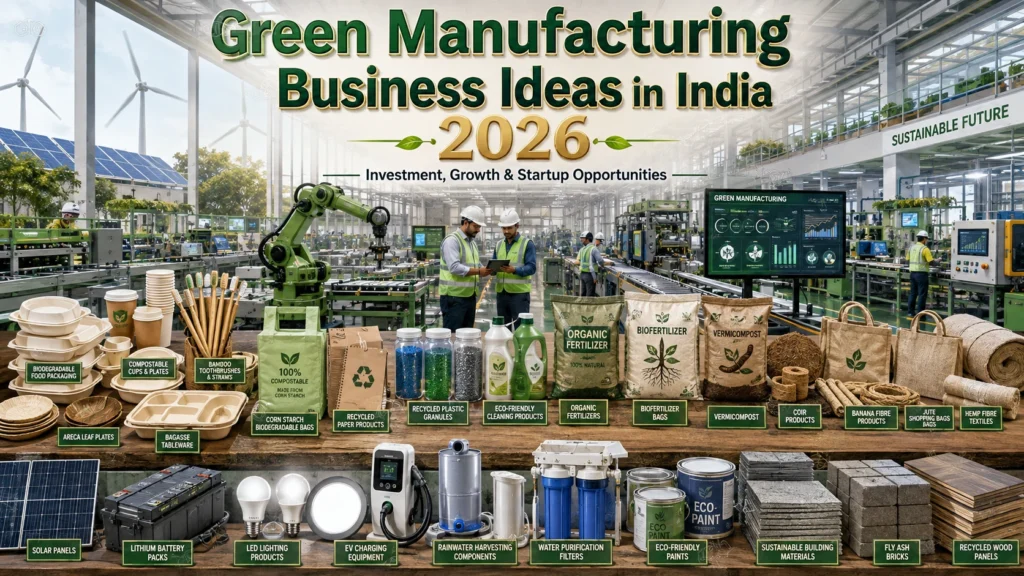
Opportunities for Circular Economy, Recycling and Eco-Friendly Products that are Profitable. The concept of sustainability has grown from being a catch phrase into a viable business model. With India taking a step toward a circular economy, recycling and eco-friendly manufacturing have become regulated, financeable, and future-proof industries. This is a once-in-a-lifetime opportunity for entrepreneurs looking for new and innovative green manufacturing business ideas in India for 2026. There are several trends pushing demand toward sustainable products, including tighter plastic bags, longer producer responsibility regulations, and green-financing incentives. The purpose of this guide is to highlight the most viable manufacturing concepts that are green and circular economy that can be pitched to startups, MSMEs and investors. Where they are successful, they have both a positive environmental benefit and a strong economic return, and many have a steady source of raw materials because they are a waste stream others are willing to pay for. Size of investment is no restriction; it is the process know-how and compliance that is important. In addition, you’ll get practical advice on licensing, government assistance, and how to take your idea from concept to product throughout. The agricultural residue, e-waste, used batteries and plastic waste that India produces annually is immense and a significant proportion of which is unutilised. Every waste stream is a raw material opportunity to a green manufacturer. Meanwhile, extended producer responsibility regulations are making brands responsible for recycling and sustainable packaging, meanwhile, which offers an assured market for conforming units. Thus, it is that green manufacturing is structurally attractive in 2026, being cheap inputs and mandated demand. Related Article: The Green Manufacturing Revolution: Paper Water Bottles, Bioplastics & Biodegradable Products Why Green Manufacturing Is Booming in India The move towards a circular economic system in India has taken recycling to an increased degree of regulation, bringing it to an industry level with long-term demand. The E-waste, battery waste and plastic reprocessing now have the regulatory certainty that provides a consistent flow of raw materials and access to green financing. Meanwhile, there is an increasing consumer demand for biodegradable and compostable products from global brands and Indian consumers which creates export avenues for eco-friendly products. Green manufacturing’s strategic value is “waste to value economics”. If your raw material is agricultural residue, old electronics or used batteries, your margins will be low, your environmental branding will be high, and you’ve got a powerful combination. Top Green Manufacturing Business Ideas in India for 2026 1. E-Waste Recycling and Metal Recovery In India, electronic waste recycling has been now legally regulated and has made the raw material available to the electronics recycling units and also created a steady demand for the recycling industry. Dematerializing copper, gold, aluminium and reusable parts from waste e-waste is a viable, eco-friendly, economically valuable scalable business. Only a tiny percentage of e-waste is processed in India and there is a huge gap in between of the organised recyclers. Building a regulated e-waste recycling centre complete with the required pollution-control and extended producer responsibility authorisations is the professional way to begin a business to securely and reliable provide this service to companies that are legally required to recycle their own products. View Full Project Details: E-Waste Recycling Projects 2. Lithium-Ion Battery Recycling As automotive and consumer electronic batteries end their service, the extraction of high-value minerals like nickel, lithium and cobalt presents an eco-friendly and economic choice. Battery recycling truly is one of the new manufacturing frontiers in India for 2026, supported by policy, and increased volumes. With India importing close to 100% of these critical minerals, it is essential that there is a strategic interest in their recovery in addition to being profitable, and cell manufacturers are more willing to purchase recovered minerals to mitigate their import risk. The first to learn the chemistry to recover the materials and to be able to obtain a regular stream of spent batteries will be able to establish a position which will serve them for decades. Read the Complete Book Here: Handbook on Lithium-Ion & Lead-Acid Battery Production and Recycling 3. PLA Bioplastic and Biodegradable Cutlery Manufacturing Poly Lactic Acid (PLA) is a biodegradable plastic, the world’s fastest growing, made from renewable corn starch. As single-use plastic restrictions increase, there is a great opportunity for restaurants, caterers and cloud kitchens to brand their cutlery, plates and packaging with PLA, a material that’s being manufactured for export. 4. Biochar Production from Agricultural Waste Biochar tackles both agricultural productivity and waste management by turning crop residue into a soil amendment and water filtration material. Crop residue is utilized as biomass in millions of tonnes every year in India which leads to air pollution; hence the conversion of this residue into a useful product has both commercial and environmental benefits. Biochar is a low barrier, high relevance, green manufacturing concept with relatively low start-up costs and increasing market relevance in the field of sustainable and organic agriculture, which is particularly suitable for bioentrepreneurs in rural regions who are close to agricultural clusters. 5. Sustainable and Biodegradable Packaging Sustainable packaging is on the rise as companies move away from plastic packaging and towards biodegradable options in response to legislation and consumer demand. The applications for bagasse tableware, moulded-fibre packaging and compostable films are of huge and increasing importance for restaurants, food delivery, airlines and e-commerce. Biodegradable packaging benefits from government incentives and increased consumer demand as single-use plastics are increasingly subject to regulation and large buyers are increasingly adopting and requiring sustainability objectives, making it one of the most bankable sustainable manufacturing ideas for 2026. Get Detailed Project Report (DPR): Biodegradable Packaging & Bio-based Polymers Guide 6. Plastic Reprocessing and Recycled Granules Plastic reprocessing units convert post-consumer and industrial plastic waste into plastic granules which are used to make plastic product. This business is now subject to the extended producer responsibility norms that guarantee it a consistent and stable supply of raw materials and sustained demand from packaging and moulding plants. Recycled content is a legal requirement and