
India Czech Republic Manufacturing
A Strategic Industrial Corridor Taking Shape
India and the Czech Republic are seldom found one and a half sentences back from each other in the business discussions. However, this two-way exchange might just be some of the most interesting manufacturing business opportunities today for entrepreneurs looking for real, fundable and globally accessible business ideas. The two nations have a shared history in sectors that are at the core of the global manufacturing economy such as machine tools, precision engineering, hydraulics, castings and advanced automation.
The Embassy of India in Prague states that bilateral trade has reached a figure of US$ 4 billion, from less than US$ 86 million in 1993. This isn’t a trivial tweak. It’s a structural change and it represents that the industrial complementarity of the two economies has gone beyond diplomatic niceties to genuine commercial flows. This moment is not something to take lightly for a startup founder, MSME investor, or an industrial project planner.
The Czech Republic has over 40 years of experience in precision manufacturing, not only in CNC machining, forging, hydraulics, environmental technology, but also in electrical power machinery. India offers scale, cost competitiveness, an ever-improving engineering talent pool and a growing domestic market with its increasing sophistication. Both countries can develop a strong two-way supply chain that will be beneficial to manufacturers and investors on both sides. The Embassy of India, Prague is very active in documenting this increasing industrial connection which can be very useful for entrepreneurs.
In this article we will discuss specifically which sectors, the policy landscape, ideas for business projects and the trade dynamics make the India–Czech manufacturing corridor a meaningful project to develop?
Related Article: How to Start a Fasteners and Precision Parts Manufacturing Export Business in India
Why This Industrial Sector Deserves Your Attention Now
The world of manufacturing is constantly evolving. The disruptions in the supply chain, geopolitical realignment and the “China Plus One” procurement strategy has compelled European industrial buyers to diversify their procurement aggressively. India has become one of the biggest beneficiaries of this change, especially in the areas of capital goods, precision components, casting, forging and automation in the industrial sphere.
The other side of the coin, however, is the Czech economy, which is very engineering oriented. Its manufacturing sector features world-class skills in CNC machine tools, hydraulic & pneumatics, surface engineering, welding technology and Industry 4.0 integration. Czech companies offer technical expertise that is required by Indian manufacturers to enter into international markets. The cost efficiency and the size of Indian companies offer a number of advantages that Czech companies need to globally compete.
The Numbers Behind the Opportunity
India is already the 2nd largest producer of castings in the world. The turnover of the foundry industry alone is about US$ 20 billion and the exports are nearly US$ 3.54 billion. India Foundry Market is expected to post a CAGR of 10.30% to cross the US$ 31.77 billion mark by 2029. Data published by the IBEF shows that engineering industry makes up 27% of the total factories in the industrial sector in India and 63% of all foreign collaborations in the country.
The India machine tool market is another indicator. One such indicator of the gaps in domestic manufacturing capacity is the quantum of import of machine tools which has crossed the ₹40,000 crore mark in a recent fiscal year. These gaps are opportunities for business investment by entrepreneurs who are able to establish import substitution or technology transfer businesses with a Czech business entity.
In addition, Czech businesses are investing into India. India has attracted more than 37 Czech companies, such as Škoda Auto, Doosan Škoda Power and Bonatrans, who have invested over US$ 283m in the country. A significant partnership between Tata AutoComp and the Czech rail parts maker Škoda Group is another example of Czech trust in India’s manufacturing capabilities. This is the place in which a fresh entrepreneur can move with a thoroughly prepared feasibility plan.
Government Policies and Incentives Supporting This Opportunity
The bilateral manufacturing opportunity is viable for startups and MSMEs in India and Czech Republic due to robust policy frameworks. The policy momentum is strong on the Indian side.
Production Linked Incentive (PLI) Scheme
Now implemented in 14 critical sectors of industry, the PLI scheme has already attracted ₹2 lakh crore investment and incured incremental production of more than ₹18.7 lakh crore. The scheme has directly and indirectly generated more than 12.6 lakh jobs till September 2025. Strategic PLI beneficiaries are those in the capital goods and engineering industries that feed directly into the machine tools and automation industries discussed in this article. As an entrepreneur, you can have a steady and high demand pipeline by matching your project with the PLI connected anchor units. Please refer to Press Information Bureau, Government of India for more details.
National Capital Goods Policy and Make in India
A dedicated policy has been announced by the government namely National Capital Goods Policy for the machine tools and industrial equipment industry. It aims to boost value addition, cut imports and make India a global hub for capital goods manufacturing. Union Minister HD Kumaraswamy, at the event of IMTEX 2025, assured this would pave the way for innovation and help in cutting India’s reliance on imported precision machines. The Indian machine tool industry is expected to achieve a revenue of US$ 3.8 billion by 2030.
Make in India initiative by DPIIT will continue to allow 100% FDI under the Automatic route for manufacturing of capital goods and machine tools. No licensing requirements for industry, no impediments to technology import agreements, and no foreign equity restrictions in most sectors involved. Investors looking into this path should utilise the Make in India portal.
Get Detailed Insights from This Book: Our Books
MSME Schemes and Credit Support
The Ministry of MSME has a slew of support programs for small manufacturers, including the Credit Guarantee Fund Trust for Micro and Small Enterprises (CGTMSE), which offers collateral-free loans worth up to ₹5 crore, and the MSME Cluster Development Programme as well as Technology Upgradation Fund. In addition, the Export Promotion Mission (EPM) approved by the Union Cabinet with an outlay of ₹25,060 crore for 6 years specifically targets challenges faced by the MSMEs in exports. The complete information on schemes and procedures of applying for the same is available in the Ministry of MSME website.
India–Czech Strategic Partnership on Innovation
The Indian Prime Minister, Narendra Modi and the Czech Prime Minister Petr Fiala signed a policy at the diplomatic level, formalizing the Czechia–India Strategic Partnership on Innovation. The partnership includes cooperation in the fields of artificial intelligence, electromobility, semiconductors, cyber security, environmental technology and defence industrial cooperation. For the industrial entrepreneurs, this framework is basically a political and institutional support for the technical cooperation and joint ventures between Indian and Czech firms, which eliminate commercial risk and create official channels for the business facilitation.
High-Potential Manufacturing Business Ideas for Startups
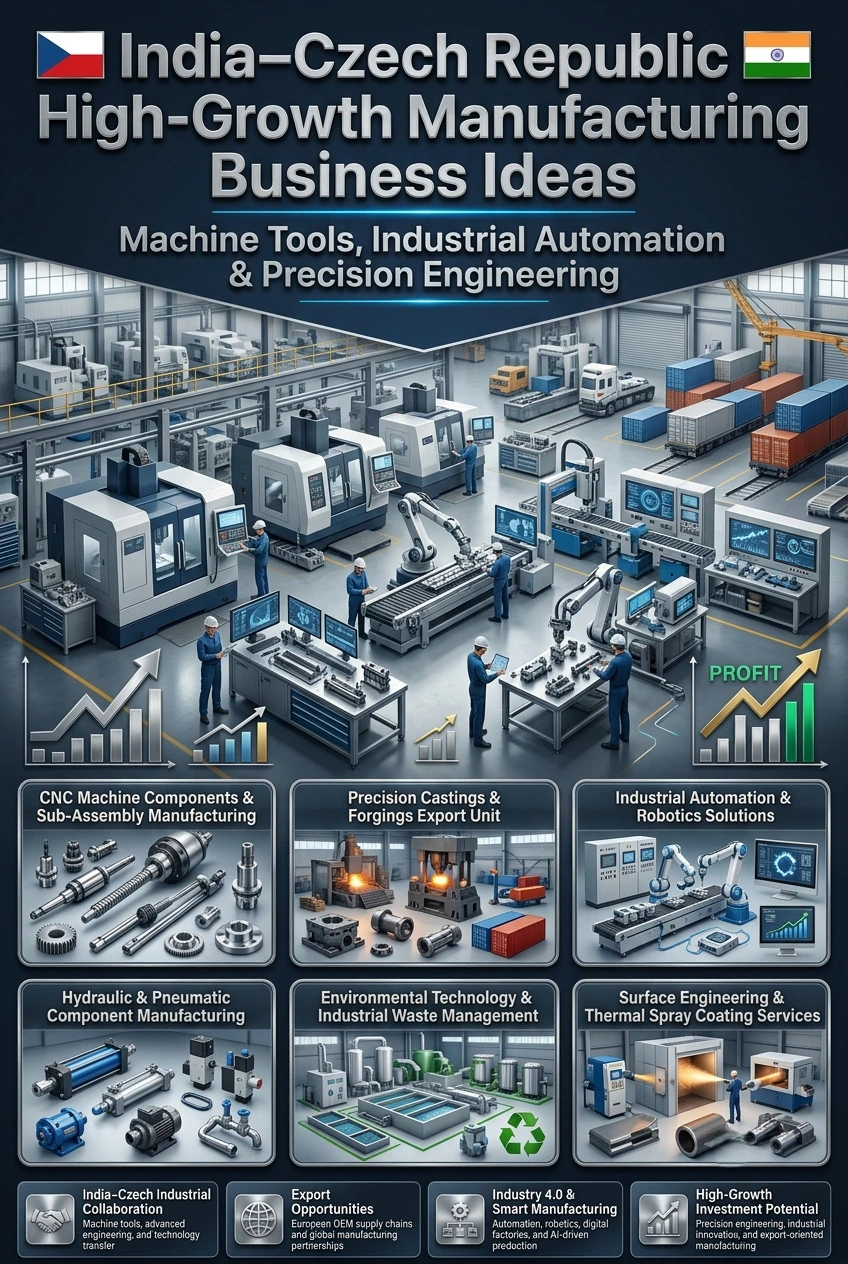
With the above-mentioned industrial link with India, there are a few specific actionable and bankable project concepts emerge. All the following concepts are based on actual market needs, bilateral trade relationships and industrial demand proven in the market. These are not “generic sector suggestions”, they are structured manufacturing business ideas based on the logic of supply-demand that is seen.
1. CNC Machine Components and Sub-Assembly Manufacturing
India imports more than ₹40,000 crore of machine tools per year. Many of these imports are for parts such as CNC spindles, ball screws, linear guides, ATC systems and CNC controllers, all manufactured by companies in the Czech Republic, such as CZ. The products are manufactured with a guaranteed precision by TECH, Raptor CNC and Strojimport. An Indian MSME can establish a precision component manufacturing facility aimed at import substitution with an MSME from the Czech Republic, after signing a technology transfer agreement.
The business model involves merging the Czech technical expertise with Indian cost structures; that is, reducing the price of the components by 30-40% compared with the European-sourced options, while satisfying the ISO quality standards.
This unit can serve the domestic Indian machine tool OEMs such as Jyoti CNC, ACE Microsmatic and LMW as well as export to Central European buyers. The capital investment is moderate, the technology transfer process is well supported by existing Indo-Czech JEC framework and the demand is structurally ensured through the manufacturing expansion trend in India.
2. Precision Castings and Forgings Export Unit Targeting European OEMs
India is the second casting major producer in the world. Czech companies such as Czech Precision Forge (CPF), Moravske Kovarny and 2JCP produce high-quality forgings for gas power plants, hydrogen energy systems, automotive OEMs and for rail infrastructure. Some of these Czech companies are on the lookout for competitive Asian casting partners. A business person from India can own an export quality precision casting centre that is targeted to the Czech and the overall central European OEM requirement, through the access of a foundry cluster (such as, Rajkot, Pune, Kolhapur or Belgaum).
The unit would specialize in the production of industrial machinery, valve bodies, pump housings, and power generation equipment castings in stainless steel, alloy steel and SG iron.
Quality certification, such as ASTM, DIN, and ISQ 9001:2015 is required and Indian clusters already manufacture to these standards for US and UK buyers. A viable two market strategy is created when Czech market-specific grade compliance is added. Being in the middle of Europe, the Czech Republic is the gateway for any Indian supplier to get access to the entire industrial procurement market in the EU by signing a distribution contract with a Czech company.
View Full Project Details: Project Reports & Profiles
3. Industrial Automation Integration and Robotics Solutions for Indian MSMEs
A report released by the Ministry of MSME has revealed that less than 25% of the MSMEs in the country have embraced advanced digital manufacturing tools. This is one big loss, and it’s a big opportunity for business. Some Czech companies, such as CZ., are available. TECH has extensive experience and knowledge in designing robotic manufacturing cells and automated production lines as well as in automation systems for Industry 4.0, which are also employed by several automation integrators based in Brno.
An Indian entrepreneur can form an industrial automation integration company that gets the core technology from the Czech partners and installs customized automation solutions for Indian MSME clusters in the automotive parts, pharmaceutical packaging, food processing and consumer electronics industries.
Their business model here is in system design, equipment sourcing and integration, installation, and annual maintenance contracts. AMC streams generate ongoing income after the project is constructed. The policy provisions in the National Capital Goods Policy and Scheme for Enhancement of Competitiveness in Indian Capital Goods Sector create an immediate policy-led demand for this business for MSMEs through financial support for automation adoption.
4. Hydraulic and Pneumatic Component Manufacturing
From construction machinery to agriculture equipment, presses in industries to materials handling, hydraulic and pneumatic systems play a vital role everywhere. The Czech industry has long enjoyed a good reputation in this area, manufacturing hydraulic cylinders, valves, actuators and control systems of European standard. India currently imports a significant number of hydraulic components and with the ‘Make in India’ initiative in the defence, construction and agricultural machinery sector, the demand for hydraulic components has grown significantly in the country.
An entrepreneur can set up a hydraulic component manufacturing unit jointly with a Czech technology licence, which will produce cylinders, manifold blocks, control valves and pneumatic fittings for the domestic market and will aim to export to South Asian and African markets, where the price of the Czech products is not affordable. Many of the hydraulic components are relatively standard, particularly at the medium-pressure end, allowing for reasonable technology transfer time, capital expenditure is not overly large, and scale-up is achievable within 24–36 months of commissioning.
5. Environmental Technology and Industrial Waste Management Systems
Environmental technology is one of the priorities of the Strategic Partnership on Innovation between the Czechia and India. Czech companies have world class knowledge in the field of water treatment for industrial wastewater and its treatment, emission control systems, air filtration technology, and wastewater treatment in industry, a field which is under increasing pressure in India due to the Central Pollution Control Board (CPCB) and State Pollution Control Boards. As an Indian project developer, which designs, suppliers and installs Czech sourced environmental technology systems in Indian industrial clusters, a strong services + equipment business can be built.
The prospect is particularly attractive in MSME clusters located in Ludhiana, Vatva (Ahmedabad), Tirupur and Howrah, where the rules regarding industrial pollution are getting stricter. The environmental technology market in the Czech Republic exports actively to Asia and there are consolidated channels via Czech Trade for cooperation agreements within the field of industrial technologies.
6. Surface Engineering and Thermal Spray Coating Services
Surface engineering (thermal spray, PVD coatings, electroplating, laser hardening) is a specialised, but high-margin manufacturing service that is relevant to the automotive, aerospace, defence and tooling industries. Czech companies have developed expertise in cutting-edge surface treatments which are not widely being reproduced in India. An entrepreneur can establish a surface treatment services centre importing the Czech technology of coating and cater to the Tier-1 companies of the auto industry, defence equipment manufacturers and precision tooling manufacturers within the country.
It is a B2B services company with a recurring revenue model, and advanced coating services have a differential value, which translates to a high power to price. With the push towards Atmanirbhar Bharat, India’s aerospace and defence manufacturing sector is growing, and this expansion is expected to drive up demand for surface engineering services even further.
Identify high-growth industries before others do
Import–Export Opportunity Analysis for New Startups
India trade with the Czech Republic clearly indicates a pattern which can be exploited skillfully by the entrepreneurs. In a recent year, India’s exports to the Czech Republic stood at US$ 3.06 billion while India’s imports from the Czech Republic were US$ 1.126 billion. The trade surplus is indeed India’s but it is limited to pharmaceuticals, organic chemicals, and consumer goods.
The picture is different in engineering and industrial machinery. India is a net importer of high precision machine tools, high precision specialized CNC, hydraulic components and Industry 4.0 hardware. This dependence on imports gives rise to a direct opportunity for import-substitution manufacturing enterprises, supported by transfer of Czech technology.
Indian castings, forgings, precision parts and engineering goods are exciting areas for Czech and EU buyers to explore as export markets. Indian companies are already shipping precision investment castings to Czech customers from Rajkot and Pune. The logical next step is to scale this into a structured bilateral supply chain with India’s production standards being matched to the requirements of the Czech OEM. The Engineering Export Promotion Council (EEPC India) actively provides export and buyers network and export finance support to Indian engineering exporters. The Indian Pavilion presented by the EEPC with 23 Indian companies at the MSV International Engineering Fair in Brno is an example of such organized trade promotion.
Further, the current negotiation of the India-EU Free Trade Agreement offers a policy tailwind in the medium-term. If the FTA is finalized, the engineering goods tariffs between India and the Czech Republic would become more favourable for the manufacturers in both countries economically. In the future, the landscape of FTA will mature, and the forward-thinking entrepreneurs who now form Czech partnerships will be in good shape for the future.
Entrepreneurs may refer to the Department of Commerce, Ministry of Commerce and Industry portal and the DGFT trade data system for detailed trade data and analysis at HS code level of export opportunities.
Indian MSME Leaders Who Built Global Industrial Businesses
Jyoti CNC Automation: From Gearboxes to Global CNC Brands
Jyoti CNC Automation, which was established in 1989 in Rajkot, Gujarat, is one of the most outstanding machine tool success stories in India. The company started out very simply, producing gearboxes for industrial machines, a relatively niche business in a typically European- and Japanese-dominated capital goods industry. Promoter Parakramsinh Jadeja had a clear vision and technology first strategy, that is, they invested in CNC and gradually moved up the value chain.
Presenting, Jyoti CNC is not just an Indian top CNC manufacturer but also an international one these days. Jyoti purchased Huron Graffenstaden SAS, a 158-year-old French machine tool manufacturer headquartered in Strasbourg, in 2007, which makers 3-axis and 5-axis machining centres with more than 100,000 units sold worldwide.
This cross-border acquisition provided Jyoti with the European customers, precision technology and credibility that would have taken many years to build organically. The lesson for those who are just starting their business: Technology-driven MSME businesses can grow on an international level by adopting a strategy of acquisition and partnership – and Europe is an open market for Indian engineering businesses which have a technical capability.
Bharat Forge: Building a Global Forging Giant from Pune
Under the leadership of Baba Kalyani, Bharat Forge has gone from being a domestic automotive component supplier to being one of the largest forging companies in the world. Its headquarter is at Pune and it serves customers in the automotive, aerospace, defence, railway, energy and industrial sectors from around the world. Bharat Forge’s formula for success was based on three key principles – that it invested in forging technology on an ongoing basis, expanded globally aggressively with acquisitions in Germany and Sweden, and remained laser-focused on engineering product quality that European OEMs demand.
Bharat Forge’s success story provides a clear and concise strategic framework for entrepreneurs contemplating business initiatives in the India–Czech corridor: establish domestic quality anchoring, build technical credentials that can be transferred to the international market and then seek access to the European market through partnership or acquisition.
Lakshmi Machine Works (LMW): National Award-Winning Export Leader
The Lakshmi Machine Works Limited, Coimbatore, has been awarded the EEPC India National Award for Export Excellence in Machine Tools – Large Enterprises category for the last few years, which was presented at the 57th EEPC India National Awards in New Delhi. LMW’s machine tool reputation was achieved through the manufacture of high-performance CNC machining centres, turning centres and spinning machines for the domestic and overseas market.
The company provides customers throughout Asia and Oceania, and their export engagements illustrate that Indian machine tool manufacturers can compete against global brands when it comes to quality, after sales service, and engineering precision. The lesson to the new players: quality reputation is the only key to retaining international customers in the machine tool business and India can do it now.
About Niir Project Consultancy Services (NPCS)
At Niir Project Consultancy Services (NPCS) we specialize in the preparation of the Market Survey cum Detailed Techno-Economic Feasibility Reports (DPRs) for any entrepreneur and investor interested in establishing a new industry or business. We have a report on each and every crucial component of a project that has to be finalized before any money is invested – detailed manufacturing process description, market research and demand analysis, process flow diagram, product mix and capacity planning, machinery specification, raw material specification and complete project financials including profitability projections.
For projects in machine tools, precision engineering, industrial automation, castings and forgings, hydraulics, surface engineering, and environmental technology — including those involving India–Czech bilateral collaboration — NPCS prepares bankable, investor-grade feasibility reports. Our work helps entrepreneurs evaluate profitability, mitigate technical risk, and build investor confidence before committing capital. If you are exploring any of the business ideas covered in this article, a professionally prepared DPR from NPCS is the most important first investment you can make.
Key Market Data: India–Czech Republic Industrial Trade & Sector Overview
| Parameter | Data / Status |
| India–Czech Bilateral Trade (Total) | US$ 4.034 billion (Czech Statistics) |
| India Exports to Czech Republic | US$ 3.06 billion |
| Czech Exports to India | US$ 1.126 billion |
| Czech Companies Operating in India | 37+ companies; investments exceeding US$ 283 million |
| India Foundry Market Size | US$ 19.46 billion (est.); projected US$ 31.77 bn by 2029 |
| India Foundry Export Value | Approx. US$ 3.54 billion |
| India Machine Tool Import Value | Over ₹40,000 crore (recent fiscal year) |
| India Machine Tool Market (Projected) | US$ 3.8 billion by 2030 |
| PLI Scheme Realized Investment (14 Sectors) | ₹2 lakh crore (as of Sept 2025) |
| MSMEs with Advanced Digital Tools Adoption | Less than 25% (MSME Ministry Report) |
| India-Czech Strategic Partnership | Strategic Partnership on Innovation (signed Jan 2024) |
| India Ranking in Global Casting Production | 2nd Largest Producer Globally |
| Capital Goods Sector Contribution to GDP | ~1.9% |
| FDI Policy: Machine Tools & Capital Goods | 100% FDI under Automatic Route |
Source: Embassy of India Prague, IBEF, DPIIT, Ministry of MSME, EEPC India, Press Information Bureau.
Frequently Asked Questions (FAQ)
Q1. What are the most viable manufacturing business ideas in the India–Czech Republic corridor?
The most commercially viable ideas include precision CNC component manufacturing under Czech technology transfer agreements, export-grade castings and forgings for Czech and EU OEMs, industrial automation integration services for Indian MSMEs, hydraulic component manufacturing, environmental technology systems deployment, and surface engineering services. Each of these addresses a documented market gap in the India–Czech bilateral trade relationship.
Q2. How does a startup in India access Czech technology for a new manufacturing project?
There are several established routes. An entrepreneur can approach Czech firms directly through the Czech Industrial Cluster in Bengaluru, through CzechTrade’s India office, or through industry events like the MSV International Engineering Fair in Brno where EEPC India regularly facilitates Indian participation. Technology transfer agreements, licensing deals, and joint ventures are all commercially viable structures. The India–Czech Joint Commission on Economic, Scientific, Technical and Cultural Cooperation also provides a diplomatic channel for high-value industrial collaborations.
Q3. What government incentives are available for manufacturing startups in these sectors?
Indian entrepreneurs can access PLI scheme benefits (through supply chain linkages with large PLI beneficiaries), the Scheme for Enhancement of Competitiveness in Indian Capital Goods Sector, Credit Guarantee Fund support for collateral-free MSME loans up to ₹5 crore, the Export Promotion Mission with ₹25,060 crore outlay, and various state-level industrial subsidies. For projects with Czech collaboration, the bilateral Strategic Partnership on Innovation also facilitates R&D and technology access support.
Q4. Is the India–Czech trade relationship stable enough to build a long-term business on?
Yes. Bilateral trade has grown from US$ 86 million to over US$ 4 billion over the last three decades — a 46-times increase. India and Czech Republic have elevated their relationship to a Strategic Partnership on Innovation, supported by active joint commission meetings, defence industrial cooperation, and a growing presence of Czech companies in India through the Czech Industrial Cluster in Bengaluru. The relationship has both political depth and commercial momentum, making it a stable foundation for long-term manufacturing investment.
Q5. How important is certification for exporting industrial goods to Czech Republic?
Certification is non-negotiable for European export. Czech and EU industrial buyers require ISO 9001:2015 quality management certification as a minimum. Sector-specific standards apply additionally: ASTM and DIN compliance for castings and forgings, CE marking for machinery and electrical equipment, and EN standards for environmental technology systems. Indian exporters from established engineering clusters in Rajkot, Pune, and Coimbatore are already producing to these standards for other European markets, making the extension to Czech buyers operationally straightforward.
Q6. What role does a feasibility report play before starting a manufacturing project in this sector?
A detailed project feasibility report — also known as a Techno-Economic DPR — is the most critical document before committing capital to any manufacturing project. It defines the project scope, validates market demand, outlines the technology and machinery requirements, estimates capital and working capital needs, projects profitability over 5–10 years, and identifies risks. For projects involving technology transfer from Czech firms, a professionally prepared feasibility report also provides the analytical basis for negotiating technology licensing terms and approaching commercial banks or NBFC lenders for project finance.
Conclusion: Act Before This Window Narrows
The India–Czech Republic manufacturing opportunity is not a future possibility. It is a present-day reality that is already scaling. Trade is above US$ 4 billion. Czech companies are on the ground in India. The Indian government has created policy frameworks worth trillions of rupees to support exactly the kind of industrial manufacturing ventures covered in this article. The Strategic Partnership on Innovation provides diplomatic momentum. And the global supply chain reconfiguration driven by China+1 strategies is actively redirecting European industrial procurement toward India.
What remains is for well-prepared entrepreneurs — backed by solid market research, viable project reports, and realistic financial models — to step in and build the industrial businesses this corridor demands. The business ideas in this article are not speculative. They are grounded in documented bilateral trade data, verified market demand, active Czech–India corporate relationships, and supportive government policy.
For those ready to move from idea to execution, the first step is a professionally prepared feasibility report. The FICCI and the Engineering Export Promotion Council remain valuable institutional anchors for market intelligence and buyer connect. The opportunity is real. The frameworks are in place. The question now is simply: who moves first?