
Disposable Syringe and Needle Manufacturing Business in India: Investment, Licensing and Profit
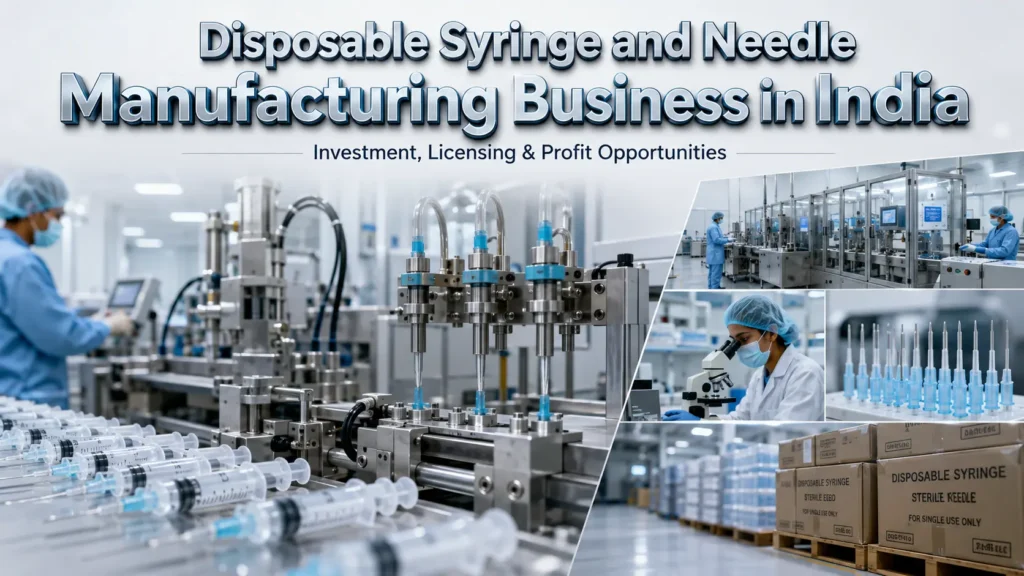
Disposable Syringe Manufacturing Business in India Although India produces more than 16 billion syringes per year and exports almost 80 percent of the world’s auto-disables, the demand for both from government and PMJAY hospitals and export markets still lags behind supply in a number of geographies making this one of the most stable and scalable manufacturing opportunities in India’s medical devices sector. The disposable syringe market is a guaranteed market for an entrepreneur who can understand CDSCO and BIS certification, as well as have clear regulatory pathways, a runway of demand over many years. Market Opportunity: Why This Business Cannot Be Ignored Though the country is a global power in the manufacture of syringes, the production base is concentrated in a few centres in Faridabad (Haryana) and Baddi (Himachal Pradesh) thereby posing procurement risk to hospital buyers in lesser served states, according to Association of Indian Medical Device Industry (AIMED). Tier-2 and tier-3 cities are actively looking for regional suppliers for reliability and quick turnaround time, presenting a solid commercial opportunity for new manufacturing companies that are certified.State government health missions and new PMJAY-empanelled hospitals are also keen on sourcing from the region for reliability and quick turnaround time, offering a clear commercial opportunity for new certified manufacturers. The segment is a geographic quality bottleneck and the Make in India production incentives by the MSME Ministry are specifically targeted to overcome this quality bottleneck. The production entrepreneurs who set up their business in less developed states are eligible for the benefit of capital subsidy under PMEGP, government industrial incentives, and preference in procurement from government health departments to diversify their medical consumables procurement from single cluster dependence. Get Detailed Project Report (DPR): Disposable Plastic Syringes Manufacturing Project Report Industry Analysis: Growth Drivers and Demand Outlook Indian domestic syringe market is worth about Rs. 4,000 crores with growth rates of 10-12% CAGR. With registration on the Government e-Marketplace (GeM), all those manufacturers will automatically get guaranteed business from the public sector as it comes through NHM, CGHS and defence hospitals, which has proven to be one of the most consistent and expanding revenue streams for any medical device manufacturer in India. SYRINGES and INJECTION DEVICES are one of the top export categories for the medical devices sector in India, with the market expected to grow at a CAGR of 14.3% to USD 50 billion by 2030, according to the IBEF Medical Devices Sector Report. With the introduction of mandatory product changeover from non-auto disable syringes to auto-disable (AD) syringes as a part of the National Health Mission’s Universal Immunisation Programme guidelines, only BIS IS:10654 manufacturers can leverage this product upgrade. The ISO 13485 and WHO-GMP certifications open the door to the UNICEF and UNFPA procurement programmes, which are among the most predictable international sources of income that are available. Auto-disable syringes have been identified as a top-10 priority import substitution product by the Invest India Medical Devices investment guide and PLI scheme incentives and government procurement preference are actively helping domestic manufacturers. The Directorate General of Foreign Trade (DGFT) handles the administration of RoDTEP and duty drawback claims, thereby enhancing the net export realisation of eligible syringes to international buyers by 2-5 percent. Indian manufacturers can follow these WHO Medical Devices Access Programme (MDAP) prequalification pathways to provide products to the UNICEF and UNFPA procurement agencies in 120+ LMICs. India Syringe Industry Snapshot Parameter Data Source / Note India Annual Syringe Output 16+ billion units FICCI and AIMED estimates Domestic Market Value Approx. Rs 4,000 crore Industry estimates Market Growth (CAGR) 10-12% per year NHM hospital expansion India Global AD Syringe Share ~80% of world supply Hindustan Syringes data Main Production Cluster Faridabad, Haryana Industry survey Key Government Buyer NHM, CGHS, state CMSDs, defence hospitals GeM procurement Leading Indian Brand Dispovan (Hindustan Syringes and Medical Devices) Faridabad, Haryana How to Start: Step-by-Step Guide for Entrepreneurs Step 1: Business Registration and MSME Enrollment Get your entity (Private Ltd, LLP or Sole Proprietorship) registered and enroll on the Udyam portal at udyamregistration.gov.in to avail MSME benefits. Locate in a state MIDC, GIDC or RIICO industrial estate on an industrial plot of at least 2,000 sq.ft. to avail benefit of lower utility charge and state capital subsidy. Before going for CDSCO License get a Factory License (Act 1948) and get GST Registration. Under the capital subsidy scheme, the new manufacturing units will have to register on the Udyam MSME Registration Portal to get benefits of the capital subsidy scheme for syringe manufacturing units, collateral-free loan under CGTMSE, and state industrial incentive which helps to keep the equity requirements minimised for setting up a syringe plant. Step 2: CDSCO Class B License and BIS Certification Disposable syringes are medical devices of class B under MDR 2017 which must be obtained from the State Licensing Authority in the form of a Manufacturing License (Form MD-5). Apply for BIS certification for both auto-disable syringes (IS:10654) and hypodermic syringe (IS:10178). Prepare your Quality Management System documentation for ISO 13485 certification which is strongly recommended to participate in government tenders and export. Read the Complete Book Here: Handbook on Medical & Surgical Disposable Products Step 3: Machinery Procurement and Clean Room Setup The core machinery mainly consists of polypropylene injection moulding machines for barrel, plunger, piston; blister sealing machine; needle tube cutting and grinding equipment; automated assembly conveyor. Set up ISO Class 7 or 8 cleanroom for assembly and packaging according to CDSCO GMP guidelines. Early stage, you can avail the contract with the certified third-party ETO or gamma sterilisation centres in Delhi NCR, Mumbai, and Bengaluru. Step 4: Quality Control Lab and Sterility Testing Maintain an in-house QC laboratory to perform dimensional checks, break-out point testing (AD syringes), dead space checks and sterility spot checks. Common instruments are a profile projector or digital calipers, a burst pressure tester, and a particle counter. Before you get a manufacturing licence, your QC lab protocol should meet the needs of CDSCO GMP and the appropriate BIS product standard specifications. Step
Blood Bag Manufacturing Business in India: CDSCO Class D Licensing, BIS IS:15716, Investment and Market Demand
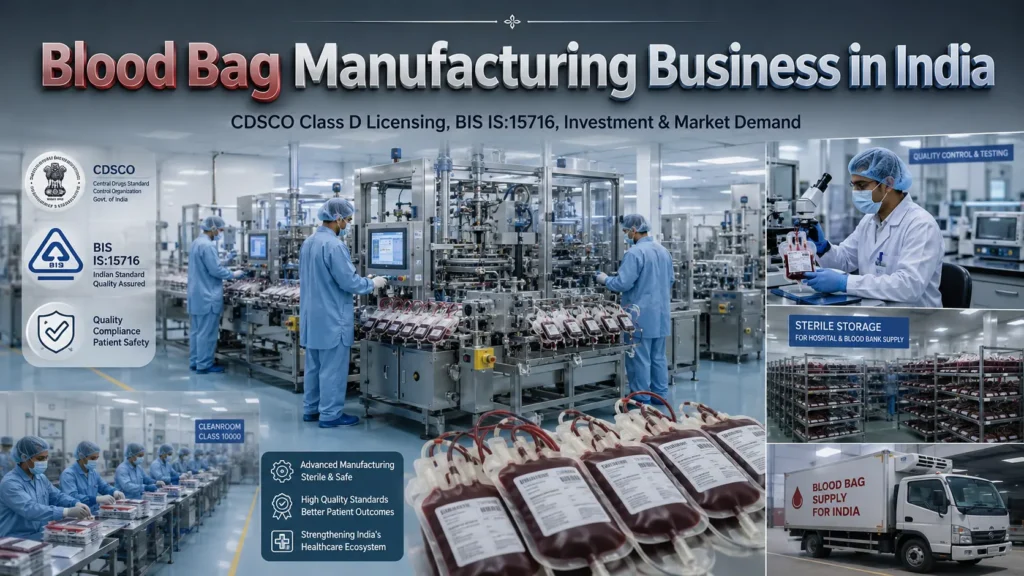
Blood Bag Manufacturing Business in India With less than 15 active manufacturers in India, serving a market of Rs 700-900 crore, every blood bag collected is clinically necessary as there is a shortage of blood units while a non-existent supply chain makes every single blood bag collected indispensable for blood banks across India, with quality manufacturers charging premium prices and secured vendor status. Market Opportunity: Why This Business Cannot Be Ignored Blood bags are added to the highest risk class D medical devices under MDR 2017, as defects may pose a direct threat to patients’ lives during a transfusion. All the class D manufacturers are required to be licensed by central CDSCO in addition to state SLA, have validated ETO processing, have thorough biocompatibility testing as per ISO 10993 and have validated ISO 13485 QMS. The barriers help quality producers to exclude the low-quality producers and make the market very attractive to serious and compliant manufacturers. The National AIDS Control Organisation (NACO), India, oversees more than 3200 blood banks which are licensed and have established certain technical requirements for the blood bags in government blood banking. The approved vendor list is the first step towards national procurement programmes which ensure payment of multi-year supply contracts to technically compliant manufacturers, one of the most predictable, and margin resilient, revenue models within the Indian medical device industry. Get Detailed Insights from This Book: Handbook on Medical and Surgical Disposable Products Industry Analysis: Growth Drivers and Demand Outlook The blood bag market in India is estimated at Rs. 700-900 crore with 10-12 percent growth year-on-year. The Ministry of Health and Family Welfare has formulated a National Blood Policy that has been implemented in district hospitals under NHM, and which requires hundreds of new blood banks per year, all of which constitute a captive, predictable buyer of blood bags in single, double, triple and quadruple packs. The National AIDS Control Organisation (NACO) Blood bank portal keeps the list of approved vendors, technical specifications, and procurement procedures that blood bag producers need to meet and provide before they can receive contracts for blood bag supply from across 3200+ blood banks across the country. There are very few manufacturers that cater this sector namely BPL Biotech, Span Medical Products, Hi-Tech Medical and international brands. When a new company gets CDSCO Class D approval and NACO vendor list approval, they instantly have access to all the procurement opportunities across the country. Blood bags are identified as a medical devices initiative priority product category by Make in India and available for PLI Medical Devices for Class D approved manufacturers. According to Invest India blood storage systems are one of the high priority local manufacturing segments which can benefit from PLI scheme and also be preferred by the government for procurement as per the blood bag import substitution report, based on government data. India Blood Bag Market Overview Parameter Market Data Source or Notes India Annual Blood Requirement 15+ million units per year Ministry of Health estimates Actual Blood Collection 12-13 million units per year NACO Annual Report Blood Bag Market Value Rs 700 – 900 crore Industry estimates Market Growth Rate 10-12% per year NACO blood bank expansion Number of Licensed Blood Banks 3,200+ across India NACO national survey CDSCO Classification Class D (highest risk category) MDR 2017 India BIS Standard for Blood Bags IS:15716 Mandatory BIS certification How to Start: Step-by-Step Guide for Entrepreneurs Step 1: Technical Feasibility Study and Regulatory Strategy The manufacturing of blood bags is the most technically challenging business in medical devices industry in India. Prior to investment, perform a comprehensive technical feasibility study that includes clean room requirements, ETO sterilisation validation plan, biocompatibility testing, ISO 13485 QMS scope and a CDSCO class D licensing timeline. NPCS can do this feasibility study as the base of your investment decision as well as bank loan application. Blood bag manufacturing units should enrol on the Udyam MSME Registration Portal so that they can avail collateral free loan from CGTMSE, term loan from SIDBI and government subsidy on investment in the huge investment of clean room and ETO sterilisation equipment. Get Detailed Project Report (DPR): Blood Bags Manufacturing Plant Report Step 2: CDSCO Class D Manufacturing Licence Please apply for CDSCO Class D Medical Device Manufacturing Licence in Central office at New Delhi. Requirements are validated ISO Class 7/8 clean rooms, validated ETO sterilisation process with biological indicator monitoring, ISO 13485 QMS certification, biocompatibility data (ISO 10993) and a complete device master record. The whole process of getting CDSCO inspection and approval to get registered as a class D can take 12-18 months, so start preparing early. Step 3: Clean Room, RF Welding, and Sterilisation Infrastructure The required minimum size for a blood bag plant is 6,000-10,000 sq ft, and includes critical assembly (RF or HF dielectric welding machines for sealing PVC bag bodies) and secondary assembly (tube assembly, needle stations, anti-coagulant pre-fill stations) equipment, as well as validated ETO sterilisation chambers. Step 4: Anticoagulant Formulation and Fill Blood bags are provided pre-filled with anticoagulant-preservative solutions: CPDA-1 (blood shelf life of 35 days, most commonly used in India), CPD (blood shelf life of 21 days) or SAG-M (Additive solution bag with blood shelf life of 65 days for the storage of red cells). The formulation needs to be validated for fill accuracy and to be sterile and pharmaceutical grade mixed and filled. The CPD, CPDA-1 and SAG-M blood storage systems are as per the WHO guidelines for Blood Transfusion services and are matched to the BIS IS:15716 compliance of blood bags in India. Step 5: BIS Certification, NACO Approval, and Sales Get BIS IS:15716 certification and join the list of approved Vendors of NACO for Government blood bank procurement. At the same time develop private blood bank connections at corporate hospitals like Apollo, Fortis, Medinat, Max etc., where the premium pricing allows a much larger margin over the government tenders. Find high-return business ideas based on your budget & ROI Project Investment Breakdown for Blood
CGTMSE Guarantee Scheme: How MSMEs Get Collateral-Free Loans
CGTMSE loan scheme for MSME collateral free loan When No Asset Is Good Enough — And the Bank Still Says Yes A Tirupur-based garment unit owner started in a bank with five years’ GST returns and standing order from an exporter from Mumbai but no land to hand over. The bank said no. He then went into the same bank after being informed that there was a government guarantee. Same returns. Same order. The bank agreed — and gave the loan in three weeks for ₹18 lakh. This is not an exception. This is what Credit Guarantee Fund Trust for Micro and Small Enterprises (CGTMSE) is designed to do. This scheme has sanctioned over 70 lakh loan accounts with guarantees of over ₹2.5 lakh crore over the last 10 years. But millions of eligible MSMEs don’t know about it — or think it requires forms too difficult to complete, or officials too hard to contact. The mechanics are not as complicated as they sound. The credit risk is borne by the bank. CGTMSE covers it. The borrower receives cash — without having to put up land, machinery, or a relative’s assets to obtain the cash. Anyone who owns or is thinking of owning a micro or small enterprise who is not familiar with this scheme is probably leaving money on the table. Related Article: Collateral-Free Business Loan up to ₹10 Crore in India: Complete CGTMSE Guide for MSMEs The Collateral Wall That Stops Most MSME Founders Collateral deficiency is always the biggest hurdle to overcome for MSME loan applications, as seen in the Reserve Bank of India’s annual report, the MSME Pulse Report, even as credit scores and business turnover were the other looming issues. As per data from the Ministry of MSME, India’s 63 million MSMEs are entirely unserved or underserved by formal credit, with approximately 60% of them in this category. The issue is a structural one. In states such as Jharkhand, Odisha, Chhattisgarh, Uttar Pradesh, most first-generation entrepreneurs are not the owners of their own land. They do their work in hired workshops. They have not been able to participate formally in the banking system, their families have not. They cannot provide borrowers with an extra ₹25 lakh mortgage to finance their working capital loans of ₹12 lakh, which is what most commercial banks require. This is one huge opportunity cost to the Indian economy. The International Finance Corporation (IFC) has estimated that the credit gap in MSMEs is more than USD 530 billion in India. When informal sources are also taken into consideration, the amount of credit that is not available for formal loans at affordable rates at collateral-free institutions falls in lakhs of crores of rupees each year.The gap between unavailability of formal loans at reasonable rates at no collateral institutions is still in lakhs of crores of rupees even after considering the informal sources. Banks are not the bad guys. The bank absorbs the loss if a borrower defaults when there is no collateral. It is a rational risk that a commercial lender will not take if there are no security interests, unless another party takes the risk. The CGTMSE does just that. Table 1: State-wise MSME Credit Concentration and CGTMSE Activity State / UT MSME Units (Approx.) Key CGTMSE-Active Clusters Avg. Loan Size (INR) Dominant Sector Uttar Pradesh 90 lakh+ Kanpur, Agra, Varanasi ₹8–15 lakh Leather, Food, Textiles Maharashtra 50 lakh+ Pune, Nashik, Aurangabad ₹12–25 lakh Engineering, Pharma Tamil Nadu 45 lakh+ Coimbatore, Tirupur, Salem ₹10–20 lakh Auto Ancillary, Textiles Gujarat 35 lakh+ Rajkot, Surat, Ahmedabad ₹15–30 lakh Chemicals, Gems, Diamond Rajasthan 28 lakh+ Jodhpur, Jaipur, Bhilwara ₹6–12 lakh Handicrafts, Textiles West Bengal 25 lakh+ Howrah, Siliguri, Durgapur ₹7–14 lakh Steel Fabrication, Jute Why This Scheme Matters More Right Now The Union Budget’s enhanced CGTMSE coverage from ₹2 crore to ₹5 crore is the biggest ever increase in the scheme. This one change has created opportunities for the little guys of small manufacturers, service providers, agro-processors, which were too big for micro-credit and too small for corporate banking. The value of CGTMSE access is growing more than ever before, due to a number of trends: The government’s move to formalization of MSMEs under the Udyam Registration has increased the number of MSMEs that can avail the benefits of the scheme. As of now, more than 4.5 crores units have been registered. Many member banks have now accepted GST data as proof of income, which means that units with no tax returns can now provide proof of turnover. SIDBI’s digital lending platforms have reduced loan processing time for loans sanctioned by CGTMSE to 15-21 days in several urban clusters. The PLI scheme for 14 sectors is creating tier-2 supplier opportunities, which are in the working capital sweet-spot range of ₹20 lakh – ₹2 crore. A SC/ST founder, a woman entrepreneur or a unit from the NE states will benefit from a guarantee cover of 85% (compared to 75% of the general category), which means that the bank’s risk exposure is only 15 paise per rupee loaned. That’s often the difference between approval and rejection! The scheme is not a subsidy scheme. There is a market linked interest rate for the bank. CGTMSE requires a small annual guarantee fee (usually 0.37% to 1.35% based on loan size). But the door opens. That is the chance. Get Detailed Insights from This Book: Grow Rich By Starting your Own Business How to Apply for a CGTMSE-Backed Loan: A Step-by-Step Guide The CGTMSE is not a lender. It operates via Member Lending Institutions (MLIs) now more than 130 banks, NBFCs and financial institutions are registered with the Trust. From an entrepreneur’s perspective, how it works. 1. Register Your Business as an MSME Before that, register your business on the Udyam portal (free and in less than 30 minutes with Aadhaar and PAN). An Udyam Registration Number (URN) will be issued to you. This is required for a scheme to be eligible. Annual investment in plant and machinery
How to Prepare a Techno-Economic Feasibility Report for a Bank Loan
Techno Economic Feasibility Report for Bank Loan The Rejection That Wasn’t About the Business In India, about 70% of MSME loan applications may be rejected not due to the strength of the business idea but because of the project documents. That number, often quoted in the Reserve Bank of India’s financial inclusion reports, is an unfortunate paradox – India has the capital, and the ideas are brought to the table by the nation’s entrepreneurs, but the paperwork doesn’t. Techno-Economic Feasibility Report (TEFR) is the document that forms the basis of all possible bank sanction processes. If you ask any MSME relationship manager from Punjab National Bank, Bank of Baroda or SIDBI, they will all reply the same: MSME feasibility report. It’s not about the entrepreneur’s enthusiasm. Not the opportunity pitch for the market. The report. In India, most first-generation entrepreneurs, who are rice mill owners in the state of Chhattisgarh, garment manufacturing in Tiruppur, cold storage investor in Agra, etc., take months to choose the equipment and negotiate land, and invest just two days in the report. That’s the exact opposite ratio. Poorly written TEFR will sink an otherwise good project. With a proper structure a one can sanction a ₹5 crore in 8 weeks. Here’s the inside scoop on what a bank-grade TEFR includes, how to assemble each section, and what sets it apart from the rejected documents that languish in a credit manager’s rejection bin. Related Article: Detailed Project Report (DPR) Consultants in India: How to Get Bank Loan and Government Subsidy for Your Business Why Most Project Reports Fail at the Bank Counter The formal banking system consisting of public sector banks, private banks and development finance institutions (DFIs) such as SIDBI have together allocated more than ₹22 lakh crore to support MSME loans as per their respective priority sector policies. However, penetration of credit into micro and small businesses is still very low. The shortage is not due to the lack of money. It is caused by poor quality project documentation. One of the most consistent findings in the Reserve Bank of India’s annual report on MSMEs is that ‘inadequate financial data’ and ‘insufficient technical details’ are the main reasons for the MSME applications to be rejected. There are many applicants that present what they term a ‘project report’ which is actually a simple spreadsheet with projected revenues and a quotation from a supplier pasted into it. A structured document which contains three layers of analysis is called a Techno-Economic Feasibility Report: Analysis of the technical aspects — what is to be produced, how it is to be produced, and what infrastructure is required for the production. Economic analysis — will the unit be able to produce cash sufficient to pay back the loan and to show a profit? Risk evaluation – what can go wrong and have they done something to minimise the risk? The TEFR is used by banks in India as a report for Due Diligence Input Report (DDIR) before the credit sanction committee meeting. The credit officer has nothing to go on but the entrepreneur’s past, if there is a credible TEFR. As per the Ministry of MSME’s Udyam registration portal, there are more than 4.6 crore MSME’s in India registered with the ministry. Only a small proportion of these have sought formal bank finance. One of the reasons is the quality of documentation – which is 100% fixable. Table 1: Common TEFR Deficiencies and Their Impact on Loan Applications TEFR Deficiency Section Affected Bank’s Concern Rejection Risk No break-even analysis Financial Projections Can the unit survive a bad quarter? High Missing pollution NOC reference Regulatory Compliance Will the plant face shutdown orders? High Equipment cost without quotations Capital Cost Estimate Is the capex realistic or inflated? Medium-High No raw material sourcing plan Technical Feasibility Supply disruption risk unquantified Medium Promoter contribution not shown Funding Pattern Is the promoter committed? High No sensitivity analysis Risk Assessment What if revenue falls 20%? Medium Generic market study, no India data Market Feasibility Is there real demand for this product? Medium-High Missing working capital estimate Financial Projections How will day-to-day operations run? High The Window That Policy Has Opened The credit scenario for MSMEs manufacturing has significantly improved in India. There are now several policy instruments that reduce the risk on bank lending to units that provide a credible feasibility plan. Collateral free loan guarantees up to ₹5 crore have been introduced for micro and small enterprises through the Credit Guarantee Fund Trust for Micro and Small Enterprises (CGTMSE) run by Government of India and SIDBI. Banks are much more likely to make loans through CGTMSE — and a decent TEFR is the most important document needed to activate the guarantee. PMEGP (Prime Minister’s Employment Generation Programme) is administered by KVIC, which provides capital subsidy ranging from 15% to 35% of the project cost for the first-generation entrepreneurs for the setting up of manufacturing units. Subsidy shall be disbursed based on the Detailed Project Report (DPR) – which is equivalent to a TEFR. Production Linked Incentive (PLI) schemes in 14 sectors (food processing, specialty chemicals, electronics, etc.) mandate for larger investments demand techno-economic documents to be submitted when claiming incentives. Some states such as Gujarat, Tamil Nadu, Karnataka and Telangana have state-level MSME investment policies which require a feasibility report for disbursement of incentives. Having a well-balanced TEFR is more than just a business case for bank loans. A well-formulated report is also a: Rationale for the application of CGTMSE guarantee Requests for refinancing by SIDBI will be handled technically by the technical input The main exhibit in an equity investment or joint venture talks The compliance documents required for availing the MSME incentive from the state governments. According to SIDBI’s MSME Pulse report, credit is available at lower interest rates and with faster sanctioning periods at MSMEs with structured techno-economic documentation (6–10 weeks) as compared to the undocumented ones (18–24 weeks). Get Detailed Insights from This Book: Select & Start Your Own Industry
Break-Even Analysis for Manufacturing Business: Formula, Examples & What Every MSME Founder Must Know
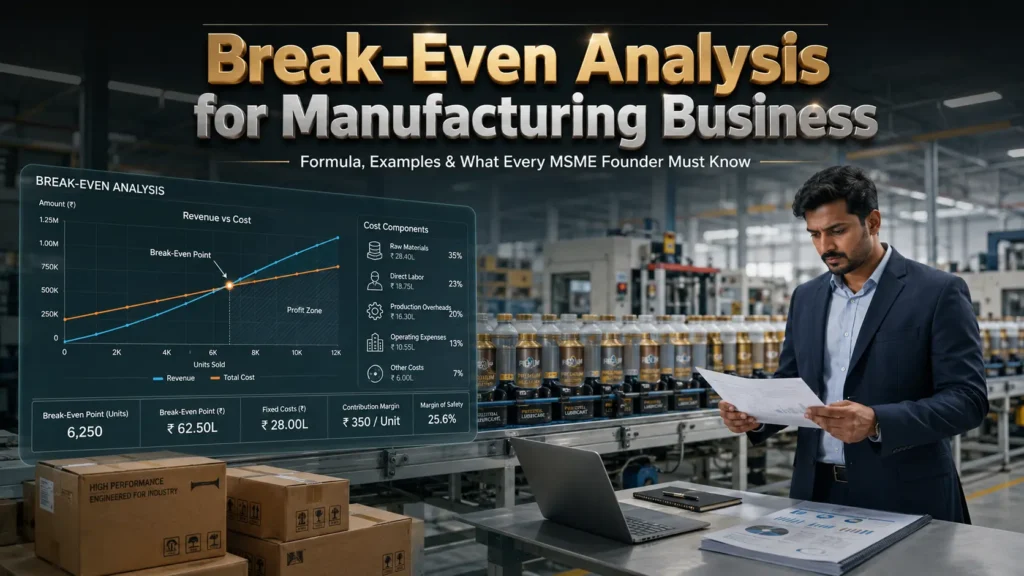
Break Even Analysis for Manufacturing Business The Number That Decides Everything — Before You Sell a Single Unit Only 72% of the first-generation manufacturing entrepreneurs in India have never worked out the break-even point before they go into production. This number is not only a number; it is a figure from a SIDBI MSME Pulse report. It is a confession. It is like driving on the Yamuna Expressway with your headlights off — fast, confident and headed for a crash. What is so deadly about this number when left unchecked; you can be operating at 80% capacity with a salary of ₹8 lakh per month and still be in the red. This is a common occurrence in industrial belts ranging from Morbi to Meerut every day. The machine is running. Workers are paid. Orders are flowing. However, the unit is running a leak! Break-even analysis will tell you precisely how many units you need to produce (or how much revenue you need to clock in) before your business starts to break even and begin to turn a profit. It is NOT a Finance Department Tool! It serves as a survival tool. It is a must-know for every MSME owner, entrepreneur with a startup investment of ₹20 lakh or ₹2 crore. In this article, you will get the formula, real-world examples in India, and the step-by-step process to compute your break-even – for any product or production scale! Why Most MSME Units Price Blind — and Pay for It According to the government, India has more than 63 million MSMEs, accounting for a whopping 30% of the country’s GDP and 45% of its exports. According to the Annual Report of the Ministry of MSME, there are more than 63 million MSMEs in India which contribute to almost 30% of GDP and 45% of exports in the country. Among these are about 14 million manufacturing units. However, there is an enduring problem in this sector – most of the owner’s price on the gut rather than on a cost basis system. The problem is structural. In clusters such as Ludhiana (hosiery), Rajkot (engineering goods), Firozabad (glassware) and Sivakasi (fireworks and matches), the pricing for first generation entrepreneurs is passed on from the older ones. They use their lower prices to compete and don’t know if those competitor prices are profitable at all. The outcome: narrow profit margins that always disappear when costs of input increase. Data from the Confederation of Indian Industry (CII) and the National Sample Survey Office (NSSO) reveals that more than 50 per cent of manufacturing units in India that close are not due to lack of demand but due to mismanagement of cash flows – a lot of which is directly related to under-pricing and unmanaged fixed-cost overhead. The three industrial towns of tier-2 and tier-3, namely, Hapur in Uttar Pradesh (rubber goods), Morbi in Gujarat (ceramics) and Batala in Punjab (agricultural equipment) are most vulnerable to this issue. In each of these clusters, new firms regularly enter without considering break-even analysis — for prices that just cover variable costs and exclude fixed costs. The immediate result: They ran straight into a wall at 6–18 months of service. Not because the market was against them. As the numbers were never calculated. Related Article: 100 Industrial Parks Worth ₹33,660 Cr: Top Business Ideas for MSME Founders Table 1: Break-Even Analysis Snapshot — Indian Manufacturing Sectors Industry / Product Fixed Costs/Month (₹) Variable Cost/Unit (₹) Selling Price/Unit (₹) Break-Even Units/Month Garment Unit (Tiruppur, TN) 3,20,000 180 320 2,286 Plastic Moulding (Rajkot, GJ) 4,80,000 42 95 906 Namkeen / Snack Food (Indore, MP) 2,10,000 28 55 7,778 Steel Fabrication (Ludhiana, PB) 6,50,000 220 440 2,955 Agarbatti / Incense (Bengaluru, KA) 1,20,000 12 28 7,500 Paper Cup Manufacturing (Pune, MH) 3,80,000 0.35 0.75 9,50,000 cups Source: Illustrative estimates based on MSME cluster data from SIDBI, CII, and industry association benchmarks. Actual figures vary by state and scale. The Formula — Simple, Powerful, Non-Negotiable There is one basic equation to break-even analysis. All other are modifications of it. Break-Even Point (Units) = Fixed Costs ÷ (Selling Price per Unit − Variable Cost per Unit) The Contribution Margin in this formula is the denominator or Selling Price per Unit minus Variable Cost per Unit. It indicates the amount of each unit sold that covers your fixed costs and ultimately, your profits. A revenue-based version is also available: Break-Even Point (Revenue) = Fixed Costs ÷ Contribution Margin Ratio As selling price increases, the contribution margin ratio has the same trend as the contribution margin.As the selling price goes up, the contribution margin ratio follows the same pattern as the contribution margin. Worked Example: Plastic Moulding Unit, Rajkot A first-generation businessman establishes a plastic injection moulding shop in Rajkot. The data from Gujarat Industrial Development Corporation (GIDC) suggests that the rent of a standard GIDC shed of 1500 sq ft in Metoda Industrial Estate is in the range of ₹35,000 to ₹45,000 per month. He has fixed monthly expenses of the following amounts: Factory shed rent (GIDC Metoda): ₹40,000 Loan EMI on machinery (₹18 lakh @ 10.5% over 5 years): ₹38,500 DGVCL (Electricity fixed charges): ₹22,000 Salaries — supervisor + admin: ₹55,000 Depreciation, insurance, misc: ₹24,500 Total Fixed Costs: ₹1,80,000 per month He incurs the following variable costs per kg of moulded output: raw material (HDPE) ₹92, direct labour ₹18, power per unit run ₹12 and packaging ₹8. He sells the product to a distributor at a price of ₹185 per kg. Contribution Margin = ₹185 − ₹130 = ₹55 per kg Break-Even = ₹1,80,000 ÷ ₹55 = 3,273 kg per month The monthly sales in this unit have to be 3,273 kg to be profitable. At 5,000 kg — a realistic 70% capacity run — it earns ₹94,985 in monthly profit. At 60% (4,300 kg), profit is ₹56,650. The numbers shouldn’t tell the originator what to shoot! Why Government Schemes Must Factor into Your Break-Even PMEGP (Prime Minister’s Employment Generation Programme) scheme provides capital
Hidden Charges in MSME Bank Loans That Are Eating Your Profit Without You Knowing

Hidden Charges in MSME Bank Loans The Loan You Got Is Not the Loan You Signed Up For As part of the process, thousands of MSME entrepreneurs in India each year look into business concepts, secure fundings and approach banks for borrowing, only to realize months later that the amount they had to pay for the loan was far more than the interest rate quoted. Sanction letters with embedded processing fees. Embedded processing fees in sanction letters. Buried in a 40-page agreement, clause 18 contained pre-payment penalties. No single conversation required for insurance premiums to be bundled. These are not simple errors. They are the inherent characteristics of business lending in India — and not many MSME founders can identify them. It’s not just a financial disaster. It is informational. When a small manufacturing or trading business is run by a first-generation entrepreneur, it is highly unlikely that he/she will have a CFO to read the loan papers line by line. They are going to trust the relationship manager. What the relationship manager will likely not mention is the true cost of a loan — post all the fine print. The Reserve Bank of India (RBI) mandates banks to show the Annual Percentage Rate (APR) of loans (which includes all charges). But there is limited adherence to this disclosure standard, and even the majority of borrowers are not educated on how to read and understand APR data. It leads to a systematic mismatch between what MSMEs believe they’re paying, and what they actually are. Why MSME Borrowing Is a High-Stakes Game MSME is the backbone of India’s economy. The Ministry of Micro, Small and Medium Enterprises estimates that it contributes almost 30% of the GDP and employs more than 11 crore people. The demand for credit in the sector is enormous – and expanding. However, the average MSME borrower is still not well educated financially, and is especially sensitive to the types of loans that yield the highest profits for the lender. Consider the math. A manufacturing MSME takes loan of ₹50 lakh at a nominal interest rate of 11% per annum. The interest that has to be paid annually is ₹5.5 lakh on paper. However, once you factor in the processing fee (1.5%), the bundled insurance (1.2% per annum), documentation charges (₹15,000) and penal interest incurred during a cash crunch of two months, the annual cost is easily more than 16% to 18%. That’s a huge amount. And it eats into the razor-thin profit margins most MSMEs have. Thus, it’s not a financial literacy exercise to just understand these hidden charges. It’s a must learn skill for every MSME founder in the competitive environments of today. Related Article: DPR for Bank Loan: Format, Example & Step-by-Step Guide for MSME Loan Approval What the Regulatory Framework Says — And Where It Falls Short The RBI’s Fair Practices Code for Lenders says that banks and NBFCs must clearly and simply write down all charges related to their loan in the first place. Further, the MSME Samadhaan platform enables MSMEs to lodge any complaints related to payment. But disclosures of pre-disbursement charges are not enforced very well. There has been some progress made by the government. Pradhan Mantri Mudra Yojana (PMMY) is an initiative by the government to provide collateral-free loans. There are three schemes namely Shishu, Kishore, and Tarun with comparatively transparent fee structures. The Credit Guarantee Fund Trust for Micro and Small Enterprises (CGTMSE) scheme minimizes the requirement for collateral and to a certain degree, insurance bundling. But, none of these schemes has gone to the extent of resolving the issue of undisclosed charges in conventional term loans and working capital facilities provided by the commercial banks. It is also worth noting that the DPIIT has created a Startup India portal with grievance redressal and financial advisory tools for the benefit of the startup entrepreneurs to help them better understand lender disclosures. Furthermore, the Federation of Indian Chambers of Commerce and Industry (FICCI) has been highlighting hidden lending charges as a structural impediment in expanding the MSME growth in India. The Major Hidden Charges That Are Costing MSMEs Dearly 1. Processing Fee: The First Hidden Blow Most founders know of the processing fee, but very few realize just how big it can be. This fee will be deducted from the sanctioned loan amount and is generally 0.5% to 2% of the sanctioned amount. If you apply for a loan of ₹50 lakh, and the processing fee is 1.5%, you’ll receive ₹49.25 lakh, but you’ll be charged interest on the entire amount of ₹50 lakh. It’s a structural feature that results in your effective interest rate starting higher than what it purports to be on the first day. 3. Prepayment and Foreclosure Penalties: The Exit Tax This is where most of the MSMEs really get taken aback. During a boom time, once the business gets better and cash flows are available, the natural inclination is to settle the loan before the time, which helps in reducing interest payments. But a lot of bank loans are subject to prepayment penalties of anything from 2 per cent to 4 per cent of the outstanding principal. A few lenders may have a lock-in requirement of 12 to 24 months, meaning you can’t make a single payment at all. This is effectively locking a borrower in to a high-cost loan when they are able to pay it off. This means that the actual price of borrowing is more expensive than any apparent interest rate comparison might indicate. Your investment deserves the right opportunity 3. Bundled Loan Insurance: The Silent Premium This is probably the most obscure of all the hidden fees. Credit life insurance or loan protection insurance is offered by many banks, especially public sector banks, as a part of the loan disbursement process. This is the premium which is levied on the loan at the rate of 0.5% to 1.5% per annum either as a lump sum or as an additional payment
Drone Manufacturing in India: Startup Opportunity & Defence Linkage

Drone Manufacturing Business in India The Number That Should Make Every MSME Founder Stop Scrolling India relies on almost 100% of its components for drones, such as circuit boards, sensors, motors, and gimbals, from China. This is in a market that is already worth around ₹13,200 crore and growing at a CAGR of more than 20%. As per the ministry of Defence, the defence establishment has been placing procurement orders with startups and MSMEs under iDEX programme worth of ₹2,326 crore. And the government has now made it a point to ban the import of fully-fledged drones, with every drone sold in the country now being assembled in the country. That’s an expenditure agenda worth ₹2,326 crore for procurement of Indian products which are yet to be produced in large numbers. Reflect on that for a while. The demand is guaranteed. The Buyer, in this case the Indian Armed Forces, is the most credit worthy buyer in the Country. But what is lacking is manufacturing capacity on the ground. It is that space that is the opportunity. This is no prediction of the future. Ten months ago, in May, Operation Sindoor was a live battle field exercise that proved the need of indigenous drones for India’s national security. The government’s response was prompt – the spending on drones will be tripled in the next 12-14 months, says Drone Federation of India, which has more than 550 member companies. One of the most real opportunities that are available right now to the first-generation entrepreneurs and MSME founders who have even basic precision assembly capacity. Related Article: Camera Drone Manufacturing: A Comprehensive Business Guide for Entrepreneurs and Industry Leaders The Gap: 80% Imported, Zero Room for Complacency As of early this year, the Directorate General of Civil Aviation (DGCA) has registered 29,501 drones in India. Delhi accounted for 4,882 units, Tamil Nadu 3,689 units, Maharashtra 2,516, Haryana 1,928 and Karnataka 1,928. Delhi led with 4,882 units followed by Tamil Nadu with 3,689, Maharashtra with 2,516, Haryana with 1,928 and Karnataka with 1,928. These are the states where the demand for drone is highest and no coincidence that these states are home to the industrial and defence clusters. The problem is structural. While the government has banned import of fully-knitted drones from (effective from February 2022, per the Directorate General of Foreign Trade), India still has a small registered drone fleet and a projected increase in this number, which is not sufficient to support the country’s domestic production of enough drone components. Propulsion systems, flight controllers, LiDAR sensors and high-resolution cameras continue to be received from Chinese and Taiwanese sources as separate components. The import duty on parts of drones is in between 28% to 35% on HS Code 8806 (Central Board of Indirect Taxes and Customs). It drives up the costs for all Indian assemblers. The dependence is critical for defence purposes. Surveillance drones are required for India’s land border of 15,106 kms and its coastline of 7,516 kms. Currently, the Indian army has drones from Israeli, American and domestic manufacturers, but with the political and strategic momentum going in favor of the post Operation Sindoor efforts, the army would like to have a large number of indigenous supplies. It’s at the component level where the MSME opportunity exists. Precision motor coils, polycarbonate frames, ESCs (electronic speed controllers) and payload enclosures are the components that can be produced in a 2,000/5,000 sq ft plant with an investment of ₹30/60 lakh in machines and equipment that makes news in the finished-drone market. TABLE 1: State-wise Drone Demand, Registered Units & Key Industrial Clusters State Registered Drones Key Demand Sector Industrial Cluster Delhi / NCR 4,882 Surveillance, Logistics Manesar, Noida Electronics Tamil Nadu ~3,200 Agri, Defence, Inspection Chennai Aerospace Corridor Maharashtra ~3,100 Industrial, Film, Agri Pune, Nashik Defence Hub Haryana 3,689 Agri, Border Security Gurugram Tech & MSME Zone Karnataka 2,516 IT-Drone Integration, R&D Bengaluru Aerospace SEZ Telangana 1,928 Agri, Pharma Delivery Hyderabad Drone Corridor Gujarat 1,338 Port, Energy, Industrial Surat, Ahmedabad Mfg Belt Uttar Pradesh ~1,200 Agri, Border Use Lucknow, Kanpur Defence MSME Source: DGCA Digital Sky Platform; Drone Federation of India (dronefederation.in) The Opportunity: Policy Wind, Defence Demand, and ₹2,000 Crore Waiting Indian manufacturers have found a fine but potent entry window at the confluence of three factors. The initial PLI scheme for drones and drone components had an outlay of ₹120 crore for a period of 2025-28 as per the Ministry of Civil Aviation, Press Information Bureau, and has been extended with a 20% incentive on value addition and minimum value addition of 40%. The minimum turnover threshold for MSMEs is as low as ₹20 lakh per annum. It’s really accessible. Second, under the iDEX (Innovations for Defence Excellence) programme, grants are offered under the SPARK programme (and under the ADITI programme for deep-tech) for prototypes up to ₹1.5 crore. More than 400 procurement contracts have been inked with startups & MSMEs. The Defence Ministry has sanctioned orders worth ₹2,400 crore this year with iDEX firms, which is actual tendered value, and not estimates. Third, the rate of GST on drones has been reduced to 5% (from 18–28%). This lowers the tax burden for consumers and makes domestic drones cost competitive with smuggled or grey market drones. DGCA has also enabled BVLOS (Beyond Visual Line of Sight) corridors in Telangana, Ladakh and Andhra Pradesh and has enabled delivery and survey work cases using a commercial drone. In the case of the MSME entrepreneur, it is easy to see that the available entry points are the agricultural spraying drone, the defence-grade surveillance frames, the drone component sub-assemblies (which are available from larger OEMs) and the drone servicing and repair networks. All these need to be different levels of capital and skill. The most cost-effective approach is to build a small-batch drone assembly and component manufacturing facility as outlined in the sections below. Get Detailed Insights from This Book: Handbook on Electric Vehicles Manufacturing TABLE 3: Applicable Government Schemes, Eligibility & Benefit
Organic Food Processing Business: Setup Cost, Certification & Investment Guide for Indian Entrepreneurs
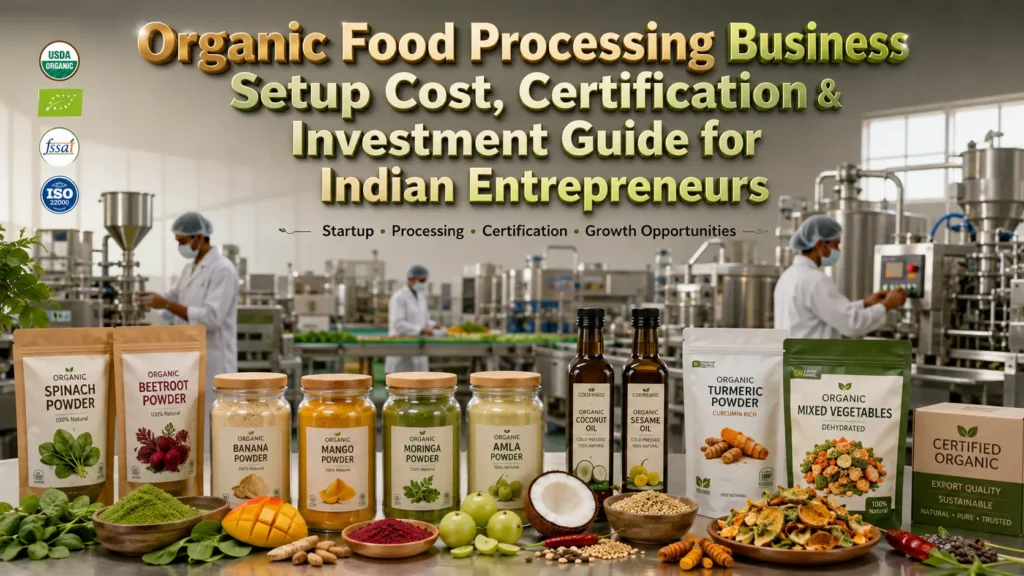
Organic Food Processing Business in India The Counter-Intuitive Truth About Organic Food in India India is exporting more than ₹5,300 crore of certified organic products annually, while it imports the processing technology to process them. Let that sink in. The nation that has over 30% of the organic produce grown in the world, the majority of which is cardamom, grown in the cardamom hills of Kerala, to the spices of the Rajasthan spice belts, are sold mostly as raw commodity. That is the profit realization, that is the packaging, that is the branded product – that goes overseas. A company from Germany imports organic turmeric powder from India and places it in a glass jar bearing a serif logo and sells it for €14. The Indian farmer received ₹42 for every kilo he sold. It is in this space between raw organic produce and finished certified organic produce that the true business is going to be. The Agriculture and Processed Food Products Export Development Authority (APEDA) has reported that demand for certified organic food has increased at the rate of 12–15% every year for the last five years in India. In the three cities, the average urban household in Bengaluru, Pune, and Delhi-NCR spends 22% more per grocery basket when shopping for organic than conventional products, on average, 5 years ago. It is not sufficiently available in the region where it is made, there is no traceability, and it is not properly certified. Get Detailed Project Report (DPR): Food Processing and Agriculture Based Projects The Supply Gap Nobody Is Filling Fast Enough India has the maximum area (36.53 lakh hectares) of certified organic farming in the world, according to the National Centre of Organic and Natural Farming (NCONAF). Less than 12% of the small and medium organic processors have been certified in India as per the minimum requirement of NPOP (National Programme for Organic Production) to be able to label a product as ‘certified organic’ for domestic retail and export market. The outcome: a deficiency in structural processing. Raw sales dominate to large aggregators, most of these who are also organic farmers sell at prices slightly higher than conventional producers. At the processed and value-added segment, less than 200 brands have a national presence with the bulk of them concentrated in Maharashtra, Gujarat and Karnataka. States such as Uttarakhand, Himachal Pradesh, Odisha and Chhattisgarh which have more than 8 lakh hectares of organic farms have virtually no processing infrastructure. The Indian Council of Food and Agriculture (ICFA) believes the India domestic organic food market has total value of around ₹9,000 crore and is estimated to reach ₹30,000 crore within a decade. Retail outlets such as the DMart, BigBasket and Nature’s Basket have admitted that there is less space for certified organic essentials priced between ₹100 and ₹500. The supply situation is even more constrained for smaller categories of organic food, such as immunity boosters, millets and cold-pressed oils. Demand from exports is just as poor. More than 85% of the certified organic exports from India are consumed by the EU, USA and the Gulf markets. Processing units that are able to ensure traceability, hygiene and NPOP or NOP (USDA Organic) certification can charge 25-40% price premium on uncertified Indian exports. TABLE 1: State-Wise Organic Demand, Key Crops & Industrial Clusters State Key Organic Crop / Product Industrial Cluster / Hub Estimated Demand Growth (Annual) Export Potential Sikkim Organic vegetables, ginger, cardamom Gangtok Agro-Processing Zone 18% High (EU, USA) Madhya Pradesh Soybean, wheat, pulses Indore, Jabalpur 14% Medium-High Rajasthan Cumin, coriander, fennel Jodhpur, Kota Spice Cluster 16% High (Middle East, EU) Uttarakhand Basmati rice, herbal extracts Rudrapur, Haridwar Food Park 12% High (USA, Japan) Maharashtra Soybeans, millets, sugarcane jaggery Pune, Nashik Agri-Zone 11% Medium Kerala Coconut oil, spices, black pepper Kochi Spice Park, Thrissur 15% Very High (Gulf, UK) Source: APEDA Organic Export Data; NCOF Annual Report; State Agriculture Department estimates Why Entry Right Now Makes Commercial Sense Organic food processing is an appealing proposition right now in three ways. First: Policy tailwinds are there and backed by cash. Organic clusters are eligible for up to ₹50,000 per hectare under the Government of India’s Parampara at Krishi Vikas Yojana (PKVY) for support in the certification process and farmer group formation. This directly lowers sourcing cost of raw material. The processors who coordinate with PKVY clusters are provided with a cost and supply benefit at the same time. Second: The demand for exports is growing faster than the supply. As per the export data from APEDA, the value of organic exports increased from ₹1,900 crore to more than ₹5,300 crore during the last decade. They are mostly made of turmeric, ginger, pulses and rice. But only part of these flows as a complete branded product. This market can be reached directly by a processing unit certified to the NPOP standards. Thirdly, the processing sector of the MSME is undercapitalized — on purpose. There has been no meaningful presence by big FMCG players in the organic sub ₹300 SKU segment. It is structurally inefficient because of their small production volumes and high marketing expenses. The price band of ₹80-250/unit is left open for agile MSME processors in this regard as it is the optimum sweet spot of the metro consumers. The Ministry of Food Processing Industries (MoFPI) has earmarked more than ₹10,000 crores for the food processing industry under the Production Linked Incentive (PLI) Scheme. Organic processors whose sales is more than ₹1 crore per year will get a 4-10% incentive on incremental sales, thus reducing the payback period by 8-12 months. The MUDRA Kishore and Tarun loan categories offer a loan of up to ₹10 lakh, which is enough for a micro-processing unit, but it does not require any collateral. The Prime Minister’s Employment Generation Programme (PMEGP) is a scheme offered by KVIC, which provides 15–35% capital subsidy based on the geographic location of the project and the type of the founder (women, SC/ST entrepreneurs receive higher subsidy). Get Detailed Insights
From Slum to Supply Chain: How a Mumbai Street Vendor Built a ₹25 Crore Cold Chain Logistics Business
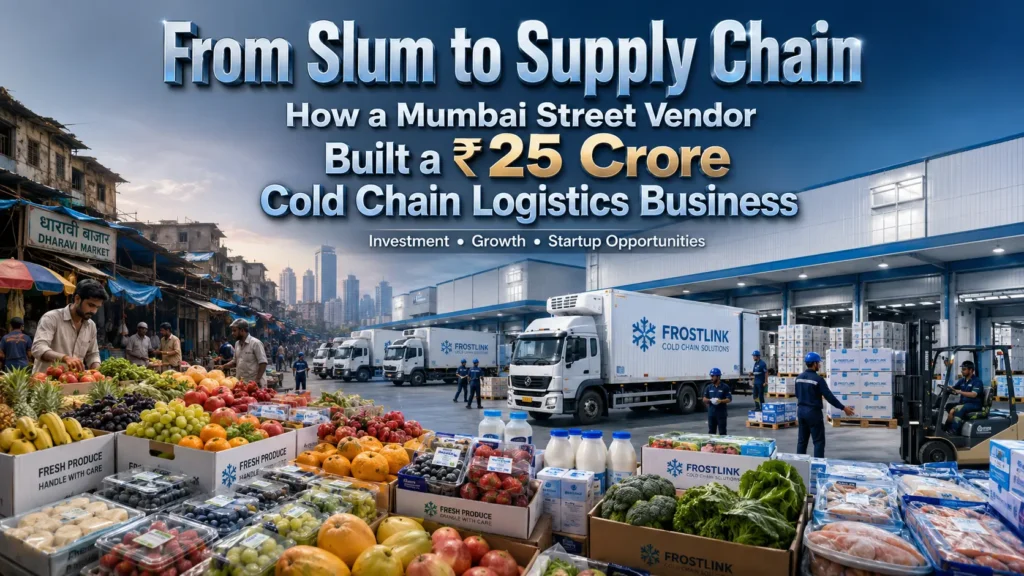
Cold Chain Logistics Business in India The Gap That Makes Millionaires Almost one third of the fruits and vegetables that are grown in India don’t reach the consumers. They decompose from the farm and up to the city market. Not due to its poor farming. This is not due to poor roads. The cold chain in India is where it lacks — at the last mile. The National Horticulture Board (NHB) reports that the installed capacity of cold storages in India is about 37 million metric tonnes. Which is large until you realise that more than 70% of that is in five states: Uttar Pradesh, West Bengal, Punjab, Gujarat and Maharashtra, and virtually no portion is temperature-controlled transport. Cold rooms are present. The refrigerated trucks have been removed. One man from Dharavi discovered his fortune in that space between warehousing and wheels. Ramesh Gaikwad started selling vegetables from a pushcart in Dadar in the late 1990s. He saw something that no logistics consultant had ever thought to write down: there were warm produce and no one owned a last-mile refrigerated van for small packs, in the hotel kitchens in South Mumbai. He took a loan of ₹3 lakh from the chit fund and started hiring a small cold van, making a firm commitment to one hotel for the same-day delivery of chilled produce. After 12 years, Ramesh’s company owns 22 cars with refrigeration and has two cold storage units in Navi Mumbai and Bhiwandi with an annual turnover of ₹25 crore. The business doesn’t spend money on advertising. All of the clients were referred. His is not a unique case. Repeatable — if you just know where to find it and how to make it. Access Complete Business Plan: Cold Chain, Temperature Controlled Supply Chain Projects India’s Cold Chain: Numbers That Should Embarrass Us The Ministry of Agriculture & Farmers Welfare estimates that India produces more than 320 million tonnes of horticulture produce every year, which is the second largest in the world. The estimated losses in the post-harvest sector from 10 years of losses by the National Centre for Cold-chain Development (NCCD) are approximately worth ₹92,651 crore annually. The nodal body on cold chain policy the NCCD estimates the demand of India at 61,000 reefer vehicles when less than 12,000 are available. This is a 80% deficit. The difference isn’t large in large cities. It’s in tier-2 towns, mandis and farm clusters in the states like Bihar, Madhya Pradesh, Assam, Odisha and Chhattisgarh. The pharmaceuticals add to the issue. According to the Pharmaceuticals Export Promotion Council of India (Pharmexcil), India exports more than USD 25 billion worth of pharma products every year. This is increasing proportionately for vaccines, biologics and temperature-sensitive APIs, which must be handled under 2°C to 8°C conditions from the factory to the airport. But only about 15% of Indian airports have dedicated pharma cold zones leaving exporters to last mile, which is fragmented. This was highlighted during the rollout of the COVID-19 vaccine where the government had to make do with blood banks, ice cream freezers, and improvised refrigeration at district health centres. The lesson has since led to serious investment by the government and private demand. It is two sectors which are seeing the greatest need across the country: processed food (11% growth per year) and pharma cold chain (14% growth per year). The last mile delivery is problematic in both the sectors. TABLE 1: State-Wise Cold Chain Demand, Infrastructure Gaps & Key Opportunity Clusters State Hort. Produce (MT/yr) Cold Storage Gap (%) Reefer Van Deficit Key Opportunity Clusters Uttar Pradesh 55 Million 28% ~9,000 vans Agra, Lucknow, Varanasi — potato, mango, milk Bihar 18 Million 67% ~4,200 vans Muzaffarpur, Patna — litchi, vegetables, pharma Maharashtra 22 Million 31% ~5,800 vans Nashik, Pune, Mumbai — grapes, onion, hospitality Madhya Pradesh 14 Million 54% ~3,600 vans Indore, Jabalpur — soybean, tomato, pulses West Bengal 19 Million 22% ~2,900 vans Kolkata, Siliguri — fish, vegetables, flower exports Assam 8 Million 72% ~2,100 vans Guwahati, Dibrugarh — tea, vegetables, fish Rajasthan 9 Million 48% ~2,400 vans Jaipur, Jodhpur — dairy, vegetables, tourism supply Get Detailed Insights from This Book: Handbook on Fruits, Vegetables & Food Processing with Canning & Preservation Why This Decade Belongs to Cold Chain Operators The cold chain business is one of the most poised logistics segments in India at present, thanks to three factors. The first one is the retail transformation. The app of quick commerce like Blinkit, Zepto, Swiggy Instamart have made it a consumer expectation to order food products in just 10 minutes. There is a need for a fresh produce delivery twice a day to every dark store in Tier-1 or Tier-2 cities from cold chain supplier. These platforms do not have the “last mile” themselves. They contract it out. The contracts are guaranteed to volume and multi-year. Second, regulation tightening by the pharma industry. Strengthening of Schedule M requirements for storage and transport of pharmaceuticals by CDSCO (Central Drugs Standard Control Organisation). The UK healthcare sector has been impacted by the transition to non-controlled environments; those that have already done so will now have to meet the requirements of becoming a controlled environment or risk suspension of their licence. This means that there is legal demand for certified cold chain operators, not merely discretionary demand. Third, government push. Under PM Kisan Sampada Yojana, the Indian government has pledged to establish an integrated cold chain network, budgeting a total of ₹2,000 crore for cold chain development initiatives nationwide. NABARD provides financing for the construction of cold storage through its development programme Rural Infrastructure Development Fund (RIDF) at subsidised interest rates. Under the Integrated Cold Chain and Value Addition Infrastructure scheme, 35% is the capital subsidy that is available from the Ministry of Food Processing Industries (MoFPI) — with the scheme, if you invest ₹1 crore, the government will write you a cheque of ₹35 lakh. NABARD Cold Chain Subsidy Scheme: Provides subsidy of up to 35% of the capital
5 Green Chemical Business Ideas in Odisha That Can Generate ₹2 Cr+/Year
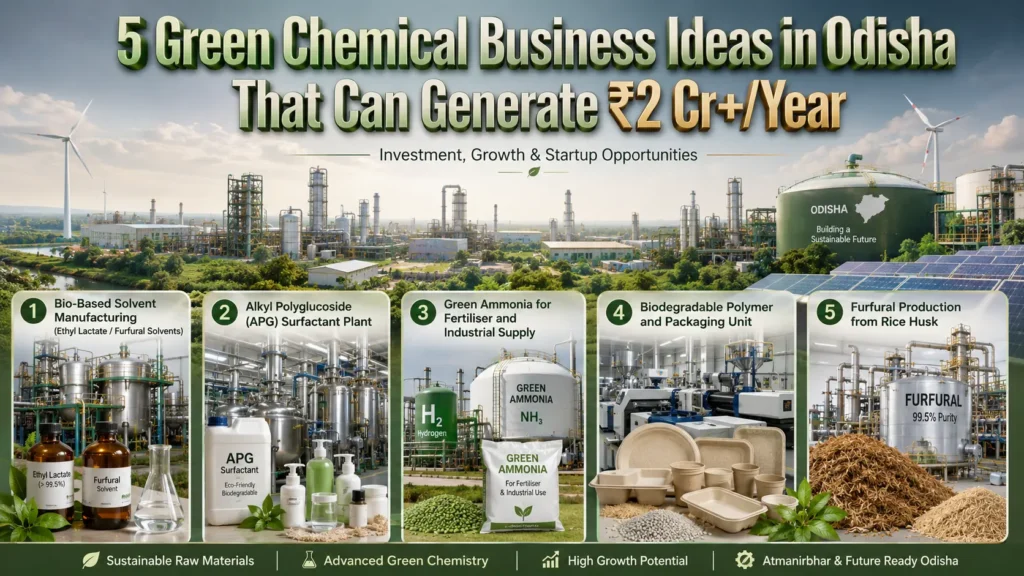
Green Chemical Business in Odisha The Green Chemistry Opportunity India Cannot Afford to Miss The size of India’s green chemicals market is now over USD 15 billion and it’s expanding by more than 10% annually. However, most chemical business owners are still trying to find a business concept that involves the same sort of products that were created 30 years ago. That is a big error! Green chemistry—biodegradable, bio-based and low-carbon specialty chemicals—is the next 10 years of Indian specialty chemicals, consumer demand and preference, and regulatory requirements of global buyers. The advantage that Odisha, which is located on a world class port, huge agricultural biomass and has a government supported petrochemical anchor at Paradip, is unparalleled in the eastern part of the country. There is no question about the growth of the green chemicals market. But who will construct it first? Why Green Chemicals — and Why Odisha? Sustainability is a hard trend. It is difficult to do this as a hard rule. Bio content for cleaning and personal care products is required for all products sold in 27 EU countries under European Union’s Green Deal requirements. Methanol and ammonia are being replaced with green alternatives by shipping lines. Exporters of pharmaceuticals to the US FDA and EMA are increasingly being encouraged to use bio-based solvents as a result of the laws and regulations concerning solvent usage in India. As the laws and regulations pertaining to solvent usage in India are moving more towards bio-based solvents, the pharmaceutical exporters are increasingly encouraged to use it for export to US FDA and EMA. All Indian manufacturers have to go green otherwise they have to lose the business in these markets. Among the three, Odisha has three attributes, which make it uniquely suited for green chemical manufacturing. The first plant, Indian Oil Paradip Petrochemical Complex, will manufacture all the key intermediates used in green formulation chemistry (IPA, phenol, MEG) with an investment of ₹61,077 crore. Second, the rice husk and agricultural biomass produced in Odisha is in millions of tonnes each year, which is the raw material for making bio-based chemicals. Third, Paradip Port has been officially named one of the three Green Hydrogen Hubs under the National Green Hydrogen Mission, which provides a policy and infrastructure benefit that no landlocked port can offer. Source: Invest India – Chemicals Sector Get Detailed Insights from This Book: The Complete Book on Biomass Based Products (Biochemicals, Biofuels, Activated Carbon) Government Policies Supporting Green Chemical Manufacturing The Union Budget has specifically provided money for the Ministry of Chemicals and Fertilizers. It has also launched three chemical parks based on clusters on a plug-and-play basis, which were developed specifically to boost specialty and green chemical manufacturing. Furthermore, the PCPIR policy in Paradip provides shared effluent, power and jetty facilities, and this significantly decreases the project setup costs. The National Green Hydrogen Mission (NGHM) offers financial incentives and financial grants to the manufacturers of green ammonia and green methanol. The SIGHT Scheme provides government offtake guarantees which lowers the risk of the revenue stream for the green chemical projects of the first movers. Another positive lever is the Production Linked Incentive (PLI) scheme for specialty chemicals. Moreover, the MSME and Large Industry policy of Odisha also offers capital subsidy of 15–25%, duty waiver on electricity for 5 years and exemption from stamp duty for qualified manufacturing unit. Source: DPIIT – PCPIR Policy Framework Source: MNRE – National Green Hydrogen Mission Green Chemical Business Ideas for Startups in Odisha Business Idea 1: Bio-Based Solvent Manufacturing (Ethyl Lactate / Furfural Solvents) VOC regulations, and buyer demand, are driving the replacement of toluene, xylene, and methyl ethyl ketone in pharmaceuticals, coatings, electronics cleaning and more with bio-based solvents. The one green solvent in this category that is most versatile is ethyl lactate which is made from lactic acid and ethanol. A small-scale ethyl lactate manufacturing plant in Odisha, using locally available broken rice to produce lactic acid and then esterifying it with bio-ethanol, could generate income of ₹80-250 per kg of ethyl lactate, whereas petro-chemical based ethyl lactate can generate income of only ₹25-35 per kg. The Paradip Pharma cluster is an indigenous buyer. The export potential for such solvents to Europe—the region where these solvents are required for pharmaceutical production — is significant. The investment required for setup is in the range of ₹15 crore to ₹50 crore, depending on the scale. Related Article: Bio-Based Chemical Business Idea: Furfural Plant Cost, Profit and Market Demand in India Business Idea 2: Alkyl Polyglucoside (APG) Surfactant Plant APG surfactants are bio-based; they are made from glucose and fatty alcohols. They’re the highest quality in personal care products – baby shampoos, personal luxury products hand washes, and sulphite-free products. They are 100% biodegradable and can be used under EU Ecolabel. There are no major APG production units in the East India. A manufacturer setting up an APG unit at or close to the port of Paradip has direct access to fatty alcohol through coastal shipping from Tamil Nadu, Andhra Pradesh and to glucose from the starch industry in Odisha. APG is priced 40-80% higher than “traditional” surfactants, and European personal care companies continue to demand it steadily making this one of the highest margin green chemical business opportunities in the country today. Capital requirement: ₹30–100 crore. Business Idea 3: Green Ammonia for Fertiliser and Industrial Supply ACME Group has already pledged a green methanol plant of capacity 200,000 TPA in Odisha. SECI will also provide ACME with 370,000 MT per year green ammonia supply under an 10-year offtake agreement to Indian fertiliser companies through its SIGHT Scheme. This indicates that the infrastructure for green ammonia offtake in Odisha is already in place. For the entrepreneur who is looking to enter this area at a smaller level of 20,000 to 100,000 TPA, the opportunities include the industrial refrigeration market, ammonium nitrate for mining chemicals, specialty nitrogen applications for agriculture, etc. By designating the port as a green hydrogen hub, it ensures