
Dairy Processing Business in India
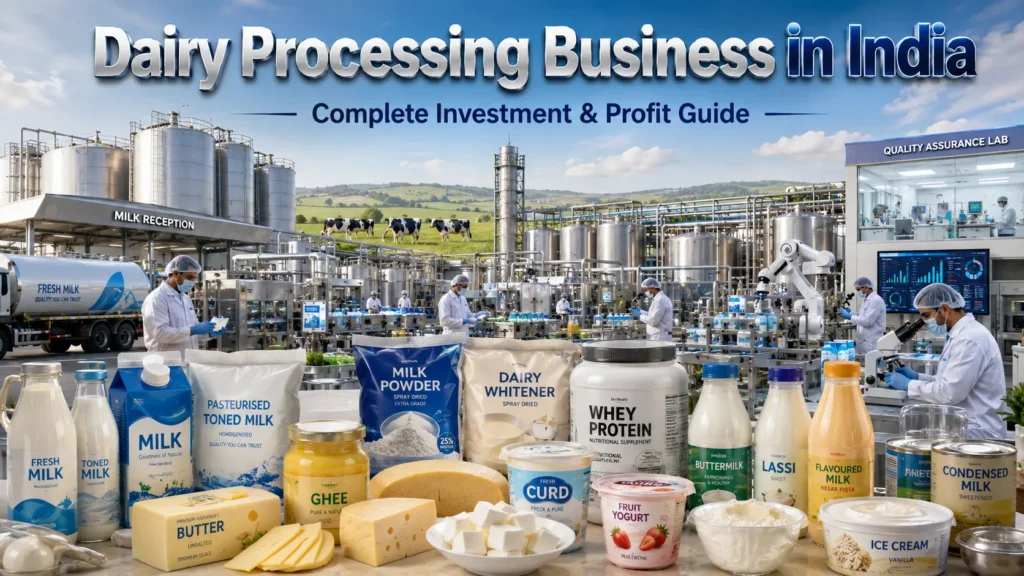
The dairy sector is one of the most structurally sound sectors to invest entrepreneurial capital in India and the ideas for a dairy processing business at the investment level of Rs.10 Crore are some of the most interesting ones in the agricultural value chain. Despite being the biggest milk producer in the world as mentioned by the National Dairy Development Board (NDDB) the value addition chain from the farm gate to the end consumer is far from developed. The ideal location in this supply chain is a Rs.10 Crore raw milk processing plant, which maximizes the share of the consumer price, while simultaneously adding value to the raw milk producers. The Ministry of Animal Husbandry, Dairying and Fisheries (DAHD) has various subsidy and loan schemes in place for this investment category.
Why Dairy Processing Is India’s Most Stable Agricultural Business
Population growth, increasing income levels, and penetration of packaged dairy products in the urban markets are the major drivers of demand of dairy in India. The NDDB releases production and consumption statistics every year, which reveal that the organised dairy sector has been expanding at a much higher rate than production of raw milk, suggesting that value addition is the area that might offer the economy an additional economic opportunity. The rising middle-class in the city has resulted in a huge boom in paneer, yoghurt and cheese consumption. High margin product categories are created due to the premium ghee, especially the A2 ghee. All of these trend changes are driving demand for dairy process capacity which organised private entrepreneurs can cater to along with the cooperative giants like Amul and Mother Dairy.
Read the Complete Book Here: Market Research Report on Milk Processing & Dairy Products in India
Government Schemes for Dairy Processing Entrepreneurs
Dairy Processing and Infrastructure Development Fund (DIDF) is a fund under the Ministry of Animal Husbandry, Dairying and Fisheries for provision of concessional loans at 6.5% per annum for the setting up of dairy processing infra. Private dairy entrepreneurs are eligible to avail capital subsidy up to 25% from NABARD under Dairy Entrepreneurship Development Scheme (DEDS). The Animal Husbandry Infrastructure Development Fund (AHIDF) provides a Rs.15,000 Crore loan at subsidised rates to dairy processors and cold chain investors. Units qualified as international Halal and cold chain standards are facilitated by APEDA for making dairy exports. To apply for FSSAI license for giving Dairy product for export markets, please refer to the FSSAI’s central licensing portal.
Top Business Ideas in Dairy Processing at Rs.10 Crore Scale
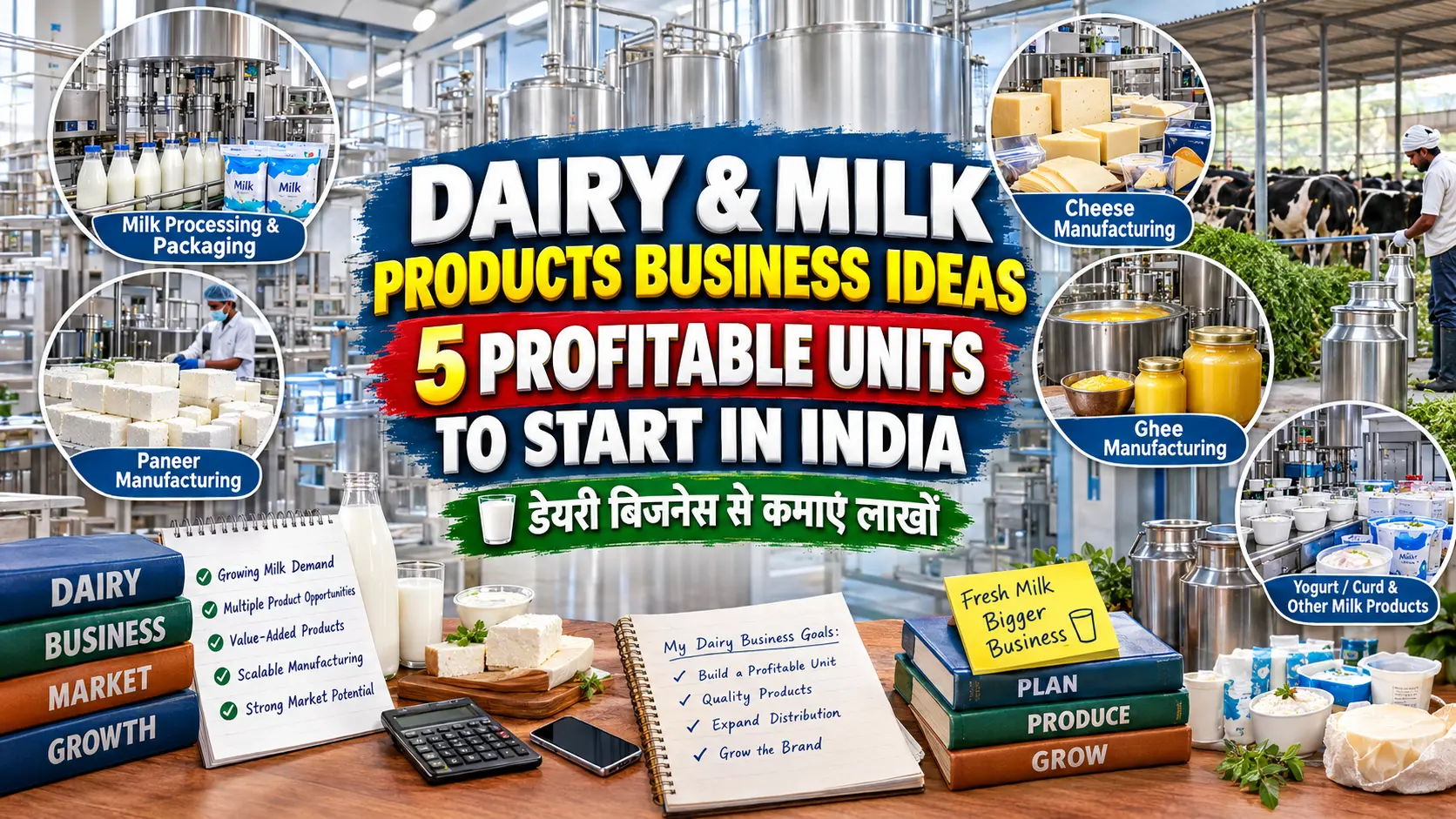
Paneer and Fresh Dairy Products for Organised Retail
The fresh paneer has become one of the most popular consumables in India because of the number of vegetarians in urban households and the boom in Indian cuisine in restaurants. A modern paneer manufacturing unit at Rs.10 Crore with capacity of 20,000 to 40,000 litres of milk per day can provide the FMCG retailers such as D-Mart, Reliance Fresh, Spencer’s Retail etc. Defensible Differentiation is achieved by building a recognized regional brand, highlighting QR code traceability and natural ingredients. Exporters have to meet the standards laid down by the FSSAI for the labelling and quality of paneer.
Ghee Manufacturing for Domestic Premium and Export Markets
Premium ghee, which is made from desi cow breeds A2 variety, bilona-churned ghee and organic certified ghee, has increased by a huge fold with urban consumers willing to pay a steep premium for genuine production. Indian brand ghee is in good demand in the Gulf Indian diaspora market. A2 ghee fetches a premium in retail channels of Rs.1500 to Rs.3000 per kg. The main requirements for the ghee export to Gulf are its halal certification and APEDA registration. The technical assistance is offered to the small dairy processors to upgrade their quality management and processing system by the NDDB.
Flavoured Milk and Probiotic Dairy Beverage Manufacturing
Flavoured milk and probiotic dairy beverages are expanding at a rate of 20-25% per year. The volume of mango lassi, chocolate milk and probiotic yoghurt drinks that are sold in Tetra Pak or PET bottles is on the rise in today’s modern retail and vending outlets. Packaged dairy beverages are big volume purchases for institutional outlets such as schools and hospitals. In addition to the subsidies for the dairy manufacturers, the DAHD’s dairy development schemes also cover dairy beverage manufacturers who meet the criteria of the AHIDF.
Get Detailed Project Report (DPR): Comprehensive Guide to Milk & Dairy Products
Import-Export Opportunity Analysis
Ghee, paneer and milk powder are exported to the markets of the Gulf countries, South East Asia, and the global diaspora. Indian Dairy market is well established in the Gulf. APEDA supports export of dairy products. For exports to the Gulf, it must be certified as Halal. Full compliance audit and listing of estates based on the EU standard for dairy products is required for export — handled via FSSAI’s export establishment certification programme.
Indian MSME Success Stories in Dairy Processing
Parag Milk Foods: Building a National Dairy Brand from Manchar
The Bhosale family owner, at Manchar, Maharashtra, established one of the most innovative private dairy companies in India with the Pride of Cows premium milk brand and India’s first mozzarella cheese plant. The company’s commitment to product innovation, for instance, in the cheese category, where there was no Indian brand, meant that it had the opportunity to penetrate an emerging market before the category became competitive.
Hatsun Agro Products: South India’s Dairy Champion
South India’s biggest private sector dairy company was developed by RG Chandramogan of Hatsun Agro Products in TamilNadu. They have two ice cream brands, Arun, and two dairy brands, Hatsun, which have high recognition value among consumers thanks to the decades of investments made in both product quality and distribution. Hatsun proves that to be successful in dairy processing, one needs to invest heavily in milk procurement from the upstream and delivery capability from the downstream.
How NPCS Can Help You Get Started
At Niir Project Consultancy Services (NPCS), the Market Survey cum Detailed Techno-Economic Feasibility Reports (DPRs) for new industries or businesses are prepared professionally. Our reports have detailed manufacturing processes, market research and demand analysis, process flow diagrams, product mix and capacity planning, details of machinery and raw material etc., complete project financials with profitability analysis etc. For detailed project reports on dairy processing plants visit us at www.niir.org.
Find high-return business ideas based on your budget & ROI
Conclusion
The investment in such a dairy processing plant with Rs.10 Crore investment in a milk surplus production cluster is a structural demand tailwind investment with government financing support from DAHD and NABARD and multiple product pathways. The NDDB is a technical and a market development support for a newly emerged dairy processor and this is one of the most supported agro-processing sectors for first generation farmers.
Rs.10 Crore Agriculture — Key Parameters
| Parameter | Details |
| Total Investment Range | Rs.9 Crore to Rs.13 Crore |
| Milk Processing Capacity | 20,000 to 50,000 litres per day |
| Key Government Scheme | DIDF Concessional Loans + NABARD DEDS Capital Subsidy 25% |
| Primary Products | Paneer, Ghee, Flavoured Milk, Yoghurt, Cheese |
| Expected Net Margin | 15% to 30% depending on product mix |
| Expected ROI Timeline | 4 to 6 years at 70%+ utilisation |
| Employment Generation | 50 to 100 direct employees |
| Key Licenses | FSSAI Central License, BIS Marks, IEC for export |
Related Article: How to Start a Dairy Processing Plant in India | Investment, Costs & Profit Guide
Key References and Government Resources
- Ministry of Animal Husbandry, Dairying and Fisheries (DAHD) — DIDF, AHIDF, dairy processing subsidies and loans
- NDDB — National Dairy Development Board — Dairy sector data, technical support, production statistics
- NABARD — Dairy Entrepreneurship Development Scheme (DEDS), 25% capital subsidy
- APEDA — Dairy export promotion, Halal certification guidance, Gulf market access
- FSSAI — Dairy product licensing, export establishment certification, product standards
- Udyam Registration — MSME registration for dairy processors
Frequently Asked Questions (FAQ)
What government subsidies are available for dairy processing?
NABARD’s scheme ‘Dairy Entrepreneurship Development Scheme (DEDS)’ offering 25% of capital subsidy. The DIDF administered by DAHD provides concessional loans at 6.5%. The AHIDF extends subsidised loans for dairy cold chain and processing. Consolidate all available schemes at DAHD’s official portal.
Which dairy products have the best margins in India?
Premium ghee — particularly A2 and organic variants — commands 25 to 40% margins. Fresh paneer in FMCG retail achieves 20 to 30% margins. Cheese manufacturing has excellent margins. Check NDDB’s market data for current retail price benchmarks across dairy product categories.
Can I export dairy products from India?
Ghee, paneer, and milk powder are the main exports to Gulf and Southeast Asia from India. The country’s exports of dairy are supported by APEDA. Halal certification is required for Gulf exports. EU export requires FSSAI compliance audit and export establishment listing — apply through FSSAI’s central licensing portal.
How do I get FSSAI Central License for a dairy plant?
Apply on FSSAI’s online portal. A dairy plant functioning in states other than the home state, or having a turnover exceeding Rs 20 Crore will need a Central License. A dairy plant exporting food, must hold a FSSAI Export License along with compliance to the food safety laws of the importing country.
What is the minimum milk procurement needed for a Rs.10 Crore dairy plant?
A dairy plant of Rs.10 Crore investment typically requires 20,000 to 50,000 litres per day of milk procurement. The NDDB provides guidance on setting up milk procurement networks and can introduce new dairy processors to existing chilling centre networks in dairy-surplus regions.
Is a dairy processing unit viable in a district-level location?
Yes. District-level locations in milk-surplus areas are ideal for dairy processing as they minimise raw milk transportation cost. The DAHD maintains district-level dairy potential maps that help new investors identify optimal locations for dairy processing investment in their states.