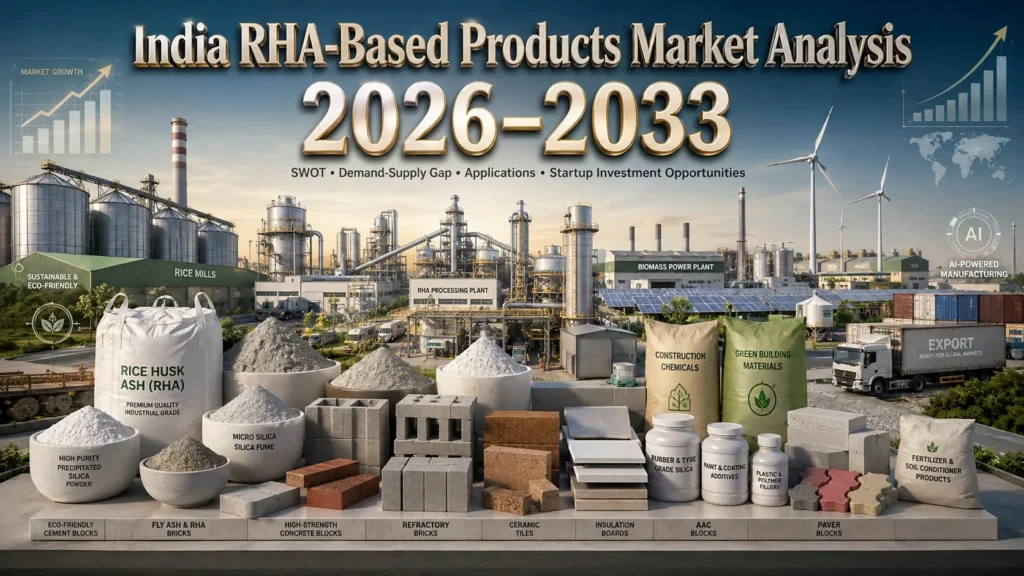

India RHA Based Products Market
The market for Rice Husk Ash (RHA) in India is emerging at a time when the country’s agriculture sector is producing more rice than ever before, its infrastructure sector has a $175-billion investment pipeline, and the country is experiencing a shortage in specialty silica supply. The global market for RHA is estimated to be in the range of USD 3.0–3.2 billion, expanding at a 4.8–5.3% CAGR to USD 4.1–4.8 billion by 2033.
In this global context India has one of the most dominant raw material positions in the world, but is structurally dependent on imports for high-purity silica, still from that very raw material. The big business opportunity for Indian MSME chemical and agro industries this decade will be closing that gap.
The demand–Supply Gap India (D-S-G) is a result of the imports of silica precipitated from China, Germany, Japan, Malaysia and Taiwan at a compounded rate of 20.59% CAGR (2020-2024) and the fragmented nature of the RHA processing capacity with quality inconsistencies in India. The country produces 30+ million tonnes of rice husk a year, but only a small proportion is used to make value added silica products, resulting in a structural gap being addressed by importing rice husk.
Organized players in various product segments of RHA include Major Indian Players Guru Metachem Pvt. Ltd., Usher Agro Limited, and Rescon (India) Pvt. Ltd., ranging from steel-grade insulating compounds, high-purity silica, to construction additives.
With raw material which is almost free from rice mill clusters, the MSME scale silica unit with a capital investment of ₹ 3–8 crore can expect to generate a profit of 20–30% IRR. The multi-sector pull from green tyre demand, EV sector growth and construction sector boom insulates this investment from single industry cyclicality.
India’s Hidden Industrial Asset: 30 million Tonnes of Wasted Silica
India’s rice mills produce in excess of 30 million tonnes of rice husk as an end product of the milling process annually in the rice bowl states of Uttar Pradesh, Telangana, West Bengal, Punjab, Chhattisgarh and Andhra Pradesh. This husk, when fired at well-controlled temperature of 500°C to 700°C, produces Rice Husk Ash (RHA) rich in amorphous silica (80-95% by weight) which is the most reactive form of SiO2 available from any raw material on earth with a highest surface area.
The contradiction is obvious. As per the Department of Agriculture & Farmers Welfare (DA&FW), India is the world’s largest or second-largest rice producing country based on the crop year with the total paddy production of 1,364 lakh tonnes in 2024–25. The Economic Survey 2025-26 reveals that Uttar Pradesh is the leading contributor of rice, with a production of 20.76 million tonnes, followed by Telangana with 17.45 million tonnes and West Bengal with 16.02 million tonnes, making the top three states contribute to more than 36% of the national rice production.
India, however, despite having what is supposed to be a world-class silica manufacturing raw material base, continues to import hundreds of thousands of tonnes of specialty silica annually, due to the lack of pace of development of the processing infrastructure.
It’s not a farming issue. It is a gap in industrial policy — and one of the most obvious MSME business opportunities in India’s manufacturing industry.
Related Article: Why Rice Husk Silica is the Future of Green Tyres: Market Growth and Demand Gap
Understanding RHA: Not Just Ash, But Industrial-Grade Silica
It is important to be aware of what RHA is in fact providing that has made it commercially viable to a number of industries, before assessing the market opportunity.
In the controlled combustion of rice husk, the organics are burned, leaving a concentrated ash of organic silicon compounds which is extremely porous and amorphous. The result is RHA that has amorphous silica — a much more chemically active form of silica than the crystalline silica from traditional quartz quarries. That’s what makes RHA so valuable. In the field of construction, it reacts with calcium hydroxide to produce more calcium silicate hydrate, which strengthens and makes the concrete impermeable at 10 to 25% cement replacement.
It is used as a top-notch filler in the rubber and tyre industry to enhance the resistance to abrasion and minimize rolling resistance. Its thermal stability of over 1500°C is ideal for steel ladle and tundish linings in refractory applications.
Global rice production is expected to reach a record high of more than 535 million tonnes (milled basis) in 2024–25, according to the Food and Agriculture Organization of the United Nations (FAO). India has the biggest share of the global upward revision, and also contributes the largest share of the world’s total rice husk production. This places India not just as the producer of RHA for in-house use but as one of the future suppliers of high purity silica derivatives in the global market, which so far India has not fully occupied.
Global and India RHA Market: Size, Growth, and What the Numbers Mean for Investors
The RHA market is expected to grow to USD 4.1–4.8 billion by 2033, from USD 3.0–3.2 billion in 2026, with the forecast range indicating scope differences among various market segments. The base RHA market is expected to reach nearly USD 1.0 billion in 2034 at 10.4% CAGR, whereas the higher value-added sub-market of Precipitated Silica from RHA will cross USD 608 million by 2026 at 19.2% CAGR. This is because the demand for higher purity of silica for application in tyres, rubber, pharmaceuticals, cosmetics, and specialty chemicals is increasing, while bulk ash for construction products is decreasing.
India is poised for faster growth compared to the global rate of 12–15% CAGR, owing to the infrastructure investments that are accelerated in the country, the rapid growth of the rubber and tyre sector, and growing awareness among institutions of the use of pozzolanic materials as carbon efficient alternatives to OPC.
The domestic precipitated silica market, the primary commercial product of RHA, was estimated at USD 76.2 million in 2024 and will expand at 10.2% CAGR, to reach USD 136–150 million by 2030, according to various industry tracking sources within India. Importantly, imports are a material and increasing share of that supply, and that’s the demand-supply gap that domestic manufacturers have to go to the market to fill.
| Segment | Value (2026) | Value (2033/2034) | CAGR |
| Global RHA Market | ~USD 3.0–3.2 Bn | ~USD 4.1–4.8 Bn | 4.8–5.3% |
| Global Precipitated Silica from RHA | USD 608 Mn | USD 1.01 Bn | 10.4% |
| India RHA Market (Domestic) | Growing at ~12% CAGR | — | 12–15% |
| India Precipitated Silica Market | USD 80+ Mn | USD 136–150 Mn | ~10.2% |
| India Precipitated Silica Imports | Growing | — | 20.59% (2020–24) |
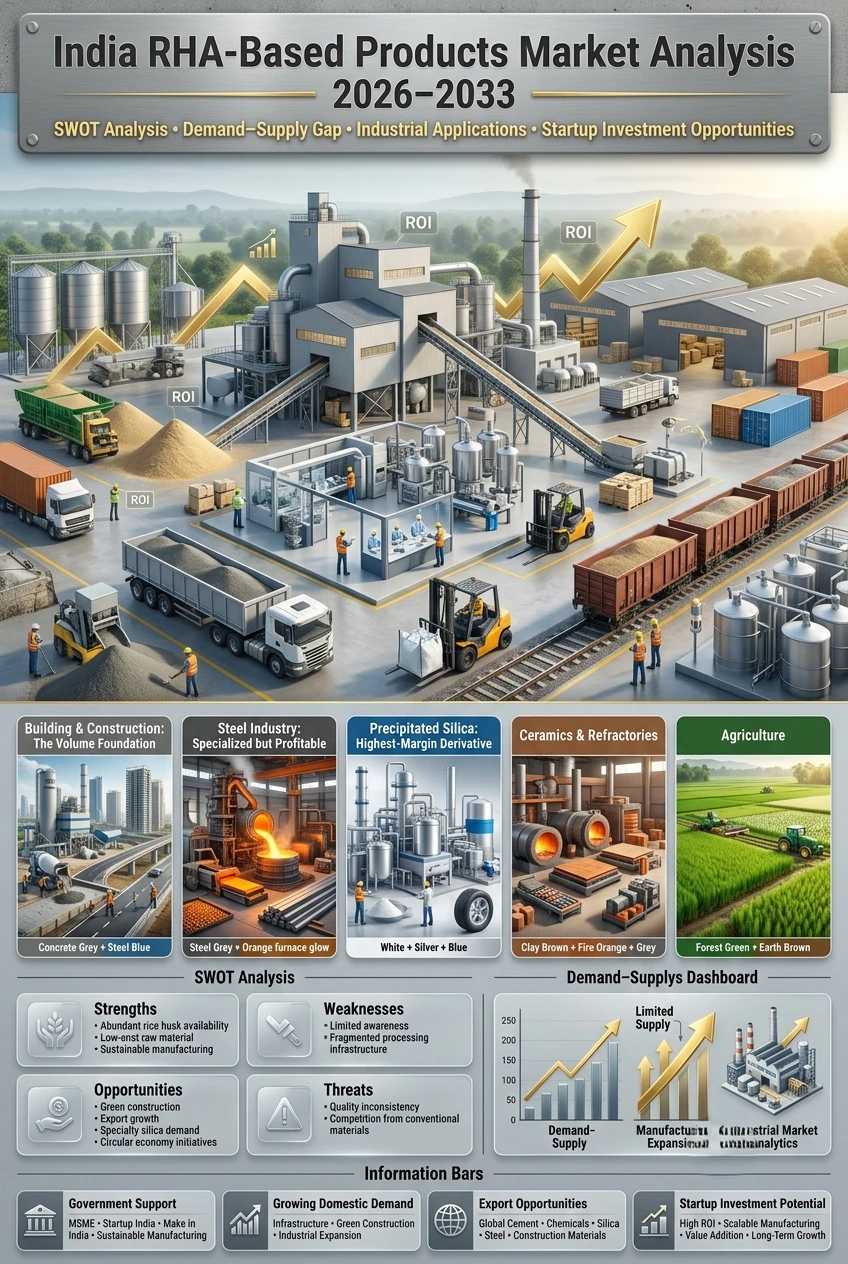
SWOT Analysis of India’s RHA-Based Products Sector
Strengths
The competitive edge that India is going to possess in this segment starts with one factor, which cannot be manufactured, imported or duplicated: a structurally permanent raw material surplus. The majority of the country’s paddy is produced in Uttar Pradesh, Telangana, West Bengal, Punjab, Madhya Pradesh, Chhattisgarh and Andhra Pradesh and thousands of rice mills are already producing RHA as a byproduct at little extra expense (at most of them, the cost of transporting it to the entrepreneurs is the only additional expense). This results in a cost basis for domestic RHA silica producers, which is more difficult for Chinese, German and Japanese manufacturers to compete with economically.
In addition to raw materials, India is blessed with a growing diversified industrial base which uses RHA products. PMAY housing, PM Gati Shakti, Bharatmala and smart city infrastructure is expected to drive India’s cement consumption to grow at 7-8% in FY26, with the construction sector being India’s single-largest RHA end market as reported by IBEF. Tyres which are the major end-user of precipitated silica, are also expanding production capacity to meet demand from domestic OEMs as well as export markets. The steel industry in India requires 300 million tonnes of capacity and requires RHA based insulating compounds for ladle and tundish applications. These aren’t potential demand drivers – they’re policy driven, budget approved programs that are already under way.
Weaknesses
Quality inconsistencies are the most important internal constraint that occurs in the sector. The quality of RHA depends to a great extent on the combustion temperature, time and moisture content of the original husk. Most of the rice mills in India have energy generation type kilns (dryer) which are not intended for ash production for controlled grade. This means most of the RHA available domestically is not as pure or has a lower surface area as required by the tyre companies, pharmaceutical formulators or ceramics companies. The investments needed for the conversion to controlled combustion (CC) (Fluidized-bed furnace with baghouse filters) are too large for most rice mills and are considered to be outside their main business.
There is a certification void as well. For RHA-based products, the level of IS specification coverage is comparatively weak and they are not widely accepted in government-tendered construction, whereas fly ash has established relatively strong IS specification coverage and wide acceptance in government-tendered construction. This helps keep organized demand in check even in the face of technically available supply.
Opportunities
The import substitution opportunity of silica from RHA is one of the most obvious in the industrial chemicals market in India. China, Germany, Japan, Malaysia, and Taiwan were the key suppliers of precipitated silica to India, with the imports increasing at 20.59% CAGR between 2020 and 2024. This is nothing new, but it has been continuing to happen in line with the growth of India’s tyre, rubber and specialty chemical industry.
The shortfall in the growth of supply and demand has been increasing — and for every tonne of specialty silica that India imports rather than produces in the country, one value-adding opportunity has been lost, beginning with the raw material, which can be considered effectively free in most parts of the country.
This is a structural opportunity supported by the green tyre revolution. In the era of the growth of EV production by the automotive OEMs under the FAME-II and PM e-DRIVE schemes, Highly Dispersible Silica (HDS) is no longer a commodity filler, but an input that becomes performance critical due to its high grade as precipitated silica, which helps reduce rolling resistance of tyres. India’s supply of HDS grade is virtually 100% reliant on the import of the product.
A domestic manufacturer with the ability to consistently produce HDS grade precipitated silica from RHA at competitive costs gets a segment that is almost devoid of domestic competition, and a captive demand base from the CEAT, Apollo, MRF and their global OEM customers.
In addition to tyres, the Indian Green Building Council (IGBC) has registered a total of more than 15,000 green building projects in India with a total coverage of more than 13 billion square feet, which is growing and increasingly enforcing the use of low-carbon supplementary cementitious materials. While the BIS is constantly evolving and now formalizes RHA as a specified SCM, the demand from the institutional sector will create a huge predictable market of construction grade RHA which can be catered by the MSME producers in the various clusters.
Choose the right startup backed by real market demand
Threats
The biggest competitive pressure is from China on precipitated silica, which has the advantage of large-scale integrated production, mature technology and low export prices. During a slowdown in the global market, or when trade tensions shift China’s export volumes to India, domestic producers are subjected to margin pressure, and the impact can be harsh for smaller businesses that have less product portfolio diversification.
Fly ash is also detrimental for the construction sector because it is competing with RHA. Fly ash produced in huge quantities from Thermal Power Plants is standardized by BIS and promoted by various Government agencies as industrial waste valorization material. For the cement producers, the economy of fly ash is its simplicity as a pozzolanic material – and for RHA to be competitive in the market, it can only do so by proven performance differentiation, not by regulation.
Another limitation for operation is due to seasonality of agricultural feedstock. The procurement pattern of paddy leads to the availability of rice husk during the post-harvest periods, forcing the producers to either hold large inventories of rice husk or invest in new facility for holding.
Application-wise Market Analysis
Building & Construction: The Volume Foundation
This is still the primary end-use application for RHA around the world and in India, as the pozzolanic reactivity and low cost of RHA as a partial replacement in cement demonstrate. According to the data on infrastructure development in India compiled by IBEF, the Union Budget 2026-27 has budgeted Rs. The public capital expenditure of 12.2 lakh crore (around USD 138 billion), mainly directed towards roads, railways, housing and urban infrastructure. Mumbai–Ahmedabad Bullet Train Corridor alone uses approximately 20,000 cubic meters of cement each day.
The potential annual requirement for this pipeline is millions of tonnes of RHA at 10-15% cement substitute rate. The results of that research, published in the peer-reviewed literature of Springer Nature, have been found to increase concrete strength and durability and decrease embodied carbon, a metric that institutional buyers under green building mandates are increasingly keeping track of. The construction sector could be lower-margin than specialty silica but is characterized by stable high-volume offtake from regional cement plants and ready-mix operators for the MSME producers.
Check Out This Recommended Book: The Complete Book on Construction Materials
Steel Industry: Specialized but Profitable
The low conductivity, chemical inertness and stability of RHA above 1,500°C are desirable qualities for steel ladle and tundish covering. RHA compound is applied to molten steel to keep the temperature in molten metal during transferring, so as to avoid the loss of the heat of molten metal and enhance the output quality. In India, the requirement for steel auxiliaries based on RHA is well catered to with the country planning for substantial increase in steel capacity.
This is a commercially proven and an exportable product category and supplied by the most organized player in this segment of the market in India, Guru Metachem Pvt. Ltd. with its product portfolio of Rice Husk Ash Balls, Pulverized RHA, Heat Insulation Compounds, Tundish Boards and Covering Fluxes to Indian steel market and export markets.
Get Detailed Insights from This Book: Steel and Iron Handbook
Precipitated Silica: The Highest-Margin Derivative
It’s here that new investors have their best bet of finding a strong investment argument. Precipitated silica from RHA is an amorphous SiO₂ which is made using acidic precipitation from alkaline extraction of silica, a process that is relatively simple and easily achievable by plants of MSME scale. The final product fetches the price of Rs. Standard industrial grades 30,000 – 80,000 per tonne and much higher for pharmaceutical, food-grade or HDS specialty grades.
More than 57% of precipitated silica used in India is in the rubber industry. The largest customers are tyre manufacturers, the second largest being non-tyre rubber goods, footwear and industrial rubber products. Precipitated silica is used as a carrier in wettable powder pesticides, a type of pesticide that is increasing in use in India due to the country’s increasing agrochemical export program. Oral care and cosmetics are premium-margin products where good product quality makes it possible to differentiate the supplier.
Ceramics & Refractories
Amorphous RHA silica can be used to replace quartz in the production of ceramic tiles, which can increase the modulus of rupture and provide a cutback of 8-12% in the kiln energy consumption at the firing temperature below 950°C. The domestic market of ceramics manufacturing in Gujarat, Rajasthan and Andhra Pradesh is accessible and represents an attractive market for RHA-based ceramic filling materials. Applications such as bricks, crucibles, and furnace linings are refractory uses, where the high purity, high surface area RHA’s are sold at premium prices by industrial users.
Agriculture
RHA, as a silicon amendment, assists plants to take up silicon, enhances the plant’s stem structure, and increases resistance to pests and biotic stress, which is particularly important for the growth of rice in silicon deficient soils in eastern India. This application provides a circular economy logic that is easily relatable to the government and development finance institutions in order to promote agro-waste valorization at the farm-level.
Get Detailed Project Report (DPR): Rice Husk & Rice Husk Ash Business Guide (Agricultural Waste)
Regional Analysis: Where the Industrial Clusters Are
Uttar Pradesh is now the biggest paddy contributor to the country with 20.76 MT (Economic Survey 2025-26) and eastern UP is among the places of higher density of RHA supplies in the country, such as Gorakhpur, Deoria, Ballia and Varanasi. Availability of industrial land, active MSME cluster development and proximity to NCR-Lucknow industrial corridor has helped in establishing a natural logistics network for finished silica products in these districts which are also available competitively.
The combined production of Telangana and Andhra Pradesh is around 25 million tonnes of paddy. The states are the most active zones for RHA silica entrepreneurship due to their close proximity to the export ports (Visakhapatnam and Krishnapatnam), state MSME incentives for agro-processing units and an established culture of industrial entrepreneurship in districts like Krishna, Godavari, Khammam and Karimnagar.
The state of West Bengal and Odisha, which is the third and sixth largest rice producing state in the country respectively, provide a huge untapped RHA processing opportunity. The cost of industrial land is low, electricity rates are competitive and the port of Kolkata is good for export of precipitated silica to buyers in the south-east Asian region.
Punjab produces 14+ million tonnes of rice, and has a very high density of rice shellers. The state is close to Ludhiana-Amirtsar industrial belt where rubber goods, chemical, steel auxiliary factories are located and thus immediate B2B market access for rubber goods-based products is provided.
Demand–Supply Gap: The Core Investment Signal
The data conveys a clear message across several different perspectives. The imports of precipitated silica in India increased at a 20.59% CAGR between 2020 and 2024, which is almost five times its domestic CAGR. This speedup has caused the domestic supply to not only fall short, but to fall further behind the demand, each year. The import basket includes predominant China (China is also the biggest global exporter of RHA), Germany (Evonik or Solvay – specialty high purity grades), Japan, Malaysia and Taiwan.
Meanwhile, the amount of RHA exported from Asia has increased from less than 50,000 tonnes to around 300,000 tonnes in the last ten years and the world is there is a well-established and expanding international trade channel for quality-certified RHA products. Indian exporters who have taken the initiative to install controlled combustion and quality certification has achieved the success in delivering to Japan, Vietnam, Chile and Costa Rica.
The disparity between these two points — India imports high-purity silica and has abundant raw material to make it — is more the result of a lack of infrastructure than market inefficiency. Investors in controlled combustion technology, downstream processing, and quality certification, are looking at a space where there is little competition from domestic players, high import prices, and demand from both the domestic and export markets is growing at the same time.
Major Indian Players in the RHA Sector
Guru Metachem Pvt. Ltd. is one of the most diversified manufacturers in RHA product segment in India. RHA product range of the company is available in five business divisions such as Steel Fluxes, Construction Additives, Agro Products, Oil & Drilling Products, and Specialty Chemicals and in the form of pulverized RHA, RHA balls, heat insulation compounds, tundish boards, covering fluxes, and slag conditioners. It ranks as a standard example of organized RHA processing in India by its export reputation in various geographies.
Usher Agro Limited has a set of integrated rice milling and the specialized RHA extraction facilities for biomass power generation. It has proprietary silica extraction technology and has considerable capacity to produce high-quality ash for ceramic, refractory and specialty chemical applications. It also has vertical integration, from paddy procurement to milling to ash extraction, which can’t be achieved by a standalone processing unit.
Rescon (India) Pvt. Ltd. has established itself as a leader in the field of sustainability and the use of applied construction materials. The company has been involved in the development of concrete formulations based on RHA, new and environmentally friendly building materials, and technology for soil stabilization, making it a specialty solutions provider instead of a bulk commodity supplier.
Other active players include KRBL Limited (leveraging paddy procurement scale), Kothari Petrochemicals, Astrra Chemicals, and a growing number of state-registered MSME units — particularly in Andhra Pradesh, Telangana, and Punjab — producing sodium silicate, construction additives, and standard-grade precipitated silica.
Techno-Economic Snapshot for New Entrant MSMEs
For a first-generation entrepreneur or institutional investor evaluating this sector, the financial parameters are accessible by specialty chemicals standards. A typical RHA silica processing unit at 1,000–3,000 tonnes per annum capacity would carry the following broad indicative profile:
| Parameter | Indicative Range |
| Capital Investment (Plant & Machinery) | Rs. 2–5 crore |
| Total Project Cost (with land, civil, WC) | Rs. 3.5–8 crore |
| Capacity | 1,000–3,000 TPA |
| Raw Material Cost | Near-zero to Rs. 500–1,500/tonne (ex-mill) |
| Realization (Standard Industrial Grade) | Rs. 30,000–55,000/tonne |
| Realization (Specialty / HDS Grade) | Rs. 65,000–1,00,000+/tonne |
| Estimated IRR (at 70% capacity utilization) | 20–30% |
| Simple Payback Period | 3.5–5 years |
Government financing and subsidy instruments applicable to new RHA units include the PMEGP (Prime Minister’s Employment Generation Programme) for MSMEs, CGTMSE (collateral-free credit guarantee up to Rs. 5 crore), SIDBI project loans for specialty chemical units, NABARD support for agri-waste valorization, and RoDTEP export promotion for silica shipments. The Ministry of MSME has specifically included agro-waste valorization projects within the priority sectors for MSME cluster development funding.
Policy Framework and Regulatory Environment
The policy environment for RHA-based products in India is directionally supportive, though still maturing on the standards side. The Bureau of Indian Standards (BIS) is progressively expanding its IS framework for supplementary cementitious materials, and formal RHA specification under IS codes is expected to follow the pattern already established for fly ash and ground-granulated blast furnace slag — both of which saw institutional adoption accelerate sharply after BIS standardization.
The Department for Promotion of Industry and Internal Trade (DPIIT) under Make in India has identified specialty chemicals — including silica derivatives — as a priority import substitution sector. The Production Linked Incentive (PLI) scheme for specialty chemicals and the National Single Window System (NSWS) for clearances both apply to new RHA silica manufacturing units.
Environmental clearance from State Pollution Control Boards is required for combustion-based units, with emissions standards for particulate matter and SO₂ applicable. States with active MSME industrial policy — UP, Telangana, Punjab, and Andhra Pradesh — have streamlined consent-to-establish frameworks for agro-processing and specialty chemical units that reduce pre-production timelines considerably compared to standalone clearance routes.
The Confederation of Indian Industry (CII) and its Indian Green Building Council arm have been active advocates for formalizing RHA’s role in green construction rating systems — a policy push that, once enacted, would create institutional demand mandates from government construction agencies under the green public procurement framework.
Startup Opportunity: Why This Sector Deserves Serious Attention Right Now
The RHA-based products sector carries a combination of attributes that are rarely found together in a single industrial opportunity:
The raw material is effectively free in most of India’s rice-growing belts, available from mills that treat it as a disposal problem. The domestic demand is large, growing, and currently serviced significantly by imports at premium prices. The technology barrier to producing standard-grade precipitated silica is moderate — accessible to a well-prepared MSME with appropriate process engineering support. The export market is established and growing, with buyers in Southeast Asia, Japan, and Latin America already purchasing from Indian suppliers who can meet quality specifications.
Perhaps most importantly, the sector aligns with every major policy and investment megatrend in India simultaneously: green infrastructure, import substitution under Atmanirbhar Bharat, waste-to-wealth conversion under the circular economy framework, and EV-linked specialty chemicals demand. No single-sector startup opportunity ticks all of these boxes simultaneously as cleanly as RHA-based silica does.
Entrepreneurs entering this space should treat quality certification — particularly compliance with ASTM C618, IS standards, and customer-specific specifications from tyre and rubber manufacturers — as the primary competitive investment. In a market where India has historically underdelivered on quality consistency, a supplier who consistently delivers product to specification commands a pricing premium and supply contract security that more than offsets higher process investment.
Frequently Asked Questions (FAQ)
Q1. What distinguishes RHA from fly ash? Can they be used interchangeably?
Both are pozzolanic materials used as cement replacement, but they differ fundamentally in origin and chemistry. RHA comes from controlled rice husk combustion and is predominantly silica (80–94% SiO₂), while fly ash is from coal combustion in thermal power plants and contains a mix of silica, alumina, and iron oxides. RHA has significantly higher silica content and reactivity, which allows it to perform at lower replacement rates and deliver superior durability outcomes in concrete. For specialty applications — rubber, ceramics, steel fluxes, and high-purity silica derivatives — RHA has no fly ash equivalent. They are not interchangeable in the industrial chemistry sense, though both serve the cement-replacement function in construction.
Q2. How is product quality controlled in RHA manufacturing, and what does it take to meet export or tyre-grade standards?
Quality begins at combustion. Controlled-temperature kilns — ideally fluidized-bed combustors with closed-loop temperature monitoring — are required to consistently produce amorphous silica with carbon content below 4% and specific surface area above 15–20 m²/g. Downstream washing, acid treatment, and classification steps further improve purity and particle size distribution. For tyre-grade precipitated silica (and especially HDS), a wet chemistry precipitation process following sodium silicate preparation is required. Third-party quality certification and regular testing against ASTM, IS, or customer-specific standards are non-negotiable for institutional buyers.
Q3. What is the realistic market entry strategy for a first-time MSME entrepreneur?
The recommended approach is to begin with standard industrial-grade precipitated silica or sodium silicate targeting rubber goods manufacturers, cement companies, and water treatment operators — markets with less stringent quality demands that allow process stabilization before investing in specialty-grade capability. Securing a long-term supply contract from one or two anchor industrial buyers before commissioning reduces working capital risk. Geographic clustering near rice mill belts in UP, Telangana, or Punjab minimizes feedstock logistics costs and simplifies supply chain management. Scale incrementally — a 1,000 TPA unit generating consistent quality is a more stable foundation than a 5,000 TPA plant producing variable material.
Q4. What government clearances are needed before starting an RHA silica unit?
Key statutory requirements include: Udyam Registration under the Ministry of MSME, Consent to Establish and Consent to Operate from the State Pollution Control Board (for combustion and chemical processing units), GST registration, and BIS certification if supply is targeted at BIS-specified construction material standards. Export-oriented units additionally need Import Export Code (IEC) from DGFT and RCMC from the applicable Export Promotion Council. DPIIT’s National Single Window System consolidates most central clearances and provides a single interface for state-level integration as well.
Q5. How significant is the export opportunity for RHA-based products from India?
It is substantial and underexplored. Global RHA exports grew from under 50,000 tonnes to approximately 300,000 tonnes over the past decade. India is already the second-largest global exporter of precipitated silica by shipment count (behind China), with active trade flows to Vietnam, Sri Lanka, Indonesia, Japan, Chile, and Costa Rica. The sustainable chemicals narrative — RHA silica as an agro-waste derived material with strong ESG credentials — resonates with buyers in Japan, South Korea, and Northern Europe who are actively seeking low-carbon supply chain alternatives. Domestic market development and export market development can be pursued in parallel once quality certification milestones are achieved.
About Niir Project Consultancy Services (NPCS)
Niir Project Consultancy Services (NPCS) is a professional industrial consulting organization with over four decades of experience supporting entrepreneurs, MSMEs, institutional investors, and development finance institutions across manufacturing, agro-processing, specialty chemicals, construction materials, food technology, and allied sectors.
For the RHA-based products sector, NPCS provides Market Survey cum Detailed Techno-Economic Feasibility Reports (DPRs) that equip entrepreneurs and investors with the full picture required for informed capital allocation decisions.
A standard NPCS DPR for an RHA-based manufacturing project typically covers:
- Detailed manufacturing process with Process Flow Diagrams (PFD/BFD) for precipitated silica, sodium silicate, RHA-based construction additives, and steel flux compounds
- Market research and demand analysis covering domestic consumption patterns, end-user industry growth projections, and competitor landscape mapping
- Product mix optimization and capacity planning based on raw material availability in the entrepreneur’s target geography
- Machinery and equipment specifications with capacity-appropriate supplier shortlisting
- Raw material sourcing strategy and supply chain design from regional rice mill clusters
- Import-export dependency analysis and pricing intelligence on competing Chinese, German, and Japanese suppliers
- Complete project financials: capital cost estimation, working capital assessment, P&L projections for five years, IRR, NPV, DSCR, and break-even analysis
- Risk assessment and mitigation framework
NPCS reports are designed to support the comprehensive evaluation of technical feasibility, financial viability, market demand, and scalability potential before any capital commitment is made — reducing investment risk and improving the quality of business planning for manufacturing projects in India’s rapidly evolving industrial landscape.