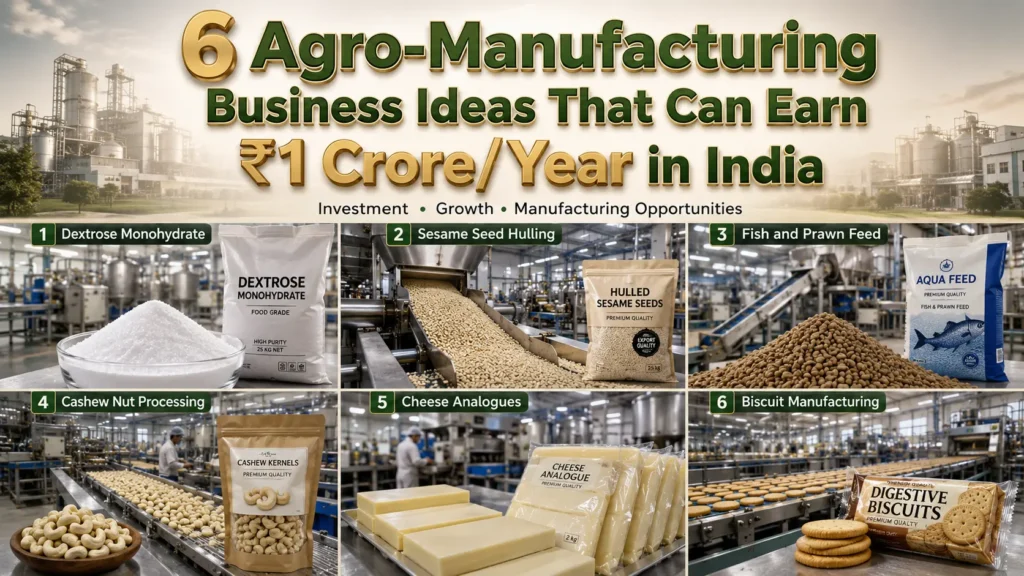
6 Agro-Manufacturing Business Ideas That Can Earn ₹1 Crore/Year in India
6 Agro-Manufacturing Business Ideas That Can Earn ₹1 Crore/Year in India Read More »
From the Farm to the Factory: High-Growth Opportunities in Food Processing, Agricultural Inputs, and Specialty Products Agro Manufacturing Business Ideas in India India is at a unique turning point. There is a daily need for food, feed and specialty ingredients, which is driven by a billion-plus population. There are still a number of manufacturing sectors that are not yet well developed. For the right entrepreneur, this void is not a hindrance, it’s a chance. This opportunity is being supported by government policy. However, the Production Linked Incentive scheme for food processing, PMEGP for small manufacturers and the consistent thrust under Make in India has helped to create a conducive environment for the first-generation entrepreneurs. But policy is not enough to establish a business. A business is created by knowing which products are in structural demand, what the real costs of producing them are and where the margins are. This article will explore six manufacturing and processing business ideas that have a strong depth of demand, approachable processes and good margins. Practical aspects of production logic, cost structure and commercial opportunity are presented for each sector: dextrose monohydrate, sesame hulling, aqua feed, cashew processing, cheese analogues, and biscuits. Get Detailed Insights from This Book: Profitable Agro Based Projects 1. Dextrose Monohydrate: The Quiet Workhorse of Indian Industry What It Is and Where It Goes Dextrose monohydrate, a hydrolysate of starch, is one of the most commonly used functional ingredients used in the Indian manufacturing. The infusion for the pharmaceutical application, called Intravenous Dextrose Normal Saline, is familiar. But the food-grade derivative market is arguably bigger and bigger. Dextrose is used in a variety of key food applications such as: Confectionery, bakery products and hard candy formulations. The production of energy drinks, sports nutrition and baby food. Amino acid, citric acid, and API production fermentation substrates Specialty chemical applications and special applications in textile processing Starch derivatives industry is located in the main part of the country in Maharashtra, Uttar Pradesh and Andhra Pradesh. There are a few big players controlling the organised segment. But demand downstream has reached a critical threshold and regional processors are discovering commercially viable niches that the large processors cannot be agile enough to serve. Investment and Growth Outlook This core process consists of starch liquefaction by alpha-amylase enzymes, saccharification by glucoamylase, purification activated carbon and crystallisation. The capital cost of a small to mid-sized plant with 10-25 tonnes per day capacity lies between ₹4 crore to ₹12 crore. Dextrose intended for food use should be in conformity with the FSSAI specifications. Dextrose used for food should comply with the FSSAI requirements. Other certifications are required for producers that sell into export markets or for pharmaceutical ingredient producers. Please refer to the FSSAI website for full regulatory requirements. The starch derivatives industry in India is expanding at about 8 – 10% CAGR due to the processed foods, sports nutrition, and expanding pharmaceutical industry. The true market potential is in differentiated applications: ultra-pure types for infant formula companies and blends of dextrose-maltodextrin types for sports nutrition companies. 2. Sesame Seed Hulling: A Business Idea with Strong Export Pull Why Sesame Deserves Serious Attention India is the largest producer and exporter of sesame seeds. It is true that there has been a world market for raw sesame from the beginning. But, hulled sesame (also called natural white sesame) fetches a much larger price, and is the preferred form for almost all international buyers. Main export destinations are Japan (150,000–180,000 metric tonnes per year), South Korea, China, Middle East and emerging markets such as North American Countries and EU. The premium for raw to hulled sesame has been between 25% and 45%. This ensures a simple value addition game called hilling and is one of the easiest agro-processing business ideas for India. Investment and Commercial Viability A sesame hulling plant is comprised of cleaning, soaking, mechanical hulling, flotation separation, washing, drying and colour sorting. Colour sorting is a crucial stage, as international buyers have stringent quality requirements, and if the colour isn’t good, even if the lot is properly hulled, it will be rejected. The investment in plants for 5–10 tonne per day operation can be from ₹80 lakh to ₹2 crore. The consistent supply of 99.95% purity by Indian exporters, ensures them premium price buyers. Exporters are assisted by the Agricultural and Processed Food Products Export Development Authority (APEDA) with regard to quality certification and market development funding. A natural raw material advantage can be acquired while setting up near major growing belts in Rajasthan or Gujarat. Another planning point of importance is working capital management and storage infrastructure, and procurement should be focused on a 2–3-month window post-harvest. Related Article: Top 3 Profitable Agro-Based Manufacturing Business Ideas in India 3. Fish and Prawn Feed: Riding the Blue Economy Wave The Structural Demand Story The aquaculture industry in India has silently undergone a change in the last 15 years. Shrimp exports have reached the levels of ₹50,000 crore per year, and consumption of fish is increasing gradually. Quality compound feed is part of the rapidly expanding demand which lies behind both of those trends. The fish and prawn reared on nutritionally balanced feeds grow faster, have less mortality rate, and yield better quality meat. The organised aqua feed market is valued at more than ₹18,000 crore and will be expected to reach ₹30,000 crore by the end of this decade. The five key states that are boosting demand are Andhra Pradesh, Odisha, West Bengal, Kerala and Tamil Nadu. Manufacturing and Margin Profile A compound aqua feed formulation usually will include fish meal or soy protein concentrate, energy ingredients (such as wheat and maize), lipid sources, vitamins, minerals and binding agents. The protein content should be higher in prawn feeds (32-40%). This is due to the increased significance of the extruded feed technology, which means that water pollution can be alleviated and the feed consumption can be monitored better. A medium size extruded plant is likely to need an