
Thin Film Photovoltaic Manufacturing in India
MARKET INSIGHT
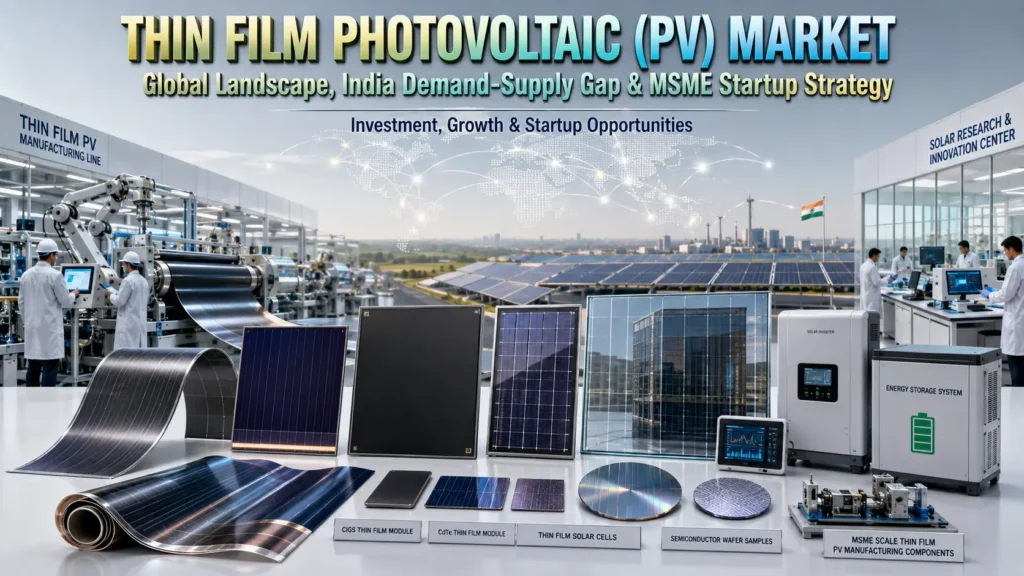
The worldwide thin-film PV (TFPV) market is worth more than USD 20 billion and is growing at more than 17% CAGR, fuelled by the growth of portable applications and building-integrated photovoltaic (BIPV) applications as well as utility-scale solar. The National Solar Mission (NSM) which aims to add one million MW of solar power by 2030, has created a high priority manufacturing opportunity for the thin-film PV industry with a significant import substitution potential. Structural demand-supply gap for thin-film modules is currently being met by imports from China, Japan and USA, which MSME manufacturers can close with the country.
The Thin-Film PV Market: An Industrial Overview
The solar energy market has experienced a fundamental change in the last 10 years, with thin film photovoltaic (PV) technology becoming a commercially viable and technically valuable alternative to traditional crystalline silicon solar modules in several high value applications. Thin-film PV cells are produced by depositing one or more ultra-thin layers of photovoltaic semiconductor material, usually in micrometres, onto a substrate like glass, metal foil or flexible plastic, and are not made by the energy-intensive ingot slicing and thick wafer processing used in conventional silicon wafer-based PV panels. This basic production disparity allows the production of significantly less material per watt of power output, power output flexibility, and distinctly superior performance characteristics under real world conditions.
Get Detailed Insights from This Book: Solar PV Power and Solar Products Handbook
The three major commercial types of thin-film technology are Cadmium Telluride (CdTe), Copper Indium Gallium Selenide (CIGS or CIS), and Amorphous Silicon (a-Si). Each of the technologies offers a specific set of efficiency, cost and application characteristics. The International Energy Agency (IEA) estimates that solar PV technology has become the world’s cheapest energy source to date in large parts of the world, and even thin-film PV technologies play a major part in this cost reduction trend, adding that solar PV has opened up new application categories besides the fixed-frame rooftop panel.
The Indian solar market is at the cross-roads of energy security, climate change and manufacturing. India is a sizeable, ongoing, policy-driven and sunny market, both for PV equipment and as a manufacturing hub for PV energy supply.
Global Manufacturing Landscape: Key Players Shaping the Industry
Many vertically integrated technology conglomerates and a handful of thin-film innovators, all vertically integrated, are present in North America, East Asia and Europe that dominate the thin-film PV industry. The following table provides a summary of the key manufacturers active in this area, the country of origin for the manufacturer and the key technology that is used, as well as the main markets targeted.
| Company | Country | Technology | Key Market Segment |
| First Solar | USA | CdTe Thin-Film | Utility-Scale Solar |
| Jinko Solar | China | Multi-Tech including TF | Utility & Commercial |
| JA Solar Co. Ltd | China | Multi-Technology | Global Utility |
| Panasonic Corporation | Japan | HIT / Thin-Film | Residential & Commercial |
| Mitsubishi Electric Corp. | Japan | Amorphous Silicon | Commercial & Industrial |
| Sharp Corporation | Japan | CIGS Thin-Film | Residential & BIPV |
| Kyocera Corporation | Japan | Multi-crystalline & TF | Commercial Systems |
| Kaneka Corporation | Japan | Amorphous Si (a-Si) | BIPV & Flexible |
| MiaSole | USA | CIGS on Foil | Flexible / Portable Solar |
| Ascent Solar Technologies | USA | CIGS on Plastic | Aerospace & Wearables |
| Hanergy Mobile Energy | China | CIGS / GaAs | Mobile & Portable Energy |
| Yingli Green Energy | China | Multi-Technology | Utility & Rooftop |
| Trina Solar | China | Multi-Technology | Global Utility |
| ReneSola Co. Ltd | China | Thin-Film & Si | Commercial Rooftop |
| Suntech Power Holdings | China | Multi-Technology | Utility Scale |
| SUNQ | China | Thin-Film | Consumer & Portable |
| Trony Solar | China | Amorphous Silicon | Commercial Solar |
| Filsom AG | Europe | CIGS Thin-Film | BIPV & Industrial |
| Shunfeng Intl Clean Energy | China | Multi-Technology | Utility Scale |
First Solar is the world’s leading technology company in large-scale, CdTe-solar, and has long been the low-cost leader in the U.S., European and portions of Asian utility-scale markets. The Chinese players (Jinko Solar, JA Solar, Trina Solar, Yingli, ReneSola, Suntech, SUNQ, Trony and Shunfeng) are the powerhouse behind the current 90%+ drop in PV module prices over the last 20 years. Meanwhile, the module efficiency and integration of BIPV products are still being dominated by Japanese technology companies, such as Panasonic, Sharp, Mitsubishi Electric, Kyocera, and Kaneka. Ascent Solar Technologies and MiaSole are pushing the envelope on the ultra-lightweight, flexible thin-film into defense, aerospace and wearable consumer applications. European specialist Filsom AG is taking the lead in the BIPV architectural segment, thanks to its precision CIGS deposition technology.
Access Complete Business Plan: Start a Manufacturing Unit of Solar Panel. The Renewable-Energy Business is Expected to Keep High Growth.
Technology Deep-Dive: CdTe, CIGS, and Amorphous Silicon
Every type of thin film technology is in a different niche in the solar industry, with varying levels of capital intensity, manufacturing needs, and points of entry for MSMEs interested in entering this growing sector.
Cadmium Telluride (CdTe)
The non-silicon solar market is dominated by CdTe thin-film. It offers the lowest manufacturing cost per watt of any commercially available PV technology and has a particular advantage in high heat, high humidity applications which are common in much of the solar belt in India. First Solar’s position is well entrenched, but the patents available in the space are beginning to give other companies a chance to get in on tellurium and cadmium supply chains. The Ministry of New and Renewable Energy (MNRE) has declared CdTe and CIGS modules as priority category in the policy framework Approved List of Models and Manufacturers (ALMM) and the policy objective is to promote the domestic manufacturing of these modules.
Copper Indium Gallium Selenide (CIGS)
CIGS technology is the most efficient of all the thin-film technologies with laboratory cells now having efficiencies of over 23% and commercial modules are now achieving efficiencies of 14-18% in mass production. Its unique strength is its flexibility of the substrate that can be deposited onto a thin aluminium foil or polymer plastic, which means it can be used in curved glass facades, portable power packs, backpack-mounted chargers and wearable electronics. Mass-market applications are being led by companies such as MiaSole, Ascent Solar and Filsom AG. The electronics manufacturing incentive programmes and the growing Internet of Things (IoT) industry in India add further pull for MSME level integrated product development based on CIGS.
Amorphous Silicon (a-Si)
Amorphous silicon is the oldest commercially viable thin film PV technology that still has many applications in consumer electronics, indoor solar sensors, low-light urban monitoring, and low power charging of IoT devices. The segment is one of the investments in which Kaneka Corporation, Sharp and Trony Solar are heavily involved to scale up the segment. As India’s consumer electronics and IoT industry (as tracked by ELCINA – Electronic Industries Association of India) continues to grow at a healthy pace, the outlook for embedded low-power solar cells is likely to be significantly higher in the medium term, ensuring that it falls within the investment range for MSMEs.
Choose the right startup backed by real market demand
Demand-Supply Gap: India’s Solar Manufacturing Deficit
DEMAND-SUPPLY GAP INSIGHT
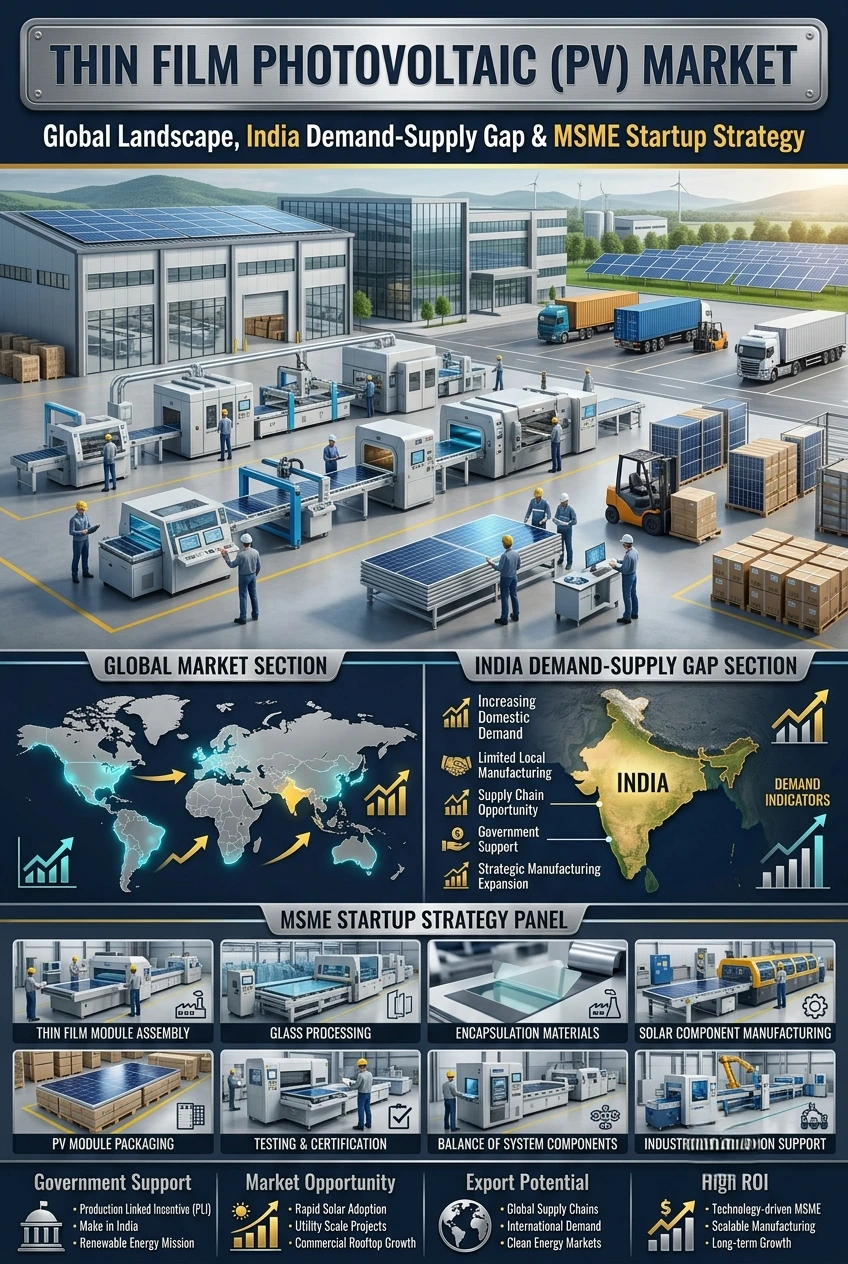
Even the domestic manufacturing capacity for thin film PV modules is far behind what is needed in India, which is 8-10 times more per annum than the installed capacity. This shortage is being made up with imports, mainly from China, for instance for thin-film technology, at an estimated level of more than 15 GW. This makes it a strategic and investable demand-supply mismatch which the Government of India is striving to address with production linked incentives, customs duty protection and domestic procurement.
India’s solar objectives are among the most ambitious objectives in the world. The National Solar Mission has identified a target of 300 GW of solar energy by 2030 and is now increasing it to 500 GW of total renewable energy in the broader energy transition vision. However, the domestic thin film production facilities have not been scaled up in line with these targets. The data released by Ministry of Commerce & Industry – DPIIT shows that PV cells and PV modules, which belong to HS Codes 8541 40 and 8541 10, respectively, are always among the top electronics import categories in India with import bills of several thousand crores of rupees each year. The implication for entrepreneurs is clear: There is a strong domestic market demand that is not being met and the government policy is to stimulate local manufacturing to meet that demand.
The demand for local production has been further escalated by India’s Approved List of Models and Manufacturers (ALMM) policy which requires the government to prefer modules produced within the country. This policy basically gives an assured market to Indian manufacturers, and in the process prevents direct competition from imports. The thin film technology, which is characterized by a lower temperature coefficient and by the better performance in high-irradiance, high-temperature conditions of Indian summer is well suited for this market.
| Parameter | Indicative Status |
| India Annual Solar Capacity Addition Target | 50+ GW per annum (2026-2030 phase) |
| Domestic Thin-Film Module Production Capacity | Below 2 GW per annum |
| Thin-Film Demand-Supply Deficit (Estimated) | 15+ GW annually |
| Primary Import Sources | China, Japan, United States |
| Import Dependency for Thin-Film Modules | Over 80% of demand met via imports |
| PLI Scheme Outlay for Solar PV Modules (GoI) | Rs. 4,500 Crore+ allocated |
| Basic Customs Duty on Imported Solar Modules | 40% (modules); 25% (cells) |
Major Indian Players in the Thin-Film & Solar PV Ecosystem
MAJOR INDIAN PLAYERS
The key Indian manufacturers in the solar PV space are Waaree Energies (India’s largest module maker in terms of capacity), Vikram Solar (famous for its high efficiency modules), Adani Solar (one of the most well-integrated manufacturing firms in India) and Websol Energy System Ltd (one of the few listed Indian solar cell and module manufacturers). SECI is the main public procurement and project development agency.
Adani Solar has set up one of the biggest vertically integrated solar manufacturing plants in India spanning the ingot pulling, wafer slicing, cell processing and module assembly segments. Waaree Energies has the maximum ever module manufacturing capacity in India and is continually exploring new technology like thin film integration. Vikram Solar is an internationally established BIPV and high-efficiency module specialist with excellent export contacts in Europe and America. As per the Solar Energy Corporation of India (SECI), domestic procurement policies based on ALMM are accelerating investment in India solar manufacturing, but specific commercial thin-film (CdTe, CIGS) production is missing.
This thin gap is exactly where the white space lies which is an investable opportunity for the entrepreneurs and MSME Industrialists having access to capital, technology licensing agreements or International Joint Venture partnerships. The focus in the organized sector has thus far been on crystalline silicon, while the thin-film sub-segment has been left as a space for first movers.
Related Article: Solar PV Manufacturing in India
Import-Export Dynamics and Policy Environment
The dynamics of India’s solar equipment trade is unmistakable; solar exports are significantly lower than the imports in the PV sector, and the volume of imports continues to increase year-on-year despite the increasing policy pressure for domestic production. Directorate General of Foreign Trade (DGFT) Solar PV products are classified under chapter 85 of the Harmonized System with sub-headings having both Basic Customs Duty and Special Additional Duty, which are enacted to provide protection and encouragement to domestic producers. The 40% BCD on solar modules and the 25% BCD on solar cells not used in modules is an important tariff difference that provides an economic advantage for the Indian manufacturers over the import-dependent customers, essentially subsidizing the Indian investment economics.
Solar PV Modules is one of the areas covered under the Production Linked Incentive (PLI) scheme which provides financial incentives to manufacturers based on incremental domestic production volumes. The scheme is technology and efficiency driven, and as a specific criterion of the scheme covers thin film CdTe and CIGS modules, it is one of the most relevant policy instruments for MSME investors who are interested in this area. At the same time, a rising demand in India for exportation of clean energy equipment equipment by various bodies such as the Confederation of Indian Industry (CII) gives the Indian thin-film manufacturers an opportunity to cater the markets in the Southeast Asian, Africa and Middle East regions, where India has strong diplomatic and trade relation with these countries.
Startup & MSME Opportunity: Entry Points for New Manufacturers
STARTUP OPPORTUNITY INSIGHT
Despite surging policy support and significant tariff protection from lower-priced imports, India’s thin-film PV segment continues to be structurally under-invested at the MSME level, thanks to a growing domestic demand from government procurement mandates. Thin-film Module Assembly, CIGS Film Deposition, or even Solar-Integrated Product Manufacturing, entrepreneurs can now reap the results of a 10-year demand tailwind supported by India’s 500 GW renewable energy target. This is an immensely supported industry entry point for first generation entrepreneurs with the PLI scheme, technology licensing availability and the credit guarantee scheme by Ministry of MSME.
There are a number of entry points for MSMEs in the thin-film PV ecosystem, some of which have already been commercially proven:
Small-to-MID-MODULES: The smallest- and mid-scale module assembly operations making use of imported CdTe or CIGS cells with locally sourced encapsulant, tempered glass, backsheet, junction box and aluminium frames is the lowest technology barrier entry point. This creates huge value-add from a readily available supply chain, and the investment is generally in the Rs. 2–10 crore range.
Building-Integrated Photovoltaic (BIPV) Products: Solar glass facades, solar roof tiles, and transparent solar panels represent the fastest-growing application segment for thin-film PV in India. Demand for BIPV products from designers, planners, architects, property developers, and city infrastructure planners who want to design and build an energy generating envelope for their projects has seen a rise given the phenomenal growth of the construction industry and its increasing inclusion of smart city and green building developments.
Ancillary Component Manufacturing: The Indian market is also a haven for innovative companies who will focus on the supply chain, in a way, like the ‘Make in India’ program driven by the DPIIT (Department for Promotion of Industry and Internal Trade) the government’s Make in India program as a part of a bigger initiative ‘Atmanirbhar Bharat’ program aims for manufacturing self-reliance of solar ancillaries in India. Without actually manufacturing the PV cell, there are umpteen companies in the country that cater to the supply of thin-film module ancillaries such as lamination film, edge-sealing compounds, junction boxes, anti-reflective coatings for the glass, or specialized aluminium mounting brackets etc.
Portable and Flexible Solar Products: The global flexible solar market — targeting backpacks, remote charging stations, disaster relief power kits, agricultural IoT sensors, and defense field equipment — is a niche but rapidly growing segment where Indian manufacturers can realistically compete internationally. CIGS-on-plastic technology, available through licensing from global technology holders, can be configured for small-scale Indian MSME production with limited footprint and moderate capital investment.
How NPCS Can Help You Evaluate This Opportunity
Niir Project Consultancy Services (NPCS) — www.niir.org — is a leading industrial consultancy established in 1994, with over 8,000 Detailed Project Reports (DPRs) delivered to entrepreneurs, MSMEs, and industrial investors across India and more than 50 countries. NPCS specializes in Market Survey cum Detailed Techno-Economic Feasibility Reports that provide entrepreneurs and investors with the comprehensive evidence base needed to evaluate and execute new manufacturing ventures.
For entrepreneurs exploring thin-film PV manufacturing, NPCS prepares feasibility studies that encompass: detailed manufacturing process descriptions for CdTe, CIGS, and a-Si modules including deposition technology selection and quality benchmarks; market research covering domestic consumption patterns, import data, government procurement trends, and growth projections; Process Flow Diagrams tailored to chosen technology and production scale; product mix and capacity planning aligned with PLI scheme eligibility; raw material and machinery sourcing specifications; import-export dependency analysis; and complete project financials covering capital expenditure, operating costs, revenue projections, IRR, NPV, and payback period assessments.
NPCS reports are recognized and accepted by banks, financial institutions, and government scheme approval bodies as the basis for project lending and scheme-based financing decisions. An NPCS techno-economic feasibility study provides entrepreneurs with the credibility and analytical foundation needed to approach lenders, co-investors, and technology partners with confidence.
Frequently Asked Questions (FAQ)
1. What is thin-film PV technology and how does it differ from conventional solar panels?
Producing these thin-film solar cells entails depositing very thin layers of one of three semiconductor materials – typically cadmium telluride (CdTe), copper indium gallium selenide (CIGS) or amorphous silicon (a-Si) – onto any of various materials including glass, foil, or flexible plastic. But where conventional crystalline silicon panels need a bulk slice of silicon to generate electricity, thin-film solar cells require drastically less raw materials per watt, resulting in reduced costs of manufacture, and greater scope for design innovation, plus a decided benefit in high ambient temperatures. This low temperature coefficient becomes a real benefit for any place experiencing anything like the average high temperatures during summer months which regularly exceed 45 deg.
2. Is thin-film PV manufacturing viable for MSME-scale investment in India?
Yes, with strong riders. While cell production at scale with thin film technology, which is high on CAPEX and technology know-how, may not be feasible for MSME operations, module assembly from imported cells, BIPV product integration and manufacturing of ancillary products is a profitable business at the MSME level with investments ranging fromRs 2 crore to Rs 10 crore. Supported by incentives through the PLI scheme, MSME credit guarantee schemes from the Ministry of MSME and Make in India initiatives, this is a good avenue for first-generation entrepreneurs with an industrial background.
3. Which thin-film technology is best suited for Indian manufacturers?
Among the options for CdTe for the utility scale or rooftop commercial market, it is the most cost-efficient solution provided there is access to telluride precursors. CIGS is ideally for the higher-value space comprising of the BIPV and mobile space and is a licensed technology globally. Amorphous silicon technology holds a niche for consumer electronics products and some IOT applications. Indian entrepreneurs looking for an entry into the manufacturing space are hereby strongly recommended to get a techno economic feasibility report completed before making a decision on which technology to adapt, given considerations about the availability of raw materials, technical skillsets available locally, and close proximity to the target customer segment.
4. What is India’s policy stance on thin-film solar manufacturing?
The government has created a strong ecosystem for domestic manufacturing, such as: The ALMM regulation forcing solar projects for government usage to adopt the government-registered module for any project, 40 percent Basic Customs Duty (BCD) for modules and 25 percent for cells imports, the PLI scheme incentivizes for higher production volume, the National Solar Mission’s 500GW solar installation by 2030. Overall, all these policies ensure a protective, assured-demand, incentivized ecosystem for the domestic PV manufacturing for thin film PV manufacturers.
5. What import-export opportunities exist for thin-film PV entrepreneurs?
This helps the thin-film PV companies to export to the SE Asian, African and Middle East countries through India’s existing trade agreements and a fast-developing Indian manufacturing brand image. There are equally compelling prospects to import certain tech inputs (like CdTe precursors, CIGS target material, specialised deposition equipment) and fabricate the final module at home for the domestic market. The import tariff shield plus the PLI incentives, combined with government guaranteed off-take from SECI, provide for a real investable opportunity with a clear path for multiple streams of revenue generation.
6. How do I begin evaluating a thin-film PV manufacturing project?
The recommended starting point is a Market Survey cum Detailed Techno-Economic Feasibility Report from a recognized industrial consultancy. This document will help you assess technology options, capital requirements, market demand, regulatory compliance requirements, and project financial metrics. NPCS (www.niir.org ) prepares such reports for thin-film PV and related solar segments, covering all aspects from plant layout and process description through to full financial modeling and risk assessment.