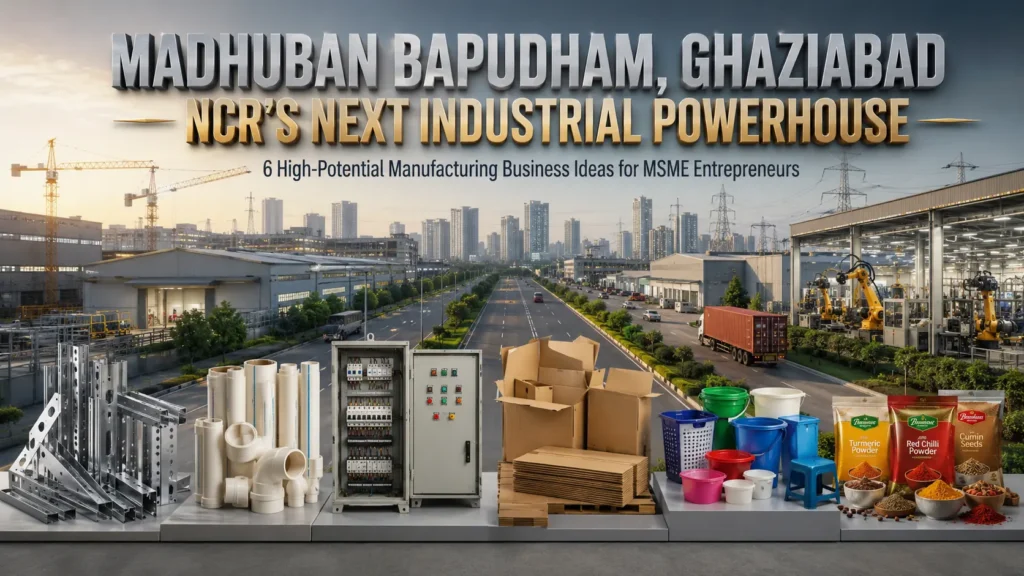

Madhuban Bapudham Industrial Hub
One News Report That Could Reshape Your Business Direction
Recently, the Navbharat Times published a report that has immense ramifications for not just entrepreneurs but MSMEs in the National Capital Region. As per this report in Navbharat Times, the Madhuban Bapudham area of Ghaziabad is slated to become a significant new industrial location with more than 200 factories in the area and the plan to provide jobs to over 5000 youths. It’s no ordinary real estate story. It’s a market shift signal, a signal that will create wide business opportunities for entrepreneurs, suppliers and service providers in coming 3-5 years.
Ghaziabad has been one of the significant industrial centres of NCR for long. The key areas of the corridor has been manufacturing activity for decades at Sahibabad Industrial Area, Loni and Modinagar. Today, Madhuban Bapudham is becoming a new industrial pole and entrepreneurs who grasp this development early will be in key position to steer their sectors of the future.
The development is particularly significant given the direct access via the Delhi-Meerut Express Highway, connection to the Duhai Namo Bharat RRTS station, and planned infrastructure growth by the Ghaziabad Development Authority. These combine to give conditions which are not usual for most emerging industrial zones. The question is not if this area will be growing, it is only if you will be part of that growth.
Navbharat Times reports that Ghaziabad Development Authority (GDA) has formally given its approval to Madhuban Bapudham as an industrial area. The main facts of this development are:
- 200+ factory units to be systematically established
- 5,000+ direct, youth employment positions
- A total of 1,200+ hectares of integrated mixed-use township planning.
- 5 km from Duhai RRTS (Namo Bharat) station — direct rail connectivity with Delhi and Meerut.
- GDA-supported modern infrastructure: underground electrical power lines, cycle tracks, wide internal roads and central water supply
What does this mean to entrepreneurs? When 200+ factories come together into one zone, a full-service economy develops around them. Canteens, logistics operators, safety equipment companies, staffing agencies and warehousing companies all have immediate demand. Navbharat Times’ report is the first official announcement in public and early movers often end up securing the biggest market share.
Related Article: Ghaziabad’s ₹500 Crore Industrial Push: 6 Manufacturing Units Smart Entrepreneurs Are Setting Up in Madhuban Bapudham
Why This Industrial Belt Is Growing — 5 Solid Reasons
1. Land Scarcity in Core NCR Creates a Ghaziabad Opportunity
Small and medium entrepreneurs have found land in Delhi and Noida for their industrial purpose far too costly. With government support from the Madhuban Bapudham, it has started offering structured plots at fair prices without any party disputes and speculative pricing. It is very important for the first-time factory owners.
2. RRTS Connectivity Is a Genuine Game-Changer
It takes less than 30-40 minutes to reach Delhi from Meerut from Duhai Namo Bharat RRTS Station, which is 1.5 km away from the township. Widely distributed commuters who can count on commuting. The expressway and rail access is an advantage for freight movement, and this is something that older industrialized areas in the region don’t have.
3. UP MSME Policy Offers Tangible Financial Benefits
The Uttar Pradesh Government has announced the MSME policy that offers tangible financial support to industrial units in Ghaziabad with 50% stamp duty exemption, EPF reimbursement for 5 years, etc. These incentives are detailed in Invest UP’s official MSME page. These aren’t promises to be made, they’re active policy provisions.
4. Make in India and PLI Schemes Are Fuelling Manufacturing Demand
Government of India’s Production Linked Incentive (PLI) scheme is encouraging massive investment in Indian manufacturing. Such national policies are directly impacting new industrial areas such as Madhuban Bapudham, which are welcoming anchor manufacturers, and thereafter there is demand for 40 or 50 MSMEs.
5. Five Thousand Jobs Mean Five Thousand Consuming Households
Secondary spending is generated by 5000 new jobs in a zone. Demand surges in the housing, food, transport, healthcare, retail and personal services sectors. The business opportunity at Madhuban Bapudham is therefore not restricted to the industrial supply, it’s extended to the services of the working population.
Government Schemes and Incentives That Will Support Your Business
The combination of central and state government programmes provides a robust support program for MSME entrepreneurs entering new industrial areas. Some of the important schemes available on the official portal of the MSME Ministry are:
- PMEGP (Prime Minister’s Employment Generation Programme) — 25-35% capital subsidy to set up a new manufacturing unit
- This is government-initiated free online MSME registration for Udyam registration and availed government benefits and priority access.
- Collateral-free loans available to eligible MSME entrepreneurs up to ₹2 crore through CGTMSE.
- In Ghaziabad, stamp duty exemption has been introduced under UP MSME Policy, which will be 50% for 5 years, and EPF reimbursement will be 100% for 5 years.
- The PLI Scheme, which is a production linked incentive scheme for priority manufacturing sectors, was established. Production linked incentive scheme for priority manufacturing sectors, PLI Scheme was created.
As per Startup India official website, registering on the platform gives a lot of advantages to the startups including tax exemption, a curated network of funding, a mentorship ecosystem, etc. which are directly relevant to the entrepreneurs launching their startups in emerging industrial zones.
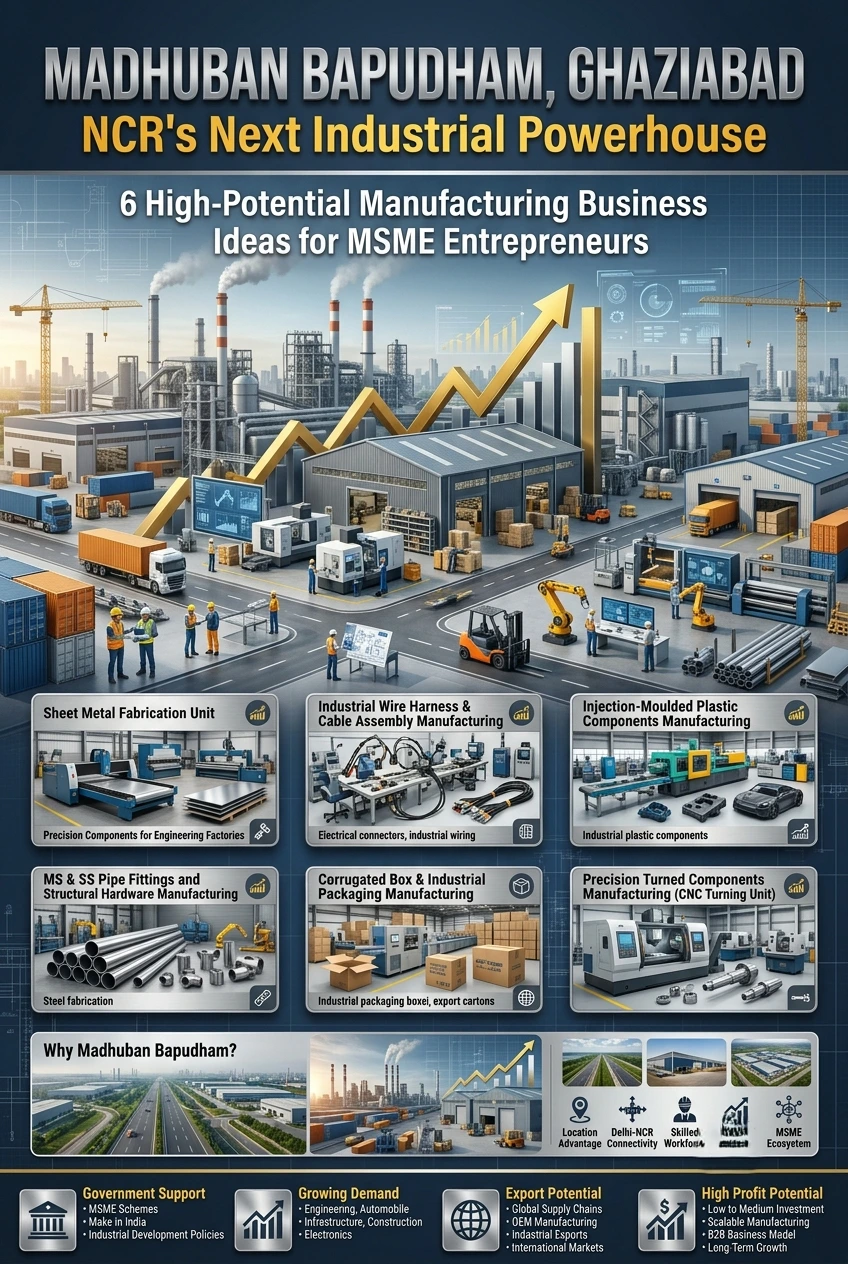
6 High-Potential Manufacturing Business Ideas for Madhuban Bapudham
Considering the industrial DNA present in Ghaziabad and the type of anchor factories that are most likely to establish in Madhuban Bapudham, six manufacturing units have been identified, which a first generation MSME entrepreneur can easily establish in this zone. Every idea is based on an existing demand, there are government schemes available, and it is kept at the MSME entry. These are viable from day one with reported Navbharat Times 200+ factory ecosystem, as buyers will be just a next-door neighbour!
1. Sheet Metal Fabrication Unit (Precision Components for Engineering Factories)
All engineering, auto-ancillary and electrical equipment manufacturing companies in the zone will require to have their requirements met by the fabrication of sheet metal parts, such as brackets, enclosures, panels, frames and housings, as per their specifications. A sheet metal fabrication shop can have laser cutting, CNC punching and bending equipment, and can meet the needs of 15-20 factories in the cluster at the same time.
This is the most tested manufacturing category in Ghaziabad as Sahibabad has been doing it for decades. The setup cost is in the range of ₹40-80 lakh for a basic MSME unit that includes 3-4 CNC machines. Revenue to be generated: ₹50-1.5 crore per annum through B2B supply contracts with 10-12 factory customers. The barrier to entry is machine investment and CGTMSE collateral-free loans offset that barrier.
2. Industrial Wire Harness and Cable Assembly Manufacturing
Every electrical panel, every generator, every machine tool, and every car or other automotive component has a nervous system—the wire harness. The Madhuban Bapudham zone, which will be a likely hotspot for electrical and auto-ancillary factories, will keep up the demand for assembled wire harnesses and cable sub-assemblies. Ghaziabad already has facilities for providing supplies to Bharat Electronics Limited (BEL) at Sahibabad. A new wire harness unit that is pitching for the market of factories in the cluster comes with no import competition and significant export potential (this is truly Made in India). Setup cost: ₹25-50 lakh. Export opportunity: wire harnesses are exported to the Gulf and Southeast Asia through DGFT’s FTP. Margins: 22-30% on B2B supply.
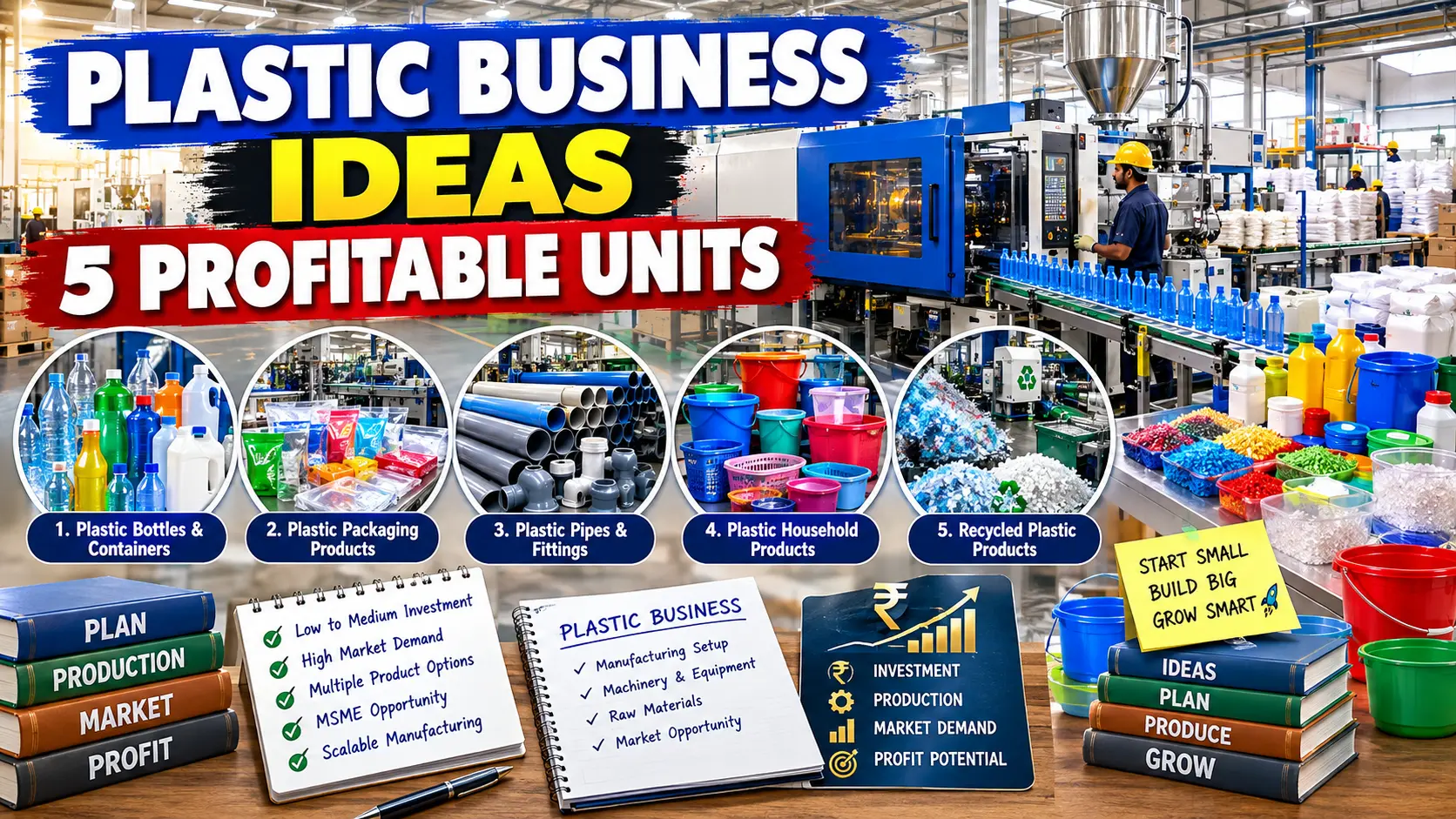
3. Injection-Moulded Plastic Components Manufacturing
Plastic injection moulding is one of the most diversified Manufacturing Sub-Microsmic (MSME) categories in NCR. Components are machine guards, housings, knobs, switches, connectors, bins and structural parts are utilized across engineering, FMCG, electronics and auto sectors. A 4-6 machine injection moulding unit can be used to serve various factories categories with a single moulding setup in Madhuban Bapudham. Being in proximity to the petrochemical supply chain in Noida ensures that Ghaziabad has competitively priced raw material costs. Setup cost: Rs.35-70 Lakh (4 machine unit). The key advantage is the fact that the moulds are funded by the client (customer) which minimises the working capital risk. The PLI scheme provides incentives for components for electronics manufacturing using plastics.
Get Detailed Project Report (DPR): Injection Moulded Plastic Goods with PVC Chappals
4. MS and SS Pipe Fittings and Structural Hardware Manufacturing
Mild steel pipe fittings, fasteners, structural clamps, nuts, bolts and hanger assemblies will be used in all factories in the zone for construction and maintenance throughout the life of the factory. A pipe-fittings and structural hardware manufacturing unit, which makes standardized products in a defined size range, can provide the construction phase of the zone and shift to continuous maintenance supplies when the factories are operational.
This is a business of double revenue, with revenue from the construction phase as well as the continued operational phase. Setup cost: ₹30-60 lakh. Availability of raw material at competitive rates is ensured due to the availability of steel supply chain in Ghaziabad already established (C.R. Strips, G.I. Tubes manufacturers are already in the district).
Get Detailed Insights from This Book: Handbook on Steel Bars, Wires, Tubes, Pipes, S.S. Sheets Production with Ferrous Metal Casting & Processing
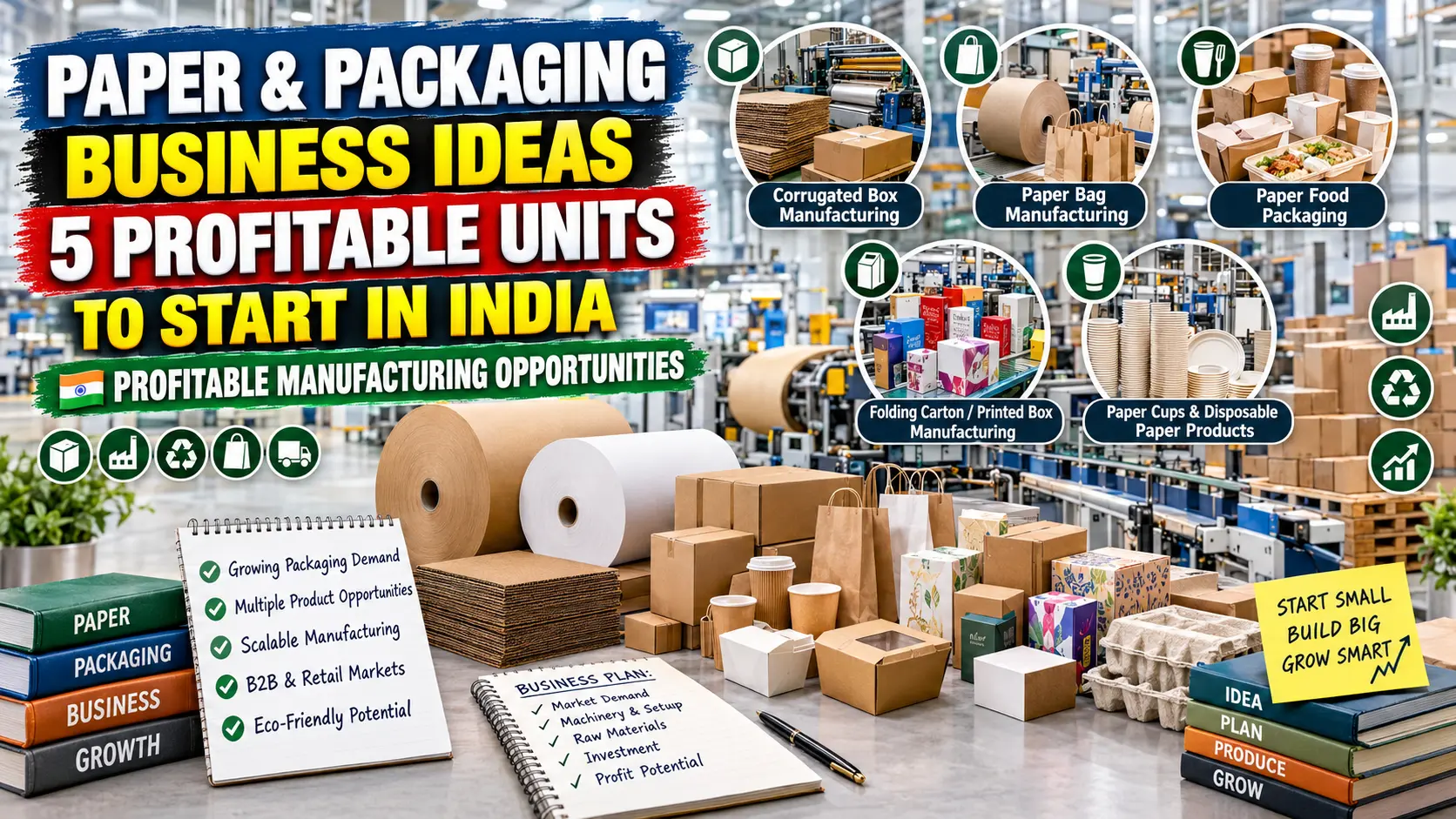
5. Corrugated Box and Industrial Packaging Manufacturing
This is not a trading business; this is a manufacturing opportunity! Corrugated boxes will be required for all the factories of Madhuban Bapudham cluster for shipping finished goods. A corrugated box manufacturing plant provides semi-automatic or automatic corrugation line that can make boxes to the factory specified size on order. A packaging manufacturer’s dream of getting its product into a short distance with a lot of orders and monthly consumption is the captive demand from 200+ factories in a single zone. This is the approximate setup cost of a semi-automatic Plant (Rupaiye 50-90 Lakhs). Annual turnover of the business at cluster level is ₹80 lakh to ₹2 crore. Raw material (Kraft paper) is purchased from UP’s existing paper mills.
6. Precision Turned Components Manufacturing (CNC Turning Unit)
CNC precision turned parts like shafts, bushes, pins, spindles, threaded inserts, and hydraulic fittings are used in large quantities by engineering, auto-ancillary, pump manufacturing and valve manufacturing factories. Depending on the zone location, depending on the factory category, multiple factory categories can be provided by one precision CNC turning unit, which consists of 6-10 CNC lathes and a basic quality inspection setup.
There is huge export potential in this sector with the European and Japanese automotive and engineering OEMs picking precision turned components from Indian MSMEs. Installation expenses: Rs. 60 lakh – 1.2 crore (based on the quality of the machine). It is a remarkably positive export story as precision turned components have been featured as one of the fastest growing engineering exports in UP consistently since the beginning of the year, according to FIEO (Federation of Indian Export Organisations) data.
Import-Export Opportunity Analysis
Madhuban Bapudham becoming an industrial hub will be a significant boost to Ghaziabad’s export potential. Uttar Pradesh already has the distinction of becoming a leading state in export of Engineering goods, Handicraft, Readymade Garments and Food processing.
All the entrepreneurs interested in export opportunities should enroll an IEC (Import Export Code) and learn the current Foreign Trade Policy from the official portal of DGFT. Ghaziabad’s strategic location near Inland Container Depot (ICD), Delhi, makes export logistics much cost effective than the majority of the cities of NCR.
- Engineering components and auto parts – high demand from the Gulf countries, Japan, Germany and the USA.
- The demand for plastic and rubber products has increased in ASEAN markets.
- The Indian diaspora market in the Middle East and Europe has become an important market for FMCG and packaged foods. The Indian community in the Middle East and Europe are a growing market for FMCG and packaged food.
- With the government’s push towards electronics manufacturing in India, electrical components offer opportunities to export.
There are active international buyer networks maintained by industry chambers like FICCI and CII that Ghaziabad based manufacturers can tap. If you are a new factory owner, the best way to reach international markets is by establishing a connection with an export promotion council of the relevant product category.
Indian MSME Success Stories: Why Ghaziabad Works
Sahibabad: The proven legacy of Ghaziabad
Sahibabad Industrial Area, which has been adjacent to Madhuban Bapudham development zone, has been NCR’s biggest manufacturing hub for decades. Hundreds of MSME companies involved in electrical goods manufacturing, steel and chemical manufacturing have their base here with thousands of crores worth of annual turnover. The next chapter to Madhuban Bapudham is the same industrial story.
We will provide small starts, large outcomes.
There are several MSMEs who have taken up a business with Rs 2-5 lakhs and have grown it to a crore worth of business every year from Ghaziabad. Navbharat Times has been recording the stories of entrepreneurs who have picked up a location at an appropriate time and put themselves in a leading position in their respective industries. Madhuban Bapudham is just such an early-mover moment, one here and now, for those who are ready to act.
NPCS – Niir Project Consultancy Services: Your Trusted Business Partner
Before entering any new industrial zone, a credible feasibility report and project plan are essential — for your own decision-making, for bank loan applications, and for government subsidy claims. NPCS (Niir Project Consultancy Services) is one of India’s most established industrial consultancy firms, with decades of experience supporting MSME owners, first-time entrepreneurs, and startup founders. Their services include:
- Industry-specific feasibility and market demand reports
- Project cost estimation and ROI analysis
- Licensing and regulatory compliance guidance
- Manufacturing process and technology advisory
- Detailed Project Reports (DPRs) for bank loan applications
Entrepreneurs who enter Madhuban Bapudham’s ecosystem with a structured NPCS project report behind them make fewer costly early mistakes and are better positioned to access institutional financing from day one.
Identify high-growth industries before others do
Data Snapshot: Madhuban Bapudham Industrial Hub — Key Facts
| Parameter | Details |
| Location | Madhuban Bapudham, Ghaziabad (NCR) |
| Total Area | 1,200+ hectares |
| Planned Factories | 200+ industrial units |
| Employment Target | 5,000+ direct jobs |
| RRTS Connectivity | 1.5 km from Duhai Namo Bharat Station |
| Highway Access | Delhi-Meerut Expressway (NH-9) |
| GDA Stamp Duty Benefit | 50% exemption for MSMEs in Ghaziabad |
| PMEGP Subsidy | 25-35% of project cost |
| CGTMSE Loan Cover | Up to ₹2 crore without collateral |
| Top Manufacturing Opportunities | Sheet metal, wire harness, plastic moulding, pipe fittings, corrugated boxes, CNC turned parts |
| Development Authority | Ghaziabad Development Authority (GDA) |
Frequently Asked Questions (Manufacturing Founder-Focused)
Q1. How much capital is realistically needed to set up a manufacturing unit in Madhuban Bapudham?
Based on the segment, an investment starting from 25-50 lakh may require 4-6 machines for setting up a wire harness or CNC turned components unit. For sheet metal fabrication or plastic injection moulding you need anywhere between 40-80 lakh for setting up a simple MSME unit. A corrugated box plant would need anywhere between 50-90 lakh. The key thing here is that CGTMSE provides collateral-free loan up to 2 crore. This combined with PMEGP subsidy of 25-35% will further reduce the capital that you actually invest.
Q2. What licences and registrations do a manufacturing unit need before starting production?
The mandatory sequence: (1) Udyam Registration — free, online, 30 minutes; (2) Factory Registration under the Factories Act with the UP-Labour Department; (3) GST Registration; (4) Pollution Control Board consent (for processes involving chemicals, fumes, or effluent); (5) BIS certification if producing standardized products like pipes or fittings. For export units, add IEC registration from DGFT. Your DIC (District Industries Centre) in Ghaziabad can guide the full sequence.
Q3. Which of the 6 manufacturing ideas has the fastest path to first revenue?
Wire harness assembly and CNC turned components both reach first revenue fastest — typically 8-12 weeks after setup — because they require minimal construction, produce immediately saleable output, and factories pay on 30–45-day credit cycles. Sheet metal and corrugated box plants take 3-5 months to reach operational stability but then generate higher monthly volumes. Injection moulding is middle-ground: mould tooling from the client funds a large portion of setup, shortening effective payback.
Q4. Is raw material supply reliable in Ghaziabad for these manufacturing categories?
Yes — this is one of Ghaziabad’s structural advantages. Steel (MS, SS, GI) is available from Sahibabad and nearby Meerut’s established steel traders. Plastic granules (PP, HDPE, ABS) flow from Noida’s petrochemical distribution network. Kraft paper for corrugated boxes comes from UP’s paper mills. Copper wire for harnesses has multiple NCR suppliers. Being inside NCR’s supply chain eliminates the raw material access problem that affects manufacturers in more remote industrial zones.
Q5. Can these manufacturing units export from Ghaziabad, and how practically accessible is that?
Very practically accessible. Register an IEC code from DGFT’s portal (₹500, fully online). The Delhi ICD (Inland Container Depot) at Patparganj is approximately 35 km away — the most commonly used export gateway for NCR manufacturers. CNC turned components, wire harnesses, sheet metal parts, and plastic components all have active international buyers. Precision engineering exports from UP have been growing consistently. First export orders typically come through trade fairs (Engineering Expo, IMTEX) or FIEO’s buyer-seller meets.
Q6. How does NPCS help a first-time manufacturing entrepreneur specifically?
NPCS (Niir Project Consultancy Services) produces detailed project reports for each of these manufacturing categories — including plant layout, machinery list with sourcing contacts, raw material specifications, manpower requirements, project cost, and 5-year financial projections. Banks require a DPR in this format for loan processing. Government agencies use it for PMEGP and other subsidy approvals. For a first-time manufacturer, this report is the difference between a professional bank presentation and a rejected loan application.
Conclusion: The Market Signal Is Clear — Act While the Advantage Remains
Navbharat Times‘s report on Madhuban Bapudham is more than a local development story. It is a market signal that a significant new industrial ecosystem is forming in Ghaziabad — and that the window for early entry, with lower land costs, minimal local competition, and full eligibility for government incentives, is open right now.
Two hundred factories, 5,000 jobs, and 1,200+ hectares of structured development will collectively reshape the economic geography of western Uttar Pradesh. The entrepreneurs who move early — with proper feasibility planning, government registrations in place, and a clear understanding of the service gaps this ecosystem will create — are the ones who will build lasting businesses here.
The support framework is already there. MSME Ministry schemes, Startup India’s registration benefits, and Invest UP’s MSME incentives are all active and accessible. The Navbharat Times report has given you the earliest public signal of this opportunity. The decision to act on it — or wait — is yours to make.