
PET Preform Manufacturing Business
Where Real Manufacturing Business Ideas Are Made
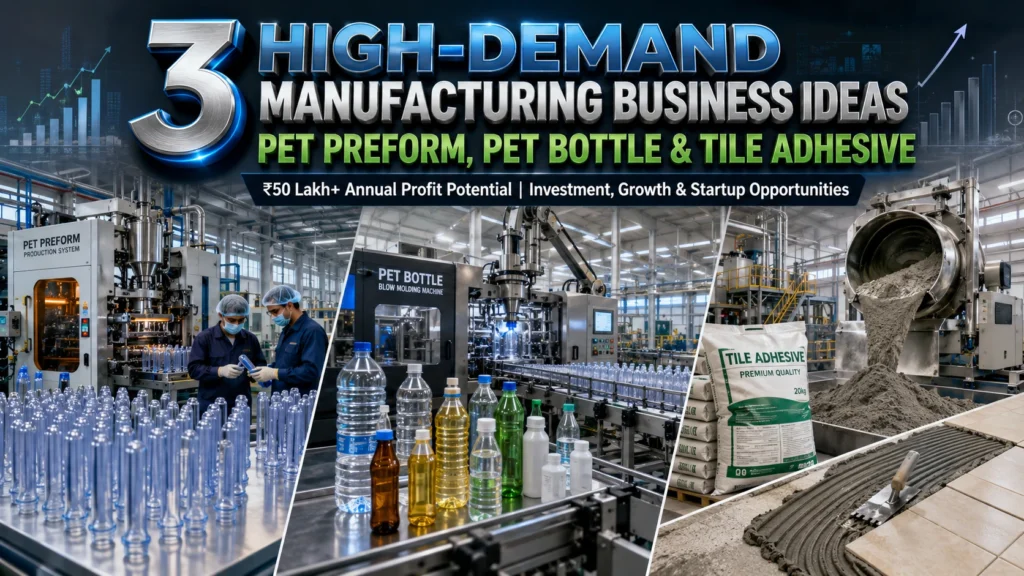
As a nation on a fast track to a $5 trillion economy, the best business concepts often cannot be enjoyed in apps or fintech, but rather reside in the supply chain of everyday materials. PET preforms, PET bottles and tile adhesive might not be in the headlines, but they work behind the scenes to provide the backbone to India’s booming beverage sector, construction industry, and pharmaceutical supply chain. They’re not down-under plays.
They are policy-mandated, demand-driven, capital efficient manufacturing avenues that are increasingly seen as one of the surest bets entry points for the manufacturing sector by first-generation entrepreneurs, MSME investors, and industrial consultants. These three segments are ones that should be closely monitored by anyone who is considering investing money on a project at the next investment cycle.
Get Detailed Insights from This Book: Our Books
Why This Sector — And Why Now
Urbanization, organised retail and government infrastructure initiatives have put packaging and construction materials in a highly conducive situation. India’s per capita consumptions of packaged beverages are far below the global average and, for the PET packaging entrepreneur, this is nothing but structural space for growth. The disorganized construction material segment, on the other hand, is undergoing transformation in response to the rising demand for performance-based adhesives for tiles, as seen in the quality-driven approach of real estate developers and the mass housing goal of Pradhan Mantri Awas Yojana.
India’s export prospects are good as the quality-price positioning is in their favour in the markets of Southeast Asia, Middle East, and parts of Africa. The domestic tile adhesives market is at a similar juncture—with the Indian flooring market shifting away from commodity tiles to higher value formats, the adhesive requirement per square metre has risen and so has the margin. These are not cyclical tailwinds; they are structural trends that are being fueled by regulatory adjustments, construction standardisation and urbanisation and income growth.
Government Policies and Incentives Supporting Entry
The government has made clear its intention to drive growth through manufacturing and it has given support for this in practice. The industrial infrastructure support, funding for technology upgradation, and single-window clearances are applicable to plastic packaging and construction material manufacturing units under the Make in India scheme. The Credit Guarantee Fund Trust for Micro and Small Enterprises (CGTMSE) scheme is a crucial support for first-generation entrepreneurs who do not have legacy assets to put up as collateral for loans for up to ₹2 crore, for MSME-registered units by the Ministry of Micro, Small & Medium Enterprises (MSME).
The CLCSS (Credit Linked Capital Subsidy Scheme) of the DPIIT offers Capital subsidy of up to 15% for Technology Upgradation in Small Enterprises, applicable for Small PET Processing units who are investing in newer Injection Moulding or Blow Moulding technology. The Production Linked Incentive (PLI) framework is now focussed on the high investment sectors, but has generated momentum in the ecosystem, resulting in Tier-2 suppliers such as PET preform manufacturers, who serve large FMCG customers being benefitted. The National Housing Bank (NHB) and PM Awas Yojana are fueling the demand for tile adhesive in affordable housing market, which is providing regular off-take for new manufacturers.
Other state governments have provided interest subventions, power tariff concessions and land package in the greenfield clusters of manufacturing units located in the industrial estates offered by various states, which significantly reduces capital deployment by the proponents of new projects.
Manufacturing Business Ideas for Startups: Product-Wise Analysis
1. PET Preform Manufacturing from PET Resin
A crucial entry point in the Indian packaging economy is PET preforms, intermediate mouldings in test tubes that are then stretch blow-moulded into PET bottles. The business model is simple in structure and requires utmost care in execution: raw PET resin (mostly obtained from Reliance Industries and IOCL and imported grades from Korea and China) is dried and then injection moulded with precise temperatures and pressures to get preforms of specific neck finish, weight and wall thickness as per client specifications.
If a mid-size unit (4-6 injection moulding machines with a combined output of 8-12 million preforms per month) operates at prevailing market prices, it can generate a revenue of ₹4-6 crore/month, excluding other expenses such as resin cost, while the EBITDA margin is likely to range from 12-18% depending upon the efficiency of resin procurement and capacity utilisation.
This is especially appealing to new investors thanks to the customer profile. PET preform buyers in the Indian market include some of the most credible players in the FMCG, beverage, and pharmaceuticals and personal care segments where the entire payment cycle is more or less standardised and there is a predictable offtake. Even having a committed supply contract with two or three local branded mineral or beverage water companies can give the base revenue predictability necessary to repay project debt.
The following are important technical factors: 28mm, 38mm or custom finishes for the neck, IV (Intrinsic Viscosity) control in order to achieve the barrier properties, and optimisation of cycle time for the control of the per-unit conversion cost. The payback period is usually 3 – 4 years, for a commercially viable plant capital investment is in the range of ₹1.5 – 3 crore with 70%+ utilization of the machines.
2. PET Bottle Manufacturing
The downstream part of the PET bottle value chain, after preform production, is the PET bottle segment, and it can be said that it is the more commercial part from the perspective of the public. These are either bought or produced in-house and are then stretched to the final bottle shape under air pressure in a mould (stretch blow moulding). PET bottles are used in beverages (carbonated soft drinks, juices, water), edible oil, pharmaceutical syrups, personal care (shampoo, hair oil, lotions) and home care products in India.
Every segment is driven by specific specification demands – such as pressure ratings for CSD bottles and HDPE demands for pharma applications – and the small business person stepping into this area needs to create a product mix strategy that will accommodate complexity and margin.
The business logic for dedicated PET bottle manufacturing units is strongest in geographies with concentrated FMCG manufacturing clusters — Haridwar, Pune, Hyderabad, Ahmedabad, and Chennai being notable examples where bottle consumption density justifies proximate supply. Integrated operations that handle both preform and bottle manufacturing have demonstrated stronger margin profiles, as conversion cost control becomes a competitive differentiator when selling to volume clients. A mid-size operation targeting 50–80 million bottles per annum can generate revenue between ₹15–25 crore, with net margins in the 10–14% range for well-managed units. The shift toward lightweighting (lower-gram bottles at the same volume) is a key industry trend that progressive manufacturers are leveraging to reduce resin consumption and improve cost-per-bottle metrics.
Market intelligence from the Confederation of Indian Industry (CII) consistently highlights packaging as one of India’s fastest-growing manufacturing sub-sectors, with rigid plastic packaging commanding the largest volume share within the broader packaging industry.
Get Detailed Project Report (DPR): PET Bottles Manufacturing Plant Report
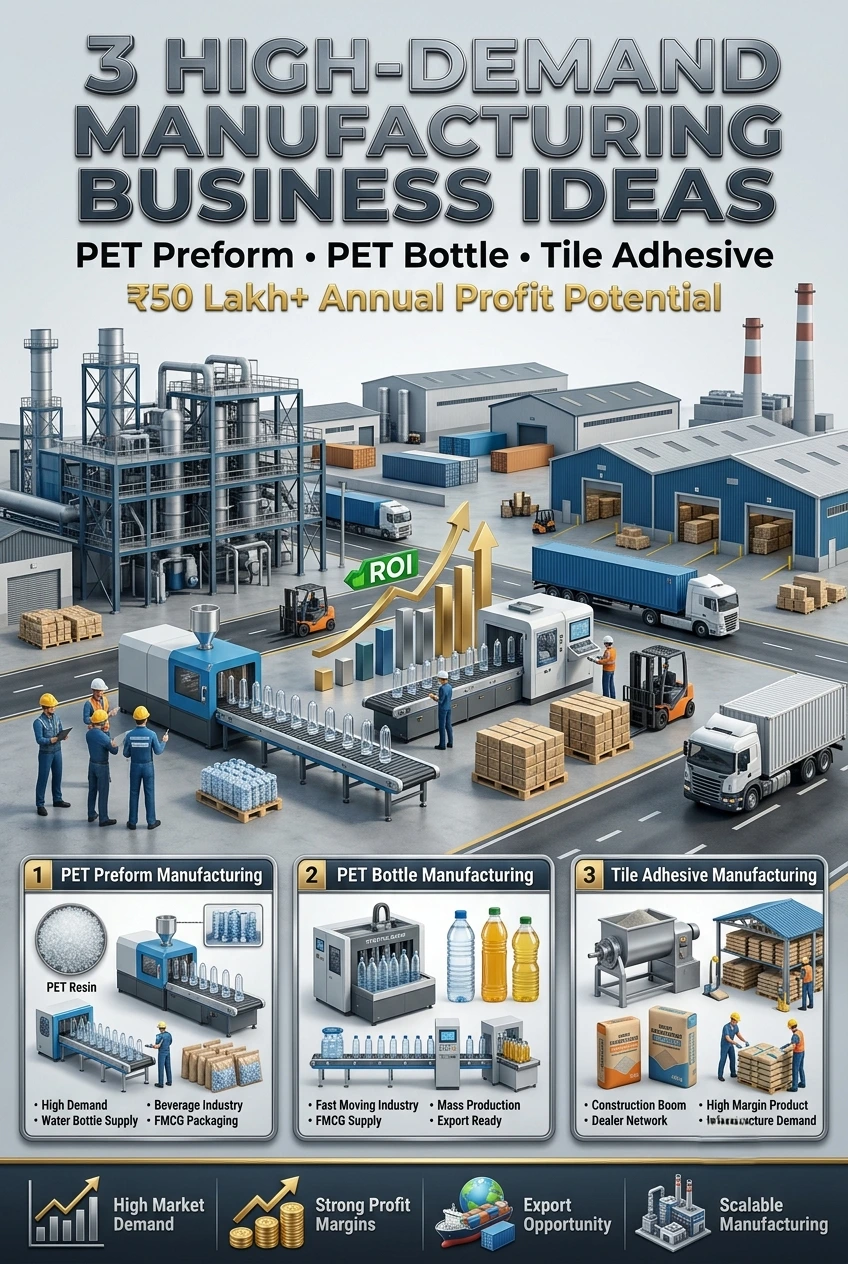
3, Tile Adhesive Manufacturing
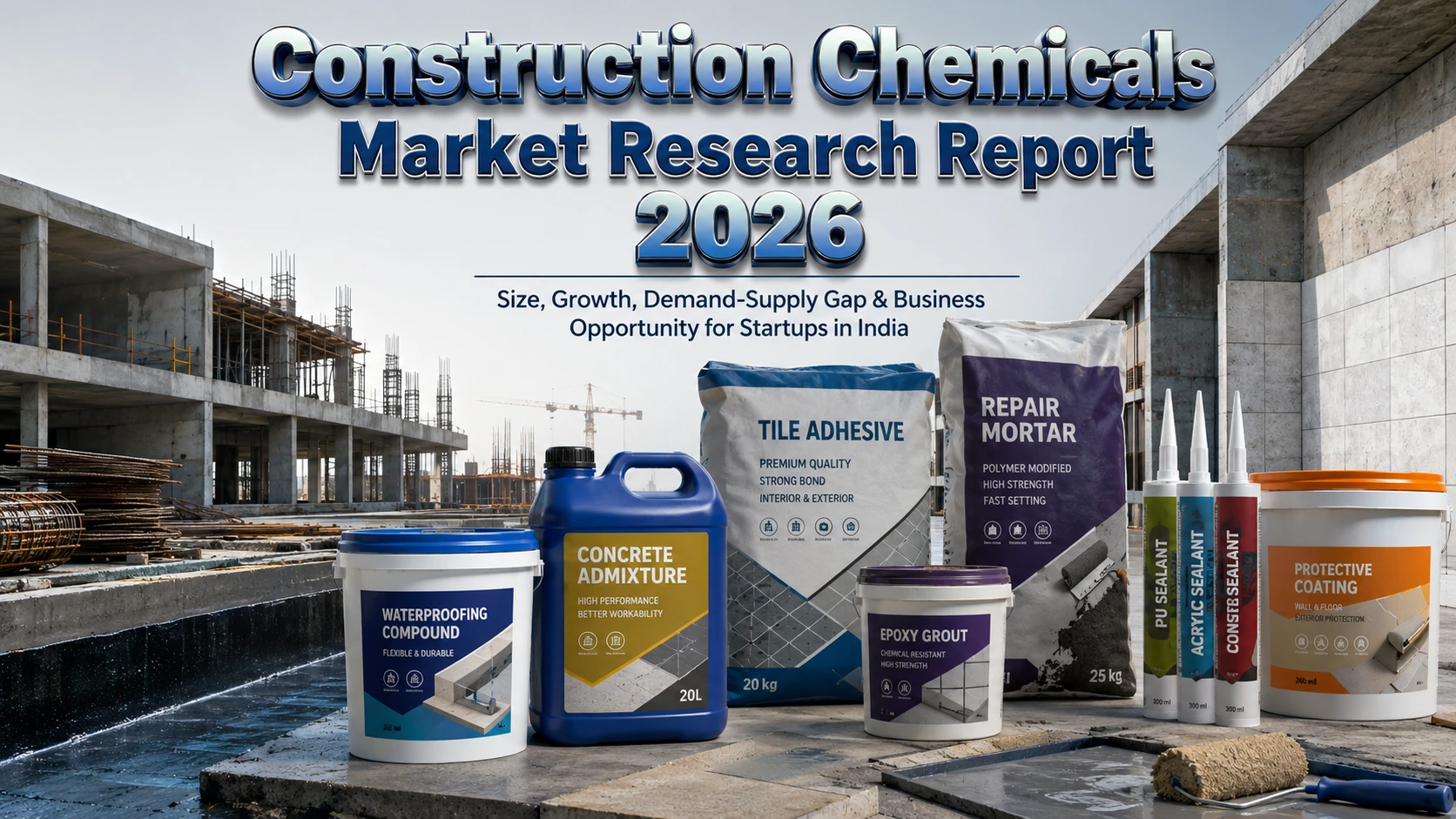
A dry-mix, polymer-modified cementitious product for application in the installation of ceramic, vitrified and natural stone tiles for walls and floors. Previously a specialty in high end applications, it is rapidly becoming mainstream in construction due to the rise in popularity of large format tiles which are unable to be applied with a sand-cement mortar, the demand for high-quality finishes in mid-market housing and the time and waste savings it provides contracting teams. The core customer base for this product is India’s construction industry, which is the second-largest employer after agriculture and contributes 25% to the country’s GDP.
Manufacturing of tile adhesive is a relatively capital-intensive process relative to many industrial products. The production process includes dry blending of Portland cement, graded silica sand and specialty polymers (mainly HPMC – Hydroxypropyl Methylcellulose, RDP – Redispersible Polymer Powder), as well as open time, sag resistance and water retention additives. The investment for the annual capacity of 15,000-20,000 MT is ₹80 Lakhs to ₹1.5 Crores based on level of automation and land utilisation.
At the product level, gross margins are around 28-35% and are one of the highest margin dry mix construction products. Factors that are essential for success are the sourcing of the raw materials (especially polymer powders, which are primarily imported) and formulation quality that is able to withstand field performance testing, along with a distribution system that can make the product available to both tile dealers and construction contractors.
Structurally, the addressable market is expanding over the next ten years with the progressive adoption of quality adhesive systems in construction projects due to favourable regulatory environment, which is being created by the Indian Green Building Council (IGBC) and new BIS standards.
Related Article: India Adhesives Market Report
Import–Export Opportunity Analysis
The Indian trade position in the PET and construction material sector is complex and presents a great opportunity for the right start-up. The main exposure for PET manufacturers in the import market is resin pricing, which is a petrochemical product (PET resin) that is much affected by the crude oil activity and the demand-supply dynamics in Asia. India is importing significant quantity of PET resin mainly from China, South Korea and Taiwan. The long-term contracts for supply and the DGFT (Directorate General of Foreign Trade) schemes of advance licensing and duty drawback can be of great value for those who are entrepreneurs and can availed these facilities to protect their cost structure from the price volatility in the imports.
As far as exports are concerned, Indian PET bottle and preform manufacturers have proven to be competitive based on their unit economics in markets that are labour cost competitive and close to them. Gulf Cooperation Council (GCC) countries, Sri Lanka, Bangladesh and some African markets have proved to be good export destinations for the Indian-origin PET packaging. Market development assistance and export promotion support is available for MSME exporters through the Plastic Export Promotion Council (PLEXCONCIL) which conducts buyer-seller meets, trade delegations and awareness programmes specifically for packaging manufacturers.
The export potential for tile adhesive is mainly in the countries where construction activities are ongoing, like Bangladesh, Nepal, Sri Lanka, parts of East Africa, and India, which is not far and has similar product quality to the price point which provides genuine commercial advantage. The existing cement industry and specialty chemicals manufacturing base in India gives it a cost base which is hard to match in smaller regional markets. Formulations designed for export from the beginning of the process should be developed keeping in mind adherence to international specifications like EN 12004 (European classification of tile adhesives) and BIS standard for indoor use.
Indian MSME Success Stories: Lessons from the Field
Manjushree Technopack – Building a Rigid Packaging Empire
Operating out of Bengaluru, Manjushree Technopack is one of the most educational examples of a PET packaging startup in India, which was established by the Kedia family. It started as a small rigid packager with a narrow range of products and now grown to become one of the biggest PET bottle and preform manufacturers in the country providing to Coca-Cola, PepsiCo, Marico, and many other top FMCG companies.
The rationale behind the startup was simple: find a manufacturing need near consumer goods hubs, build quality infrastructure before it got squeezed, and grow it back by reinvestment, not over-leverage it. A Manjushree story once again emphasizes the significance of close-fitting strategy, positioning on quality basis, and the prudence of establishing long term supply partnerships with A grade clients, instead of solely going on spot prices.
Pidilite Industries – Chemistry of Market Creation
Today, Pidilite Industries is a listed large cap company but its origin story with Balvant Parekh in Mumbai is certainly a learning for construction chemicals start-ups. In the construction materials market, the answer to the question of what’s the best product is not always the cheapest product, but it’s the one contractors, applicators and builders trust to be the best product.
The Company invested in technical application training, brand building at the contractor level and continual product innovation (such as the Roff brand of tile adhesives and grouts), which formed a moat that pure commodity competitors could not cross. For MSME entrepreneurs coming into the tile adhesive area, the lesson is that the depth of distribution, loyalty applications for contractors and application help are just as crucial as the formulation itself.
Time Technoplast – From MSME to Multinational
The third instructive model is Time Technoplast, Mumbai-based company run in the family by the Goel family, who have transformed the business from being regional rigid packaging manufacturer to multinational with branches in India, Middle East and South East Asia. The growth model of Time Technoplast had been based on the absorption of technology, diversification of products in the plastics market, and judicious capacity additions in tune with demand signals.
Their early investment in industrial packaging before moving sideways into consumer rigid packaging is evidence of the benefit of getting operational competency in one segment, before building adjacencies. As long as the right project foundation is developed, this path from local to regional to export-oriented manufacturing is a very feasible dream for PET entrepreneurs.
Discover business ideas that actually make money
About NPCS – Niir Project Consultancy Services
We at Niir Project Consultancy Services (NPCS) provide professional consulting for the preparation of Market Survey cum Detailed Techno-Economic Feasibility Reports (DPRs) for setting up new industries or businesses. Our reports cover detailed manufacturing processes, market research and demand analysis, process flow diagrams, product mix and capacity planning, machinery and raw material details, and complete project financials with profitability analysis.
Whether you are evaluating a PET preform plant, a tile adhesive manufacturing unit, or any other industrial project, our objective is to help entrepreneurs assess feasibility, validate profitability assumptions, and understand long-term scalability before capital is committed. Our work bridges the gap between an entrepreneur’s intent and an investor-ready project plan — grounded in current market intelligence and real-world manufacturing economics.
Market Overview: Key Metrics at a Glance
| Product | Market Size (India) | CAGR | Key End-Use Sectors | Profitability Index |
| PET Preforms | ₹18,000+ Cr | ~8–10% | Beverages, Pharma, Personal Care | High |
| PET Bottles | ₹22,000+ Cr | ~9–11% | FMCG, Water, Oils, CSD | High–Very High |
| Tile Adhesive | ₹6,500+ Cr | ~12–15% | Construction, Real Estate, Infra | Medium–High |
Note: Market size figures are indicative estimates derived from industry association data and trade body publications. CAGR projections are based on demand modelling across key end-use sectors.
Frequently Asked Questions (FAQ)
Q1. What is the minimum investment required to start a PET preform manufacturing unit?
Commercial Viability A full-fledged PET Preform Plant with a capacity of 3-5 million pieces per month, supporting 2-4 injection moulding machines can be set up for an all-in project cost of ₹1.5 – 2.5 crore, covering machinery, civil works, utilities and working capital margin. Although smaller project size configurations are feasible, they are likely to be constrained by margins owing to lower throughputs. The equity requirement is manageable with bank loans from MSME registered units under CGTMSE scheme for the first-generation promoters.
Q2. Is prior technical experience necessary to enter the tile adhesive business?
While deep chemistry expertise is not a prerequisite, a basic understanding of dry-mix formulation and construction materials applications is valuable. Most entrepreneurs enter this space by partnering with an experienced formulation consultant or hiring a technically qualified production manager. The manufacturing process itself — dry blending of cement, sand, and polymer additives — is relatively standardised, and equipment suppliers typically provide initial process training. What matters more than laboratory expertise is market knowledge: understanding contractor preferences, application requirements for different tile types, and the distribution dynamics of the building materials trade.
Q3. Which location is best for setting up a PET bottle manufacturing plant?
The ideal location is determined by proximity to your target customer base. Given the bulk nature of PET bottles and the logistics sensitivity of packaging-to-filling operations, plants located within 100–150 km of major FMCG manufacturing clusters or beverage filling facilities have a natural freight advantage. Industrial estates around Haridwar, Pune, Hyderabad, Ahmedabad, and Hosur have established track records for packaging manufacturing. State-level incentives — including power subsidies and capital grant schemes — should also factor into the location decision alongside raw material access and labour availability.
Q4. How does resin price volatility affect PET preform/bottle manufacturing margins?
The largest single cost factor in preform and bottle production is PET resin, which contributes approximately 65-75% to the variable cost. Resin price trends move with crude oil and PX levels, and have the potential to move 5-10% even in the space of one year. Mature companies may counter this through a number of mechanisms: build inventory when price is low, enter into fixed volume pre-buy contracts with domestic suppliers likeReliance, enter into indexed price customer contracts, participate in government facilitated advance license-based free import of duty-free resin. New entrepreneurs may have to consider resin price risk as an input to their model, and avoid fixed customer prices without linking the resin price.
Q5. What government schemes specifically support tile adhesive or construction chemicals manufacturing?
Tile adhesive manufacturers (registered with MSME) are eligible for CGTMSE Scheme (for collateral-free term loans), CLCSS Scheme (for subsidy for technology upgradation), and state-specific capital investment subsidy as per industrial policy in the states like Rajasthan, Gujarat, UP which has major construction activity and tile consumption. PLI scheme for speciality chemicals could be considered by bigger size units. Start-up firms with location at or near SEZ or DPITT notified industrial estates will get the benefit of shared infrastructure to reduce the effective cost of establishing a unit.
Q6. Can a startup export PET packaging or tile adhesive directly from India?
Yes — and several MSME-scale operations do so successfully. Export viability depends on unit economics: at meaningful scale (typically above 30% of production being exported), the combination of DGFT drawback benefits, RODTEP (Remission of Duties and Taxes on Exported Products) incentives, and the competitive advantage of Indian manufacturing costs creates a viable commercial case. PLEXCONCIL for plastics packaging and CHEMEXCIL for construction chemicals are the designated export promotion councils that provide market intelligence, buyer introductions, and participation in international trade fairs. Exporters must also ensure product compliance with destination market standards — BIS certification is mandatory for domestic sales and provides a credibility base that can be adapted for regional export documentation.