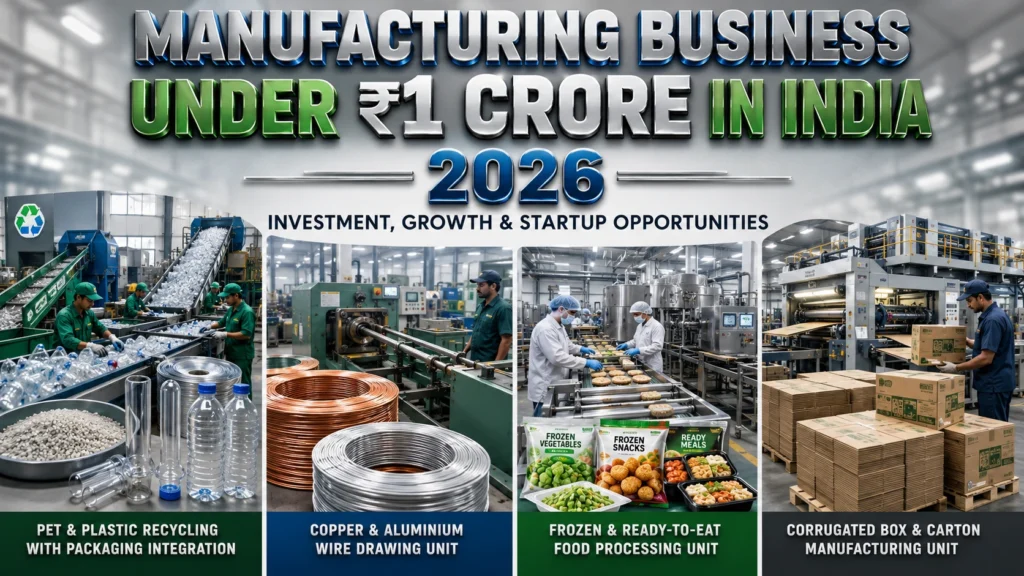

Manufacturing Business Under ₹1 Crore in India
For each and every entrepreneur sitting with ₹1 crore, the question is: Where does this money work best? So, it’s no accident that manufacturing is the honest answer. It builds assets, it qualifies for government subsidy and it generates a business that a bank will re-lend on again next year. This article covers real project report, real client discussion, real factory floor, and real business ideas that are feasible and affordable with a ₹1 crore budget.
Until the price of a compact manufacturing line, crore rupees seem like a lot of money. That’s quickly consumed by machinery, working capital, a small shed and statutory approvals. Fortunately, there are a number of manufacturing segments developed just for these ticket sizes and government assistance brings the price differential even closer, up to 30-40%.
Why Manufacturing Deserves Your ₹1 Crore Right Now
The supply of local food products, local packaged products, and locally manufactured components have lagged behind the demand and India is steadily rising in factory production. No longer a slogan, import substitution is manifested through actual orders from FMCG buyers seeking Indian suppliers, auto-ancillary buyers and export houses for their reliable vendors.
The different nature of manufacturing adds complexity to the trading of manufactured goods. The trading business expands as you increase your investment. A manufacturing facility grows with your capacity utilisation; and capacity can be increased without raising additional equity on quarterly basis. The better the unit is run, the better the margin will be as the fixed cost becomes more spread over the higher turnover, and this is why a well-run unit at 40 lakh turnovers can look totally different at 4 crore turnovers three years later.
Land and power costs are also lower in Tier-2 and Tier-3 industrial areas and state industrial policies often add soft industry support in the form of capital subsidy, stamp duty exemption, and lower power tariffs for new units. It’s not so easy to duplicate in services nor in trading.
Related Article: Medium Investment Manufacturing Business Ideas in India for MSMEs
Government Policies and Incentives That Change the Math
Budget support is not an afterthought here; it can be a deciding factor between a viable project and an unviable one. The Prime Minister’s Employment Generation Programme (PMEGP) provides capital subsidy of 25% (35% in rural areas) for setting up new manufacturing units under funded by KVIC and its partner banks.
The Credit Guarantee Fund Trust for Micro and Small Enterprises (CGTMSE) guarantees loans of up to ₹2 crore without collateral, which is very significant for an entrepreneur who has no collateral to offer for the first time. Many projects worth ₹1 crore are approved only on the basis of a solid Detailed Project Report as collateral is no longer required with CGTMSE.
CLCSS, a scheme of the government provides capital subsidy of 15% for technology upgradation of new machine while PLI scheme provides incentive to the scale generated and exports done in selected sectors like food processing and specialty chemicals. In the meantime, the ZED Certification Scheme provides a financing up to 80% of the certification cost, thus giving a young unit credibility with the bigger buyers sooner than it would otherwise.
Before applying anywhere, entrepreneurs should register in Udyam as nearly all the schemes like CGTMSE and PMEGP treat Udyam registration as the entry ticket.
Manufacturing Business Ideas Worth Backing With ₹1 Crore
Small-Scale PET and Plastic Recycling with Packaging Integration
Plastic packaging waste continues to rise and the new Extended Producer Responsibility (EPR) legislation now requires that big brands in the FMCG sector buy recycled material. A unit that can gather, wash and reprocess PET flakes into granules, and take a portion of those granules to make packaging sheets or strapping, takes margin at two levels, rather than one. Washing and extrusion and pelletising machine is available in the range of ₹60-70 lakh which leaves scope for working capital and Pollution Control Board clearance as well. It is not difficult to find buyers; almost all plastics processors and many packaging exporters today are searching for recycled granule suppliers.
Get Detailed Project Report (DPR): Plastic Waste Recycling Plant
Copper and Aluminium Wire Drawing Unit
Demand for electrical cables follows closely India’s housing and infrastructure cycle and both continue to be in strong growth phase. The setup cost of a wire drawing unit that can take copper or aluminium rod and draw into smaller gauge wire can be from ₹80 lakh to ₹1 crore depending on the capacity of the unit, which requires a wire drawing machine, a furnace for annealing the wire and a wire spooling machine. Even with the margins being thin on paper, this business works when the volume of the business reaches 3-4 tonne per day as it can easily cross ₹20 lakh monthly turnover once the regular buyer base is established by the cable makers and electrical contractors.
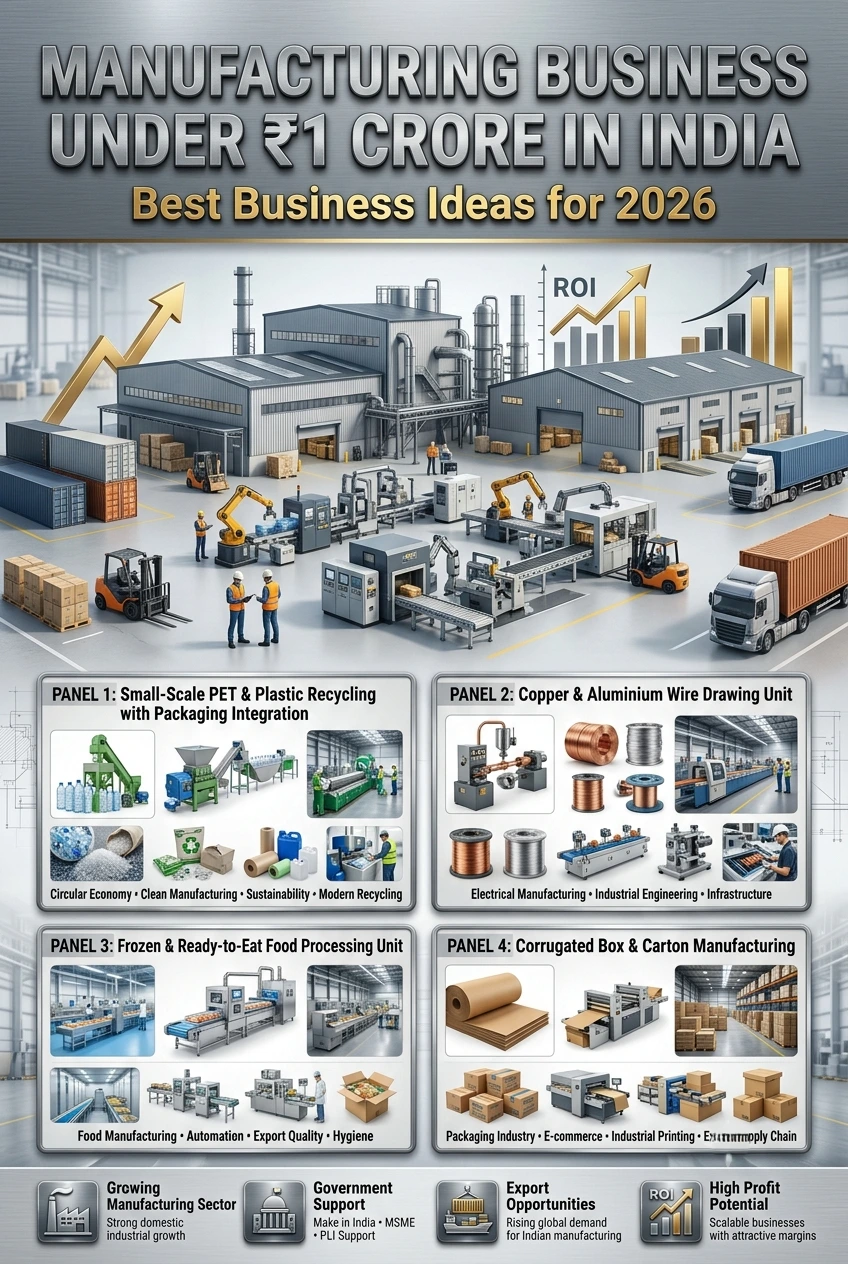
Frozen and Ready-to-Eat Food Processing Unit
Urban kitchens are getting smaller and working families are looking for quick food without compromising on quality. For a small capacity, a blast freezer, cold storage and packaging line is needed for a frozen paratha, as well as snacks or ready-to-eat curry unit, the cost of which is a maximum of ₹60-90 lakh. This section is also non-negotiable, with FSSAI licensing and clean HACCP aligned process, but with some of the healthiest margins on this list, especially for products with regional and ethnic identity that aren’t served by national brands.
Explore This Book: Handbook on Fruits, Vegetables & Food Processing with Canning & Preservation
Corrugated Box and Carton Manufacturing
The demand for corrugated packaging is constant and exists in all ecommerce clusters, especially those. A single or double facer corrugation machine in conjunction with slotting and stitching machine is available between ₹70 lakh and ₹1 crore for a regional scale plant. This business is contract-driven, repeat orders rather than single orders, so it has higher cash flow predictability for a manufacturing business of this size.
Import-Export Opportunity in These Segments
India continues to import sizable quantities of specialty plastic granules and some parts for wire-drawing machines, giving you a hint of where the country’s value addition deficit lies. On the export front, ethnic food products are being processed and frozen and seeing shelf space in the Middle East, UK, and North America through the Indian diaspora retail chains.
The Federation of Indian Export Organisations (FIEO) conducts a programme called ‘buyer-matchmaking’ which can be availed by new manufacturers even in their first year of their manufacturing if the product complies with export packaging and labelling norms. Outward looking corrugated packagers are also witnessing higher demand from FMCG distributors in the Gulf countries which like to buy corrugated packaging material from the countries in between as opposed to from China.
Indian MSME Success Stories Worth Studying
Haldiram’s began as a single sweet shop in Bikaner under Ganga Bishan Agarwal and grew into a multi-thousand-crore food processing empire by staying disciplined about quality while scaling regional flavours nationally. The lesson for a new entrepreneur is patience with product consistency before chasing geographic expansion.
CavinKare, built by C.K. Ranganathan starting with sachet-sized shampoo, shows how a single smart packaging decision, selling small affordable units, can open a mass market that larger competitors overlook. A ₹1 crore manufacturer today can borrow this exact logic in food, personal care, or packaging.
DS Group, which grew from a small tobacco trading operation into a diversified FMCG and food manufacturing conglomerate under the Dharampal Satyapal family, illustrates how reinvesting early profits into new manufacturing lines, rather than pulling them out, compounds a business faster than any external funding round.
How NPCS Helps You Get from Idea to Bankable Project
We at Niir Project Consultancy Services (NPCS) provide professional consulting for the preparation of Market Survey cum Detailed Techno-Economic Feasibility Reports (DPRs) for setting up new industries or businesses. Our reports include detailed manufacturing processes, market research and demand analysis, process flow diagrams, product mix and capacity planning, machinery and raw material details, and complete project financials with profitability analysis. Our objective is to help entrepreneurs evaluate feasibility, profitability, and long-term scalability before investing, so the ₹1 crore goes into a project that a bank, and the market, both believe in.
Discover business ideas that actually make money
₹1 Crore Manufacturing Business Ideas: Quick Comparison
| Business Idea | Approx. Investment | Est. Monthly Turnover | Gross Margin |
| Small PET/Plastic Recycling & Packaging Unit | ₹75 Lakh – ₹1 Crore | ₹18-22 Lakh | 22-28% |
| Copper & Aluminium Wire Drawing Unit | ₹85 Lakh – ₹1 Crore | ₹25-30 Lakh | 12-16% |
| Frozen & RTE Food Processing Unit | ₹60 Lakh – ₹95 Lakh | ₹20-26 Lakh | 25-32% |
| Corrugated Box & Carton Manufacturing | ₹70 Lakh – ₹1 Crore | ₹22-28 Lakh | 18-22% |
Frequently Asked Questions
Which manufacturing business gives the fastest return under ₹1 crore?
Frozen and ready-to-eat food units typically show the fastest cash cycle because retail and modern trade payments come in weeks, not months, unlike B2B industrial supply.
Can I get a bank loan for the full ₹1 crore project cost?
Banks usually finance 70-90% of project cost once CGTMSE guarantee applies, so an entrepreneur’s own contribution can realistically stay between 10-20%.
Do I need a Detailed Project Report even for a small unit?
Yes. Banks will not process a scheme-linked loan without one, and a weak DPR is the single most common reason for rejection or delay.
Is PMEGP subsidy available for all four business ideas listed here?
PMEGP covers manufacturing projects up to ₹50 lakh directly; larger projects can still combine PMEGP-linked components with CGTMSE-backed additional financing.
How long does it take to set up a unit like this?
Machinery procurement, shed readiness, and approvals together usually take four to seven months, depending on the state and the specific licences involved.
Which sector has the least competition right now?
Copper and aluminium wire drawing sees fewer new entrants because of higher working capital needs, which actually keeps margins healthier for organised players.
Conclusion
₹1 crore is enough to build a genuine manufacturing asset in India today, provided the entrepreneur chooses a segment with real demand, keeps the DPR honest about costs and timelines, and structures financing around available government schemes. Plastic recycling, wire drawing, food processing, and corrugated packaging each offer a realistic, fundable path from idea to factory floor. The businesses that succeed are rarely the flashiest; they are the ones where the founder understood the numbers before signing the first machinery order.
References:
Ministry of MSME – msme.gov.in
Make in India – makeinindia.com
Development Commissioner MSME – dcmsme.gov.in
CGTMSE – cgtmse.in
Udyam Registration Portal – udyamregistration.gov.in
FIEO – fieo.org