
B2B Manufacturing Business Ideas for Indian MSMEs
The factory floor of India is stealthily becoming the most potent engine of wealth creation and that is giving a huge opportunity to new B2B manufacturing business ideas. When compared to consumer startups that are looking to satisfy the short-lived desires of retail customers, B2B manufacturers are providing products and services to the demand side of the supply chain that has a deep appetite for reliable, quality consistent vendors. That makes this segment particularly good for the budding entrepreneur.
Large OEMs in all automotive, electrical, construction and FMCG businesses are actively de-risking their suppliers. They would like to see more home vendors, rather than fewer. It is indeed one of the better windows to get into industrial production in India for a founder with a small capital and willing to get his hands dirty to master a manufacturing process.
Why B2B Manufacturing Deserves Serious Attention Right Now
Consumer manufacturing is on a growth trajectory and demand for components, packaging and industrial inputs is continuing to rise. Dozens of smaller vendors need to supply parts, packaging and sub-assemblies to every new appliance manufacturing plant, to every new EV assembly line, to every new FMCG manufacturing plant. Now, a new player can easily slot in into that vendor ecosystem.
This is further complicated by export potential. There has been increasing trend in the global market towards diversification from one country-based purchase to a mix of countries, and India has emerged as a viable option. Therefore, a well-managed small manufacturing plant today can supply the local OEMs or convert into export orders as soon as the quality system is developed.
It’s a similar scenario as B2B, where profitability means it’s better to sell to other businesses than to consumers. Business buyers can buy large quantities, pay over a well-defined credit cycle and are not in the business of spending as much as the consumer products spend on branding and marketing their products. When margins are steadier, it’s not because they’re slimmer, per se, but because volumes and repeat orders do the bulk of the work.
Discover business ideas that actually make money
Government Policies and Incentives Backing New Manufacturers
The government’s involvement in manufacturing has come a long way beyond the subsidies. Credit Linked Capital Subsidy Scheme (CLSS) by the Ministry of Micro, Small and Medium Enterprises and the Credit Guarantee Fund Trust for Micro and Small Enterprises (CGTMSE) are initiatives that provide capital subsidy and remove the collateral barrier for many first-generation entrepreneurs from accessing credit.
The PLI scheme will continue to offer financial incentives on the basis of scale and production to various manufacturing activities, and the MUDRA loan scheme is still the most convenient option for micro enterprises looking for working capital loans of less than a few lakh rupees. In addition, most state industrial policies include capital investment subsidies, waiver of stamp duty and power tariff concessions on the units established in designated industrial areas.
In the meantime, the Make in India initiative is working on these new unit preferences by moving the public procurement agenda toward local manufacturers, albeit in a subtler fashion.
Learn more via the DPIIT, and the Make in India portal.
Multiple B2B Manufacturing Business Ideas Worth Exploring
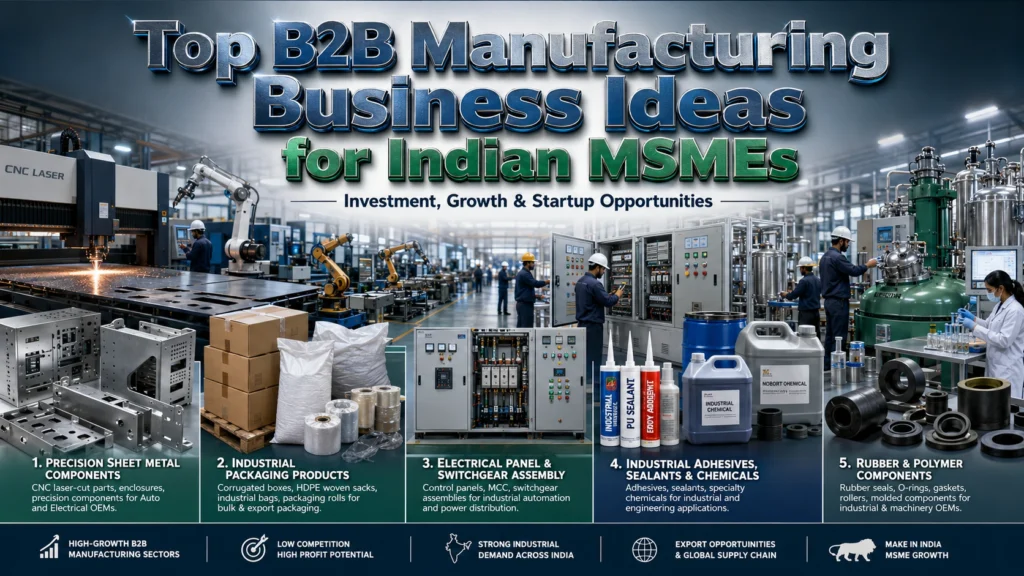
Precision Sheet Metal Components for Auto and Electrical OEMs
Sheet metal fabrication is one of the most solid starts to B2B manufacturing because nearly every OEM, including automotive, electrical panel manufacturers, and more, outsources bracket, bezel, and enclosure work, rather than doing it in-house. A unit based on a CNC turret punch, press brake and simple powder coating line can begin to provide local OEMs in a matter of months—after commissioning.
The investment in a small machine is usually in the range of ₹40 lakh to ₹80 lakh, depending on the tonnage of the machine, and the gross profit is in the range of 20 to 30 per cent after tooling cost is adjusted. Since OEMs are expecting the vendors to be consistent, a founder who succeeds in the first year in controlling tolerance and delivering on time is likely to secure repeat orders in no time.
Explore This Book: Handbook on Steel Bars, Wires, Tubes, Pipes, S.S. Sheets Production with Ferrous Metal Casting & Processing
Industrial Packaging: Corrugated Boxes and HDPE Woven Sacks
One of the business ideas that is more recession-proof is corrugated board and HDPE woven sack manufacturing as every manufacturing plant, warehouse, and export unit requires a regular packaging supplier. Corrugation plants may begin with a semi-automatic flexo printer and slotter unit and expand to a fully automatic line. Woven sack units for HDPE (High Density Polyethylene), however, are used by cement, fertiliser and food-grain packers who require bulk and reliable capacity. Both segments are also supported by availability of raw material in most of the industrial clusters and the demand for packaging follows the overall demand of industries; demand for packaging is not cyclical and does not dry up easily.
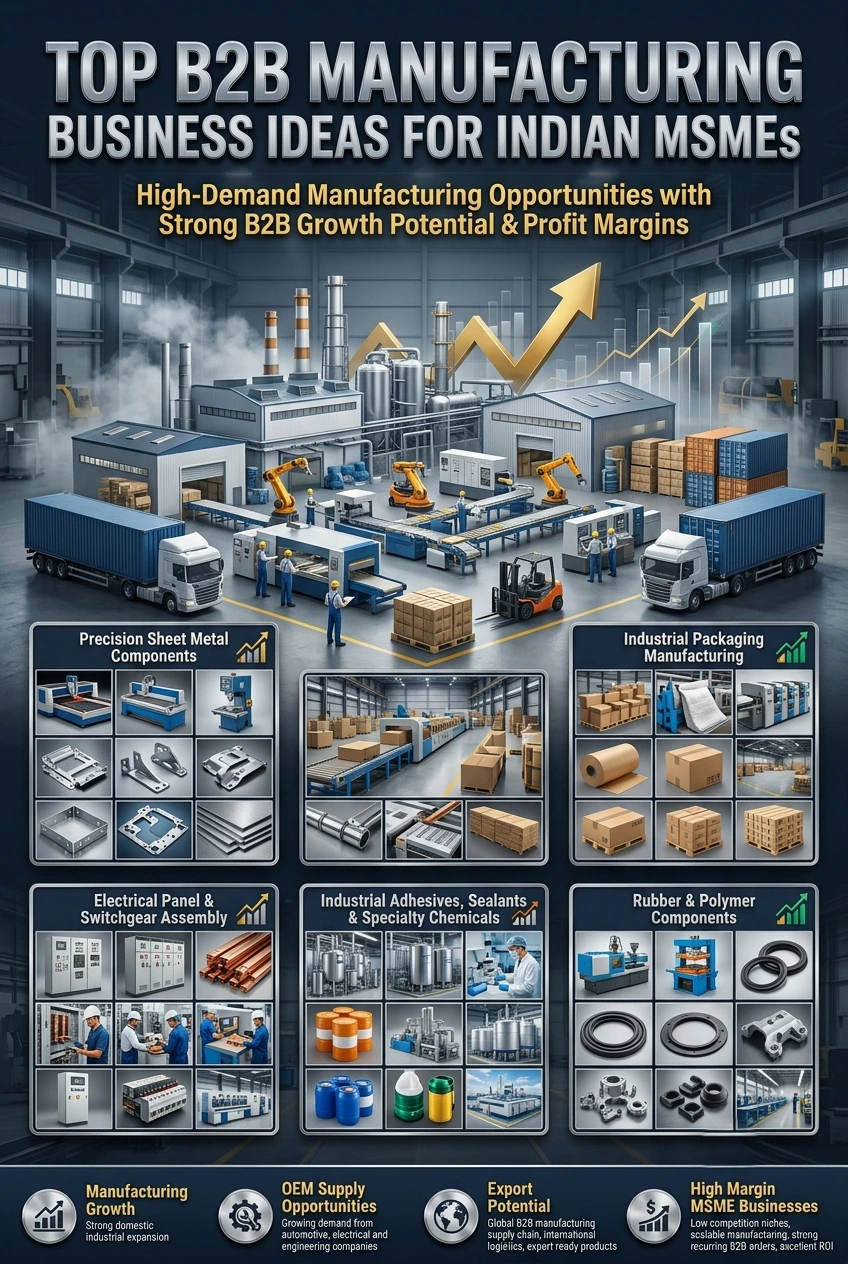
Electrical Panel and Switchgear Assembly Units
The demand for low voltage distribution boards, motor control centres, switchgear panels has steadily increased with the proliferation of real estate, infrastructure and renewable energy projects. The critical components of assembling a panel are skilled wiring labour, a testing bay and good connections with the component suppliers such as circuit breaker and busbar manufacturers. In the case of panels, they are engineered products that pay off for design skill, not assembly speed, and margins here are better than pure fabrication work, at the 25 to 35 percent level. EPC contractors and builders also order more from the same vendor after they have a history of reliability with lead time.
Related Article: India’s $235 Billion Electrical Equipment Boom: What Every Founder Must Know
Industrial Adhesives, Sealants, and Specialty Chemicals
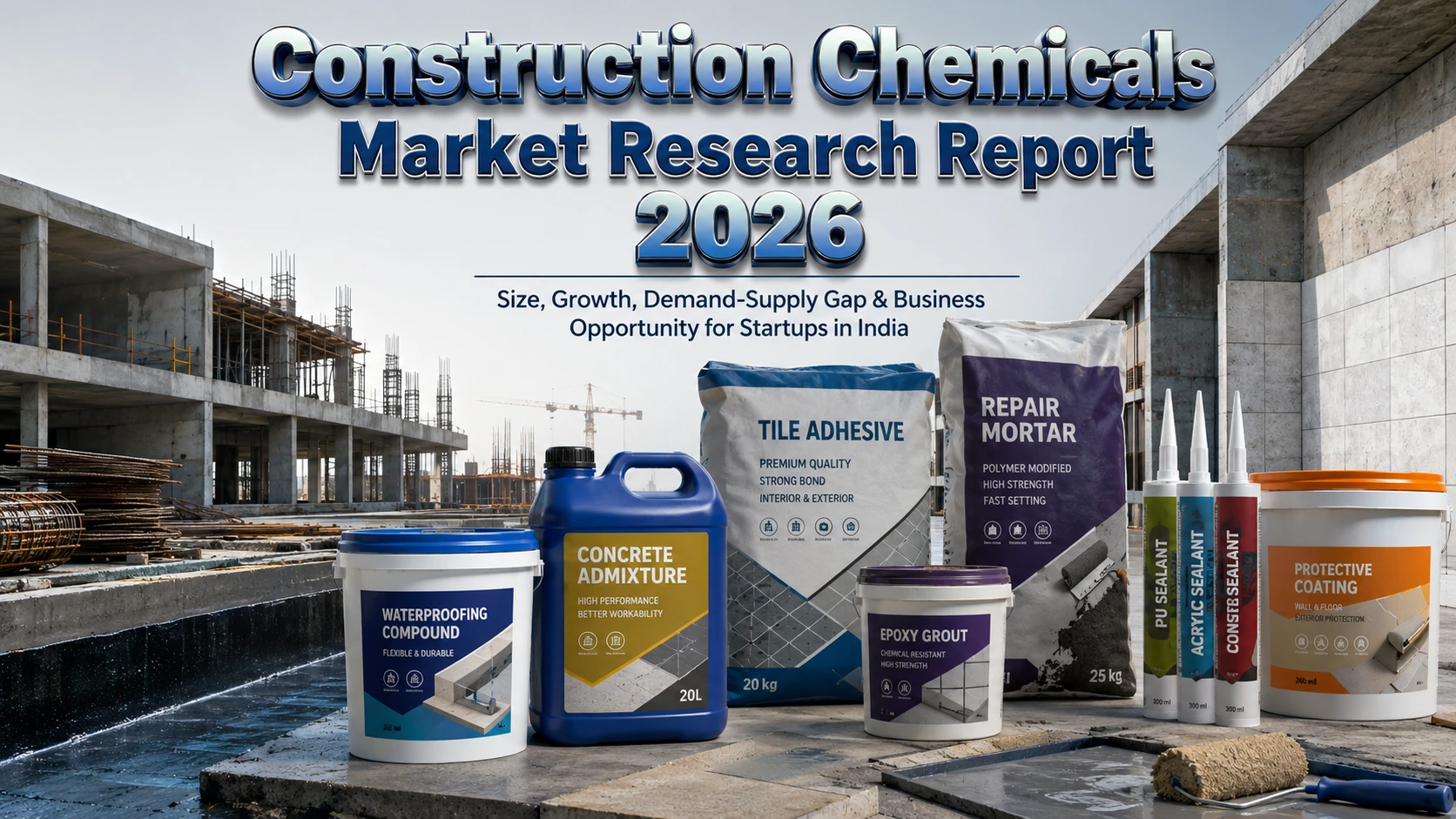
Another type of opportunity exists in formulation-based manufacturing, including industrial adhesives, sealants, and specialty coatings, where an IP can be embedded into the product. A small batch manufacturing facility including reactors, mixers and quality testing equipment will provide construction, furniture, packaging and automotive assembly. The entry investment in the basic facility ranges from ₹25 lakh to ₹60 lakh, while the formulations can be customised according to the application for the customer, which means that a founder can create real differentiation instead of just competing on pricing. Also exportable into good quality when formulations are tested to international standards.
Rubber and Polymer Components for Machinery OEMs
Gaskets, O-rings, bushings and molded rubber parts are those mundane, but key components used in pump, compressor and machinery production. Starting a compression/injection moulding unit for rubber components requires only a few moulding presses and a compounding line, and enjoys long product life cycles because OEMs do not want to change the rubber supplier after tooling is approved. This stability can be an appealing initial production business for the one who would like more predictable and engineering-based demand than trend-driven markets.
Access Complete Business Plan: Rubber & Plastic Industries, FRP Products, Polymers, PET, PVC, LDPE, HDPE, Polypropylene, Acrylic and Polyutherthane Projects
Import-Export Opportunity Analysis for New Manufacturing Startups
India’s push to reduce dependence on imported components, particularly in electrical, electronic, and precision engineering categories, has created real substitution opportunities for domestic manufacturers. Segments like electrical connectors, small motors, and specialty fasteners still see meaningful import volumes, which is exactly the gap a new, quality-focused unit can start closing.
On the export side, buyers in the US, Europe, and Southeast Asia are actively adding Indian vendors to reduce concentration risk in their supply chains. Therefore, a manufacturer who builds proper documentation, testing certificates, and consistent batch quality from day one positions themselves for export orders much faster than they might expect. Trade bodies and export promotion councils also offer market access support that first-time exporters can tap into at low cost.
Reference trade data via FICCI, CII, and IBEF.
Indian MSME Success Stories Worth Studying
Rajkot-based Ajay Industries and similar component clusters in Gujarat built entire export businesses out of small forging and machining sheds, proving that geographic clustering around a single process discipline can compound learning and quality across an entire region rather than one company.
Divgi TorqTransfer, founded by Jitendra Divgi, grew from a small transmission-component manufacturer in Pune into a listed auto-component supplier by focusing relentlessly on precision engineering for OEM clients rather than chasing the aftermarket. The lesson for new entrants is straightforward: depth in one process beats breadth across many.
Similarly, Anand Mahindra’s early-stage bets on component manufacturing subsidiaries within the Mahindra Group show how disciplined reinvestment of early profits into tooling and quality certification, rather than aggressive early expansion, builds durable OEM relationships over a decade rather than a quarter.
Turning a Business Idea Into a Bankable Project
We at Niir Project Consultancy Services (NPCS) provide professional consulting for the preparation of Market Survey cum Detailed Techno-Economic Feasibility Reports (DPRs) for setting up new industries or businesses. Our reports include detailed manufacturing processes, market research and demand analysis, process flow diagrams, product mix and capacity planning, machinery and raw material details, and complete project financials with profitability analysis. Our objective is to help entrepreneurs evaluate feasibility, profitability, and long-term scalability before investing, so that a business idea on paper becomes a bankable project on the ground.
Indicative Investment and Margin Snapshot Across These Business Ideas
| Business Idea | Approx. Investment | Typical Gross Margin | Lead Buyer Segment |
| Sheet Metal Components | ₹40–80 Lakh | 20–30% | Auto & Electrical OEMs |
| Corrugated / HDPE Packaging | ₹30–70 Lakh | 15–25% | FMCG, Cement, Agri |
| Electrical Panel Assembly | ₹20–50 Lakh | 25–35% | Builders, EPC Contractors |
| Adhesives & Sealants | ₹25–60 Lakh | 25–35% | Construction, Auto, Furniture |
| Rubber & Polymer Parts | ₹30–65 Lakh | 20–30% | Pump & Machinery OEMs |
Frequently Asked Questions
Which B2B manufacturing business idea needs the lowest starting investment?
Electrical panel assembly and small-batch adhesive manufacturing usually need the least capital, since both rely more on skilled labour and formulation know-how than on heavy machinery.
Do I need prior industry experience to start a manufacturing unit?
Not necessarily, but hands-on process knowledge helps enormously. Many first-generation entrepreneurs pair a short technical apprenticeship or a professionally prepared feasibility report with hired production expertise.
How long does it take to become a qualified OEM vendor?
Vendor qualification typically takes three to nine months, depending on the sector, since OEMs test sample batches, audit processes, and review consistency before issuing regular purchase orders.
Are MSME loan schemes enough to fund a manufacturing unit?
For very small units, MUDRA loans can cover working capital needs. Larger machinery-heavy units usually combine MSME schemes with term loans and, where eligible, state capital subsidies.
Which of these ideas has the strongest export potential?
Rubber and polymer components, along with specialty adhesives, tend to travel well into export markets once a unit secures international testing and quality certifications.
How do I estimate whether a business idea is financially viable?
A proper techno-economic feasibility study, covering capacity, capital cost, raw material pricing, and break-even analysis, is the most reliable way to test viability before committing capital.
Conclusion
Each of these B2B manufacturing business ideas rewards patience over speed. Founders who invest early in process discipline, vendor documentation, and quality certification tend to build the kind of steady, recurring OEM relationships that make small manufacturing units genuinely durable businesses.