
Manufacturing business ideas in Odisha
Odisha has quietly emerged as one of the most attractive manufacturing locations in India. This state now provides a unique mix for those who are looking into their business ideas with a capital of ₹15 crore — abundant natural resources, fast-improving industrial infrastructure as well as a very aggressive government policy to encourage investment pulling in. From a first-generation entrepreneur to an MSME promoter seeking diversification, the manufacturing business scenario in Odisha is expanding across various industry sectors that may not have been taken seriously until now.
Strategically located near the important mineral belts, Odisha has three major ports (Paradip, Dhamra, Gopalpur) and a coastal geography that allows for export logistics. The Odisha Industrial Development Corporation (IDCO) has been developing more than 50 industrial estates and parks in various important districts of the state which are equipped with plug and play infrastructure for new manufacturing units, according to the corporation. Combine these with the fact that the population is over 45 million, the consumer class is expanding, and the road and rail infrastructure is improving and you have the makings of a manufacturing company that has the potential to grow significantly over the next five to seven years after commission.
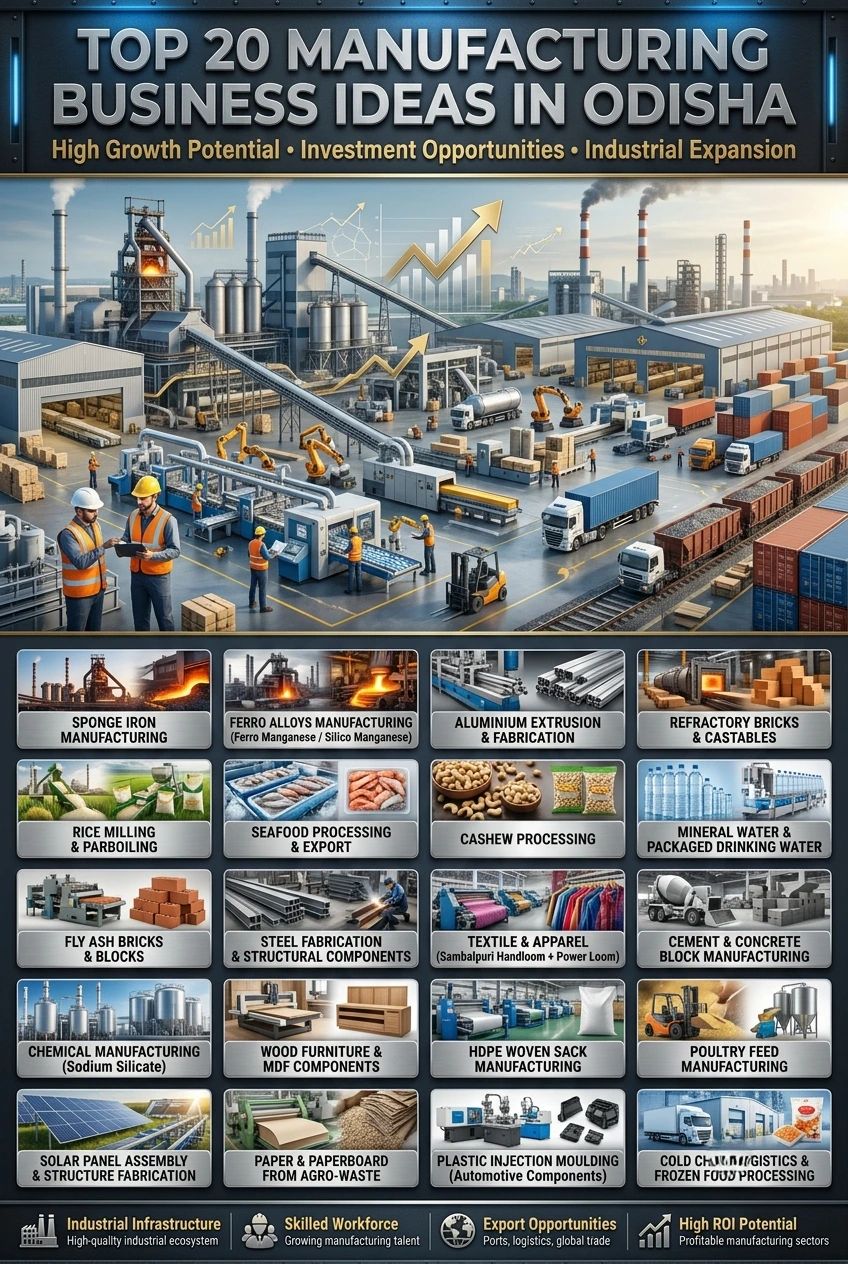
This article discusses 20 potential manufacturing projects which are ideal for the investment range of ₹ 15 crores. These business ideas have been screened using a criterion of feasibility, namely access to raw materials, the demand for the business, policy support, and the logic of profitability.
Why Odisha Is a Smart Location for Manufacturing Business
Even the investors still prefer to go for Gujarat or Maharashtra for manufacturing business planning. It’s a natural instinct but one that is also becoming more expensive: land value has skyrocketed, labour costs have skyrocketed, and competitive density has skyrocketed in those states. The state of Odisha, on the other hand, has prospered in a quiet and effective manner. The State of Odisha, on the other hand, has been growing quietly and effectively.
The Indian Bureau of Mines (IBM) shows that Odisha has almost 25% share of the country’s total iron ore reserves and has a significant advantage in the distribution of reserves of chromite, bauxite, coal and manganese – which is a mineral asset that is not found in any other states of India in the same quantity.
These mineral reserves are not only for big steel and aluminium companies. They develop a whole downstream system – processed minerals to industrial chemicals, precision components, refractory products – which can be profitably entered by smaller manufacturers having ₹10-20 crore revenue. Moreover, the industrial policy of the Odisha government provides you with land at subsidised rate in the industrial parks, capital investment subsidy and power tariff concession which all directly reduces your operating cost.
The Ministry of Commerce & Industry, Government of India data reveals an uninterrupted growth rate in the year-on-year trend of investments in industries in Odisha. Enhancement in ease of doing business and improved single window clearance has also driven growth in the state’s MSME sector.
Government Policies and Incentives That Make Manufacturing Business Viable
The Odisha Industrial Policy offers detailed incentives for both MSMEs and big manufacturing establishments. With just a few schemes available for a project that is worth ₹15 crore.
Perhaps the greatest leverage is the state capital investment subsidy on fixed capital investment of 20-40%. This cuts your equity requirement and increases ROI. Further, you benefit from VAT/GST concession, electricity duty exemption for the first 5 years and stamp duty waiver on land purchase in Industrial Estates which further helps bring down your set-up cost.
The Ministry of MSME has established Credit Guarantee Fund Trust for Micro and Small Enterprises (CGTMSE) at the national level, which provides for collateral-free loan facility of up to ₹5 crore. The Production Linked Incentive (PLI) scheme under DPIIT includes 14 industries, most of them with good presence in Odisha such as food processing, textile, specialty chemicals etc.
The Make in India initiative has also simplified environmental/ factory clearance for manufacturing units located in the notified areas. The time and cost of commissioning is minimized with ready infrastructure from Industrial Development Corp of Odisha at its various clusters such as Kalinganagar, Jharsuguda and Parasdep SEZ.
Also, the National Bank for Agriculture and Rural Development (NABARD) provide refinance schemes and direct credit to agro-processing and food manufacturing units in Odisha — which is a significant source of support for food-sector entrepreneurs.
20 Manufacturing Business Ideas in Odisha at ₹15 Crore Investment
1. Sponge Iron Manufacturing
There are more sponge iron plants in Odisha than anywhere else in India. This is because Odisha is the largest concentration of sponge iron plant in India. Keonjhar and Sundargarh are the two districts which have rich deposits of iron ore. The Ministry of Steel, Government of India has published data on direct reduced iron (sponge iron) which portrays India is the largest producer of direct reduced iron (sponge iron) in the world, and Odisha contributes a major chunk of the total capacity of the country.
The investment required for a small scale (50000 TPA) sponge iron plant is within the range of ₹12–15 crore. Sponge iron is still in demand as it is a raw material for small steel re-rollers and induction furnaces. Margins are closely related to iron ore procurement expenses, giving Odisha an edge. But any entrepreneur will have to properly invest in the pollution control system and waste heat recovery system to comply with the norms while minimizing the cost of fuel.
2. Ferro Alloys (Ferro Manganese / Silico Manganese)
Ferro alloys are essential inputs for steelmaking and that Odisha is endowed with deposits of manganese ore which gives it a clear upstream advantage. The cost of establishing a Ferro Alloy Plant of medium size (10,000-15,000 TPA) will require around ₹13-15 crore. A steady demand exists for these products from Japan, South Korea and Europe, which are steelmakers. According to data collected by Ferro Alloys Producers’ Association of India (FAPA), India is one of the largest exporters of ferro alloys in the world and Odisha-based ferro alloys producers play a significant role in this export. The margin (usually 18-22% net) is worthwhile if raw material sourcing is done efficiently.
Explore This Book: Complete Book on Ferroalloys
3. Aluminium Extrusion and Fabrication
Odisha is close to the primary aluminium ingots as Nalco’s aluminium smelter is in Angul. The set up cost of aluminium extrusion plant for manufacture of aluminium profiles for construction, automobile and electrical applications is in the range of ₹12-15 crore. Aluminium sections demand has consistently been increasing, with the expansion of the construction industry and increased use of lightweight material in the transport industry. Demand for aluminium extrusions is more than adequately met in the domestic market, which presents a significant opportunity with an easily-accessed customer base in eastern India.
Download the Full Guide: The Complete Technology Book on Aluminium and Aluminium Products
4. Refractory Bricks and Castables
The ready availability of the steel plants in Rourkela, Angul and Kalinganagar in Odisha also creates a captive demand to produce refractory products. Steel, cement and glass plants use a vast number of refractory bricks, high alumina castables and monolithic refractories. The investment required to establish a refractory manufacturing unit is ₹10–15 crore. The raw materials, such as fireclay, bauxite and silica, are available locally. Due to refractories being consumables in the industrial furnaces, this manufacturing business has a stable demand. An upside dimension would be exporting potential to the ASEAN and Middle East market.
5. Rice Milling and Parboiling (Agro-Processing)
Odisha is one of the leading states in rice cultivation in India. However, the modern rice milling machinery is still concentrated in a few districts and there is a tremendous space for new capacity. The modern parboiling and milling plant with sortexing and packing lines is set up at the rate of ₹8-14 crore at 6-8 tonne/hour. The business model can be accepted for both the branded consumer sale and institutional supply to the Food Corporation of India.
Agricultural and Processed Food Products Export Development Authority (APEDA) actively assists the rice processors in creating market linkages for export, including the GI tagged rice varieties such as Kalajeera from Odisha. Both NABARD and SIDBI provide preferential financing of food processing projects.
Check Out This Recommended Book: Handbook on Rice Cultivation and Processing
6. Seafood Processing and Export Unit
Odisha’s long coastlines and a strong marine fisheries industry make it a good place for seafood processing manufacturing. A large volume of shrimp, pomfret, rohu and catla are commercially harvested. The setup cost of seafood processing unit including freezing, filleting, and export grade packers is ₹12-15 crore. Demand for Indian sea food in the export market, especially to the USA, Europe and Japan, is robust. Marine Products Export Development Authority (MPEDA) supports seafood processing units financially, with quality certification support and buyer-seller facilitation. This is one of the most export-oriented manufacturing business in the coastal belt.
7. Cashew Processing
Odisha is the third most important cashew bearing state of India. However, a significant percentage of raw cashew nuts is still traded to Kerala and Goa traders who process them in other areas. Modern cashew processing unit having Shelling, Peeling, Grading and Vacuum-packing capacity of 2,000 to 3,000 tonnes per year can be established at a cost of Rs. 8-12 crore. Value added products (VAPs) of cashew (cashew butter, cashew flour and flavoured cashews) have much higher margins than raw cashews. Demand is good in both the domestic retail and export markets in North America and Europe.
Read the Complete Book Here: The Complete Book on Cashew (Cultivation, Processing & By-Products)
8. Mineral Water and Packaged Drinking Water
The quality groundwater aquifers are available in some of the districts of Odisha. The drinking water market for packaged water has shifted rapidly with urban consumers increasingly buying branded water. The plant running at 10,000–15,000 bottles an hour, incorporating BIS certified purification and multi-layer packaging, can be established for ₹6–10 crore and the balance of ₹15 crore can be spent on brand building, distribution network etc. The business model is applicable for both B2B business (hospitals, hotels, corporate campus) and retail distribution.
9. Fly Ash Bricks and Blocks
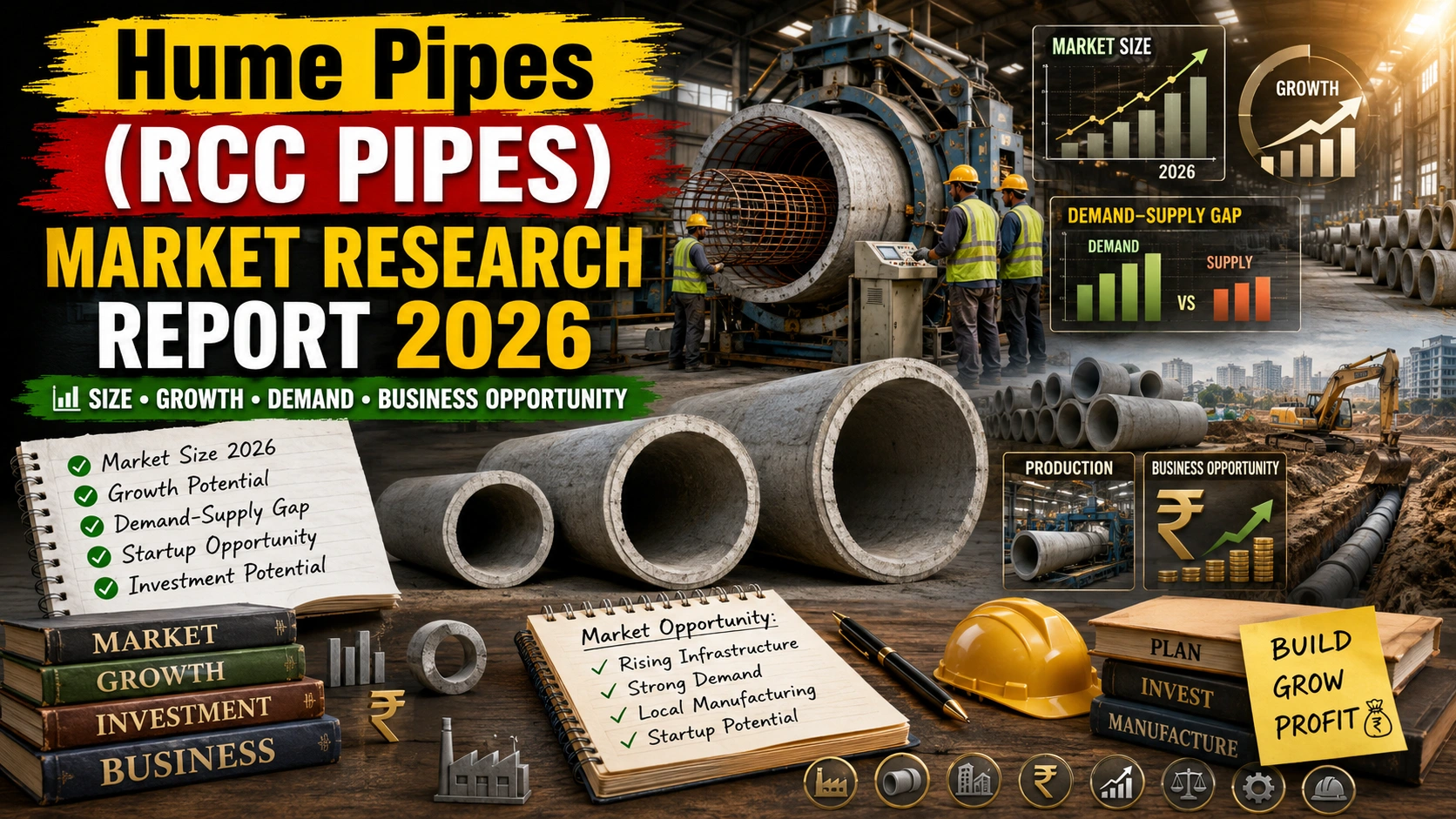
There are several thermal power plants, such as Talcher, Jharsuguda, and Ib Valley thermal power plants, in Odisha which produce a considerable amount of fly ash. As per Government notification issued by Ministry of Environment, Forest & Climate Change (MoEFCC), the mandatory use of Fly Ash bricks in the construction of notified areas. Modern fly ash brick plant can be set up for ₹ 4 – 7 crores with a production of 30,000 – 40,000 bricks per day. The cost structure is very competitive and power plants hardly cost anything for raw materials as part of the MoU arrangements. It is one of the most capital-intensive business ideas that offer quick Turnaround Period.
Check Out This Recommended Book: The Complete Technology Book on Bricks, Cement and Asbestos
10. Steel Fabrication and Structural Components
With the steel production base in Odisha, there is high domestic demand for a steel fabrication unit that fabricates structural parts like trusses, frames, transmission towers, industrial shelving etc. Fab shop with CNC cutting, welding, surface treatment facilities can be established at ₹ 10 – 14 crores. A vast amount of fabricated steel is being used in Infrastructure projects in Eastern India, such as bridges, warehouses and metro structures. Compliant manufacturers have a steady supply of orders through the government’s CPWD, railways and state PWDs.
Related Article: How to Start a Steel Fabrication Unit in India: Investment, Machinery & Export Potential
11. Textile and Apparel Manufacturing (Sambalpuri Handloom + Power Loom)
The handloom arts of Odisha especially the Sambalpuri ikat are well recognized worldwide. But it’s not a simple or straightforward task to scale production; it requires power loom integration for the high volume and handlooms for the premium positioning. The textile manufacturing business can be established in both the formats i.e. Dyeing & Finishing business with an investment of ₹ 12-15 Cr. The export of traditional Indian textiles to the European fashion markets has increased. The government schemes under Textile Ministry SAMARTH & SITP offer financial assistance in the form of training assistance and cluster development fund.
Download the Full Guide: The Complete Technology Book on Textile Spinning, Weaving, Finishing and Printing
12. Cement and Concrete Block Manufacturing
The demand for cement-based products keeps on rising with huge investments in infrastructure in Odisha – be it roads, housing, smart cities, etc. Establishment cost of a concrete block and hollow brick manufacturing plant with an annual capacity of 20 lakh units of interlocking pavers, 50 lakh units of hollow blocks and 3 lakh panels is in the range of ₹8-12 crore. The growth of Bhubaneswar, Cuttack, Rourkela and Berhampur is sustained with local demand without any need for long haul logistics.
View Full Project Details: Concrete, Cement and Cement based Products and Projects
13. Chemical Manufacturing: Sodium Silicate
Domestically, sodium silicate is used in detergents, paper, construction chemicals, and foundry binders, and is experiencing increasing demand. A sodium silicate plant of 5,000–8,000 TPA can be set up for ₹10–14 crore. The raw material used is silica sand and soda ash, which are readily available in Odisha. Having a number of industrial applications decreases the risk of demand concentration. Stable and low cyclicality manufacturing with export potential to South and SouthEast Asia.
14. Wood-Based Furniture and MDF Component Manufacturing
The forest cover and plantation timber base in Odisha is conducive to wood-based manufacturing. The integrated modern furniture manufacturing workshop, which integrates MDF board production, CNC routing and assembled furniture production, can cater to institutional buyers (hotels, hospitals, government office buildings) and the retail market. A capacity of 500–800 units/day can be set up for investment of ₹10–15 crore. The “Make in India” initiative for sourcing furniture locally from government institutions provides a certain level of security of supply for compliant manufacturers.
Get Detailed Insights from This Book: The Complete Technology Book on Wood and Its Derivatives
15. Industrial Packaging: HDPE Woven Sacks
HDPE woven sacks are used in various industries such as cement, fertilizers, rice, sugar and chemicals. Establishment of a sack manufacturing plant including winding, weaving, lamination and printing machinery can be done at an investment of ₹8-12 crore. The agro-processing industry and mining industry in Odisha are large industries, which generate captive demand for industrial packaging. In addition, there is value added opportunity with export cargo sacks made of HDPE. The raw material used is imported HDPE granules, with competitive price but with volume purchase.
16. Poultry Feed Manufacturing
The demand for compound poultry feed is also high as the poultry farming has been growing at an accelerated pace in the rural areas of Odisha. The setup cost of a poultry feed plant of 3000-5000 TPA for producing broiler feed, layer feed and pre-starters is around ₹ 6-10 crores. Local and national commodity markets are available for raw materials, such as maize, soybean meal, fish meal. This is a manufacturing operation which has regular and predictable demands and is appropriate for the involvement of farmers in agricultural cooperatives for financing.
17. Solar Panel Assembly and Structure Fabrication
The growth of renewable energy in Odisha, such as rooftop solar installations and solar parks, is driving robust market demand for solar panels and mounting systems. The renewable energy initiatives in Odisha, including rooftop solar projects and solar parks, are creating significant demand for solar panels and mounting structures. The Ministry of New and Renewable Energy (MNRE) has set a target of 500 GW of renewables installed in the country, with states setting procurement targets for locally made parts. A solar panel assembly unit of cell stringing, lamination and framing, together with galvanised steel structure fabrication line can be established for ₹12-15 crore. Government tenders include protection from import competition in the form of the domestic content requirement.
View Full Project Details: Renewable Energy Sector: Green Power & Renewable Energy Projects
18. Paper and Paperboard from Agro-Waste
In Odisha, there are considerable amounts of agricultural residues, such as rice straw, sugarcane bagasse and bamboo. A small-scale paper and paper board plant with production capacity of 1000 TPD of kraft paper, tissue paper or duplex paper can be established with an investment of ₹13 – 15 crores using agro-waste as raw material. The Indian paper industry is always short of supply, especially in the packaging grades. An agro-waste unit is eligible for green manufacturing incentives and also fetches a premium with the sustainability-conscious consumers in FMCG and e-commerce packaging.
Read the Complete Book Here: The Complete Technology Book on Pulp & Paper Industries
19. Plastic Injection Moulding for Automotive Components
With the increasing scale of industrial activity in Odisha and the city’s location near the eastern Indian hubs for automotive assembly, precision plastic components are in demand. Setup of a plastic injection moulding unit comprising of 8-12 plastic injection moulding machines, tool room and quality inspection facility costing at ₹10-14 crore. Products range from dashboards, switches, clips to under hood parts for two wheelers and passenger cars. Quality certification (IATF 16949) is a condition for access to Tier-2 supply chains of automotive OEMs, and this budget is sufficient to cover quality certification.
20. Cold Chain Logistics and Frozen Food Processing
The lack of proper cold chain facilities results in high post-harvest losses in the production of fruits, vegetables, seafoods and poultry in Odisha. The cost of setting up a frozen food processing and cold storage unit, which includes blast freezing, IQF tunnels, and temperature-controlled warehousing, is about ₹13–15 crore. The business model includes frozen foods retailing under the own brand and providing cold chain services to third parties. Besides supplying domestic markets, export markets for IQF vegetables, frozen seafood, and frozen fruits offer a source of revenue diversification for Middle Eastern and European markets.
Import–Export Opportunity Analysis for Manufacturing Businesses in Odisha
Manufacturing companies have direct access to global trade lanes from the three working ports of Odisha namely, Paradip, Dhamra and Gopalpur. It is a structural benefit, which most landlocked states can’t provide for logistics at a similar cost.
The industry has also good prospects on the export side in the production of mineral-based products such as ferro alloys, sponge iron, refractory materials, agro processed products like par boiled rice, cashew kernel, sea food and industrial chemicals. The Japanese and South Korean steel makers are regular customers of ferro alloys. Indian’s seafood exports have increased rapidly and Odisha’s coast is geared to meet the needs of seafood processing units for supplying the markets like the US, EU and the Japanese market. Detailed commodity level trade data is available on Ministry of Commerce, Export-Import Data Bank that documents the export performance of India by HS code and destination country.
However, in the export segment, Odisha’s manufacturing enterprises rely on imports to some extent for raw materials like HDPE granules, specialty chemicals, precision machinery parts and electronic sub-assemblies. To protect margins, control import expenses by using bulk purchasing contracts and foreign exchange hedging.
Duty drawback, RODTEP and export credit insurance through ECGC are some of the export promotion schemes provided by the Directorate General of Foreign Trade (DGFT). The manufacturing entrepreneurs should consider incorporating these schemes in their financial model in the beginning.
Indian MSME Success Stories: Lessons for New Manufacturing Entrepreneurs
Balasore Alloys Limited: Building on Mineral Proximity
The rise in the number of manufacturers of ferro alloys in Odisha is largely due to the first-generation glass blowers who started with small furnaces and went on to grow with reinvestment. The promoters of Balasore Alloys Limited had realised from the very beginning that location of manganese ore, coupled with port facilities in Odisha, afforded a secure cost position. Balasore Alloys now is an MSME-origin organization and is a public limited company exporting its products to more than 20 countries. The takeaway for new business owners is clear: look for a structural advantage and go with it, not trend cycles.
Maa Tara Agro Industries: Agro-Processing as a Scaling Strategy
A few medium scale agro-processing units in Odisha have evolved from rice milling to diversified food processors. What they have in common is the fact that they invest in modernisation at an early stage in the process – sortex machines, vacuum packaging, and branded consumer products. Some began at ₹2–5 crore, and made the switch to ₹50–100 crore revenues in just 10 years by carving out a niche for branded rice in urban Odisha and eastern India. Moving from a commodity to a brand is the one most important margin-improving decision in agro-processing.
Eastern Packaging: From HDPE Sacks to Export Contracts
Industrial packaging manufacturers from the state of Odisha have established a stable company in the business by signing a long-term agreement with the cement factory and fertiliser companies. The one big decision was investing in early printing and lamination to provide value adding packaging services instead of printed sacks. A number of these units gained contracts to export agricultural products to the South Asian and African countries. The lesson here is that commodity manufacturing becomes defensible when you bring in the capability to finish commodity that commodity players can’t do on the cheap.
Discover business ideas that actually make money
How NPCS Supports Your Manufacturing Business Journey
A 15-crore investment in manufacturing facilities in Odisha, demands more than just enthusiasm and vision. It needs exhaustive feasibility studies, a strategic choice of technology, comprehensive market research and a robust financial model, even before the first rupee is spent. This is exactly where our consulting can add value for your investment.
At NPCS, we offer professional consultancy services for Market Survey cum Detailed Techno-Economic Feasibility Reports (DPRs) for new manufacturing projects/business opportunities. Our reports cover detailed manufacturing processes, market study and demand analysis, process flow diagram, product mix & capacity planning, machineries and raw material list, and full project financials with profitability analysis. We strive to assist aspiring entrepreneurs in making a decision that is feasible, profitable, and scalable in the long run before a real investment is made. For every budding entrepreneur who seriously considers making manufacturing happen in Odisha, a properly structured DPR is essential.
Manufacturing Business in Odisha: Market Snapshot (Data Table)
| Sector | Est. Investment (₹ Cr) | Annual Revenue Potential (₹ Cr) | Export Potential |
| Sponge Iron | 12–15 | 22–30 | High |
| Ferro Alloys | 13–15 | 20–28 | Very High |
| Aluminium Extrusion | 12–15 | 18–25 | Medium |
| Refractory Bricks | 10–15 | 15–22 | High |
| Rice Milling & Parboiling | 8–14 | 20–40 | High |
| Seafood Processing | 12–15 | 25–45 | Very High |
| Cashew Processing | 8–12 | 12–20 | High |
| Fly Ash Bricks | 4–7 | 6–12 | Low |
| HDPE Woven Sacks | 8–12 | 12–18 | Medium |
| Solar Panel Assembly | 12–15 | 18–30 | Low |
| Frozen Food & Cold Chain | 13–15 | 20–35 | High |
| Paper from Agro-Waste | 13–15 | 18–26 | Medium |
| Poultry Feed | 6–10 | 10–16 | Low |
| Concrete Blocks | 8–12 | 14–20 | Low |
| Sodium Silicate | 10–14 | 15–22 | Medium |
Frequently Asked Questions (FAQs)
1. What is the minimum investment to start a manufacturing business in Odisha?
Depending on the industry the figure changes; fly ash bricks and poultry feed can start from Rs 4-7 crore; for intermediate projects such as cashew or rice mills the figure can range from Rs 8-14 crore; heavy industry sectors like ferro alloys or aluminium extrusion need Rs 13-15 crore. So a project of Rs 15 crore is a comfortable figure to start most MSME units in Odisha.
2. What government subsidies are available for manufacturing businesses in Odisha?
Under the Odisha Industrial Policy, capital investment subsidies for eligible entities range from 20-40% of the fixed capital assets. Also eligible for concessions are stamp duty exemption, five years’ exemption on electricity duty and concessional priced land in industrial estates. At the national level, CGTMSE can extend loans collateral-free up to ₹5 crore, while PLI schemes cover 14 manufacturing segments.
3. Which districts in Odisha are best suited for industrial manufacturing?
The most preferred industrial belts that include: Kalinganagar (Jajpur), Jharsuguda, Angul, Rourkela (Sundargarh) & Paradip (Jagatsinghpur), which are equipped with readily available facilities, since IDCO has created industrial estates in these areas. For consumer goods and packaging industry, peripheral areas around Bhubaneswar and Cuttack are attractive due to availability of customers.
4. How do I get a project feasibility report for a manufacturing business in Odisha?
In addition to manufacturing process, a professional techno-economic feasibility study (DPR) by the consultant details capacity planning, cost of machinery, availability of raw materials, market size and future prospects as well as financial forecasts. NPCS also renders DPR reports in various manufacturing industries. The DPR is commonly required by Banks & other Institutional Lenders for project loan sanction.
5. Is it possible to export from an Odisha-based manufacturing business?
Yes, it is. With as many as three functional seaports (Paradip, Dhamra and Gopalpur), Odisha offers an excellent and cost-effective environment for export-oriented manufacturing. Some key sectors in which Odisha has considerable export demand are ferro alloys, seafood, cashew kernels, parboiled rice, refractory materials, etc. The RODTEP scheme of the DGFT and duty drawbacks on exports boost this viability even more.
6. What are the top business ideas for a ₹15 crore manufacturing investment in Odisha?
If demand from the market is taken into consideration and then availability of raw materials & Govt policy support for industry, then the business opportunities are strongest on:- ferro alloys, seafood processing, aluminum extrusion, sponge iron, modern rice milling, solar panel assembly & frozen food processing in the current price. Each of these has a clear demand driver, viable raw material supply chain, and established export pathway from Odisha.
Conclusion: Making Your Manufacturing Business Decision in Odisha
Odisha has moved decisively from a resource-extraction economy toward a diversified manufacturing destination. The combination of natural resources, port access, government incentives, and a growing industrial base creates a genuinely competitive environment for new manufacturing businesses.
A ₹15 crore investment, properly structured across the right sector, can generate annual revenues of ₹20–45 crore within three to five years of commissioning, depending on product type and market positioning. The 20 business ideas covered in this article represent sectors where this outcome is not aspirational — it is achievable with sound planning, disciplined execution, and the right technology and market access decisions.
The state’s trajectory is clear. Entrepreneurs who enter Odisha’s manufacturing ecosystem now will benefit from lower entry costs, growing infrastructure, and rising domestic and export demand before competitive density catches up. The window is open. The question is which business idea best aligns with your strengths, networks, and risk appetite.
For further sector intelligence, market data, and industry advocacy support, entrepreneurs can consult the Confederation of Indian Industry (CII) and the Federation of Indian Chambers of Commerce & Industry (FICCI) — both of which publish sector-specific reports and actively engage state governments on manufacturing policy.