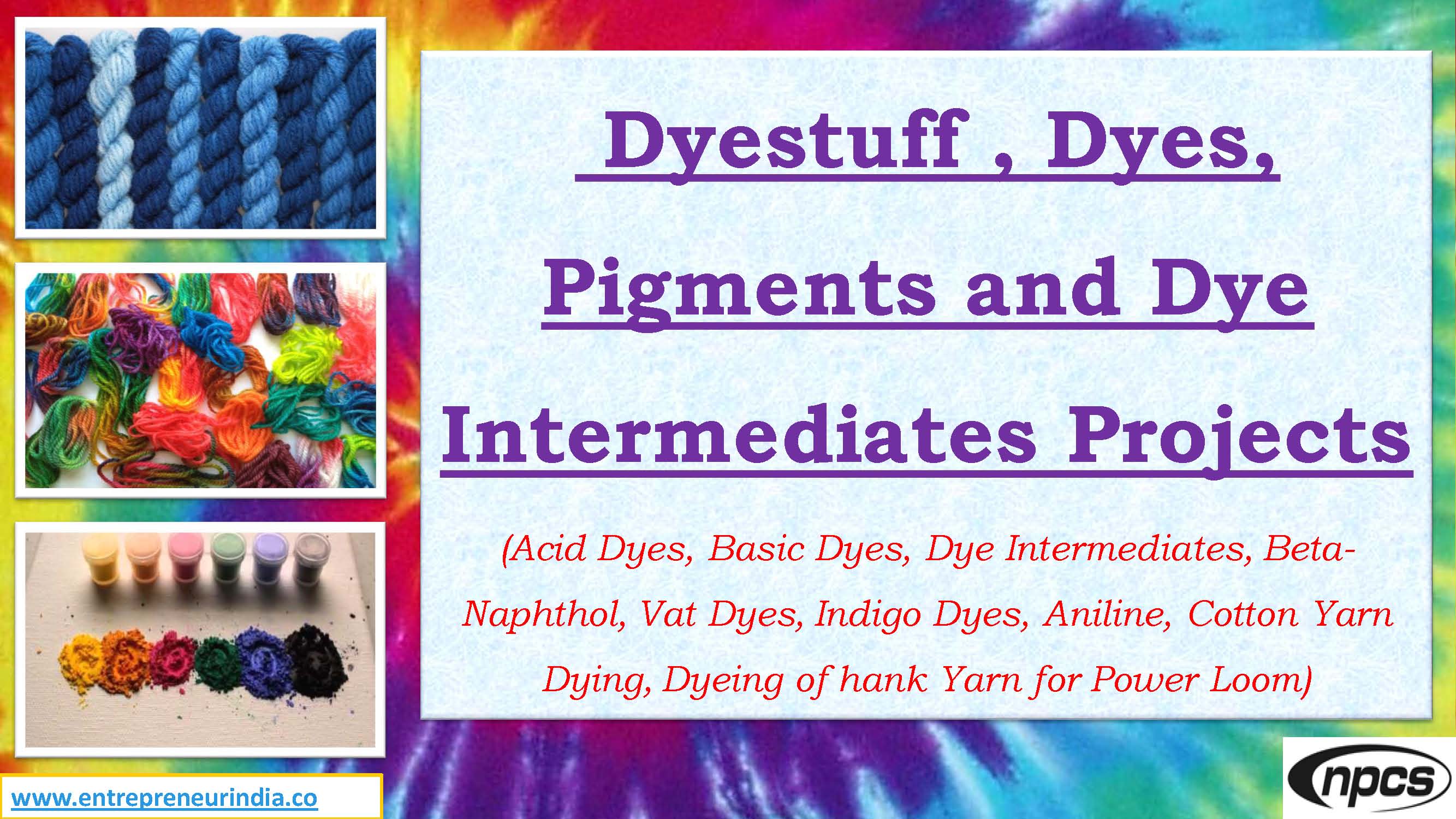
India ranks among the world’s largest producers and exporters of colorants, thanks to its strong foundation in chemical manufacturing and textile processing. As the demand for colorful textiles, plastics, paints, and printing inks continues to grow globally, Dyestuff & Pigment Projects have emerged as high-potential opportunities for industrial entrepreneurs. Whether you’re targeting domestic consumption or export markets, these projects offer consistent demand, scalability, and good profit margins. Moreover, the increasing shift toward eco-friendly and high-performance pigments opens new avenues in this evolving sector.
Dyestuff & Pigment Projects | Dye Intermediates Business
Dyestuff & Pigment Projects primarily focus on the production of synthetic dyes, organic pigments, and dye intermediates. These colorants are essential in industries such as textiles, plastics, paints, inks, paper, cosmetics, and leather. While dyes are soluble and bind chemically to substrates, pigments are insoluble and provide color through dispersion. Moreover, dye intermediates—key raw materials for producing dyestuff—present another lucrative business line with high export demand.
Read Also :PP/HDPE Woven Bag
India has a robust infrastructure for manufacturing reactive, acid, basic, direct, vat, and disperse dyes, as well as organic pigments like phthalocyanine blue and green, azo pigments, and high-performance pigments (HPPs). Starting your own Dyestuff & Pigment Projects can involve making final dyes, intermediates, or pigment dispersions depending on your capacity and market strategy.
Types of Dyes and Pigments You Can Produce
Before setting up your plant, identify which product categories you want to focus on:
Reactive Dyes: For cotton and cellulosic fibers
Disperse Dyes: For polyester and synthetic textiles
Vat Dyes: Used in denim and yarn dyeing
Pigments: Organic (azo, phthalocyanine) or inorganic (iron oxide, titanium dioxide)
Solvent Dyes and Acid Dyes: For leather, wood stains, and plastics
Dye Intermediates: H-acid, vinyl sulfone, gamma acid, etc.
Moreover, you can specialize in eco-friendly dyes or develop custom formulations for high-end applications.
Raw Materials and Chemical Inputs
Key inputs for Dyestuff & Pigment Projects include:
Aromatic hydrocarbons (benzene, toluene, naphthalene)
Sulfuric acid, nitric acid, and caustic soda
Aniline, beta-naphthol, phenol
Copper salts (for pigments)
Solvents and dispersants
Filtration and drying agents
These chemicals are readily available in India’s chemical hubs like Gujarat and Maharashtra. Moreover, working with reliable chemical suppliers ensures consistent quality and cost control.
Manufacturing Process and Equipment
The production process for dyes and pigments varies by type but generally involves:
Nitration and sulfonation (for dye intermediates)
Diazotization and coupling reactions
Filtration and drying
Grinding and blending (for pigments)
Packing and sealing
Machinery required includes:
Reactors with agitators
Centrifuges and dryers
Pulverizers and ribbon blenders
Water scrubbers and ETPs
Lab testing equipment
Moreover, automated dosing systems and batch controllers help improve accuracy and yield.
Investment and Profit Potential
Setting up a Dyestuff & Pigment Projects unit involves moderate to high investment based on capacity and technology:
| Scale of Unit | Investment (INR) | Monthly Profit Potential |
|---|---|---|
| Small-scale (50–100 MT/year) | ?25–40 lakhs | ?1 – ?2.5 lakhs |
| Medium-scale (300–500 MT/year) | ?75 lakhs – ?1.2 Cr | ?3 – ?5 lakhs |
| Export-focused (1000+ MT/year) | ?2 – ?5 Cr | ?7 – ?10 lakhs |
Moreover, producing high-purity pigments and branded formulations offers better margins in niche industries.
Licensing and Regulatory Compliance
Chemical businesses are strictly regulated in India. To start legally, you need:
Udyam (MSME) registration
GST registration
Factory license
Pollution Control Board clearance
Hazardous Waste Management authorization
Consent to Establish and Operate under Environment Acts
Moreover, obtaining BIS certification or ISO 9001/14001 standards boosts your credibility in export markets.
Quality Control and R&D
Success in Dyestuff & Pigment Projects depends heavily on consistent shade, solubility, stability, and purity. Setting up an in-house lab helps monitor:
Color value (CV)
pH levels
Moisture content
Particle size distribution
Heavy metal content
Fastness properties (light, wash, rub, etc.)
Moreover, R&D allows you to innovate in low-salt, formaldehyde-free, and bio-based dyes, which are in demand worldwide.
Target Markets and Buyers
Potential buyers for your products include:
Textile mills and dye houses
Paint and coatings manufacturers
Plastic compounders
Ink and printing companies
Cosmetic brands
Exporters and chemical traders
Moreover, B2B platforms like IndiaMART, TradeIndia, and ChemIndia can help you reach industrial buyers quickly.
Export Potential and Global Trends
India exports over ?25,000 crore worth of dyes and pigments annually. Major export destinations include:
USA
Germany
China
Bangladesh
Vietnam
Brazil
Moreover, demand is growing in Africa and Southeast Asia as textile industries expand. Meeting REACH, RoHS, and GOTS compliance helps open doors to premium global buyers.
Sustainability and Green Chemistry Trends
Modern clients prefer environmentally safe products. Trends include:
Azo-free and metal-free dyes
Bio-based dye intermediates
Zero liquid discharge (ZLD) processing plants
Waterless dyeing techniques (supercritical CO?)
Moreover, adopting sustainable practices not only improves compliance but also gives a competitive edge in branding.
See Also :Herbal Beauty & Cosmetic Products
Conclusion
Dyestuff & Pigment Projects represent a vibrant business segment with strong domestic and export demand. From textiles and plastics to cosmetics and coatings, the applications are vast and growing. Moreover, India’s robust chemical ecosystem, skilled labor, and rising compliance with global standards make it a fertile ground for new entrants. Whether you start with dye intermediates, organic pigments, or full-scale dye production, there’s ample room to build a high-profit, scalable business.