
How to Start Power Cable and Winding Wire Manufacturing Business: High-Demand Business Ideas in India’s Electrical Conductors Sector
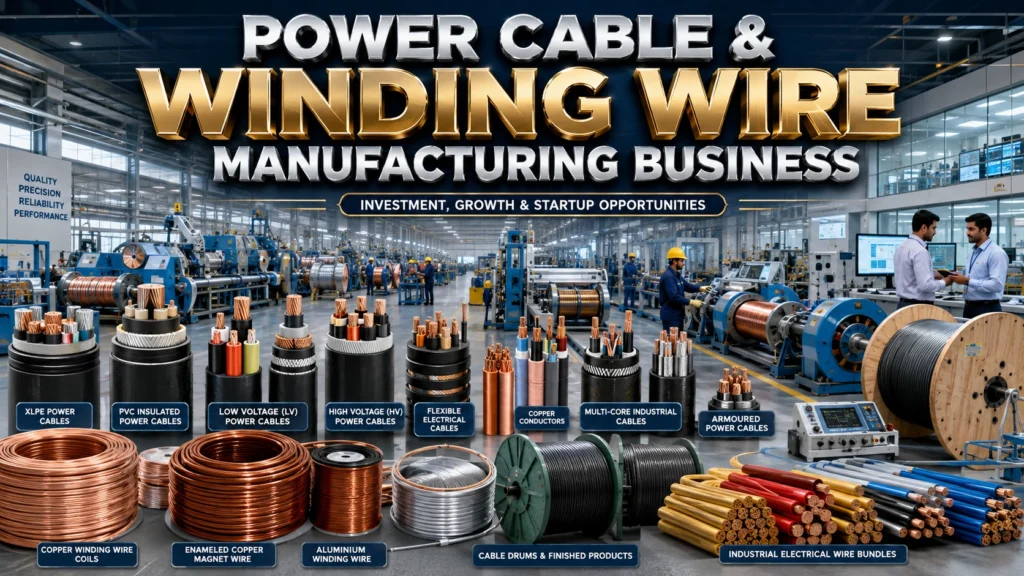
Power Cable Manufacturing Business Business ideas do come in cycles. There are also companies that are part of the cycle. Power cable and winding wire factories are in second category. Conductors are used every kilometre of transmission line, every substation commissioned, every transformer wound, every motor assembled and every industrial building electrified. The power cable, control cable, winding wire, and specialty conductor segments of the Indian electrical conductor market together account for tens of thousands of crores per year and have seen compounded growth across a number of fronts. Cables and winding wires combine a large and dynamic market, government initiatives to boost domestic manufacturing, a well-defined opportunity for import substitution at the specialty end, multiple product entry points at varying investment scales, and significant future opportunities for entrepreneurs to assess, making them an attractive manufacturing business idea for an MSME. However, there are some challenges inherent in the sector, particularly the prices of copper and aluminium which are benchmarked and volatile throughout the world; but experienced manufacturers overcome this by using commodity hedging, by timing purchases and by passing through material cost fluctuations to customers. Get Detailed Insights from This Book: Manufacture of Electrical Cables, Wire and Wire Products Handbook Why This Manufacturing Business Is Growing at an Exceptional Pace The power transmission and distribution in India is experiencing the most forward-thinking investment cycle in its history. The National Electricity Plan calls for installing more than 50,000 circuit kilometres of transmission lines within 10 years’ time. Particularly in urban areas, the underground cabling of distribution networks is creating a persistent demand for underground LT and HT cables in all key metropolises under the Revamped Distribution Sector Scheme (RDSS). The amount of conductor needed on cabling for each kilometre of length of underground cable is significantly greater than that of lines of a similar capacity on the top of the tower. There is an alternative demand engine from the renewable energy industry. Solar parks need DC cables from panel strings to the inverter and AC cables from the inverter to the point of connection to the grid. Several thousand kilometres of cable might be used in a 100MW solar installation. The wind farm network needs flexible wind farm cables buried and armoured cables in the turbine towers. The Indian target of 500 GW of renewable capacity equates to a demand for the industry to meet at home, which it is actively working on. Enamelled copper and aluminium wires for transformers, motors and generators are also experiencing a surge in demand. Winding wire is used for every new transformer made. Each EV motor needs a certain type of enamelled copper wire. Winding wire is utilized with all types of industrial motors, home appliances compressors and generators. Winding wire demand is directly linked to the growth of the domestic transformer, motor and EV component manufacturing. The demand for winding wire goes hand-in-hand with the growth of the domestic transformer, motor and EV component manufacturing. This is an actual inflection point in the sector. Export Opportunity: Indian Cable Manufacturers Are Winning Global Orders Indian power cable manufacturers are adept at exports and have established a strong presence in the power cable market in Africa, Middle East, and Southeast Asia. The data obtained from EEPC India reveals that engineering exports, such as cables and conductors, have been growing steadily. The UAE, Bangladesh, Kenya and Tanzania are some of the countries that import large quantities of Indian cables. A well certified MSME manufacturer can generate some good export revenues which when added up can give a good cushion against the price fluctuations of the domestic market, especially with regard to exporting IEC certified cables from India as compared to the Chinese and the European options in many of the export markets. Government Policies and Incentives for Cable and Wire Manufacturers BIS Certification: Mandatory and a Market Advantage All power cables delivered to Indian utilities, government projects and big power plants have to be BIS certified. PVC Insulated power cables are covered by IS 1554. XLPE-insulated cables are covered in IS 7098. IS 8783 is applicable to flexible cables. IS 13730 is the standard for winding wires. Although it involves some upfront cost for type testing and factory evaluation, BIS certification can bring benefits such as preferential bidding in Government tenders and deliver credibility in terms of quality to the private sector buyers. BIS certification provides the domestic cables with a score advantage when public tenders are evaluated in accordance with Make in India approach. MSME Support Schemes The Ministry of MSME’s CGTMSE scheme has been introduced to provide working capital and term loan assistance without any collateral up to Rs 5 crores, which is very crucial for the cable manufacturing industry as copper and aluminium are the major expenditure items and the working capital. Upgrading the existing equipment with modern extrusion and wire-drawing machines is supported by the Technology Upgradation Fund Scheme (TUFS). There are two other state level subsidy schemes for electrical conductor manufacturing units under the name of capital subsidy in Rajasthan, Gujarat, Uttar Pradesh and Telangana. PLI and Domestic Content Policy Ministry of Heavy Industries has been actively encouraging the production of electrical componentry at home with PLI-adjacent support schemes. Remarkably, some of the state electricity boards have adopted local content clauses in cable procurement tender that mandates a percentage of locally made cable, which directly benefits Indian MSMEs manufacturers. Duty drawback benefits are also available for exported cable products by Directorate General of Foreign Trade (DGFT), which makes export-oriented manufacturing models more economical. Business Ideas in Power Cable and Winding Wire Manufacturing Business Idea 1: LT Power Cable Manufacturing (Up to 1.1 kV, PVC and XLPE) The low-tension power cable market segment is the widest and most accessible cable manufacturing market, and includes 1.1 kV power cables with PVC insulation (widely used, lower cost) and 1.1 kV power cables with XLPE insulation (higher capacity, longer service life, preferred by utilities). The uses of LT cables are vast in the field
Mega Food Park in India: Business Ideas, Government Schemes and Startup Opportunities
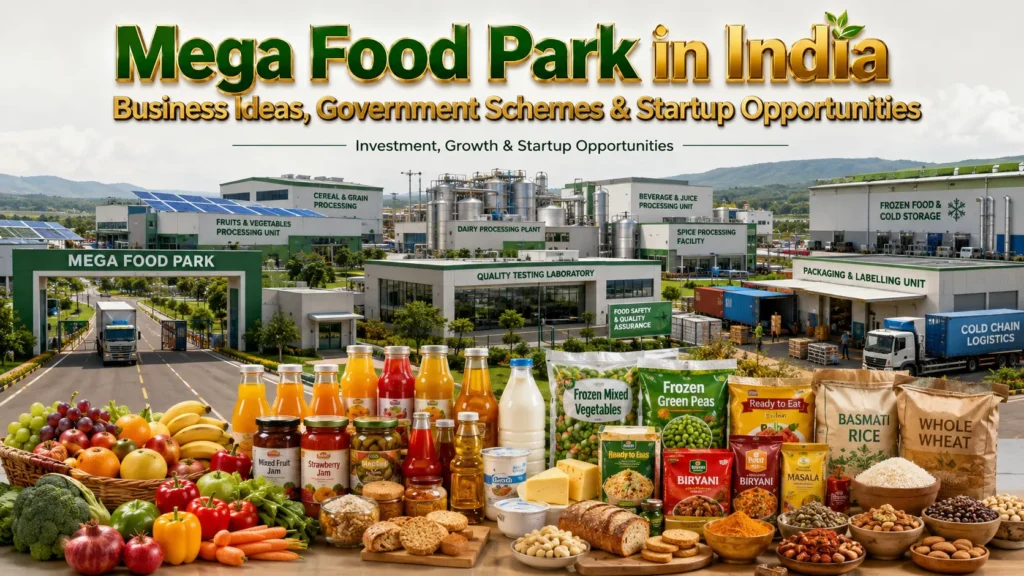
The fact that India wastes almost one-third of the food grown in its farms before it ends up on a plate is enough to make food entrepreneurs see potential in Mega Food Park business ideas. A Mega Food Park is not a factory. It is a collaborative industrial complex where cold storage, processing sheds, testing labs and logistics are available under the same roof and have been designed specifically for the ease of a small manufacturer. That’s a complete game change for a first-generation entrepreneur. A unit owner may lease an already developed plot within an existing unit and commence production within months, rather than spending crores building effluent treatment plants, power plants, and land. In this article, he explains why food processing is one of the most promising businesses for new entrants in India these days, what kind of government schemes are currently used to support a new player and what would be the most suitable business lines. Why Food Processing Is a Smart Sector to Enter Right Now India generates huge production of fruits, vegetables, milk, grain and marine products. But much of that production does not go into higher value, longer shelf-life products. That’s the space where profit is hiding! Tomatoes are sold at the farm gate at a decent price, a tonne of raw tomatoes. Transform it to packaged puree, ketchup, or dehydrated flakes, and the value realisation increases several-fold as the buyer is now paying for shelf life, convenience, and brand trust, instead of paying for the raw crop. The closed setting of Mega Food Parks allows the new player to leverage the infrastructure of other processors, such as processing units, cold chains and packaging plants, which would take years to construct on their own. A unit can simply be installed at operational parks with existing effluent treatment plants, weigh bridges, quality testing labs and warehousing facilities, which removes the need to invest large amounts of money into developing raw industrial land. There’s also a chance to export. Gulf, Southeast Asia, the U.S. and the European Union are all areas that have become hot markets for processed food, spices, marine products and organic products from India. A unit that can access export documentation services, has access to a cold chain, and is located within a food park would thus have the best chance of capturing these markets when compared to a standalone rural unit operating in isolation. Choose the right startup backed by real market demand Government Policies and Incentives Supporting New Entrants Here, a word of clarity is important before a founder’s business plan is created around it. The Ministry of Food Processing Industries has already withdrawn fresh sanctions under the original Mega Food Park Scheme, which means that there is no fresh sanction going down for any new park under the same window. Where there are already sanctioned parks, there will be no funding for unpaid liabilities. The real chance which a new entrepreneur has these days is two-fold—he can lease plots within the existing operational food processing parks formed under the scheme and he can look into the newer schemes which has replaced this scheme as the government’s staple food processing support measures. Pradhan Mantri Kisan Sampada Yojana (PMKSY) PMKSY continues to be the umbrella central sector scheme for food processing with infrastructure development, cold chain and agro-processing clusters. A new unit can join and plan its capital requirements in accordance with the components of infrastructure support under PMKSY within an existing food park ecosystem. Production Linked Incentive Scheme for Food Processing Industry (PLISFPI) This scheme offers incentives for eligible manufacturers based on the number of incremental sales of their processed food products, such as those in the branding and international marketing sectors. It is relevant to a food park-based manufacturing unit particularly because it is a focus on units that can increase the volume and create a brand that can compete in the export market. PM Formalisation of Micro Food Processing Enterprises (PMFME) PMFME can be a more appealing option for a truly small or new business owner. It provides credit linked capital subsidy, common infrastructure support, branding and skill training for micro and unorganized food processing units on a targeted basis to formalize and expand. MSME and State-Level Support In addition to the different schemes available in the different sectors, some food processing units are also classified as manufacturing MSMEs and can avail of the benefit of collateral-free credit guarantee cover, interest subvention on term loans and capital investment subsidy provided by a number of state industrial policies. Many state governments also exempt/reduce stamp duty for units established in notified food parks/in industrial estates. Read as a package, these documents indicate that the road to funding for the Mega Food Park, as conceived, has been closed, but the government’s support of food processing, in general, has been more complex and more favorable to those who are careful about planning. Multiple Business Ideas for Startups Inside a Mega Food Park Establishment of business idea around a food park must match a product line with the infrastructure already provided by the food park. Some of the most viable options for a first-time investor entering the market as a founder. Fruit and Vegetable Processing Unit One of the most natural places for a Mega Food Park is a fruit and vegetable processing line which converts local horticulture produce into pulp, puree, jam, pickle or dehydrated products, the cold storage and primary processing centres of a Mega Food Park are generally built around a particular agri-horticultural area. A founder can get raw material from the collection centers within the park, reducing losses during transportation and procurement expenses. Shelf-stable products such as jams, purees and ready-to-cook paste have healthy margins over fresh products and can be profitable within 2-3 years of fit-up even if only a few tonnes per day of capacity is installed, if quality and packaging is managed well from the beginning. Get Detailed Insights from This Book: Handbook on Fruits, Vegetables
How to Start Floriculture Export Business in India: Investment, APEDA Support & Export Opportunities

Floriculture Export Business Floriculture – the cultivation, export and marketing of cut flowers, potted plants, dried flowers and floral products is one of the most underdeveloped agriculture export business ideas in India. Cultivated globally, the cut flower industry generates over $50 billion per year, with the Netherlands, Colombia, Kenya and Ethiopia as the leading producers. India has a small share in this global market considering the range of tropical climates, skilled agriculture labour and existing farming tradition of flower cultivation in the country. APEDA’s floriculture export promotion mandate and support from the National Horticulture Board for modern greenhouse cultivation are paving the way to a new era for Indian Floriculture entrepreneurs to enter into the international markets. Floriculture export is a high value, land intensive land-based business with good commercials for the entrepreneurs who have access to land in suitable agro climatic zones like Karnataka, Tamil Nadu, Himachal Pradesh, West Bengal and J&K. Why Floriculture Export Is a Premium Agricultural Opportunity Cut flower export is one of the highest valued agricultural enterprises in terms of value per square metre as it generates a turnover of ₹500 – ₹2,000 per square metre of land in well managed polyhouse cultivation versus the most commonly grown vegetable crops which generate a turnover of ₹50 – ₹200 per square metre on the same area. Floriculture is particularly appealing to farmers having less agricultural area and seeking to utilize their farm for the maximum agricultural exportable value per area. Year-round consumption is the driving force behind global demand for cut flowers; floral gifting, wedding decoration, hotel amenity, and corporate event decoration are year-round markets. India’s tropical and sub-tropical climate variety allows flowers to be produced throughout the year; which is in stark contrast to the European countries who are very reliant on costly heated greenhouses during the winter months. This natural season advantage coupled with low labour cost provides a structural competitiveness to Indian floriculture exporters as compared to the established exporters from Europe and South America. Explore 10,000+ business ideas aligned with your investment goals APEDA and Government Support for Floriculture Exporters The floriculture and floriculture products (cut flowers, cut foliage, dried flowers and potted plants) are in the mandate of the Agricultural and Processed Food Products Export Development Authority (APEDA). APEDA offers loans for market development, pack house, pre-cooling, modern greenhouse (polyhouse) and financial assistance for refrigerated transport. APEDA also arranges participation of exporters from India in the largest Flower trading platform in the world, Flora Holland auction at Aalsmeer. The National Horticulture Board (NHB) offers subsidy and financial assistance for the construction of polyhouse and greenhouse where 50% of the total eligible capital cost is eligible up to the limit of the scheme. For new floriculture entrepreneurs, a considerable portion of the investment is taken up by the investment support provided by NHB for the protected cultivation infrastructure. The Ministry of Agriculture and Farmers Welfare has the National Horticulture Mission and the Horticulture Mission for North East and Himalayan States under its wings, which gives extra impetus to floriculture development in specific areas with climate conditions conducive to high value cultivation of flowers. An important logistics element for the export of perishables such as flowers is the air cargo capacity and cost. The government’s efforts towards developing air cargo infrastructure at key airports and APEDA’s push for dedicated air cold chain capacity for the flower exporters are gradually making the flower export logistics economics more attractive. Improvements to cold chain logistics from the farm to the airport are provided by APEDA’s financial support for pre-cooling and refrigerated transportation facilities. The logistics support of APEDA is explained in detail on the APEDA portal. Business Ideas in Floriculture Export 1. Cut Rose Export from Polyhouse Cultivation Roses are the most traded cut flower in the world, representing more than 30% of cut flower trade. So, the modern roses cultivated in polyhouse of Karnataka (Bengaluru district) and Himachal Pradesh are already exported to the markets of the Gulf, European and Japanese countries. A 1-hectare rose growing polyhouse can yield 1,500 to 2,500 flowers, which can be converted into 1.5 to 2.5 million stems for export, with investment ranging from ₹80 lakh to ₹1.5 crore, covering the construction of the polyhouse, irrigation, growing structures and post-harvest handling. The cost of the construction of the polyhouse is 50% subsidized by NHB. The main markets include export to Dutch flower markets and to the markets for flowers in the Gulf. With proper cultivation management, profits from 1-ha of polyhouse can be up to ₹30 lakh to ₹60 lakh annually. Get Detailed Project Report (DPR): Cut Rose Flower (Floriculture) Manufacturing Project Report 2. Tropical and Exotic Flower Export Tropical flowers (anthurium, heliconia, bird of paradise, ginger flower, and tropical foliage) are exported to Japanese, European and American florists, who are looking for unique non-European flower varieties for high-quality floral arrangements. These varieties have natural climatic conditions in the tropical southern part of India and North East India. One of the most valuable opportunities is to export to Japanese flower markets, where exotic tropical flowers have a high value. The investment on tropical flower cultivation & export unit varies from ₹30 lakh to ₹80 lakh based on plant species and scale of the project. The main logistics needs are air freight to Japan and EU. 3. Dried and Preserved Flower Export Dried flowers, potpourri, silica-dried roses, preserved eucalyptus and dried decorative botanicals are in high demand in the retail market in Europe and North America, especially on the home décor and gift market. India is blessed with a tremendous biodiversity, which offers a remarkable source of dried flower products. The investment in drying infrastructure, preservation chemical processing, sorting, and packaging is estimated to be between ₹10 lakh and ₹30 lakh for a dried flower processing unit. Dried products have the advantage of a shelf life of 12-24 months, which removes the time constraint of fresh cut flowers by air freight. Effective channels of export include the e-commerce platforms and
How to Start Agri-Warehouse Business in India: Investment, AIF Subsidy & Profit Guide
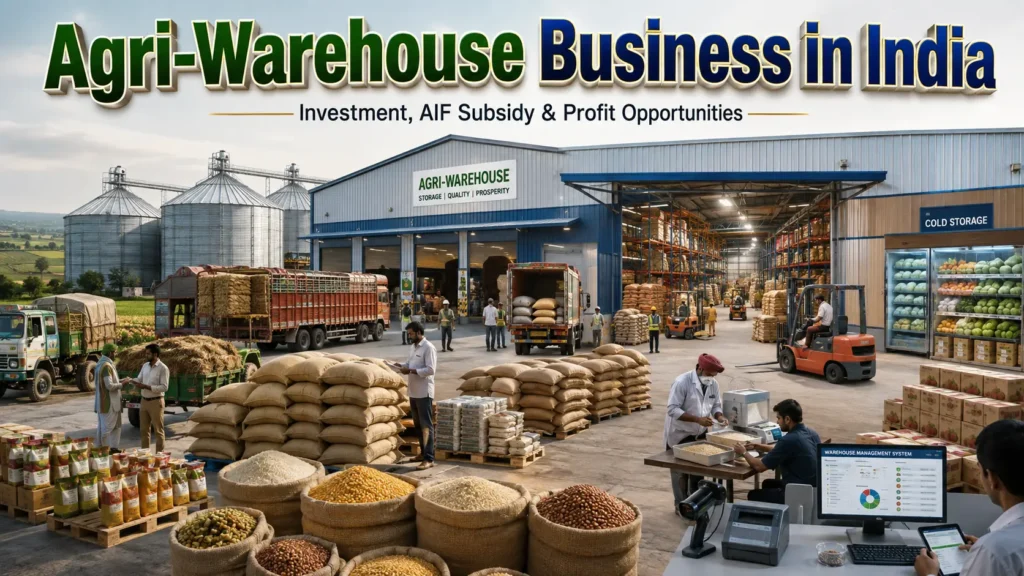
Agri Warehouse Business in India India wastes nearly 16% of its agricultural produce every year due to poor storage infrastructure. This gap is a huge business opportunity for entrepreneurs considering having high impact business ideas in the agri-sector. It is not only a logistics project, but a platform to integrate farmers, traders, processors & exporters in the Central India Agri-Warehouse and Commodity Trading Hub on a single ecosystem with Rs.50 Crore investment. The interesting rate on loans for qualified agri-infrastructure projects is paid by the Agriculture Infrastructure Fund (AIF) at 3%. The Warehouse Development and Regulatory Authority (WDRA) allows registered warehouses to issue a powerful financial tool called Negotiable Warehouse Receipts (NWRs), which can generate additional income for the hub operators. Get Detailed Project Report (DPR): Cold Storage & Cold Chain Technology Guide Why Central India Is the Right Location for This Business Soybean and wheat, pulses and cotton are vast in number produced in Madhya Pradesh, Vidarbha region in Maharashtra and Chhattisgarh. However, infrastructure for local storage and trading is still very poorly developed. The Agmarknet portal offers district-wise available commodity data which reflects good volume of throughput but lack in storage capacity to match in these districts. A modern warehousing infrastructure created in advance will give the entrepreneur the first-mover advantage in an area where demand is outpacing supply. Government Policies and Incentives Supporting Agri-Warehousing Agriculture Infrastructure Fund (AIF): It is a fund that has been established with an interest subvention of 3% on loans upto Rs.2 Crore for eligible projects, backed by credit guarantee from CGTMSE. Pradhan Mantri Kisan Sampada Yojana (PMKSY) provides capital subsidy for the cold chain and storage projects ranging from 35% to 50% in general areas and SC/ST and NE areas respectively. The NABARD has long-term refinance for warehouse construction through its Rural Infrastructure Development Fund (RIDF). The warehouse may also be registered as a warehouse under the WDRA, which would allow it to issue Negotiable Warehouse Receipts (NWRs) which would give the farmers a second source of income as they may pledge the stored commodities as collateral for loans. Turn your budget into a successful business plan Top Business Ideas Within the Agri-Warehouse and Trading Hub Model Commodity Storage and Negotiable Warehouse Receipt (NWR) Services This business’s core is the large-scale commodity storage registered by the WDRA. NWR system allows the warehouse to issue receipts for the commodities stored in the warehouse. These receipts are accepted by the banks, and the farmers borrow against them, instead of selling the produce at distress prices after harvest. The warehouse charges the storage fee on a per quintal, per month basis, handling charges and quality certification charges. Commodity backed financing and price discovery is provided on the NCDEX (National Commodity and Derivatives Exchange) platform which can be directly accessed by the WDRA registered warehouses. Commodity Grading, Testing, and Quality Certification Centre An FSSAI approved testing laboratory and grading facility in the hub warehouse enables a business to take a charge for moisture testing, aflatoxin testing, protein content testing and separation of foreign material. Soybean meal exporters, rice millers and pulses traders will all need certified quality reports before they can move on to large transactions. The APEDA mandates certification of agri-products exports, and a set-up having its own NABL certified testing facility makes the service offering more attractive for export processors. Electronic Commodity Trading and Auction Platform The third option of high-value business ideas in the hub is registering as a sub-broker/affiliate with NCDEX or setting up an electronic auction platform for trading at the mandi level. Traditional mandis are still in existence in central India, where many farmers sell their produce at lesser prices. The hub can fill this gap by organizing electronic auctions where registered buyers will bid for lots stored in the warehouse. The platform charges a transaction fee, which is usually between 0.5% – 1% of the transaction amount. Monitor real time commodity prices, highlight the price discovery value to the farmers through the Agmarknet. Related Article: Cold Storage, Cold Chain & Warehouse Import-Export Opportunity Analysis Some commodities are identified in Central India which have high export potential. The soybean meal is sold overseas in animal feed in Southeast Asian and European countries. Wheat and flour is exported to neighbouring countries, West Asia and Africa. APEDA helps to export agri-commodities and offers support for phytosanitary certificates. As an export consolidation service, a hub operator with APEDA registration will be able to bring together small lots from smallholder farmers into export ready shipments. Check for export documentation/IEC code from DGFT. Indian MSME Success Stories in Agri-Warehousing Arya.ag — Building India’s Agri-Finance Backbone Chattanathan Devarajan and Prasanna Rao of Arya.ag, were able to address one of the most significant agri-problems in India, which is post-harvest financing, by leveraging Technology and Warehousing. The company developed an asset-light warehousing network in the rural areas of India, established digital NWRs, and linked the farmers to the institutional credit market at affordable rates. Arya.ag proved that agri-warehouse infrastructure coupled with fintech is a high return and scalable business. A key part of their business model was the integration with WDRA’s NWR framework. Star Agri warehousing and Collateral Management Ltd Initially, Star Agriwarehousing started with one warehouse in the state of Rajasthan and has now emerged as one of the largest collateral management companies in India. The company’s approach, which involved managing storage on the field at a client’s owned or rented warehouse, enabled it to grow without a significant capital expenditure. Today it has stocking of millions of metric tonnes in various states and is serving banks, NBFCs, traders, agri-processors etc. The lesson for new business owners: You may require third-party storage infrastructure, but not self-owned infrastructure, to achieve this reduces capital requirements. Get Detailed Insights from This Book: The Complete Book on Cold Storage, Cold Chain & Warehouse (with Controlled Atmosphere Storage & Rural Godowns) How NPCS Can Help You Build This Project The Niir Project Consultancy Services (NPCS) aims to provide professional consulting for
LED Bulb Manufacturing Plant in India: Investment, Machinery & Business Opportunities
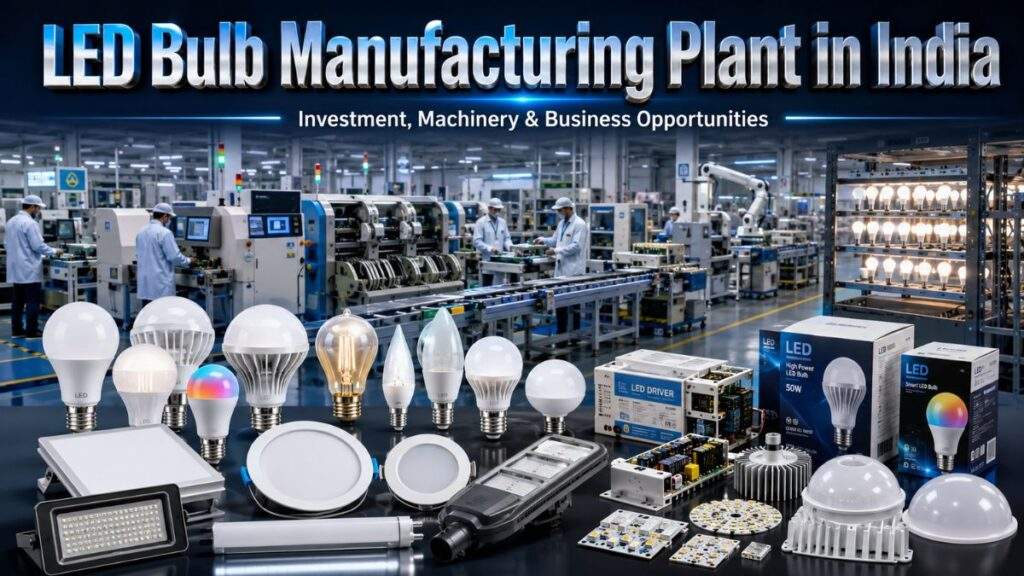
LED Bulb Manufacturing Plant The LED light revolution in India is one of the most successful government initiatives in the field of transitioning from traditional lighting to LED technology, and it offers entrepreneurs an exciting opportunity in the electronics manufacturing business with a Rs.5 Crore LED light manufacturing unit at a sweet spot of high domestic demand, institutional procurement by the government and the emerging export possibilities. Mass LED adoption has been achieved through the UJALA programme and the energy efficiency regulations that have ensured that LED is the standard light for the household, commercial and industrial sectors in the country under the leadership of the Bureau of Energy Efficiency (BEE), Ministry of Power. Beyond just replacing bulbs, India’s LED market is still expanding with the introduction of smart lighting, horticulture LED, and solar powered LED systems. Why LED Manufacturing Is a Strategic Opportunity in India The LED lighting market in India has witnessed tremendous growth over the years, driven by the increasing push for energy conservation, declining LED lighting chip prices, and government regulations. Institutional demand alone saw the UJALA scheme roll out over 36 crores of LED bulbs at subsidised rates in India. Commercial and Industrial LED use – factories, office buildings, hospitals, and street lighting – is also expanding with energy cost savings being measurable and payback periods generally ranging from 12-24 months. The Ministry of New and Renewable Energy also supports solar LED systems for rural electrification, thus establishing a renewable energy market for LED. Based on the BIS certification, an LED manufacturer from India will be able to sell LED products to the private sector and institutions across India. Get Detailed Project Report (DPR): LED Light Bulbs, Tubes, Fittings, Spotlights and Wall Lights Projects Government Policies Supporting LED Manufacturing LED products are certified under the star rating programme by BEE under the Ministry of Power and procurement preference is given to LED products that are BEE rated in government procurement. The Government e-Marketplace (GeM) portal provides access to Government as one of the biggest institutional buyers to MSME manufacturers registered on GeM. The technology upgradation funds under MSME Ministry are used to acquire the modern LED assembly and testing machine. LED Lamps sold in India must have BIS (Bureau of Indian Standards) certification as per IS 16102 and can be checked from BIS portal. There is a PLI scheme for electronics manufacturing that offers production subsidy to LED manufacturing companies that meet its criteria. Top Business Ideas in LED Manufacturing at Rs.5 Crore Scale LED Bulb and Tube Light Assembly for Domestic Market and GeM A semi-automated LED assembly machine with an investment of Rs.5 Crore can produce 10,000 to 30,000 LED bulbs as well as tube lights per day for imports of LED chips and drivers and domestically manufactured LED housing and heat sink. The main quality marks for the domestic market sale are IS 16102 certified by BIS. The GeM portal enables MSME manufacturers to directly sell to Government departments, Municipal corporations and public sector units, making it one of the biggest LED buyers in India. The municipal street lighting, government building lighting and school and hospital LED projects are big tender categories for institutions in which MSME manufacturers having GeM registration and BIS certification compete directly with each other. Agricultural and Horticulture LED Grow Lights The use of plant growth LEDs is a niche segment of LED manufacturing that is growing rapidly, and is tailored for greenhouse horticulture, vertical farming, and controlled environment agriculture. The growing protected agriculture in India, poly-house and vertical farming by urban farms place demand on the light spectrum specific grow lights, which stimulate plant growth and electricity usage compared to conventional horticulture lighting. The cost of grow lights per watt is 3–5 times as much as normal LED bulbs, which results in a better revenue per unit and margin profile. There is also good export potential to horticulture markets in South East Asia and Europe for this product category. Solar-Integrated LED Street Lighting and Garden Lighting The use of solar powered LED street lights, including solar panel, battery storage, LED luminaire and intelligent controller, is required in rural electrification projects, border area lighting and off-grid community lighting. There is a significant budget for solar LED street-lighting procurement in the MNRE and the state electricity boards. One manufacturing unit with the capacity of Rs.5 Crore per set of solar LED integrated systems can apply for state/central government tenders for rural street lighting. The average unit price is also much higher than the price of a retail LED bulb, which ranges from Rs.50 to Rs.200, to the cost of a solar LED street light system ranging from Rs.8,000 to Rs.25,000 per system, which greatly enhances the revenue per order. Get Detailed Insights from This Book: Solar PV Power and Solar Products Handbook Import-Export Opportunity Analysis India presently imports a substantial quantity of LED chips (epitaxial wafers) and LED drivers mainly from China, Taiwan and South Korea. The PLI scheme by the government for electronics manufacturing and global buyers’ China Plus One policy are providing opportunities for Indian LED manufacturers to increase the supply of chips and drivers from domestic manufacturers. Indian LED manufacturers are price competitive and quality as compared with the markets of Africa, South Asian and Middle East region of the world. The DGFT registers LED product exporters for RoDTEP benefits. Other LED export market development is through export promotion of electronics through APEDA equivalent, in the form of Electronics and Computer Software Export Promotion Council (ESC). Indian MSME Success Stories in LED Manufacturing Syska LED: Building India’s Largest LED Brand The Rajesh and Govind Uttam Chandani of the Syska Group developed the India’s most recognised LED lighting brand, choosing to specialise entirely in LED as India began its energy transition from a small electronics company. Its aggressive distribution strategy – that is, introducing Syska LED products in all segments of the Indian retail from modern trade to kirana stores – gave the company national visibility,
How to Start Empty Capsule Manufacturing Plant in India: Cost, Investment & Profit
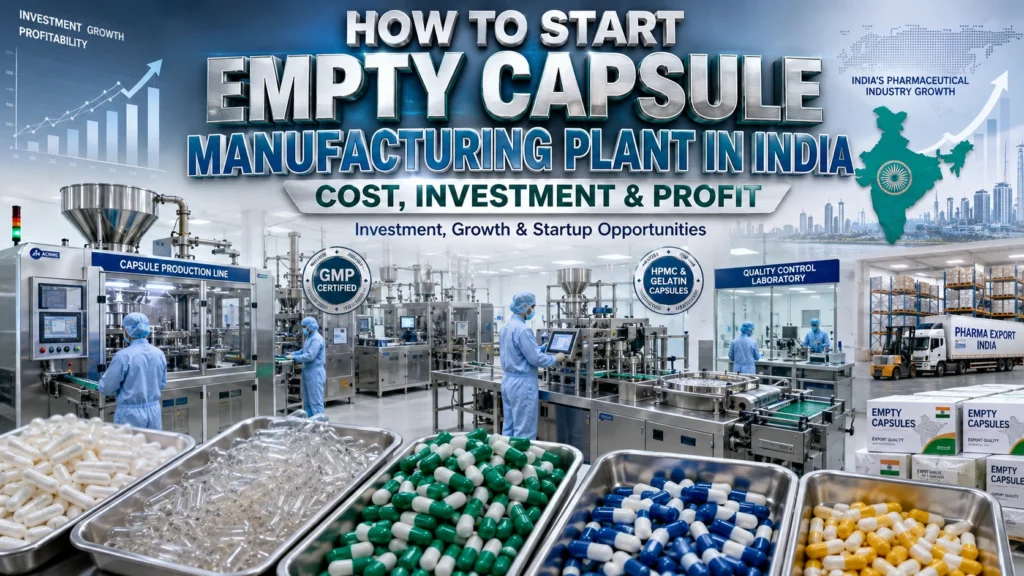
Each tablet that is not produced is a capsule order and each capsule order requires an empty capsule before the first milligram of active ingredient is placed in the capsule. However, India’s low bulk capsule production market is concentrated with just a few large-scale manufacturers, with mid-size formulation companies and nutraceutical brands waiting for days for orders which would fill their weeks in a free competitive market. It is the space where India businessmen can create an empty capsule manufacturing plant that can be sold to other business-to-business players – not branded as a consumer product. It’s packaging-adjacent manufacturing — not sexy, not obvious to the purchaser, and not a business that first-generation entrepreneurs typically think about. The vegetarian and HPMC capsule market is expanding more quickly than the domestic supply, due to the demand of halal, kosher and vegan consumers, which can’t be met by the gelatine capsule market. Get Detailed Project Report (DPR): Empty Gelatin Capsules Why This Is a Genuine Opening In this case, the demand reasons aren’t based on convincing anyone of anything. All tablet manufacturers making the move to capsule dosage, all new supplement brands from the nutraceutical industry, and every export order from Africa or Southeast Asia requires a dependable capsule supplier, but the supply base at home has not been able to keep up with the increase in formulation and nutraceutical manufacturing it feeds. There’s a special challenge for vegetarian HPMC capsules: consumers’ growing preference for plant-based shells for religious, dietary, and ethical reasons has created a shortage that’s exacerbated by the fact that only a few Indian manufacturers are currently producing HPMC capsules on a scale that meets demand. The entry cap-ex is not negligible. The cost of the single-line hard gelatin capsule unit, which is capable of producing about one billion to 1.5 billion capsules a year, is about eight to 15 crore rupees, involving investment in dip-pin machines, drying tunnels and printing equipment. The processing and drying conditions for the polymer used to make capsule lines are significantly different from those used in the case of gels and the lines are therefore more expensive, fifteen to twenty-five crore rupees. FSSAI registration is required for licensing and in case of export oriented pharmaceutical formulators, facility approval from CDSCO or USFDA clearance is required, which takes around twelve months of the commissioning process. Margin and Risk Structure This is because the commodity hard gelatin capsules is a thin margin business itself (gross margins are 8-12 percent) and because buyers change suppliers by fractions of a rupee per thousand capsules. The gross margin on HPMC vegetarian and specialty capsules is very high, anywhere from 18-25% gross margin, due to the fact that far fewer manufacturers can reliably produce these capsules to pharmacopeia specification, allowing the early movers to really have the pricing power that commodity gelatin manufacturers do not. In this segment, scalability typically comes from installing lines, not from building new facilities — a founder typically launches with a handful of dip-pin machines, tests out quality uniformity with a few formulation buyers, then expands lines based on repeat demand. The primary risks are raw material dependent; the price for gelatin is tied to the prices of bone and hide collagen on the global market, and is liable to sudden fluctuations, while HPMC is a derivative of cellulose, with a smaller and more concentrated global base of suppliers for its raw polymer. The other risk is rejection by quality-sensitive pharmaceutical buyers; if a buyer orders a year’s worth of sales but finds that one batch is out-of-specification, he or she may not order the next one. Product and Project Opportunities Worth Evaluating Standard Hard Gelatin Capsules The standard hard gelatin capsules are by far the biggest share of the market, providing generic pharmaceutical formulations to the overcrowded manufacturing camps in Baddi, Hyderabad and Ankleshwar in India. A unit designed to serve 1-1.5 billion capsules per year requires capex of ten to fourteen crore rupees, with an expectation of supplying companies in the formulation business within a radius of 300-400 kilometres to ensure cost of logistics. With the strong competition in the price of the existing large suppliers, it is obviously not a margin play that the new entrants can make the economics work with, but a business model based on volume and reliability. Gross margins finally settle at 8-12 percent. Related Article: Building a Successful Pharmaceutical Manufacturing Business HPMC Vegetarian Capsules For nutraceutical brands, halal and kosher export buyers, and pharmaceutical formulators seeking alternatives to animal-derived capsules, HPMC vegetarian capsules are the right choice. A dedicated line, which costs between a hundred and two crore rupees, accounting for the specialised polymer-processing and humidity-control specifications, directly targets nutraceutical contract manufacturers and export-based supplement brands. Margins are 18-24 % which is significantly better than gelatin, since there is very limited number of qualified HPMC capsule manufacturer in India till now with a growing demand. Colored and Printed Specialty Capsules Colored and custom printed capsules meet the brand differentiation needs of nutraceutical and consumer wellness companies looking to achieve a white shell that stands out on the shelf. Print and multi-colour capability is an additional cost of 2-4 crore rupees over the existing capsule line, margins are between 20-28 percent as the pricing is done based on brand value and not on the economics of capsules. A good second phase addition for an existing base gelatin or HPMC brand with a founder who does not want to invest in an additional facility for the higher margin brand-conscious consumers. Enteric-Coated Capsule Shells The enteric coated shells, which resist stomach acid and only open up in the intestine, appeal to a more niche but higher-value pharmaceutical and probiotic buyer segment. The additional cost of a specialised coating line at an existing capsule plant is of the order of Rs.5 to 8 crore, and margins are 25-30 per cent due to the technical barrier to entry, where the ability to replicate the coating consistency is a skill that
गांव में शुरू होने वाले 50 सबसे फायदेमंद बिजनेस आइडियाज़
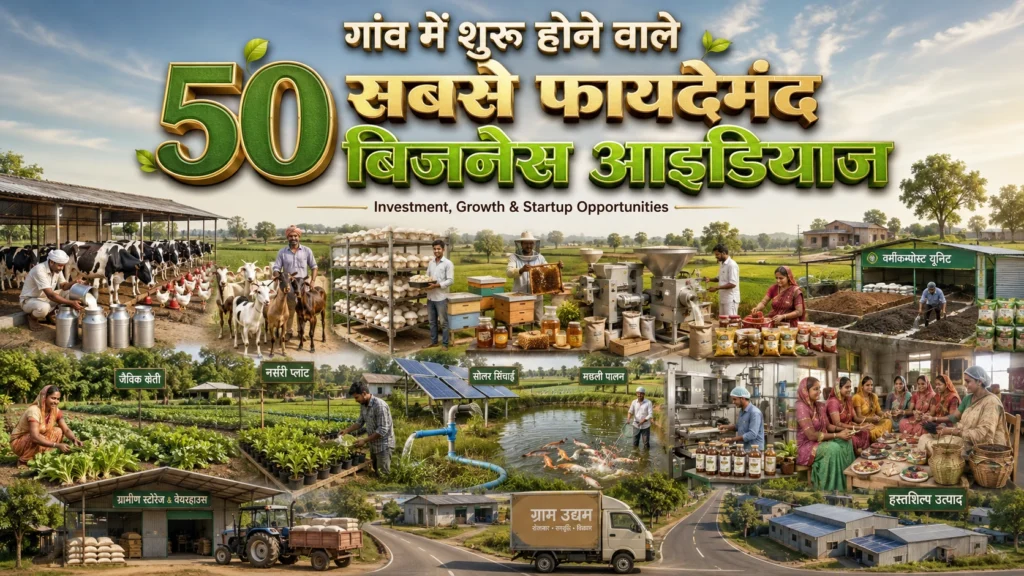
गांव में बिजनेस आइडिया भारत के गांवों में एक बड़ा आर्थिक बदलाव चल रहा है। जमीन सस्ती है। मजदूरी कम है। कच्चा माल करीब है। और सरकारी योजनाएं पहले से कभी इतनी अनुकूल नहीं थीं। एमएसएमई मंत्रालय के आंकड़ों के अनुसार देश के कुल सूक्ष्म, लघु और मध्यम उद्यमों का करीब 51 प्रतिशत ग्रामीण और अर्ध-शहरी क्षेत्रों में काम करता है। नाबार्ड की वित्तीय समावेशन रिपोर्ट बताती है कि ग्रामीण परिवारों की औसत मासिक आय पिछले एक दशक में दोगुनी से ज्यादा हो चुकी है। यह रिपोर्ट उन 50 बिजनेस की बात करती है जो असल में चलते हैं — और जिनकी व्यवहार्यता जमीनी स्तर पर साबित हो चुकी है। यह क्षेत्र मजबूत स्टार्टअप अवसर क्यों है बाजार की मांग और विकास ग्रामीण खपत लगातार बढ़ रही है। खाद्य प्रसंस्करण, कृषि सामग्री, हस्तशिल्प और हल्के विनिर्माण — सभी में मांग बढ़ी है। हर बड़ी सरकारी योजना एक नई स्थानीय आपूर्ति श्रृंखला बनाती है। सरकारी सहयोग और नीतियां पीएमईजीपी योजना के तहत ग्रामीण उद्यमियों को 25 लाख रुपये तक की विनिर्माण इकाई के लिए 35 प्रतिशत पूंजी अनुदान मिलता है। अनुसूचित जाति, जनजाति और महिला उद्यमियों को यह और अधिक मिलता है। पीएमएफएमई योजना खाद्य प्रसंस्करण इकाइयों को दस लाख रुपये तक का ऋण सहायता अनुदान देती है। नाबार्ड ग्रामीण उद्योगों को कार्यशील पूंजी ऋण और तकनीकी सहायता देता है। जोखिम जागरूकता ग्रामीण बिजनेस में तीन मुख्य जोखिम हैं — कच्चे माल की मौसमी उपलब्धता, परिवहन की सीमाएं और कुशल कार्यबल की कमी। बिजनेस चुनते समय पहले स्थानीय कच्चे माल और खरीदार की पुष्टि करें — फिर पूंजी लगाएं। बिजनेस चयन का तर्क गांव में बिजनेस चुनते समय ‘क्या चल सकता है’ नहीं, ‘यहां क्या टिकेगा’ यह पूछें। मुनाफे की संरचना तीन स्तरों पर काम करती है: पहला — कृषि आधारित प्रसंस्करण: सकल मुनाफा 18 से 30 प्रतिशत, पूंजी कम, बाजार करीब। दूसरा — हस्तशिल्प और वस्त्र: सकल मुनाफा 35 से 55 प्रतिशत, बाजार जोड़ जरूरी। तीसरा — हल्का विनिर्माण (साबुन, मोमबत्ती, कागज थैली): मुनाफा 35 से 60 प्रतिशत, विस्तार संभव। विस्तार का रोडमैप सरल रखें। छोटी इकाई से शुरू करें, स्थानीय मांग सिद्ध करें, फिर बढ़ें। Find the most profitable startup for your investment range 50 फायदेमंद गांव के बिजनेस — विस्तृत विवरण 1. आटा चक्की गांव में हर घर रोज आटा पिसवाता है — यह मांग कभी नहीं रुकती। पांच से दस घोड़े-शक्ति की मोटर वाली छोटी चक्की में डेढ़ से तीन लाख रुपये की शुरुआती लागत है। रोजाना 200 से 500 किलो पिसाई पर सकल मुनाफा 15 से 22 प्रतिशत बनता है। पीएमईजीपी में 35 प्रतिशत पूंजी अनुदान मिलता है। विपणन की जरूरत लगभग शून्य है — ग्राहक खुद आते हैं। 2. दाल मिल अरहर, मूंग, उड़द — ये सभी दालें ग्रामीण इलाकों में बड़े पैमाने पर उगाई जाती हैं। छोटी दाल मिल में तीन से सात लाख रुपये की लागत है। प्रसंस्कृत दाल कच्चे अनाज से 30 से 40 प्रतिशत महंगी बिकती है। मध्यप्रदेश और महाराष्ट्र में ऐसी इकाइयां सालाना पांच से दस लाख रुपये कमाती हैं। उद्यम पंजीकरण के बाद नाबार्ड से कार्यशील पूंजी ऋण आसानी से मिलता है। 3. अगरबत्ती निर्माण घर से शुरू होने वाला जाना-पहचाना सूक्ष्म उद्योग। मशीन और कच्चे माल पर 50 हजार से डेढ़ लाख रुपये। महिला उद्यमियों में यह सबसे लोकप्रिय विनिर्माण बिजनेस है। तमिलनाडु और कर्नाटक में घरेलू इकाइयां सालाना तीन से पांच लाख रुपये कमाती हैं। खादी एवं ग्रामोद्योग आयोग प्रशिक्षण और बाजार सहयोग देता है। सकल मुनाफा 30 से 45 प्रतिशत। 4. मोमबत्ती निर्माण पैराफिन मोम, धागा और सांचों से शुरुआत होती है। 30 हजार से 70 हजार रुपये में इकाई लग जाती है। सजावटी मोमबत्तियां ऑनलाइन बाजार में 150 से 800 रुपये प्रति नग बिकती हैं। त्योहारी मौसम में मांग तीन गुना हो जाती है। देशभर के ऑनलाइन बाजार तक पहुंच सरल है। सकल मुनाफा 40 से 55 प्रतिशत। 5. साबुन निर्माण हर्बल और हाथ से बने साबुन की मांग शहरी बाजार में बढ़ रही है। 40 हजार से 80 हजार रुपये में घरेलू उत्पादन शुरू होता है। नीम, हल्दी, चारकोल — ये सामग्री गांव में आसानी से मिलती हैं। ठंडी विधि से बने साबुन में सकल मुनाफा 35 से 50 प्रतिशत है। सूक्ष्म खाद्य उद्यम योजना में पैकेजिंग के लिए अलग अनुदान उपलब्ध है। 6. वर्मी खाद उत्पादन जैविक खेती की मांग साल-दर-साल बढ़ रही है। 100 वर्ग फुट इकाई से शुरुआत — लागत 15 हजार से 30 हजार रुपये। तीन महीने में पहली खेप तैयार। आठ से 12 रुपये प्रति किलो के भाव पर महीने में 500 किलो बेचना संभव है। कच्चा माल लगभग मुफ्त मिलता है। सकल मुनाफा 40 से 55 प्रतिशत। 7. मुर्गी पालन एवं चारा प्रसंस्करण 500 ब्रॉयलर मुर्गियों से शुरुआत — लागत डेढ़ से ढाई लाख रुपये। प्रति खेप 45 दिन में शुद्ध आमदनी 20 हजार से 35 हजार रुपये। साल में छह खेप संभव हैं। नाबार्ड के कुक्कुट उद्यम पूंजी कोष से वित्त उपलब्ध है। चारा प्रसंस्करण जोड़ने पर मुनाफा और बढ़ता है। Read the Complete Book Here: Preservation of Meat and Poultry Products 8. मधुमक्खी पालन एवं शहद प्रसंस्करण दस बक्सों से शुरुआत पर 25 हजार से 40 हजार रुपये की लागत। प्रति वर्ष 200 से 300 किलो शहद उत्पादन। जैविक शहद 300 से 500 रुपये प्रति किलो बिकता है। प्रसंस्करण और पैकेजिंग जोड़ने पर 600 से 900 रुपये प्रति किलो तक मिलता है। कौशल विकास मिशन और खादी आयोग दोनों प्रशिक्षण देते हैं। 9. पशु चारा निर्माण डेयरी पशुपालन की वृद्धि के साथ गुणवत्तापूर्ण चारे की कमी है। छोटी चारा मिल में दो से पांच लाख रुपये की लागत है। कृषि उपउत्पादों को मूल्यवर्धित चारे में बदला जाता है। स्थानीय डेयरी सहकारी से सीधा आपूर्ति अनुबंध मिलता है। सकल मुनाफा 20 से 30 प्रतिशत। मध्यम आकार की इकाई सालाना 15 से 25 लाख रुपये का राजस्व बनाती है। 10. गुड़ निर्माण गन्ना उत्पादक गांवों में यह सबसे स्पष्ट अवसर है। पारंपरिक क्रशर और उबालने की इकाई में एक से तीन लाख रुपये लगते हैं। जैविक गुड़ शहरी बाजार में 80 से 150 रुपये प्रति किलो बिकता है जबकि उत्पादन लागत 25 से 35 रुपये है। सूक्ष्म खाद्य उद्यम योजना में पैकेजिंग के लिए अनुदान मिलता है।
Top 10 Industrialists of Bihar: Success Stories, Business Ideas, and Future Vision
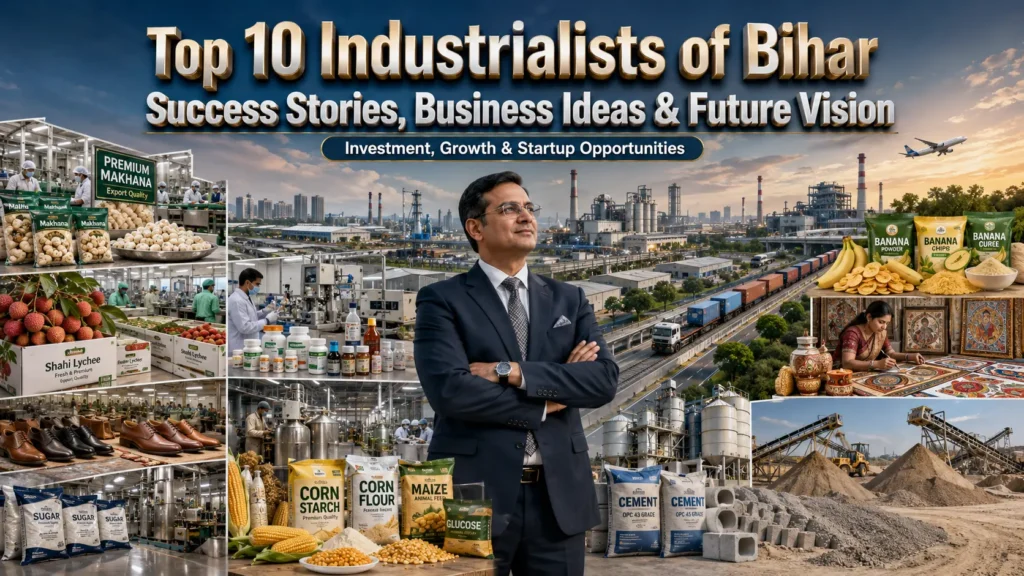
Industrialists of Bihar Awakening Bihar is going through its biggest economic metamorphosis in a century and a half, and a host of business concepts are taking shape. Bihar’s problems for decades have been: poverty, flood susceptibility, and not being industrialized. Presently, it is one of the fastest growing state economies and it is being promoted in a direction of food processing, agri-industrialisation, pharmaceuticals, light manufacturing, and construction of infrastructure. Bihar’s per capita income has seen a lot of improvement in the state due to sustained focus of the government and the commitment made by the Prime Minister for the development of the state’s infrastructure has been a huge boost to the increased interest in investment in the state. Bihar’s key strength lies in its scale – it is the third most populous state in India, and the population is young, both meaning a consumer market and a source of labour for manufacturing. The state is the top producer of vegetables in India, 2nd largest lychee producer in the country and a major contributor of maize, wheat and fish to national supply chains. These agricultural surpluses provide good feedstock for food processing industrial investments. This article talks about Bihar’s 10 industrialists, their contribution and future plans. IBEF Bihar Report offers an up-to-date sector analysis with respect to State data. Why Bihar Is an Emerging Industrial Opportunity There are a number of factors that are driving Bihar’s industrialization. Megaprojects are first of all, massive investments in infrastructure – a commitment by the Union government of over Rs. 58,900 crores of infrastructure investments for Bihar. The connectivity between inter-district and inter-state is drastically enhanced with the six national highway corridors, expressway projects like Patna-Purnia Expressway and Kosi River Bridge project. Second, the food processing opportunity: The vegetable, maize, makhana, lychee and fisheries surpluses in Bihar are almost entirely processed outside the state, providing an enormous opportunity for investment in the food processing sector within Bihar. Third, demographic dividend: Bihar’s youth population will have higher education levels, leading to skilled workforce which will be more preferred by labour-intensive manufacturing. The Ministry of MSME has a proactive approach to the development of the MSME sector and has been actively promoting the development of Bihar’s food processing, handloom, and light manufacturing sector. The Nalanda Agri-Business School has done research on the agricultural value chains in Bihar and found that the value of the chains is over Rs. The annual processing opportunity is 50,000 crore which is being exported to other states for value addition. The essence of Bihar’s future generation of industrial entrepreneurs is to capture a part of this opportunity. Access Complete Business Plan: Bihar Industry Startup & Entrepreneurship Guide Government Policies Supporting Bihar’s Industrial Growth Capital investment subsidy, concessional land and power tariff concession are provided in Bihar Industrial Investment Promotion Policy for new industrial investment. BIADA is the Industrial Estate Authority of Bihar that runs industrial estates in various districts. The Mega Food Park – under PM Sampada Yojana – for the food surplus districts of Bihar is a vital common infrastructure for food processing entrepreneurs. The export of makhana (fox nut), lychee and vegetables is promoted in Bihar by APEDA with the help of quality certification and market access programmes. Bihar has identified ‘food processing’, ‘Leather’, ‘Textile’ and ‘Manufacture of construction materials’ as priority sectors in ‘Make in India’. The central government has been investing in Bihar Special Package and the PMGSY (Pradhan Mantri Gram Sadak Yojana) for rural road connectivity which is helping to ease the last-mile logistics cost of agri-processing entrepreneurs in flood-prone districts. The state’s good land reform history offers a fairly good level of land security, which is one of the risks associated with industrial investment in Bihar. Top 10 Industrialists of Bihar: Profiles and Future Vision 1. Anil Agarwal (Bihar Origins) – Vedanta Resources Anil Agarwal, Founder of Vedanta Resources, was born at Patna, Bihar. From humble beginnings, trading in scrap metal in Mumbai, he was able to grow up into India’s largest diversified natural resource company with the help of a bank loan on the first cable company that he acquired. This is one of the great entrepreneurial origin stories in India, from Agarwal in Patna to London, via his days in the scrap yards in Mumbai. His industrial strategy, who would acquire resource assets and establish refining and processing facilities around them, established a zinc-copper-aluminium-iron ore-oil and gas conglomerate. Agarwal’s vision is to bring back substantial investments in the semiconductor and tech industry in India. 2. Food Processing Industry Leaders – Makhana and Lychee, Darbhanga Bihar is the leading state in the production of makhana (fox nut / water lily seed) which is in increasing demand in the country and abroad as a healthy snack food and accounts for 90% of the total production in the country. The benefit of these industrial entrepreneurs who have established organised businesses for the production of makhana, roasting and packing is that they are making a most unique product for export in Bihar. The government’s GI (Geographical Indication) tagging of Mithila Makhana and export promotion support from APEDA is opening up markets for health food retailers in the US, Europe and Middle East. The lychee processing from Muzaffarpur which has the largest lychee cultivation belt in India is also a potential opportunity in food processing. Get Detailed Insights from This Book: Handbook on Fruits, Vegetables & Food Processing with Canning & Preservation 3. Sitaram Jindal – Jindal Charitable Trust and Bihar Steel The Jindals’ industrial and philanthropic footprint in the Indian state of Bihar extends to steel manufacturing, construction materials, and substantial investments in the social sector through the Jindal Charitable Trust. Bihar is seeing capacity building by industrial leaders that have a link with steel and infrastructure sector, keeping in view the state focus on its huge capacity building plan. Bihar’s expressway, railway and bridge construction pipeline generates huge demand for rebar, structural steel, cement and construction equipment, where industrial entrepreneurs situated in the state enjoy
Products from Biogas Plant Digestate: Manufacturing Process, Investment & Business Opportunities
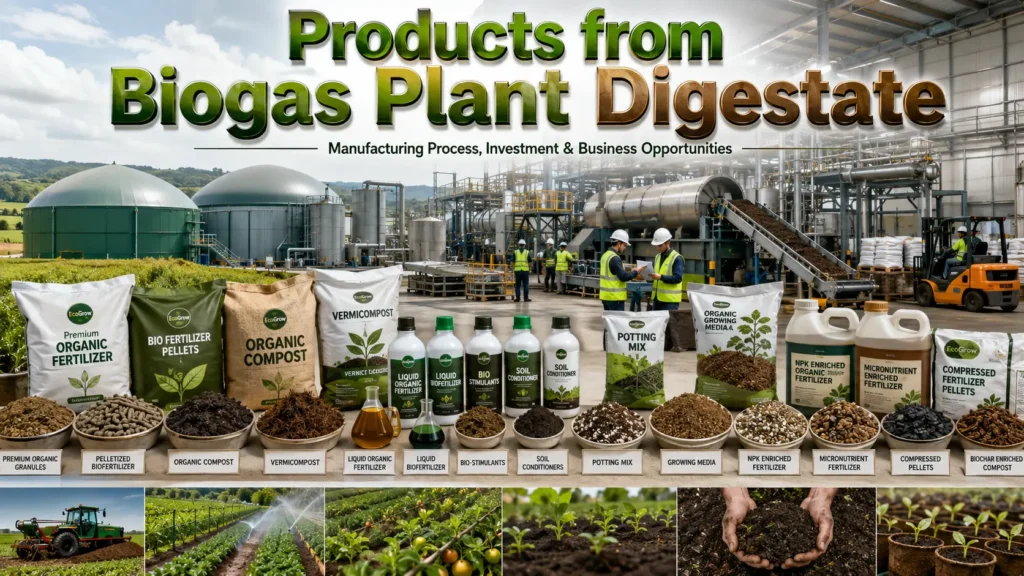
Biogas Digestate Products India has one of the world’s highest installed bases of domestic biogas plants (about 5 million) and commercial biogas plants (hundreds) at dairies, food processors, distilleries and municipal waste sites. The Satat Scheme has also introduced a compressed biogas plant (CBG) and MNRE is supporting fresh biogas capacity. However, in this extensive installed base, the digestate (liquid and solid residue after the energy has been extracted from the waste material as biogas) is not adequately managed and monetized. Most biogas plants just release liquid digestate into the adjacent agricultural land or water bodies and solid digestate piles up in pits, without making any effort to utilise them commercially. The digestate is not waste, but the best liquid organic fertilizer for Indian farmers. While composting and raw manure must undergo weeks of soil mineralisation before the available N can be absorbed by plants, anaerobic digestion breaks down complex organic nitrogen (protein and amino acids) quickly into ammoniacal nitrogen (NH₄-N) and is readily available for plant uptake without requiring weeks to mineralise the soil. Liquid digestates produced by well-managed biogas plants is a complete NPK fertiliser, consisting of 1.5–4% N, 0.8–2% P₂O₅ and 2–4% K₂O on dry matter basis. It has been consistently proven that application of digestate increased crop yields by 15–30% compared to the same mineral fertiliser application, which is probably due to growth hormones and beneficial microorganisms present in digestate. Explore This Book: Handbook on Biogas and Its Applications Top 6 Products from Biogas Digestate 1. Liquid Bio-Fertiliser (Direct Application Grade) This is because the digestate of food, agricultural and dairy waste biogas plants can be filtered at the plant (to remove fibre >1 mm) and quality tested before being sprayed directly onto crops in both drip irrigation or sprinkler irrigation systems. Bulk liquid bio-fertiliser (Rs. per unit) 200–300 litre tankers at Rs. 2,000–5,000 per tonne (Rs. The biogas plant is serving the organic and conventional farmers within 50 km radius. 2. Concentrated Liquid Bio-Fertiliser (Evaporation) The multi-effect evaporators enable digestate to be concentrated to 3-4 times its original concentration (from 1.5 % dry solids to 5-6 % dry solids) and allows for a more economic transport over longer distances for the bio-fertiliser. The digestate is produced in concentrated form (20–25% DS) in Rs. The cost of 20 litre containers is Rs. In urban horticulture and hydroponic crop production, premium prices are obtained for 150 – 300 per litre. A digestate concentration evaporation system: 50–150 lakh. Get Detailed Project Report (DPR): Biotechnology, Enzymes & Organic Farming Guide 3. Separated Fibre Compost (Press Cake) Organic compost material (25–30% DS) is produced by screw press separation of digestate to solid press cake and into liquid fraction, which can be stacked and transported. Granular Organic Compost for bagged retail is prepared by pressing the fibre cake and after drying and bulking agents, the compost is obtained at the retail price of Rs. 5,000–10,000 per tonne. Screw press separator and compost yard: Rs. 30–80 lakh. 4. Nutrient-Rich Irrigation Water (Fertigation) Using filtered digestate in on-farm irrigation systems (such as drip and furrow irrigation) to contracted farmers provides a complete service which can replace 30-50% of mineral fertiliser need. The operators of biogas plants establish long-term agreements with farmer clusters within 5 km of the plant, providing digestate via stationary pipelines or mobile digestate tank systems. 5. Dried Organic Fertiliser Granules Press cake from digesters is further dried (rotary dryer) to less than 10% moisture, and subsequently granulated to yield organic fertiliser granules which are easily spread mechanically and sold in the retail market. For the same, the FCO certified dried digestate granules sell for Rs. Premium organic fertiliser markets: 6-12 tonnes per tonne. Investment in the dryer and granulation line is Rs.: 40–120 lakh. 6. Algae Cultivation Substrate Microalgae (Spirulina/Chlorella) cultivation in raceway ponds or photobioreactor systems can be done with high nutrient liquid digestates diluted with water which serve as a perfect growth medium. Nitrogen and phosphorus (nutrient polishing) removed by algae at digestate water is converted to algal biomass with economic value of Rs. Nutraceutical, animal feed, and biofuel applications: 200-800 per kg. A digestate fed algae pond system: 30–100 lakh. Investment and Market Summary Product Investment (Rs.) Price Key Buyer Liquid Bio-Fertiliser 10–30 lakh Rs. 2,000–5,000/MT Organic/Conv. Farmers Concentrated Bio-Fertiliser 50–150 lakh Rs. 150–300/litre Urban Horticulture Fibre Press Cake Compost 30–80 lakh Rs. 5,000–10,000/MT Organic Farmers, Export Organic Fertiliser Granules 40–120 lakh Rs. 6,000–12,000/MT Premium Organic Market Algae Biomass (on Digestate) 30–100 lakh Rs. 200–800/kg algae Nutraceuticals, Feed Farmer Contracts: Building the Digestate Market Utilisation of digestate is only feasible if reliable farmer buyer relationships are established within the economic transport distance from the biogas plant. A 50 km radius around a large biogas plant contains tens of thousands of farmer fields, which however, need systematic market development, demonstration plots in which digestate crop response is demonstrated and infrastructure for delivery. The most successful digestate utilisation model in India is the biogas plant operators forming partnerships with Farmer Producer Organisation (FPO) where FPO provides farmer market aggregation, the operator supplies digestate at a cost below mineral fertiliser equivalent, and both parties benefit from the partnership. This FPO – biogas partnership model is being actively promoted by NABARD and the State cooperative departments. Related Article: Compressed Biogas Export India Opportunities That Can Earn ₹8 Cr/Year Digital Platforms for Digestate Marketing The agri-tech ecosystem in India is maturing to create online platforms that allow organic fertiliser producers (biogas plant digestate suppliers included) to connect with farmer buyers directly instead of through the traditional distributing chain to enhance farmer and producer margins. DeHaat, Ninjacart, AgriBazaar etc. are developing organic input procurement wings that will link the organic input producers to their farmer network. Aqgromalin (an aquaculture focused agri-platform) collects fish and shrimp farm inputs such as organic fertilisers. They offer the following services for biogas plant digestate producers: nationwide farmer buyer access beyond the geographical reach, digital payment and invoicing system, and quality test by the platform. Agri-tech platforms
BHAVYA-Rasayan Scheme: 3 Chemical Parks, 10 chemical manufacturing Business Ideas for MSMEs
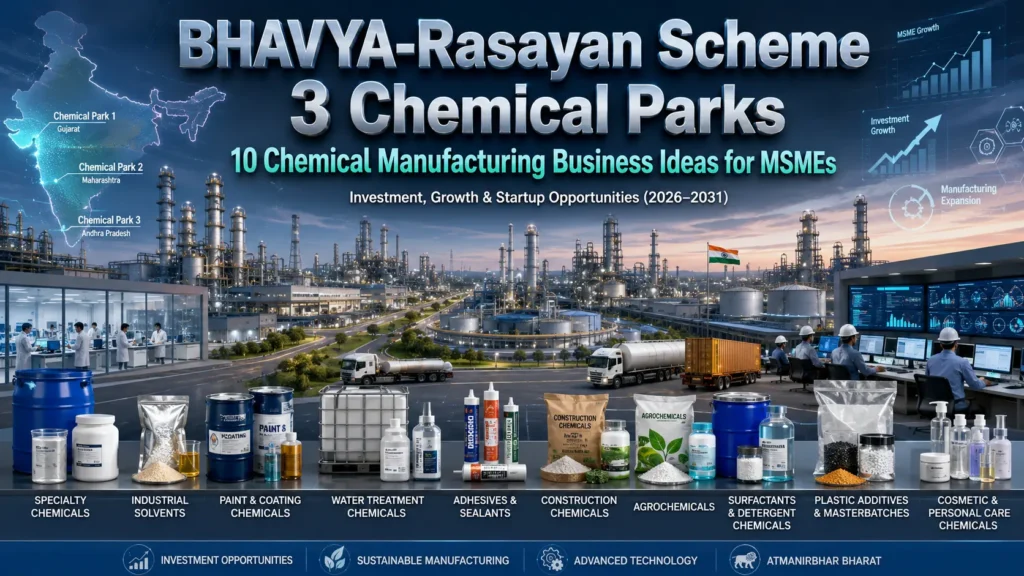
BHAVYA Rasayan Scheme Ten first-time promoters will say: What does it take to manufacture chemicals? Nine will say: What does it take to manufacture chemicals? How many dollars does it cost? That’s a good question, but it’s masking a better one. The question is what is the interest earned on each rupee and what is the time period. This article has both answers. It classifies practical business ideas based on the amount you can invest; so that you will not waste your time on the projects that you can’t afford. The timing is also a factor. Three dedicated chemical parks are a part of the BHAVYA-Rasayan scheme and the Union Cabinet has approved funding of ₹3030 crore for the same. Concentrated utilities within those parks will reduce the capital cost for all units within those parks. As a result, a number of projects that were considered to be too expensive just a year ago are now at the reach of a mid-size promoter. Why Founders Ask the Wrong Question First Capital Is Rarely the Real Constraint Good chemical projects are bank financed. They have been doing so for decades. The money is the least thing that prevents most promoters from succeeding. Far more projects fail due to weak product selection, missing approvals, and unrealistic demand estimates than due to tight budgets. Thus, capital is a result of good planning and not the beginning. What Actually Decides Your Return The profitability of this sector is determined by three factors. The first is the level of narrowness and defensibility of your product. Second, the efficiency with which you are using utilities like steam, power, water etc. Thirdly, your rate of filling capacity. The plant is not the same at 40 per cent as it is at 80 per cent. In most years, in fact, utilisation is more than the price. Margins Rise as Products Get Harder to Copy Simple blending businesses have regular, but modest margins. Product with the need of process know-how, catalysts or tight product purity fetches much more. They also require improved chemists and extended customer approval processes, though. So it does not actually make any sense to say it is a choice of ladders anymore. Select the rung that suits your team, not your bank account. How to Read a Chemical Project Cost Sheet The Five Blocks Every Project Contains When you’re judging a project, divide it up into 5 parts: Land and site development, which is eliminated by a park location. This is typically 15 to 20 per cent of the building or civil work cost. Plant, machinery and instrumentation (usually the largest block). Utilities and pollution control, typically 20 – 30 per cent, in standalone units. Working capital in the form of preliminary expenses, contingency and margin money. Be aware of the significant contribution of utilities and pollution control to the total. This one sentence is the answer as to why shared park infrastructure is such an important issue to smaller promoters. Related Article: 15 Profitable Chemical Business Ideas in India (Low Investment Manufacturing Guide) The Working Capital Trap This is where new founders are most likely to get hurt. Raw material must be paid for within a short period of time, and customer payment takes 60 to 90 days. Export buyers pull it even more. In the meantime, there is never an idle hour for salaries or power bills. Thus, even if a profitable plant is developed, it may still be cash-flowed in the first year. For at least 3-4 months operating cost, budget the operating cost as working capital; arrange the limit before commissioning; don’t wait after commissioning to arrange the operating cost limit. Business Ideas Under ₹2 Crore Don’t let small capital fool you, this is a big opportunity. The ideas below require small investments since they do not demand a lot of synthesis and pollution load. Chemical Testing and Calibration Laboratory All chemical units are required to test raw materials, finished products, effluent and emissions. Small units don’t have the resources for their own full analytical lab; therefore, they outsource. Thus, there is a demand for a NABL accredited third party laboratory from its first year. Services smoothly widen into instrument calibration, safety data sheet preparation and export support. Investment is in the instruments and qualified analysts, not land and reactors. Margins remain high because the key factor is skill. Fortunately, tougher environmental standards continue to grow the market without needing to be pushed. This still stands as one of the best opportunities for a technically savvy entrepreneur with little money to invest, anywhere in the industry. Drum Reconditioning and Chemical Packaging Chemicals are transported in drums, carboys, IBCs and each and every one of these requires cleaning, testing and certification before reusing. A reconditioning unit removes the used containers, conditions them to be standard and puts them back into circulation. The demand gradually increases with the increasing capacity of chemicals, which is close to the demand. Discipline in the areas of safety and traceability is more important for the business than extensive knowledge of deep chemistry. Therefore, it is appropriate for promoters coming from an engineering or logistics background looking for a presence in the sector without taking on process risk. The cash cycles are short, as buyers are not distant distributors but some industrial units. Subsequent operators go on to expand into bulk liquid transport, using the same customers. Institutional Cleaning and Sanitation Chemicals Consumables such as floor cleaners, disinfectants, degreasers and hand hygiene products are purchased on a regular basis by hospitals, hotels, food plants, and large offices. These are blending operations, not synthesis, which means that capital remains low and approvals remain easy. The real business is in the quality of the formulations and institutional selling. The majority of volume is generated by tenders and annual rate contracts which means income is predictable after empanellation. Another thing that you should know about contract manufacturing for bigger brands is that you will get your cash flow early and