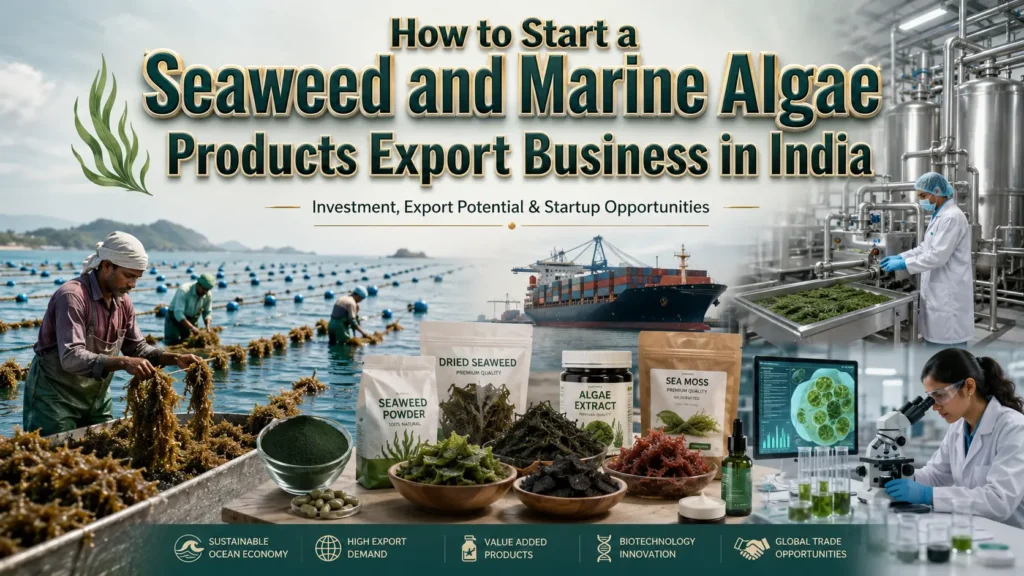

Seaweed and Marine Algae Products Export Business
The seaweed and marine algae products manufacturing for export is one of the promising and fastest-growing business ideas in the blue economy in India. The global seaweed market is over 16 billion dollars annually and is expanding at a rate of 10% to 12% per year, due to the increasing trend in the world towards natural, plant-based, and sustainable products. Seaweed farming and processing is a high priority marine export category promoted by MPEDA and there are significant natural resources of seaweeds in India available along the coast, especially in Tamil Nadu, Gujarat and Andaman and Nicobar Islands. Seaweed and marine algae products represent a business opportunity for entrepreneurs who have access to coastal land, interest in aquaculture or a chemistry processing unit, and are interested in supporting sustainable, healthy, and sustainable business development and future growth.
Why Seaweed Products Export Is a Growing Blue Economy Opportunity
The potential benefits of seaweed are its exceptional chemical diversity, with carrageenan, agar, alginates, fucoidan, laminarin and various bioactive compounds being used as food additives, excipients for pharmaceuticals, cosmetic actives, agricultural bio stimulants and sustainable packaging materials. This chemical variety provides several opportunities for market penetration and investment and margin characteristics.
Seaweed has a strong competitive edge for India because of coastal biodiversity, tropical water temperature, availability of sunlight and its traditional harvesting knowledge among the seaweed harvesting communities in Tamil Nadu and Gujarat. The use of seaweed aquaculture (cultivation of species such as Kapahulu’s alvarezii (cottonii) and Gracilaria (used for agar) production can supplement the natural harvest in terms of scale and consistency.
MPEDA and Government Support
The Marine Products Export Development Authority (MPEDA) is actively encouraging the cultivation and processing of seaweed products with financial assistance for seaweed cultivation infrastructure, processing equipment, quality certification, and developing market. MPEDA’s seaweed development programme offers subsidies for systems of raft and ropes, for drying facilities and for extraction machines.
Seaweed farming infrastructure such as rope, raft cultivation system and seaweed processing equipment are given capital subsidy in the Department of Fisheries PMMSY. The support given to PMMSY is also generous, especially for the cultivation of seaweeds which aligns to the coastal livelihood development and blue economy goals.
Central Institute of Fisheries Technology (CIFT), ICAR, offers technical support and technology transfer for the processing of seaweed such as carrageenan extraction, agar production and manufacture of seaweed biostimulant technologies to help entrepreneurs with proven technologies for setting up new enterprises.
Exports of seaweed and marine algae products are covered under DGFT RoDTEP Scheme. MPEDA RCMC must be claiming these benefits. Seaweed products are one of the most promising marine export products for MSME entrepreneurs, due to their relatively low investment requirements and the increasing global demand.
Read the Complete Book Here: Handbook on Fisheries and Aquaculture Technology
Business Ideas in Seaweed and Marine Algae Products
1. Dried Seaweed and Raw Seaweed Export
The exported seaweeds are mainly sun-dried Kappaphycus alvarezii (cottonii) from Tamil Nadu coastal farms for processing in food grade carrageenan by the carrageenan extraction companies in Philippines, China and Europe. This is the most readily available seaweed export venture which has minimal processing facilities. Cost investment range between ₹10 lakh to ₹30 lakh for seaweed drying platforms, packaging and basic quality testing. The farmers and SHG of Tamil Nadu involved in seaweed farming under the support of MPEDA and PMMSY provide raw seaweed which is processed and packaged by the traders/exporters. The export price of dried cottonii seaweed is from ₹25 to ₹50 per kg, depending on the quality and the amount of carrageenan present.
2. Carrageenan Extraction and Export
A widely used food additive in this country, carrageenan is a natural hydrocolloid obtained from red seaweed, which is used in dairy products, processed meats, infant formula, and cosmetics. The Kappaphycus seaweed cultivation in India is the source of raw material used in the production of carrageenan. The investment amount in an extraction vessel, filtration unit, drying and milling is in the range of ₹1crore to ₹4crore in a carrageenan extraction unit. Premium food industry buyers must use carrageenan that is food grade and certified by JECFA as well as Kosher and Halal. Carrageenan is sold internationally as a stabiliser and gelling agent for dairy manufacturers and processed food producers in the EU, US, Japan and Southeast Asia.
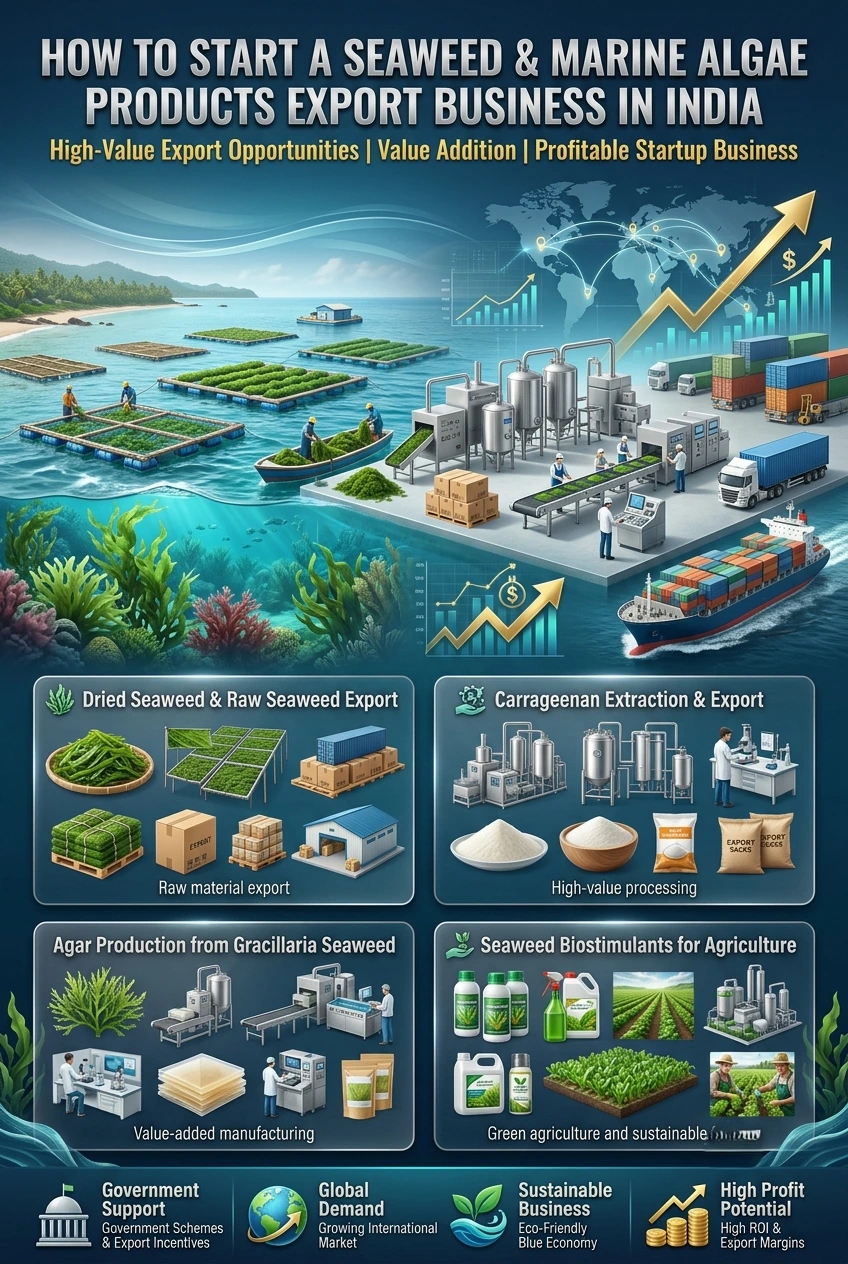
3. Agar Production from Gracilaria Seaweed
Agar is a gelling agent from red seaweeds (Gracilaria and Gelidium) that is widely used in microbiology laboratory media, food production and in the manufacture of pharmaceutical capsules. In India natural Gracilaria resources are found in Tamilnadu and Gujarat. The cost of investment for a production unit of the bacteriological agar and food grade agar lies between ₹80 lakh and ₹2.5 crore. The bacteriological agar used in laboratories is one of the most expensive seaweed derivatives in international markets where its prices range from Rs. 2000 to 5000 per kg. Its export markets include some of the global research institutions, food manufacturers, diagnostic laboratories and pharmaceutical companies. To gain access to the pharmaceutical market, the USP and BP agar specifications must be adhered to.
Get Detailed Project Report (DPR): Agar Agar (Bacteriological Grade) Manufacturing Industry
4. Seaweed Biostimulant for Agriculture
With the growing popularity of organic farming and sustainable agriculture, the use of seaweed based agricultural biostimulants is accelerating in the form of liquid seaweed extracts, seaweed powder and seaweed meal. They are used to enhance crop productivity, tolerance to stress and soil quality when applied to a crop or soil. Mechanical or chemical extraction of fresh or dried seaweed can be used to establish a seaweed biostimulant production unit with an investment of ₹20 lakh to ₹60 lakh. Premium market for organic agriculture opens by compliance with EU Organic Regulation and US organic certification (USDA NOP). The countries with the highest adoption of biostimulants in their export markets are organic farming communities in EU, US, Japan, and Australia.
Import-Export Opportunity Analysis
The export of seaweed products is steadily increasing in India. In terms of exports, dried seaweed, seaweed extracts and agar are emerging as new categories in seaweed exports, according to MPEDA data. The major markets are Japan, China, the EU and the US. Global seaweed-based packaging and bioplastics market is making a new chapter in the high value exports as brands and governments around the world are looking for plastic alternatives.
The seaweed ingredients market is undergoing a transformation from bulk commodity hydrocolloids (Carrageenan and Agar) to precision bioactive compounds such as fucoidan, which is being used in anti-viral and anti-cancer research applications, fucoxanthin for weight management and phycocolloids in pharmaceutical applications. Indian entrepreneurs that invest in the seaweed bioactive extraction technology will have access to a niche segment of the seaweed market, which commodity producers cannot capture.
Find high-return business ideas based on your budget & ROI
Indian MSME Success Stories
AquAgri Processing, a Gujarat-based seaweed processing company, built significant export business in seaweed-derived biostimulants for agricultural markets in EU and US by combining seaweed extraction technology with organic certification and agronomic efficacy data — demonstrating that Indian seaweed processors can access premium sustainable agriculture input markets.
Sea6 Energy, a Chennai-based seaweed technology company, developed India’s first seaweed cultivation and processing technology for large-scale offshore seaweed farming — demonstrating that Indian companies can innovate at the frontier of seaweed aquaculture technology with global commercial applications.
Several Tamil Nadu-based women’s Self-Help Groups have successfully commercialised seaweed drying and export businesses — supported by MPEDA’s coastal livelihood programmes — demonstrating that seaweed export can simultaneously generate rural women’s economic empowerment and international revenue from India’s coastal biodiversity.
How NPCS Supports Seaweed Business Planning
We at Niir Project Consultancy Services (NPCS) provide professional consulting for the preparation of Market Survey cum Detailed Techno-Economic Feasibility Reports (DPRs) for setting up new marine products and seafood businesses. Our reports include detailed processing technology, market research and demand analysis, regulatory compliance roadmap, plant layout and equipment specifications, and complete project financials with profitability analysis. The Goal To assist entrepreneurs to check out the viability, lucrativeness, and sustainability.
Related Article: Top 25 Fisheries Aquaculture Business
Seaweed Products Export: Key Data Overview
| Seaweed Product | Investment Range | Key Certification | Target Markets | Typical Margin |
| Dried Seaweed (Cottonii) | ₹10L – ₹30L | MPEDA + FSSAI | Philippines, China, EU | 20–40% |
| Carrageenan Extraction | ₹1 Cr – ₹4 Cr | JECFA + Halal/Kosher | EU, US, Japan, SE Asia | 30–55% |
| Agar Production | ₹80L – ₹2.5 Cr | USP/BP + ISO 22000 | Global pharma and food | 40–80% |
| Seaweed Biostimulant | ₹20L – ₹60L | EU Organic + USDA NOP | EU, US, Japan, Australia | 35–65% |
| Seaweed Cosmetic Extracts | ₹30L – ₹80L | ISO 22000 + Organic | EU, US, Japan | 45–80% |
Frequently Asked Questions (FAQ)
1. What seaweed species are commercially important for Indian exporters?
Kappaphycus alvarezii (cottonii) is the primary farmed species for carrageenan production in Tamil Nadu. Gracilaria species are farmed for agar production. Sargassum, Turbinaria, and Dictyota species — wild-harvested from natural seaweed beds — are used for biostimulant production. Marine macro-algae like Ulva (sea lettuce) a promising food & cosmetics product.
2. What is carrageenan and what are its food applications?
Carrageenan (E407) A sulphated polysaccharide which occurs in red seaweeds is naturally occurring and it is used in the food industry as a food additive, gelling agent, thickener, stabilizer and in confectionery. Food uses include dairy products such as desserts, chocolate milk, ice cream and formula milk, processed meats, salad dressings and vegan dairy alternatives. Only food grade carrageenan that complies with the JECFA limits for heavy metals, microbiological criteria and viscosity should be used.
3. How is seaweed farming done in India?
The predominant technology for cultivation of seaweed in India is the rope culture method in which the seed seaweed fragments are tied to ropes and planted in shallow coastal waters (1 to 3 m depth). Kappaphycus is well adapted to warm shallow waters with clear, nutrient rich, well oxygenated waters, and grows at a fast rate with yield varying from 500 g to 1 kg per fragment in about 45–60 days. Support for rope and raft farming infrastructure is provided by MPEDA and PMMSY. Day to day monitoring of grazing damage and diseases is required.
4. What quality parameters matter for exported dried seaweed?
The important quality parameters for dried seaweed for export are: moisture (maximum 35% for cottonii), carragenan content (30% minimum for good cottonii), salt content (variable), freedom from sand and foreign materials and uniform colour. Quality criteria should be indicated in the purchase contract with the buyer who may carry out their own tests of exported consignment upon arrival.
5. Is there a domestic market for seaweed products in India?
Yes. The Indian food industry (bakery, confectionery) uses significant amounts of seaweed derived products – particularly agar. Other key markets are bacteriological agar for laboratory use and seaweed biostimulants (for organic farming). Developing a domestic business alongside exports reduces market risk compared to a purely export model.
6. What is fucoidan and why is it a high-value seaweed extract?
Fucoidan is a sulphated polysaccharide extracted from brown seaweed species (Sargassum, Fucus, Undaria). Its research-proven activities including antiviral, anti-tumour, anti-inflammatory and anti-coagulant have caught the attention of researchers from various industries including the pharmaceutical and nutraceutical sectors worldwide. High-purity fucoidan extracts command ₹10,000 to ₹50,000 per kilogram in research and nutraceutical markets. Sargassum species available on India’s coasts provide potential raw material for fucoidan extraction.
Conclusion
Seaweed and marine algae products export is one of India’s most forward-looking blue economy business ideas — combining natural coastal resource advantages, growing global demand for sustainable plant-based ingredients, and MPEDA’s active promotion through financial assistance and market development. The spectrum of business models — from simple dried seaweed export at ₹10 lakh investment to sophisticated carrageenan extraction or agar production at ₹1 crore to ₹4 crore investment — allows entrepreneurs at every capital level to enter this sector. The global seaweed market’s growth trajectory — driven by food, pharmaceutical, cosmetic, agricultural, and emerging bioplastics applications — ensures that Indian entrepreneurs who invest in seaweed farming and processing capability today are building businesses aligned with multi-decade global demand growth.