
Brewery Spent Grain Business in India
Beer and Spirits in India has experienced a tremendous growth in the last 10 years. The Indian market is now the second biggest in the world for whisky and 8–10% of the population are drinking beer every year. This growth equates to increasing amounts of processing waste, such as brewer’s spent grain (BSG) from the brewing industry and distillery spent wash from alcohol production. BSG is the barley malt and adjunct grain used to make the wort that is left over from the brewing processes. About 20kg of wet BSG is produced for every 100 liters of beer produced. The wet BSG is produced by a large Indian brewery (1 lakhs liters per month) and is sold/donated as cattle fodder at Rs. 200 per ton. 1,000–3,000 per ton.
BSG is 25–30% protein, 15–25% dietary fiber and has a high content of B vitamins and antioxidants. With the rise in market demand for high fiber, high protein food ingredients like protein bars, sports nutrition, functional foods, food enrichment, there is scope for processing BSG into food grade ingredients which fetches high price of Rs. 100–250 per kg versus Rs. 1- 3 per kg feed as wet cattle feed. The distillery spent wash is a by-product of the alcohol distillation process that contains high levels of BOD (50,000-100,000mg/l) and is rich in potassium, nitrogen and organic compounds useful as crop fertilizers. However, the regulatory pressure (i.e. effluent discharge prohibition) and fertilizer requirement creates a business structure for valorization of spent wash.
Top 8 Products from Brewery and Distillery Waste
1. Brewer’s Spent Grain Protein Flour
Dried (drum dryer or spray dryer) spent grain after centrifuge and ground to fine flour has a protein content of 25-30% and a fibre content of 15% (dietary fibre). Protein enriched bread, crackers, pasta and health food products use food grade BSG flour. It sells at Rs. 80–150 per kg versus Rs. 1–3 per kg wet. A BSG drying and milling unit will cost Rs. 60–150 lakh.
2. Dried Distillers Grain (DDG) for Animal Feed
Dried and pelletised distillery grain residue (corn, sorghum or barley based) is high in protein (26–30%), high in metabolisable energy and high in fat (9–11%) making it a premium animal feed ingredient. DDG can be used in rations for dairy cattle, poultry and swine as a protein-energy source at a competitive price. DDG is a product of large grain-based distilleries and smaller operations can be given the chance to complement their facility with drying and pelletising.
Get Detailed Project Report (DPR): Business Plan for Starting Animal Feed Production
3. Spent Wash Potash Fertiliser (Bio-Composted)
Distillery spent wash (after multi-effect evaporation) is mixed with agricultural biomass (bagasse, press mud) and forms an organic manure containing 2-3% K₂O, 1.5-2% N and 1% P₂O₅. The Fertiliser Control Order allows spent wash compost as an acceptable organic fertiliser. The cost of the spent wash treatment by composting plant is Rs. It is able to save 50-150 lakh and also addresses the effluent compliance.
4. Biogas from Spent Wash
Amongst all industrial effluents, spent wash generates the most energy efficient biogas from high-rate reactors such as UASB and CSTR with 25-35 m³ of gas per m³ of spent wash. The biogas is fired in boilers in place of biomass or coal. A number of large Indian distilleries (United Spirits, Radico Khaitan, Allied Blenders) have installed biogas plants from spent wash. Cost of 1 million litre/day distillery spent wash biogas plant is Rs. 3–8 crore.
Get Detailed Insights from This Book: Handbook on Biogas and Its Applications
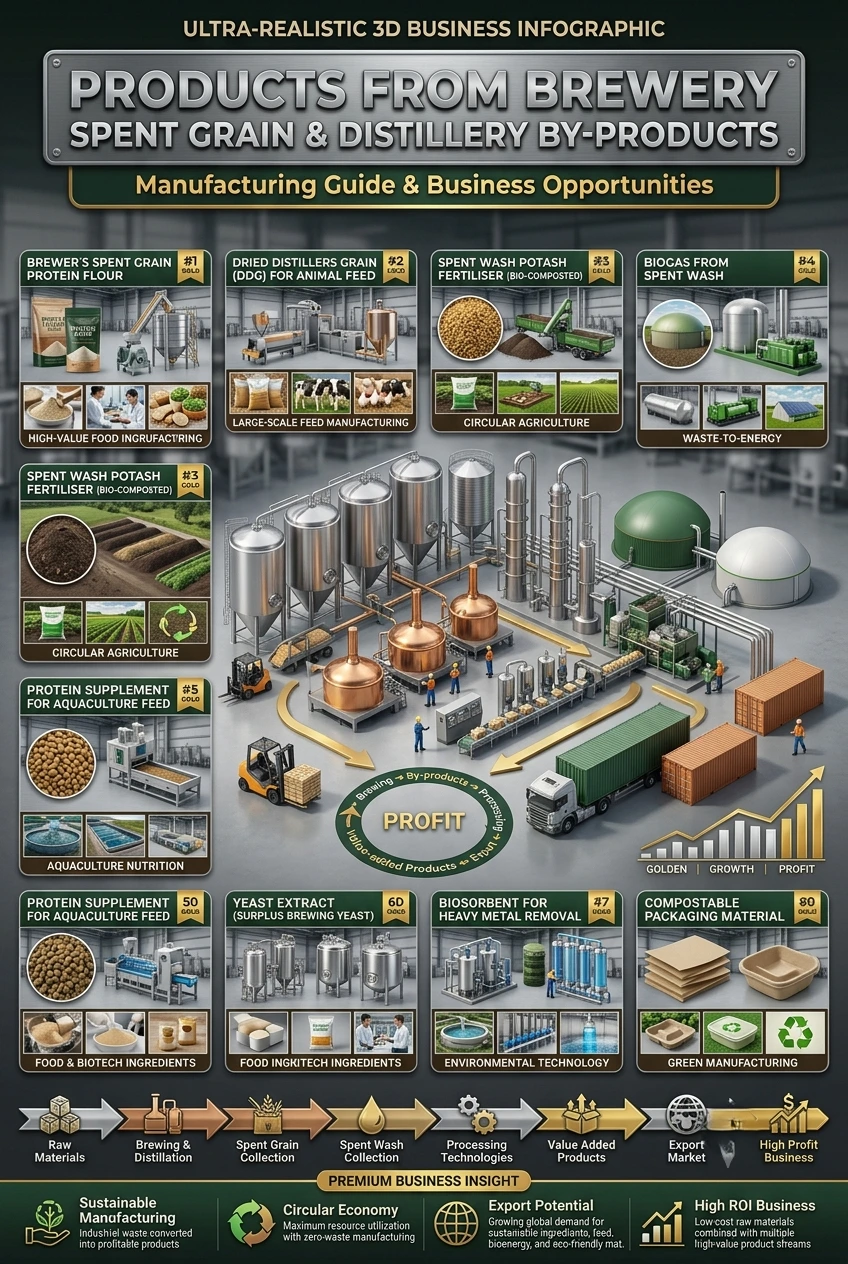
5. Protein Supplement for Aquaculture Feed
Dried and pelletised with balanced amino acid profile, Brewer’s spent grain protein is accepted in tilapia, rohu, catla and shrimp aquafeed at inclusion levels of 10-20%. In the context of the rising production in Andhra Pradesh, West Bengal and Odisha, the demand for plant-based protein feed alternatives to fishmeal is increasing. The price of BSG protein supplement is Rs. 40,000–70,000 per tonne in the aquafeed market.
6. Yeast Extract (from Surplus Brewing Yeast)
Protein-rich by-product of the brewing process, surplus brewer’s yeast can be lysed (heated or treated with enzymes) before spray drying into yeast extract, a savory flavour ingredient found in processed soups, sauces, seasoning blends and pet food. The price of yeast extract is Rs. It is imported at present, and costs 200–500 per kg. The cost of a yeast extract production unit is Rs. 1–3 crore.
7. Biosorbent (Spent Grain for Heavy Metal Removal)
Chemical processed (acid washed and crosslinked) spent grain is used to make a biosorption material that is efficient in the removal of heavy metals (lead, cadmium, chromium) from industrial effluents. A specialty, niche chemical application for the ETP industry. The cost of a specialty biosorption preparation unit is Rs. 40–100 lakh.
8. Compostable Packaging Material
Dried and compressed BSG fibre with starch binders, can be used to create rigid compostable packaging trays, plates and containers. These products are in competition with bagasse and wheat bran moulded packaging products — the single-use plastic alternative market. The cost of a BSG moulded packaging unit is Rs. 80–200 lakh.
Discover business ideas that actually make money
Investment and Market Summary
| Product | Investment (Rs.) | Price | Key Buyer |
| BSG Protein Flour (Food Grade) | 60–150 lakh | Rs. 80–150/kg | Health Food, Bakeries |
| DDG Animal Feed Pellets | 40–100 lakh | Rs. 25–40/kg | Dairy, Poultry, Aquafeed |
| Spent Wash Compost | 50–150 lakh | Rs. 4,000–8,000/MT | Organic Farmers |
| Biogas from Spent Wash | 3–8 crore | Fuel Cost Saving | Self-Consumption, OMC |
| Yeast Extract | 1–3 crore | Rs. 200–500/kg | Food Flavour, Pet Food |
Related Article: Strategic Role of Zinc and Copper in Animal Nutrition: Why Every Feed Formulation Must Include Trace Elements
Raw Material Contracts with Breweries and Distilleries
Formal contracts must be signed with breweries and distilleries to assure supply of BSG and spent wash including agreed delivery dates, quality data (moisture, protein content), and price. In addition, large breweries are willing to outsource the entire BSG logistics to a processor, even if they have to pay a small service charge for regular pick up. Distilleries that have an issue with spent wash disposal are partners who are motivated to support establishment of adjacent processing units. The most effective supply model is an on-site processing plant located with the brewery or distillery, from which the wet BSG is supplied directly, and not transported. This is becoming a more common business model, and is usually a partnership between the processor and the brewery, with the processor installing equipment and operating it on the brewery site in return for the brewery supplying raw materials.
Frequently Asked Questions (FAQ)
Q1. What is the moisture content of wet BSG and how does drying affect economics?
Wet BSG is 70–80% moisture. Drying to below 10% moisture reduces weight 4–5x. The energy cost of drying is the primary operating cost in BSG processing — at Rs. 8–12 per kg of moisture evaporated, drying cost is Rs. 250–400 per tonne of dry BSG. This must be offset by the Rs. 80–150 per kg BSG flour selling price to ensure profitability.
Q2. Does BSG protein flour require FSSAI approval for human food use?
Yes. FSSAI food business operator licence is required to be procured before making BSG into food items for human consumption, to get product for testing heavy metals and mycotoxins, microbiological parameters and stability/shelf-life study. BSG of organically certified brewing plants, that also comply with FSSAI food grade, is preferred. Need to be a protein standard for buyers.
Q3. What is the spent wash composition and treatment challenge?
Spent wash from grain-based distilleries has BOD 50,000–100,000 mg/L, TDS 80,000–100,000 mg/L, and high potassium content (4–5%). Direct discharge is prohibited. CPCB mandates zero liquid discharge for distilleries. Anaerobic treatment, composting, and concentration-evaporation are the approved management pathways — all of which produce valuable by-products.
Q4. Can small craft breweries economically process their BSG?
Small craft breweries (producing 500–2,000 litres per batch) generate 10–40 kg BSG per batch — insufficient for industrial drying. The best model for craft brewery BSG is direct supply to local mushroom farmers, bakeries, or urban compost programmes. Several craft breweries partner directly with restaurants and bakeries for BSG uptake.
Q5. What is yeast extract and which industries use it?
Yeast extract is produced by autolysis (self-digestion) or enzymatic hydrolysis of surplus brewer’s yeast, followed by centrifugation, evaporation, and spray drying. It contains glutamic acid (umami flavour), B vitamins, and amino acids. Primary markets are processed food (soups, sauces, seasonings), pet food, and fermentation medium for pharmaceutical and food bioprocesses.
Q6. Is there export demand for Indian BSG protein flour?
BSG protein flour export to European and US health food markets is growing as functional food manufacturers seek high-fibre, moderate-protein ingredients with authentic brewing provenance stories. Several Indian BSG flour startups (like ReGrained India concept) are exploring premium export positioning. APEDA facilitates export market development for specialty food ingredients.
How NPCS Helps Entrepreneurs Enter This Sector
At Niir Project Consultancy Services (NPCS), we provide professional consulting for Market Survey cum Detailed Techno-Economic Feasibility Reports (DPRs) for setting up brewery spent grain and distillery by-product processing manufacturing businesses. Our reports cover the complete manufacturing process, market demand analysis, process flow diagrams, plant layout, machinery and raw material sourcing, and full financial projections with profitability analysis.
For entrepreneurs looking to enter waste-based manufacturing, NPCS project reports give you the technical and financial foundation to approach banks, investors, and government agencies with confidence. Visit www.niir.org to explore our full library of waste-based project reports.
Key References and Useful Links
- Ministry of MSME — Government of India
- Make in India — Official Portal
- DPIIT — Dept. for Promotion of Industry
- APEDA — Agricultural and Processed Food
Conclusion: The Business Case for Brewery and Distillery By-Product Manufacturing
India’s rapidly growing beer and spirits industry generates daily volumes of spent grain, spent wash, and yeast that are currently substantially under-processed relative to their nutritional and chemical value. BSG protein flour, yeast extract, DDG, and spent wash potash fertiliser are all established products with known buyer bases and proven technology. Entrepreneurs who position themselves as by-product processing partners for Indian breweries and distilleries are entering a sector where raw material supply is growing, buyer markets are large, and the processing technology is well-documented.
Entrepreneurs who move early into waste-based manufacturing secure raw material relationships, buyer networks, and regulatory approvals that latecomers find difficult to replicate. The best time to act on these business ideas is before the sector becomes crowded — and for most waste streams profiled here, that window is still open.
Craft Brewery Ecosystem and BSG Upcycling Opportunities
India’s craft beer revolution has created over 400 microbreweries and craft breweries in metro cities, with Mumbai, Bengaluru, Pune, Delhi, and Hyderabad having the largest concentrations. Each craft brewery generates BSG in smaller daily volumes (20–200 kg per batch) but with consistent craft beer identity that enables premium narrative marketing. Unlike large industrial brewery BSG (which is entirely commodity), craft brewery BSG has provenance — ‘BSG from Flying Saucer Brewing’ or ‘Bira 91 spent grain’ carries brand recognition that consumer product companies can use in their sustainability marketing. Craft brewery BSG has been used successfully in: protein bread (GoNanas in the US, several Indian craft food startups), mushroom cultivation (with provenance story), pet food (as premium dog treats), and home compost subscription services. The craft brewery sector’s strong sustainability ethos and social media presence make them ideal partners for BSG upcycling entrepreneurs who can provide compelling circular economy narratives that breweries can share with their consumer communities.