
Scrap Dealer to Solar Entrepreneur: The Telangana Story That Belongs in Every Business School

Solar Installation Business in India A man who didn’t have a formal education read the renewable energy boom right, and made his way to 20 MW projects under MSME finance The Man Who Sold Scrap and Bought the Sun Ravi Shankar Reddy was an uneducated person. He went into the business of buying old transformers, old machinery and industrial waste to run a scrap metal yard in Nizamabad, Telangana. His understanding of the metal was more than just a knowledge of its weight and grade; it extended to its market value. Little did he know that this skill would help him to become one of the most successful solar installation entrepreneurs in the Deccan belt someday. The surprising reality about the Indian solar industry is that the largest profits aren’t being generated by IIT engineers backed by VC investment. It is being produced by solar channel partners, contractors and former electricians who got it right from the off: the channel partner model in solar is just like the distribution model in FMCG. You don’t manufacture. The panels are not your property. You bring buyers and installers together, deal with the paperwork with DISCOMs and earn a margin for every kilowatt installed. Within 4 years of his first installation, Reddy had crossed the ₹12 crore annual revenue mark. He never took a rupee from a venture capitalist. The funding was provided by IREDA, an Indian Renewable Energy Development Agency, and a loan from a cooperative bank in Karimnagar from the CGTMSE scheme to the tune of ₹50 lakh. He’s not the only one who had a story. It is a blueprint. Read the Complete Book Here: Solar PV Power and Solar Products Handbook The Gap That’s Still Wide Open India has made a pledge to achieve 500 GW of non-fossil fuels electricity generation. The installed solar power is about 90 GW as per data from the Ministry of New and Renewable Energy (MNRE). The country must increase the supply of electricity by about 400 GW — in a decade or so. The math alone will give you the opportunity. It’s not about utility-scale solar farms in Rajasthan. It is the unmet demand in small and medium industrial estates in Telangana, Maharashtra, Gujarat, Tamil Nadu and Madhya Pradesh. The industrial parks accommodate 200-500 MSMEs each with heavy machinery running on the grid at a cost of ₹8-11 per unit. With 25 years’ cost, Rooftop Solar can reduce this cost to ₹3.50 – 4.50 per unit. Nearly 25% of the total electricity consumption in India is used by MSME sector as per the Bureau of Energy Efficiency (BEE). However, the penetration of rooftop solar on the MSME sector is still around 8%. The answer is not price — it’s economics that make it the reason. The obstacle is the awareness of the entrepreneur, the trust of the vendors and working capital for the entrepreneur who starts the installation business. States such as Telangana, Andhra Pradesh, Karnataka and Rajasthan have been very aggressive with their state solar policies, providing faster DISCOM approvals and net metering policies. Rooftop solar is set for 2,000MW capacity for the residential and commercial segment in Telangana. At the present, only less than 400 MW are installed. The gap is 1,600 MW and actively seeking channel partners to fill. TABLE 1: State-wise Solar Opportunity — Rooftop & Industrial Captive Power State State Solar Target (MW) Current Installed (MW) Gap (MW) Key Industrial Clusters DISCOM Approval Timeline Telangana 2,000 ~400 ~1,600 Patancheru, Bollaram, Nacharam 45–60 days Andhra Pradesh 10,000 ~4,200 ~5,800 Visakhapatnam, Tirupati, Chittoor 30–45 days Karnataka 8,000 ~3,800 ~4,200 Peenya, Bommasandra, Hubli 30–60 days Gujarat 30,000 ~14,000 ~16,000 Surat, Rajkot, Anand, Vapi 21–30 days Rajasthan 40,000 ~18,500 ~21,500 Bhiwadi, Jodhpur, Alwar 30–45 days Maharashtra 12,000 ~5,200 ~6,800 Pune, Nashik, Aurangabad, Nagpur 45–75 days Why This Is the Right Window — And It Won’t Stay Open Forever The opportunity window is narrowing thanks to three policy tailwinds. Firstly, the PM Surya Ghar Muft Bijli Yojana is promoting rooftop solar in residential demand by offering up to ₹78,000 per household as central subsidy. This is building a pipeline of trained installers and familiar customers for channel partners to upsell to commercial and industrial customers. Secondly, the Production Linked Incentive (PLI) scheme for the solar module has begun to decrease the reliance on Chinese solar panels. There have been a lot of changes in the price of domestic modules, but the PLI is building a supply chain that will ensure a stable supply price in coming years, thereby providing installation companies with more predictable input costs. Thirdly, the IREDA financing structure explicitly identifies MSME solar installers and small-scale project developers as a priority lending segment. IREDA has established competitively 10 – 11 per cent per year term loan rates for solar projects and provided a moratorium of up to 12 months — a much-needed breathing space for a business which takes 3 – 6 months to commission its first project. On the finance side, the MSME (Credit Guarantee Fund Trust for Micro and Small Enterprises) enables solar channel partners with no tangible assets to pledge to avail loans up to ₹2 crore for their first-generation entrepreneurs. The PMEGP scheme of KVIC offers a capital subsidy of 25% to 35% in the manufacturing or service unit to the solar installation companies who are registered in the rural areas or semi-urban. One of the biggest structural hurdles that most potential solar entrepreneurs overlook – vendor empanelment with state DISCOMs is a real entry barrier – but good news for those who are successful. If a vendor is on Telangana’s DISCOM approved vendor list or on Karnataka’s BESCOM empanelled list, then the vendor will have a recurring pipeline which the new vendors will not get for 6 months to 18 months. This is the moat for which Ravi Shankar Reddy fought a long battle. View Full Project Details: Renewable Energy Sector: Green Power & Sustainable Technologies How to Set Up a Solar Installation Business in
Top 10 Manufacturing Business Ideas in Rajasthan with Government Subsidies
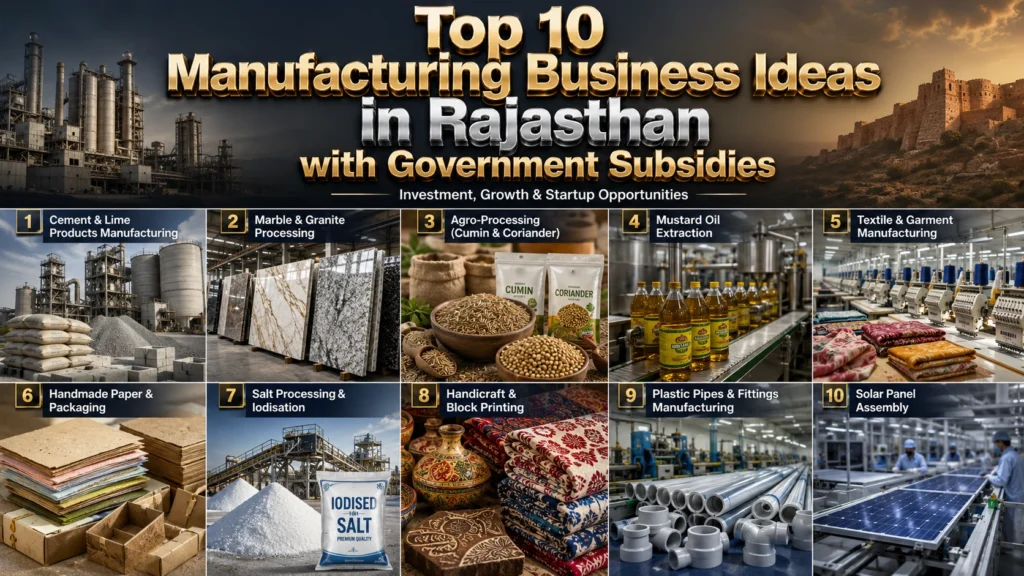
Manufacturing Business Ideas in Rajasthan Rajasthan Manufactures More Than Marble — And Most Entrepreneurs Still Don’t Know It About ₹10,000 crore are lost in the mineral-based manufacturing sector every year due to the lack of operational manufacturing units in less than 12% of the industrial plots registered with RIICO (Rajasthan State Industrial Development and Investment Corporation) in the state. This is not an indication of an absence of opportunity. It’s a lack of information. The State accounts for 10.4 % of the total area of India, has the largest deposits of minerals after the State of Jharkhand and is the source of more than 90 % of the marble and emeralds in India. It is a source for the entire food processing chain of the country with its base of agriculture cumin, coriander, mustard, guar. In recent years, the Rajasthan government has been implementing the Industrial Incentive Schemes of the Rajasthan Investment Promotion Scheme (RIPS) that provide capital subsidy, power tariff relief, and stamp duty exemption to new manufacturing units. For those who are first generation entrepreneurs, and want to start a business where they can manufacture more cost-efficiently with government grants, Rajasthan is one of the most underrated states of India to set up a business. In this article, the top 10 manufacturing enterprises that are available — now — where the raw material, the market demand, and the subsidy access is available are all there. Get Detailed Project Report (DPR): Guide to Business Opportunities and Startup Projects in Rajasthan The Supply Gap No One Talks About The value of finished mineral products, processed agro commodities, and specialty textiles imported into India is more than ₹1.2 lakh crore per year, and this can be replaced by local production in raw material-rich states such as Rajasthan. Rajasthan’s contribution to the overall manufacturing GSDP of India is less than 5% as per the Department for Promotion of Industry and Internal Trade (DPIIT), which is significantly lower than what the dependence of mineral and agricultural base should be able to provide. Try using processed cumin (jeera). Rajasthan and Gujarat account for more than 70% of world’s supply of cumin. However, the value-added cumin products (cleaned, graded, packaged and exported) are controlled by a few big processors. More than 60 percent of the cumin that leaves the Nagaur, Barmer and Pali districts of Rajasthan is still used as raw material without processing, thus foregoing processing margins. The situation is similar with marble also, Kishangarh has more than 3,000 traders for marble but less than 400 processing unit with proper CNC machine. Another underutilized industry is textile. Rajasthan is a major cotton, wool and silk producing state with the bulk of the products being exported as raw fibre. The Rajasthan Small Industries Corporation (RSIC) has reported that textile and apparel exports in the state are under ₹8,000 crore per year, which is less than the export in Gujarat and Maharashtra, both of which are under ₹32,000 crore per year. Manufacturing facilities, skilled workforce and raw material available. What is lacking is an organized well-capitalised MSME processing unit. TABLE 1: Top 10 Manufacturing Business Ideas in Rajasthan — Overview # Business Idea Investment (INR) Govt Scheme Net Margin 1 Cement & Lime Products ₹40–80 lakh PMEGP, MSME Rajasthan 14–18% 2 Marble & Granite Processing ₹25–60 lakh RIPS, MSME Clusters 20–28% 3 Agro-Processing (Cumin/Coriander) ₹15–35 lakh PMEGP, SFURTI 18–24% 4 Mustard Oil Extraction ₹12–30 lakh PMEGP, MUDRA 16–22% 5 Textile & Garment Manufacturing ₹20–50 lakh PLI Textiles, ASPIRE 15–20% 6 Handmade Paper & Packaging ₹10–25 lakh SFURTI, PMEGP 22–30% 7 Salt Processing & Iodisation ₹8–20 lakh PMEGP, NSIC 18–25% 8 Handicraft & Block Printing ₹5–15 lakh SFURTI, Stand-Up India 25–35% 9 Plastic Pipes & Fittings ₹35–75 lakh CGTMSE, RIPS 14–20% 10 Solar Panel Assembly ₹50 lakh–1.2 cr PLI Solar, KUSUM 12–18% Source: Ministry of MSME (msme.gov.in), RIICO Industrial Data, Entrepreneur India Research Get Detailed Insights from This Book: Solar PV Power and Solar Products Handbook Why This Is the Right Window to Enter There are three policy changes right now which are creating good tailwinds for the first time manufacturers in Rajasthan. The first step is that the Production Linked Incentive (PLI) Scheme is being expanded to 14 sectors including textiles, food processing, and solar PV. The PLI is tiered and thus provides 4-6% on incremental sales for the next 5 years for the small manufacturers having investment ranging from ₹50 lakh to ₹2 crore. Second, the industrial policy of the State of Rajasthan, called ‘Rajasthan Industrial Policy (RIPS)’ has been updated to focus on MSME clusters in Tier-2 and Tier-3 towns in the State. In some districts such as Jodhpur, Bikaner, Ajmer, Kota etc., industrial areas have been identified with pre-laying of infrastructure facilities which cuts the infrastructure cost by 20-30% for the new industrial units as compared to the greenfield industrial set up in non-notified areas. Third, Khadi and Village Industries Commission (KVIC), under the control of the central government provides capital subsidy of 25-35% for manufacturing units with project cost up to ₹25 lakh. The subsidy is increased to 35% for SC/ST/women entrepreneurs or rural units. PMEGP is open to first-time business founders, as they don’t have to have experience in a business for it. There are other schemes that are relevant, such as MUDRA (collateral-free loans up to ₹50 lakh under the Tarun category), CGTMSE (credit guarantee for loans up to ₹2 crore without collateral), SFURTI (cluster development grants for rural artisan and agro-processing units), and Stand-Up India (bank loans of ₹10 lakh to ₹1 crore for SC/ST and women entrepreneurs starting their first manufacturing venture). How to Set Up a Manufacturing Unit in Rajasthan: Step-by-Step The following is an explanation of the set-up guide, covering the case of a processing unit that uses marbles as a product, which is one of the most easily accessible and high return manufacturing entries in Rajasthan. The process broadly applies to agro-processing and mineral-based manufacturing as well. Step 1 — Business Registration and Licences
Defence Manufacturing Business Ideas for MSMEs and Startups in India: The 2026 Opportunity Guide
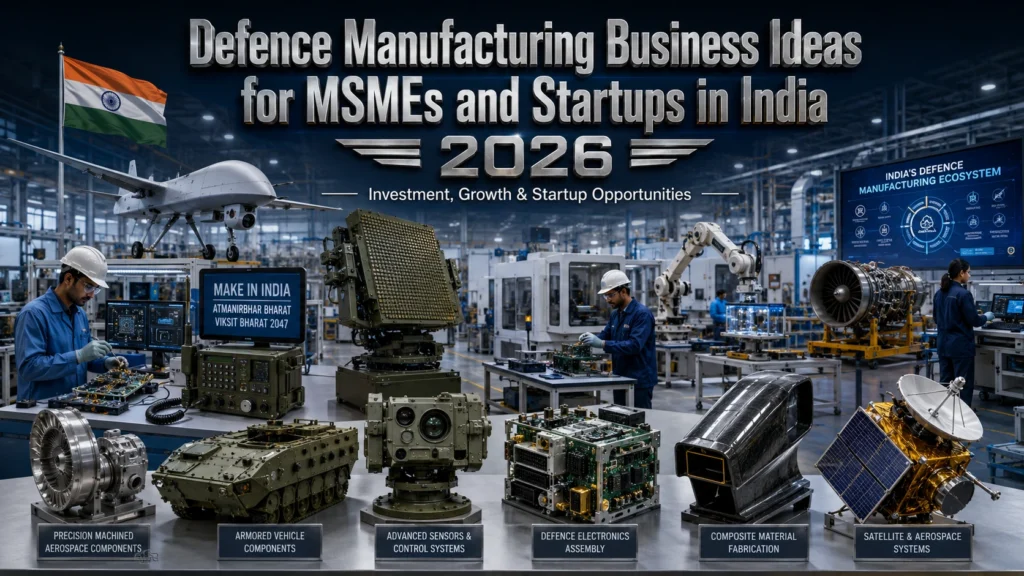
Defence Manufacturing Business Ideas in India 2026 India’s path of Defence is now different. Over the years, the country became the world’s biggest importer of arms. This is completely different now in New Delhi. During the National Defence Industries Conclave 2026, the Minister of State for Defence announced that MSMEs and startups have now become a key driver towards India becoming a global defence manufacturing hub. Businesses ideas which are available in this sector now, would have been unimaginable just 10 years ago. The Union Budget 2026–27 has allocated ₹7.85 lakh crore to defence, the highest ever, which is an increase of 15.19% year-on-year, according to the Ministry of Defence. The volume of Defence production has just touched new heights and the message to small manufacturers is loud and clear: The gates of one of India’s most protected industries have opened! The Gap Nobody Talks About The paradox at the core of India’s defence build-up. Large Defence Public Sector Undertakings (DPSUs) and a few big private companies seem to be in the news but they cannot do everything themselves. There are tens of thousands of parts in one fighter aircraft! From precision-machined valves and special cables to fasteners, castings, forgings, rubber gaskets and electronic sub-assemblies, all are necessary for a warship. The DPSUs are supposed to do their business on the clear directive of the government to boost outsourcing to Indian vendors. In the meantime, thousands of items have been added to the Positive Indigenisation Lists and no longer can be imported into this country. The actual number of MSMEs working in the defence sector is about 16000 but the number of registered, qualified MSME vendors in defence sector is far less than the actual requirement, according to IBEF. That disparity is the opportunity. Why 2026 Is the Inflection Point Various forces have converged at one time and 2026 is the most apt time for MSME defence suppliers of India in the history of the country. Reflect on change: All-time high defence budget: The defence budget in the Union Budget 2026–27 is the highest ever, and approximately ₹1.39 lakh crore has been allocated for procurement from domestic industry only. Capital Acquisition funds are now mostly assigned to Indian companies with close to 75% of the budget dedicated to them. Indigenisation lists: Thousands of components and sub-systems are reserved for Indian manufacturers under the Positive Indigenisation Lists of the Ministry of Defence and DPSUs. More than 34,000 items are listed on the SRIJAN portal, of which over 10,000 have already been indigenised. iDEX grants: Startups and MSMEs working on defence prototypes can avail of a grant of not less than ₹1.5 crore under the SPARK scheme and up to ₹25 crore under the ADITI scheme from the iDEX (Innovations for Defence Excellence) framework. Up to 676 startups, MSMEs and innovators are part of the iDEX ecosystem as of early 2026. Defence corridors: Two dedicated Defence Industrial Corridors in Uttar Pradesh (Aligarh, Agra, Jhansi, Kanpur, Chitrakoot, Lucknow) and Tamil Nadu (Chennai, Coimbatore, Hosur, Salem, Tiruchirappalli) offer plug-and-play infrastructure, land incentives, and state subsidies. Defence exports have improved: India’s defence exports are estimated at a record ₹23,622 crore during FY 24–25, which is more than 34 times the figure in the previous decade. According to PIB, private players like MSMEs contributed to the increasing share of defence exports, and the number of defence exporters grew by 17.4% during a single year. Related Article: India’s Defence Manufacturing Boom: A $15 Billion Opportunity for MSMEs and Startups Entry Routes: Where a Small Manufacturer Fits It is not necessary to create a missile in order to be in defence manufacturing. The realistic and practical entry points for an MSME or start-up are clearly defined: Tier-2/Tier-3 vendor: Register with the DPSUs like HAL, BEL, BDL, GRSE, Mazagon Dock and seven new corporatised ordnance units. Each has a vendor registration portal, as well as regular publications of outsourcing needs. Private prime supply chain: Provide parts for the large prime vendors like L&T, Tata Advanced Systems, Bharat Forge, Adani Defence, etc. who do their own prime assembly. Innovation route: Address problem statements from iDEX/ DISC with working prototype. Meaningful de-risking of the whole trip is achieved through grant support and guaranteed first customer – the military. Direct procurement: Items like Protective equipment, Drone Components, Batteries, Optics, Simulation Software, MRO consumables and Ground Support Equipment are being purchased through the GeM portal and defence tenders available for MSMEs. These are all different risk/reward scenarios. Tier 2/Tier 3 vendor work is stable and repeat order. The innovation route will have higher margins and will provide IP ownership. The majority of successful MSME defense suppliers start their business with build to print vendor products and then move on to product development. The high-potential ideas for businesses are the Products Segments for MSMEs. The table below provides an overview of eight categories of products in which MSMEs can realistically and commercially participate. These are the best business concepts for engineers, electronics, chemicals or textile entrepreneurs: Product Segment Why It Suits MSMEs Indicative Investment Precision machined components (CNC) Recurring DPSU/prime orders; existing job-shops can upgrade ₹1.5 – 5 crore Cable harnesses & connectors Labour-intensive, low capital; AS9100/defence specs achievable ₹75 lakh – 2 crore Drone frames, propellers & sub-systems Fast-growing UAV ecosystem; iDEX-friendly ₹1 – 4 crore Rubber & polymer parts (seals, gaskets, mounts) Indigenisation list items; moderate technology barrier ₹1 – 3 crore Defence-grade fasteners & springs High-volume consumables across platforms ₹1 – 2.5 crore Ballistic protection & technical textiles Body armour, helmets, camouflage nets; export demand ₹2 – 6 crore Batteries & power systems Soldier systems, UAVs, communication sets ₹2 – 8 crore EMI/EMC shielding & enclosures Electronics-heavy platforms need certified enclosures ₹1.5 – 4 crore All items on this list are found on the government’s Positive Indigenisation Lists, thus encouraging import-substitution. In fact, Goldman Sachs estimates the earnings growth of private defence companies in India at a steady 32% from FY25 to FY28, with the very areas MSMEs cater to
10 Creative Small Business Ideas in Bahrain for 2026 | Profitable Opportunities with Investment Costs and Profit Margins
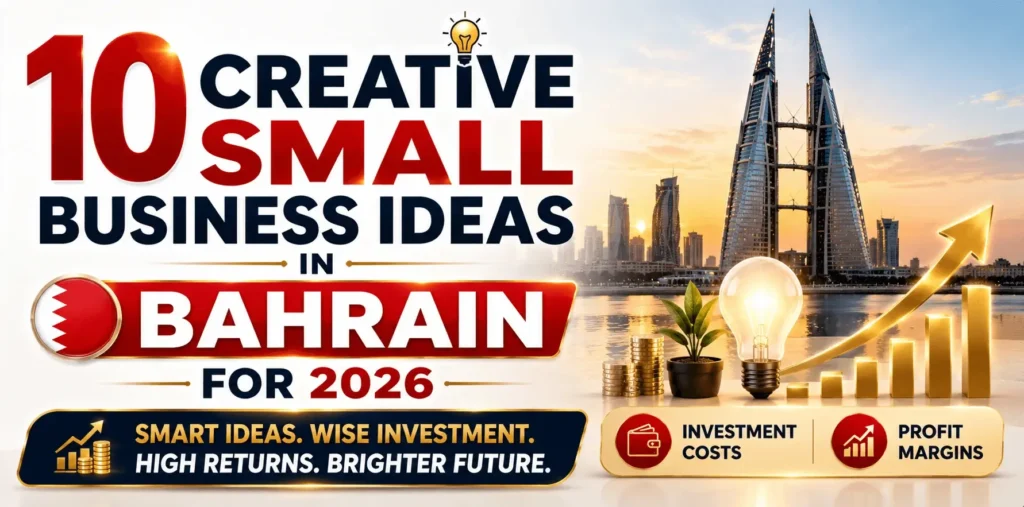
Startup Costs | Profit Margins | Licensing | Fintech | E-Commerce | Wellness | EdTech | 2026 Market Guide Bahrain is quietly emerging as one of the profitable destinations for creative small business ideas in Bahrain 2026. While most entrepreneurs focus on Dubai or Saudi Arabia, Bahrain offers something that’s hard to find in the Gulf: low startup costs, a digitally progressive regulatory environment, zero personal income tax and a market where high-quality service businesses face limited competition. Bahrain is different from other countries in the area because it has a good system for new businesses to start and grow. The government is investing in areas like technology and healthcare which is creating opportunities for businesses. The country also has a location, which makes it a great place to start a business that wants to sell to other countries in the area. The Kingdoms Vision 2030 is actively investing in fintech, technology, healthcare, e-commerce, education and sustainability. Creating real market gaps that entrepreneurial businesses can fill profitably. Whether you are a first-time founder, a professional already based in Bahrain or an overseas investor looking to enter the GCC this guide covers the 10 most creative and profitable small business ideas in Bahrain for 2026. With real investment figures, profit margins and licensing requirements for each. All 10 Business Ideas at a Glance Use this table to compare startup investment, revenue potential, and time to profit before diving into the details of each idea: Business Idea Min. Investment Monthly Revenue Profit Margin Time to Profit Fintech / Digital Wallet BHD 5K–20K BHD 3K–15K 35–60% 12–24 months E-Commerce / Hyperlocal Delivery BHD 2K–8K BHD 1K–6K 20–40% 12–18 months Healthtech / Wellness Clinic BHD 8K–25K BHD 4K–12K 25–45% 18–30 months EdTech / Tutoring Platform BHD 500–3K BHD 800–3K 40–65% 6–12 months Eco-Friendly / Green Products BHD 2K–8K BHD 1K–4K 30–50% 12–24 months Digital Marketing Agency BHD 500–2K BHD 1.5K–6K 35–60% 6–12 months Indian Restaurant / Cloud Kitchen BHD 3K–12K BHD 1.5K–5K 20–35% 18–30 months Event Management BHD 1.5K–5K BHD 1K–6K 20–40% 12–18 months AI Automation / Tech Consulting BHD 1K–4K BHD 2K–10K 40–65% 6–12 months Manpower / Staffing Agency BHD 1.5K–5K BHD 1K–4K 30–50% 12–18 months Note: BHD = Bahraini Dinar. 1 BHD = approximately INR 225 (June 2026). Figures are estimates based on current market conditions. Why Bahrain Is the Right Market for Creative Business Ideas in 2026 Before exploring individual business ideas, it is important to understand what makes Bahrain structurally different from other Gulf markets in 2026. And why these differences make it particularly well-suited for creative, tech-forward small businesses. Advantage What It Means for Your Business 2026 Relevance Zero income tax Keep 100% of your personal profit Every GCC country now competes on this — Bahrain was first Fintech sandbox (CBB) Test financial products with regulator support Only licensed crypto in MENA launched here (Rain) 100% foreign ownership No local sponsor needed in most sectors Significantly simpler than pre-2022 UAE rules Fast digital registration Company live in 1–2 weeks via Sijilat Lower friction = faster revenue Tamkeen funding support Wage support, training grants, loan guarantees Reduces early-stage burn significantly 5G and IoT infrastructure Enables tech, logistics, and health-tech businesses Ahead of most regional peers GCC market gateway Bahrain = access point to Saudi, UAE, Kuwait Strategic for scale-up after Bahrain launch 10 Creative and Profitable Small Business Ideas in Bahrain for 2026 1. Fintech, Digital Wallets, and BNPL Services Bahrain’s Central Bank (CBB) is one of the most forward-thinking financial regulators in the MENA region. The Regulatory Sandbox allows startups to test financial products with real customers under regulatory oversight. Eliminating the main risk that kills fintech startups elsewhere. The success of Rain (the first licensed crypto exchange in the Middle East) and Tarabut Gateway (the GCC’s open banking leader) proves that Bahrain’s regulatory environment genuinely works for fintech founders. Creative fintech business ideas with strong market fit in Bahrain for 2026: BNPL (Buy Now, Pay Later) platform targeting Bahrain’s retail and e-commerce sector — currently underserved by existing players Digital wallet for expatriate remittances — the Indian, Pakistani, and Bangladeshi communities send billions in remittances annually AI-powered financial advisory platform for SMEs — helping small businesses manage cash flow and access credit Sharia-compliant micro-investment platform — strong demand from Bahraini Muslim-majority population Startup Investment: BHD 5,000–20,000 (technology build + regulatory filing + CBB sandbox application) Monthly Revenue Potential: BHD 3,000–15,000 once user base reaches 500+ active accounts Profit Margin: 35–60% — software businesses have very low marginal cost per user Key Support: Apply to Flat6Labs Bahrain accelerator or Brinc MENA for seed funding and mentorship NPCS provides market research reports covering fintech demand in the GCC, competitive landscape analysis, and financial feasibility studies for technology startups seeking investor capital. 2. E-Commerce Store and Hyperlocal Delivery Service E-commerce in Bahrain accelerated dramatically during 2020–2022 and has maintained its growth trajectory into 2026. Bahraini consumers now expect same-day or next-day delivery for groceries, electronics, and everyday essentials — but the market is still dominated by a small number of players, leaving significant room for niche operators. The most creative and profitable e-commerce opportunities in Bahrain for 2026 are in underserved niches that large platforms ignore: Indian and South Asian specialty grocery store — 320,000+ Indians in Bahrain; currently poorly served online Eco-friendly and sustainable products marketplace — growing fast with Bahrain’s under-35 environmentally conscious demographic Local artisan and handcrafted products platform — Bahraini pearl jewellery, pottery, and traditional crafts have unmet global demand Hyperlocal dark store model — 30-minute grocery delivery within specific Manama neighbourhoods Startup Investment: BHD 2,000–8,000 (Shopify store, inventory, delivery vehicle, WhatsApp Business API) Monthly Revenue Potential: BHD 1,000–6,000 depending on niche and order volume Profit Margin: 20–40%; Indian specialty products carry 30–50% margin Platform Strategy: List on Talabat, Noon, and Careem simultaneously — do not rely on a single platform 3. Healthtech, Telemedicine, and Wellness Business Healthcare is Bahrain’s second-fastest growing sector in 2026. Government investment in health infrastructure, combined with a
TReDS and Invoice Discounting: Smart Business Ideas for MSME Working Capital Without Collateral
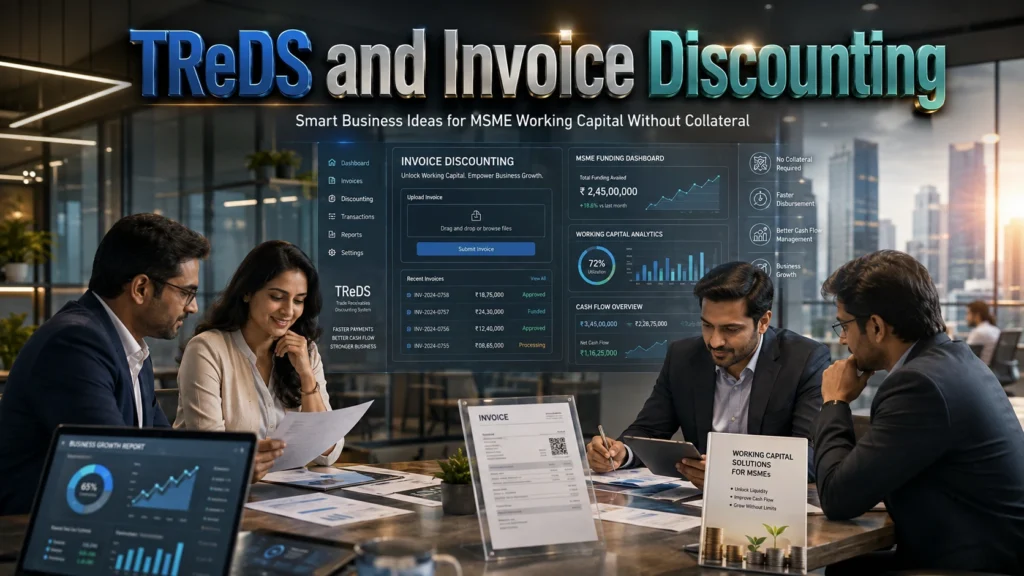
TReDS invoice discounting for MSME Without Collateral This is a phenomenon that all manufacturers are familiar with. Once you’ve sold the product, you send the invoice, and then wait. Forty-five days. Sixty days. Ninety. In the meanwhile, salaries, electric bills, and raw material payments continue undisturbed. In most MSMEs, the problem is not the demand issue, it is working capital shortage. If you are thinking of starting a business in manufacturing or supply, you may have heard this more than once: It is not too difficult, or even impossible, to cash up unpaid receivables. Nowadays, it is a fact of regulation with the RBI’s back. Consider the numbers. One of the three RBI-licensed TReDS, RXIL has been facilitating discounting of more than 88.5 lakh invoices through a completely digital platform. Consequently, the registrations of MSMEs on TReDS platforms have increased. Meanwhile, the level of MSME loans in the banking sector is falling short of the five-year benchmark at around 1.8% of the total credit while the overall credit sector has crossed Rs. 35 lakh crores. Lenders are more comfortable with MSMEs than ever before and the back-end processes to convert unpaid invoices to same-week cash have evolved into a viable, viable, and widely available system. The Working Capital Gap: Why Receivables Trap Small Businesses The combined value of all MSMEs’ receivables is a huge pool of money stuck in their inventories from large corporate and government buyers. The issue is the structure. Long payment cycles are the norm for large buyers. Smaller suppliers are less likely to be able to bargain. The classic answers — a mortgage on the property or postponing payment — either require the property as security that the entrepreneur may not have, or they slowly eat away at the profit margin – the entrepreneur is forced to resort to emergency loans with steep interest rates. This imbalance in the structure has been recognised by the Ministry of MSME as well, which has released a notification to ensure that buyers with turnover exceeding Rs. 500 crores have to be uploaded on TReDS platforms. The RBI took the initiative to implement the Trade Receivables Discounting System (TReDS) just to stop this cycle. It enables an MSME to sell the approved invoice to other interested banks and get the amount paid to it within days, without having to take the credit risk on its books. Get Detailed Project Report (DPR): Business Ideas with High Investment (₹65 Crore+) Project Profiles How TReDS Actually Works: A Step-by-Step Business Overview This is easy to do. If you know it, you know the efficiency difference. Step 1 — Registration: All three actors (MSME seller, corporate buyer and financiers/banks or NBFC factors) register on an RBI-approved TReDS platform. There are three licensed operators (RXIL, M1xchange and Invoicemart). Step 2 — Invoice Upload: Once goods/services are delivered the MSME uploads the invoice digitally. The buyer then takes it on the platform, which becomes a ‘factoring unit’. Step 3 — Competitive Auction: Several financial institutions bid to provide a discount on the accepted invoice. Financiers are competitive, which is why the interest rate is normally lower than the typical working capital loan interest rate. The seller has the ability to determine the price. Step 4 – Payout: When the bid is accepted, the winning financier deposits the money into the MSME’s bank account, typically within 24-72 hours. No security is taken. No paperwork trail — just digital confirmation. Step 5 — Settlement: On the due date, the buyer pays the financier directly. In the standard ‘without recourse’ factoring structure, the credit risk of the buyer rests entirely with the financier — not the MSME. The final one is really important. MSME gets prior payment and is not liable to the buyer if delay or default occurs. This is a complete reversal of the normal lending process. TReDS vs. Traditional Working Capital: An Honest Comparison In the beginning, many MSME owners compare TReDS discounting with their existing bank overdraft/cash credit facility. The difference is clear in the table below: Parameter TReDS Invoice Discounting Bank OD / CC Limit Collateral None — invoice is the asset Property or FD usually required Speed of Cash 24–72 hours after acceptance Weeks for sanction; drawal limits apply Pricing Basis Linked to buyer’s credit rating Linked to MSME’s own rating Balance Sheet Impact Off-book in without-recourse factoring Adds to borrowings on books Paperwork Fully digital, one-time KYC Annual renewal documentation Best For Receivables from rated corporate or PSU buyers General operational float Who Should Register: Eligibility and the Business Sweet Spot Eligible for any Udyam registered MSME who sells to corporates/PSUs/ Government departments. Your big customers may well be on these platforms anyway, as buyers over the turnover threshold are already required to be on these platforms by law. The areas with the greatest acceptance rates and competition for the best discounts are: Automotive original equipment manufacturers (OEMs) and Tier 1 suppliers and Tier 2 suppliers FMCG distributors, retail chains and major FMCG companies A railway company, defence PSUs, and power sector utilities Small-scale producers of ingredients for the pharmaceutical industry Large Construction and Infrastructure rated credit profiles Importantly, there are no minimums in practice, on the platforms. However, even a small volume supplier benefits! Registration fees are inexpensive—just a small percentage of the interest saved on just one of the paid invoices. Get Detailed Insights from This Book: 50 Best Home Businesses To Start With Just 50,000 Real Numbers: What Invoice Discounting Actually Costs It is hard to see the value of any abstract benefit unless there is a tangible monetary component. Let’s use this hypothetical example: Parameter Indicative Value Invoice value Rs. 10,00,000 Buyer payment terms 60 days Auction discount rate (indicative) 8.5% per annum Discount charge for 60 days Rs. 13,972 (approx.) Cash received within 72 hours Rs. 9,86,028 (approx.) Saving vs. 14–18% emergency borrowing Rs. 9,000 – Rs. 16,000 per Rs. 10 lakh Hidden benefit No collateral blocked; limits stay free for expansion Note: Rates vary with
How to Set Up a High-Tenacity Industrial Webbing and Seatbelt Fabric Manufacturing Plant in India
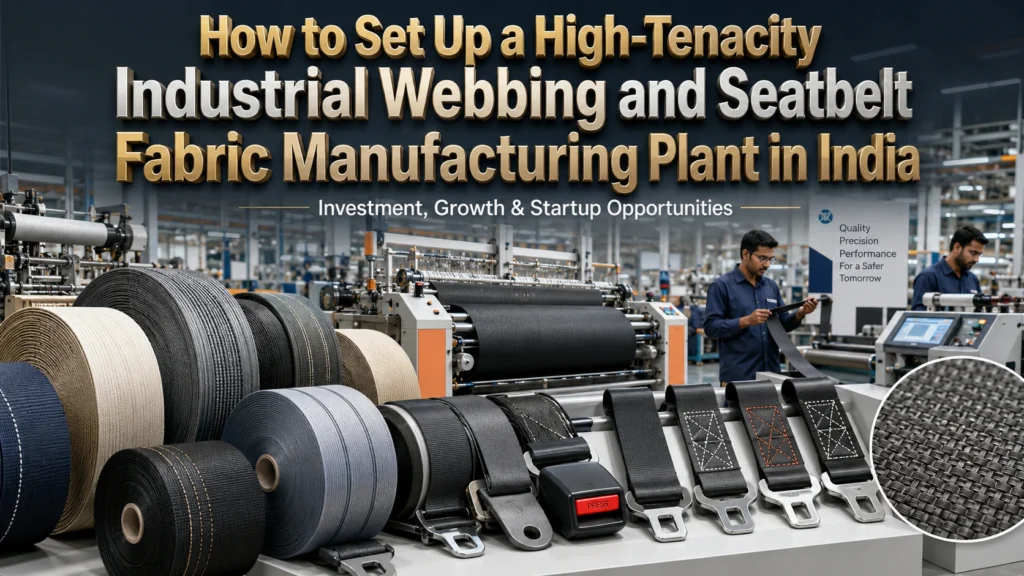
High-Tenacity Industrial Webbing Manufacturing Plant On Indian roads more than 15 crore vehicles use seatbelts manufactured from high-tenacity webbing each year. Then there are the thousands of tonnes in industrial lifting slings, para drop gear for the Indian Army, container lashing belts and adventure sports harnesses – and that’s a market that most people walk past day in and day out without even recognising it. India imports about 35-40% of its high-performance technical textile webbing requirements, mostly from China, Taiwan and South Korea. The cost of imports is in the hundreds of crore rupees every year. That the India deficit is not because of a failure of policy is not a claim to be taken for granted. It is a call that is open to you. One of the most unglamorous but most-profitable segments in the Indian technical textile industry is the high-tenacity industrial webbing and seatbelt fabric. No consumer brand name to build and no retail distribution headaches. You’re selling to automotive OEMs, defense procurement firms, cargo logistics firms, and safety equipment manufacturers, all of whom sign annual purchase agreements and pay promptly, and who demand quality above all else. So, if you are thinking of starting a manufacturing business with a defensible customer base, low advertising costs and domestic demand that is growing with the growth of the auto sector and Indian infrastructure then this is the article you should read. Get Detailed Insights from This Book: The Complete Technology Book on Textile India’s Import Dependency: A Supply Gap Worth Hundreds of Crore The data released by the Ministry of Textiles puts the value of India’s technical textiles industry at INR 2.19 lakh crore, and this is projected to grow to INR 4 lakh crore in the near future. In this, one of the most im-port-dependent segments is the industrial webbing and belting. The use of seat belts in the passenger vehicle sector alone exceeds 8,000 tonnes of webbing annually. As per reports from Society of Indian Automobile Manufacturers (SIAM), homegrown passenger vehicle production has hit the 40 lakh mark per year, which is on the back of consistent demand, with the requirement of fitting seatbelts on all seating positions under AIS-072 norms. There are also commercial vehicles, two-wheelers with lap belts and bus retrofitting which contribute to the volume. Another under-served pocket is defence procurement. High tenacity webbing is required by Indian Army, Air Force and Para Military for load-bearing equipment, para-descent equipment, vehicle towing strap and rifle sling. The DRDO has been alerting on dependency on imports in the field of technical textiles on several occasions. Domestic manufacturers that are certified by BIS and have the military grade testing clearance enjoy a captive market where there is hardly any room for price negotiation. The current capacity of webbing production in India is largely in Karnataka, Tamil Nadu and Gujarat, but these produce less than 65% of the national demand. States such as Rajasthan, Uttar Pradesh and Maharashtra have a high proportion of downstream consumption (automotive, construction, agriculture) with little or no upstream webbing manufacturing. That is the opening. Industrial clusters with highest demand concentration and those requiring urgent supply of locally-sourced webbing are mapped against state-wise demand concentration in the table below. Table 1: State-wise Industrial Webbing Demand and Key Clusters State / Region Key Application Major Industrial Cluster Estimated Annual Demand (MT) Maharashtra Automotive seatbelts, cargo straps Pune, Nashik, Aurangabad 18,000–22,000 MT Tamil Nadu Auto ancillary, defence webbing Chennai, Coimbatore, Hosur 14,000–17,000 MT Gujarat Industrial lifting, marine Surat, Ahmedabad, Vadodara 12,000–15,000 MT Haryana / Delhi NCR Seatbelts, safety harness Faridabad, Gurugram, Manesar 10,000–13,000 MT Rajasthan Military, para-drop webbing Jaipur, Jodhpur 6,000–8,000 MT Uttar Pradesh Cargo securing, agriculture Kanpur, Agra, Noida 5,500–7,000 MT Source: SIAM Annual Report, Ministry of Textiles Technical Textiles Mission, DRDO procurement data. MT = Metric Tonnes. Why Entry Now Makes Commercial Sense The launch of the National Technical Textiles Mission (NTTM) has come with a budget of INR 1,480 crore which is the biggest structural push India has given in this sector. Industrial webbing, geotextiles and safety belts are specific categories mentioned in the mission. The Production Linked Incentive (PLI) scheme offers 15% incentive on incremental sales for technical textiles in the first two years, followed by 11% and 3% respectively in the subsequent years. There are three macro factors that are all driving demand up. First: India’s vehicle production is on the rise steadily. At a minimum, 4–7 metres of seatbelt webbing is needed for every new vehicle. The market for seatbelt webbing is expanding with the introduction of new seatbelt in certain commercial categories under the new crashworthiness rules and as EV makers such as Tata, Mahindra and Ola Electric increase their production. Secondly, the BIS mandatory certification order for personal protective equipment now extends to industrial safety harnesses, climbing slings and fall arrest systems – all of which are based on high-tenacity webbing as the principle structuring material. This compulsory certification system effectively bans imports that are not certified and provides the domestic manufacturers with a quality threshold for the imported products. Third: India’s exports of readymade garments, cargo and industrial goods all go through container shipping. The lashing straps used in containers and cargo securing webbing, which are fully composed of high-tenacity polyester or nylon, are being used in huge numbers at all the major ports—JNPT, Mundra, Chennai and Vizag. PMEGP (Prime Minister’s Employment Generation Programme): This provides capital subsidy of up to 35% for new manufacturing units in rural areas. The credit guarantee provided by CGTMSE is up to INR 5 crore, which is collateral-free and is offered to the initial borrowers of the MSME. Subvention on machinery loans is given under TUFS (Technology Upgradation Fund Scheme) at 4-6%. All the above are unlocked after a 10-minute Udyam Registration in the MSME Ministry. Get Detailed Project Report (DPR): Technical Textiles: Agrotech to Sportech Projects How to Set Up: A Step-by-Step Blueprint Investment and Space The total investment required in the small-scale entry (8-10 high speed
10 Manufacturing Business Ideas in West Bengal with 12–26% Net Margins Under ₹80 Lakhs
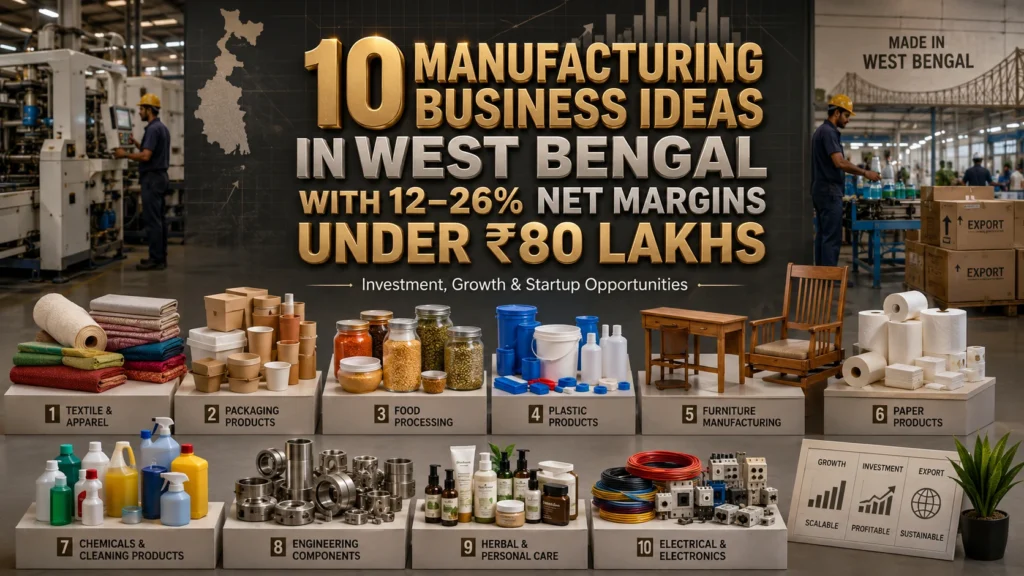
Manufacturing Business Ideas in West Bengal When it comes to the most preferred choice of location for a startup, most entrepreneurs would think of Gujarat, Maharashtra or Karnataka. There were hardly any who included West Bengal in their list of contenders. That’s a thing which has to be fixed — the state government of West Bengal currently grants capital subsidy of 15-30% on plant and machinery, power tariff rebate, stamp duty waiver and a single window clearance system which can issue 36 licences in 30 working days. No state in the eastern part of the country boasts that incentive package for the first time manufacturer. The state’s premier nodal agency, West Bengal Industrial Development Corporation (WBIDC), has developed more than 20 functional industrial parks in various districts from Howrah to Haldia to Barjora, where the land has already been pre-cleared, infrastructure has been laid out, and all the utilities are connected. Everything can be done on the Internet, including Factory Licences and Environmental NOCs on the Silpa Sathi portal. There’s another number that makes it more directly. Yet, there are only 4% industrial investments in West Bengal despite having more than 900,000 MSME units in the state, which is the third among the most important industrial hubs of the country based on the MSME Annual Report, released by the Ministry of MSME. That gap exists because of perception, not ground reality. Get Detailed Project Report (DPR): Best Business Opportunities in West Bengal What West Bengal Has That Other States Do Not The geographical location of the state gives business opportunities which are unattainable elsewhere in India. West Bengal shares its borders with another nation with 170 million people, Bangladesh, which is experiencing a growth in incomes and enormous demand for processed food, garments and consumer goods. The port of Kolkata, Syama Prasad Mookerjee, imports more than 17 million metric tonnes of cargo annually, and has direct shipping routes to the South-East Asia. The National Fisheries Development Board (NFDB) says West Bengal has an annual rice production of 15.7 million tonnes, is the biggest producer of vegetables by volume in the country and contributes almost one-third of inland fisheries production. However, food processing penetration remains at between 12-15% of overall agricultural production, which is less than the average for agricultural economies in similar countries, which is between 25-40%. Thousands of viable business units exist but have not been created, just this one. The jute narrative is as compelling. Jute crop in the state contributes 75% of the total jute production of the country, but most of this is exported as raw fibre. As part of the sustainability requirements imposed by European retailers, finished jute products (such as bags, composites and technical textiles) are in growing demand from FMCG companies. Domestic demand for jute bags has been increasing at more than 12% compounded rate according to the National Jute Board (Ministry of Textiles). A unit for jute bag manufacturing in Howrah or Hooghly can make bags for ₹18/$-22/bag and sell for ₹35/$-50/bag for corporate customers. Howrah, one of the oldest metal fabrication clusters in Asia, continues to provide the unfinished castings to customers in other states in light engineering. Moving to the value chain of “machined parts”, “precision parts”, or “finished sub-assemblies” could see revenue per tonne of produced parts treble from the same raw materials. TABLE 1: Top 10 Business Ideas in West Bengal — Sector, Investment, Schemes & Returns # Business Idea WB District / Cluster Min. Investment (INR) Applicable Scheme Net Margin Range Payback Period 1 Agro-processing & Vegetable Packaging Nadia, Murshidabad, Bardhaman ₹20–₹50 lakh PMEGP, PLI Food 14–20% 3–5 years 2 Fish Processing & Cold Storage South 24 Parganas, North 24 Parganas, Purba Medinipur ₹35–₹80 lakh PMEGP, CGTMSE, NHB 16–22% 3.5–5 years 3 Jute Bags & Eco-Packaging Manufacturing Howrah, Hooghly, North 24 Parganas ₹15–₹40 lakh PMEGP, JUTE-ICARE, SFURTI 12–18% 3–4 years 4 Ready-made Garments & Knitwear Kolkata, South 24 Parganas, Nadia ₹25–₹60 lakh PMEGP, TUFS, WB Textile Policy 10–16% 3–5 years 5 Light Engineering & Metal Fabrication Howrah, Durgapur, Kharagpur ₹30–₹75 lakh CGTMSE, WB MSME Policy 10–15% 4–6 years 6 Plastic Moulding & Packaging Components Barjora (Bankura), Durgapur ₹40–₹90 lakh PMEGP, CGTMSE 12–18% 4–5 years 7 Dairy & Milk Products Processing Nadia, Hooghly, Bardhaman ₹25–₹65 lakh PMEGP, DEDS, NHB 14–20% 3–4 years 8 Gems & Jewellery Manufacturing Kolkata (Manikanchan SEZ, Ankurhati) ₹10–₹30 lakh (artisan unit) PMEGP, GJC Schemes 15–25% 2–4 years 9 Herbal & Ayurvedic Products Jalpaiguri, Darjeeling, Alipurduar ₹20–₹50 lakh PMEGP, ASPIRE 18–26% 3–4 years 10 EV Component & Auto Parts Manufacturing Durgapur, Kharagpur, Haldia ₹75 lakh–₹2 crore PLI (Auto), CGTMSE, WB MSME Policy 12–18% 4–6 years Get Detailed Insights from This Book: Herbal Cosmetics & Ayurvedic Medicines (EOU) (3rd Revised Edition) Why Now: Policy, Infrastructure, and Market Timing The WB Government has been actively working towards building its EoDB ranking in the industrial sector. Now supported by WBIDC, the Silpa Sathi single-window system encompasses 36 pre-establishment and pre-operation approvals all online with guaranteed delivery dates. Key schemes creating an entry window right now: PMEGP: Capital subsidy of 25-35% on the project cost (upto ₹25 lakh) for manufacturing units. District level administration via KVIC and DIC offices. Capital subsidy for plant and machinery: 15–30% at state level; power tariff rebate; exemption of stamp duty on land registration—WB MSME Incentive Policy. CGTMSE: Credit cover for ₹5 crore up to 100% without collateral through scheduled banks. SIDBI’s Credit Guarantee Fund Trust for Micro and Small Enterprises. This is the crucial scheme for a first-generation founder who didn’t have property to pledge. PLI for Food Processing: 10% production linked incentive for 6 years for units with investment of ₹10 crore or above. SFURTI: Cluster development grants for jute units, khadi and handicraft units and soft loan facilities. How to Form a Company and Start a Business in West Bengal: Step-by-Step The incorporation process outlined below applies to the most usual structure for a manufacturing or trading business that is looking to scale up, and that is the Private Limited
6 Green Manufacturing Business Ideas in Afghanistan with 35% Margins and Growing Demand
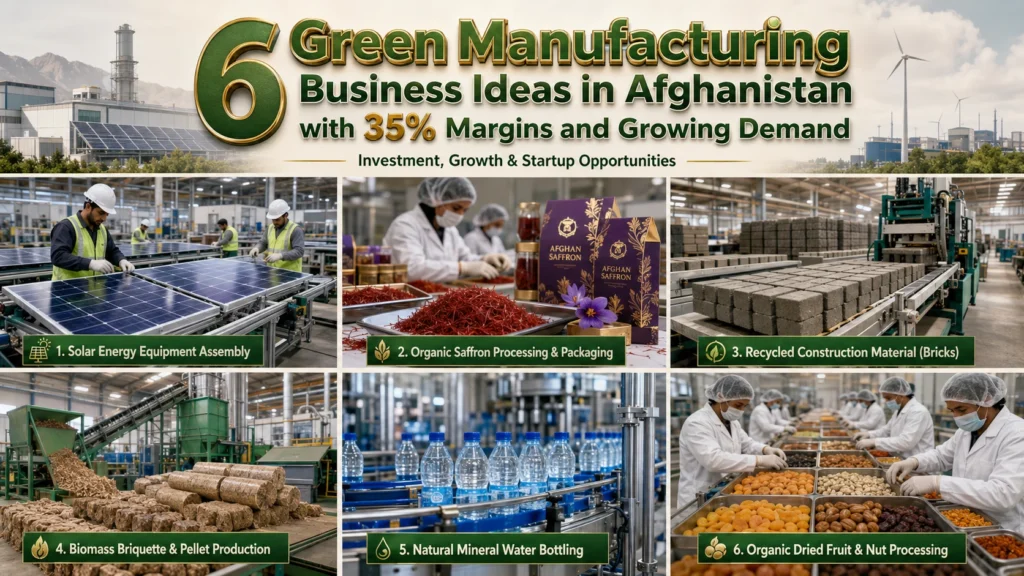
Green Manufacturing Business Ideas in Afghanistan In Afghanistan, the average annual amount of sunshine is over 300 days. It receives an average solar irradiance of more than 5.5 kWh/m2/day, higher than most of Europe and comparable to the belt of the deserts in Rajasthan, as per solar resource data available in the Global Solar Atlas published by World Bank. However, more than 70% of its citizens still do not have access to reliable electricity. Businesses run generators. Hospitals operate on borrowed electricity! For six to eight hours a day, factories sit idle due to the failure of the grid to deliver. This paradox, of a vast abundance of natural resources and a grinding poverty of industry, is no tragedy for those who merely look on. An investor or a green entrepreneur or a manufacturer, it is a signal. Such a market niche will not remain unoccupied for long. The Afghan country is also a major producer of saffron, the spice, which fetches INR 3.5–4 lakh per kilogram in international markets. The United States Geological Survey (USGS) has identified some of the most abundant deposits of lithium, copper and rare earth elements in the world in its mountains. It is an agriculture-based area that yields apricots, pomegranates, figs and almonds used in Central Asia and the Middle East. This is hardly processed locally. Related Article: Profitable Green Manufacturing Business Ideas in India: Waste to Wealth Opportunities The Market Gap: Resource-Rich, Processing-Poor Put it in numbers. The importation of manufactured consumer goods into Afghanistan accounts for approximately 80% of imports. Electricity generation capacity is less than 700 MW for a population of 40 million compared to Nepal’s 2,000 MW and Pakistan’s 40,000 MW for 300 and 220 million people respectively. Solar energy alone could power the entire electricity demand of Afghanistan multiple times while IRENA (International Renewable Energy Agency) has identified Afghanistan’s renewable energy potential as one of the least tapped in Central Asia. On the green side in particular: solar panel imports have been increasing by more than 18 per cent a year for several years now, but there is, to date, no significant solar panel assembly plant in the country. All panels are imported from China, India and UAE with import duty, freight charges and dealer margins. If assembled locally, even at a small scale, a 20-28% reduction in the landed cost of an imported unit can be achieved by a locally assembled panel. Saffron has a more pointed tale. There are approximately 20,000–25,000 tonnes of raw saffron filaments produced in Afghanistan every year. More than 85% of which is exported unprocessed to Iran and UAE, where much value is lost, as detailed by the Food and Agriculture Organization (FAO) . Iran cleans, grades, repackages it, gives it its own name and sells it to Europe at four to five times the farm-gate price. The benefits of the capturing in the Afghan units are currently enriching Iranian intermediaries. Another important gap is the lack of biomass briquettes. For more than 60% of Afghan households, wood fuel and animal dung fuel continue to be their main source of heat. These industrial briquettes, which are made from agricultural waste, such as wheat straw, cotton stalks, or almond shells, are burned with fewer pollutants, for a longer duration and to help significantly reduce indoor air pollution by up to 70%. Demand from urban areas is strong and growing. There is virtually no organized supply. Table 1: Key Green Manufacturing Sectors in Afghanistan — Opportunity Snapshot Green Business Sector Key Advantage Priority Regions Est. Investment (INR) Market Demand Solar Energy Equipment Assembly High solar irradiance (300+ days/yr) Kabul, Herat, Kandahar INR 42–65 Cr Growing rapidly Organic Saffron Processing & Packaging World’s top saffron producer Herat, Farah INR 8–18 Cr High — export-driven Recycled Construction Material (Bricks) Massive post-conflict reconstruction Kabul, Jalalabad INR 6–12 Cr Very High Biomass Briquette & Pellet Production Critical heating fuel shortage All major provinces INR 3–7 Cr Very High Natural Mineral Water Bottling Untapped aquifer resources Bamyan, Nuristan INR 5–10 Cr Moderate–High Organic Dried Fruit & Nut Processing Global demand for Afghan dried fruit Kandahar, Helmand, Farah INR 4–9 Cr High — USD-earning Source: UNAMA trade data, Afghan Ministry of Commerce, NPCS Market Research estimates. All INR figures are indicative investment ranges. Get Detailed Insights from This Book: Solar PV Power and Solar Products Handbook How to Set It Up: Solar Panel Assembly Unit Among the green manufacturing sectors presented above, the assembly of solar panels has the lowest technology risk, the highest local demand alignment, and the shortest payback period. This is a step-by-step guide to setting up a small to medium assembly unit. Minimum Investment The total capital expenditure needed for a functional assembly unit of 5 MW per year would be between INR 65-100 lakh, which includes the plant setup, machinery, and working capital for 3 months. The cost of the put together system is Rs. 22-30 lakh per MW/year in micro scale, and sharply improved at the 5 MW scale. Land and Space Requirements There should be 500–800 square metres of factory space available that is covered. Clean, dust-controlled environment is required for lamination and cell tabbing. There are industrial areas in Herat and Kabul where plots are available. The cost of a month in the industrial zone of Herat is currently USD 0.4 to USD 0.6 per sq metre. Key Machinery Equipment Cost Range (INR) Solar cell tabber and stringer machine ₹12–18 lakh Laminator (EVA film press) ₹6–9 lakh Solar simulator and IV curve tester ₹4–6 lakh Frame assembly jig and junction box attachment station ₹2–4 lakh EL imaging system for defect detection ₹3–5 lakh Raw Material Sourcing Solar cells are manufactured using monocrystalline or polycrystalline wafers from China (the leading world supplier) and usually have a lead time of 30-45 days. EVA encapsulant film, backsheet, aluminium frames and junction boxes also come in from their main supplier China. Logistics planning from the outset should include a reliable import route, either via the Herat–Islam
India-Oman CEPA: The Trade Gateway Every Indian Exporter Has Been Waiting For
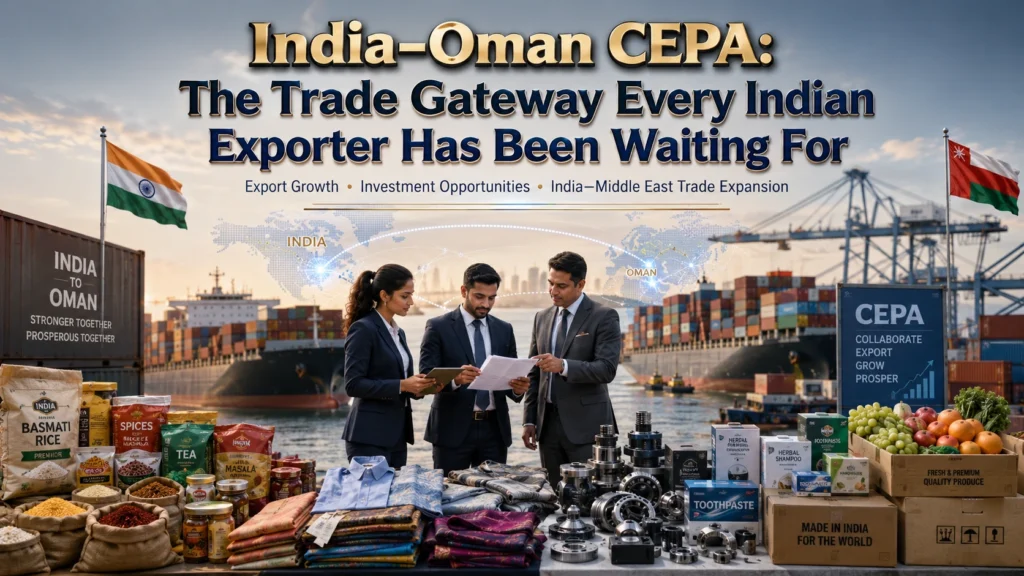
Source: Ministry of Commerce & Industry, Government of India | Press Information Bureau India Oman CEPA export opportunity MSME Until June 1st this year, there was a quiet competition between Italian jewellers, Thai seafood processors and Chinese engineering exporters for a share in the USD 28 billion import market in Oman; a market which had been dominated by Indian players. Until June 1st this year, outsiders — Italian jewellers, Thai seafood processors and Chinese engineering exporters — enjoyed a quiet lead in the USD 28 billion import market in Oman, which was dominated by Indian players. They both had the same 5% tariff. So did the Indians! This balance is now out of equilibrium. Under the new norms of India-Oman CEPA, 99.38% of India’s exports are being duty-free. Not next quarter. Today. Imagine the implications for a textile exporter in Surat, a seafood processor in Andhra Pradesh or a pharmaceutical manufacturer in Ahmedabad. From Italy, Turkey, Thailand and China, each competitor is now at a structural disadvantage in Oman because of the tariffs they still have to pay. India and Oman have also signed an all-embracing bilateral trade pact, a first for a country after the USA. This exclusivity is what creates a time-sensitive window. MSMEs and Industrial Units that are first in the queue, getting Compliant, Export Ready and connected to Oman’s Ports will grab their market share before it is too late. Oman is not a far-remote destination in the Gulf. It provides access to the broad market of the rest of the GCC and East Africa via hubs in Sohar, Duqm and Salalah. Three ports that link South Asia with some of the world’s fastest growing consumer markets. View Full Project Details: Investment Opportunities and Business Ideas in Oman (Middle East) The Gap That Has Held Indian Exporters Back Bilateral trade between India and Oman was worth USD 11.18 billion during the previous financial year as compared with USD 10.61 billion during the previous year. Impressive on paper. However, when looking carefully at sector level data, the difference is stark. Bring gems and jewellery. Oman’s total imported market for this is USD 1.07 billion per year. India’s current share? Just USD 25.78 million, less than 2.5%. The clusters, which are key suppliers of polished diamond and gold jewellery export to the world, are excluded from the market which is sitting on India’s doorsteps, as the Italian, Turkish and Thai competitors are also paying the same import duty of five per cent as the Indian exporters. Marine products tell an even more clear-cut story. Oman imported USD 35.3 million in seafood and India, despite being home to some of the biggest clusters of shrimp and fish processing in the world in Andhra Pradesh, Kerala, Tamil Nadu and Gujarat, had only imported USD 10 million of seafood. A 5% import duty on shrimp and cuttlefish was sufficient to kill the exporters’ business, operating on slim margins. Oman’s import market is worth USD 302.84 million and expanding at 6.6% CAGR in the pharmaceutical sector. Approvement delays, duplicate inspections and regulatory bumps delayed Indian generic drug makers from gaining market access and took months to approve. The USFDA, EMA or UK MHRA approved products now receive marketing authorization in Oman within 90 days. The acceleration is not just a minor bureaucratic adjustment but a structural change. In the previous financial year, India exported USD 875.83 million of engineering goods to Oman, such as machinery, electrical products, automobiles, iron and steel. The actual “total addressable market” is much bigger. The imports of electronics are only USD 1.7 billion in Oman, whereas India claims only USD 146 million. Source: Ministry of Commerce & Industry, Press Information Bureau | APEDA Export Statistics TABLE 1: Sector-wise Export Opportunity Under India-Oman CEPA Sector India’s Current Exports to Oman Oman Market Size Duty Before CEPA CEPA Duty Status Gems & Jewellery USD 25.78 mn USD 1.07 bn Up to 5% Zero (Day 1) Marine Products USD 10 mn USD 35.3 mn Up to 5% Zero (Day 1) Agriculture & Processed Food USD 552.85 mn ~USD 3.1 bn share Varies Eliminated Pharmaceuticals Growing USD 302.84 mn Varies Zero (binding) Engineering Goods USD 875.83 mn USD 1.7 bn (electronics alone) 0-5% Zero Textiles & Footwear Significant Large Varies Eliminated IT & Professional Services USD 863 mn (bilateral services) USD 12.52 bn (Oman global) Various barriers 127 sub-sectors opened Source: PIB Press Release, Ministry of Commerce & Industry, Government of India Why This Is the Right Moment to Move There are various forces in play at this moment and an alert MSME operator shouldn’t underestimate any of them. The duty removal is immediate, that’s the first. As of June 1st, the day the agreement entered into force, all concessions with a zero duty rate were to be implemented. There is no phased schedule, no waiting period, no transitional clause for the 99.38% of export lines covered. Exporters who ship now reap rewards now. Second, the NTBs have been addressed head on. Oman will now accept mandatorily, at its ports, Indian certificates from the Export Inspection Council (EIC) eliminating any duplicate testing. Both NPOP Organic and halal certification is recognised in India. This eliminates months of compliance hassles at the border for food processors, agri-exporters and organic product producers. Third, the services and professional mobility provisions open up doors which pure goods exporters do not often reach. Oman has offered 127 services sub-sectors, the most comprehensive offer to India by any GCC country. Oman has now provided legally binding certainty for IT professionals, engineers, doctors, architects and educators. Independent professionals have a time limit of up to 180 days. The Intra-Corporate Transferees are allowed to remain for a period of up to four years. Almost 6000 joint ventures between India and Oman are directly affected. There are various support mechanism provided by the government that can be utilized by the MSME manufacturers for export market. Production Linked Incentive (PLI) offers 4-6% incentive on incremental sales for sectors that are directly
6 Agro-Manufacturing Business Ideas That Can Earn ₹1 Crore/Year in India
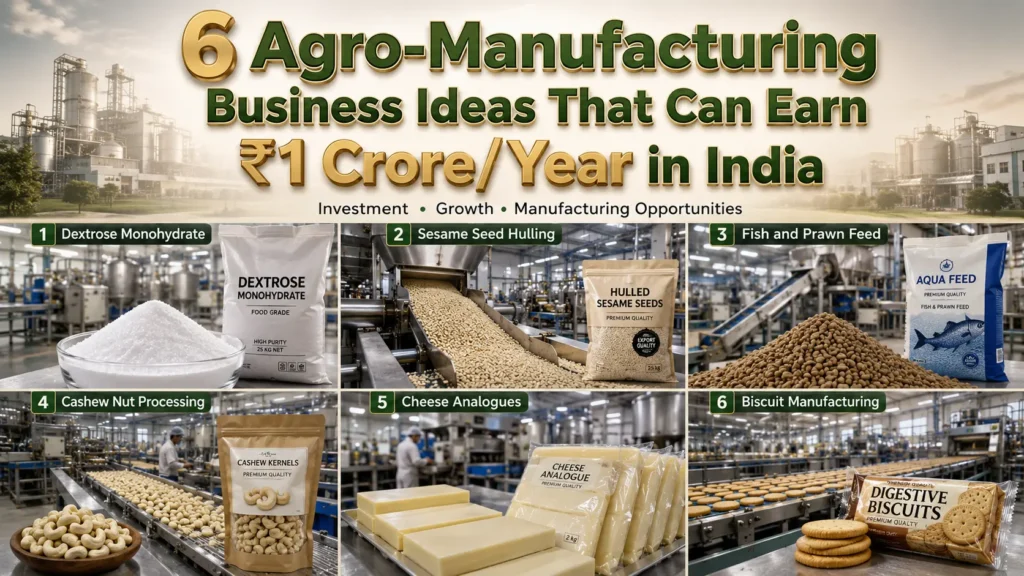
From the Farm to the Factory: High-Growth Opportunities in Food Processing, Agricultural Inputs, and Specialty Products Agro Manufacturing Business Ideas in India India is at a unique turning point. There is a daily need for food, feed and specialty ingredients, which is driven by a billion-plus population. There are still a number of manufacturing sectors that are not yet well developed. For the right entrepreneur, this void is not a hindrance, it’s a chance. This opportunity is being supported by government policy. However, the Production Linked Incentive scheme for food processing, PMEGP for small manufacturers and the consistent thrust under Make in India has helped to create a conducive environment for the first-generation entrepreneurs. But policy is not enough to establish a business. A business is created by knowing which products are in structural demand, what the real costs of producing them are and where the margins are. This article will explore six manufacturing and processing business ideas that have a strong depth of demand, approachable processes and good margins. Practical aspects of production logic, cost structure and commercial opportunity are presented for each sector: dextrose monohydrate, sesame hulling, aqua feed, cashew processing, cheese analogues, and biscuits. Get Detailed Insights from This Book: Profitable Agro Based Projects 1. Dextrose Monohydrate: The Quiet Workhorse of Indian Industry What It Is and Where It Goes Dextrose monohydrate, a hydrolysate of starch, is one of the most commonly used functional ingredients used in the Indian manufacturing. The infusion for the pharmaceutical application, called Intravenous Dextrose Normal Saline, is familiar. But the food-grade derivative market is arguably bigger and bigger. Dextrose is used in a variety of key food applications such as: Confectionery, bakery products and hard candy formulations. The production of energy drinks, sports nutrition and baby food. Amino acid, citric acid, and API production fermentation substrates Specialty chemical applications and special applications in textile processing Starch derivatives industry is located in the main part of the country in Maharashtra, Uttar Pradesh and Andhra Pradesh. There are a few big players controlling the organised segment. But demand downstream has reached a critical threshold and regional processors are discovering commercially viable niches that the large processors cannot be agile enough to serve. Investment and Growth Outlook This core process consists of starch liquefaction by alpha-amylase enzymes, saccharification by glucoamylase, purification activated carbon and crystallisation. The capital cost of a small to mid-sized plant with 10-25 tonnes per day capacity lies between ₹4 crore to ₹12 crore. Dextrose intended for food use should be in conformity with the FSSAI specifications. Dextrose used for food should comply with the FSSAI requirements. Other certifications are required for producers that sell into export markets or for pharmaceutical ingredient producers. Please refer to the FSSAI website for full regulatory requirements. The starch derivatives industry in India is expanding at about 8 – 10% CAGR due to the processed foods, sports nutrition, and expanding pharmaceutical industry. The true market potential is in differentiated applications: ultra-pure types for infant formula companies and blends of dextrose-maltodextrin types for sports nutrition companies. 2. Sesame Seed Hulling: A Business Idea with Strong Export Pull Why Sesame Deserves Serious Attention India is the largest producer and exporter of sesame seeds. It is true that there has been a world market for raw sesame from the beginning. But, hulled sesame (also called natural white sesame) fetches a much larger price, and is the preferred form for almost all international buyers. Main export destinations are Japan (150,000–180,000 metric tonnes per year), South Korea, China, Middle East and emerging markets such as North American Countries and EU. The premium for raw to hulled sesame has been between 25% and 45%. This ensures a simple value addition game called hilling and is one of the easiest agro-processing business ideas for India. Investment and Commercial Viability A sesame hulling plant is comprised of cleaning, soaking, mechanical hulling, flotation separation, washing, drying and colour sorting. Colour sorting is a crucial stage, as international buyers have stringent quality requirements, and if the colour isn’t good, even if the lot is properly hulled, it will be rejected. The investment in plants for 5–10 tonne per day operation can be from ₹80 lakh to ₹2 crore. The consistent supply of 99.95% purity by Indian exporters, ensures them premium price buyers. Exporters are assisted by the Agricultural and Processed Food Products Export Development Authority (APEDA) with regard to quality certification and market development funding. A natural raw material advantage can be acquired while setting up near major growing belts in Rajasthan or Gujarat. Another planning point of importance is working capital management and storage infrastructure, and procurement should be focused on a 2–3-month window post-harvest. Related Article: Top 3 Profitable Agro-Based Manufacturing Business Ideas in India 3. Fish and Prawn Feed: Riding the Blue Economy Wave The Structural Demand Story The aquaculture industry in India has silently undergone a change in the last 15 years. Shrimp exports have reached the levels of ₹50,000 crore per year, and consumption of fish is increasing gradually. Quality compound feed is part of the rapidly expanding demand which lies behind both of those trends. The fish and prawn reared on nutritionally balanced feeds grow faster, have less mortality rate, and yield better quality meat. The organised aqua feed market is valued at more than ₹18,000 crore and will be expected to reach ₹30,000 crore by the end of this decade. The five key states that are boosting demand are Andhra Pradesh, Odisha, West Bengal, Kerala and Tamil Nadu. Manufacturing and Margin Profile A compound aqua feed formulation usually will include fish meal or soy protein concentrate, energy ingredients (such as wheat and maize), lipid sources, vitamins, minerals and binding agents. The protein content should be higher in prawn feeds (32-40%). This is due to the increased significance of the extruded feed technology, which means that water pollution can be alleviated and the feed consumption can be monitored better. A medium size extruded plant is likely to need an