
Manufacturing Business Ideas in West Bengal
When it comes to the most preferred choice of location for a startup, most entrepreneurs would think of Gujarat, Maharashtra or Karnataka. There were hardly any who included West Bengal in their list of contenders. That’s a thing which has to be fixed — the state government of West Bengal currently grants capital subsidy of 15-30% on plant and machinery, power tariff rebate, stamp duty waiver and a single window clearance system which can issue 36 licences in 30 working days. No state in the eastern part of the country boasts that incentive package for the first time manufacturer.
The state’s premier nodal agency, West Bengal Industrial Development Corporation (WBIDC), has developed more than 20 functional industrial parks in various districts from Howrah to Haldia to Barjora, where the land has already been pre-cleared, infrastructure has been laid out, and all the utilities are connected. Everything can be done on the Internet, including Factory Licences and Environmental NOCs on the Silpa Sathi portal.
There’s another number that makes it more directly. Yet, there are only 4% industrial investments in West Bengal despite having more than 900,000 MSME units in the state, which is the third among the most important industrial hubs of the country based on the MSME Annual Report, released by the Ministry of MSME. That gap exists because of perception, not ground reality.
Get Detailed Project Report (DPR): Best Business Opportunities in West Bengal
What West Bengal Has That Other States Do Not
The geographical location of the state gives business opportunities which are unattainable elsewhere in India. West Bengal shares its borders with another nation with 170 million people, Bangladesh, which is experiencing a growth in incomes and enormous demand for processed food, garments and consumer goods. The port of Kolkata, Syama Prasad Mookerjee, imports more than 17 million metric tonnes of cargo annually, and has direct shipping routes to the South-East Asia.
The National Fisheries Development Board (NFDB) says West Bengal has an annual rice production of 15.7 million tonnes, is the biggest producer of vegetables by volume in the country and contributes almost one-third of inland fisheries production. However, food processing penetration remains at between 12-15% of overall agricultural production, which is less than the average for agricultural economies in similar countries, which is between 25-40%. Thousands of viable business units exist but have not been created, just this one.
The jute narrative is as compelling. Jute crop in the state contributes 75% of the total jute production of the country, but most of this is exported as raw fibre. As part of the sustainability requirements imposed by European retailers, finished jute products (such as bags, composites and technical textiles) are in growing demand from FMCG companies. Domestic demand for jute bags has been increasing at more than 12% compounded rate according to the National Jute Board (Ministry of Textiles). A unit for jute bag manufacturing in Howrah or Hooghly can make bags for ₹18/$-22/bag and sell for ₹35/$-50/bag for corporate customers.
Howrah, one of the oldest metal fabrication clusters in Asia, continues to provide the unfinished castings to customers in other states in light engineering. Moving to the value chain of “machined parts”, “precision parts”, or “finished sub-assemblies” could see revenue per tonne of produced parts treble from the same raw materials.
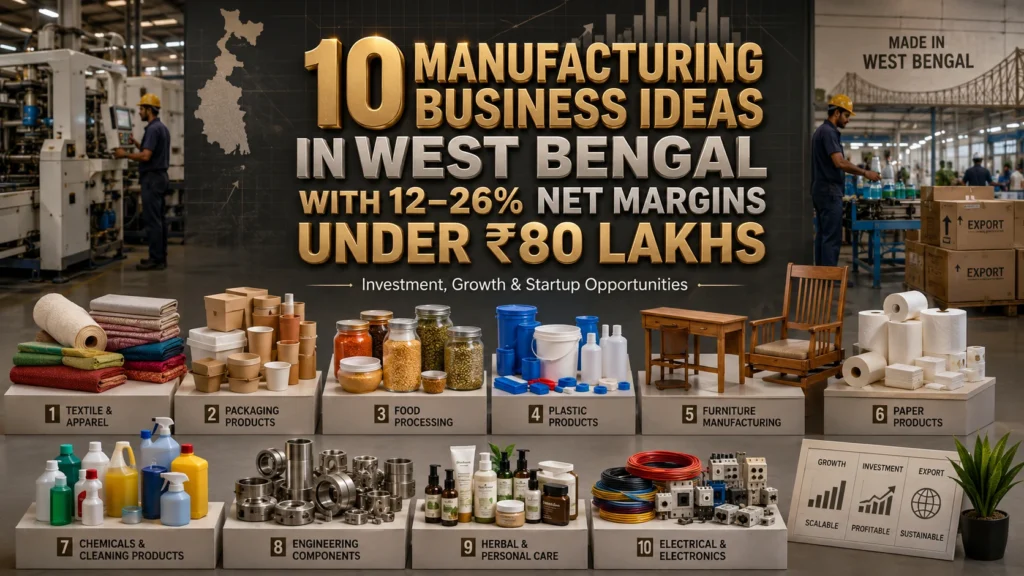
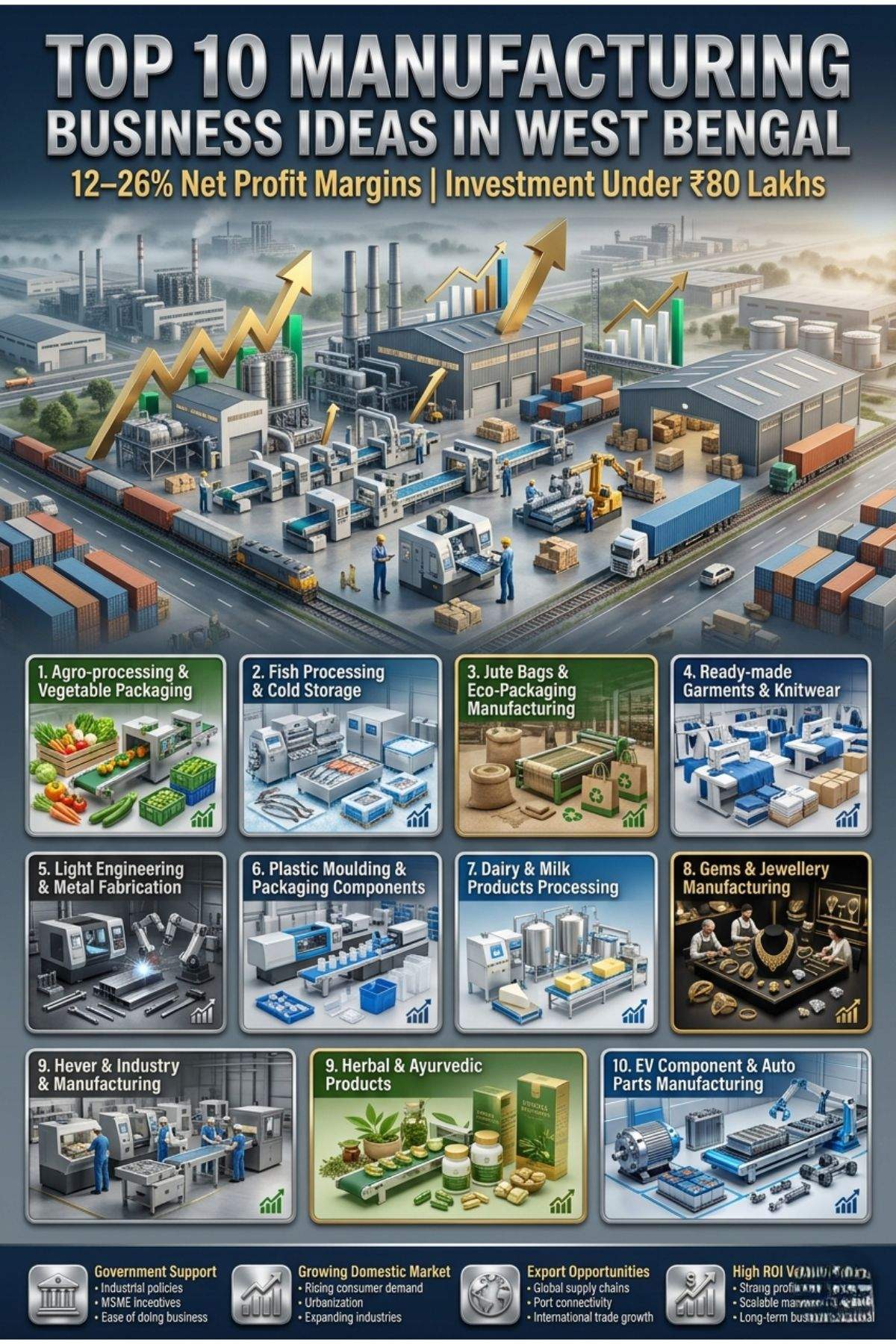
TABLE 1: Top 10 Business Ideas in West Bengal — Sector, Investment, Schemes & Returns
| # | Business Idea | WB District / Cluster | Min. Investment (INR) | Applicable Scheme | Net Margin Range | Payback Period |
| 1 | Agro-processing & Vegetable Packaging | Nadia, Murshidabad, Bardhaman | ₹20–₹50 lakh | PMEGP, PLI Food | 14–20% | 3–5 years |
| 2 | Fish Processing & Cold Storage | South 24 Parganas, North 24 Parganas, Purba Medinipur | ₹35–₹80 lakh | PMEGP, CGTMSE, NHB | 16–22% | 3.5–5 years |
| 3 | Jute Bags & Eco-Packaging Manufacturing | Howrah, Hooghly, North 24 Parganas | ₹15–₹40 lakh | PMEGP, JUTE-ICARE, SFURTI | 12–18% | 3–4 years |
| 4 | Ready-made Garments & Knitwear | Kolkata, South 24 Parganas, Nadia | ₹25–₹60 lakh | PMEGP, TUFS, WB Textile Policy | 10–16% | 3–5 years |
| 5 | Light Engineering & Metal Fabrication | Howrah, Durgapur, Kharagpur | ₹30–₹75 lakh | CGTMSE, WB MSME Policy | 10–15% | 4–6 years |
| 6 | Plastic Moulding & Packaging Components | Barjora (Bankura), Durgapur | ₹40–₹90 lakh | PMEGP, CGTMSE | 12–18% | 4–5 years |
| 7 | Dairy & Milk Products Processing | Nadia, Hooghly, Bardhaman | ₹25–₹65 lakh | PMEGP, DEDS, NHB | 14–20% | 3–4 years |
| 8 | Gems & Jewellery Manufacturing | Kolkata (Manikanchan SEZ, Ankurhati) | ₹10–₹30 lakh (artisan unit) | PMEGP, GJC Schemes | 15–25% | 2–4 years |
| 9 | Herbal & Ayurvedic Products | Jalpaiguri, Darjeeling, Alipurduar | ₹20–₹50 lakh | PMEGP, ASPIRE | 18–26% | 3–4 years |
| 10 | EV Component & Auto Parts Manufacturing | Durgapur, Kharagpur, Haldia | ₹75 lakh–₹2 crore | PLI (Auto), CGTMSE, WB MSME Policy | 12–18% | 4–6 years |
Get Detailed Insights from This Book: Herbal Cosmetics & Ayurvedic Medicines (EOU) (3rd Revised Edition)
Why Now: Policy, Infrastructure, and Market Timing
The WB Government has been actively working towards building its EoDB ranking in the industrial sector. Now supported by WBIDC, the Silpa Sathi single-window system encompasses 36 pre-establishment and pre-operation approvals all online with guaranteed delivery dates.
Key schemes creating an entry window right now:
PMEGP: Capital subsidy of 25-35% on the project cost (upto ₹25 lakh) for manufacturing units. District level administration via KVIC and DIC offices.
Capital subsidy for plant and machinery: 15–30% at state level; power tariff rebate; exemption of stamp duty on land registration—WB MSME Incentive Policy.
CGTMSE: Credit cover for ₹5 crore up to 100% without collateral through scheduled banks. SIDBI’s Credit Guarantee Fund Trust for Micro and Small Enterprises. This is the crucial scheme for a first-generation founder who didn’t have property to pledge.
PLI for Food Processing: 10% production linked incentive for 6 years for units with investment of ₹10 crore or above.
SFURTI: Cluster development grants for jute units, khadi and handicraft units and soft loan facilities.
How to Form a Company and Start a Business in West Bengal: Step-by-Step
The incorporation process outlined below applies to the most usual structure for a manufacturing or trading business that is looking to scale up, and that is the Private Limited Company structure.
Step 1: Get Your Digital Signature Certificate (DSC)
All the directors require a Class-II DSC issued by an MCA approved agency. Cost: ₹800–₹2,000. Time: 1 day. PAN, Aadhaar and a passport photo are the documents required.
Step 2: Reserve Your Company Name via RUN
Sign in to mca.gov.in and avail RUN service, which stands for Reserve Unique Name. A maximum of two names can be proposed at any one time. Cost: ₹1,000. Approval takes 2–3 days.
Step 3: File SPICe+ with e-MoA and e-AoA
SPICe+ (INC-32) is the consolidated form for incorporation of companies. It includes Company Registration with PAN/TAN, up to 3 Director Registration with DIN, name reservation. Application for filing must be made within 20 days after name approval. Once processed, Certificate of Incorporation (CIN) is issued in a digital format.
Step 4: File AGILE-PRO for GST, EPFO, and ESIC
The filing of AGILE-PRO (Form INC-35) is made at the same time as filing SPICe+ as a linked form. Registers your company for GST (GSTIN), EPFO Establishment Code and ESIC Employer code in a single shot. There is no need to make applications to the tax departments separately.
Step 5: Register on Silpa Sathi for Industry Licences
After getting the CIN and GST, one can apply for Factory Licence (Directorate of Factories), Environmental/Pollution NOC (WBPCB), Building Plan Sanction (WBIDC), Plinth Certificate and Occupancy Certificate in the silpasathi.wb.gov.in website. Timeline: Most approvals will require 15-30 working days.
Step 6: File Udyam Registration
Now visit the site udyamregistration.gov.in and register using the Aadhaar of the proprietor or any of the directors. Free and 15 minutes. This registration is required to avail PMEGP, CGTMSE, MUDRA and WB MSME Policy incentives.
Step 7: Open a Current Account and Apply for Scheme Finance
Open a current account with any scheduled bank in the name of the company. Submit project DPR, Udyam certificate, identification documents and machinery quotations to the nearby District Industries Centre (DIC) or kviconline.gov.in for PMEGP application.
Sector-Specific Licences to Note
- Food processing units: FSSAI licence — must be obtained before the first sale.
- Chemical and rubber units: WBPCB Consent to Establish + Consent to Operate
- Pharmaceutical units – State Drugs Controller licence
- Export units: IEC (Import-Export Code) from DGFT — ₹500, online, 1 day
TABLE 2: Company Formation in West Bengal — Steps, Costs, Timelines & Documents
| Step | Action Required | Agency / Portal | Time Required | Cost (INR) | Documents Needed |
| 1 | Obtain Digital Signature Certificate (DSC) for directors | Any MCA-certified DSC agency | 1 day | ₹800–₹2,000 | PAN, Aadhaar, passport photo |
| 2 | Reserve Company Name via RUN service | mca.gov.in | 2–3 days | ₹1,000 | Proposed name, business object |
| 3 | File SPICe+ form (INC-32) with e-MoA and e-AoA | mca.gov.in (Central Registration Centre) | 4–7 days | Stamp duty + ₹500–₹2,000 | ID/address proof all directors, office proof, shareholding pattern |
| 4 | File AGILE-PRO (INC-35) for GST, EPFO, ESIC | Linked with SPICe+ on mca.gov.in | Simultaneous with Step 3 | NIL (bundled) | Principal place of business proof |
| 5 | Register on Silpa Sathi for industry-specific clearances | silpasathi.wb.gov.in | 1 day (registration) | NIL | CIN, GST, director PAN, site address |
| 6 | Apply for Factory Licence, Pollution NOC, Building Plan Sanction | Directorate of Factories / WBPCB via Silpa Sathi | 15–30 working days | ₹2,000–₹15,000 | Site plan, factory layout, NOC from local body |
| 7 | File Udyam Registration (mandatory for MSME) | udyamregistration.gov.in | 1 day | NIL | Aadhaar of proprietor/director, PAN, bank details |
| 8 | Apply for PMEGP / CGTMSE / WB MSME subsidy at DIC office | District Industries Centre (DIC) / KVIC | 30–60 days processing | NIL to apply | DPR, Udyam certificate, bank account, machinery quotations |
Related Article: Manufacturing Opportunities in West Bengal
Financial Snapshot: What It Actually Costs to Start
Initial capital cost before subsidy – small scale unit is economically viable at ₹35–₹80 lakh.
With PMEGP subsidy (25-35%): Net capital outflow comes down to ₹25 lakh to ₹55 lakh and balance is financed using the bank term loan.
Monthly Operating Cost: ₹4–₹10 lakh (raw materials 55–60%, labour 15%, power 8–10%, packaging and logistics 10–12%).
Revenue at 60% Capacity: ₹10 to ₹18 lakh/month as per the product & buyer contracts.
Revenue at 100% Capacity: ₹18–₹30 lakh per month.
Gross Margin: 20-28% for majority of food and jute-based products.
Payback Period: 3-5 years on average utilisation of 65-70%.
TABLE 3: Government Schemes for WB Businesses — Best-For Match, Benefits & Application Portals
| Scheme | Best For | Max Benefit | Implementing Body | Eligibility | Where to Apply |
| PMEGP | Food, agro, jute, garment, light engineering micro units | ₹25 lakh subsidy (25–35% of project) | KVIC / KVIB / DIC | 18+ yrs, new unit only | Nearest DIC / kviconline.gov.in |
| WB MSME Incentive Policy | All new manufacturing units in WB | 15–30% on plant & machinery; power tariff rebate | Dept. of MSME & Textiles, WB | Investment ≤₹50 crore in WB | myenterprisewb.in / Silpa Sathi |
| CGTMSE | First-gen founders without collateral assets | Collateral-free credit up to ₹5 crore | SIDBI + Member Banks | Micro & Small enterprises | Through any scheduled bank / SIDBI |
| SFURTI | Jute, khadi, handicrafts, cluster-based units | ₹5 crore (soft loan + grant for cluster) | Ministry of MSME | Cluster of ≥50 artisans / units | msme.gov.in |
| PLI – Food Processing | Food manufacturers with ≥₹10 cr investment | 10% on incremental sales for 6 years | MoFPI | New or expansion units, ₹10 cr+ capex | mofpi.gov.in |
| MUDRA (Tarun) | Working capital, machinery for micro units | Up to ₹10 lakh (Tarun tier) | Banks / NBFCs under PMMY | Non-farm income-generating micro units | Any PSU bank or MFI |
| Silpa Sathi (Single Window) | All new industrial units in West Bengal | 36+ clearances in 30 working days online | WBIDC / Industry Dept., WB Govt | Any investor registering in WB | silpasathi.wb.gov.in |
Entrepreneur Spotlight
With an initial investment of ₹14 lakh (Out of which WBIDC subsidy of ₹5 lakh), Priya Dutta, Founder – GreenWrap Jute Solutions, Hooghly District gave up her job in a bank and started a jute bag manufacturing unit at a WBIDC allotted shed. She provides printed jute carry bags to the e-commerce packaging companies and modern retail chains in Kolkata, Delhi and Bengaluru. Today her unit generates a turnover of ₹1.2 crore per year and employs 18 manual workers. Her message to others: “Just apply for Udyam the day you think about starting your business — every scheme, every bank loan and every government tender will require you. It takes 10 minutes; there is no reason to wait.
Discover business ideas that actually make money
Getting Your Project Report Right: Where NPCS Comes In
In West Bengal, every single application for PMEGP, every loan application from the bank and every approval of the state subsidy would require a project report which is not a business plan in a casual sense but a formalized Detailed Project Report (DPR) with detailed breakdowns of investments, machinery specifications, sourcing plans for raw materials, market analysis, projected financials etc. Founders’ DPRs are turned down by banks and DIC offices regularly, which delays their projects for months. NIIR Project Consultancy Services (NPCS), can be contacted at niir.org and entrepreneurindia.co for techno-economic feasibility studies and complete DPRs in food processing, agro-industries, light engineering, textiles, chemicals and manufacturing. They provide their reports with plant layout designs, environmental compliance guides and return projections which are organized for bank and subsidy authority submission.
One Decision. One Afternoon. Start Today.
Infrastructure, schemes, raw materials, and labour are available in West Bengal. Silpa Sathi porta online! Application process for PMEGP is online. The process of Udyam registration can be completed in just 15 minutes and will be free of charge. It takes 7-10 working days to incorporate the company via SPICe+ in total.
Choose one business opportunity from this article to work on that fits your capital, your district and your existing expertise. So, visit udyamregistration.gov.in today for your registration. Next, go to wbidc.com and find the location of the most convenient WBIDC industrial park. These two actions – Udyam registration and a site visit by the WBIDC – will give you a better idea about if West Bengal is the right place or not to run your business than six months of passive research.
Frequently Asked Questions
Q1. What is the cheapest way to start a manufacturing business in West Bengal?
The cheapest option is to take a shed on rent at a WBIDC industrial park, sheds can be rented in Howrah, Haringhata, Kharagpur and Barjora for 10 year period eliminating the cost of land purchase and construction. In addition to PMEGP subsidy and MUDRA financing of working capital, a micro unit can start its production with only a net cash outflow of ₹10–20 lakh.
Q2. What is the time taken for the Private Limited Company incorporation in West Bengal?
Normally it takes 7-12 working days from the DSC procurement till the Certificate of Incorporation for the SPICe+ incorporation process. Registration for both GST and EPFO is automatic, via the AGILE-PRO form. For manufacturing licences, there is a further 15-30 working days from the date of incorporation for Silpa Sathi clearances to be issued.
Q3. What is the highest profit margin among the following business in the current scenario of West Bengal?
The net margin is highest in herbal and ayurvedic product manufacturing (North Bengal districts) and gems & jewellery (Manikanchan SEZ, Kolkata), at 18-26% at full capacity, the rest of the options discussed here. The branded retail foods processing segment also sees consistent 14–20% net margins.
Q4. Does the PMEGP exists for all the districts of West Bengal?
Yes. PMEGP is a centrally-sponsored programme, which is run through District Industries Centres (DICs) in every district of West Bengal. Subsidy rate is higher for those units set up in rural areas and for those applicants who are SC/ST, Women or Ex-Servicemen. Units in the general category in the cities receive a 25% discount. Submit application on kviconline.gov.in or in the DIC office.
Q5. How does NPCS help with the DPR required for West Bengal scheme applications?
NIIR Project Consultancy Services (NPCS) has an extensive set of Detailed Project Reports (DPRs) that are accepted by District Industries Centers, nationalized banks, SIDBI, and the state incentive authorities of the State of West Bengal for applying for subsidy under the PMEGP, CGTMSE and MSME policy. Their DPRs include investment required, lists of machinery, purchase of raw materials and a three year forecast of the project’s finances.