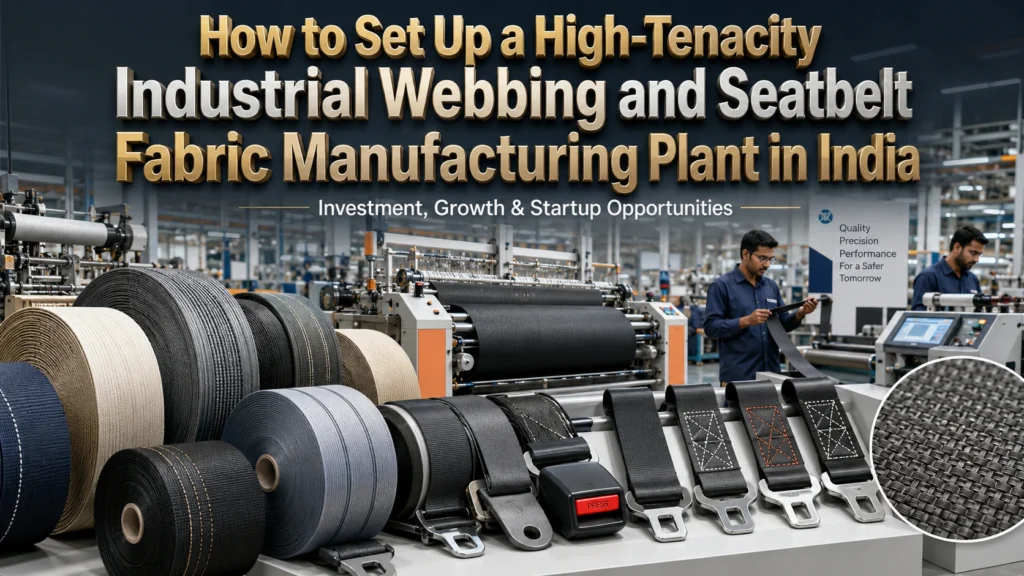

High-Tenacity Industrial Webbing Manufacturing Plant
On Indian roads more than 15 crore vehicles use seatbelts manufactured from high-tenacity webbing each year. Then there are the thousands of tonnes in industrial lifting slings, para drop gear for the Indian Army, container lashing belts and adventure sports harnesses – and that’s a market that most people walk past day in and day out without even recognising it. India imports about 35-40% of its high-performance technical textile webbing requirements, mostly from China, Taiwan and South Korea. The cost of imports is in the hundreds of crore rupees every year.
That the India deficit is not because of a failure of policy is not a claim to be taken for granted. It is a call that is open to you.
One of the most unglamorous but most-profitable segments in the Indian technical textile industry is the high-tenacity industrial webbing and seatbelt fabric. No consumer brand name to build and no retail distribution headaches. You’re selling to automotive OEMs, defense procurement firms, cargo logistics firms, and safety equipment manufacturers, all of whom sign annual purchase agreements and pay promptly, and who demand quality above all else.
So, if you are thinking of starting a manufacturing business with a defensible customer base, low advertising costs and domestic demand that is growing with the growth of the auto sector and Indian infrastructure then this is the article you should read.
Get Detailed Insights from This Book: The Complete Technology Book on Textile
India’s Import Dependency: A Supply Gap Worth Hundreds of Crore
The data released by the Ministry of Textiles puts the value of India’s technical textiles industry at INR 2.19 lakh crore, and this is projected to grow to INR 4 lakh crore in the near future. In this, one of the most im-port-dependent segments is the industrial webbing and belting.
The use of seat belts in the passenger vehicle sector alone exceeds 8,000 tonnes of webbing annually. As per reports from Society of Indian Automobile Manufacturers (SIAM), homegrown passenger vehicle production has hit the 40 lakh mark per year, which is on the back of consistent demand, with the requirement of fitting seatbelts on all seating positions under AIS-072 norms. There are also commercial vehicles, two-wheelers with lap belts and bus retrofitting which contribute to the volume.
Another under-served pocket is defence procurement. High tenacity webbing is required by Indian Army, Air Force and Para Military for load-bearing equipment, para-descent equipment, vehicle towing strap and rifle sling. The DRDO has been alerting on dependency on imports in the field of technical textiles on several occasions. Domestic manufacturers that are certified by BIS and have the military grade testing clearance enjoy a captive market where there is hardly any room for price negotiation.
The current capacity of webbing production in India is largely in Karnataka, Tamil Nadu and Gujarat, but these produce less than 65% of the national demand. States such as Rajasthan, Uttar Pradesh and Maharashtra have a high proportion of downstream consumption (automotive, construction, agriculture) with little or no upstream webbing manufacturing. That is the opening.
Industrial clusters with highest demand concentration and those requiring urgent supply of locally-sourced webbing are mapped against state-wise demand concentration in the table below.
Table 1: State-wise Industrial Webbing Demand and Key Clusters
| State / Region | Key Application | Major Industrial Cluster | Estimated Annual Demand (MT) |
| Maharashtra | Automotive seatbelts, cargo straps | Pune, Nashik, Aurangabad | 18,000–22,000 MT |
| Tamil Nadu | Auto ancillary, defence webbing | Chennai, Coimbatore, Hosur | 14,000–17,000 MT |
| Gujarat | Industrial lifting, marine | Surat, Ahmedabad, Vadodara | 12,000–15,000 MT |
| Haryana / Delhi NCR | Seatbelts, safety harness | Faridabad, Gurugram, Manesar | 10,000–13,000 MT |
| Rajasthan | Military, para-drop webbing | Jaipur, Jodhpur | 6,000–8,000 MT |
| Uttar Pradesh | Cargo securing, agriculture | Kanpur, Agra, Noida | 5,500–7,000 MT |
Source: SIAM Annual Report, Ministry of Textiles Technical Textiles Mission, DRDO procurement data. MT = Metric Tonnes.
Why Entry Now Makes Commercial Sense
The launch of the National Technical Textiles Mission (NTTM) has come with a budget of INR 1,480 crore which is the biggest structural push India has given in this sector. Industrial webbing, geotextiles and safety belts are specific categories mentioned in the mission. The Production Linked Incentive (PLI) scheme offers 15% incentive on incremental sales for technical textiles in the first two years, followed by 11% and 3% respectively in the subsequent years.
There are three macro factors that are all driving demand up.
First: India’s vehicle production is on the rise steadily. At a minimum, 4–7 metres of seatbelt webbing is needed for every new vehicle. The market for seatbelt webbing is expanding with the introduction of new seatbelt in certain commercial categories under the new crashworthiness rules and as EV makers such as Tata, Mahindra and Ola Electric increase their production.
Secondly, the BIS mandatory certification order for personal protective equipment now extends to industrial safety harnesses, climbing slings and fall arrest systems – all of which are based on high-tenacity webbing as the principle structuring material. This compulsory certification system effectively bans imports that are not certified and provides the domestic manufacturers with a quality threshold for the imported products.
Third: India’s exports of readymade garments, cargo and industrial goods all go through container shipping. The lashing straps used in containers and cargo securing webbing, which are fully composed of high-tenacity polyester or nylon, are being used in huge numbers at all the major ports—JNPT, Mundra, Chennai and Vizag.
PMEGP (Prime Minister’s Employment Generation Programme): This provides capital subsidy of up to 35% for new manufacturing units in rural areas. The credit guarantee provided by CGTMSE is up to INR 5 crore, which is collateral-free and is offered to the initial borrowers of the MSME. Subvention on machinery loans is given under TUFS (Technology Upgradation Fund Scheme) at 4-6%. All the above are unlocked after a 10-minute Udyam Registration in the MSME Ministry.
Get Detailed Project Report (DPR): Technical Textiles: Agrotech to Sportech Projects
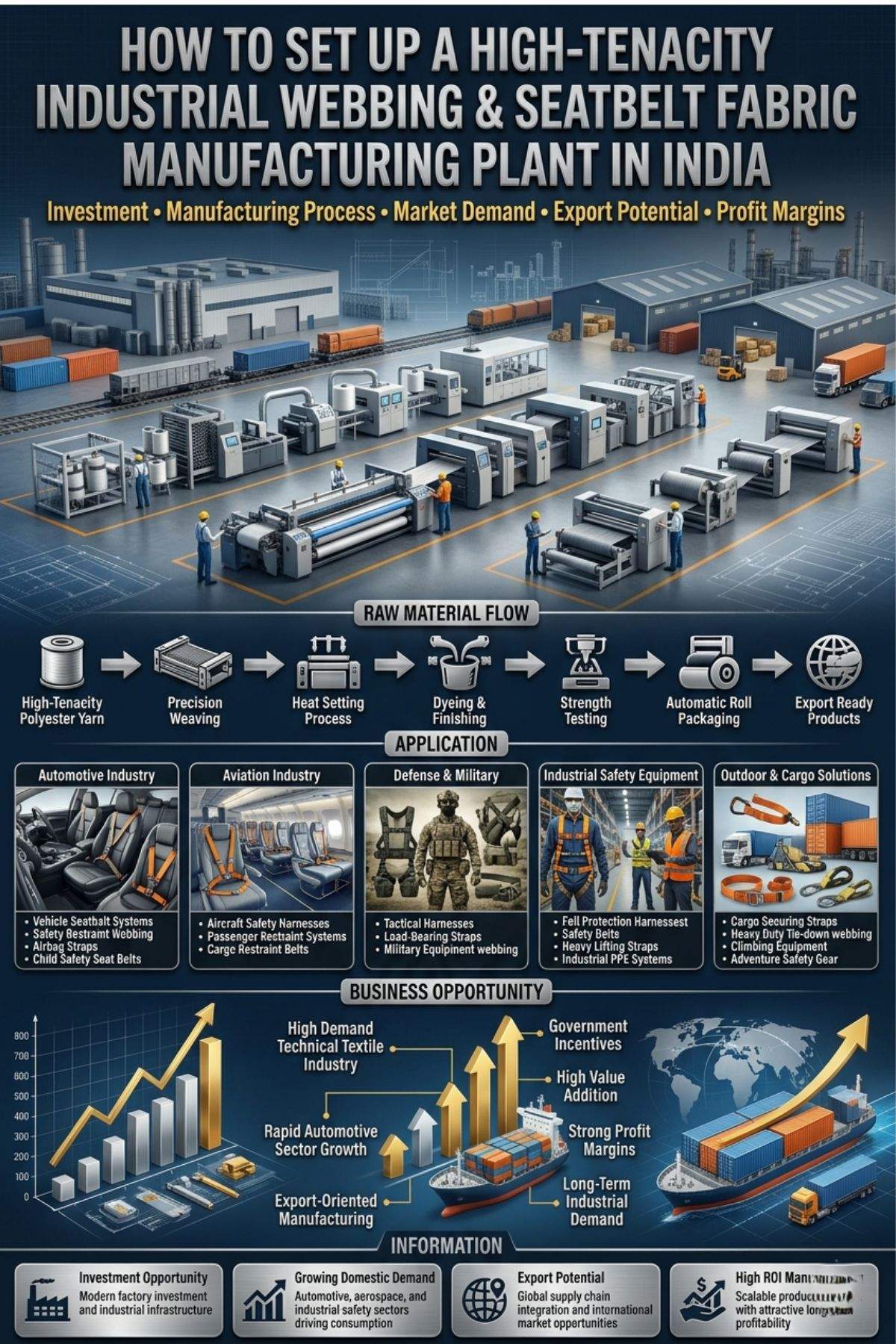
How to Set Up: A Step-by-Step Blueprint
Investment and Space
The total investment required in the small-scale entry (8-10 high speed needle loom machines, 400-600kg of webbing per day) is in the range of INR 1.1 crore to 1.65 crore. For a medium scale operation (1000-1500kg/day) the investment varies from INR 2.7 crore to INR 3.8 crore. Land or shed requirement is 5,000 to 8,000 sq. ft for a small unit; 12,000 to 18,000 sq. ft for a medium operation. An industrial shed in leased state GIDC/SIDCO estate is available at INR 12-25 per sq. ft per month, thus saving from the burden of purchasing land.
Core Machinery
Production backbone is the narrow-fabric needle loom, which is used to weave high-tenacity yarn into flat webbing of specified widths (most common are 25mm, 38mm, 50mm and 75mm). Suppliers include Müller (Germany), Bonas (Belgium) and Indian manufacturers such as Rabatex Industries (Surat) and Cimmco International (Ahmedabad). The price of a single high-speed needle loom with electronic let-off and take-up mechanism is INR 8-14 lakh ex-factory. A complete production line with dyeing and finishing support requires 8-12 machines.
Supporting equipment: warping machines, bobbin winders, yarn tension control unit, heat setting oven (crucial for dimensional stability), and dyeing jigger. Avoid missing out on in-house testing lab — customers such as automotive OEMs and defence agencies need a test certificate with each lot. Minimal testing machine: Universal tensile testing machine (INR 3–5 lakh); UV ageing chamber and elongation tester.
Raw Material Sourcing
The main raw material is high-tenacity polyester (HT polyester) yarn or nylon 6/6 yarn. Reliance Industries (Hazira, Gujarat), SRF Limited and Indo Rama Synthetics (Nagpur) are the top three producers in India. You can also get from Indorama Ventures’ Indian arm. HT polyester yarn comes in a price range of INR 95 to 140 per kg, where the denier range is from 1000D to 2800D, which is standard for webbing. Nylon 6/6 yarn is an expensive military and aerospace webbing material, with a price range of INR 200 – 280 per kg. Normally, the minimum order quantity of domestic mills is 500 kg per denier variant.
Licences and Approvals
You will require Udyam Registration (MSME, free), Factory Licence from state Labour Department, GST Registration (mandatory), Trade Licence from local municipal authority, Environmental Clearance / Consent to Operate from State Pollution Control Board (this industry is in Green/Orange category which is relatively easy) and BIS certification under IS 1370 (industrial webbing) or IS 14223 (vehicle seatbelt assemblies) if you’ll be supplying to automotive OEMs or defence. Lab Test and Minimum 3-months factory audit process are required for BIS certification.
If you are a defence supply company, you need to be registered as a vendor by DGQA (Directorate General of Quality Assurance). The application process is a 6–12-month duration, followed by a predictable tender every year for a captive buyer.
Timeline and Team
Time to first production (set up): 9-14 months. This includes the preparation of the sheds (2-3 months), procurement and installation of machinery (3-4 months) and the process to apply for BIS (3-5 months, which can be done concurrently) along with the trial run and quality testing (1-2 months). Plan for a team of 22-30: 2 production supervisors, 1 quality control technician, 10-14 machine operators, 4-6 helpers to work with materials, 2 maintenance people, 1 account executive and 2 people in sales.
Table 2: Project Investment Breakdown — Small Scale vs Medium Scale Unit
| Cost Head | Small Scale (INR Lakhs) | Medium Scale (INR Lakhs) |
| Land & Civil Construction (leased or owned) | 15–25 | 40–60 |
| High-Speed Needle Loom Machines (8–12 units) | 40–55 | 90–120 |
| Warping, Beaming & Yarn Winding Equipment | 10–15 | 25–35 |
| Dyeing, Finishing & Heat-Setting Unit | 12–18 | 30–45 |
| Testing Lab (Tensile, Elongation, UV Testing) | 5–8 | 12–18 |
| Working Capital (3 months raw material + wages) | 20–30 | 50–70 |
| Contingency & Misc. (8%) | 8–12 | 20–28 |
| TOTAL CAPITAL INVESTMENT | INR 110–163 Lakhs | INR 267–376 Lakhs |
Source: NPCS project cost benchmarks, machinery supplier quotations, SIDCO/GIDC industrial estate lease rates (current).
Financial Snapshot: What the Numbers Actually Look Like
In the small-scale case of 10 needle with an annual output of 125 MT (250 working days per year):
- Capital Expenditure: INR 1.2-1.6 crore (all in plus working capital)
- Monthly Operating Cost: INR 18-24 Lakhs (yarn, wages, power, maintenance, packaging)
- At 60% Capacity: INR 1.8-2.2 crore per Year (webbing is sold at INR 240-380 per kg ex-factory as per specification)
- Revenue at 100% Capacity: INR 3.0–3.8 crore per year
- Gross Margin: 32 – 38% (webbing is used in large quantity; gross margin is limited by the price of HT yarns)
- Total Net Margin: 10-14% (before all expenses but for depreciation, interest at 11%, and wages)
- Payback Period: 5-4.5 years with 80% capacity utilisation.
OEM supplies 20-30% premium over open market webbing; Defence supplies 30-40% premium over OEM. A unit that gets just two big OEM accounts can recoup its investment in less than 3 years. The crucial variable is raw material cost: HT polyester yarn costs are volatile due to the variation of crude oil prices and it is a normally practised industry standard to maintain the buffer of four and half month’s stock in the yarns.
Turn your budget into a successful business plan
Table 3: Government Schemes for Webbing / Technical Textile Manufacturing Units
| Scheme Name | Nodal Ministry / Body | Key Benefit for Webbing Unit | Max Subsidy / Credit |
| PMEGP (PM Employment Generation Programme) | KVIC / MSME Ministry | Capital subsidy for new manufacturing units in rural/urban areas | Up to 35% of project cost (rural) |
| CGTMSE (Credit Guarantee Scheme) | SIDBI / MSME Ministry | Collateral-free credit up to INR 5 Crore for eligible MSMEs | 85% credit guarantee |
| MUDRA Loan – Tarun Category | MUDRA / PSU Banks | Working capital + term loan for small textile manufacturers | Up to INR 10 Lakhs (Tarun) |
| PLI Scheme – Technical Textiles | Ministry of Textiles | Production-linked incentive of 3–15% on incremental sales over 5 years | INR 1,480 Cr total outlay |
| TUFS (Technology Upgradation Fund Scheme) | Ministry of Textiles | Interest subsidy of 4–6% on term loans for machinery upgradation | 4–6% interest subvention |
| SFURTI (Cluster Development) | MSME Ministry | Infrastructure support for textile MSME clusters | Up to INR 10 Crore per cluster |
Sources: KVIC, SIDBI, Ministry of Textiles, Ministry of MSME — scheme terms as currently published.
Entrepreneur Spotlight
Ramesh Patel, Surat, Gujarat — Annual Turnover: ~INR 8 Crore
Ramesh initiated a six-loom webbing unit at Pandesara GIDC, Surat to provide lashing straps to freight forwarders at JNPT. During his first year he worked on making yarns the right tension — a slight difference led to getting rejected by a shipping client. He was already bringing 3 tonnes per month and was BIS certified by year three and was supplying to a Pune-based automotive parts maker. His main rule: “Don’t start to diversify product widths until you get the one right. Begin at 50mm cargo webbing and move to no defect supply, then, 38mm seatbelt grade. He has 38 employees working in his unit today, which runs three shifts.
Expert Project Guidance: NIIR Project Consultancy Services (NPCS)
Many aspects of setting up a technical textile manufacturing unit involve knowledge of BIS standards, machinery specification, raw material grades, plant layout and structuring of finances, all of which requires expertise in the field that most founders don’t necessarily have in-house. NIIR Project Consultancy Services at niir.org, have been serving and assisting the industrial investors and MSME / Entrepreneurs with Detailed Project Report, techno-economic feasibility study and plant layout design for more than four decades. Their reports include information on the industrial webbing unit, technical textile unit and the selection of machinery, capacity planning, regulatory compliance and financial projections for the Indian market. NPCS backed sector analysis and business setup guide for manufacturing entrepreneurs is regularly published by Entrepreneur India (entrepreneurindia.co) in India.
Related Article: Top 10 Most Successful Businesses to Start
What You Should Do in the Next 30 Days
The production of automobiles in India won’t be slowing. The spending on defence modernization will not get reversed. The shipments through the Indian ports of call will not decrease in container shipping. All of these are committed customers of high-tenacity webbing and they are putting greater demand on the domestic supply chain than Indian manufacturers are providing.
No need to be a textile engineer to go in this line of business. Capital of Rs.1 to 4 crores, a rented out industrial sheds in a state with automotive or logistics activities, BIS certification is a must have and spend 6 months establishing a network of suppliers with 2 to 3 OEM’s before going after clients from the open market.
The one thing to do now: get a Detailed Project Report done for your desired state and product width. A DPR will provide you with plant layout options, accurate estimates of costs of machinery, contacts of the suppliers of raw materials and a financial model based on real, up-to-date figures. You can’t walk in to a discussion with an OEM or a bank with no credible report; you will end up just begging. Walk in to it with a DPR and you can close with no problem. For sectors specific information, please contact NPCS at www.niir.org or check Entrepreneurindia.co. The chances are here, the calculation is possible and the market exists.
Frequently Asked Questions
Q1. How much is the minimum investment required to set up a webbing manufacturing unit in India?
A total capital investment of INR 1.1 crore-INR 1.65 crore is needed for an efficient small-scale unit of 8-10 needle looms (includes machinery, civil work and working capital for 3 months). Medium scale units will cost between INR 2.7 crore-INR 3.8 crore. Purchasing a plot of land and constructing a shed can be replaced with leasing of industrial shed in a state GIDC/SIDCO estate to save capital.
Q2. What licenses/certificates are essential to start supplying to automotive OEM’s?
Essential are: Udyam Registration, GST registration, factory license and BIS certification for seatbelt grade webbing as per IS 14223. Automotive OEMs will not issue a purchase order without a validBIS certificate and an in-house testing facility/ capability. This certification will take around 3-5 months as laboratory testing will be carried out at an NABL accredited lab.
Q3. From where can I obtain High-tenacity polyester yarn from within India?
Leading domestic suppliers include Reliance Industries (Hazira, Gujarat), SRF Limited (Manali, Tamil Nadu), Indo Rama Synthetics (Nagpur, Maharashtra) and the Indian subsidiary of Indorama Ventures. The HT polyester yarn from 1000 D-2800 D can be acquired for Rs 95-140 per kg from suppliers within the country. For nylon 6/6 yarn contact Nilit India and the dealer network for Invista.
Q4. What is a reasonable profit margin in this business?
The business has gross profit margins of around 32%-38% (varies by yarn cost and product mix), and at full capacity utilization net profit margin is 18%-24% (after considering depreciation, interest and wages). Providing webbing for defense use and to OEM’s can generate 20%-30% premium price over open market webbing. The client-mix becomes the most important aspect of profitability.
Q5. What government support is available for this type of unit?
PMEGP offers capital subsidies up to 35% of project cost for rural locations. CGTMSE provides collateral-free credit guarantees up to INR 5 crore. The PLI Scheme for Technical Textiles gives 3–15% incentive on incremental sales. TUFS offers interest subvention of 4–6% on machinery loans. All these are accessible post Udyam Registration. Visit www.dcmsme.gov.in and www.sidbi.in for updated eligibility criteria and application portals.
Q6. Can NPCS prepare the plant design and financial projections for a webbing unit?
Yes, NIIR Project Consultancy Services (NPCS) can prepare comprehensive Detailed Project Reports (DPR) for an industrial webbing or technical textile unit, including the plant layout and the details of machinery required along with cost of raw materials, financial model, market analysis and the required permits and licenses. Such reports can be presented to banks for loan application or PMEGP scheme applications. Visit www.niir.org or contact through entrepreneurindia.co.
Data Sources and References
- Ministry of Textiles, Government of India — National Technical Textiles Mission
- Society of Indian Automobile Manufacturers (SIAM) — Annual Reports
- Bureau of Indian Standards (BIS) — Certification Schemes IS 1370 / IS 14223
- Defence Research and Development Organisation (DRDO) — Technical Textiles
- SIDBI (Small Industries Development Bank of India) — CGTMSE and MUDRA Schemes
- DC-MSME, Ministry of MSME — PMEGP, SFURTI Scheme Details