
TReDS invoice discounting for MSME Without Collateral
This is a phenomenon that all manufacturers are familiar with. Once you’ve sold the product, you send the invoice, and then wait. Forty-five days. Sixty days. Ninety. In the meanwhile, salaries, electric bills, and raw material payments continue undisturbed. In most MSMEs, the problem is not the demand issue, it is working capital shortage. If you are thinking of starting a business in manufacturing or supply, you may have heard this more than once: It is not too difficult, or even impossible, to cash up unpaid receivables. Nowadays, it is a fact of regulation with the RBI’s back.
Consider the numbers. One of the three RBI-licensed TReDS, RXIL has been facilitating discounting of more than 88.5 lakh invoices through a completely digital platform. Consequently, the registrations of MSMEs on TReDS platforms have increased. Meanwhile, the level of MSME loans in the banking sector is falling short of the five-year benchmark at around 1.8% of the total credit while the overall credit sector has crossed Rs. 35 lakh crores. Lenders are more comfortable with MSMEs than ever before and the back-end processes to convert unpaid invoices to same-week cash have evolved into a viable, viable, and widely available system.
The Working Capital Gap: Why Receivables Trap Small Businesses
The combined value of all MSMEs’ receivables is a huge pool of money stuck in their inventories from large corporate and government buyers. The issue is the structure. Long payment cycles are the norm for large buyers. Smaller suppliers are less likely to be able to bargain. The classic answers — a mortgage on the property or postponing payment — either require the property as security that the entrepreneur may not have, or they slowly eat away at the profit margin – the entrepreneur is forced to resort to emergency loans with steep interest rates.
This imbalance in the structure has been recognised by the Ministry of MSME as well, which has released a notification to ensure that buyers with turnover exceeding Rs. 500 crores have to be uploaded on TReDS platforms. The RBI took the initiative to implement the Trade Receivables Discounting System (TReDS) just to stop this cycle. It enables an MSME to sell the approved invoice to other interested banks and get the amount paid to it within days, without having to take the credit risk on its books.
Get Detailed Project Report (DPR): Business Ideas with High Investment (₹65 Crore+) Project Profiles
How TReDS Actually Works: A Step-by-Step Business Overview
This is easy to do. If you know it, you know the efficiency difference.
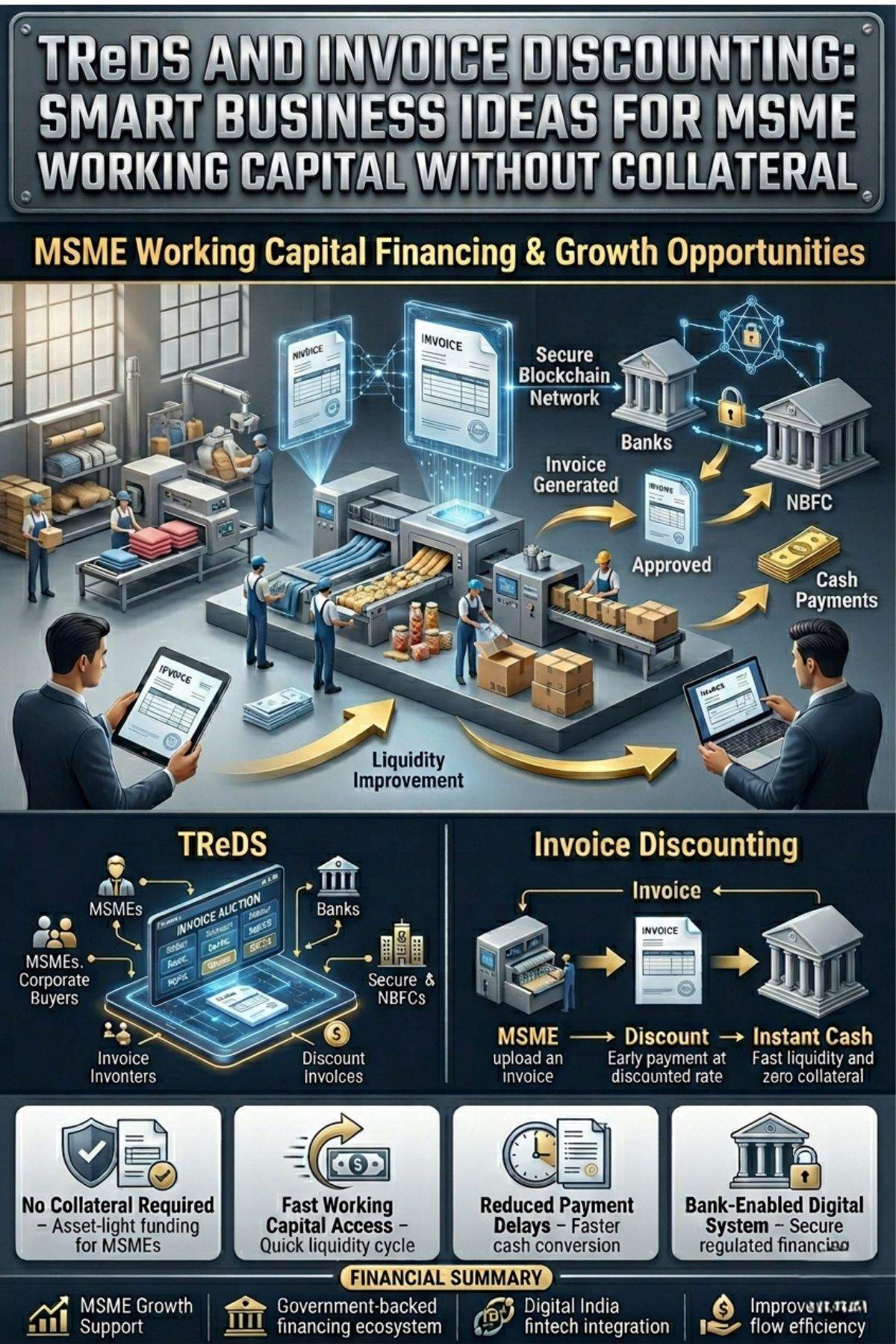
- Step 1 — Registration: All three actors (MSME seller, corporate buyer and financiers/banks or NBFC factors) register on an RBI-approved TReDS platform. There are three licensed operators (RXIL, M1xchange and Invoicemart).
- Step 2 — Invoice Upload: Once goods/services are delivered the MSME uploads the invoice digitally. The buyer then takes it on the platform, which becomes a ‘factoring unit’.
- Step 3 — Competitive Auction: Several financial institutions bid to provide a discount on the accepted invoice. Financiers are competitive, which is why the interest rate is normally lower than the typical working capital loan interest rate. The seller has the ability to determine the price.
- Step 4 – Payout: When the bid is accepted, the winning financier deposits the money into the MSME’s bank account, typically within 24-72 hours. No security is taken. No paperwork trail — just digital confirmation.
- Step 5 — Settlement: On the due date, the buyer pays the financier directly. In the standard ‘without recourse’ factoring structure, the credit risk of the buyer rests entirely with the financier — not the MSME.
The final one is really important. MSME gets prior payment and is not liable to the buyer if delay or default occurs. This is a complete reversal of the normal lending process.
TReDS vs. Traditional Working Capital: An Honest Comparison
In the beginning, many MSME owners compare TReDS discounting with their existing bank overdraft/cash credit facility. The difference is clear in the table below:
| Parameter | TReDS Invoice Discounting | Bank OD / CC Limit |
| Collateral | None — invoice is the asset | Property or FD usually required |
| Speed of Cash | 24–72 hours after acceptance | Weeks for sanction; drawal limits apply |
| Pricing Basis | Linked to buyer’s credit rating | Linked to MSME’s own rating |
| Balance Sheet Impact | Off-book in without-recourse factoring | Adds to borrowings on books |
| Paperwork | Fully digital, one-time KYC | Annual renewal documentation |
| Best For | Receivables from rated corporate or PSU buyers | General operational float |
Who Should Register: Eligibility and the Business Sweet Spot
Eligible for any Udyam registered MSME who sells to corporates/PSUs/ Government departments. Your big customers may well be on these platforms anyway, as buyers over the turnover threshold are already required to be on these platforms by law.
The areas with the greatest acceptance rates and competition for the best discounts are:
- Automotive original equipment manufacturers (OEMs) and Tier 1 suppliers and Tier 2 suppliers
- FMCG distributors, retail chains and major FMCG companies
- A railway company, defence PSUs, and power sector utilities
- Small-scale producers of ingredients for the pharmaceutical industry
- Large Construction and Infrastructure rated credit profiles
Importantly, there are no minimums in practice, on the platforms. However, even a small volume supplier benefits! Registration fees are inexpensive—just a small percentage of the interest saved on just one of the paid invoices.
Get Detailed Insights from This Book: 50 Best Home Businesses To Start With Just 50,000
Real Numbers: What Invoice Discounting Actually Costs
It is hard to see the value of any abstract benefit unless there is a tangible monetary component. Let’s use this hypothetical example:
| Parameter | Indicative Value |
| Invoice value | Rs. 10,00,000 |
| Buyer payment terms | 60 days |
| Auction discount rate (indicative) | 8.5% per annum |
| Discount charge for 60 days | Rs. 13,972 (approx.) |
| Cash received within 72 hours | Rs. 9,86,028 (approx.) |
| Saving vs. 14–18% emergency borrowing | Rs. 9,000 – Rs. 16,000 per Rs. 10 lakh |
| Hidden benefit | No collateral blocked; limits stay free for expansion |
Note: Rates vary with the buyer’s credit rating and prevailing market liquidity. Strong buyers — large PSUs, rated multinationals — routinely attract single-digit annualised discount rates on their accepted invoices.
Find high-return business ideas based on your budget & ROI
Beyond TReDS: The Wider Receivables Financing Toolkit
TReDS is one of the most structured, but not exhaustive. Business owners need to be familiar with the entire arsenal of resources that can be used to manage receivables wisely.
- Direct Factoring Agreements: NBFC factors provide direct factoring for the buyers not registered on TReDS. These transactions are regulated by the Factoring Regulation Act, 2011, and have been well-codified.
- GST-Data-Based Cash Flow Lending: There are a number of fintechs which currently provide instant credit products based on the GSTN data as the key underwriting signal. This can be particularly beneficial for smaller B2B invoices that may not be sufficiently large to be included in a formal TReDS auction.
- The MSME Samadhaan delayed payment portal offers a platform to MSMEs to lodge complaints against buyers who are violating the 45-day payment requirement in the MSMED Act. The power of compound interest on delayed payment — a strong legal deterrent.
- Digital B2B Payment Rails: As large-value B2B digital payment infrastructure matures, reconciliation and credit decisions are becoming increasingly automated. This reduces friction in supplier finance and shortens the working capital cycle organically.
These tools provide a multi-layered protection to MSME founders against the receivables trap. Smart operators avail TReDS for the rated corporate invoices, apply factoring to mid-tier buyer and Samadhaan portal as a threat to speed up payments.
Project Feasibility and Working Capital Planning: Where NPCS Adds Value
Having healthy working capital isn’t an event that happens on the day you raise your first invoice. It starts from the project planning phase. Techno-economic studies (TEs) by NIIR Project Consultancy Services (NPCS) have been prepared with long years of experience and more than 8,000 Detailed Project Reports in the manufacturing & industrial sector, which gives a realistic estimate of working capital including receivable cycles, industry norms and payment delays, and optimum credit structures from day one for approval by banks for issuing adequate working capital limits.
If entrepreneurs want to know about business planning and industrial feasibility having a look at www.entrepreneurindia.co, they can access these practical business plan guidelines and sector-specific project reports at www.niir.org.
Related Article: MSME Subsidy Scheme: How to Get 15% Capital Subsidy on Machinery (CLCSS Guide)
Frequently Asked Questions: Business Ideas Around TReDS and Invoice Finance
Q1. Is TReDS a loan? What does the law say?
No. TReDS is not a loan, but the sale of a receivable. Without recourse factoring: If the buyer defaults, the default risk is the responsibility of the financier. This eliminates the debt on the balance sheet of the MSME and also the need to pay back to TReDS. The Act which regulates the transaction is the Factoring Regulation (Amendment) Act, 2021.
Q2. Will my buyer be receptive to my employing TReDS?
No, generally, large buyers with the required turnover do need to be on boarded on TReDS platforms. A lot of people like it because it standardizes the supplier’s payables process, while not causing any issue in the supplier relationship. TReDS also helps the buyer to manage their working capital requirements by providing for a formal extension of working capital period to financier.
Q3. How much does it cost to register and utilize TReDS?
A one-time registration fee and small transaction fee is required. These are normally just a slice of the interest savings that you can get by even with a single discount. Invoices are not charged for if they are uploaded but failed to be auctioned. Registration is digital, and is processed within a few business days.
Q4. May I offer a discount on bills that are due to government department buyers?
Yes. There are multiple platforms called TReDS, on which PSUs are active sellers and some government buyers are active. Such bills are frequently subject to better discounts since the buyer’s credit quality comes from a government. TReDS can prove to be very beneficial for MSMEs who supply to the railways, power companies, defence establishments, or central ministries.
Q5. Does TReDS impact on my credit profile and CIBIL score?
It doesn’t add debt to your books, so there’s no negative impact on leverage ratios or credit scores with without-recourse factoring. Rather, when used properly, disciplined use of TReDS can enhance your banking image. Once cash flows are regular and predictable, lenders are more likely to do more and increase credit limits.
Q6. What about situations where my buyer has yet to sign up for a TReDS platform?
There are two choices you can make right away. It is important to try to get your buyer to register first. It is a requirement that 500-crore turnover do so, and it is possible to formally request the onboarding. Second, check out direct factoring with NBFC factor, where the buyer has to be on the digital platform. As the TReDS process grows, the majority of the large corporate buyers are anticipated to be within the next few years.
Conclusion: Working Capital as a Competitive Advantage
Delayed payments have been the norm in the MSME sector of India for years. This acceptance is no longer required. Now the regulatory framework, the digital platforms and the legal framework are in place to turn approved receivables into immediate cash (with competitive rates, without collateral, and without leveraging your balance sheet).
Knowing about receivables finance is as crucial as production efficiency for business builders whose business concepts involve manufacturing, supply chain or B2B services. Any rupee that gets stuck on an unpaid invoice is a rupee that can’t be used to invest in growth, can’t be used to purchase raw materials at quantity discounts and can’t be used to significantly cut down your reliance on high-cost emergency credit.
TReDS and invoice discounting industry in India is one of the most potential and underestimated instruments for MSMEs today. It’s best to install it before you really need it!