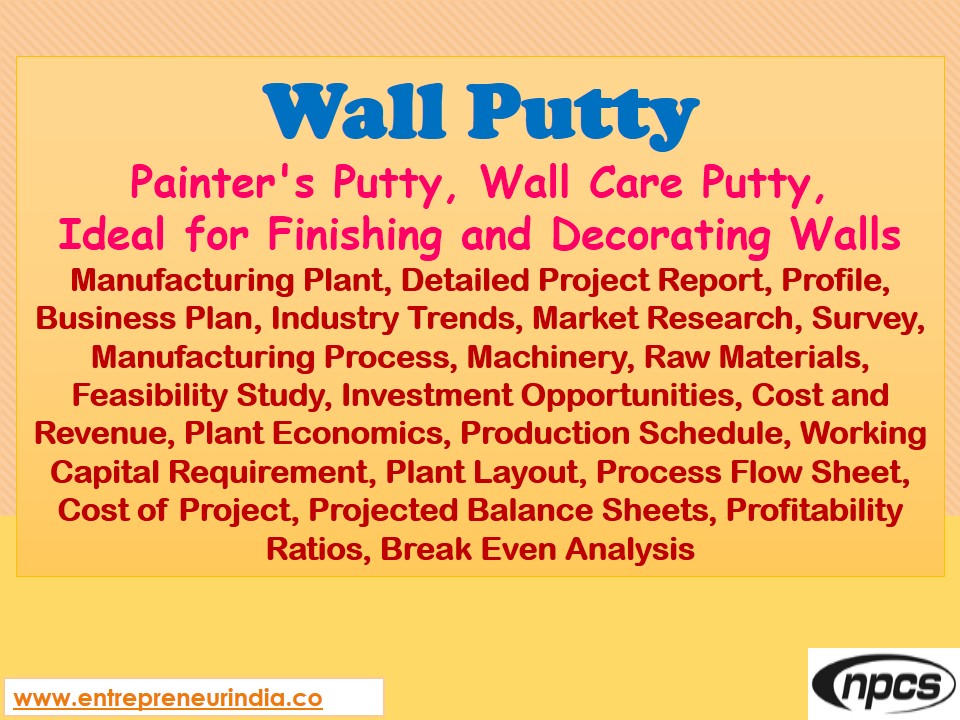
The construction and interior decoration industry continues to grow at a rapid pace, and with it, the demand for wall finishing materials has also surged. Among these, wall putty has emerged as one of the most essential products used for smoothening wall surfaces before painting. This finishing material plays a significant role in ensuring durability, aesthetics, and enhanced paint performance. Entrepreneurs looking for a profitable venture can consider starting a wall putty manufacturing business due to its growing demand in both residential and commercial segments.
Overview of Wall Putty and Its Market Potential
Wall putty is a white cement-based fine powder that forms a smooth base on walls and ceilings before applying paint. It provides an even surface, covers imperfections, and enhances the paint’s life and finish. Due to urbanization, real estate expansion, and infrastructure development, the wall putty manufacturing industry has witnessed consistent growth across emerging economies.
See Also : food processing and agro-based industries
Moreover, as people increasingly prefer high-end wall finishes, the market for wall putty has diversified. From exterior applications to interior designs, the product is widely used. Builders, architects, and individual homebuyers frequently demand this product, which makes it a lucrative manufacturing opportunity.
Composition and Types of Wall Putty
Wall putty generally contains white cement, polymers, and additives that increase adhesion and performance. It is available in two primary forms:
White Cement-Based Putty: Preferred for its strong bonding, smooth finish, and water resistance.
Acrylic-Based Putty: This is used mainly for interior walls and offers a quick-drying feature.
The raw materials are easily available in local markets, making procurement simpler for small and medium-scale businesses. A consistent blend and quality check during the wall putty manufacturing process ensure a high-quality final product.
Manufacturing Process of Wall Putty
The manufacturing process involves several stages, each contributing to the product’s final strength and finish. The following steps are essential in wall putty production:
Raw Material Selection and Weighing
All ingredients such as white cement, dolomite powder, polymers, and binders are measured accurately to ensure consistency.Dry Mixing Process
The raw materials are fed into a ribbon blender or a high-speed mixer. Uniform mixing is critical for product quality.Wet Mixing (If Required)
In some formulations, a wet process is also used to enhance the polymer dispersion.Sieving and Filtration
The mix is passed through sieves to eliminate lumps and obtain a fine texture.Packaging
Once blended, the material is packed in moisture-resistant HDPE or laminated paper bags, generally in 20 kg or 40 kg units.
This process is scalable, and depending on investment capacity, both semi-automatic and fully automatic plant setups are available. Modern plants also incorporate dust collection systems to minimize environmental impact.
Machinery and Equipment Needed
To set up a wall putty manufacturing plant, the following machines are typically required:
Ribbon blender or mixer
Storage silos for raw materials
Weighing scales and conveyors
Automatic or semi-automatic packaging machines
Dust collection and air handling units
The choice of machinery depends on the desired production capacity. For instance, a small-scale unit may begin with 1 to 2 tons per hour, while larger setups can exceed 10 tons per hour.
Raw Materials and Their Sourcing
The major raw materials used in wall putty manufacturing include:
White Cement: Acts as the main binder and gives strength
Dolomite Powder: Adds smoothness and reduces production costs
Redispersible Polymers: Improve adhesion and flexibility
Preservatives and Binders: Enhance shelf life and performance
Methyl Hydroxyethyl Cellulose (MHEC): Provides water retention and workability
These materials are easily available in India and can be sourced from domestic chemical suppliers or cement factories. In fact, many manufacturers establish vendor agreements for consistent supply and pricing benefits.
Setting Up the Manufacturing Unit
Establishing a wall putty plant involves several essential steps:
Location Selection: Choose an area close to raw material sources and construction zones.
Licensing and Registration: Obtain necessary registrations like GST, MSME Udyam, pollution clearance, and factory license.
Infrastructure: Ensure adequate electricity, water supply, and storage space for raw materials and finished products.
Manpower: Employ trained workers for machine operation, quality testing, and packaging.
Quality Control Laboratory: Set up a basic lab to monitor pH, viscosity, setting time, and bonding strength.
By setting up a well-planned facility, consistent production and long-term success can be ensured. Additionally, companies that meet ISO and BIS standards often enjoy greater trust among buyers and contractors.
Marketing and Distribution Strategies
Marketing plays a vital role in the success of any manufacturing business. When it comes to wall putty manufacturing, effective promotion can attract builders, construction companies, and hardware retailers. The following strategies are often used:
Brand Development: Create attractive packaging, logos, and slogans.
Retail Network: Distribute products through hardware shops, paint dealers, and building material suppliers.
Digital Marketing: Use websites, social media, and online directories to generate leads.
Tenders and B2B Sales: Participate in bulk supply tenders for real estate companies and infrastructure projects.
As trust builds with quality and supply consistency, repeat orders and referrals become a major source of sales. Besides, offering product variants such as fast-drying putty or waterproof putty can help tap niche markets.
Financial Considerations and Profit Margins
The investment required for a wall putty manufacturing unit depends on scale and automation. Here’s a rough breakdown:
Small-Scale Unit: ?15–25 lakhs
Medium-Scale Plant: ?40–75 lakhs
Large Plant: ?1 crore and above
Costs include land, machinery, working capital, licenses, marketing, and labor. Despite this, the profit margins remain attractive. On average, manufacturers earn margins between 20% to 35% depending on their cost control and pricing.
When selling in bulk, discounts may apply, but increased volume usually balances the margin. Over time, with brand loyalty and regional dealership networks, the income becomes steady and scalable.
Environmental and Safety Considerations
Although wall putty manufacturing is considered a low-pollution activity, manufacturers must take care of worker safety and air quality. Installing dust collectors, providing safety gear, and using non-toxic ingredients are necessary. Additionally, waste disposal should follow local environmental norms.
Transitioning to eco-friendly variants is another trend many companies are adopting. Formulations using natural binders or recycled materials are slowly gaining popularity due to growing environmental awareness among consumers.
Expansion Opportunities
After stabilizing the core manufacturing operations, expansion into related segments can significantly enhance profits. Some potential areas include:
Decorative Plaster and POP Products
Interior Paints and Primers
Waterproofing Compounds
Tile Adhesives and Grouts
These products often share common raw materials and distribution channels, making diversification easier. With time, entrepreneurs can develop a full-fledged wall finishing solutions brand.
See Also : Fruits and Vegetables
Conclusion
The wall putty manufacturing business presents a highly promising opportunity for entrepreneurs in the construction and building materials sector. With increasing demand driven by real estate growth and aesthetic awareness, the market is expanding rapidly. Starting a unit requires moderate investment, readily available raw materials, and a clear understanding of the production process. When quality and branding are maintained, manufacturers can build a loyal customer base and achieve long-term profitability. Given the rising standards of urban living and home décor, the future of this business remains bright.