
Introduction: Profitable Manufacturing Business Ideas in India
India’s manufacturing sector is in powerful growth stage driven by growth in domestic demand, import substitution, sustainability trends and excellent policy support for MSMEs. For entrepreneurs and 1st generation manufacturers, opportunities today are not necessarily big industrial plants but demand-driven products that address everyday business and consumer problems.
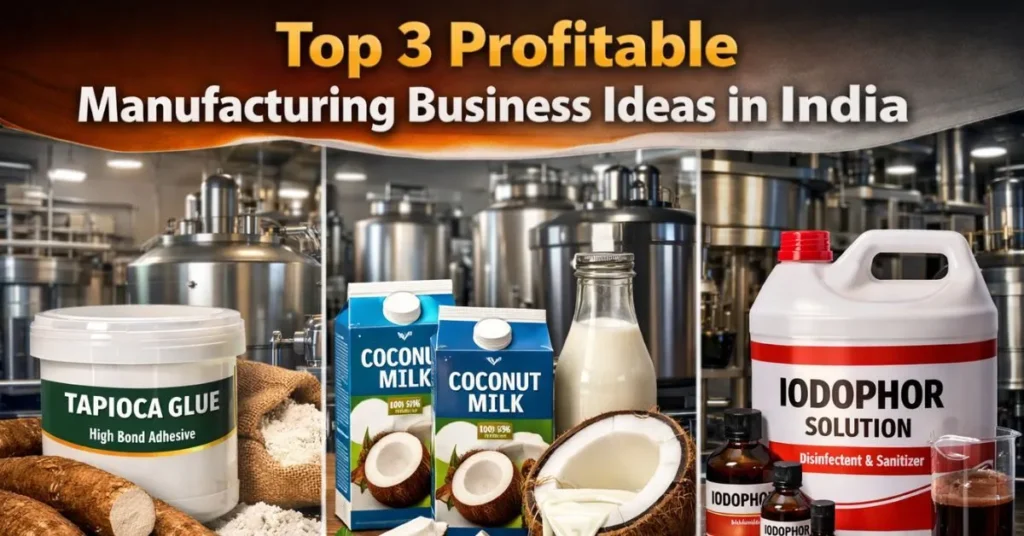
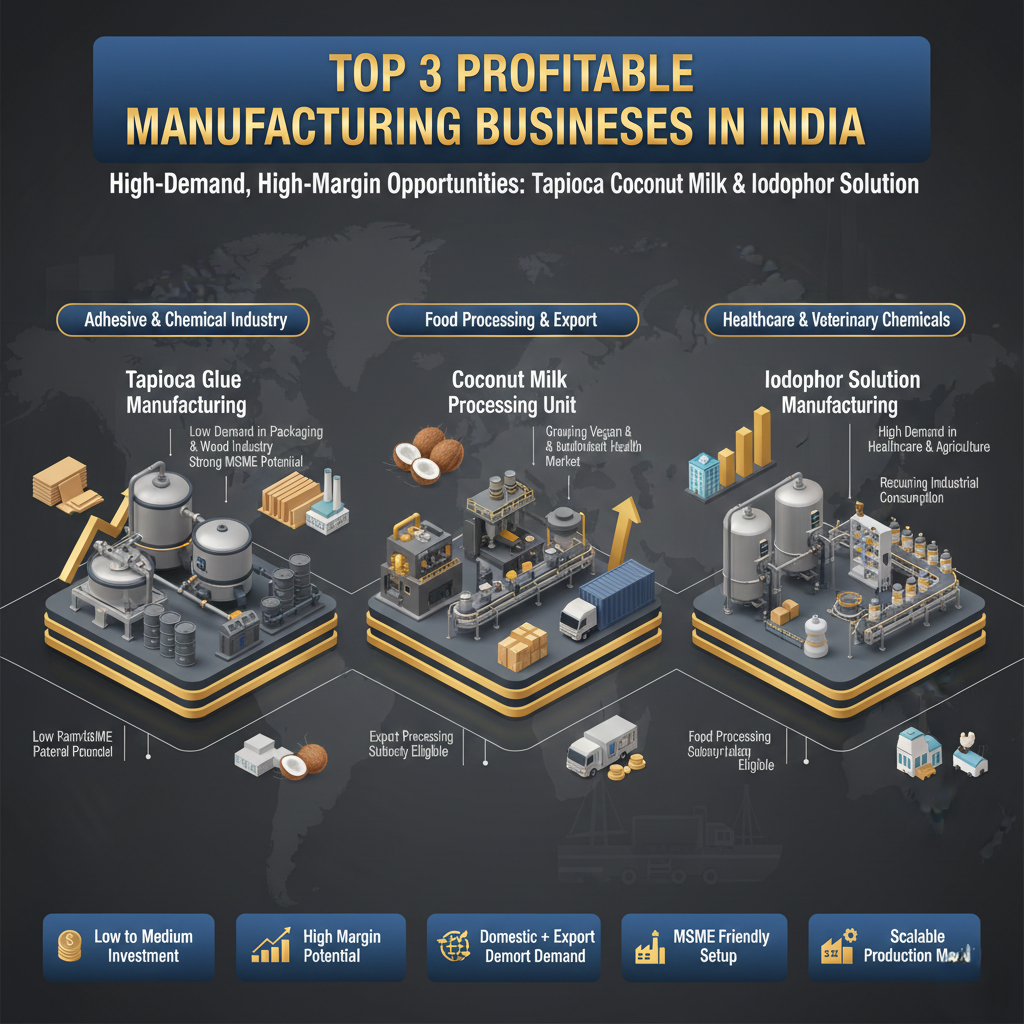
Three manufacturing segments are highlighted for their scalability and fairly manageable investment levels: tapioca starch-based glue, coconut milk processing, and iodophor disinfectant solution. The products represent different industrial clusters which currently experience fast growth because they create eco-friendly adhesives and plant-based food processing products and institutional hygiene chemicals.
The article examines three manufacturing opportunities through its analysis of market potential and manufacturing process and demand drivers and profitability outlook to assist entrepreneurs in making investment decisions.(Profitable Manufacturing Business Ideas in India)
Contents
- 1. 1. Tapioca Starch Glue Manufacturing: A Sustainable Industrial Adhesive Enterprise
- 1.1. Product Overview
- 1.2. Manufacturing Process
- 1.3. Raw Materials and Supply Chain
- 1.4. Market Demand and profitability
- 1.5. Read More: White Phenyl – Manufacturing Plant, Detailed Project Report, Profile, Business Plan, Industry Trends, Market Research, Survey, Manufacturing Process, Machinery, Raw Materials, Feasibility Study, Investment Opportunities, Cost and Revenue, Plant Economics
- 2. 2. Coconut milk processing: A High Growth Food Manufacturing Opportunity
- 3. 3. Iodophor Solution Making: A High Trust Chemical Company
- 4. Key Lessons of Indian Manufacturing Success Stories
- 5. Policy Support for Manufacturing by MSMEs in India
- 6. Conclusion
- 7. Frequently Asked Questions (FAQ)
Read More: The Complete Book on Coconut & Coconut Products (Cultivation and Processing)
1. Tapioca Starch Glue Manufacturing: A Sustainable Industrial Adhesive Enterprise
Product Overview
Tapioca starch glue is a bio-based glue made from cassava starch. It is used extensively in the manufacture of corrugated boxes, paper bonding, bookbinding, textile sizing and plywood lamination. With the industries moving away from petroleum based chemicals, starch adhesives are gaining good acceptance.
The product is valued for its non-toxicity, biodegradability, fast bonding properties and cost advantage over synthetic alternatives. Growing e-Commerce and FMCG packaging demand has seen a big rise in consumption of corrugated boxes – indirectly leading to growth in adhesive demand.(Profitable Manufacturing Business Ideas in India)
Manufacturing Process
The production process is relatively simple and can be done in MSME scale units:
- Gelatinisation of tapioca starch by controlled heating
- Mixing with water and chemical additives
- Addition of preservatives to ensure shelf stability
- Viscosity control & packaging
Typical plant capacity is between 1 and 5 tonnes per day, which enables gradual expansion. Capital investment is medium and energy consumption is not prohibitive.
Raw Materials and Supply Chain
Primary raw material: Tapioca starch (mostly sourced from Tamil Nadu and Andhra Pradesh). Secondary inputs include borax, caustic soda and stabilizers. Maintaining a consistent starch quality is the key to product reliability.(Profitable Manufacturing Business Ideas in India)
Market Demand and profitability
Industries that drive demand are:
- Manufacturers of corrugated packaging
- Notebook and stationery manufacturers
- Textile processing units
- Veins and plywood industries
Bio-based adhesives market is expanding faster than the traditional adhesives and small units often get healthy operating margins due to steady repeat orders.
2. Coconut milk processing: A High Growth Food Manufacturing Opportunity
Product Overview
Coconut milk has gone from being a regional item to an international food item. It is extensively used in ready-to-eat meals, vegan beverages, desserts, sauces and bakery applications. Increasing awareness among people about health and a growing demand for dairy alternatives have fueled great growth in this segment.(Profitable Manufacturing Business Ideas in India)
In India rising urbanization and plant-based dietary trends are increasing the domestic market, whereas export demand is high in Europe, the Middle East and Southeast Asia.
Manufacturing Process
Coconut milk production consists of:
- Dehusking and shell removal
- Extracting and grinding kernel
- Pressing and filtration
- Thermal processing and homogenisation
- Packaging (pasteurised or aseptically)
Units can start small – processing 5,000 to 10,000 coconuts per day – and work up to export grade production.
Raw Material Sourcing
Mature coconuts are largely coming from Kerala, Karnataka and Tamil Nadu. Price fluctuation is a significant issue, dealt with often by forming long-term supplier agreements or partnership with farmers.
Standards of cleanliness, fat content and shelf stability are important, particularly for institutional buyers and the international market.(Profitable Manufacturing Business Ideas in India)
Market Demand, Profitability
Demand segments include:
- FMCG companies operating in curries and ready meals
- Hotels, restaurants, cloud kitchens
- Vegan and health food brands
- Export distributors
In order to increase profitability, manufacturers can use by-products such as coconut oil and coconut residue.
3. Iodophor Solution Making: A High Trust Chemical Company
Product Overview
Iodophor solution is an iodine-based disinfectant that is widely used in dairy farms, food processing plants, breweries, pharmaceutical manufacturing and hospitals. The product delivers comprehensive antibacterial defines while releasing iodine at controlled rates which makes it appropriate for areas that require strict hygiene standards.(Profitable Manufacturing Business Ideas in India)
The food sector and healthcare sector both experience rising demand for institutional disinfectants because sanitation regulations become more stringent.
Manufacturing Process
The process of production involves:
- Dissolving iodine using non-ionic surfactants
- Controlled mixing and stabilisation,
- Dilution with purified water
- Quality Testing and Packaging
The project needs moderate funding yet it requires organizations to follow strict safety measures and complete regulatory obligations.(Profitable Manufacturing Business Ideas in India)
Raw Materials and Operational Factors
The manufacturing process depends on iodine and surfactants and acids and purified water as its main components. The business needs reliable sources of iodine and secure chemical storage facilities to ensure its daily activities run smoothly.
Market Demand and Profitability
Primary demand comes from:
- Dairy and poultry farms
- Food processing industries
- Pharmaceutical manufacturers
- sani pairs to institutional sanitation services
The organization establishes long-term relationships with customers through its continuous institutional order process which generates predictable revenue streams.
Key Lessons of Indian Manufacturing Success Stories
Successful Indian industrialists prove that it is more important to execute with discipline than to expand fast. Entrepreneurs who pay attention to the stability of supply chains, quality control and targeted markets tend to build more resilient businesses.(Profitable Manufacturing Business Ideas in India)
Backward integration into raw materials helps in reducing cost volatility. Export orientation, good compliance systems and consistent product quality create customer trust for the long term – especially within chemical and food manufacturing industries.
Policy Support for Manufacturing by MSMEs in India
Government initiatives for MSME manufacturing include:
- Credit support and collateral free loans
- Technology upgradation schemes
- Industrial cluster development
- Infrastructure and compliance simplification
Entrepreneurs of agro-processing or chemical manufacturing may take advantage of these programs to minimize risk at startup and gain an edge.
Conclusion
Tapioca starch glue, processing of coconut milk and manufacturing of iodophor solution are some examples of practical, scalable opportunities in the changing industrial landscape of India. Each of the products targets a different demand segment – sustainable materials, plant-based foods, and hygiene chemicals – but all have a high growth potential if backed by disciplined operations and strategic planning.(Profitable Manufacturing Business Ideas in India)
For the first-generation entrepreneurs, the most important thing is to begin with a manageable scale with a focus on quality and supply chain control, and to grow slowly according to market demand. Manufacturing ventures need forethought to develop into successful businesses which will generate stable revenue streams while competing in both domestic and international markets.
Frequently Asked Questions (FAQ)
- Which manufacturing business has the lowest startup investment?
Tapioca starch glue manufacturing generally requires lower capital investment compared to food processing or chemical production.
- Is coconut milk manufacturing suitable for export businesses?
Yes. With proper hygiene standards and packaging technology, coconut milk products have strong international demand.
- Do iodophor solution units require special licenses?
Yes. Chemical manufacturing requires compliance with safety, environmental, and industrial regulations.
- Can first-time entrepreneurs start these manufacturing businesses?
Yes, provided they invest in technical knowledge, process discipline, and proper feasibility planning.
- How important is plant location?
Location significantly affects logistics costs, raw material sourcing, and market access, directly influencing profitability.
- What are the biggest risks in these businesses?
Raw material price fluctuations, inconsistent product quality, and lack of market research are common risks.