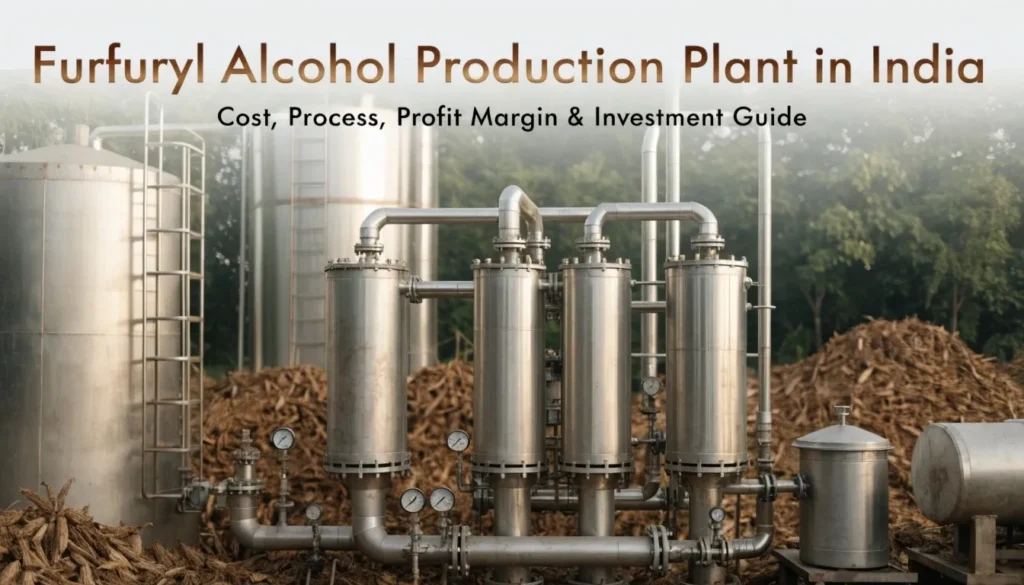

Introduction: Furfuryl Alcohol Production Plant in India
India’s chemical manufacturing industry is growing rapidly, and this is causing new opportunities for entrepreneurs and investors. Among the many specialty chemicals that are drawing attention, Furfuryl Alcohol is a hot topic, as it is a high demand industrial chemical market with a good market potential. It is widely used for foundry casting, construction materials, resins and industrial coating. Despite an increase in demand, domestic production is limited and industries have to rely heavily on imports.
This supply gap provides a good opportunity for MSMEs and new entrepreneurs to set up local manufacturing units. The Furfuryl Alcohol production plant operates as a profitable business through effective execution of its planning activities and raw material procurement and operational processes.
Contents
- 1. What is Furfuryl Alcohol and Why is it Important in
- 2. Market Demand & Growth Potential in India
- 3. Raw Materials Needed in Furfuryl Alcohol Production
- 4. Investment Cost of Establishing a Furfuryl Alcohol Plant
- 5. Profit Margin, and Return on Investment
- 6. Best Places to Establish Furfuryl Alcohol Manufacturing Plant
- 7. Government Subsidies and Financial Aid
- 8. Why Furfuryl Alcohol Manufacturing is a Lucrative Business
- 9. Future Growth and Expansion Opportunities
- 10. Conclusion
- 11. Commonly Asked Questions (FAQs)
Get Detailed Insights from This Book: Handbook On Chemical Industries (Alcohol Based)
What is Furfuryl Alcohol and Why is it Important in
Furfuryl Alcohol is a chemical compound of organic origin obtained from furfural, which is obtained from agricultural waste like sugarcane bagasse and rice husk. India produces huge amounts of by-products of agriculture annually, which makes this country suitable for the manufacturing of this chemical.
The significance of Furfuryl Alcohol is that it can find a wide variety of industrial applications. It is used as a binding agent, solvent and intermediate chemical in several industries. Due to the critical role that it plays in manufacturing processes, industries are dependent on a consistent supply and quality.
Important Uses of Furfuryl Alcohol
- Foundry industry for sand casting Molds
- Corrosion resistant materials construction sector
- Well cementing in the oil and gas industry
- Chemical manufacturing for resins and polymers
- Pharmaceutical and specialty chemical production|
The various uses of the product create continuous market which extends throughout all twelve months of the year.
Get Detailed Project Report (DPR): Alcohol-Based Fuel Gel Manufacturing Plant

Market Demand & Growth Potential in India
India is currently one of the world’s fastest growing industrial economy. The government’s priorities in infrastructure development, domestic manufacturing and export promotion have led to a growing demand for industrial chemicals. The foundry industry alone uses a major part of the Furfuryl Alcohol produced worldwide.
Another critical factor in the demand is the ongoing dependence of India on imports. When domestic manufacturers enter the market they can take advantage of shorter delivery times, lower logistics costs, and the improvement of customer relationships. Companies with good quality are often rewarded with long-term contracts with industrial buyers.
Export opportunities are growing also as many developing countries demand industrial chemicals but do not have adequate capacity for producing them. Indian manufacturers are able to take advantage of cheap production costs and geographical proximity to target international markets.
Raw Materials Needed in Furfuryl Alcohol Production
The availability and cost of raw materials has a direct effect on the profitability of this business. Luckily, the main raw materials Furfuryl Alcohol needs are easily available in India.
Main Raw Materials
- Furfural (from agricultural residues)
- Hydrogen gas
- Catalyst (copper-based)
- Water and utilities
- Packaging materials
India’s strong agricultural base provides a stable supply of raw materials, which helps to ensure stable production and competitive pricing.
Process Of Production Step By Step
- Raw Material Preparation
Furfural is cleaned and purified before it is processed.
- Hydrogenation Reaction
Furfural undergoes hydrogen reaction at specific temperature and pressure conditions through the use of a catalyst.
- Distillation and Purification
The purification process starts with the distillation of crude product which allows for the removal of undesired substances and the creation of pure material.
- Cooling and Storage
The storage tanks contain the chemical material which has undergone purification through a process that requires the substance to be cooled.
- Packaging and Distribution
The ultimate product is packed and delivered to industrial customers.
The maintenance of correct temperature and pressure values together with proper catalyst operation remains essential for sustaining product quality throughout the entire production process.
Investment Cost of Establishing a Furfuryl Alcohol Plant
The investment needed to set up a manufacturing plant depends on the production capacity, location and the choice of technology. A small to medium range plant is usually good for MSME entrepreneurs.
Estimated Project Cost (MSME Scale)
- Land and site development: INR 20 – 40 Lakhs
- Civil construction and building: INR – 60 – 120 Lakhs
- Plant and machinery): INR 150 – 280 Lakhs
- Utilities and effluent treatment: INR 30 – 60 Lakhs
- Pre-operative expenses: INR 15- 25 Lakhs
- Working capital: INR 80 – 140 Lakhs
Total Estimated Investment:
INR 3.5 Crore to INR 6.5 Crore
Entrepreneurs who already have land or infrastructure ownership may cut down on their startup costs considerably.
Profit Margin, and Return on Investment
Furfuryl Alcohol manufacturing can boast some of the best financial returns because they have a steady demand and have the same industrial customers in place again and again. Once the plant is in a steady production, the business will usually have predictable revenue and controllable operating costs.
Estimates of Financial Performance
- Net profit margin: 18% to 24%
- Payback period: 4 to 6 years
- Break-even period: About 3 years
- Potential Revenue per year: INR 8 to 15 Crore
Profitability is enhanced if supply of raw materials is contracted over the long term or if production systems are integrated.
Best Places to Establish Furfuryl Alcohol Manufacturing Plant
Selecting the right location is among the most important decisions of any manufacturing business. The ideal location for a plant should have easy access to raw materials, transportation systems, and utilities.
Appropriate States for Setting up Plants
- Uttar Pradesh
- Maharashtra
- Gujarat
- Punjab
- Haryana
- Tamil Nadu
These states have good agricultural production, industrial base and skilled manpower in that place.
Government Subsidies and Financial Aid
The Government of India offers various financial aid schemes in favor of manufacturing business. These schemes help reduce the cost for starting up and better access to funding.
Major Government Schemes
- PMEGP Scheme – Granted subsidy up to 35% of project cos
- MUDRA Loan – Provides collateral free loans to small businesses
- CGTMSE Scheme – Provides the credit guarantee to bank loans
- State Industrial Subsidies – Includes land and electricity concessions
Taking advantage of these programs can go a long way toward improving project feasibility.
Why Furfuryl Alcohol Manufacturing is a Lucrative Business
There are a number of reasons that make entrepreneurs more and more interested in this industry. The combination of increasing demand, low competition and government support makes it an attractive investment option.
Key Business Advantages
- Increasing demand from manufacturing industries
- Limited domestic competition
- Import substitution opportunity (high scope of import substitution)
- Availability of raw materials in India
- Government incentives for manufacturing
- Stable long-term market demand
The chemical sector provides newcomers with an attractive business environment because it offers multiple advantages.
Future Growth and Expansion Opportunities
After establishing a successful production facility, business owners can develop their operations through new product lines and entry into fresh market territories. Expansion is helpful in increasing of revenue and reducing the dependence on a single product.
Possible Expansion Options
- Furan resin manufacturing
- Integrated production of furfural
- Export oriented Production unit
- Specialty chemical manufacturing
Businesses that offer a wide variety of products often prove to be more profitable and stable in the long run.
Conclusion
Furfuryl Alcohol production is a lucrative and feasible venture for entrepreneurs looking to get into the chemical industry. The business depends on three advantages which include high industrial demand and availability of raw materials and existence of government support programs. The industry requires both strategic planning and technical expertise but its financial benefits will produce substantial results throughout the extended period.
With the right strategy, efficient operations, and consistent product quality, a Furfuryl Alcohol production plant can be a sustainable and high growth manufacturing venture in India.
Commonly Asked Questions (FAQs)
What is the amount of investment need to start Furfuryl Alcohol plant?
The minimum investment generally varies between INR 2.5 crore to INR 5 crore based on the capacity of production and location.
Is Furfuryl Alcohol manufacturing profitable?
Yes. Most plants will have profit margins in the range of 18% to 24% after the initial stabilization period.
How long does it take to begin the production?
The full setup process usually takes 6 to 12 months from the building of the plant to the commercial production operation.
Can this business be started under MSME Registration?
Yes. Furfuryl Alcohol manufacturing comes under the ambit of MSME classification and avails government subsidiaries and financial support.