
Rice Husk Products Business Ideas
Why Rice Husk Is One of India’s Most Undervalued Industrial Raw Materials
The one thing that most business people fail to consider when they start a business based on agricultural waste is that the raw materials are nearly free. Rice husk, the sheathing of paddy is just such an opportunity. India is the second largest rice producer, producing around 12 million tonnes of rice husk as a by-product of the milling process every year. Most of this husk was used as fuel for boiler generation of steam in rice mills until recently, but was accompanied by particulate pollution. What entrepreneurs are finding is that rice husk is not only a fuel, but also a chemical feedstock, construction material, and an industrial input that is much more valuable than its fuel value.
Rice husk is about 20% silica in a highly amorphous and reactive form. Ash from the controlled combustion known as Rice Husk Ash (RHA) is about 85-92% amorphous silica. This silica is used as a raw material in the production of precipitated silica, sodium silicate, activated carbon, cement additives and refractory materials. The business is real and proven and can be done by the MSME entrepreneurs with an understanding of the processing.
Get Detailed Insights from This Book: Manufacture of Value Added Products from Rice Husk (Hull) and Rice Husk Ash (RHA)
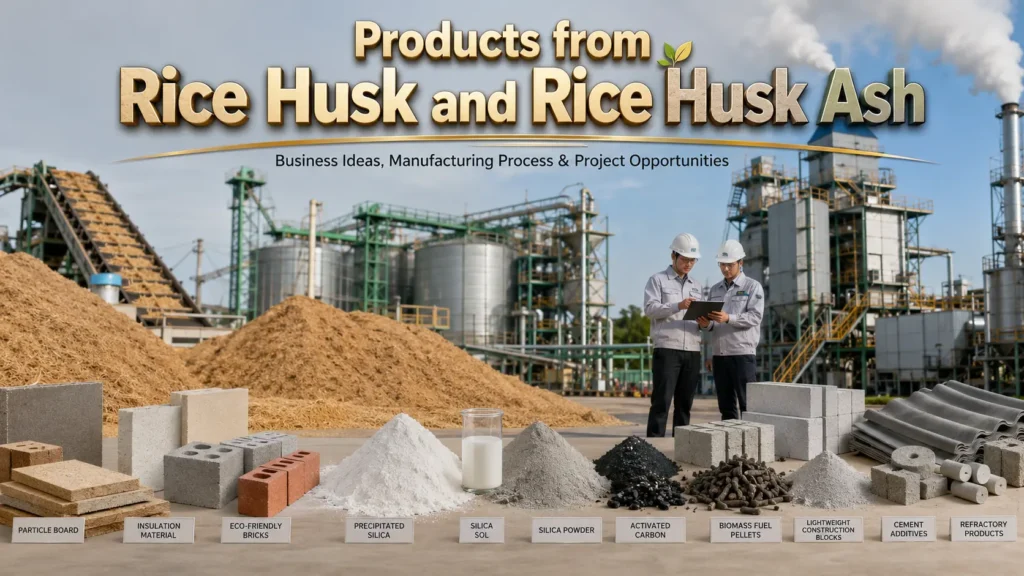
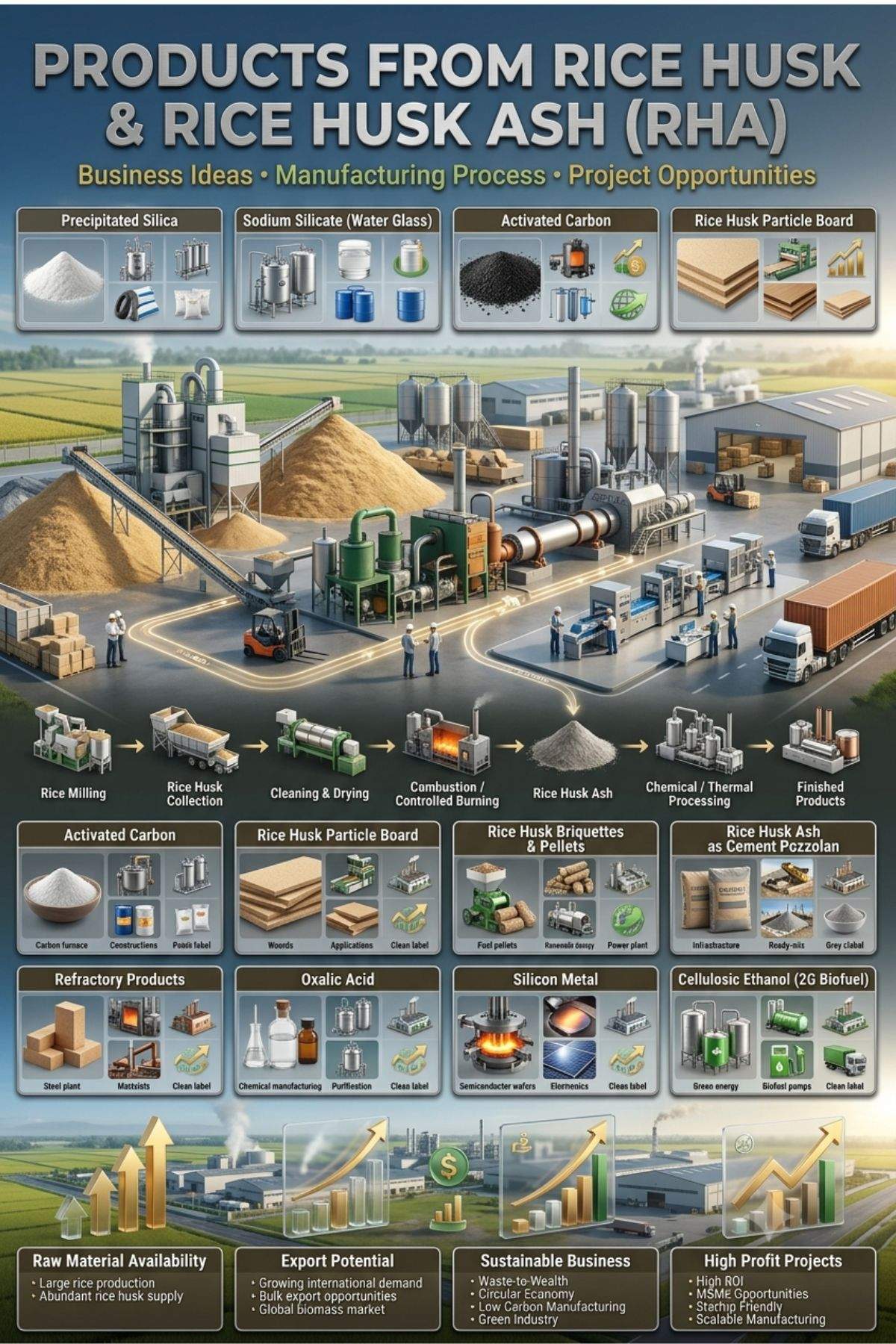
Top 10 Products from Rice Husk and Rice Husk Ash
1. Precipitated Silica
Precipitated silica is produced by reacting RHA with caustic soda to produce sodium silicate solution, and then precipitating silica by acidification with sulphuric acid. The white powder produced is used as a rubber tyre reinforcement, a flow aid in toothpaste, an anti-caking agent in animal feed and a tablet excipient in pharmaceuticals. India is now importing so many materials from China and Germany. The cost of a 5 TPD unit is Rs. The investment requirement for this is about 80 lakh to 150 lakh and has the potential to create Rs. The annual net profit lies in the range of 40-60 lakh at market price of Rs. 35,000–70,000 per tonne depending on grade.
2. Sodium Silicate (Water Glass)
Sodium silicate can be obtained by melting RHA with soda ash at high temperature or by dissolving RHA in caustic soda at high pressure. It is used for making detergents, paper adhesives, foundry core binding, textile processing and water treatment. There is a big domestic market in India. In the case of a 10 TPD plant, the investment costs are: 30–80 lakh. It is easy to process and there is a reliable industrial buyer base for the product.
3. Activated Carbon
Rice husk activated carbon is obtained when the rice husks are carbonised at 500-700°C and then activated with steam or CO₂ at 800-950°C. Surface areas of 800-1200 m2/g are used for water purification, air filtration, decolourisation in pharmaceuticals, food processing and gold recovery. The cost of a 3 TPD unit is around Rs. Investment required is 60 to 120 lakh and the revenues earned are Rs. Depending on application grade between 50000 and 1,50,000 per tonne.
4. Rice Husk Particle Board
Particle board is made from rice husk, Urea Formaldehyde or isocyanate binders and is hot pressed into panels that are used for furniture, partition and low-cost housing. The boards have termite resistance and moisture stability. The cost of a 5,000 m³/year plant is Rs. 1.5–3 crore. Clients are furniture makers, government housing schemes, interior fit out companies etc.
Get Detailed Project Report (DPR): Rice Husk, Rice Hull, Rice Husk Ash (Agricultural Waste) Based Projects
5. Rice Husk Briquettes and Pellets
The biomass fuel of dense quality with calorific value of 3200 – 3600 kcal/kg is produced by compressing the rice husks under high pressure, without using binders. These briquettes are used in industrial boilers of the food processing, textile, ceramic and brick industries as an alternative to coal. Investment: Rs. 25–60 lakh. Renewable energy requirements around the world are increasing, and so are European and South Korean demands on biomass fuel exports.
6. RHA as Cement Pozzolan
The rice husk ash contains a large amount of amorphous silica ash, which has excellent pozzolanic activity, when the rice husk is burned at 600–700°C. RHA can be used as a substitute for 10 – 25% of the Portland cement used in concrete, enhancing durability and reducing carbon footprint. As per contract, RHA is supplied to cement companies at the rate of for 2,000-5,000 per tonne, only investment for collection and quality control is required. It is a low-cost product with 10 to 25 lakh customers and low processing cost.
7. Refractory Products
High-silica RHA used in the refractory bricks and castable for industrial furnace, which has high resistance to temperature above 1,600℃, is suitable for steel ladles, foundry furnaces, ceramic kilns, etc. The niche, higher margin product is well-balanced with an industrial buyer base. The price of a small refractory unit begins at Rs. 50–100 lakh.
8. Oxalic Acid
Rice husk cellulose is treated with alkaline water at high temperature and pressure to produce oxalic acid which is further acidified to produce oxalic acid. Currently it is imported for use in the textile industry, in leather manufacturing and in the synthesis of pharmaceuticals as well as in metal surfaces. The cost of a 2 TPD unit is Rs. 40–80 lakh. RHA is a cost competitive alternative to imported production.
9. Silicon Metal (Advanced Application)
High-temperature carbothermic reduction is being used commercially to provide a source of high purity silicon for electronic and solar cell applications for RHA. India and abroad there are several pilot and commercial plants. This requires a lot of capital (Rs.). The selling price of silicon metal is Rs. 10 lakh – 50 lakhs (10 – 50 crore). The rice husk has the highest value-addition of Rs 1.5–3 lakh per tonne.
Discover business ideas that actually make money
10. Cellulosic Ethanol (2G Biofuel)
Rice husk is rich in cellulose (35-40%) and hemicellulose (25-30%) which can be fermented when enzymatically hydrolysable. The making of ethanol from rice husk is highly subsidised under the National Biofuel Policy and fuel ethanol has ensured the buyers in oil marketing companies under the Ethanol Blending Programme. Investment: Rs. $5 to $20 for significant scale.
Market and Investment Summary
| Product | Investment (Rs.) | Selling Price (per tonne) | Key Market |
| Precipitated Silica | 80–150 lakh | Rs. 35,000–70,000 | Tyres, Pharma, Feed |
| Sodium Silicate | 30–80 lakh | Rs. 8,000–15,000 | Detergents, Adhesives |
| Activated Carbon | 60–120 lakh | Rs. 50,000–1,50,000 | Water Treatment, Food |
| Particle Board | 1.5–3 crore | Rs. 12,000–20,000/m³ | Furniture, Housing |
| Briquettes / Pellets | 25–60 lakh | Rs. 4,000–8,000 | Industrial Boilers, Export |
| RHA Pozzolan | 10–25 lakh | Rs. 2,000–5,000 | Cement Companies |
| Refractory Products | 50–100 lakh | Rs. 30,000–80,000 | Steel, Foundries |
| Oxalic Acid | 40–80 lakh | Rs. 20,000–40,000 | Textiles, Pharma |
Raw Material Sourcing and Location Strategy
Access to raw material is the most important key to the success of a rice husk business. Ideal areas are those that are within 50 km of a rice milling cluster. Major surplus areas of rice husk in India are West Bengal, Uttar Pradesh, Punjab, Andhra Pradesh, Telangana, Chhattisgarh and Odisha. Establishing a plant in the milling cluster significantly cuts the logistics costs and guarantees supply security. A large number of rice millers sell their husk at Rs. 50-150 per tonne or even free of charge, provided that there are regular offtake and reduction of pollution load.
Related Article: Rice Husk Ash Silica Manufacturing in India: Market Demand, Plant Cost & Profit Outlook
Government Policy Support
Various support mechanisms can be provided to the rice husk-based industries. The CGTMSE scheme offered in the Ministry of MSME offers collateral-free loans of up to Rs. Rs. 2 crores for the first-generation entrepreneurs. Cellulosic ethanol is supported by the National Biofuel Policy. Capital subsidy is available for biomass-based power plants with rice husk from the Ministry of New and Renewable Energy (MNRE). Other than this, the State MSME departments in rice surplus states provide extra land, power tariff and capital subsidy for processing units involved in agro-waste.
Frequently Asked Questions (FAQ)
Q1. How much does it take to get into the rice husk industry?
The least expensive products are rice husk briquettes or RHA pozzolan supply from Rs. 10–25 lakh. It is necessary to use precipitated silica and activated carbon for the following. 60–150 lakh. When installing particle board plants, they require the following: 1.5 crore or more.
Q2. There are no buyers for precipitated silica from rice husk available.
The major buyers include tyre manufacturers (MRF, Ceat and Apollo), toothpaste manufacturers (Colgate, HUL), animal feed compounders and pharmaceutical excipient suppliers. The Indian Rubber Manufacturers Research Association (IRMRA) has industry directories that offer buyer contacts.
Q3. Is the quality of rice husk activated carbon comparable to the coconut shell activated carbon?
Rice husk activated carbon is designed with macro-pore structure to be used in liquid-phase application such as decolourisation and heavy metal removal. Coconut shell is often a better source for gas purification. There are markets and different price points for both grades.
Q4. Which pollution control equipment is needed for RHA processing?
Bag filter or ESP dust collection systems are needed for controlled combustion chambers. Emissions limits are as per the CPCB and state pollution control boards. Dust control is crucial and should be planned from the beginning of the project and incorporated into the budget.
Q5. What are the prospects for exporting the rice husk products?
Biomass renewable fuel exports to Germany, South Korea, Japan and UK as briquettes and pellets. Activated carbon exports to Japan and southeast Asia and Middle East. Exports of precipitated silica to regional markets. APEDA and Export Promotion Councils make connections.
Q6. What are the ways how NPCS helps entrepreneurs to enter into rice husk manufacturing?
NPCS provides detailed project reports on the entire manufacturing process, equipment list with vendors, raw material cost estimate, market demand estimates, financial models and profit analysis which are liked by banks, government agencies and private investors.
How NPCS Helps Entrepreneurs Enter This Sector
Niir Project Consultancy Services (NPCS) are professional consultants for Market Survey cum Detailed Techno-Economic Feasibility Reports (DPRs) for Rice Husk (RH) and Rice Husk Ash (RHA) based product manufacturing business. We provide our reports that include details of the entire manufacturing process, market demand analysis, process flow diagram, plant layout, sourcing of raw materials and machinery, and complete financial projections along with profitability analysis.
As an entrepreneur, you can take the term “waste-based manufacturing” to the bank, investors and the government with the technical and financial assistance provided by project reports from NPCS. See our complete library of reports from www.niir.org on waste-based projects.
Key References and Useful Links
- Ministry of MSME — Government of India
- Make in India — Official Portal
- DPIIT — Dept. for Promotion of Industry
- APEDA — Agricultural Export Development
- NPCS — Waste-Based Project Reports
- Ministry of Environment, Forest & Climate
Conclusion: The Business Case for Rice Husk Manufacturing
India produces 12 million tonnes of rice husk annually with the majority of it being burnt as low-grade fuel or wasted. Waste entrepreneurs who are turning this waste into precipitated silica, activated carbon, sodium silicate or particle board are establishing manufacturing enterprises on a raw material which is virtually free and can be found in close proximity to almost all the rice milling clusters in the country. Each of these products has already a well-known and large market and in some cases relies on imported products which are replaceable by domestic products.
Startups that establish relationships with raw material owners and build buyer networks and get regulatory clearance early in the era of waste-based manufacturing have an advantage that is hard to duplicate for latecomers. Most of the waste streams covered here are still in the early stages of the market, and the time to take action on these business opportunities is now.
Key Success Factors for a Rice Husk Manufacturing Business
There are three important factors to consider when running a rice husk business. Firstly, raw material reliability, getting supply contracts from 3-5 rice mills within 50 km with a written contract with formal moisture parameter and tonnage given in monthly quantities. The seasonal nature of milling production must be taken into account for working capital planning. Second, quality control: the purchasers of precipitated silica and activated carbon products set strict requirements on the product parameters, such as iodine value, pH, surface area, and particle size distribution. From the start invest in in-house quality testing equipment, otherwise it is a domino effect getting the batches rejected and the customers are lost. Third, product certification: This will entail meeting FSSAI and WHO-GMP standards for the food and pharmaceutical industries respectively. Incorporating these certifications into the business plan before the plant is built not only saves a lot of time, but a significant amount of customer acquisition cost. Quality infrastructure and certification are investments and when entrepreneurs invest in it, they always succeed where they do not invest in production capacity only, and delay their planning for certification.