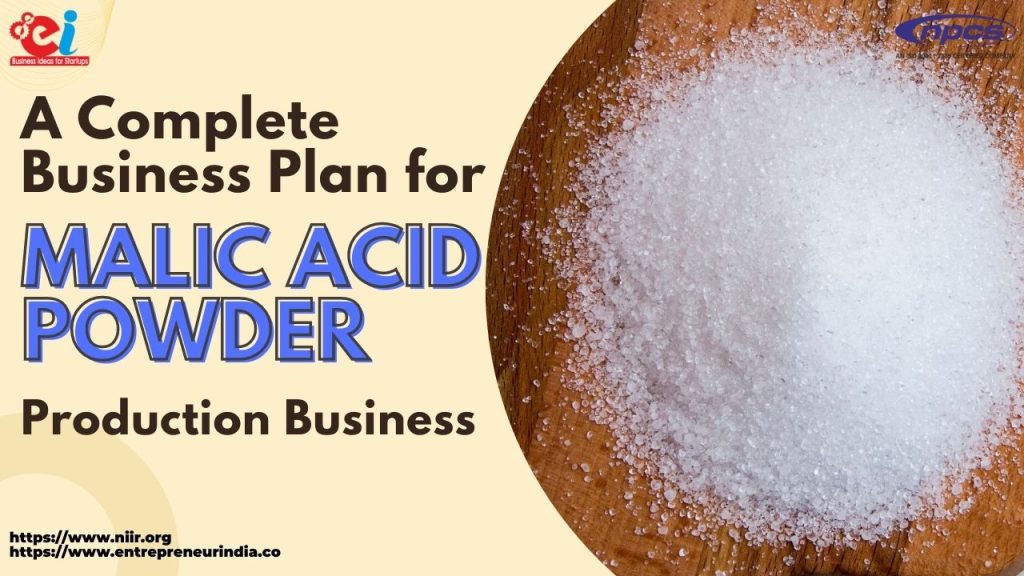

Starting a Malic Acid Powder Production Business can be a highly lucrative opportunity in today’s industrial and food-grade chemical landscape. Malic acid, known for its tart flavor and excellent stabilizing qualities, is widely used across the food & beverage, pharmaceutical, cosmetic, and industrial cleaning sectors. With increasing demand for organic acids and clean-label ingredients, entrepreneurs are looking to tap into this growing niche with efficient production setups and targeted marketing strategies. If you’re looking to enter the world of specialty chemicals with a product that has high market acceptance and scalable potential, malic acid powder is an ideal choice.
Visit this Page for More Information: Start a Business in Chemical Industry Projects
Contents
- 1. Overview of Malic Acid Powder Production Business
- 1.1. What is Malic Acid Powder?
- 1.2. Key Uses and Applications
- 1.3. Raw Materials Required
- 1.4. Production Process
- 1.5. Machinery and Equipment Needed
- 1.6. Factory Setup and Area Required
- 1.7. Investment and Capital Requirements
- 1.8. Licenses and Certifications Needed
- 1.9. Packaging and Branding
- 1.10. Target Market and Distribution Strategy
- 1.11. Profitability and Return on Investment
- 1.12. Challenges and Mitigation Strategies
- 1.13. Future Scope and Sustainability
- 1.14. Final Words
Overview of Malic Acid Powder Production Business
The business of producing malic acid powder revolves around transforming either synthetic or bio-based substrates into a high-purity, fine-grade white crystalline product that meets industry standards for food, cosmetics, or pharmaceutical applications. While chemical synthesis using maleic anhydride is the most common method, biotechnological fermentation has gained momentum due to the rising preference for natural and eco-friendly ingredients.
Business Plan: Start Malic Acid (Powder) Production Business
What is Malic Acid Powder?
Malic acid is a dicarboxylic acid that occurs naturally in apples and other fruits. It plays a key role in the Krebs cycle, supporting energy production in living organisms. In industrial usage, it is appreciated for its acidifying, flavor-enhancing, and stabilizing properties. The powder form is highly soluble in water and easy to blend, making it ideal for precise formulations.
There are two forms of malic acid:
L-Malic Acid (natural): Produced by microbial fermentation and used in high-quality products.
DL-Malic Acid (synthetic): Derived from maleic anhydride and used in technical and food-grade products.
Related Feasibility Study Reports: Chemicals (Organic, Inorganic, Industrial) Projects
Key Uses and Applications
Malic acid powder is versatile and has applications across multiple industries:
Food & Beverage: Acts as a souring agent and flavor enhancer in candies, fruit juices, soft drinks, and bakery products.
Pharmaceuticals: Improves the bioavailability of minerals and aids in formulation stability.
Cosmetics: Used in skincare products for its exfoliating and pH-balancing qualities.
Industrial Cleaning: Used in metal surface treatment, boiler descaling, and eco-friendly cleaning agents.
Raw Materials Required
Depending on your chosen production method, you will require:
For Chemical Synthesis:
Maleic Anhydride or Fumaric Acid
Catalyst (e.g., phosphoric acid)
Water (Deionized)
pH regulators and preservatives
For Fermentation Method:
Glucose or starch-based substrate
Microbial strain (e.g., Aspergillus niger)
Nutrient medium
Filtration and drying agents
Production Process
There are two primary manufacturing processes:
1. Chemical Synthesis Process
React Maleic Anhydride with water under heat and pressure.
Use a catalyst to convert to malic acid.
Filter, purify, and cool the mixture.
Crystallize the malic acid and separate solids.
Dry and mill to produce a fine powder.
Package under sterile, airtight conditions.
2. Fermentation Process
Use microbial fermentation with glucose as the carbon source.
Cultivate the strain in bioreactors with controlled pH and temperature.
Extract and purify the fermented solution.
Crystallize and spray-dry to obtain powder form.
Ideal for creating premium, organic L-malic acid.
Machinery and Equipment Needed
To set up a production unit, the following machinery is essential:
Reactors or Fermenters (depending on method)
Filtration Units and Centrifuges
Crystallization Tanks
Tray Dryers or Spray Dryers
Pulverizers and Blending Machines
Packaging Units (Sealing & Weighing)
Water Treatment System
Laboratory Testing Equipment
Read Similar Articles: Chemical Industry
Factory Setup and Area Required
Minimum space requirement: 1500–2000 sq. ft.
Proper ventilation, drainage, and fire safety
Raw material storage area
Finished goods and packaging room
Power backup and utility area for equipment
Investment and Capital Requirements
Small-scale setup: ?20–?30 Lakhs (approx. $25,000–$40,000)
Medium-scale setup: ?40–?60 Lakhs (approx. $50,000–$75,000)
Cost distribution includes:
Machinery: 50–60%
Raw materials: 15–20%
Labor, utilities, licensing, branding: 25–30%
With good market linkage, break-even can be achieved in 12–18 months.
Licenses and Certifications Needed
To legally operate your Malic Acid Powder Production Business, you must acquire:
Udyam/MSME Registration
GST Registration
FSSAI License (for food-grade acid)
Factory License from local authorities
Pollution Control Board Clearance
ISO 9001 and GMP Certification (optional but recommended)
Packaging and Branding
The shelf life and quality of malic acid depend significantly on appropriate packaging. Recommended options include:
1kg, 5kg, and 25kg foil-laminated pouches
Vacuum-sealed HDPE or PET containers
Bulk fiber drums with liners
Your label must include:
Product grade (Food/Pharma/Industrial)
Manufacturing & expiry dates
Batch number, net weight
FSSAI or drug license number (if applicable)
Usage instructions and safety precautions
Target Market and Distribution Strategy
Sell your product to:
Beverage manufacturers
Candy and confectionery companies
Nutraceutical brands
Cosmetic product developers
Pharmaceutical formulators
Chemical and agro-chemical firms
Leverage B2B platforms like IndiaMART, Alibaba, and TradeIndia. Explore export opportunities to regions like the Middle East, Southeast Asia, and Africa where demand is rising rapidly.
Profitability and Return on Investment
Profit margins can range between 30% to 55%, depending on the method used and product grade. Natural, L-malic acid typically yields higher profits. If you operate at 70% plant capacity, monthly profits of ?3–?5 lakhs are achievable. With rising global demand, your ROI window can be as short as 12 months.
Challenges and Mitigation Strategies
Common challenges:
Fluctuation in raw material prices
Consistent quality assurance
Regulatory compliance for export
Wastewater disposal and sustainability
Solutions:
Lock long-term supply contracts
Hire a trained chemist or chemical engineer
Invest in QA/QC lab setup
Install an effluent treatment plant
Future Scope and Sustainability
The global market for malic acid is projected to reach $270 million+ by 2027. Sustainability trends, clean-label demand, and natural fermentation methods are shaping the future. Companies producing organic and green-certified malic acid are expected to capture a larger market share in the coming years.
Final Words
A Malic Acid Powder Production Business is not only profitable but also aligned with emerging trends in food safety, clean chemistry, and functional health. With proper machinery, quality standards, smart sourcing, and a customer-first distribution plan, you can establish a highly scalable and rewarding venture in this segment.
Read our Books Here: Chemical Technology (Organic, Inorganic, and Industrial), Fine Chemicals
See More Links:
- Start a Business in Asia
- Start a Business in Potential Countries for Doing Business
- Best Industry for Doing Business
- Business Ideas with Low, Medium & High Investment
- Looking for Most Demandable Business Ideas for Startups
- Startup Consulting Services
- Start a Business in Africa
- Start a Business in India
- Start a Business in Middle East
- Related Videos
- Related Books
- Related Projects
- Related Market Research Reports
NIIR PROJECT CONSULTANCY SERVICES, DELHI
An ISO 9001:2015 Company
ENTREPRENEUR INDIA
106-E, Kamla Nagar, Opp. Mall ST,
New Delhi-110007, India.
Email: npcs.ei@gmail.com
Tel: +91-11-23843955, 23845654, 23845886
Mobile: +91-9097075054, 8800733955
Website: https://www.entrepreneurindia.co
https://www.niir.org