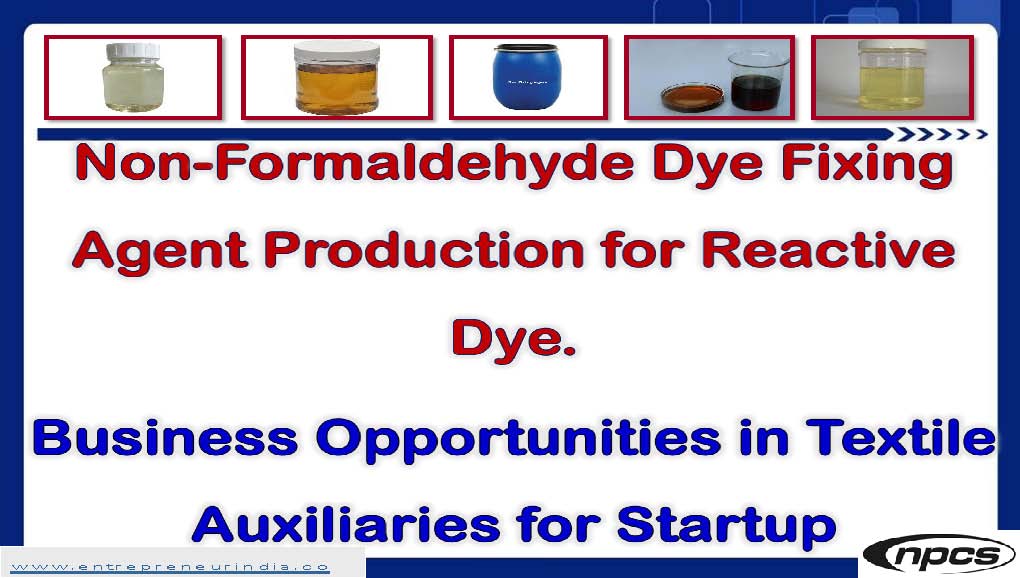
The demand for Non-Formaldehyde Dye Fixing Agent Production is gaining traction in the textile chemical industry due to rising environmental concerns and the need for safer, eco-friendly alternatives. These dye fixing agents improve the wash fastness and rubbing fastness of dyed fabrics, especially cotton and reactive dyes, without releasing toxic formaldehyde residues. As textile manufacturing transitions toward sustainable and compliant practices, the market for Non-Formaldehyde Dye Fixing Agent Production continues to expand. This business not only supports the growing green chemistry trend but also opens doors to profitable manufacturing and export opportunities.
Understanding the Need for Non-Formaldehyde Fixing Agents
Traditional dye fixing agents, especially those used in reactive dyeing, often contain formaldehyde-based compounds that pose serious health and environmental risks. Formaldehyde is classified as a potential carcinogen and is restricted in many countries, particularly in textiles for babies, home furnishings, and skin-contact garments.
Non-Formaldehyde Dye Fixing Agent Production addresses this issue by using safe chemical substitutes that offer similar or even better performance in fixing dyes to fibers. These agents reduce bleeding and fading while being compliant with global environmental and safety standards such as REACH, OEKO-TEX, and GOTS. As the textile industry is under pressure to reduce harmful emissions, this shift to non-formaldehyde solutions is both urgent and inevitable.
Key Benefits of Non-Formaldehyde Fixing Agents
The rise of Non-Formaldehyde Dye Fixing Agent Production is attributed to the following advantages:
Formaldehyde-Free: Safer for workers and end-users
Eco-Friendly: Meets global environmental norms
Excellent Dye Fixing: Improves wet fastness of reactive and direct dyes
Non-Yellowing: Does not affect fabric brightness or tone
Compatibility: Works well with cationic, anionic, and nonionic systems
Wide Application: Used in cotton, viscose, nylon, and blended fabrics
Manufacturers of home textiles, garments, and baby wear are particularly shifting to such agents to ensure safety compliance and product certification.
Market Potential and Growth Trends
The global textile auxiliary chemicals market is expected to exceed $10 billion by 2026, with dye fixing agents forming a significant segment. The Non-Formaldehyde Dye Fixing Agent Production sub-sector is witnessing higher demand due to tightening regulations in the EU, U.S., and other developed nations.
India, being one of the world’s largest textile producers, offers a significant domestic market. Additionally, the export potential to textile hubs like Bangladesh, Vietnam, Indonesia, and Turkey makes this a globally relevant business. Niche players, contract manufacturers, and even MSMEs are exploring this segment for its low-risk, high-demand appeal.
Raw Materials Used in Production
To start Non-Formaldehyde Dye Fixing Agent Production, a combination of the following raw materials is typically used:
Polyamines and quaternary ammonium compounds
Organic polymers (polycarboxylic acids, polyurethanes)
Fatty acid derivatives
Non-ionic surfactants
Water as the primary medium
Preservatives and pH adjusters
The precise formulation depends on the type of fabric, dye class, and application method. Proprietary blends and customized recipes offer scope for innovation and market differentiation.
Production Process Overview
A simplified production workflow for Non-Formaldehyde Dye Fixing Agent includes the following steps:
Raw Material Pre-Mixing: All ingredients are measured and pre-blended in holding tanks.
Reactor Mixing: The mixture is transferred to stainless steel reactors for controlled heating and chemical reactions under agitation.
pH Adjustment: Acid or alkali is added to bring the formulation to the desired pH range (usually 4.5–6.5).
Cooling and Homogenization: After reaction completion, the product is cooled and passed through a homogenizer for uniformity.
Filtration: The solution is filtered to remove impurities or undissolved residues.
Packaging: The final dye fixing agent is filled into HDPE drums, IBC tanks, or carboys depending on customer requirements.
Labeling and Dispatch: Proper labeling with batch number, manufacturing date, and safety symbols is done as per chemical labeling standards.
The production process is relatively straightforward and scalable, with batch or continuous setups based on investment levels.
Machinery and Infrastructure Requirements
To establish a Non-Formaldehyde Dye Fixing Agent Production unit, you’ll need:
Stainless steel reaction vessels (100–1000 liters capacity)
Overhead stirrers or agitators
Cooling system (water jacket or heat exchanger)
pH meter and dosing pumps
Filtration system (cartridge or pressure filter)
Homogenizer or emulsifier
Filling, sealing, and labeling machines
Storage tanks for raw materials and finished goods
A facility with 1,000–2,000 sq. ft. is sufficient for a small-to-medium-scale unit. It should comply with safety norms, have adequate ventilation, and proper chemical handling zones.
Investment and Profit Margins
The cost to set up a Non-Formaldehyde Dye Fixing Agent Production plant varies depending on scale:
Small unit: ?15–25 lakhs
Medium unit: ?40–70 lakhs
Large capacity setup: ?1 crore and above
This includes plant machinery, working capital, raw materials, and compliance costs. Gross profit margins range from 25% to 40%, making it a profitable chemical manufacturing opportunity. Additionally, offering contract manufacturing or custom formulation services can increase earnings.
Licensing and Regulatory Approvals
To start a compliant production unit, the following registrations and approvals are needed:
MSME/Udyam registration
GST registration
Factory license
Consent from State Pollution Control Board (SPCB)
Chemical storage license (if required)
ISO 9001 or ISO 14001 certification (optional but beneficial for exports)
REACH or OEKO-TEX compliance (if exporting to EU markets)
Maintaining an updated MSDS (Material Safety Data Sheet) for each product is also mandatory for safe handling and logistics.
Marketing and Sales Channels
There is strong B2B demand for Non-Formaldehyde Dye Fixing Agents from:
Textile dyeing and printing units
Garment processing houses
Export-oriented textile manufacturers
Textile auxiliaries traders and distributors
Chemical dealers and industrial product suppliers
Online directories, trade shows (like ITMA, Techtextil), and email outreach to buyers in Bangladesh, Turkey, and Vietnam can generate bulk orders. Branding the product as “green”, “compliant”, and “custom-formulated” improves customer trust and opens premium pricing avenues.
Government Schemes and Industry Support
The Indian government supports chemical and specialty manufacturing businesses through:
Credit Linked Capital Subsidy Scheme (CLCSS)
Technology Upgradation Fund (TUFS) for textile-linked industries
Make in India and Startup India initiatives
Export Promotion Capital Goods (EPCG) Scheme
NABARD term loans and working capital support via SIDBI
These can reduce initial investment burden and make the business more competitive, especially for MSMEs and startups.
Conclusion
The Non-Formaldehyde Dye Fixing Agent Production business offers an eco-conscious, future-ready manufacturing opportunity with steady market demand. It aligns with both global environmental regulations and the textile industry’s evolving needs for safety, quality, and compliance.
Whether you’re a chemical manufacturer diversifying your portfolio or a new entrant in the green chemistry domain, this segment offers scalability, profitability, and export potential. With strategic formulation, robust quality control, and aggressive B2B marketing, this niche can be turned into a highly sustainable business.
Niir Project Consultancy Services
An ISO 9001:2015 Company
106-E, Kamla Nagar, Opp. Spark Mall,
New Delhi-110007, India.
Email: npcs.ei@gmail.com , info@entrepreneurindia.co
Tel: +91-11-23843955, 23845654, 23845886, 8800733955
Mobile: +91-9811043595
Website: www.entrepreneurindia.co , www.niir.org