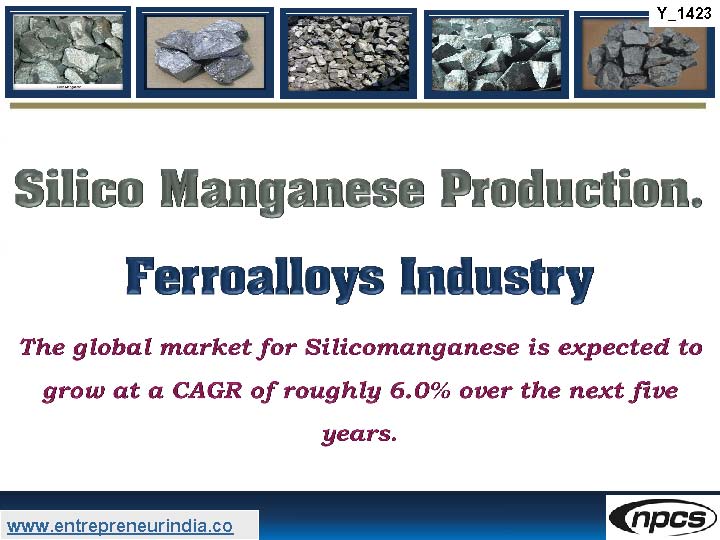
The Silico Manganese Production business plays a vital role in the global steel industry. As a key ferroalloy, silico manganese is widely used as a deoxidizer and alloying element in steel manufacturing. Its robust demand across foundries and steel plants, combined with its relatively low-cost production process, makes silico manganese one of the most profitable segments in the ferroalloy industry. As infrastructure and manufacturing expand worldwide, so does the appetite for strong, high-performance steel, fueled by silico manganese.
What is Silico Manganese and Why It Matters
Silico manganese is an alloy composed primarily of manganese (60–70%), silicon (10–20%), and carbon (1.5–2.5%). It is produced by carbothermic reduction of manganese ores and quartz in submerged arc furnaces. Its main function in steel production is to improve tensile strength, toughness, and workability while also acting as a powerful deoxidizing agent.
Due to its low cost and effectiveness, silico manganese is a standard addition in nearly all grades of steel — from rebar and structural steel to high-strength low-alloy (HSLA) steels. Its widespread use makes Silico Manganese Production not only vital for steelmakers but also a strategic industrial sector for emerging economies.
Setting Up a Silico Manganese Manufacturing Plant
Establishing a successful Silico Manganese Production unit requires considerable planning and investment. The setup includes:
Key Raw Materials:
Manganese Ore
Quartz (Silica)
Coke or Charcoal
Dolomite or Limestone (as flux)
Main Equipment:
Submerged Arc Furnace (SAF)
Briquetting and Screening Units
Dust Collection and Air Pollution Control Systems
Weighing and Material Handling Systems
The typical furnace capacity ranges from 6 MVA to 33 MVA, depending on production scale. For a medium-sized plant with a 9 MVA furnace, the daily production capacity can be around 30–40 tons. Initial capital investment may range from $5 million to $20 million depending on automation, capacity, and environmental compliance needs.
The Silico Manganese Manufacturing Process
The Silico Manganese Production process primarily involves the smelting of manganese ore with coke and quartz in a submerged arc furnace. The steps include:
Raw Material Preparation: Ores are crushed, screened, and dried.
Mixing & Charging: The burden mix of ore, reductant, and flux is charged into the furnace.
Smelting: Electric arc heating melts the material; chemical reduction forms the silico manganese alloy.
Tapping: Molten metal is tapped from the furnace into ladles, and slag is removed.
Casting & Crushing: Alloy is cast into molds or cast beds, cooled, and then crushed into various sizes.
Packaging & Transport: Graded alloy is packed and shipped to steel manufacturers.
The entire process is energy-intensive and requires careful monitoring to ensure recovery rates, metal purity, and emission control.
Applications of Silico Manganese in Steelmaking
Silico Manganese is indispensable in steelmaking due to its multiple functions:
Deoxidizing: Removes oxygen from molten steel to prevent brittleness and improve quality.
Alloying: Enhances mechanical properties like hardness, strength, and corrosion resistance.
Desulfurization: Helps reduce sulfur content, improving ductility.
Applications extend across:
Long steel products (rebar, structural steel)
Stainless and special steels
Automotive components
Shipbuilding and construction equipment
Railway tracks and tools
The versatility of this alloy guarantees strong, consistent demand throughout industrial value chains.
Profit Margins and Market Potential
The Silico Manganese Production business can generate healthy margins, particularly for plants with integrated raw material sources. Typical figures include:
Gross Margins: 25%–40%
Net Profit Margins: 12%–20%
Break-even Timeframe: 3–5 years
Factors influencing profitability:
Proximity to raw material sources (like India, South Africa, or Brazil)
Energy cost optimization
Efficient furnace design
Export incentives and duty benefits
Global steel production exceeds 1.8 billion tons annually — ensuring a continuous and growing market for silico manganese.
Leading Markets and Export Opportunities
India, Ukraine, China, South Africa, and Norway are the major producers of silico manganese. However, the global market is highly export-driven, and many countries depend on imports for their alloying needs.
Top export destinations include:
Europe (Germany, Italy, France)
Gulf Cooperation Council (UAE, Saudi Arabia)
Southeast Asia (Indonesia, Vietnam, Malaysia)
Africa (Nigeria, Kenya)
Compliance with international specifications such as ASTM A102, EN ISO standards, and REACH regulations can help gain access to premium overseas markets.
Environmental Compliance and Sustainability in Silico Manganese Production
Silico manganese production is resource- and energy-intensive, and hence environmental responsibility is a priority. Common practices include:
Dust and fume extraction systems to reduce airborne pollutants
Slag recycling for road construction or cement additive industries
Energy-efficient furnace operations and process heat recovery
Water recycling systems and closed-loop cooling
Regulatory compliance includes local Pollution Control Board (PCB) approvals and international certifications such as ISO 14001 for environmental management.
Challenges Faced by Silico Manganese Manufacturers
While Silico Manganese Production is a lucrative business, it also faces specific operational and market challenges:
Volatility in raw material prices, especially manganese ore and coke
Power supply reliability in certain regions
Strict environmental and pollution norms
Fluctuating steel demand tied to global construction cycles
High capital intensity and maintenance costs
Mitigation involves long-term contracts with suppliers, captive power plants, and diversification into other ferroalloys like ferro silicon or ferro chrome.
Future Outlook of the Silico Manganese Industry
The future for Silico Manganese Production is bright, driven by:
Expanding infrastructure in emerging economies
Increasing demand for high-strength steels
Technological advancements in energy-efficient smelting
Vertical integration with steel plants for cost savings
Global consumption is expected to grow steadily, and countries with raw material advantages will continue to dominate exports. Innovations like pre-reduction of manganese ore and AI-driven furnace control systems are set to increase operational efficiency and product consistency.
Conclusion
The Silico Manganese Production business is a cornerstone of the steel industry. Its consistent demand, high profitability, and role in critical manufacturing make it a promising industrial investment. By embracing technology, securing reliable inputs, and adhering to global standards, producers can not only achieve success domestically but also establish themselves in lucrative international markets.
Niir Project Consultancy Services
An ISO 9001:2015 Company
106-E, Kamla Nagar, Opp. Spark Mall,
New Delhi-110007, India.
Email: npcs.ei@gmail.com , info@entrepreneurindia.co
Tel: +91-11-23843955, 23845654, 23845886, 8800733955
Mobile: +91-9811043595
Website: www.entrepreneurindia.co , www.niir.org