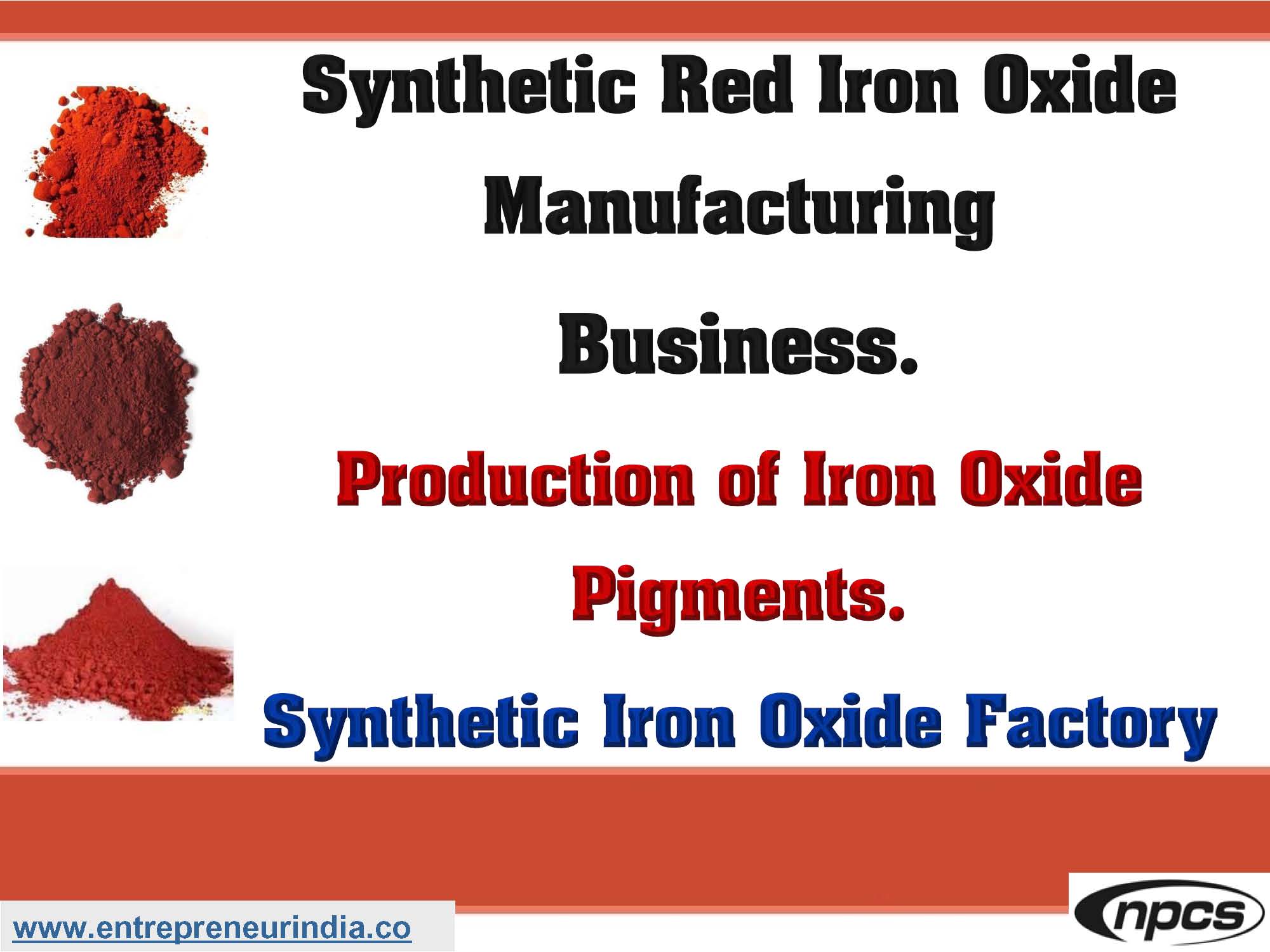
The Synthetic Red Iron Oxide manufacturing business offers a lucrative opportunity in the specialty chemicals and pigment industry. This inorganic pigment is widely used for its excellent tinting strength, stability, non-toxicity, and UV resistance. Industries like paint, construction, plastic, cosmetics, ceramics, paper, and rubber rely heavily on Synthetic Red Iron Oxide due to its color durability and cost-effectiveness. With steady global demand, minimal raw material constraints, and scalable production technology, this business provides high profitability with long-term sustainability.
Growing Demand for Synthetic Red Iron Oxide
The demand for Synthetic Red Iron Oxide is surging across construction, paint, and paving sectors. Governments and private players increasingly prefer oxide-based colorants for architectural coatings, floorings, tiles, and concrete products due to their weather resistance and color permanence. The product’s ability to retain vibrant color even in harsh environments makes it a trusted pigment globally.
Applications of Synthetic Red Iron Oxide
The versatile nature of Synthetic Red Iron Oxide enables its use across various sectors:
Paints & Coatings: Offers deep red color and anti-corrosive properties in industrial and decorative paints.
Construction Materials: Used in colored concrete blocks, interlocking pavers, cement tiles, and roofing sheets.
Plastics & Rubber: Acts as a coloring agent for plastic parts, rubber goods, and elastomers.
Cosmetics: Used in blush, lipstick, and foundation due to its non-toxic and skin-safe properties.
Ceramics & Tiles: Provides long-lasting pigment for glazed and unglazed ceramic tiles.
Printing Inks & Paper: Delivers rich coloration in specialized printing applications.
Fertilizers: Sometimes added to color-control agricultural products.
Its non-reactive, UV-stable, and weather-resistant properties make it a top choice in environments that demand long-term color retention.
Types of Synthetic Red Iron Oxide
The business primarily deals with two types of synthetic production:
Micronized Grade: Finely ground for high dispersion in paints and plastics.
Granular Grade: Ideal for construction materials, such as pavers and concrete.
Micronized grades serve premium industries like automotive coatings and printing, while granular grades cater to large-volume sectors like cement and flooring.
Raw Materials Used in Manufacturing
To produce Synthetic Red Iron Oxide, the following materials are typically required:
Iron Salts (Ferrous Sulfate or Ferric Chloride)
Caustic Soda (Sodium Hydroxide)
Oxidizing Agents (like Sodium Nitrate or Air/Oxygen)
Water
Acid for pH Adjustment (Hydrochloric or Sulfuric Acid)
All raw materials are readily available, cost-effective, and suitable for bulk procurement from domestic sources.
Manufacturing Process of Synthetic Red Iron Oxide
The most common manufacturing technique is the precipitation process:
Dissolution of Iron Salts
Prepare a solution of ferrous sulfate or ferric chloride in water.Oxidation
Add oxidizing agents (like sodium nitrate or controlled air bubbling) to convert iron salts into hydrated iron oxides.Precipitation
Adjust pH using caustic soda. This causes iron oxide particles to precipitate from the solution.Aging and Filtration
Allow the precipitated particles to age for better crystal structure, then filter out the solids.Washing and Drying
Wash the filter cake to remove impurities, followed by drying in rotary or tray dryers.Grinding and Micronizing
Dry material is ground to desired mesh size using ball mills or pulverizers.Packaging
Pack the product in moisture-proof bags (25kg or 50kg) with proper labeling for storage and sale.
The result is a fine, stable red pigment ready for commercial use.
Machinery and Infrastructure Required
To set up a Synthetic Red Iron Oxide manufacturing plant, the following equipment is essential:
Reaction vessels with stirrers
Oxidation tanks with aeration system
Filtration units (plate and frame or vacuum filter)
Tray or rotary dryers
Pulverizer or micronizer
pH monitoring systems
Weighing, packing, and sealing machines
Pollution control units (scrubbers, ETPs)
For a small-scale setup (500 kg/day), the investment ranges from ?25–?40 lakhs. Larger units with higher automation may require ?1 crore or more.
Quality Control and Compliance
High-quality Synthetic Red Iron Oxide must meet the following standards:
High Tinting Strength
Low Oil Absorption
Controlled Particle Size Distribution
Consistent Shade and Purity
pH Range of 5.0 to 8.0
Certifications like ISO 9001, RoHS, and REACH enhance market credibility, especially for exports.
Environmental and Safety Considerations
Manufacturing involves chemical reactions that release fumes and generate wastewater. Key environmental practices include:
Installing scrubbers to neutralize exhaust gases
Treating effluents using an Effluent Treatment Plant (ETP)
Ensuring proper storage of raw materials and by-products
Training staff in chemical handling and PPE compliance
Adherence to Pollution Control Board norms and Hazardous Waste Management Rules is mandatory for licensing.
Market Scope and Growth Potential
The Synthetic Red Iron Oxide market is growing rapidly due to urbanization, infrastructure development, and demand for colored construction products. Major markets include:
India, China, and Southeast Asia: Dominant users in the construction sector
Europe and USA: High demand in coatings and plastic industries
Middle East and Africa: Emerging demand for architectural paints and tiles
Domestic manufacturers can achieve 15–25% gross profit margins with reliable B2B and export partnerships.
Licensing and Legal Requirements
Operating a Synthetic Red Iron Oxide plant requires the following:
MSME or Udyam Registration
Factory License
GST Registration
Pollution Control Board Clearance
Import/Export Code (IEC) for international trade
Trademark Registration for product branding
For higher credibility, ISO and BIS certifications are recommended.
Conclusion
The Synthetic Red Iron Oxide manufacturing business provides a high-profit opportunity with widespread industrial demand. Its non-toxic nature, stability, and application versatility make it indispensable in sectors ranging from paints to plastics and beyond. With moderate investment, scalable technology, and a reliable supply chain, entrepreneurs can establish a successful, export-ready manufacturing unit. Choosing the right plant size, ensuring consistent quality, and maintaining regulatory compliance will position your brand as a trusted pigment supplier.
Niir Project Consultancy Services
An ISO 9001:2015 Company
106-E, Kamla Nagar, Opp. Spark Mall,
New Delhi-110007, India.
Email: npcs.ei@gmail.com , info@entrepreneurindia.co
Tel: +91-11-23843955, 23845654, 23845886, 8800733955
Mobile: +91-9811043595
Website: www.entrepreneurindia.co , www.niir.org