

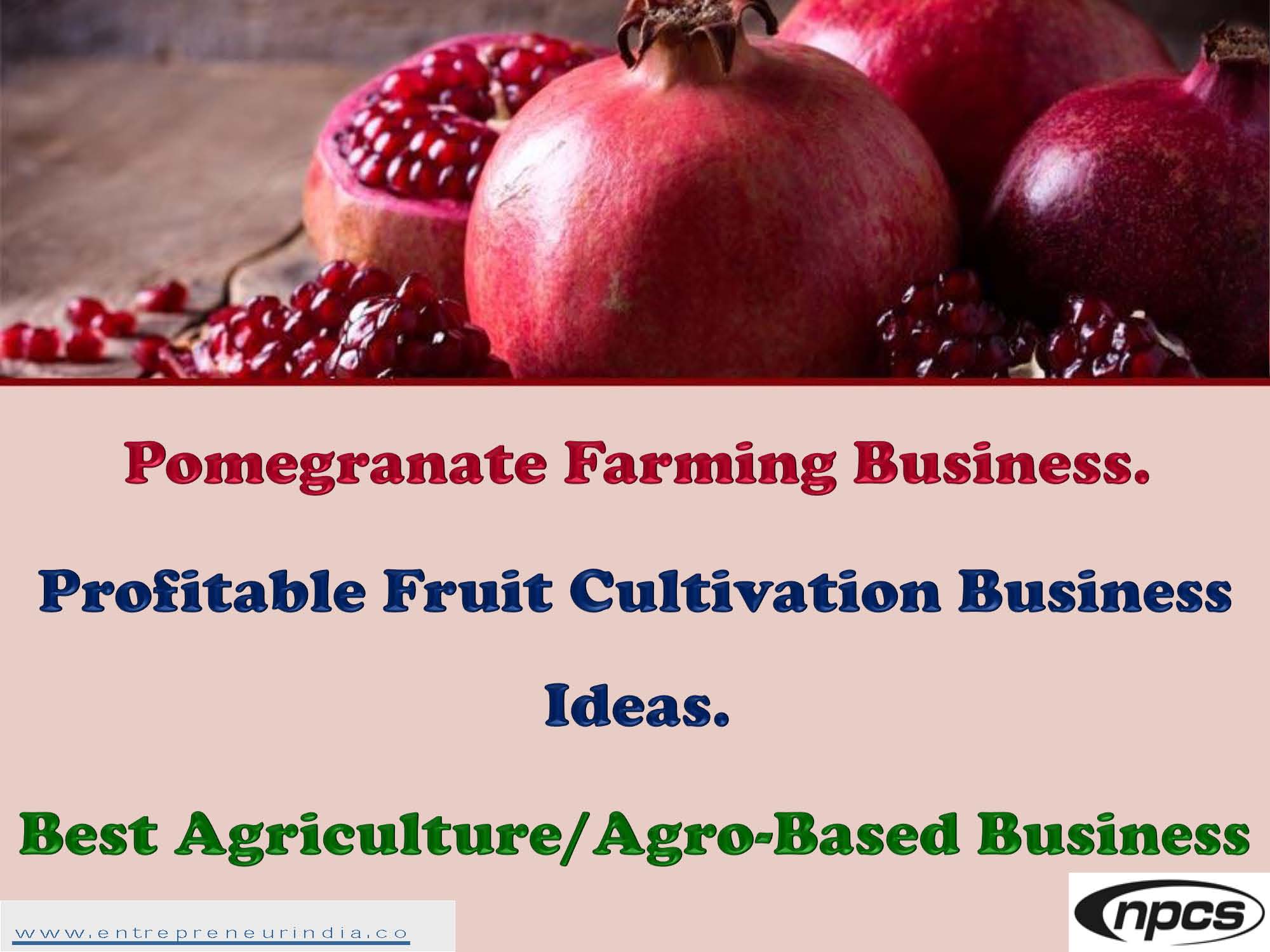
The Pomegranate Farming Business is rapidly becoming one of the most profitable and sustainable ventures in modern agriculture. With rising global demand for superfoods and health-conscious consumption patterns, pomegranate has carved out a valuable niche in the fresh fruit, juice, and nutraceutical markets. Known for its antioxidant properties, long shelf life, and drought resistance, the pomegranate is a fruit with immense commercial potential. Entrepreneurs, farmers, and agribusiness investors are increasingly turning toward the Pomegranate Farming Business to tap into both domestic and export markets.
Why Pomegranate Farming is in Demand
In recent years, the demand for pomegranate and its by-products has skyrocketed. Rich in vitamin C, potassium, fiber, and antioxidants, pomegranate is widely used in juices, jams, health drinks, and even skincare. India is the world’s largest producer of pomegranate, with major cultivation in Maharashtra, Gujarat, Karnataka, and Andhra Pradesh.
The Pomegranate Farming Business offers significant advantages such as low water requirements, resistance to diseases, and consistent market prices. Export opportunities to Gulf countries, Europe, and Southeast Asia further enhance its profitability. With proper scientific techniques, even small farmers can achieve high yields per acre, ensuring quick returns and stable income.
Ideal Climate and Soil for Pomegranate Farming
Pomegranates thrive in tropical and subtropical climates. They require hot, dry summers and cool winters for optimum growth and fruiting. An annual rainfall of 500–800 mm is ideal, although the crop can be grown in areas with even less rainfall using drip irrigation.
The Pomegranate Farming Business prefers loamy, sandy-loam, or black cotton soils with good drainage. A soil pH between 6.5 to 7.5 is considered best. Farmers should avoid waterlogged or highly alkaline soils. Soil testing prior to planting helps determine nutrient needs and suitability for cultivation.
Popular Varieties and Their Characteristics
Choosing the right variety is crucial for a successful Pomegranate Farming Business. Some high-yield and market-preferred varieties include:
Bhagwa: Most popular in India, known for its bright red skin and soft seeds
Ganesh: Early-maturing with pinkish-red skin and juicy arils
Mridula: Suitable for processing, has deep red seeds
Arakta: Deep red color, longer shelf life, ideal for export
Kesar and Jyoti: Region-specific varieties grown in parts of Gujarat and Maharashtra
Each variety has unique advantages in terms of sweetness, seed hardness, and suitability for processing or fresh consumption, making it easier to align with market demand.
Planting and Spacing Guidelines
For commercial Pomegranate Farming Business, propagation is done through hardwood cuttings or tissue culture saplings. Planting is generally carried out during monsoon (June–August) or in early spring (February–March), depending on the region.
The ideal planting distance is 4 m × 4 m, which accommodates around 625 plants per hectare. In high-density plantations, spacing may be reduce to 3 m × 3 m, increasing plant count and yield. Pits of 60×60×60 cm are dug and filled with a mixture of farmyard manure, topsoil, and bio-fertilizers before planting.
Irrigation and Fertilizer Management
Although drought-tolerant, pomegranates need timely irrigation, especially during flowering and fruit development. Drip irrigation is highly recommended for efficient water use in the Pomegranate Farming Business. Watering frequency depends on soil moisture, weather, and crop stage but is typically done every 7–10 days.
For fertilizers, a combination of organic manure and chemical nutrients is essential. FYM (Farmyard Manure) is apply at 10–15 kg per plant annually. Additional nutrients like Nitrogen, Phosphorus, and Potassium (NPK) are add in split doses throughout the growing cycle. Foliar sprays of micronutrients like Zinc, Iron, and Boron help improve flowering and fruit size.
Pruning and Crop Management
Regular pruning is vital to maintain plant shape, airflow, and productive growth. It helps eliminate dead wood, control height, and encourage new fruit-bearing branches. Pruning is done annually after harvesting.
The Pomegranate Farming Business also requires effective pest and disease control. Common issues include fruit borers, aphids, mealybugs, and fungal leaf spots. Integrated Pest Management (IPM) practices such as neem-based sprays, sticky traps, and biological control agents can reduce chemical use while protecting crop quality.
Flowering, Fruiting, and Harvesting Timeline
Pomegranate trees typically begin to bear fruit after 2 to 3 years of growth. Depending on regional climatic conditions and irrigation practices, the trees may flower two to three times annually. However, the best-quality fruits are usually harvest from the main flowering season, which falls between April and June.
Once flowering occurs, the fruits take around 5 to 6 months to reach maturity. Harvesting is done manually when the fruit’s outer skin turns bright, smooth, and glossy—an indicator of ripeness. Timely harvesting is crucial, particularly during the monsoon season, as delayed picking can lead to fruit splitting, which reduces market value.
In the initial fruiting years, a healthy pomegranate tree yields 25 to 30 fruits per season. As the tree matures and management practices improve, this number can rise to 100 or more fruits per tree, significantly boosting farm profitability.
Post-Harvest Handling and Marketing
After harvest, fruits are sort base on size, color, and ripeness. Grading enhances market value, especially for exports. Proper packaging using ventilated crates or cardboard boxes minimizes damage during transportation. Cold storage extends shelf life up to 4–6 weeks, which is essential for distant markets.
The Pomegranate Farming Business sells through multiple channels:
Local wholesale markets
Agri-mandis and APMCs
Contract farming arrangements
Direct retail or online farm produce models
Export agents and food processors
Adding value through juice extraction, seed drying, or pomegranate peel powder can further enhance profit margins.
Investment and Returns
Starting a Pomegranate Farming Business on one hectare typically involves:
Land preparation: ?30,000–?40,000
Planting material: ?1,50,000 (for 625 plants @ ?200–250 each)
Drip irrigation setup: ?75,000–?1,00,000
Fertilizers and pesticides: ?25,000–?35,000 annually
Labor and maintenance: ?40,000 per year
Total initial investment in the first year may range between ?3.5–?4.5 lakhs per hectare. From the 3rd year onward, returns can exceed ?5–?7 lakhs per hectare annually, depending on fruit quality and market prices. ROI becomes significantly higher with export linkage or processing partnerships.
Government Support and Subsidies
The Indian government supports Pomegranate Farming Business through various schemes:
NABARD horticulture loans under subsidy-linked financing
MIDH (Mission for Integrated Development of Horticulture)
PMKSY (Pradhan Mantri Krishi Sinchai Yojana) for irrigation
ATMA and State Horticulture Departments for training and extension support
Subsidies are available for drip irrigation, planting material, and organic input promotion. Farmers can also avail crop insurance under PMFBY (Pradhan Mantri Fasal Bima Yojana) for risk management.
Conclusion
The Pomegranate Farming Business presents a unique opportunity by combining low input costs, high yield potential, long shelf life, and strong market demand. It appeals to small and marginal farmers, agri-entrepreneurs, and investors seeking sustainable and profitable ventures.
As consumers increasingly prioritize health, superfoods, and environmentally conscious choices, the demand for pomegranates continues to rise.
Farmers who adopt scientific cultivation methods, apply proper post-harvest handling practices, and implement strategic marketing can transform pomegranate farming into a dependable, long-term source of income. Moreover, this sector holds significant potential for generating rural employment and contributing to regional economic development.
Interested in starting your own Pomegranate Farming Business?
We provide end-to-end project reports, agronomic training, soil testing, drip irrigation layout, and market linkage support. Let us help you grow profitably from the first season itself.
Niir Project Consultancy Services
An ISO 9001:2015 Company
106-E, Kamla Nagar, Opp. Spark Mall,
New Delhi-110007, India.
Email: npcs.ei@gmail.com , info@entrepreneurindia.co
Tel: +91-11-23843955, 23845654, 23845886, 8800733955
Mobile: +91-9811043595
Website: www.entrepreneurindia.co , www.niir.org