
The global shift toward sustainable energy and reduced carbon emissions has accelerated the adoption of electric vehicles (EVs). What was once considered an experimental concept has now become a rapidly growing industry, with EVs dominating future mobility discussions. From startups to established automobile manufacturers, businesses around the world are investing in electric vehicle manufacturing. India, too, is experiencing a surge in EV interest, driven by favorable government policies, rising fuel prices, and increased environmental awareness.
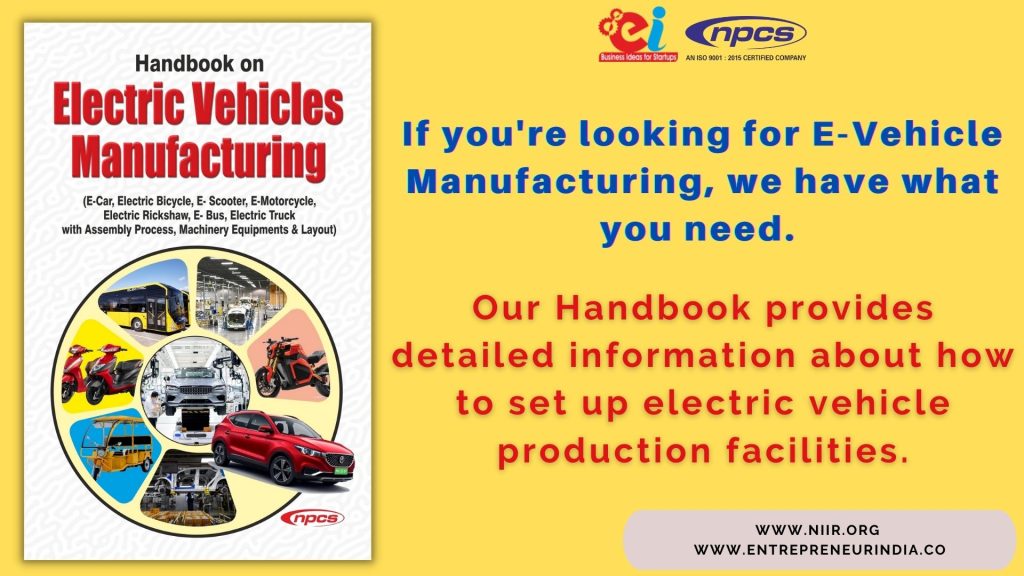
If you are an entrepreneur, engineer, or investor eyeing the EV space, this handbook on electric vehicles manufacturing will guide you through the fundamentals of EV production—from components and processes to setup, cost, and compliance.
Visit this Page for More Information: Start a Business in Electric Vehicle Industry
Contents
- 1. Understanding Electric Vehicle Manufacturing
- 1.1. 1. Core Components of an Electric Vehicle
- 1.2. 2. EV Manufacturing Process Flow
- 1.3. 3. Plant Setup and Infrastructure
- 1.4. 4. Licenses and Regulatory Compliance
- 1.5. 5. Government Policies and Subsidies
- 1.6. 6. Target Market and Business Models
- 1.7. 7. Cost Estimation and ROI
- 1.8. 8. Marketing and Distribution Strategy
- 1.9. 9. Challenges in EV Manufacturing
- 2. Final Thoughts
Understanding Electric Vehicle Manufacturing
The process of manufacturing an electric vehicle is significantly different from that of traditional internal combustion engine (ICE) vehicles. EVs require a deep integration of mechanical engineering, electrical systems, software, and clean energy components. The major parts of an electric vehicle include a battery, motor, power control systems, chassis, and an interface system.
The EV ecosystem includes:
Electric two-wheelers (scooters, bikes)
Three-wheelers (rickshaws, loaders)
Four-wheelers (cars and vans)
Heavy commercial vehicles (buses, trucks)
Each segment offers opportunities based on investment, target market, and technology capabilities.
Read Similar Articles: E- Vehicle Projects
1. Core Components of an Electric Vehicle
Manufacturing EVs involves assembling and integrating multiple critical systems. Here’s a breakdown:
a. Battery Pack
Usually made of lithium-ion cells
Determines the range and performance of the vehicle
Includes a Battery Management System (BMS) for monitoring, temperature control, and safety
b. Electric Motor
Converts electric energy into mechanical power
Common types: BLDC (Brushless DC Motor), PMSM (Permanent Magnet Synchronous Motor), and Induction Motor
Motor selection depends on vehicle size and usage
c. Controller and Inverter
Controls power flow between the battery and the motor
Affects vehicle speed, torque, and energy efficiency
d. Vehicle Chassis and Body
Can be modified from traditional automotive platforms or newly designed for lightweight and better battery housing
e. Software and IoT Integration
Enables diagnostics, battery monitoring, smart dashboards, GPS, and mobile app integration
Plays a crucial role in customer experience and maintenance
Read our Books Here: Electric Vehicles Manufacturing
2. EV Manufacturing Process Flow
EV manufacturing is a blend of mechanical assembly and electronic integration. The typical steps include:
Design and Prototyping
CAD design and digital simulations
Performance, battery capacity, and safety tests
Component Sourcing
Motors, batteries, controllers, chargers, wiring, and software systems
Components can be locally sourced or imported
Body Fabrication
Sheet metal or fiber molds for the vehicle body
Integration of lightweight materials for efficiency
Assembly Line Setup
Frame welding, motor fitting, battery placement
Wiring and control unit installation
Quality Testing
Road tests for stability, range, charging time
Electrical safety and emissions compliance
Branding and Finishing
Logo placement, body paint, accessory fittings
Packaging and Distribution
Ready vehicles are distributed through dealerships or direct-to-consumer platforms
Related Feasibility Study Reports: E- Vehicle
3. Plant Setup and Infrastructure
Establishing an EV manufacturing plant requires the following:
Land and Factory Building
Area needed: 10,000–50,000 sq. ft. (depending on output)
Should have space for R&D lab, assembly area, testing zone, and inventory storage
Machinery and Tools
Welding machines, hydraulic lifts, painting booths
Assembly stations, testing benches, power backup systems
Manpower Requirements
Electrical engineers, mechanics, software developers, quality controllers, assembly workers
Utilities
High-load electrical connection, water treatment, dust-free environment
Download PDF: Handbook on Electric Vehicles Manufacturing
4. Licenses and Regulatory Compliance
Before launching your EV manufacturing business, acquire the following licenses:
Company Registration (Private Ltd., LLP, or MSME)
GST Number
Factory License
Pollution Control Certificate
FAME-II Eligibility Certification (if availing subsidies)
Approval from ARAI or ICAT for vehicle compliance and roadworthiness
BIS Certification for battery safety standards
5. Government Policies and Subsidies
India is aggressively promoting EV adoption. You can benefit from:
FAME-II (Faster Adoption and Manufacturing of Hybrid & Electric Vehicles)
Offers subsidies for both manufacturers and buyers
State-level EV Policies (Delhi, Maharashtra, Tamil Nadu, Gujarat offer capital subsidies, tax rebates, and power discounts)
Production-Linked Incentive (PLI) Scheme
For battery and auto component manufacturing
Startup India Incentives for innovative EV technologies
Watch other Informative Videos: Automobile Industry
6. Target Market and Business Models
You can enter the EV market through several approaches:
OEM Manufacturing
Design and produce complete vehicles under your brand
White Labeling
Manufacture EVs that other companies sell under their brand
Component Manufacturing
Specialize in batteries, chargers, BMS, or motors
EV Conversion Kits
Offer kits to convert petrol/diesel vehicles into electric
Franchise or Dealership Models
Sell ready-made EVs via distributor channels
7. Cost Estimation and ROI
Cost of setting up an EV manufacturing unit:
Small-Scale Unit (2-wheelers, 10–20/day): ?1.5 to ?3 crore
Mid-Scale (3-wheelers or 100 units/month): ?5 to ?10 crore
Large-Scale (cars, buses, or exports): ?25 crore and above
ROI Timeline: 2 to 4 years depending on production capacity, sales model, and market demand.
Margins can range between 15%–35%, with higher profits in niche or B2B segments (e.g., delivery vehicles, fleet services).
8. Marketing and Distribution Strategy
To sell electric vehicles successfully, consider:
Building a strong brand identity
Creating product demo videos and test ride events
Listing on EV directories and B2B platforms
Partnering with last-mile delivery companies and ride-share platforms
Setting up service stations and charging points for brand loyalty
Digital platforms (website, YouTube, LinkedIn, and Facebook Ads) are powerful tools for reaching early adopters and sustainability-conscious consumers.
9. Challenges in EV Manufacturing
Despite the opportunities, several challenges persist:
Battery sourcing and cost volatility
Lack of charging infrastructure
Skilled manpower shortage
Compliance complexities and testing delays
Limited access to high-end EV software tech
Overcoming these requires innovation, strategic partnerships, and continuous improvement.
Final Thoughts
The electric vehicle manufacturing business is a golden opportunity for forward-thinking entrepreneurs and investors. As India aims to make 30% of vehicles electric by 2030, the demand for high-quality, affordable EVs is exploding.
This handbook on electric vehicles manufacturing outlines the fundamentals of entering and growing in this industry. By focusing on quality production, smart design, and eco-conscious practices, you can build a brand that contributes not just to the economy—but also to a greener planet.
If you’re ready to begin, start by validating your idea, forming the right team, and planning a lean but scalable production model. The EV revolution is just beginning—this is your chance to drive it forward.
See More Links:
- Start a Business in Asia
- Start a Business in Potential Countries for Doing Business
- Best Industry for Doing Business
- Business Ideas with Low, Medium & High Investment
- Looking for Most Demandable Business Ideas for Startups
- Startup Consulting Services
- Start a Business in Africa
- Start a Business in India
- Start a Business in Middle East
- Related Videos
- Related Books
- Related Projects
- Related Market Research Reports
NIIR PROJECT CONSULTANCY SERVICES, DELHI
An ISO 9001:2015 Company
ENTREPRENEUR INDIA
106-E, Kamla Nagar, Opp. Mall ST,
New Delhi-110007, India.
Email: npcs.ei@gmail.com
Tel: +91-11-23843955, 23845654, 23845886
Mobile: +91-9097075054, 8800733955
Website: https://www.entrepreneurindia.co
https://www.niir.org