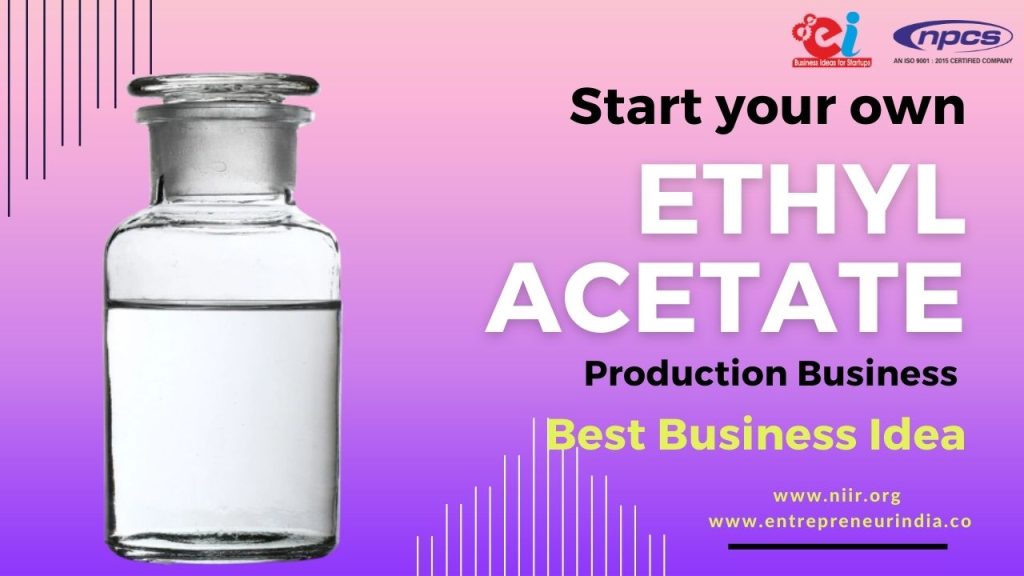

The global chemicals industry continues to evolve, offering numerous lucrative opportunities for entrepreneurs and industrialists. One such profitable and widely used organic compound is Ethyl Acetate (CH?COOC?H?). Known for its sweet, fruity smell, Ethyl Acetate Production Business is a colorless, flammable liquid and a key solvent in several industries. From printing inks and adhesives to pharmaceuticals and cosmetics, its demand is steadily rising across various sectors.
As industrial applications expand, especially in emerging economies like India, Southeast Asia, and Africa, starting an Ethyl Acetate production business can be a smart and rewarding decision. With growing market needs, relatively stable raw material availability, and export potential, Ethyl Acetate presents a scalable and future-ready business opportunity.
Related Feasibility Study Reports: Chemicals (Organic, Inorganic, Industrial) Projects
Contents
- 1. What is Ethyl Acetate and Why Is It in Demand?
- 2. Final Thoughts
What is Ethyl Acetate and Why Is It in Demand?
Ethyl Acetate Production Business is an ester compound formed from the reaction of ethanol and acetic acid. It is primarily used as a solvent due to its excellent volatility, mild toxicity, and ability to dissolve a wide range of resins and compounds. Common applications include:
Paints and coatings
Printing inks
Adhesives
Cosmetic products
Pharmaceutical formulations
Decaffeination of tea and coffee
Its pleasant smell also makes it popular in the flavoring and fragrance industries. The compound’s biodegradability and relatively low environmental impact make it preferable over many other solvents in eco-sensitive formulations.
Visit this Page for More Information: Start a Business in Chemical Industry Projects
1. Production Process of Ethyl Acetate
The most commonly used process to manufacture Ethyl Acetate is the esterification of ethanol and acetic acid in the presence of an acid catalyst. Here’s an overview:
a. Raw Materials
Ethanol (C?H?OH)
Acetic Acid (CH?COOH)
Sulfuric acid (as catalyst)
b. Esterification Reaction
The basic chemical reaction is:
CH?COOH + C?H?OH ? CH?COOC?H? + H?O
This is a reversible reaction and requires:
Heating (typically at 60–80°C)
Continuous water removal to shift equilibrium to the right
Distillation unit for product purification
Other methods include:
Tishchenko reaction
Acetaldehyde condensation process
But the ethanol-acetic acid route is the most economical and widely practiced, especially in India.
Download PDF: Ethyl Acetate Production Plant. Highly Profitable Business for Entrepreneurs
2. Plant Setup and Equipment Requirements
Setting up an Ethyl Acetate manufacturing unit requires a mix of chemical engineering infrastructure and strict safety protocols.
Required Equipment:
Reactor vessel with agitator
Heat exchanger
Fractional distillation column
Condenser and decanter
Storage tanks for raw materials and final product
Process control and instrumentation systems
Safety and ventilation setup
Depending on scale, you can go for:
Batch-type setup (ideal for small-scale production)
Continuous process plant (for large-scale industrial output)
Area Requirement: Minimum 8,000–12,000 sq. ft. for a small to mid-scale unit.
3. Raw Material Sourcing
India has an abundant supply of both ethanol and acetic acid, thanks to its strong agro-based alcohol industry and chemical production clusters. For better profitability:
Source ethanol from molasses-based distilleries
Obtain acetic acid from chemical plants in Gujarat, Maharashtra, or Tamil Nadu
Buy in bulk or long-term contracts to stabilize raw material costs
Ensure that materials are of industrial-grade purity to achieve desired conversion efficiency and product quality.
Read our Books Here: Chemical Technology
4. Licenses and Compliance
Manufacturing Ethyl Acetate involves handling flammable and reactive chemicals. Hence, you must secure multiple approvals before commencing operations:
Company registration (MSME, Pvt Ltd, or LLP)
GST number
Factory license
Pollution Control Board (PCB) clearance
Explosive and hazardous chemical handling license
Drug and Cosmetics License (if selling to pharma/cosmetic clients)
ISO and BIS certification for quality assurance (optional but beneficial)
You also need to ensure worker safety training, fire control systems, and proper waste disposal protocols are in place.
5. Investment and Setup Cost
The investment depends on the plant’s scale, automation level, and target capacity.
Approximate Costs:
Small-scale unit (1,000–2,000 liters/day): ?1.5 – ?3 crore
Medium unit (5,000 liters/day): ?5 – ?8 crore
Large-scale industrial plant (10,000+ liters/day): ?10 crore and above
Major cost elements:
Equipment and machinery: 50%
Civil work and land development: 20%
Licensing and compliance: 5%
Working capital (raw materials, labor, utilities): 20%
Marketing, R&D, logistics: 5%
6. Market Scope and Buyers
Ethyl Acetate is in high demand across multiple industries:
a. Domestic Buyers:
Paint and Coating Companies
Adhesive and Lamination Manufacturers
Pharmaceutical Formulators
Tea and Coffee Processing Units
Fragrance and Personal Care Brands
Printing Ink Companies
b. Export Market:
India is a major exporter of Ethyl Acetate to countries like:
USA
UAE
Brazil
South Korea
European Union nations
Setting up an export-oriented unit (EOU) or registering with DGFT and EPC (Export Promotion Council) can help you scale faster and get government incentives.
7. Profit Margin and Return on Investment
The profit margin in the Ethyl Acetate business is generally 20% to 30%, depending on:
Efficiency of raw material use
Process control and automation
Market pricing and bulk sales
Quality consistency
A medium-sized plant can achieve break-even within 2–3 years, with proper market linkages and consistent supply chain management.
The production cost (including materials, labor, utilities, etc.) is roughly ?55–65 per liter, while the average selling price ranges between ?80–100/liter depending on purity and buyer category.
8. Marketing and Sales Strategy
To ensure consistent business, focus on:
Direct industrial supply contracts
Tenders and bulk order participation
Partnerships with pharmaceutical companies
Presence on B2B platforms like IndiaMART, Alibaba, TradeIndia
Attending chemical expos and networking with buyers
Building a technical datasheet and product brochure for your brand
Offer product samples, flexible packaging, and on-time delivery to build trust.
Final Thoughts
The Ethyl Acetate production business is a strong industrial venture with broad applicability and global demand. With its wide range of end uses and eco-friendlier profile compared to other solvents, it remains a staple chemical in multiple industries.
India’s infrastructural capacity, raw material availability, skilled chemical workforce, and export capabilities make it an ideal base for starting this business. Whether you are looking to diversify from the chemical sector, enter B2B manufacturing, or set up a solvent supply chain—Ethyl Acetate production offers stability, profitability, and growth potential.
Read Similar Articles: Chemical Industry
See More Links:
- Start a Business in Asia
- Start a Business in Potential Countries for Doing Business
- Best Industry for Doing Business
- Business Ideas with Low, Medium & High Investment
- Looking for Most Demandable Business Ideas for Startups
- Startup Consulting Services
- Start a Business in Africa
- Start a Business in India
- Start a Business in Middle East
- Related Videos
- Related Books
- Related Projects
- Related Market Research Reports
NIIR PROJECT CONSULTANCY SERVICES, DELHI
An ISO 9001:2015 Company
ENTREPRENEUR INDIA
106-E, Kamla Nagar, Opp. Mall ST,
New Delhi-110007, India.
Email: npcs.ei@gmail.com
Tel: +91-11-23843955, 23845654, 23845886
Mobile: +91-9097075054, 8800733955
Website: https://www.entrepreneurindia.co
https://www.niir.org