
Introduction: Container Manufacturing Opportunity in India
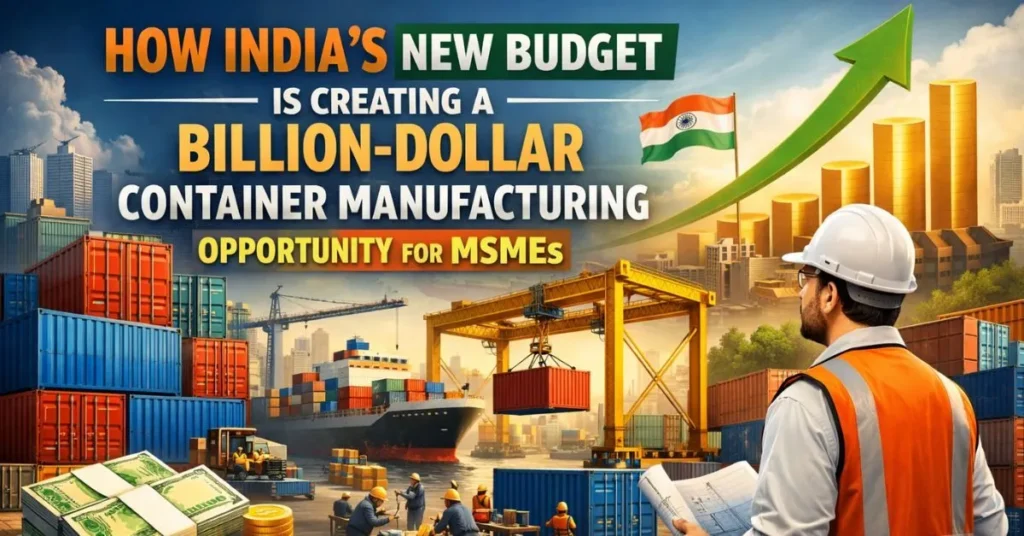
India’s latest Union Budget has quietly set up one of the most promising manufacturing opportunities for entrepreneurs – seaworthy container manufacturing. With a dedicated government scheme, heavy investments in logistics infrastructure, MSME credit reforms and a growing emphasis on decreasing import dependency, the sector is progressing from a niche industrial activity to a strategic national priority.
Shipping containers are no longer merely metal boxes used for the transportation of goods. The present day infrastructure functions as an essential system that supports international trade operations and military supply chains and coastal shipping activities and rail freight transportation and multimodal freight systems. India’s policy push is a sign that it is looking at building domestic capacity rather than heavily relying on imports from countries such as China in the long term.(Container Manufacturing Opportunity in India)
For MSME founders, engineers and industrial entrepreneurs, this change presents a rare chance to get into a manufacturing sector that is supported by robust policy support, structural demand growth and financing incentives.
Contents
- 1. Government Policy Push: What's Driving Growth on Container Manufacturing
- 2. Why Seaworthy Containers is a Strategic Manufacturing Sector
- 3. Business Logic: Why Container Manufacturing Makes Financial Sense
- 4. Important Business Models That Entrepreneurs Can Explore
- 5. Financial Assistance and MSME Incentives
- 6. Risks That Are Essential for Entrepreneurs to Consider
- 7. Conclusion: A Strategic MSME Opportunity in the Future of Manufacturing in India
- 8. Frequently Asked Questions (FAQ)
Read More: Plastic Battery Containers Manufacturing Business
Government Policy Push: What's Driving Growth on Container Manufacturing
The Indian government has launched a Scheme for Container Manufacturing as part of the advanced manufacturing and strategic sector schemes. This puts container production on par with industries such as electronics, semiconductors and infrastructure equipment manufacturing.(Container Manufacturing Opportunity in India)
A number of policy reforms make the business environment more attractive:
- Increased public capital expenditure on freight corridors, ports, logistics parks and water ways.
- Dedicated Freight Corridors linking mineral areas with industrial ports.
- Expansion of children’s coastal cargo and inland waterways transportation.
- The implementation of digital single window customs clearance systems aims to decrease export processing times.
- The MSME financing system provides funding through three channels which include SME Growth Funds and credit guarantees and TReDS invoice discounting.
The initiatives provide entrepreneurs with three essential resources which include demand visibility and operational risk assessment and financial market access to launch their container manufacturing facilities.(Container Manufacturing Opportunity in India)
Why Seaworthy Containers is a Strategic Manufacturing Sector
The logistics industry in India experiences rapid growth which exceeds normal expansion rates. With the increase in the volume of trade and government investment in multimodal transport networks, it is likely that the demand for containers will grow substantially.(Container Manufacturing Opportunity in India)
Major reasons why containers are now strategic infrastructure are:
- Growth in export import trade that requires standardized transport solutions.
- Expansion of rail freight and inland waterways.
- Coal transport is valuable for boosting trade.
- Around the world, the maritime sector has been impacted in the past three quarters by multiple events that had a positive influence on container liner companies.
As India’s aims to be a global manufacturing hub, domestic container production will play a major role in improving the supply chain resilience and reducing the imports.
Read More: Business Plans / Project Profiles

Business Logic: Why Container Manufacturing Makes Financial Sense
1. Localization Advantage and Demand Growth
Historically, container manufacturing was dominated by China because of scale and cost. However, India has a new policy framework which aims to reduce this gap through incentives, cluster-based manufacturing, and better logistics infrastructure.(Container Manufacturing Opportunity in India)
Entrepreneurs now have an advantage from:
- Reduced inland logistics cost.
- More rapid port turnaround time.
- Government procurement preferences.
- Increasing domestic demand of logistics companies and shipping operators.
2. Opportunities for Profitable Product Mix
The container manufacturing plant can fulfill product diversification through its capacity to manufacture different product types:
- The plant produces standard 20ft and 40ft dry containers because they meet the needs of high volume customers.
- The company generates higher profits through its production of high cube and refrigerated containers.
- The company produces specialized containers that include three different types flat-rack tank and open-top containers.
- Custom containers for defence, infrastructure and coastal cargo.
Focusing on higher levels of manufacturing technology, such as automated welding, corrosion-resistant coatings, and smart containers enabled with RFI can help greatly improve value addition and profitability.(Container Manufacturing Opportunity in India)
Read More: Our Books
3. MSME Friendly Industrial Clusters
Government plans to revive legacy industrial clusters give rise to an ecosystem in which container manufacturing units can benefit from:
- Shared fabrication infrastructure.
- Skilled welding and engineering man-power
- Complete access to ancillary suppliers for doors, locks, coatings and hardware.
- Lower capital investment through the sharing of resources within a cluster.
This approach gives the MSMEs an opportunity to start with mid-scale operations and grow gradually as the demand grows.(Container Manufacturing Opportunity in India)
Important Business Models That Entrepreneurs Can Explore
Standard Container Manufacturing Plants
A high-throughput plant which produces ISO-standard containers for logistics companies, rail operators and coastal shipping companies. Success requires the efficient procurement of steel, good buyer relationships, and production scalability.
Specialised Container Manufacturing Units
Plants that focussed on high margin customised containers for inland waterways or project cargo or hazardous materials. Technical expertise is the differentiator instead of scale alone.
Container Refurbishment and Leasing Centres
With the growing circulation of containers, much of the rehearsal, repair, and leasing of containers are interesting recurring revenue opportunities. These facilities can also recycle used containers into modular offices, site camps or retail structures.(Container Manufacturing Opportunity in India)
Integrated Fabrication Facilities
Entrepreneurs can consider manufacturing the containers as well as fabricating the trailers, cargo equipment or steel structures so the machinery can be used better and income can be diversified.
Financial Assistance and MSME Incentives
The budget provides various financial advantages to container manufacturing MSMEs through its multiple funding mechanisms:
- SME Growth Funds for equity support of expansion.
- TReDS platforms for invoice discounting and better cash flow.
- Credit ensures the minimization of financing risks.
- Digital customs systems reducing export delays and working capital cycles.
These measures are important in enhancing the viability of capital-intensive manufacturing activities.
Risks That Are Essential for Entrepreneurs to Consider
Despite the best of opportunities, promoters should plan for:
- Volatility in steel prices affecting the production costs.
- Cyclicality in the global shipping demand.
- Competition from established international manufacturers.
- Technological obsolescence where plants concentrate on basic container models
Mitigation strategies include diversification of products, long-term contracts for steel purchases, investment in high-tech manufacturing technologies, and developing a good after-sales and refurbishment service.(Container Manufacturing Opportunity in India)
Conclusion: A Strategic MSME Opportunity in the Future of Manufacturing in India
India’s new budget has put seaworthy container manufacturing on a strategic industry trajectory in line with modernisation of the logistics industry and global supply chain diversification. With government incentives, better infrastructure, and better MSME financing options, the sector presents a compelling opportunity for those entrepreneurs who are willing to invest in quality manufacturing, process discipline, and scalability for the long term.
For founders interested in developing a serious industrial business as opposed to a short term trading venture, container manufacturing offers a rare combination of policy support and structural demand growth along with global market potential.(Container Manufacturing Opportunity in India)
Frequently Asked Questions (FAQ)
1.Is container manufacturing suitable for new MSME entrepreneurs?
Yes, provided they invest in technical expertise, professional management, and strong feasibility planning. Partnerships with experienced engineers and consultants are highly recommended.
2.How important is export demand for this business?
Export demand is crucial because global logistics companies are diversifying sourcing beyond traditional manufacturing hubs. Plants meeting international standards can access global markets.
3.What is the best location for a container manufacturing plant?
Ideal locations are near ports, freight corridors, steel suppliers, or industrial clusters with strong logistics connectivity.
4.How can MSMEs manage working capital challenges?
Using TReDS platforms for invoice discounting and leveraging government credit guarantees can significantly improve cash flow management.
5.What are the biggest risks in container manufacturing?
Key risks include steel price fluctuations, global shipping cycles, and technological changes. Diversification into specialized containers and refurbishment services helps reduce risk.(Container Manufacturing Opportunity in India)