
Profitable Agri Chemical Business Ideas India
Why These Six Business Ideas Deserve Your Attention Right Now
India’s most successful manufacturing entrepreneurs have one common thing; they did not take the path of glamorous products. Instead, they selected unromantic chemicals, raw materials which travelled between factories without all the fanfare. The use of synthetic camphor, sodium silicate, urea fertilizer, 2,4-D herbicide and potassium permanganate are not popular topics on social media. But they are found in nearly all critical supply chains, from the farm to the drug manufacturing plant or the food processing facility. These six products are among the most under-explored business areas in India for those entrepreneurs who are looking for viable manufacturing business ideas with structural demand.
The drive towards import substitution, growth in domestic agri-chemical demand and increased scale-up of MSMEs due to PLI and various government incentives for industrial policies have created a rare opportunity. Specialty chemical imports remain at almost 30 percent penetration for some sub-segments, according to government data. With that gap directly comes a market opportunity to well capitalised Indian manufacturers who are ready to take action.
In this article, all products will be reviewed individually as a business venture that could be started on its own or in combination with others. In each of these, we will discuss the fundamentals of manufacturing, important demand factors, and what a realistic expectation of profitability is for a serious MSME promoter. The aim isn’t to sell up — it’s to arm entrepreneurs with a clear view of what these businesses are about and why the timing can’t be better.
1. White Petroleum Jelly — The Multi-Industry Workhorse
White petroleum jelly is a semi-solid hydrocarbon mixture that’s obtained from the petroleum refining process. It has no smell, is unreactive and thermally stable, hence its widespread use in industry.
Who Buys It and Why
It is employed as a base for dermatological preparations and topical ointments in the pharmaceutical industry. It is used by cosmetic companies in hair care products, moisturisers and lip balms. It is useful as a corrosion inhibitor and lubricant to industrial users. Food grade petrolatum is used in food processing as a release agent in bakery, confectionery and packaging.
The slack wax fraction from lubricating oil refining is used to make the production wax. This is then subjected to hydrotreating (a high-pressure process in a pressure vessel with hydrogen and a catalyst) to give the pharmaceutical grade petrolatum or food grade petrolatum. Slack wax can be sourced from Gujarat or Rajasthan refineries and the production can be cost competitive.
Financial Outlook
The capital investment required for a plant of 500 to 2,000 MT/year varies from ₹1.5 crore to ₹6 crore depending on the level of automation of the plant. Pharmaceutical grade has a price premium ranging between 20-35 percent, gross margins of 22-28 percent. The pharmaceutical industry in India is expanding at the rate of nearly 11 percent per year, while the cosmetics industry is expanding at a rate of 9-10 percent. It is estimated that the domestic market is 85,000-95,000 MT per year, which is one of the highest demand-stable entries on this list.
| Parameter | Detail |
| Domestic Market Size | ~90,000 MT/year |
| Growth Rate | 8–10% p.a. |
| Key End-Uses | Pharma, Cosmetics, Cables, Auto |
| Indicative CapEx | ₹1.5–6 Crore |
| Gross Margin (Pharma Grade) | 22–28% |
Get Detailed Project Report (DPR): Petroleum Jelly Manufacturing Plant Report
2. Potassium Permanganate — The Oxidiser That Crosses Sectors
Potassium permanganate (KMnO4) is an industrial oxidising agent. Water treatment facilities employ it as a means to oxidize iron, manganese and hydrogen sulphide in raw water sources. In India, the supply of KMnO4 is directly connected with the initiatives of the municipal water supplies to scale up the treatment facilities in Tier 2 and Tier 3 cities. Its applications also extend into a wide range of other areas such as textile bleaching, pharmaceutical intermediates, food sanitisation and agricultural fungicide applications, providing manufacturers with various revenue streams from a single product.
Why Demand Stays Resilient
The solid demand theme is the investment in water infrastructure, as required by the government. The Jal Jeevan Mission in India is an initiative to provide access to tap water to more than 190 million people living in rural areas. All new treatment plants within that network are potential customers. Furthermore, wastewater treatment standards in industry are also constant with no relation to consumer sentiment.
Domestic price of pharmaceutical grade KMnO4 is ₹130-180 per kilogram. Investment range of a plant of 300-800 MT/year is ₹3 – ₹9 crore. With good raw material procurement strategies, margins of 18 to 24 percent can be expected.
Related Article: Potassium Schoenite Manufacturing Business in India: Investment, Profit Margin & Setup Guide for Entrepreneurs
| End-Use Sector | Demand Share | Growth Outlook |
| Water Treatment | 42% | High (9–11% p.a.) |
| Pharmaceuticals | 20% | Moderate-High (8–10%) |
| Textiles | 15% | Moderate (5–7%) |
| Agriculture | 12% | Growing (7–9%) |
| Other Industrial | 11% | Stable (4–6%) |
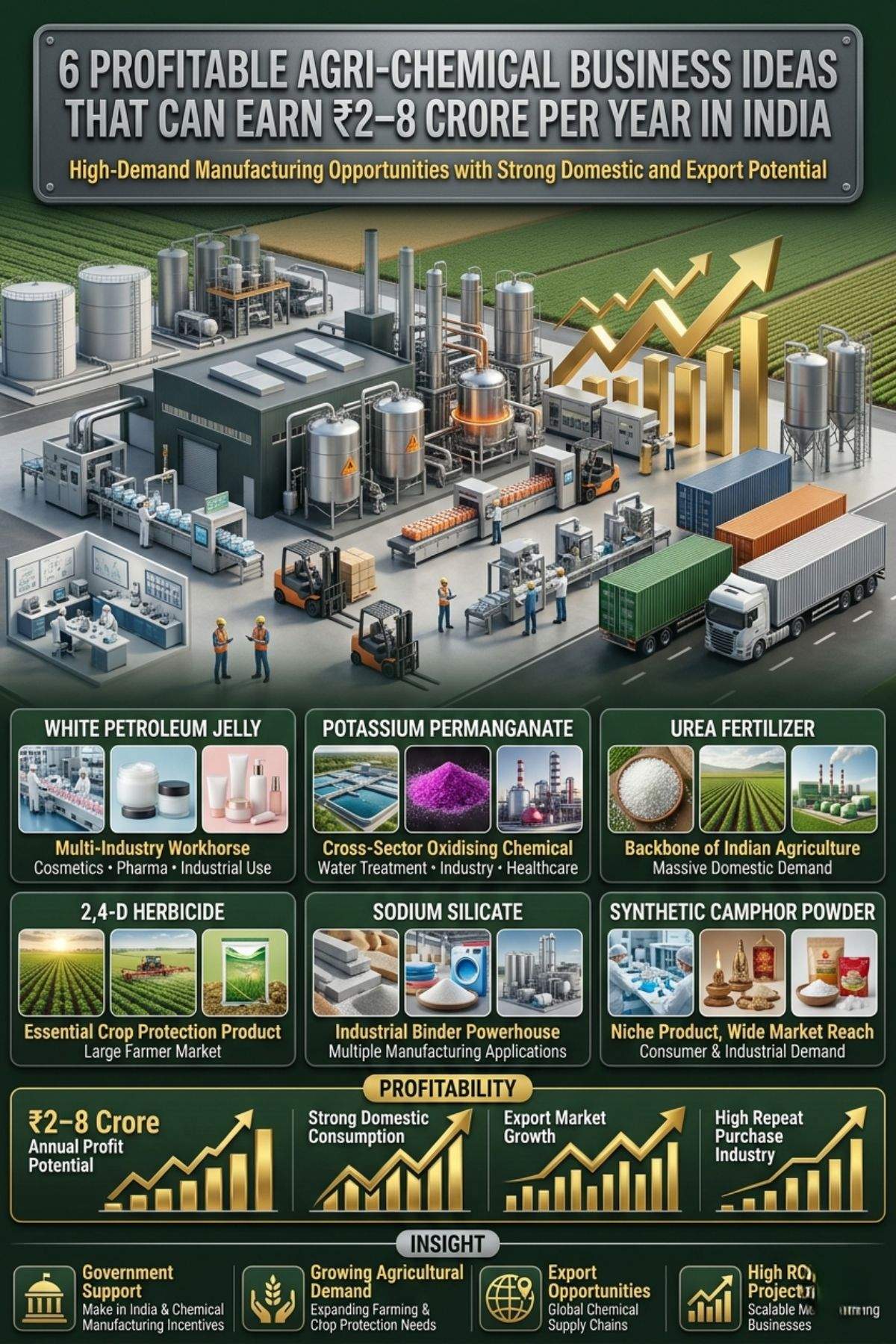
3. Urea Fertilizer — Foundation of India’s Agrarian Economy
Almost 50% of the total consumption of nitrogenous fertilizer in India is done by urea. The annual demand is between 33-35 million metric tonnes which is highest for the second time in the world after China. India has 31 operating production plants, but still imports 7-9 million MT per year to meet the demand.
The MSME Entry Point
Economically feasible urea production involves large natural gas quantities and very high capital investment (in the range of thousands of crores of rupees). This means that primary production is not in the reach of MSMEs. But there are some easy business ideas for smaller manufacturers in the surrounding ecosystem:
- Sub-micron elements (such as iron, manganese, zinc, copper, and boron) at lower levels, mainly as chelates
- Coated and slow-release urea with sulphur or polymer membrane
- Fertilizer blends with micronutrients, specific to crop
- The distribution of agricultural inputs and branded retail downstream.
The price premium for slow-release urea is in the range of 30-60 percent on top of conventional urea. The demand is building up across Maharashtra, Karnataka and Tamil Nadu, among horticulture, floriculture and high value crop farmers. Structural demand has supported a low capital investment with high value urea business for MSME entrepreneurs, who can buy the prills or granulate urea from primary producers and customize them into a mixture with additional value.
Explore This Book: Manufacture of Biofertilizer and Organic Farming (2nd Edition)
4. 2,4-D Herbicide — The Crop Protection Chemical Farmers Depend On
2,4-Dichlorophenoxy acetic acid (2,4-D) is one of the three most popular herbicides sold in India in terms of volume. It is a selective systemic herbicide that can be used to control broadleaved weeds in wheat, maize, rice and sugarcane without injury to the crop. 2,4-D is actually all but essential to cereal farmers because yields can drop 30-40% due to uncontrolled broadleaf weeds. The India agrochemicals industry will grow at a compound annual growth rate of 8 to 9 per cent to grow to USD 14.5 billion by FY28, says India Brand Equity Foundation (IBEF). The herbicide business is outpacing fungicides and insecticides in growth due to mechanized farming and its economic unfeasibility for manual weeding.
Manufacturing and Regulatory Realities
There are two steps in the commercial synthesis. Phenoxy acetic acid is formed when chloroacetic acid reacts with sodium phenate. This intermediate is then chlorinated with chlorine gas to give 2,4-D acid. Depending on the formulation desired, the product turns into amine salt or ester form. The process requires investment in the safety infrastructure and trained technical staff because of corrosive intermediates.
The Central Insecticides Board and Registration Committee (CIBRC) need to be obtained for new plant registrations. This registration period (18-36 months) is quite a long time. But it also serves as a useful barrier to low barrier competitors and is a beneficial way to keep established manufacturers unaffiliated. The usual range of formulation margins is 18% to 25%.
| Parameter | Value / Range |
| Indian Herbicide Market Size | ~₹4,800–5,200 Crore (Annual) |
| 2,4-D Market Share | ~18–22% |
| CAGR (Herbicide Segment) | 9–11% |
| Major Crop Applications | Wheat, Rice, Maize, Sugarcane |
| Indicative Margin (Formulation) | 18–25% |
5. Sodium Silicate — The Industrial Binder No Factory Can Replace
Sodium silicate, also known as water glass, is an inorganic compound in water that has the formula Na₂SiO₃. It is used in industries for its binding, adhesive and sealing properties in various sectors.
Where It Gets Used
Key applications are across a range of industries:
- Sand binder used in casting at the foundry.
- The products for making detergents as a builder and anti-corrosion agent.
- The waterproofing and sealants used in construction.
- The bleaching of pulp and paper. Bleaching of pulp and paper.
- Catalytic components for refinery catalysts
Reliable incremental demand is provided by the expansion of the construction sector under the National Infrastructure Pipeline and PMAY. At the same time, the move away from phosphate builders by the detergent industry is creating further momentum to switch to sodium silicate.
Production and Location Advantage
The production is carried out in a rotary kiln by mixing silica sand and soda ash and melting them at a temperature between 1,100 and 1,200 degrees Celsius. The resulting cullet melts in water under pressure to form the liquid product. Both these raw materials are readily available and cheap in the Indian market.
Entrepreneurs can establish a meaningful cost of silica sand advantage over other competitors in the production process in Rajasthan, Gujarat and Andhra Pradesh, where silica sand is readily available. The capital required in a medium scale plant (5000 to 15000 MT/year) ranges between ₹2.5 crore to ₹8 crore and operating margin is 14-20 percent on the basis of liquid grade. Margins remain higher for specialty grades of catalysts and paper.
6. Synthetic Camphor Powder — A Niche Product with Broad Market Reach
Turpentine oil contains alpha-pinene which is used to make synthetic camphor. It is the same compound as natural camphor, but produced in bulk and much cheaper. Camphor is culturally and functionally important in India. Year-round baseline demand, which is structurally independent of economic cycles, is a characteristic of religious use in puja, yagnas and temple rituals, rare among industrial chemicals.
Multiple Revenue Channels in One Product
Synthetic camphor has also been proven to have uses beyond religious purposes in multiple industries:
- Topical analgesics are used to treat pain and include dermal counterirritants such as pharmaceuticals.
- Plastics — as (some) plasticisers in polymer formulations
- Household products such as mothballs and insect repellents.
- Southeast Asia, the Middle East and Africa are all export markets.
The Indian camphor market is estimated to be at the tune of ₹1,400–1,600 crore per annum. Synthetic camphor is more than 85% of total volume. The margins in branded retail camphor vary between 25 and 40 per cent, depending on the channel and pack size.
The most successful manufacturers are the ones that have both B2B industrial and B2C consumer brands to sell and make a margin. This two-sided model, which has been tried and tested by brands like Mangalam Organics, can be executed by other companies starting with limited capital and tapping into turpentine value chain.
Find high-return business ideas based on your budget & ROI
| Parameter | Detail |
| Indian Market Value | ₹1,400–1,600 Crore/year |
| Synthetic Share | ~85%+ |
| Key Demand Segments | Religious, Pharma, Industrial, Export |
| Typical Retail Margin | 25–40% |
| Primary Raw Material | Alpha-Pinene / Turpentine Oil |
Growth Outlook and Viability Comparison
| Product | CapEx Range | Margin Range | Demand CAGR |
| White Petroleum Jelly | ₹1.5–6 Cr | 22–28% | 8–10% |
| Potassium Permanganate | ₹3–9 Cr | 18–24% | 9–11% |
| Urea (Value-Add / Blending) | ₹1–4 Cr | 12–18% | 6–8% |
| 2,4-D Herbicide | ₹5–15 Cr | 18–25% | 9–11% |
| Sodium Silicate | ₹2.5–8 Cr | 14–20% | 7–10% |
| Synthetic Camphor Powder | ₹2–7 Cr | 25–40% | 8–11%
|
Frequently Asked Questions — For First-Time Manufacturers and Investors
Q1. Which product suits a first-time manufacturer with limited capital?
White petroleum jelly and sodium silicate offer the most straightforward entry for entrepreneurs with ₹1.5 to ₹4 crore in investable capital. Both use commercially available raw materials, well-documented manufacturing processes, and reliable domestic off-take markets. Blending to enhance urea value addition can also be realized if entrepreneur can establish linkage with primary urea producers, and to have existing distribution channels within agricultural sectors.
Q2. Is 2,4-D manufacturing viable for an MSME given its regulatory complexity?
The CIBRC registration process takes 18 to 36 months, so the business plan must account for this lead time upfront. However, completing registration creates a meaningful competitive advantage because the entry barrier discourages casual competition. The alternative — contracting toll manufacturing from a registered producer while focusing on formulation and marketing — is a lower-capital, faster-market-entry route that many successful regional agrochemical companies have used effectively.
Q3. What makes potassium permanganate demand particularly resilient?
The vast majority of KMnO 4 consumption is generated by government driven infrastructure expenditure and not consumer demand. The Jal Jeevan Mission’s scale — targeting over 190 million rural households — combined with industrial effluent treatment requirements, creates a demand floor that does not fluctuate with general economic conditions. This gives KMnO4 manufacturing a demand quality that few other industrial chemicals can match.
Q4. What is the most common reason small-scale chemical ventures fail?
Raw material sourcing instability and under-investment in quality control are the two most frequently cited causes. Entrepreneurs who plan capital expenditure carefully but then underinvest in effluent treatment, process instrumentation, and product testing labs often find that institutional buyers reject their products or impose heavy penalties. Therefore, building quality infrastructure into the original project cost — rather than treating it as an avoidable add-on — is the single most important discipline for a new chemical manufacturer.
Q5. What financing is typically available for setting up these plants?
SIDBI (Small Industries Development Bank of India) offers term loans specifically for MSME manufacturing units, including those in the chemicals sector. MUDRA loans under the Kishore and Tarun categories cover smaller operations. CGTMSE provides collateral-free loan guarantees for eligible MSMEs. For first-generation entrepreneurs without established credit history, a well-documented feasibility report — covering process parameters, raw material cost structure, and financial projections — is the single most important document for securing bank finance.
Q6. How should entrepreneurs prioritise which product to pursue first?
Start with market proximity, not just margin data. If you have contacts in the pharmaceutical distributors industry then the white petroleum jelly could be viable for an entrepreneur to produce. For a person close to the chemical clusters in Gujarat then a choice between potassium permanganate or sodium silicate may be more worthwhile. The supply of the raw materials as well as logistics cost and the current buyers would dictate the profit margin more than any spreadsheet.
Conclusion: Thinking Like an Industrial Entrepreneur
These six business ideas are not exciting in the way startup culture defines exciting. There is no viral moment, no app store listing, and no influencer campaign required. What they offer is something more durable: consistent, structurally supported demand; pricing that moves predictably with input costs; and industrial markets that reward technical competence over clever marketing.
India’s manufacturing ambition has rarely been better aligned with policy, infrastructure, and market fundamentals. The government’s push on import substitution, the expansion of rural water infrastructure, and the growth of pharmaceutical and agrochemical manufacturing are all meaningful tailwinds. Consequently, these businesses operate in conditions where competent, well-capitalized entrepreneurs have a genuine probability of building lasting value.
The entrepreneurs who capture this opportunity will do the homework first. They understand their raw material supply chain before commissioning a plant. They engage seriously with regulatory requirements rather than hoping to manage them later. They invest in quality infrastructure from day one. That combination of preparation and discipline separates the factories that endure from those that do not. A rigorous feasibility study built on real market data is the most valuable first step. The manufacturing opportunity is real. The discipline to pursue it properly is what makes the difference.