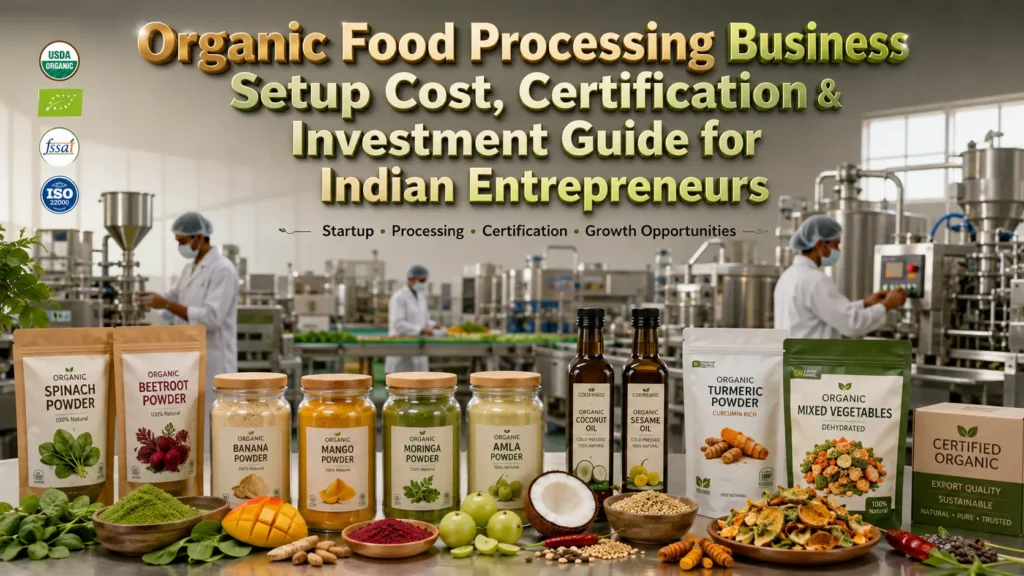

Organic Food Processing Business in India
The Counter-Intuitive Truth About Organic Food in India
India is exporting more than ₹5,300 crore of certified organic products annually, while it imports the processing technology to process them. Let that sink in.
The nation that has over 30% of the organic produce grown in the world, the majority of which is cardamom, grown in the cardamom hills of Kerala, to the spices of the Rajasthan spice belts, are sold mostly as raw commodity. That is the profit realization, that is the packaging, that is the branded product – that goes overseas. A company from Germany imports organic turmeric powder from India and places it in a glass jar bearing a serif logo and sells it for €14. The Indian farmer received ₹42 for every kilo he sold.
It is in this space between raw organic produce and finished certified organic produce that the true business is going to be. The Agriculture and Processed Food Products Export Development Authority (APEDA) has reported that demand for certified organic food has increased at the rate of 12–15% every year for the last five years in India. In the three cities, the average urban household in Bengaluru, Pune, and Delhi-NCR spends 22% more per grocery basket when shopping for organic than conventional products, on average, 5 years ago. It is not sufficiently available in the region where it is made, there is no traceability, and it is not properly certified.
Get Detailed Project Report (DPR): Food Processing and Agriculture Based Projects
The Supply Gap Nobody Is Filling Fast Enough
India has the maximum area (36.53 lakh hectares) of certified organic farming in the world, according to the National Centre of Organic and Natural Farming (NCONAF). Less than 12% of the small and medium organic processors have been certified in India as per the minimum requirement of NPOP (National Programme for Organic Production) to be able to label a product as ‘certified organic’ for domestic retail and export market.
The outcome: a deficiency in structural processing. Raw sales dominate to large aggregators, most of these who are also organic farmers sell at prices slightly higher than conventional producers. At the processed and value-added segment, less than 200 brands have a national presence with the bulk of them concentrated in Maharashtra, Gujarat and Karnataka. States such as Uttarakhand, Himachal Pradesh, Odisha and Chhattisgarh which have more than 8 lakh hectares of organic farms have virtually no processing infrastructure.
The Indian Council of Food and Agriculture (ICFA) believes the India domestic organic food market has total value of around ₹9,000 crore and is estimated to reach ₹30,000 crore within a decade. Retail outlets such as the DMart, BigBasket and Nature’s Basket have admitted that there is less space for certified organic essentials priced between ₹100 and ₹500. The supply situation is even more constrained for smaller categories of organic food, such as immunity boosters, millets and cold-pressed oils.
Demand from exports is just as poor. More than 85% of the certified organic exports from India are consumed by the EU, USA and the Gulf markets. Processing units that are able to ensure traceability, hygiene and NPOP or NOP (USDA Organic) certification can charge 25-40% price premium on uncertified Indian exports.
TABLE 1: State-Wise Organic Demand, Key Crops & Industrial Clusters
| State | Key Organic Crop / Product | Industrial Cluster / Hub | Estimated Demand Growth (Annual) | Export Potential |
| Sikkim | Organic vegetables, ginger, cardamom | Gangtok Agro-Processing Zone | 18% | High (EU, USA) |
| Madhya Pradesh | Soybean, wheat, pulses | Indore, Jabalpur | 14% | Medium-High |
| Rajasthan | Cumin, coriander, fennel | Jodhpur, Kota Spice Cluster | 16% | High (Middle East, EU) |
| Uttarakhand | Basmati rice, herbal extracts | Rudrapur, Haridwar Food Park | 12% | High (USA, Japan) |
| Maharashtra | Soybeans, millets, sugarcane jaggery | Pune, Nashik Agri-Zone | 11% | Medium |
| Kerala | Coconut oil, spices, black pepper | Kochi Spice Park, Thrissur | 15% | Very High (Gulf, UK) |
Source: APEDA Organic Export Data; NCOF Annual Report; State Agriculture Department estimates
Why Entry Right Now Makes Commercial Sense
Organic food processing is an appealing proposition right now in three ways.
First: Policy tailwinds are there and backed by cash. Organic clusters are eligible for up to ₹50,000 per hectare under the Government of India’s Parampara at Krishi Vikas Yojana (PKVY) for support in the certification process and farmer group formation. This directly lowers sourcing cost of raw material. The processors who coordinate with PKVY clusters are provided with a cost and supply benefit at the same time.
Second: The demand for exports is growing faster than the supply. As per the export data from APEDA, the value of organic exports increased from ₹1,900 crore to more than ₹5,300 crore during the last decade. They are mostly made of turmeric, ginger, pulses and rice. But only part of these flows as a complete branded product. This market can be reached directly by a processing unit certified to the NPOP standards.
Thirdly, the processing sector of the MSME is undercapitalized — on purpose. There has been no meaningful presence by big FMCG players in the organic sub ₹300 SKU segment. It is structurally inefficient because of their small production volumes and high marketing expenses. The price band of ₹80-250/unit is left open for agile MSME processors in this regard as it is the optimum sweet spot of the metro consumers.
The Ministry of Food Processing Industries (MoFPI) has earmarked more than ₹10,000 crores for the food processing industry under the Production Linked Incentive (PLI) Scheme. Organic processors whose sales is more than ₹1 crore per year will get a 4-10% incentive on incremental sales, thus reducing the payback period by 8-12 months.
The MUDRA Kishore and Tarun loan categories offer a loan of up to ₹10 lakh, which is enough for a micro-processing unit, but it does not require any collateral. The Prime Minister’s Employment Generation Programme (PMEGP) is a scheme offered by KVIC, which provides 15–35% capital subsidy based on the geographic location of the project and the type of the founder (women, SC/ST entrepreneurs receive higher subsidy).
Get Detailed Insights from This Book: Handbook on Fruits, Vegetables & Food Processing with Canning & Preservation
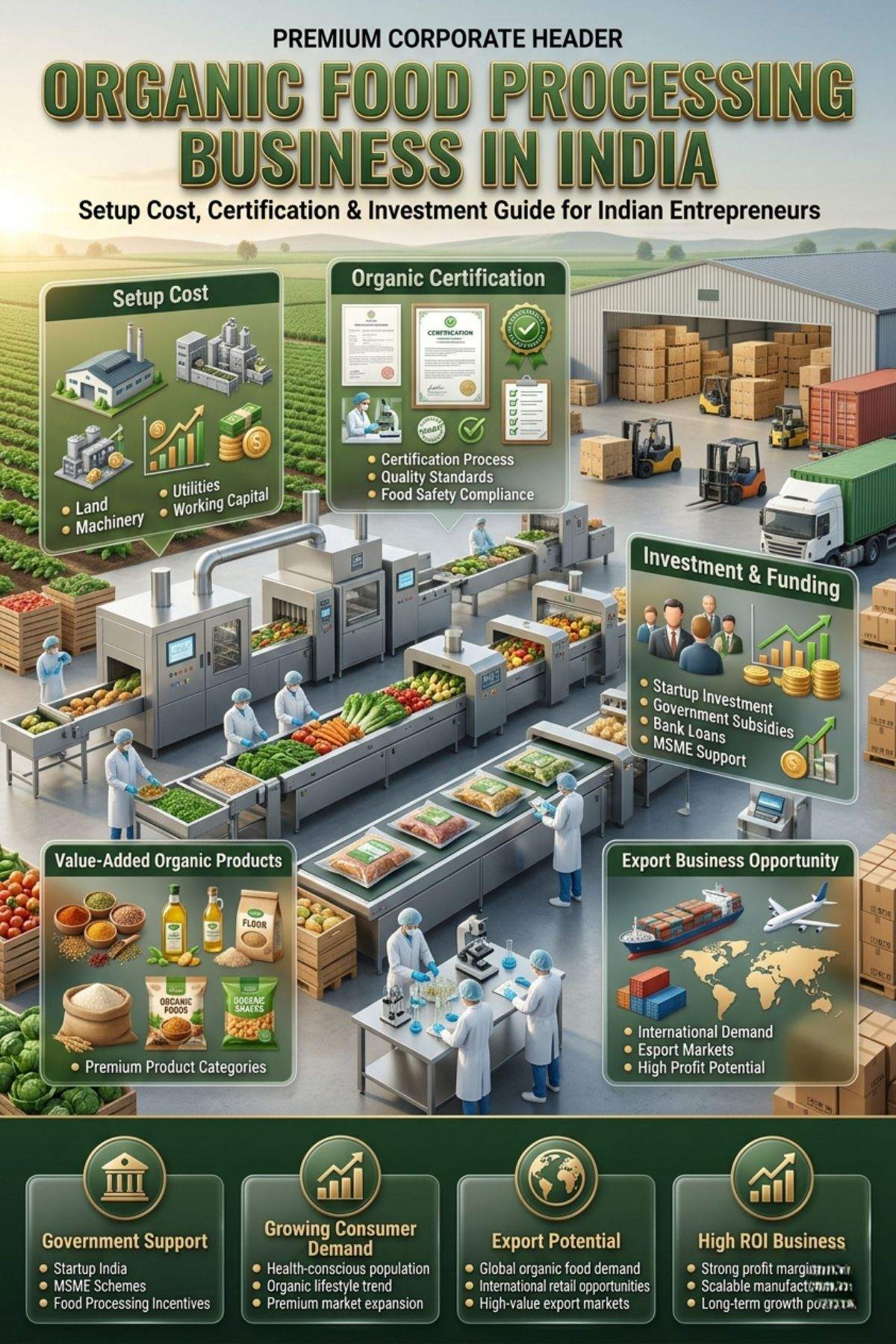
Setting Up Your Organic Food Processing Unit: Step by Step
1. Minimum Investment & Space
For small unit, with processing capacity of 200-500 kg/day, functional entry-level organic processing unit for spices, pulses or millets products involves a total capital outlay of at least ₹38–53 lakh. Medium units with the capacity to process 1-2 tonnes per day will require Rs 1.23-1.84 crore. The minimum built-up area for a small unit is 1,500-2,500 sq. ft. In case of an already built shed in an agro-industrial estate, the expenses on civil costs come down by 35-40% (Rudrapur in Uttarakhand or MIDC, Nashik area are viable choices).
2. Key Machinery
- Cleaning and grading machine: ₹2.5-5 lakh (destoner, aspirator, sieve grader)
- If oils are processed, cold press oil expeller will be required, its cost is ₹4 – 8 lakhs.
- Pulveriser / spice grinding unit: ₹1.5–3 lakh
- Automatic pouch/sachet packaging line: ₹3 to 7 Lakhs
- SS storage bins & food grade containers: ₹1 – 2 lakhs
- laboratory test equipment (moisture meter, spectrophotometer for aflatoxin): ₹1.5–3 lakh
Get machinery from machinery clusters in Coimbatore (Tamil Nadu) for processing machinery, oil and grain or from Rajkot (Gujarat) for packaging lines. The alternatives, if imported, cost 3-4 times as much and don’t provide as much benefit at this scale.
3. Raw Material Sourcing
Directly connect with farmer producer organisations (FPOs) registered with PKVY in the home state of the target crop. Cumin, coriander, methi from Rajasthan, pepper, cardamom, coconut from Kerala, basmati from Uttarakhand and organic soybean and wheat from Madhya Pradesh. The National Bank for Agriculture and Rural Development (NABARD) have a directory on its portal for FPOS. The process of direct procurement from the FPOs cut out two layers of the middleman and also saves the raw material cost by 18-25%.
4. Licences and Certifications
- FSSAI Central/State Licence (Compulsory): Rs. 2,000-7,500/- per year based on the turnover. Apply via fssai.gov.in
- NPOP Organic Certification (for ‘certified organic’ labelling): issued by an accredited certifier such as ECOCERT India, Control Union or SGS India. Eligibility: 10th Passed
- Udyam Registration (MSME): Free, online at udyamregistration.gov.in
- GST Registration (if turnover is greater than ₹20 lakh): Normal commercial registration.
- If the number of employees is more than 10, then Factory License is granted by the State Labour Department under Factories Act.
- Pollution NOC from State Pollution Control Board: Usually Green (dry organic processing)
- BIS certification: required only if processing packaged drinking water or specific notified food categories
Cost of total licence and certification: Rs 1.5 – 2.5 lakhs in Year 1 (for small unit). As from day one, incorporate this into working capital.
5. Timeline
- Month 2–3: Business Plan & Tax Registration
- Month 5-8: Machinery ordering and installation, water supply, waste water treatment, and civil works will be completed.
- The NPOP organic certification audit will take place in Month 4-6 (needs documented processes).
- Month 6–7: Trial production runs, quality testing
- Month 7–8: Commercial production launch
The realistic time frame for registration to first commercial sale is 7–9 months. The NPOP certification audit will be the longest single step – document requirements are not to be underestimated.
6. Team Size
The minimum required number of staff for a small unit is 8-10: 1 production supervisor, 4-5 floor workers, 1 quality/lab assistant, 1 packaging operator and 1 accounts/compliance person. Agro-industrial town units have skilled machine operators available at ₹14,000-22,000 monthly.
Find the most profitable startup for your investment range
TABLE 2: Investment Breakdown — Small vs Medium Organic Processing Unit
| Cost Head | Small Unit (INR) | Medium Unit (INR) | Notes |
| Land & Civil Works | ₹8–12 lakh | ₹25–40 lakh | Leased land reduces capex by 40% |
| Processing Machinery (sorting, cleaning, packaging) | ₹15–20 lakh | ₹55–80 lakh | Cold press, roaster, grinder, sealer |
| Storage & Cold Chain Setup | ₹4–6 lakh | ₹12–18 lakh | Essential for perishable produce |
| Working Capital (3 months) | ₹6–8 lakh | ₹18–25 lakh | Includes raw material & labour |
| Certifications & Licences (FSSAI, Organic Cert, GST) | ₹1.5–2.5 lakh | ₹2.5–4 lakh | One-time + annual renewal |
| Contingency Reserve (10%) | ₹3.5–5 lakh | ₹11–17 lakh | Strongly recommended |
| TOTAL ESTIMATED CAPEX | ₹38–53 lakh | ₹1.23–1.84 cr | Excluding land purchase |
Source: MSME Technology Development Centre estimates; Entrepreneur India primary research; MoFPI project cost benchmarks
Financial Snapshot: What the Numbers Actually Look Like
In a small organic processing unit with ₹ 40 – 50 lakh capital investment, with 250 – 350 kg/day of spices and pulses processed:
- [object Object]: ₹3.5–5 lakh (includes raw material, labour, utilities, packaging, and compliance costs)
- [object Object]: ₹7–9 lakh/month
- [object Object]: ₹12–15 lakh/month
- [object Object]: 28–35% (certified organic commands a premium over commodity pricing)
- [object Object]: 18–24% after depreciation, loan servicing, and overheads
- [object Object]: 3–4.5 years at 70–80% utilisation; closer to 2.5 years with PLI incentive and PMEGP subsidy combined
The net margin of cold-pressed oils is the highest in the range of 22–28%, because of their strong brand positioning as premium products. Spice blends and millet-based products are 18-22% net. Organic staples (rice, pulses) are the most competitive segment as well as providing stable cash flow.
These figures are based on direct-to-retailer (or DTC – direct-to-consumer) sales. Dealing through distributors incurs a net margin loss of 6 – 9 percentage points. From the beginning, create your own online identity – be it through Jiomart, BigBasket or your own site.
TABLE 3: Government Schemes Applicable to Organic Food Processing MSMEs
| Scheme | Nodal Body | Key Benefit | How to Apply |
| PMEGP | KVIC / State DIC | 15–35% capital subsidy (up to ₹25 lakh) | kviconline.gov.in |
| MUDRA Loan (Kishore/Tarun) | Commercial Banks / SIDBI | Collateral-free loan ₹5–10 lakh; Tarun up to ₹10 lakh | mudra.org.in or nearest bank branch |
| Food Processing PLI Scheme | MoFPI | 4–10% production-linked incentive for eligible processors | mofpi.gov.in |
| CGTMSE | SIDBI / MOF | Credit guarantee up to ₹2 crore without collateral | cgtmse.in |
| Paramparagat Krishi Vikas Yojana (PKVY) | Ministry of Agriculture | ₹50,000/hectare for organic cluster formation & certification | pgsindia.net / State Agriculture Dept |
| Udyam Registration | MSME Ministry | Access to priority lending, government tenders, subsidies | udyamregistration.gov.in |
Source: KVIC, SIDBI, MoFPI, Ministry of Agriculture & Farmers Welfare official portals
ENTREPRENEUR SPOTLIGHT
Priya Nair, Kerala — Organic Spice Processor
Priya Nair quit her job in an HR position in the corporate sector in Bengaluru and started Nilambur Organics in Malappuram, Kerala with an initial investment of ₹ 42 lakh. She is involved in the processing of black pepper, cardamom and ginger in her unit and sells the products to the organic chain stores and exports to the UK under NPOP and EU organic certification. In just three years, the annual revenues touched ₹1.8 crore. There’s one thing she learned early on that has remained constant: “You need to get your NPOP documentation system right before you process the first gram, otherwise it will set you back four months and almost cost your first UK buyer.
Related Article: 5 Smart Food Manufacturing Business Ideas That Can Generate ₹50 Lakh/Year in India
Expert Project Support: NIIR Project Consultancy Services
Entrepreneurs desiring to go from concept to a bankable project report can find one of the most complete techno-economic feasibility platforms for Indian MSMEs with Niir Project Consultancy Services (NPCS). Organic food processing units are available in various categories with detailed project reports, which comprise of plant layout designs, plant machinery specification, raw material sourcing map, financial projection and regulatory roadmap. The reports are accepted by nationalised banks and NBFCs for project finance applications. Established by industry veterans, NPCS is also capable of providing end-to-end consultancy services for the setup of a unit, starting from site selection till the first production. The resources can be found at niir.org and entrepreneurindia.co, where entrepreneurs can find guides to the sector and cost benchmarks, as well as analyses of investments relevant to MSME founders.
Your Next Move
Organic food processing opportunity in India is clear, untapped and policy-driven. But it is rewarding those who act upon particulars and not on the perfect condition.
First do this: know what is the one crop or product category that is most plentiful within 150km of the target crop location. Then contact the nearest Krishi Vigyan Kendra or Organic Farming Cell of State Agriculture Department and request the list of the FPOs registered under PKVY in the zone. This single step provides a raw material base, a cost advantage and the foundation of a traceable supply chain, which are three of the four items any institutional buyer will seek before ordering.
Frequently Asked Questions
1. How much investment is needed to start a small organic food processing unit in India?
Estimated Capital Investment (000 Rs.) Unit Size Processing Cap (200-500 kg / day)Machinery, Tools & Ancillary Civil Works Working Capital Other expenses (Registration, Licenses etc) Total investment (38.41 – 53.08 lakh)Medium unit(1 – 2 tonnes per day) (123.32 – 184.42 Lakh) if existing shed is leased then civil expenses reduced by 35-40 % in agro-industrial estate.
2. Which licences and certifications are mandatory for an organic food processing business?
At minimum, you need an FSSAI licence (state or central depending on turnover), Udyam Registration, and GST registration. To legally label and sell your products as ‘certified organic,’ you must obtain NPOP (National Programme for Organic Production) certification from an accredited body. NPOP is also the prerequisite for organic exports. Factory Licence and a Pollution NOC from the State Pollution Control Board are required as operations scale.
3. Where can I source certified organic raw material reliably in India?
The most efficient sourcing route is direct tie-ups with PKVY-registered Farmer Producer Organisations (FPOs). NABARD’s FPO directory (accessible at nabard.org) lists certified organic clusters by state and crop. Key sourcing states include Rajasthan for spices, Uttarakhand for herbs and basmati, Kerala for pepper and coconut products, and Madhya Pradesh for pulses and oilseeds.
4. What profit margins can an organic food processing unit realistically achieve?
Efficiently managed organic processing facilities can operate with net margins as high as 18-24%, with the top-end in cold-pressed oils (22-28%) and the low end in staples (14-18%). The high price of certified organic versus conventional food products results in gross margins of 28-35%. Directly supplying retailers or DTC yields significantly higher net realisation margins than working via distributors.
5. What government schemes are available for organic food processing MSMEs?
Several schemes can be directly applied such as PMEGP, 15-35% capital subsidy (max 25 Lakh); MUDRA (Kishore/Tarun): interest-free loan up to 10 lakh, up to 10 lakh of collateral; PLI Scheme under Ministry of Food Processing Industries (MoFPI): 4-10% subsidy on increase in sales; CGTMSE: credit guarantees up to 2 Cr; PKVY: certification for clusters for indigenous and organic inputs; A synergy between PMEGP and PLI may cut down the Payback Period by 18 months.
6. How can NPCS help me set up my organic food processing unit?
Niir Project Consultancy Services (NPCS) undertake detailed project report preparation, techno-economic feasibility report preparation, plant layout design and investment cost estimation for organic food processing industries accepted by the financial institutions/ Banks. NPCS also offers one-to-one consultancy for site selection, machinery procurement, and regulatory compliance. Visit niir.org or entrepreneurindia.co for reports and further resources.