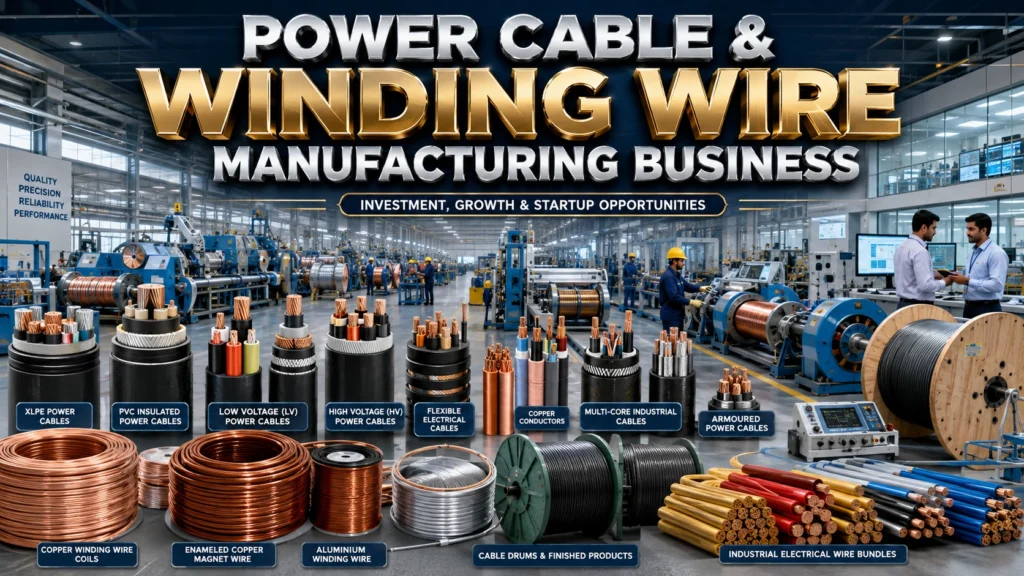

Power Cable Manufacturing Business
Business ideas do come in cycles. There are also companies that are part of the cycle. Power cable and winding wire factories are in second category. Conductors are used every kilometre of transmission line, every substation commissioned, every transformer wound, every motor assembled and every industrial building electrified. The power cable, control cable, winding wire, and specialty conductor segments of the Indian electrical conductor market together account for tens of thousands of crores per year and have seen compounded growth across a number of fronts.
Cables and winding wires combine a large and dynamic market, government initiatives to boost domestic manufacturing, a well-defined opportunity for import substitution at the specialty end, multiple product entry points at varying investment scales, and significant future opportunities for entrepreneurs to assess, making them an attractive manufacturing business idea for an MSME. However, there are some challenges inherent in the sector, particularly the prices of copper and aluminium which are benchmarked and volatile throughout the world; but experienced manufacturers overcome this by using commodity hedging, by timing purchases and by passing through material cost fluctuations to customers.
Get Detailed Insights from This Book: Manufacture of Electrical Cables, Wire and Wire Products Handbook
Why This Manufacturing Business Is Growing at an Exceptional Pace
The power transmission and distribution in India is experiencing the most forward-thinking investment cycle in its history. The National Electricity Plan calls for installing more than 50,000 circuit kilometres of transmission lines within 10 years’ time. Particularly in urban areas, the underground cabling of distribution networks is creating a persistent demand for underground LT and HT cables in all key metropolises under the Revamped Distribution Sector Scheme (RDSS). The amount of conductor needed on cabling for each kilometre of length of underground cable is significantly greater than that of lines of a similar capacity on the top of the tower.
There is an alternative demand engine from the renewable energy industry. Solar parks need DC cables from panel strings to the inverter and AC cables from the inverter to the point of connection to the grid. Several thousand kilometres of cable might be used in a 100MW solar installation. The wind farm network needs flexible wind farm cables buried and armoured cables in the turbine towers. The Indian target of 500 GW of renewable capacity equates to a demand for the industry to meet at home, which it is actively working on.
Enamelled copper and aluminium wires for transformers, motors and generators are also experiencing a surge in demand. Winding wire is used for every new transformer made. Each EV motor needs a certain type of enamelled copper wire. Winding wire is utilized with all types of industrial motors, home appliances compressors and generators. Winding wire demand is directly linked to the growth of the domestic transformer, motor and EV component manufacturing. The demand for winding wire goes hand-in-hand with the growth of the domestic transformer, motor and EV component manufacturing. This is an actual inflection point in the sector.
Export Opportunity: Indian Cable Manufacturers Are Winning Global Orders
Indian power cable manufacturers are adept at exports and have established a strong presence in the power cable market in Africa, Middle East, and Southeast Asia. The data obtained from EEPC India reveals that engineering exports, such as cables and conductors, have been growing steadily. The UAE, Bangladesh, Kenya and Tanzania are some of the countries that import large quantities of Indian cables. A well certified MSME manufacturer can generate some good export revenues which when added up can give a good cushion against the price fluctuations of the domestic market, especially with regard to exporting IEC certified cables from India as compared to the Chinese and the European options in many of the export markets.
Government Policies and Incentives for Cable and Wire Manufacturers
BIS Certification: Mandatory and a Market Advantage
All power cables delivered to Indian utilities, government projects and big power plants have to be BIS certified. PVC Insulated power cables are covered by IS 1554. XLPE-insulated cables are covered in IS 7098. IS 8783 is applicable to flexible cables. IS 13730 is the standard for winding wires. Although it involves some upfront cost for type testing and factory evaluation, BIS certification can bring benefits such as preferential bidding in Government tenders and deliver credibility in terms of quality to the private sector buyers. BIS certification provides the domestic cables with a score advantage when public tenders are evaluated in accordance with Make in India approach.
MSME Support Schemes
The Ministry of MSME’s CGTMSE scheme has been introduced to provide working capital and term loan assistance without any collateral up to Rs 5 crores, which is very crucial for the cable manufacturing industry as copper and aluminium are the major expenditure items and the working capital. Upgrading the existing equipment with modern extrusion and wire-drawing machines is supported by the Technology Upgradation Fund Scheme (TUFS). There are two other state level subsidy schemes for electrical conductor manufacturing units under the name of capital subsidy in Rajasthan, Gujarat, Uttar Pradesh and Telangana.
PLI and Domestic Content Policy
Ministry of Heavy Industries has been actively encouraging the production of electrical componentry at home with PLI-adjacent support schemes. Remarkably, some of the state electricity boards have adopted local content clauses in cable procurement tender that mandates a percentage of locally made cable, which directly benefits Indian MSMEs manufacturers. Duty drawback benefits are also available for exported cable products by Directorate General of Foreign Trade (DGFT), which makes export-oriented manufacturing models more economical.
Business Ideas in Power Cable and Winding Wire Manufacturing
Business Idea 1: LT Power Cable Manufacturing (Up to 1.1 kV, PVC and XLPE)
The low-tension power cable market segment is the widest and most accessible cable manufacturing market, and includes 1.1 kV power cables with PVC insulation (widely used, lower cost) and 1.1 kV power cables with XLPE insulation (higher capacity, longer service life, preferred by utilities). The uses of LT cables are vast in the field of residential construction, commercial and industrial electrification, underground distribution systems, and renewable energy projects. The customers include Electricians, Contractors, Real Estate Developers, Industrial EPC Contractors and Power Distribution Companies.
Manufacturing LT power cables requires wire drawing equipment (to reduce rod to the required conductor size), stranding machines (to assemble multi-wire conductors), an insulation extrusion line, and an armouring machine for armoured cable variants. The investment for a basic LT cable manufacturing unit — targeting conductor sizes from 1.5 sq mm to 240 sq mm — typically ranges from ₹1.5 crore to ₹3 crore for machinery, plus working capital for copper and aluminium rod procurement. Copper rod prices are globally volatile; experienced manufacturers manage this by purchasing against confirmed orders, using price escalation clauses in supply contracts, and maintaining a short working inventory rather than speculative stock.
EBITDA margins in LT cable manufacturing typically range from 10–16%, but can reach 18–22% for specialty cable variants such as FR (flame retardant), FRLS (flame retardant low smoke), and solar DC cables, which command a measurable premium.
Get Detailed Project Report (DPR): Wire & Cable Projects
Business Idea 2: HT Power Cable Manufacturing (11 kV to 33 kV, XLPE)
The growth product in the Indian cable market is the high tension or underground cables of class 11 kV and 33 kV. The growing demand for 11 kV XLPE cables has been driven by the efforts to move the urban and semi-urban distribution networks underground in the RDSS and Smart Cities programmes, which the industry is finding difficult to fulfil efficiently from the existing domestic production capacity. Further, renewable energy generation sources, especially large solar and wind farms, rely on 33 kV underground cables heavily for inter array connections and for the last leg to the pool substation.
The manufacturing of HT XLPE cables is much higher technically than LT cables. To avoid the formation of voids and partial discharge defects, the XLPE insulation needs to be applied in a clean room with a dry-curing nitrogen-pressurised extrusion process. Application of semi-conductive screens should be done accurately above and below the XLPE layer. In further stages, metallic shielding, bedding, armour and outer sheath is applied. At each production batch, all the process needs to be controlled in terms of quality and voltage withstand.
The investment in an HT cable unit, with a rating of 11 kV and 33 kV, is around ₹4 crore to ₹8 crore. The commercial return, however, is commensurate, as the realisation for the HT cables is much higher per metre compared to the LT cables, the volumes procured by DISCOMs are higher and there is lesser competition at the end-user level for HT cables than for LT cables.
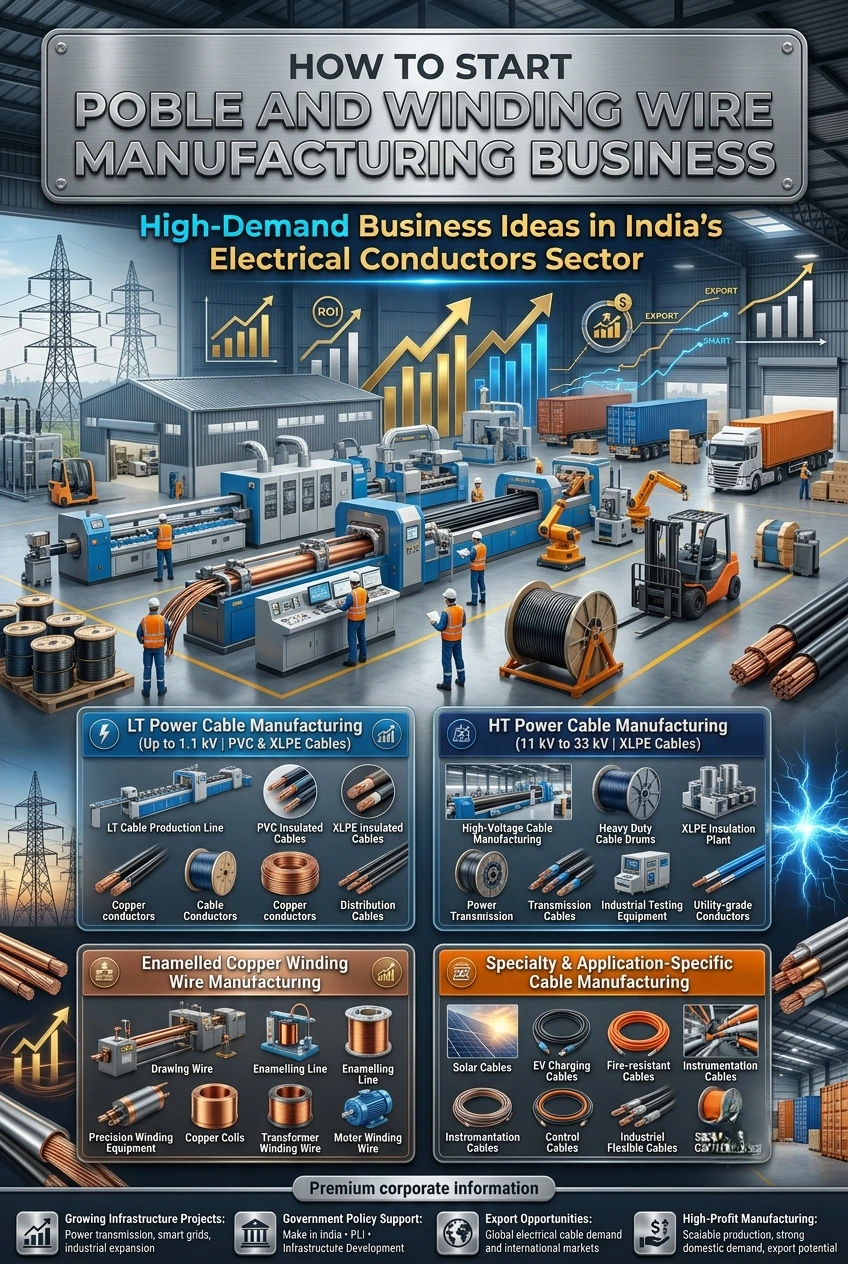
Business Idea 3: Enamelled Copper Winding Wire Manufacturing
Transformers, motors, generators and many electromagnetic components start with enamelled copper winding wire, which is drawn to a specific diameter, coated with polyester or polyimide, and wound on spools. It is used in all types of power transformers. All induction motors are involved in it. It’s incorporated in all EV traction motors. The demand for end products such as windings increases in line with the increased production of these components in India. The segment has been long dominated by a few large manufacturers, but the demand of the market is so huge that there is real space for new MSME manufacturers equipped with the most advanced and modern machinery.
The technology of manufacturing enamelled winding wire includes the following steps: high-purity copper rod precision drawing to obtain the final wire size (usually 0.05mm to 5mm); precision enamelled furnace; and precision spinning, ensuring the wire is applied with a proper tension. The requirement of the quality is very strict: enamel thickness uniformity, pinhole count, springback and thermal class should conform to IS 13730 and IEC 60317.
The cost of a starter winding wire plant producing standard polyester grades is between ₹2 crore and ₹4 crore. Specialty grades like polyimide (HT motors and aerospace) or self-bonding (EV motors) will need higher temperatures furnaces and specialty enamel handling investments. The margin profile is nice: specialty grades typically earn 22-28% EBITDA while the winding wire guys make 12-20%.
Related Article: Electrical & Electronics Manufacturing: 4 Business Ideas from Copper Wire to Lithium Batteries
Business Idea 4: Specialty and Application-Specific Cable Manufacturing
In addition to regular power cables, there is now a larger portion of India’s cable market of application specific specialty cables which have a meaningful price premium. Solar DC cables with a 1,500 V rating that are UV and ozone resistant, and have TUV-rated insulation compounds are definitely in demand as solar projects transition to the higher-voltage string configuration. The submersible pump cable market for agriculture and water supply is a high-volume rural market. The instrumentation and control cables market for process plants, offshore cables market for wind turbines, and fire survival cables market for high-rise buildings are all specific market segments, which are less competitive as compared to commodity LT cables market.
Specialty cable plant can also be built with a lesser investment as compared to big LT cable plant (₹1.2 crore to ₹2.5 crore), as specialty cable is usually manufactured in smaller quantities in higher value per kg. The main success factor is APPLICATION KNOWLEDGE: know what they need for a solar cable, what the temperature rating of a submersible cable should be, what shielding a process instrumentation cable should have. Those manufacturers that have a solid understanding of electrical engineering and specialize in certification from BIS and various application-specific certifications can create a defensible niche role that other commodity cable manufacturers can only duplicate in a matter of time.
Import-Export Opportunity Analysis for New Startups
India imports specialised cables and winding wires in those categories where production does not meet the demand. The main imports are high-temperature superconducting cables, submarine cables, umbilical cables for offshore installations and some grades of polyimide winding wire for defence and aerospace. They are long-term import substitution targets for technically capable manufacturers, but they are not starter-market products which require little R&D investment.
On the other side, there are certain XLPE compound grades and special items of cable from Europe and Japan that are imported into India where the accessibility of the market is more. A domestic manufacturer with investment in the development of compounds or blending can be able to cater to a significant amount of this import stream. Cable exporters can avail market access and documentation aid from EPCES as well as from Engineering Export Promotion Council (EEPC India).
The most likely markets in the near future are those in Africa and South Asia: Indian power cables and winding wires are competitive in price, but conform to the IEC standards, and they can be supplied with shorter lead time than the European alternatives. A manufacturer that can implement export quality certifications early is able to see a 20-30% export revenue mix in 3-4 years’ time.
Indian MSME and Industry Success Stories in Cable and Wire Manufacturing
Polycab: From Gujarat MSME to Market Leader
The Jaisinghani family’s story behind Polycab India is the most interesting story in the Indian cable industry that was founded in Gujarat. Started as a small wire and cable manufacturer at Halol and expanded its product line and invested in its brand and distribution network to become the largest listed cable company in India. The founding family’s investment in manufacturing and distribution systems proved to be the key as opposed to just selling on price. The Polycab story is very relevant for a new MSME entrepreneur because in the cable industry, brand trust and distribution is as important as manufacturing efficiency, and building this trust and reach gradually from the beginning has cumulative benefits.
Choose the right startup backed by real market demand
Finolex Cables: Manufacturing Excellence and Backward Integration
Finolex Cables, promoted by the Finolex group in Pune, built a uniquely defensible position in the Indian cable market through backward integration into copper rod manufacturing. By controlling the primary input material, Finolex achieved cost stability advantages that pure cable manufacturers — dependent on spot copper rod markets — could not match. While full backward integration into copper smelting is beyond MSME scale, the broader lesson is instructive: manufacturers who can optimise their raw material procurement strategy — through futures, long-term supply agreements, or partial integration — achieve more stable margins than those who remain fully exposed to commodity price movements.
Winding Wire MSMEs in Punjab and Tamil Nadu
India’s winding wire industry has significant MSME representation, particularly in the Punjab small industries belt and in Tamil Nadu’s Coimbatore region. Several small winding wire manufacturers in these clusters have built profitable ₹15–40 crore businesses by supplying directly to transformer and motor manufacturers in their region. Their competitive advantage is simple: faster delivery, flexible order sizes, and responsive customer service that large national manufacturers cannot match for small-volume buyers. This cluster-based model — where a winding wire manufacturer serves a regional base of transformer, motor, and pump manufacturers — is a proven and replicable framework for a new entrepreneur entering this space.
Professional Feasibility Analysis: Why It Matters Before You Invest
Cable and winding wire manufacturing involves significant capital in machinery and even more significant capital in raw materials. The copper or aluminium procurement alone can represent 60–75% of a cable manufacturer’s total cost structure. Getting the working capital model wrong, or misreading the product-market fit for a particular cable type in a target geography, creates financial stress that is difficult to recover from in the early years of operation.
At Niir Project Consultancy Services (NPCS), we prepare detailed Market Survey cum Techno-Economic Feasibility Reports (DPRs) for entrepreneurs planning to enter the cable and wire manufacturing sector. Our reports cover end-to-end manufacturing process documentation, market demand assessment by product type and geography, equipment selection and plant layout, raw material procurement strategy, BIS and IEC certification pathways, and comprehensive financial projections including sensitivity analysis on raw material price movements.
Our goal is to give entrepreneurs a complete analytical picture before they commit capital — so that investment decisions are made on evidence, not assumptions, and business plans hold up under the scrutiny of banks, investors, and government scheme evaluators.
Power Cable and Winding Wire Manufacturing: Planning Benchmarks
The table below provides indicative benchmarks for the four product lines discussed in this article. These figures are planning guides and should be validated through a detailed techno-economic feasibility study specific to the proposed location and product mix.
| Parameter | LT Power Cable (1.1 kV) | HT Cable (11–33 kV) | Enamelled Winding Wire | Specialty / Solar Cables |
| BIS / IEC Standard | IS 1554, IS 7098 | IS 7098, IEC 60502 | IS 13730, IEC 60317 | TUV 2 Pfg 1169, IS 694 |
| Estimated Plant Investment | ₹1.5 Cr – ₹3 Cr | ₹4 Cr – ₹8 Cr | ₹2 Cr – ₹4 Cr | ₹1.2 Cr – ₹2.5 Cr |
| Plant Area Required | 10,000 – 20,000 sq ft | 20,000 – 40,000 sq ft | 8,000 – 15,000 sq ft | 6,000 – 12,000 sq ft |
| Primary Customers | Contractors, builders, DISCOMs | DISCOMs, IPPs, utilities | Transformer, motor cos | Solar EPCs, pump cos |
| Key Raw Material | Copper / aluminium rod, PVC, XLPE | Copper rod, XLPE compound | Electrolytic copper rod | Copper / aluminium, specialty compounds |
| Raw Material % of Cost | 65% – 75% | 60% – 70% | 70% – 80% | 55% – 65% |
| Est. EBITDA Margin | 10% – 16% | 15% – 22% | 12% – 20% | 16% – 24% |
| Payback Period | 4 – 6 years | 4 – 6 years | 3 – 5 years | 3 – 5 years |
| Export Market Potential | Africa, South Asia | Africa, Southeast Asia | South Asia, Middle East | Global (solar markets) |
| Initial Workforce | 30 – 60 personnel | 50 – 90 personnel | 25 – 50 personnel | 20 – 40 personnel |
Frequently Asked Questions
Q1. What is the minimum investment to start a power cable manufacturing business in India?
A basic LT power cable manufacturing unit can be started with ₹1.5 crore to ₹3 crore, covering wire drawing equipment, stranding machines, PVC or XLPE extrusion lines, basic armouring capability, and initial copper or aluminium rod procurement. HT cable manufacturing requires ₹4 crore to ₹8 crore given the higher precision of XLPE extrusion and the additional process stages. Enamelled winding wire units can be started at ₹2 crore to ₹4 crore. Specialty cable units, being smaller-batch and more compact, can begin at ₹1.2 crore to ₹2.5 crore.
Q2. How do I manage the risk of copper and aluminium price volatility?
This is the most important operational risk in cable and winding wire manufacturing, and managing it well separates profitable manufacturers from those who struggle with margin erosion. The standard practice is to purchase raw material against confirmed orders with price escalation clauses, rather than maintaining speculative inventory. Some manufacturers use MCX (Multi Commodity Exchange) copper futures to hedge a portion of their forward procurement. A robust pricing policy with customers — where copper price is benchmarked to LME at the time of delivery rather than at order booking — is standard in the industry and protects margin from sudden commodity moves.
Q3. What BIS certifications are required, and how long does the process take?
The primary BIS standards are IS 1554 for PVC-insulated power cables, IS 7098 for XLPE cables, IS 13730 for winding wires, and IS 694 for flexible building wires. The certification process involves submitting product samples to a BIS-recognised test laboratory, followed by a factory inspection by BIS officials. The process typically takes 4–8 months from application to grant of licence, depending on product complexity and test schedule availability. Entrepreneurs should budget ₹5–15 lakh for type testing, factory assessment fees, and associated compliance costs.
Q4. Can a small cable manufacturer compete effectively with large brands like Polycab, Havells, and Finolex?
Direct competition with national brands for branded retail market share is not a viable strategy for a startup MSME. However, the cable market has large segments where brand is secondary to price, certification, and service — particularly in DISCOM procurement, industrial project supply, and EPC contractor sourcing. A well-certified MSME manufacturer with competitive pricing, reliable quality, and good delivery performance can build a strong ₹10–50 crore business in regional industrial and infrastructure markets without competing against Polycab in the retail channel. Several successful cable MSMEs follow this exact model.
Q5. What is the key quality control challenge in cable manufacturing?
The most critical quality challenge is insulation integrity — ensuring the PVC or XLPE insulation is applied uniformly, free of voids, and achieves the required dielectric strength. Periodic spark testing of cable during production (using a 6 kV or 9 kV holiday detector) is standard practice. For XLPE cables, the extrusion environment cleanliness and moisture control during cross-linking are critical. For winding wires, enamel thickness uniformity, pinhole count, and heat resistance of the enamel coating are the primary quality parameters. Investment in adequate testing equipment — including electrical test bays, spark testers, and thermal aging ovens — should not be compromised at the setup stage.
Q6. Which government schemes support cable and winding wire manufacturing startups?
The CGTMSE scheme provides collateral-free credit up to ₹5 crore for MSME manufacturers — particularly useful for both term loan and working capital financing in a raw-material-intensive business like cables. PMEGP offers capital subsidy of 15–35% on eligible project costs. State industrial policies in Gujarat, Rajasthan, Tamil Nadu, and Uttar Pradesh include additional subsidies for electrical conductor manufacturing. The SIDBI (Small Industries Development Bank of India) also operates specific loan schemes for MSMEs investing in machinery and process upgrading. Entrepreneurs should engage with the District Industries Centre in their target state to understand the full stack of available incentives before finalising the project plan.
Conclusion: A Sector Built on India’s Infrastructure Ambition
Power cable and winding wire manufacturing is, at its core, an infrastructure play. Every metre of underground cable laid, every transformer wound, every motor assembled, and every renewable energy installation commissioned creates demand for these products. India is executing infrastructure ambition at a scale that directly and durably benefits manufacturers who are positioned correctly in this supply chain.
The sector rewards preparation: the right product choice for the target market, the right certifications for the customer base, and the right raw material procurement discipline to protect margins. These are all learnable, executable challenges. For an entrepreneur willing to approach the business with that level of seriousness, power cable and winding wire manufacturing offers genuine scale potential, strong policy tailwinds, and a demand environment that will remain favourable for the next decade and beyond.
References and Further Reading
- Ministry of MSME – Schemes and Incentives
- DGFT – Export Import Data and Policy
- EEPC India – Engineering Export Promotion Council
- Ministry of Heavy Industries
- EPCES – Export Promotion Council for EOUs and SEZs